




Abstract
Reducing sugars can react nonenzymatically with the amino groups of proteins to form Amadori products. These early glycation products undergo further complex reactions, such as rearrangement, dehydration, and condensation, to become irreversibly cross-linked, heterogeneous fluorescent derivatives, termed advanced glycation end products (AGEs). The formation and accumulation of AGEs have been known to progress in a normal aging process and at an accelerated rate under diabetes. Nonenzymatic glycation and cross-linking of proteins not only leads to an increase in vascular and myocardial stiffness, but also deteriorates structural integrity and physiological function of multiple organ systems. Furthermore, there is accumulating evidence that interaction of AGEs with a cell-surface receptor, receptor for AGEs (RAGE), elicits oxidative stress generation and subsequently evokes inflammatory, thrombogenic, and fibrotic reactions, thereby being involved in atherosclerosis, diabetic microvascular complications, erectile dysfunction, and pancreatic β-cell apoptosis. Recently, AGE cross-link breakers have been discovered. Therefore, removal of the preexisting AGEs by the breakers has emerged as a novel therapeutic approach to various types of diseases that develop with aging. This article summarizes the potential clinical utility of AGE cross-link breakers in the prevention and management of age- and diabetes-associated disorders.
Introduction
N-Phenacylthiazolium Bromide
Reducing sugars can react nonenzymatically with the amino groups of proteins to form Amadori products (AP). Successive dehydraion by β-elimination of AP gives an AP-dione and then AP-ene-dione. 23 A major pathyway of AGE corss-link formation is supposed to proceed through an AP-ene-dione intermediate. 23
PTB is a prototypic AGE cross-link breaker. 23 PTB reacts with an AP-ene-dione–derived cross-link, and the carbon–carbon bond of α-diketones can be selectively cleaved by PTB. Indeed, PTB not only cleaved AGE cross-links in tail-tendon collagens of diabetic rats, but also disaggregated AGE-modified β-amyloid fibrils in vitro. 23
Alagebrium
Alagebrium is a methylthiazolium analog of PTB with carbon–carbon bond cleaving activity. 24 Breaking of the AGE cross-links by alagebrium has been shown to ameriolate pathological changes and organ dysfunction in a variety of disorders.
Vascular stiffness, endothelial dysfunction, and atherosclerosis
Arterial stiffness is associated with the prevalence of CVD and could predict future cardiovascular events in healthy and diseased subjects. 27 –29 Type I and III collagens and elastin are major components of extracellular matrix within the arterial wall. 27 Quantitative and qualitative alterations of collagen and elastin fibers by AGE modification play a role in decreased elastic properties of the vessels, thus being involved in arterial stiffness. 30,31
Alagebrium treatment for 1–3 weeks significantly reversed the increase in systemic arterial stiffness and improved the impairment of carotid artery compliance and distensibility in streptozotocin-induced diabetic rats. 24 Furthermore, alagebrium treatment was shown to reduce left ventricular and aortic mass index, left-ventricular end-diastolic diameter, urinary protein excretion and to improve E-wave deceleration time in echocardiography, a marker of diastolic left ventricular chamber stiffness in aged spontaneously hypertensive rats. 32 Shapiro et al. also reported that alagebrium therapy decreased pulse pressure and systemic vascular resisitance associated with the improvement of aortic distensibility in elderly dogs with experimental hypertension. 33
The efficacy of alagebrium on arterial stiffness was also shown in human studies. 34 –36 Compared with the control, alagebrium (210 mg/day) significantly decreased pulse pressure and pulse wave velocity (PWV) and improved total arterial compliance in aged subjetcs with vascular stiffness. 34 Alagebrium (210 mg twice a day for 8 weeks) improved arterial stiffness assessed by carotid augmentation index and brachial artery distensibility in patients with isolated systolic hypertension. 35 McNulty et al. reported that plasma AGE levels were significantly higher in hypertensive patients than in normotensive subjects and independently correlated with aortic PWV, but not with augmenation index, a marker of aortic wave reflection. 36 Therefore, large-vessel remodeling may be more impaired by AGEs than small-vessel remodeling in patients with essential hypertension.
Infusion of AGE-modified serum albumin significantly impaired the vasodilatory response to acetylcholine in Spraque–Dawley rats. 37 AGEs augmented hyperglycemia-associated decrease in endothelial nitric oxide synthase (eNOS) expression and NO production in vitro, and alagebrium chloride partly restored the parameters. 37 Furthermore, alagebrium significantly ameliorated endothelial flow-mediated vasodilation in patients with isolated systolic hypertension as well. 35 However, alagebrium was shown not to improve the alteration in pressure-induced vasodilation or acetylcholine-evoked, endothelium-dependent vasodilation in 1-week-old diabetic mice exhibiting no neuropathy. 38
Alagebrium treatment significantly attenuated plaque area or complexity within the thoracic and abdominal aortas and inhibited accumulation of AGE-modified collagens in the aortas with reduced expression of RAGE and profibrotic cytokines, transforming growth factor-β (TGF-β) and connective tissue growth factor (CTGF) in streptozotocin-induced diabetic apolipoprotein E (ApoE)-deficient mice. 39 The same group recently reported that delayed intervention with alagebrium also decreased plaque area in the diabetic ApoE-deficient mice, which was associated with a significant reduction in oxidative stress and circulating AGEs and methylglyoxal. 40 But they showed that delayed intervention with alagebrium was ineffective for removing preformed AGEs from the vascular wall in these mice. 40 In addition, AGEs significantly stimulated proliferation of rat aortic smooth muscle cells (SMCs) via oxidative stress generation and subsequent activation of extracellular signal-related kinase and cyclooxygenase-2, all of which was blocked by the treatment with alagebrium. 41 Moreover, alagebrium significantly prevented neointimal formation in balloon-injured arteries of diabetic rats, which was accompanied with the reduction of RAGE expression. 41 Methylglyoxal increased reactive oxygen species (ROS) generation and AGE accumulation of SMC and decreased respiratory complex III activity and adenosine triphosphate (ATP) synthesis in the mitochondria, all of which were blocked by alagebrium. These observations suggest that AGE-induced mitochondrial dysfunction in SMC could also play a role in the pathogenesis of arterial stiffness and accelerated atherosclerosis in diabetes. 42
Recently, adenosine triphosphate-binding membrane cassette transporter A1 (ABCA1) and ABCG1 have been reported to play a crucial role in macrophage cholesterol efflux and reverse cholesterol transport in vivo. 43 –46 Indeed, combined deficiency of ABCA1 and ABCG1 promotes foam cell formation and accelerates atherosclerosis in an animal model. 47 Loss-of-function mutations in the ABCA1 gene were identified as the cause of Tangier disease, a rare autosomal disorder characterized by accumulation of cholesterol in macrophages, a very low level of high-density lipoprotein cholesterol (HDL-C), and premature atherosclerosis in humans. 48 ABCA1 promotes cholesterol efflux from macrophages to lipid-free ApoA1, whereas ABCG1 facilitates the cholesterol efflux to HDL particles. 43 –46 AGEs significantly decreased ABCA1 and ABCG1 mRNA levels in THP-1 macrophage cells via ROS generation and subsequently inhibited the macrophage cholesterol efflux to ApoA1 and HDL-C. 49 Furthermore, the ability of AGE-modified ApoA1 to promote cholesterol efflux from THP-1 macrophages was significantly reduced compared with unmodified ApoA1, and the effect was prevented by alagebrium. 50 Alagebrium decreased methylglyoxal-mediated glycation of ApoA1 in discoidal reconstituted HDL and conserved the ability of the particles to act as substrates for lecithin:cholesterol acyltransferase, a key enzyme that generates cholesteryl esters in HDL particles. 51 These findings suggest that alagebrium may preserve antiatherogenic properties of HDL in diabetes.
Myocardial stiffness and heart failure
AGE and type III collagen accumulation, RAGE, and CTGF expression were increased, whereas left ventricular (LV) collagen solubility was decreased in streptozotocin-induced diabetic hearts compared with nondiabetic control. 52 Moreover, diabetic hearts were characterized by increased LV mass and brain natriuretic peptide expression. Alagebrium treatment attenuated all of these diabetes-associated cardiac abnormalities in rats. 52 Mitochondrial DNA deletion, AGE accumulation, and oxidative stress in aging rat heart were attenuated by alagebrium, which was accompanied with preserved diastolic function. 53 Alagebrium significantly reduced ventricular stiffness and improved cardiac function in aged dogs. 54 Furthermore, alagebrium was also shown to restore LV ejection fraction, reduce aortic stiffness and LV mass, and increase myocardial LV collagen solubility, which was associated with downregulation of collagen type I and type III expression in the hearts of aging diabetic dogs. 55 Alagebrium improved both arterial and ventricular function and optimized ventriculo-vascular coupling in old, healthy, nondiabetic rhesus monkeys as well. 56 A Western diet was associated with cardiac hypertrophy, inflammation, mitochondrial superoxide generation, and cardiac AGE accumulation in mice, which were prevented by alagebrium. 57 Furthermore, cardiomyocyte hypertrophy, inflammation, and oxidative stress were attenuated in RAGE knockout mice compared with wild-type mice. 57 The observations suggest that the AGE–RAGE axis is also involved in cardiac injury associated with a Western fast-food diet.
Sixteen weeks of treatment with alagebrium (400 mg/day) decreased LV mass and improved LV diastolic filling and quality of life in 23 patients with diastolic heart failure. 58 The BENEFICIAL study is a proof-of-concept study that reduction of preformed AGEs by alagebrium can result in a clinically improvement in patients with systolic heart failure. 59,60 In contrast to the ealier promising data, 58 200 mg of alagebrium twice daily for 32 weeks did not improve exercise tolerance, cardiac function, or AGE accumulation evaluated by skin autofluorescence in 102 patients with heart failure and LV ejection fraction ≤0.45. 60
Diabetic nephropathy and kidney injury
Diabetic nephropathy is a leading cause of end-stage renal disease and accounts for disabilities and the high mortality rates in patients with diabetes. 61 Diabetic nephropathy is characterized by functional and structural changes in the glomerulus, such as glomerular hyperfiltration, thickening of glomerular basement membranes, and an expansion of extracellular matrix in mesangial areas. 61 However, it has recently been recognized that changes within tubulointerstitium are more important than glomerulopathy in terms of renal prognosis in diabetic nephropathy. 62,63
AGEs induced dose-dependent epithelial-myofibroblast transdifferentiation via TGF-β expression through the interaction with RAGE, thus being involved in tubulointerstitial injury and fibrosis. 64 Transdifferentiation was also apparent in the proximal tubules of diabetic rats and in a renal biopsy from a patient with type 1 diabetes. 64 Alagebrium significantly reduced transdifferentiation in diabetic rats in association with reduced tubular AGE and TGF-β levels. Alagebrium treatment also decreased AGE and collagen accumulation in the diabetic kidneys, inhibited glomerulosclerosis and tubulointerstitial injury, and retarded albumin excretion rate in streptozotocin-induced diabetic rats, which were associated with reduced renal expression of RAGE, TGF-β, and CTGF. 65
Alagebrium significantly reduced not only urinary albumin excretion and renal pathological changes, but also suppressed renal expression of nicotinamide adenine dinucleotide phosphate (NADPH) oxidase subunits in db/db mice, an animal model of type 2 diabetes with obesity. 66 Moreover, alagebrium effectively prevented high glucose or hydrogen peroxide–induced membrane translocation of NADPH oxidase subunits in mesangial cells. 66 The findings suggest that renoprotective effects of alagebrium may be ascribed partly to its antioxidative properties. Alagebrium may ameliorate accumulation of extracellular matrix proteins in the kidneys and reduce albuminuria in experimental diabetic nephropathy via suppression of mitochondrial superoxide production or inhibition of protein kinase C-α pathway. 67,68 Renal injury was accelerated in diabetic ApoE-deficient mice, which was also attenuated by the treatment with alagebrium. 69 Algebrium also improved creatinine clearance and reduced renal oxidative stress generation and monocyte chemoattractant protein-1 expression in a mouse model of obesity induced by a high-AGE, high-fat, Western diet. 70
Long-term peritoneal dialysis, using high-glucose solutions could increase peritoneal AGE accumulation and as a result impair the peritoneal permeability to small solutes. 71 Breakdown of preformed peritoneal AGEs by alagebrium may preserve the peritoneal function in end-stage renal failure patients with peritoneal dialysis.
Diabetes and insulin resistance
AGEs impaired glucose-stimulated insulin secretion and induced mitochondrial abnormalities, including excess superoxide generation and a decline in ATP content in pancreatic β-cells and isolated mouse islets, which were improved by alagebrium or manganese superoxide dismutase mimetic, MnTBAP. 72 Intraperitoneal injection of AGEs or high dietary intake of AGEs impaired insulin secretion and induced superoxide generation and β-cell death in healthy male Sprague–Dawley rats, all of which were ameliorated with alagebrium. 72 Furthermore, nonobese diabetic (NOD) mice had elevated plasma AGE levels in association with an increase in islet mitochondrial superoxide generation, which was prevented by alagebrium. Alagebrium also reduced the incidence of autoimmune diabetes in NOD mice. 72 These observations suggest the active participation of the AGE-induced impairment of islet mitochondrial function in the development of type 1 diabetes. Blocking islet abnormalities using alagebrium may be a therapeutic target for the prevention of type 1 diabetes.
Continuous infusion of methylglyoxal with a minipump for 28 days to healthy rats reduced insulin secretion, increased AGE accumulation and RAGE expression, and caused apoptosis in pancreatic β-cells. 73 Methylglyoxal injection caused insulin resistance, and all of these harmful effects of methylglyoxal were inhibited by the treatment of alagebrium. 73,74 Previously, we have shown that the AGE–RAGE interaction elicits ROS generation and subsequently causes insulin resistance in cultured adipocytes and hepatic cells. 75,76 Moreover, inhibition of AGE formation ameliorates insulin resistance in obese and type 2 diabetic mice, and serum levels of AGEs are independently correlated with homeostasis model assessment of insulin resistance, an index of insulin resistance in nondiabetic subjects. 16,17,77 –79 Therefore, blockade of the AGE–RAGE axis by alagebrium may also be a novel target for the treatment of insulin resistance in type 2 diabetes.
Eye diseases
Nonenzymatic glycation of crystallin, a major protein in human lens, progresses as the normal aging process and could affect the structure and function of crystalline, being involved in the pathogenesis of cataract, opacification of the lens, especially in patients with diabetes. 80,81 Alagebrium cleaved both in vitro– and in vivo–formed cross-links of α-crystallin. 82 Alagebrium also regained α-crystallin chaperone activity and provided structural stability to other human lens proteins, thus suggesting the protective role of alagebrium against cataract in diabetic subjects. 83
Age-related macular degeneration (AMD) is the most common cause of acquired blindness among the people of occupational age.
84,85
Choroidal neovascularization in exudative AMD is responsible for the majority of severe vision loss.
84
Although the pathogenesis of AMD is not fully understood, AGEs accumulation on Bruch's membrane could impair the function of retinal pigment epithelium and play a role in AMD.
84
–86
Lipoprotein particles accumulate in Bruch's membrane before basal deposits and drusen, two characteristic lesions of AMD, occur.
87
In
Neuronal disorders
Alagebrium markedly decreased pial venular leukocyte adhesion and extravasation after transient forebrain ischemia in diabetic rats. 88 Diabetic animals receiving alagebrium exhibited a significant improvement in neurologic function at 72 hr postischemia, compared to vehicle-treated controls. 88 Therefore, AGEs may contribute to postischemic neuropathology and inflammation in diabetes. Alagebrium prevented loss of number of neuronal nitric oxide synthase (nNOS)-expressing enteric neurons and may protect against gastrointestinal dysfunction in diabetic subjects. 89
Erectile dysfunction
Physiological alterations in neural, vascular, hormonal, and endothelial function has been involved in erectile dysfunction (ED) in diabetes. 90 Endothelial dysfunction and ED are interrelated; decreased production and/or impaired action of NO are involved in both endothelial dysfunction and ED in diabetic patients. 90 Indeed, inhibitors of phosphodiesterase-5 (PDE-5), an enzyme that catalyzes the degradation of cyclic guanosine monophosphate (GMP) and subsequently blocks the vasoprotective actions of NO, not only ameliorate ED, but also reduce future cardiovascular events in diabetic patients with ED. 91 In addition, we have recently found that vardenafil, an inhibitor of PDE-5, blocks the AGE-induced upregulation of monocyte chemoattractant protein-1 mRNA levels in endothelial by suppressing RAGE expression and ROS generation via elevation of cGMP. 20 Erectile responses to cavernous nerve stimulation and penile nNOS protein content were significantly reduced, whereas AGE levels were elevated in the penises and serum of untreated diabetic animals. 92 Treatment with alagebrium reversed ED and nNOS depletion and reduced serum and penile tissue AGE levels. 92 Alagebrium plus sildenafil therapy significantly decreased AGE accumulation and oxidative stress generation, preserved cGMP contents in diabetic penile tissue, and subsequently improved erectile function. 93 Therefore, alagebrium may reverse the diabetes-related ED.
Limited joint mobility
Limited joint mobility (LJM) is frequently observed in elderly diabetic patients, thereby disturbing the activities of daily living (ADL). 94 –96 Since increasing the cross-linking of collagens in the extracellular matrix of articular capsule, ligaments, and muscle–tendon units could contribute to limit the mobility of ankle, knee, hip, elbow, and shoulder joints, alagebrium treatment may ameliorate the restriction of joint mobility in aged diabetic subjects. 94 –96
Cognitive decline and Alzheimer disease
Alzheimer disease (AD) is the most common cause of dementia in developed countries. 12 AD is characterized pathologically by the presence of senile plaques and neurofibrillary tangles, the major constituents of which are the amyloid β (Aβ) and tau proteins, respectively. 12 Several epidemiological studies have reported moderately increased risk of AD in diabetic patients compared with general population. 12
AGEs are detected immunohistochemically in both senile plaques and neurofibrillary tangles from patients with AD. 12 RAGE has been found to be a specific cell-surface receptor for Aβ peptide, being involved in neuronal cell perturbation. 97,98 Indeed, double-transgenic mice with neuronal overexpression of RAGE and mutant amyloid precursor protein (mAPP) displayed early abnormalities in spatial learning/memory, accompanied by altered activation of markers of synaptic plasticity and exaggerated neuropathological findings, before such changes were found in mAPP transgenic mice. 97 A potent multimodal RAGE blocker has been shown to inhibit progression of Aβ-mediated brain disorder and normalize cognitive performance in a mouse model of AD. 98 Moreover, we have found that the neurotoxic effect of diabetic serum was completely blocked by neutralizing antibodies against glyceraldehyde-derived AGEs. 99 High circulating levels of AGEs are associated with greater cognitive decline in elderly adults with and without diabetes as well. 100 These observations suggest that inhibition of the AGE–RAGE axis is a novel therapeutic target for preventing AD. However, as far as I know, there is no paper to examine the effects of AGE cross-link breakers on the development and progression of AD.
Other AGE Cross-Link Breakers
C36, or 3-benzyloxycarbonylmethyl-4-methyl-thiazol-3-ium bromide, is a novel breaker of AGEs, which cleaves AGE-modified cross-links of collagen formed in vitro. 25 Furthermore, C36 improves systemic arterial compliance, decreases total peripheral resistance, and increases myocardial and tail tendon collagen solubility in diabetic rats. 25 Treatment with C16, 3-[2-(4-Bromo-phenyl)-1-methyl-2-oxo-ethyl]-4,5,6,7-tetrahydro-benzothiazol-3-ium bromide, was also shown to increase cardiac output and systemic arterial compliance and to reduce total peripheral resistance in diabetic rats, which were associated with decrease in immunoglobulin G–red blood cell surface cross-link content and an increase in collagen solubility. 26
TRC4186, a novel AGE-breaker, has been shown to improve diabetic cardiomyopathy and nephropathy in obese Zucker spontaneously hypertensive fatty rats, a model of type 2 diabetes with hypertension. 101 In a phase I clinical study, TRC4186 was safe and well tolerated when administered orally with either a single or multiple doses across the different ages, sexes, and races. 102 TRC4149 was reported to break preformed AGEs with free radical scavenging activity. 103 TRC4149 preserved endothelial and cardiac function in diabetic spontaneously hypertensive rats as well. 103
Side effects and limitations
Alagebrium is a potent inhibitor of thiamine diphosphokinase, which can convert thiamine to thiamine diphosphate, a cofactor for pyruvate dehydrogenase, α-ketoglutarate dehydrogenase, and transketolase. 104 Decreased activity of these enzymes has been shown to cause beriberi and Wernicke–Korsakoff syndrome. 104 Therefore, although binding affinity of alagebrium to thiamine diphosphokinase is relatively low, it may interfere with thiamine metabolism at higher doses. 32,104 Furthermore, although there was no significant difference of serious adverse events in alagebrium-treated patients and placebo-treated subjects in the BENEFICIAL study, 60 alagebrium-treated patients more often had gastrointestinal symptoms.
There is some controversy regarding the ability of PTB and alagebrium to actually break the AGE cross-links. 105 –107 Thornalley reported that the α, β-dicarbonyl cleavage reaction of PTB only competed effectively with the hydrolysis when the α,β-dicarbonyl substrate was at nonphysiological high levels. 105 Moreover, although AGE breakers cleaved dicarbonyl structures in model compounds, they may not cleave cross-links in insoluble skin or tendon collagen of diabetic animals. 106,107
Several safety and efficacy studies of alagebrium on microalbuminuria in type 1 diabetes, diastolic heart failure, and systolic pressure, such as BREAK-DHF-I and SPECTRA, have been terminated early due to financial constraints of Synvista Therapeutics, Inc. (Montvale, NJ).
Conclusions
As discussed here, there is accumulating evidence that removal of preformed AGEs by AGE cross-link breakers and resultant blockade of the AGE–RAGE–ROS axis could ameliorate cardiovascular stiffness, endothelial dysfunction, and ED, and prevent the progression of atherosclerosis and chronic kidney disease in aged or diabetic subjects (Fig. 1). However, there is still controversy about the modes of action of these AGE cross-link breakers. AGE breakers may have beneficial effects on various AGE-related disorders via chelating and antioxidative properties. Further basic and clinical studies with the AGE breakers will provide us a clue for developing a novel therapeutic strategy for the rejuvenation of aged and damaged organs.
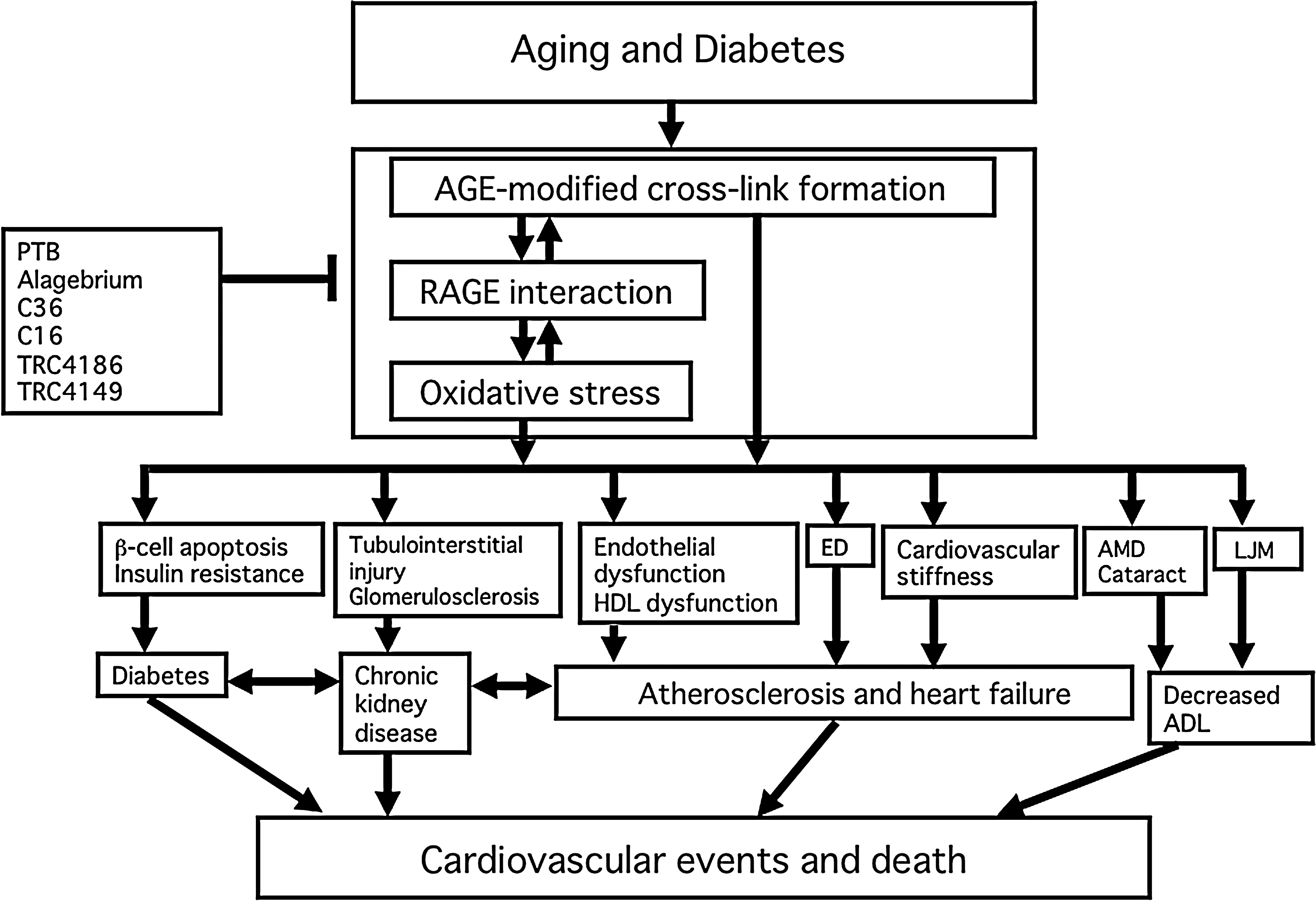
Potential clinical utility of advanced glycation end product (AGE) cross-link breakers for various disorders. RAGE, receptor for AGEs; PTB, N-phenacylthiazolium bromide; ED, erectile dysfunction; AMD, age-related macular degeneration; LJM, limited joint mobility; ADL, activities of daily living.
Footnotes
Acknowledgments
This work was supported in part by Grants of Collaboration with Venture Companies Project from the Ministry of Education, Culture, Sports, Science and Technology, Japan (S. Yamagishi).
Author Disclosure Statement
No competing conflicts of interest exist.