




Abstract
The high incidence of unmet medical needs in combination with the rising burden of chronic diseases, linked to an increasingly aging population, necessitates new approaches to therapeutic intervention. One potential class of health care innovation that may offer an alternative approach to addressing current shortfalls is stem cell therapies. The CASMI Translational Stem Cell Consortium (CTSCC) was formed to elucidate the key hurdles to the commercialization and clinical adoption of stem cell technologies, with a particular focus on pluripotent stem cell (PSC) technologies. As a global pre-competitive academic–industry consortium, the CTSCC unites thought leaders from a range of sectors and technical specialties in defining and discovering solutions to roadblocks that will impede the field. Targeted toward stakeholder requirements at the delivery end of the translational spectrum, the CTSCC aims to provide mechanisms for multidirectional dialogue and to produce academically rigorous and commercially practicable research outputs to accelerate industry progress. On the 30th and 31st of July, 2013, the CASMI Translational Stem Cell Consortium (CTSCC) held a launch event at the Saint James Club, Paris, France.
Introduction
O
The compiled questionnaire data presented herein has significant limitations in that the sample size of questionnaire responders (20 in total) was low. However, the inherent value of the data is rooted in the deep discussion from a preceding event that educated the focus, in addition to the prominent influence of questionnaire responders, all leaders within their respective areas, spanning multiple specialties and sectors. A potential confounding issue is that responders might have identified focus areas with a view to the perceived capabilities of the CTSCC team and not solely on the basis of sector need.
Three overarching directives can be identified from the responses provided: 1. A fundamental requirement to advance the basic scientific understanding of the underlying biology is focused around product attributes that are linked to clinical safety and efficacy. 2. Measures should be enabled to encourage widespread utilization of stem cell banking resources and to foster open global exchange. 3. Mechanisms should be created to more effectively align the demands and expectations of industry and academia.
Key Findings
The questions posed in the survey were based around input from the CTSCC's funding and research partners and the Consortium's research findings to date.
1
The resulting questionnaire was completed by 20 opinion leaders and senior managers, importantly with balanced representation from industry, academia, and translation center/other (Fig. S1) (Supplementary Data are available at
To compare prioritization of components within a question group, a “score” was assigned based on the following computation. A cumulative count of total responses for each component was calculated, and the mean value for the total count was calculated. The mean count for the question group was then subtracted from the cumulative counts for each component to define the score. This reflected the distance from the group mean of the total count for a component within a question group.
Standards
The delineation of standards for stem cells and stem cell–derived therapies offers numerous productive functions, such as enabling efficient dialogue between disparate stakeholder groups, expediting regulatory approval, and facilitating transfer and applications of cell lines. Standards also play an essential role in the effective evaluation and assessment of significance in clinical outcomes. Defining standards for stem cell therapies, and PSC-derived therapies in particular, is challenging due to the inherent plasticity of living cells.
Standards focus areas were ranked with principal topics of interest identified as “Standardizing characterization methodologies, technologies and instrumentation to create reference standards including appropriate tolerances” and “Global harmonization of standards for stem cell bank creation” (Fig. 1A). While PSCs in their undifferentiated state are unlikely to be a therapeutic product, the need for standards in stem cell line selection and bank creation, especially those intended as current Good Manufacturing Practices (cGMP) materials, was highlighted: “Sorting out if the line will be acceptable for use at the end of a multi-year effort is critical. Finding a line that was developed under appropriate conditions that also efficiently performs in the differentiation protocol is not trivial.” This is of particular relevance due to the reported variation in differentiation abilities and efficiencies of various PSC lines. 2 –4
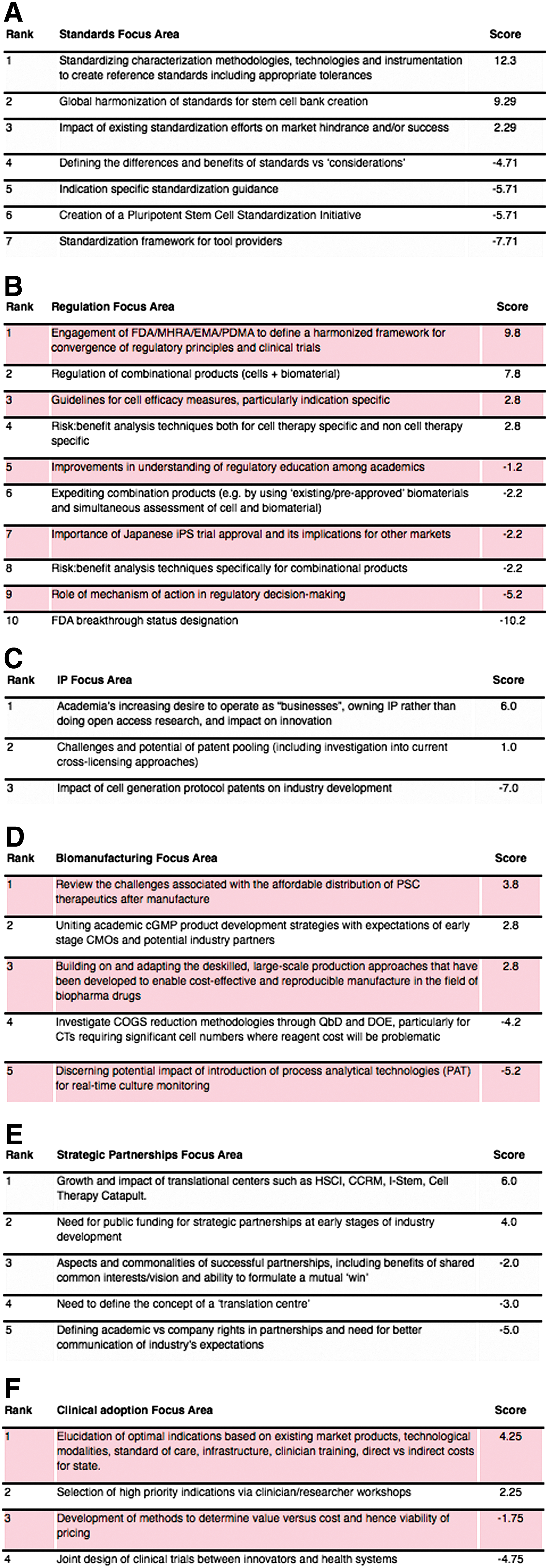
Prioritization of key challenges within focus areas: “Score” was assigned based on distance of the cumulative count for a question group component from the mean cumulative count within the question group. (
The relative importance of a range of in vitro and in vivo assessments within the context of a cell standardization framework was investigated. Of the in vivo assessments, “tumorgenicity” (score 9.5) and “immune response” (score 5.5) were rated as the most important parameters (Fig. S2Aii). Highlighted within the in vitro assessment question group were “identity” (score 9.0), “expression of phenotypic markers” (score 3.0), and “genomic stability” (score 2.0) (Fig. S2Ai). As identity is frequently assigned based on the expression of a limited number of cell-surface markers, it was stressed that “this is dependent on phenotypic and gene expression profiles.” It was, however, noted that the “development of informative functional/potency assays with associated release criteria are critical—more relevant than marker expression,” a common view shared in academic and industry literature. 5 –7
Regulation
Productive communication with international regulators is critical to clinical trial initiation, reporting, and product approval. There have been efforts by regulators in the United States, European Community (EC), and Japan to revise and devise a regulatory system more suitable for cell-based therapies due to the numerous unique and inherent challenges not historically encountered with traditional pharmaceutical. 8 –11
The “Engagement of Food and Drug Administration (FDA)/Medicines and Healthcare Products Regulatory Agency (MHRA)/European Medicines Agency (EMA)/Pharmaceuticals and Medical Devices Agency (PMDA) to define a harmonized framework for the convergence of regulatory principles and clinical trials” and the “Regulation of combinational products (cells+biomaterial)” were highlighted as key focus areas for the CTSCC (Fig. 1B). It was noted that the engagement of the FDA/MHRA/EMA/PDMA is already happening, led in part by the The International Conference on Harmonisation of Technical Requirements for Registration of Pharmaceuticals for Human Use (ICH) (
Biomanufacturing
A prerequisite to the widespread commercialization and clinical adoption of PSC-derived therapies and stem cell therapies is the transition to cGMP manufacturing-scale processes that reduce and/or eliminate the variability introduced by manual approaches. Concurrently, in addition to regulatory compliance though a Quality by Design (QbD) approach, it is essential that any biomanufacturing strategy also supports Cost of Goods (CoGs), which is a profitable business model.
Of the specific focus areas within the biomanufacturing theme, the areas outlined for investigation by the CTSCC were “Review the challenges associated with the affordable distribution of PSC therapeutics after manufacture,” “Uniting academic cGMP product development strategies with expectations of early stage CMOs and potential industry partners,” and “Building on and adapting the deskilled, large-scale production approaches that have been developed to enable cost-effective and reproducible manufacture in the field of biopharma drugs” (Fig.1D). “Key process scale-up challenges,” such as suspension cell culture technologies and automated systems (score 9.89), was rated as the most significant hurdle, followed by “communication of industry process expectations to innovators” (score 4.89) and “inadequate process development strategies” (score 3.89) (Fig. S3C).
Strategic Partnerships
Partnerships within and across sectors have become increasingly prevalent throughout biomedical sciences. 12 This collaborative approach has been embraced significantly within the cell therapy field, as a risk-sharing strategy between academia/Small and Medium Enterprises (SMEs) and the traditional trailblazers, “big pharma,” and as a result of the early stage of the field. 13 A number of “translation centers” have also been formed with a view to empower the clinical and commercial potential of the field. Therefore, the CTSCC looked to understand the various partnerships that have been formed to date and to assess potential implications for the future stem cell therapy industry.
As specific focus areas for the CTSCC, “Growth and impact of translational centers such as Harvard Stem Cell Institute (HSCI), Centre for Commercialization of Regenerative Medicine (CCRM), I-Stem, Cell Therapy Catapult” (score 6.0), and “Need for public funding for strategic partnerships at early stages of industry development” (score 4.0) were rated as the most important areas for investigation (Fig. 1E). Cell banking has taken on a leading role in the stem cell field, 14,15 the important banking initiative features were identified as “access” (score 8.4) and “comparability of cell lines offered” (score 5.4) (Fig. S3A).
Intellectual property
Intellectual property rights are central to the existing model of protecting revenues from market-leading innovations in drug development, while at the same time encouraging innovation through the sharing of information. The ill fit of the current IP process/approach for the cell therapy field has frequently been discussed. 16 –19
“Academia's increasing desire to operate as ‘businesses’, owning IP rather than doing open access research, and its impact on innovation” was identified as a primary focus area for the CTSCC within IP (Fig. 1D). The most significant IP challenges were identified as the “(Mis)alignment of aims of public and private partners in collaborations” (score 6.86), the “optimal stage of technological development at which to patent” (score 5.86), and a “lack of rigorous publicly available IP landscapes for cell based technologies” (score 5.86) (Fig. S2C).
Clinical
Despite the fact that highly skilled clinicians will typically make the decision of which therapeutic option is best suited for a particular patient, this important stakeholder group has been poorly integrated into the early product development of stem cell therapies. An improved understanding of the decision-making process, practicalities, and preferences of clinicians that can be directly used to shape product development should facilitate improved uptake following market approval.
Of the focus areas for specific investigation, the requirement for the “Elucidation of optimal indications based on existing market products, technological modalities, standard of care, infrastructure, clinician training, direct vs. indirect costs for state” was highlighted (Fig. 1F). This multifactorial approach to identifying possible areas in which stem cell therapies might be most effective was supported by a respondent outlining the need to match the technology to a disease rather than going after a specific indication to improve the likelihood of positive outcomes. The “Provision of relevant and/or indication specific end points” (score 9.55), “examination of reimbursement assessment models, e.g., Quality-adjusted life years (QALYs)” (score 5.55), and the “optimization of clinical trial design” (score 4.55) were all identified as key aspects of clinical engagement (Fig. SB).
Conclusion
The translational pathway for pluripotent stem cell–derived products and other stem cell therapies is impeded by a range of deficiencies in scientific knowledge, technological capabilities, and regulatory uncertainties. 20,21 The CTSCC was formed to unify international and multidisciplinary luminaries from major stakeholder groups to break down translational barriers. 1,22 Through disseminating timely and clear findings reflecting contemporary opinions of sector leaders, the aim of this effort will make a practicable contribution to stem cell translation.
The data described herein, albeit with a limited sample size, begins to form a picture of the prevailing critical limiting factors in the stem cell translation pathway. Across respondent groups and questionnaire responses, there was a prevailing requirement for a heightened emphasis on research into the fundamental principles and basic biology as related to key requirements, both safety and efficacy, of the potential cell product. Additionally, the increased support and use of stem cell banks, with concepts surrounding harmonization of standards, comparability of cell lines offered, and open access privileges, were tantamount for their success. Finally, the further alignment between sectors, predominantly industry and academia and particularly in the current financial climate, stands to benefit all involved, as would a route to improved comparability of clinical end points.
In closing, pre-competitive collaborative consortia, such as the CTSCC, have a critical role to play in co-ordinating at times disparate expert stakeholders in the rapidly developing stem cell technology field. 1,23 And in so doing, de-risking and maximizing the overall research and development product of the field ultimately benefits patients suffering with debilitating diseases.
Footnotes
Acknowledgments
The authors wish to express their gratitude to the following for their support and insight during the preparation of this manuscript: Research and funding partners of the CTSCC; in particular to questionnaire responders and attendees of the CTSCC's July 2013 meeting, upon which the findings of this manuscript are based; Richard Barker (CASMI), Andrew Carr (Oxford), Zhanfeng Cui (Oxford), Megan Morys (CASMI), David Newble (TAP Biosystems), Brock Reeve (HSCI), Sven Wagner (Sartorius Stedim), and Ivan Wall (UCL). We wish to express our sincere thanks to the following organizations that have contributed to the consortium as funding and events partners, without whom the consortium and the benefits it will bring to stem cell translation would be unacceptably constrained: GE Healthcare, CCRM, TAP Biosystems, Lonza, CIRM, SENS Research Foundation, UK Cell Therapy Catapult, and NIH Centre for Regenerative Medicine.
Author Disclosure Statement
The content outlined herein represents the individual opinions of the authors and may not necessarily represent the viewpoints of their employers.
D.A.B. gratefully acknowledges support from the SENS Research Foundation (Mountain View, CA). D.A.B. is a stockholder in Translation Ventures Ltd. (Charlbury, Oxfordshire, UK), a company that amongst other services provides cell therapy biomanufacturing, regulatory, and financial advice to clients in the cell therapy sector. D.A.B. has conducted paid consultancy for the Technology Strategy Board (funder of UK CT Catapult) (Swindon, UK), Lonza (Basel, Switzerland), and CCRM (Toronto, Canada) within the past 7 years with a cumulative value of greater than $10,000. D.A.B. has also received hospitality from TAP Biosystems within the past 7 years with a cumulative value of less than $10,000. Additionally, at the time of writing, D.A.B. may have pending private and/or academic funding pending with other organizations named. D.A.B. is subject to the CFA Institute and CAIA Association's Codes, Standards, and Guidelines, and as such this author must stress that this piece is provided for academic interest only and must not be construed in any way as an investment recommendation.
K.E.B's employer, TAP Biosystems, is currently in late-stage, publicly disclosed negotiations with Sartorius Stedim concerning a potential acquisition. Please contact K.E.B for further information.
A.F. declares no competing financial interests.
References
Supplementary Material
Please find the following supplemental material available below.
For Open Access articles published under a Creative Commons License, all supplemental material carries the same license as the article it is associated with.
For non-Open Access articles published, all supplemental material carries a non-exclusive license, and permission requests for re-use of supplemental material or any part of supplemental material shall be sent directly to the copyright owner as specified in the copyright notice associated with the article.
