




Abstract
Life expectancy has increased continuously for at least 150 years, due at least in part to improving life conditions for the majority of the population. A substantial part of this historical increase is due to decreases in early life mortality. In this article, we analyze the longevity of four privileged sets of adults who have avoided childhood mortality and lived a life more similar to the modern middle class. Our analysis is focused on writers and musicians from the 17th through the 21st centuries. We show that their average age at death increased only slightly between 1600 and 1900, but in the 20th century increased at around 2 years/decade. We suggest that this confirms that modern life span extension is driven by delay of death in older life rather than avoidance of premature death. We also show that productive life span, as measured by writing and composition outputs, has increased in parallel with overall life span in these groups. Increase in age of death is confirmed in a group of the minor British aristocracy and in members of the US Congress from 1800 to 2010. We conclude that both life span and productive life span are increasing in the 20th and early 21st century, and that the modern prolongation of life is the extension of productive life and is not the addition of years of disabling illness to the end of life.
Introduction
L
Starting with Fries, 8 it has been proposed that life span has been extended by deferring the diseases and disabilities of old age, so that morbidity is compressed into the last few years of life. Compression of morbidity is 4,9 –12 or is not 13 –15 seen in actual aging populations; whether compression of morbidity is seen or not seems to depend mostly on how the authors define morbidity. Diagnostic and biomarker measures of age-related disease have generally (but not always) been seen to decrease. 16 –22 In cases where disease and disability are found to decline, it is controversial whether this is as a result of intense medical intervention to offset disability 13,23,24 or a genuine delay in the onset of the disabilities that are usually associated with aging. In cases where disease and disability are found to increase, it is not clear the extent to which this is due to improved screening and more stringent diagnostic criteria (for example, the changes in diagnostic criteria for diabetes in the last half century 25,26 and the adoption of “pre-diabetes” as a diagnostic category in the late 1990s. (The International Classification of Diseases [ICD] codes are a guide to accepted diagnostic criteria. ICD-8 [adopted in 1965] did not recognize “pre-diabetes” as a diagnostic criteria. ICD-9 [adopted in 1975] had several diagnostic categories consistent with “pre-diabetes”—790.21, 790.22, and 790.29, the latter mentioning the term “pre-diabetes.” ICD-10 [adopted in 1990] had one category explicitly called “pre-diabetes,” R73.09).
Activity-based measures of age-associated disability seek to reflect the experience of aging rather than its biochemistry, but have also produced conflicting results. Scores such as the Activities of Daily Living (ADL) scores detect whether people can perform basic tasks necessary for independent life. The rate of ADL decline with age has been seen to slow (or be deferred) in most, 27 –29 but not all, 22 populations. Other measures of disability also have been reduced or compressed in some elderly populations, 30,31 but increased in others. 32,33
Measuring Productive Life Span Through Professional Output
These previous studies of life span, health span, 22,34 and the compression of mortality have used the medically derived measures mentioned above to detect when an individual was diseased or disabled. In this study, we introduce lifetime professional output as a novel measure of the individual function, and its change with age, which can be tracked across historical time. We term this “productive life span.” Productive life span is the span of life in which an individual can actively pursue those activities that they want to pursue, and (in this case) contribute the results of those activities to society. For the creative professions (including scientific research), productive life span is the time when an individual is producing recognized works. For practical reasons, we define productive life span as the time from birth until the cessation of professional or creative output.
There are three reasons for considering professional output as a measure of active life. First, unlike biomedical measures, some professional activities can be tracked over historical times, and so health span, like life span, can be determined over periods of several hundred years. Second, what many people understand by “health span” is not just absence of severe disability but the ability to live the life they wish to live. For those who enjoy their profession (or those without a pension), this means the ability to continue to be a productive member of society, not simply being able to walk from the bed to the bathroom. Last, the only viable solution to the current economic “pensions crisis” is for people to work longer. 35 Therefore, it is of practical economic importance to know how long people can work.
To compare modern populations with previous centuries, we have chosen to study a population that has lived essentially a modern, “middle class” lifestyle since at least the 1600s, the group of classical musicians and professional writers. Both groups are composed of people who are economically privileged, in the sense that they have had to have access to wealth, resources, and power structures necessary to make their works known, which also means that they avoid the physical stress of hard manual labor. They have time free of basic labor to work and reasonably luxurious living conditions (by the standards of the day) to keep the paper and ink dry. Artists are considered “a fair representation of the European middle classes from the 15th century.” 36 If we wish to compare longevity of people who share a lifestyle similar to our modern one (although obviously without modern medicine), professional artists are a plausible comparator group. Both writers and musicians have left a record of when they were active in their life. We supplement this with two other groups of people who have lead privileged (i.e., health-protected) lives since the late 18th century.
Our primary interest in this article is to compare artists in one era with those in another. Although such changes can be compared to life span changes in other populations (and we do compare artists to two others), we are interested in determining how age at death and productive life span has changed over the last four centuries in this well-defined and economically privileged group.
Methods and Data Sources
Choice of populations
The goal of this project was to determine whether the increase in life expectancy in the 20th century is accompanied by a corresponding increase in productive life span, as defined by the years in which an individual is able to pursue his or her profession. A secondary goal was to see at what date any change in productive life span or overall life span had started. Therefore, we studied populations that are inherently free of the most common causes of infant and childhood injury and illness, had themselves survived childhood, and had an objective measure of accomplishment or performance that could be used as a measure of professional output.
The populations we chose to study were writers and musicians, for the following reasons: 1. Musicians and writers before ∼1950 were required to be economically privileged to get their work published or performed (see ref. 37 for discussion of the role of economic power in success in composition). Given the known association of economic privilege with longevity,
31
this makes them more directly comparable to modern, Western populations than the average population of their day. 2. Creative output can be measured quasi-objectively. Although there is no absolute measure of creativity, the Oxford Guide series of reference works seeks to provide a complete, balanced, and curated overview of a field of creative endeavor from the Renaissance to the present, only including individuals who have made what the collective understanding of the field believe is a significant contribution to their art. This provides a consistent standard against which “creative output” can be compared between centuries. 3. Production methods and standards are consistent over historical times. For “classical” music and conventional creative writing, the output of J.S. Bach can be realistically compared to Harrison Birtwistle (if not to Irish boy band Boyzone), and that of Jane Austen with J.K. Rowling. 4. The large majority of writers and musicians are primarily self-employed. Even if they are employed for a while by a wealthy patron or an institution, they remain in control of their own output. As a result, they are seldom required to stop working at a stipulated age and usually desire to continue working until they are no longer able to do so. Retirement practices therefore have little effect on this group. 5. Because they inherently follow an intellectual profession requiring significant education (again, pace Boyzone), writers and musicians are equally biased by the observed greater longevity of those with higher intelligence, education, or mental activity levels, and especially their relative resistance to early neurodegenerative disease.
38
–42
6. Many of the biasses inherent in data sets of survival of the oldest old that are reviewed by Vaupel and Lundstrom
43
apply with minimal force to famous writers and composers. They are unlikely to be confused with other, younger people of the same name because their output is distinct (as illustrated by the clearly distinct operi of the different Bach or Strauss, or for that matter Lennon or Jackson, family members). Their deaths are noted and so they are unlikely to be scored as alive after they are dead, and their later lives at least are well documented, so their precise date of death is recorded avoiding “age heaping.”
43
We also analyzed brief biographies of members of the US Congress, to see if similar data could be analyzed for this larger, US-based data set. Longevity data was also complemented by analysis of some members of the British minor aristocracy, for which “productivity” is not relevant but point 6 above applies for longevity analysis.
Data sources
Biographies for English language writers and classical tradition musicians were extracted manually from print editions of the Oxford Companion to English Literature 44 and the Oxford Companion to Music, 45 respectively. Data were compared with online databases, and inconsistencies were resolved by comparison with Bakers Dictionary of Music 46 or The Wiley-Blackwell Encyclopaedia of Literature. 47 Data recorded from the entries in the Oxford Companions included year of birth and death, gender, year of first and last work recorded in the biography, and country in which the artist spent the majority of their life. Entries were also classified by occupational specifics (composer, different performance types for musicians, poetry, fiction, factual writing, publishing, etc., for writers). The data set contained data on 2434 writers and 1536 musicians.
Data on composers was also gathered from a systematic download and subsequent page analysis of all the composers listed in the Wikipedia page “List of composers by name” (
Data on birth and death of members of the English minor aristocracy were compiled manually from the online edition of Burke's Peerage. 48 The complete family entries for families of British Prime Ministers from the 18th and 19th centuries were retrieved and dates of birth and death for all family members who survived to the age of at least 1 year old were recorded. Burke's Peerage records all the families, both known ancestors and known descendants, of all members of the titled classes of the United Kingdom's extensive honor system, including past and present senior members of government if they have been ennobled. We note that many junior family members (i.e., family members who were not in direct line to inherit the family title) who died in childhood may not be recorded in this database, because they would not be genealogically significant. A total of 2141 members of 23 families were included in the data set.
Data on members of the Congress of the United States were collected from the brief biographies available online in the Biographical Directory of the United States Congress. 49 All biographies were automatically “scraped” from this database and then analyzed automatically to identify by keyword search the dates of birth, death, graduation, first- and last-mentioned occupation, and retirement (if mentioned). In all, 12,070 biographies were collected and analyzed.
All data are Excel spreadsheets, and are available on request to W.B.
Analytical approach
Throughout this work, we have chosen the age at death as a measure of the extent of life span. This is for two reasons.
1. “Life expectancy” depends on the age of the person being considered. Life expectancy at birth is the most commonly used parameter for describing life span, but is not relevant for this study because we know that anyone becoming a professional musician or writer has survived childhood (and conversely we do not know at birth who will become a writer or a musician). The age at which someone “becomes” a writer or a musician is undefined (although see Fig. 5, below), and so, therefore, is the age at which life expectancy should be measured. However, the age at which someone dies is exactly defined.
2. We wish to probe whether the productive life span tracks overall life span. It is not clear that the concept of “productive life span expectancy” could be defined, given the uncertainty of when someone starts producing creative work. For example, Edward Elgar did not write his first symphony until the age of 51 and died 26 years later. Did Elgar have a greater or lesser productive life than W.A. Mozart, who wrote his first symphony at the age of 8 and died 27 years later? However, the date at which a writer or composer stops work can be defined and compared to the date at which they died, and the number of “unproductive” years between their last work and their death can be explicitly calculated from this data.
Age at death, age at last “work,” and time between last work and death are calculated directly from the data, and averaged in date classes depending on when the artist was born or died. In all graphs, error bars are 1.98 times the standard error of the mean (SEM) of the values for the date bin.
Results
Life span and health span in writers and musicians
The age of death of musicians and writers is shown in Fig. 1. Shown are ages binned by year of death. Data can also be binned by year of birth, but as this gives biased results after ∼1910 it was not used here. (For example, no one born in 1960 can have died at an age older than 60 years, so an analysis of age at death by year of birth suggests a catastrophically declining longevity in the 20th century.) Binning in Fig. 1, A and B, is in equal time periods, and hence containing unequal numbers of people. Data can also be binned into bins containing equal numbers of people but unequal duration: This is also done in Fig. 1, showing essentially the same pattern.

Age of death and last work of musicians (
Figure 1 shows a clear pattern of a gradual, slight increase in average age of death from 1600 to around the start of the 20th century, and a steeper increase of ∼2 years/decade from around the start of the 20th century to the present. (Musicians: Average age at death 1900–1925=65.4, average age 2000–2014=84.2. Writers: Average age at death 1900–1925=63.4, average age at death 2000–2014=82.6.) This latter rate of increase is consistent with the current increase in life expectancy of ∼2.5 years/decade in the general population. This is a different picture from that gathered from studies of life expectancy at birth that show a steady increase from the start of the 19th century to today. 1 The reason for this difference is that our data set does not include deaths that occur before the writer or musician has made their mark on their chosen art. No “mute Milton” is recorded in the data sources used here. Life expectancy at age 25–30 years (a plausible age at which a young artist can make their mark; see Fig. 5, below) has been in the region of 55–60 years since the early 19th century in Sweden and similar from the 1850s onward in the United Kingdom and France (when reliable records started to be kept). So musicians and writers lived a bit longer than the general population in the past, 50 but like the general population their life expectancy once they reached adulthood had not changed substantially from the Enlightenment until the mid 19th century. This is broadly consistent with Mirzada et al., 50 who show only a 2-year increase in life expectancy at 50 years for musicians and writers (and visual artists) from 1700 to 1899.
Our measure of the productive life span of this population is also illustrated in Fig. 1, where the age of the last recorded work of the writer and musician sets is shown. It is clear from Fig. 1 that the age at which the last work is produced has increased in parallel with the age at death. This is illustrated more clearly in Fig. 2, which plots the average number of years between the last noted work and death for writers and musicians. This is “unproductive” old age (i.e., the period during which the artist did not produce any works of sufficient importance to be recorded in the reference works consulted here). Figure 2 shows a lot of “noise” in the data before the 19th century (due to small numbers of people in each category), but within this limitation it shows that there has been no significant increase in “unproductive” old age—if anything, the number of years of (relative) non-productivity has declined since the start of the 20th century. Writers seem to stop producing major works before musicians: This may be an artefact of what is considered a “major” notable work.
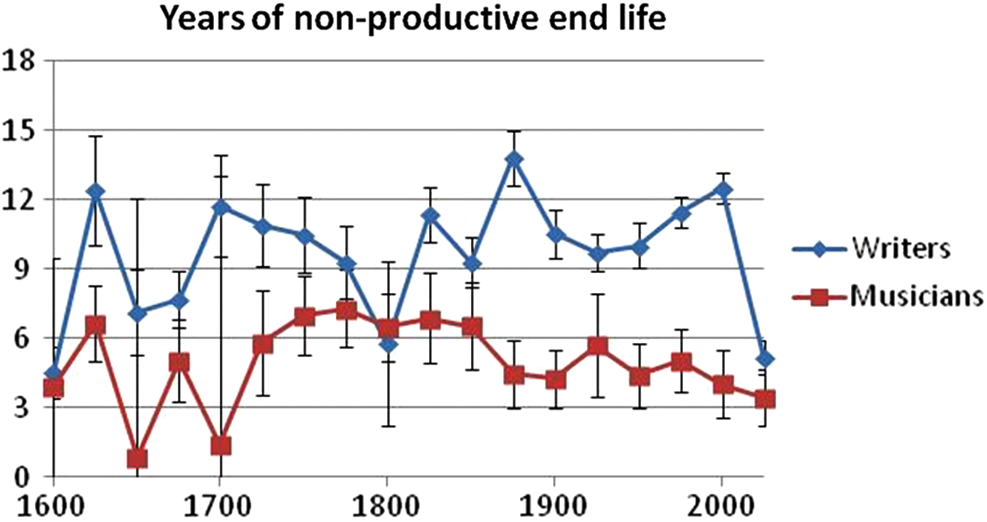
Unproductive old age for writers and musicians. Average number of years between date of last noted work and date of death, for writers and musicians, binned in 25-year bins. Color images available online at
We analyzed the number of “non-productive” years as a function of the age of death of writers and musicians, an analysis shown in Fig. 3. As might be expected, there is a general trend for artists who die young to work up to near their death, whereas artists who die old spend longer in a non-productive phase of life. However the late-life period of non-productivity has declined substantially for both writers and musicians in the 20th century. This is consistent with the constancy of the period of unproductive life shown in Fig. 2, despite increasing life expectancy shown in Fig.1. It is also consistent with a compression of morbidity into later life.
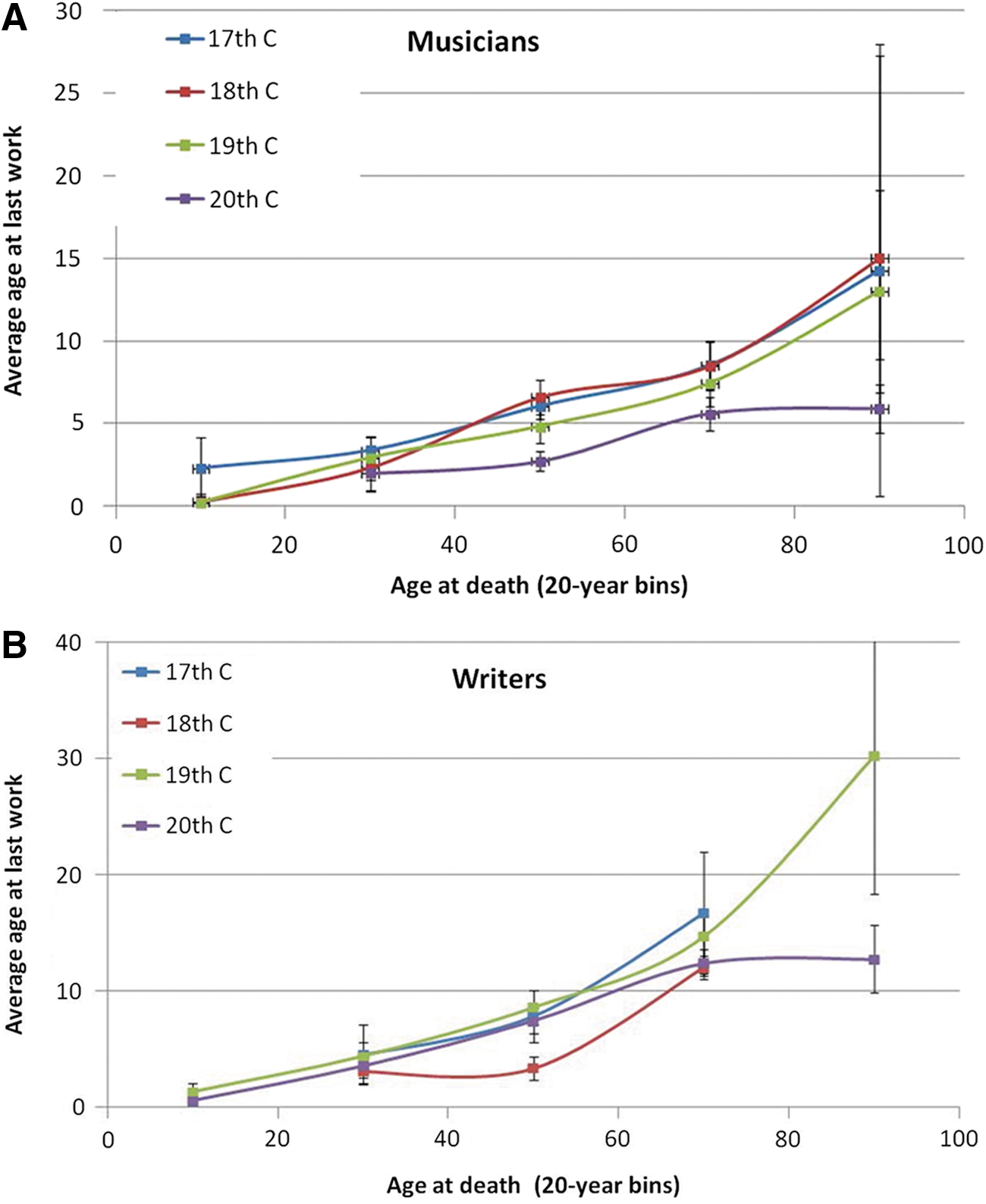
Non-productive years as a function of age at death. The average of the non-productive late life years ([age at death] − [age at last work]) is plotted as a function of age at death, binned into 20-year bins. (x axis) Age at death (20-year bins); (y axis) average non-productive end-life years. Data for artists dying in four different historical eras are plotted separately: 17th century, all dates up to and including 1699; 18th century, 1700–1799; 19th century, 1800–1899; 20th century, all dates after 1900 inclusive. Color images available online at
Most of the entries in the music biography database are for composers (1371 out of 1540 entries), but some are for artists who were known for performance. Performance is more physically demanding, but equally exercise is known to improve life span and health span and cognitive aging, 51,52 so performance could increase or decrease life span or health span. We find no evidence for significant difference between the average age of death of non-performance and performance musicians (Fig. 4). Poets (renowned in the Romantic tradition for their dissipated lifestyle) also do not show significantly different ages of death from novelists or writers in general (Fig. 4), although many entries are for writers who are poets and novelists, so these groups overlap substantially.

Ages of death of sub-groups of artists. Average age at death of sub-groups of artists, grouped by date of death and binned in 25-year bins. (
Changes in age at death and productive life span are not due to selection
Could the results here be in part due to sample bias? The results shown in Figs. 1 –4 show changes with time, so analysis done here is valid for this sample providing any biases in selection do not change materially with time (i.e., if there are biases in the sample, they are the same biases in 1600 as in 2010). We have tried to test for changes in the data set with time, to eliminate the possibility of changing selection bias between 1600 and 2010.
The sets of writers and musicians used sampled different people and are compiled independently. Writers are predominantly sampled from 19th and 20th centuries, musicians more uniformly from ∼1600 onward, but both sets show very similar patterns of changes in longevity and productive life span. There are more writers in the data set from the 19th and 20th centuries than previous times, so the number of people per bin is different in different epochs if binning is done by date. However if the data are sampled into bins of equal numbers of people, rather than equal duration (Fig. 1C, D), essentially the same change in average age at death is observed. The average age at first work (Fig. 5) is remarkably constant from the 17th century onward, suggesting that there is no change in the age at which people become candidates for inclusion into the data set. Therefore, we think it unlikely that changing inclusion criteria could be a major contributor to the patterns seen in Figs. 1 –4.
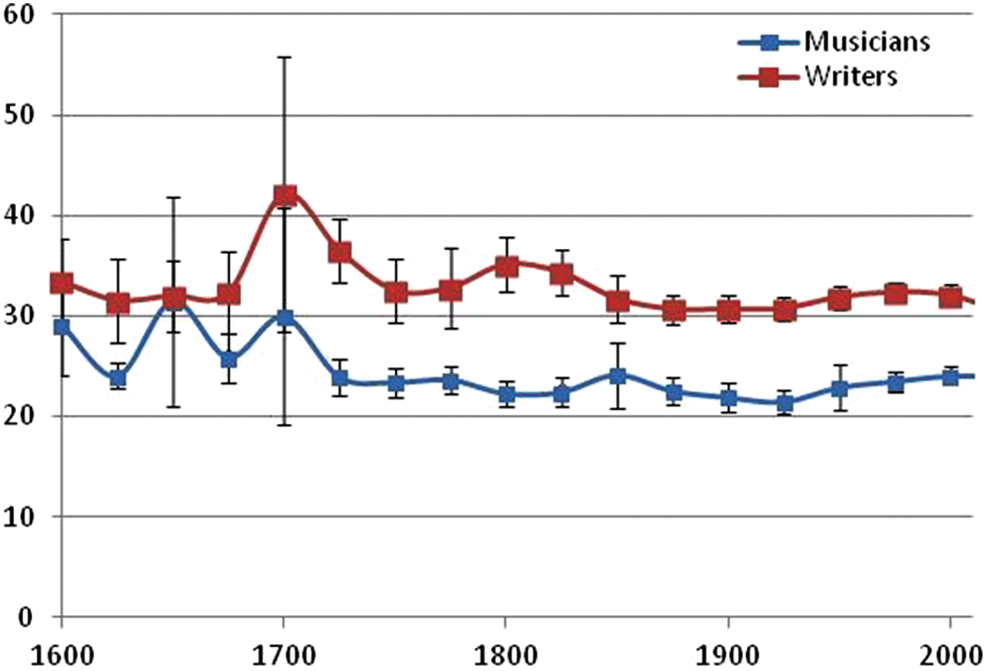
Average age of first work. Average age at which artists created the first work recorded in this data set. (x axis) Date of death (in 25-year bins); (y axis) average age of first work for that time period. Color images available online at
We also measured the heaping index, a measure of the extent to which dates are rounded to the nearest 5- or 10-year value (calculated as the number of dates in a time period ending in 5 or 0 minus the number of dates in that time period divided by 5, a value that varies between 1 [unbiased] and 5ref. 53 ). Prior to 1600, the heaping index analysis showed that birth dates were frequently rounded to the nearest 5 or 10 years (so that, for example, 1553 might be recorded as 1550 or 1555). After 1600, the heaping index suggested negligible rounding in this data set. Also there was no significant difference between the age at death or productive life span of writers or musicians from different countries. (Further details of these analyses are provided in refs. 54, 55). The results in Figs. 1 and 2 were also confirmed by “scraping” the biographies of classical composers from Wikipedia, and extracting life span and productivity data from those biographies automatically. The average ages of death and of last work, and years of “unproductive” life closely match those shown in Fig. 1 (not shown).
Life span in the minor British aristocracy
We examined the minor British aristocracy as another example of a group of people with substantial economic privilege. It is not practical to examine the productivity of this group, because they do not have a defined social role beyond their hereditary title (i.e., their “productive output” is being alive). Figure 6 shows the average age of death of this group. Unlike musicians and writers, which were overwhelmingly male until the 20th century, this data set also recorded some females, and so the data set is separated into men and women. Apart from a severe drop in the average age of female death in the early 20th century, there is little difference in this data set between the average age of death of men and women; however, the uncertainty in the data on women is very large, in part because there are only 721 women to 1396 men in the data set, but also because there seems to be more variability in age of death of women, possibly due to mortality in childbirth before the 20th century.

Longevity of British minor aristocracy. Average age of death of members of families of 18th and 19th century British Prime Ministers, binned by age of death. Shown are the age at death of all men in the dataset (Male-all), men who were not recorded as being killed in action (Men-not action), and Women (Female). Color images available online at
The ruling and professional classes in Britain over the 18th to early 20th centuries were the social group from which the majority of the officer class of the armed forces was taken, and the high death rate of the junior officer classes during the First World War might be expected to bias the average age of death in the period covering 1914–1918. Therefore, Fig. 6 separates average age of death from all causes from average age of death for those who died in combat. While there is a noticeable effect of combat deaths in from the English Civil War (1642–1651) and the First World War (1914–1918), deaths in combat do not substantially change the trend. The average age of those killed in combat was between 20 and 30 years (not shown), but the absolute numbers of those killed was small in this group. (We note it might have been much larger if we had chosen to analyze families with a military rather than a political tradition.)
We conclude that the life span patterns seen in Figs 1–4 are not unique to writers and musicians, but probably apply to a wide range of the economically privileged European classes.
Life span and health span in US Congress members
We examined short summary biographies of all of the members of the Congress of the United States (Senators and members of the House of Representatives [“Congressmen”]), to compare with the European data sets above. These are one-paragraph biographies of the lives of busy and accomplished men and women and as a consequence are likely to be incomplete regarding their professional activities. Congressmen show increasing life span from 1800 to 2010 broadly consistent with that shown in Figs. 1 and 4, but with a less pronounced change in slope in the early 20th century (Fig. 7). However, subdivision of the data brought out inconsistencies not present in the writers and musicians analyzed above, which suggested that analysis of their careers would be futile on the basis of this data. Reporting of retirement was inconsistent. Mid 19th century Democrats seem to live up to 5-year shorter lives than mid 19th century Republicans, and the proportion of lawyers in the data set changes between 30% in those dying in 1800 and 2000 to 68% in those dying in 1850. This variability shows that it is important to analyze biographies in detail to get meaningful results from a professional life analysis of the type shown in this paper and emphasizes that the data on writers and musicians above are unusual in being quantitative, specific about professional output as well as survival, and internally consistent in sub-sets of the data.

Longevity of members of the US Congress. Average age at death of members of the US Congress, binned by age of death.
Discussion
We have analyzed the longevity and professional lives of writers and classical musicians, and supplemented this with analyses of British minor aristocracy and members of the US Congress. We show that the average age of death of all groups has increased over the last 400 years, and for all except US Congressmen the rate of increase has itself increased since the start of the 20th century. For the last 100 years, the average age of death has increased about 2 years every decade.
The age at which writers and musicians stopped producing major works has also increased in parallel with the increase in age of death. There is no evidence for an increase in the number of years between when writers and musicians stop producing notable works and when they die, and there is some indication that this gap has reduced in the 20th century. Specifically, the years of “unproductive” end life for those dying age 70 or older appear to have reduced substantially in the 20th century. This is consistent with morbidity being compressed into the last years of life. 4,9 –12
We should emphasize that our measure of productive life span is an indication of the age at which artistic productivity declines. It is not meant to imply that at the “age of last work” the artist ceases to do anything. They can continue teaching, editing, producing works that later centuries consider too minor to be worthy of note, or take up another profession entirely (like rock musician turned physicist Brian Cox). Figure 2 does not imply that writers are disabled for a decade at the end of life. The production of noted works reflects peak professional output, which is assumed here to track overall professional activity.
Consistent with some studies, 50 but in contrast to others, 36,56 we find no significant difference in longevity between writers and musicians. Before the 20th century, the artists analyzed here had a slightly greater average age at death than minor aristocrats. Practicing art is generally associated with extension of high quality of life (e.g., refs. 36 and 50), especially music. 57 We note, however, that such research usually refers to art as a hobby or pastime, not as a profession. (It is W.B.'s anecdotal observation that professional writing, at least, is no more relaxing than accountancy or scientific research.)
Can this clear increase in productive life span be squared with the increase in disability in the older population in recent times that is found by some studies? 13 –22 We believe it can, because our study is measuring productive life, not medical disability. Mild disability need not stop a writer or composer. Musicians compensate for decline in peripheral and autonomic acoustic processing capacity by enhanced attentive thinking, 58,59 especially if the musical training starts early in life. 60 Adaptive mechanisms of this sort mean that cognitive performance can remain high into the 70s in all fields. 52,61 This is a reflection of the concept of “successful aging.” 62 Our study provides a measure of when artists cease to be productive as they age, rather than when an arbitrary biomedical threshold is passed.
Selection bias and data completeness
A major limitation on any study that takes a subset of the population for analysis is potential bias in selection of that population. We have deliberately selected the populations analyzed here as: (1) Living to be old enough to be professionally active (except the British aristocracy), and (2) coming from social strata that have economic privilege compared to the average population. Our conclusions will not be valid if the criteria for entry into the sample change with time. Our analyses suggest that the age of entry, frequency of entry, nationality, and nature of the work recorded either does not change with time or, if it does change, does not affect our conclusions. However, we obviously cannot rule out other biases, and therefore urge other researchers to carry out productive life span analyses on other, independent data sets.
Has increase in life span and productive life span changed in the 20th century?
The curves of age at death and age at last work in all the studies above give the visual appearance of a step change in gradient in the early 20th century. We explored whether this was “real” by matching the data to several simple curves, listed in Table 1. The three-parameter exponential model matches the data as well as the four-parameter “broken stick” model, and better than any linear model. Both suggest a change in the pace of life extension in the early 20th century, the four-parameter model setting the date explicitly in the early 1920s. Obviously there are many other models that can be matched to this data (we note that another obvious three-parameter model, a quadratic equation, cannot be fitted as well to this data). Our point here is that the two plausible models that show better matching than a straight line both show a substantial increase in the rate of increase of age at death in the 20th century, and they are essentially indistinguishable in terms of match to the data. Others have noted that extrapolating such curves is not a reliable way to predict the future. 63 The two models that fit the data well have similar predictions of continuously increasing life span and productive life span for the next 20–30 years, but diverge dramatically for how fast life span and productive life span increase in the far future. However, both the curves and the data themselves suggest that productive life span and overall life span will continue to increase.
Data for writers and musicians who died on or after 1600 were pooled. Data were matched to linear equations using Excel's inbuilt linear least squares function. Equations for the Exponential and Two Lines functions were optimized be seeding an algorithm with an estimate of the best constants in the function, and then iteratively testing small changes in the constants for lower RMS match of the calculated curve with the actual data, until no further improvement could be found (typically ∼1000 cycles).
A “pure” exponential increase leads to nonsensical results, e.g., predicting that someone dying in 2200 would die at an age of 10,000 years, i.e., must have been born in 8800 B.C.
P, parameter to be fitted (age at death or age at last work); D, date; m, c, e, f, constants; RMS fit, root mean of the square of the difference of actual data values from those predicted by the equation, for all data points from writers and musicians.
Conclusion
We have shown that the overall life span and productive life span of writers and musicians, who lived what we would regard today as a “middle class” life from the 17th century onward, have both increased in the 20th century. We show that productive life span has increased by at least the same number of years as total life span. The caricature of life span being increased by increasing a period of disabled dependence at the end of life is strongly refuted by this data. Throughout the 20th century, life span in these groups of people have been increasing at ∼2 years per decade. Predictions being made by others of extremely long life for today's young people should therefore be taken to mean that they are likely to live very long healthy, productive lives, and not (on average) spend decades of disability and illness. We hope this optimistic conclusion can help inform both career planning and policy on such subjects as pensions and retirement.
Footnotes
Acknowledgments
We are very grateful to Dr. Aubrey de Grey and the SENS Research Foundation for comments and guidance, to Dr. Jim Oeppen and Dr. Rebecca Oakes for many helpful comments, Dr. Patrick Barrie (CEB, Cambridge) for advice on statistics, to two reviewers whose comments helped us improve the draft paper substantially, and to the Department of Chemical Engineering and Biotechnology for hosting this work in their excellent Biotech tearoom. The analysis of writers and musicians presented here was submitted by T.P. and C.S. in partial fulfillment of the degree requirements for a M.Eng degree at Cambridge University.
Author Disclosure Statement
No competing financial interests exist.