




Abstract
Older adults undergo a progressive decline in cardiorespiratory fitness and functional capacity. This lower peak oxygen uptake (VO2peak) level is associated with increased risk of frailty, dependency, loss of autonomy, and mortality from all causes. Regular physical activity and particularly aerobic training (AT) have been shown to contribute to better and healthy aging. We conducted a meta-analysis to measure the exact benefit of AT on VO2peak in seniors aged 70 years or older. A comprehensive, systematic database search for articles was performed in Embase, Medline, PubMed Central, Science Direct, Scopus, and Web of Science using key words. Two reviewers independently assessed interventional studies for potential inclusion. Ten randomized controlled trials (RCTs) were included totaling 348 seniors aged 70 years or older. Across the trials, no high risk of bias was measured and all considered open-label arms for controls. With significant heterogeneity between the RCTs (all p < 0.001), pooled analyses were computed for VO2peak. Not only was VO2peak found significantly higher in the training group compared to controls (mean difference [MD] = 1.56; 95% confidence interval [CI]: 0.90–2.23) in pooled analysis of the 10 RCTs but also when the analysis was adjusted on the participants' health statuses. MD among healthy and unhealthy seniors were, respectively, 1.72 (95% CI: 0.34–3.10) and 1.47 (95% CI: 0.60–2.34). This meta-analysis confirms the AT-associated benefits on VO2peak in healthy and unhealthy seniors.
Introduction
A
This decline results from the combined reduction at the muscle level of O2 delivery and oxidative capacity. 10,11 The first appears to play the dominant role up to late middle age. It is principally due to reduced cardiac output by decline in maximal heart rate (HR) and stroke volume (blood pumped per beat). The misdistribution of cardiac output and the reduced extraction of O2 at the cell level are also incriminated. The second results from mitochondrial dysfunction, which appears to play a particularly important role in extreme old age. It is noteworthy that the structural aspects of the capillary bed do not appear to be reduced in a manner that would compromise the capacity for muscle O2 diffusion even at a later age. 12
The loss in cardiorespiratory fitness and aerobic capacity occurring as a natural consequence of aging is further impinged by muscle wasting (i.e., sarcopenia), inactive lifestyle, and/or by the course of some chronic diseases. 13,14 This means that, some sedentary older adults are of an age and/or in a health condition that might place them close to an aerobic capacity threshold from which it would need only a further small reduction to make some daily living activities either unpleasant or impossible to perform. 15 In other words, a minimal level of VO2peak must be maintained for independent physical functioning. 8,9 Functionally independent seniors tend to have VO2peak values ≥15 mL/(kg·min) for women and ≥18 for men. 10 Furthermore, in this population, VO2peak is a central component of the vicious cycle contributing to the frailty process, which is a transitional state in the dynamic progression from robustness to functional decline. 16,17 VO2peak has also become the most powerful predictor of mortality than other established risk factors for all-cause and cardiovascular mortality, 18,19 and premature death. 20
Recently, the World Health Organization has revealed that 60%–85% of people in the world lead a sedentary lifestyle. 21 In parallel, public health guidelines advocate that regular exercise training is essential to promote health, physical and mental well-being, quality of life (QoL), and survival. 22 Compared to the types of exercise, aerobic training (AT) has demonstrated greater benefits on health outcomes (e.g., longer lifespan, better QoL, reduced risks for stroke, heart disease, diabetes, and cancer, improved mood and self-esteem, and improved sleep patterns) 1,8,23 and it is recommended to better prevent and control noncommunicable diseases. 24,25 One of the key elements that contribute to explain this statement is the improvement in aerobic capacity.
This meta-analysis aimed at estimating to what extent the exact benefits of AT are in terms of VO2peak among healthy and unhealthy seniors aged 70 years or older.
Methods
Search strategy
The comprehensive, systematic database search was electronically performed (Medline, PubMed Central, ScienceDirect, Scopus, Embase, and Web of Science) for all articles published till the 31st of March 2017. Categorical searches were conducted using the following keywords: (i) exercise group; endurance or aerobic training; (ii) cardiorespiratory fitness; aerobic fitness; maximum/peak O2 consumption (VO2max/peak); (iii) community dwelling; elderly; older adults; older patients; aged; aging; oldest or old; and seniors. Then titles were manually searched and articles extracted. Reference lists and review articles, and position stands were examined for further relevant publications.
Criteria for study inclusion/exclusion
According to titles and abstracts, the articles were first evaluated using the following criteria:
Study design and article type
Only randomized controlled trials (RCTs) published in peer-reviewed journals into English language were selected.
Population
All studies that enrolled participants aged 70 years or older were included with no restriction to any specific medical condition. This means that participants enrolled in the RCTs were unavoidably neither healthy nor robust.
Intervention
AT refers to the use of O2 to adequately meet energy demands during exercise by aerobic metabolism. 26 Generally, light-to-moderate intensity activities that are sufficiently supported by aerobic metabolism can be performed for extended periods of time. 27 The American College of Sports Medicine (ACSM) defines aerobic exercise as “any activity that uses large muscle groups, can be maintained continuously, and is rhythmic in nature.” Aerobic exercise is physical activity of low to high intensity that depends primarily on the aerobic energy-generating process and lasting for at least 15–20 minutes or longer, while maintaining 60%–80% of maximum heart rate (HRmax). Aerobic activities include treadmill walking/running, swimming, walking, cycling, and aerobic classes. 9 No specific threshold was set as inclusion, noninclusion, or exclusion criteria for the frequency, duration, and intensity of training sessions. The home-based training programs or other types that were not directly supervised have not been considered, because usually reported as being less effective on health outcomes. 1,28
Quality assessment
This systematic review was conducted in accordance with the PRISMA statement (PRISMA). 29 Once trials were collected, the assessment of the study eligibility was conducted as depicted by Figure 1. The quality of trials was systematically assessed in terms of random sequence generation, allocation concealment, blinding, and other sources of bias according to the Cochrane Collaboration risk of bias assessment. 30 Open-label studies were of course also considered because a specific exercise training program makes blind design very challenging. Adverse events were also assessed, and when informed, their type and severity were collected as well as the compliance rate.
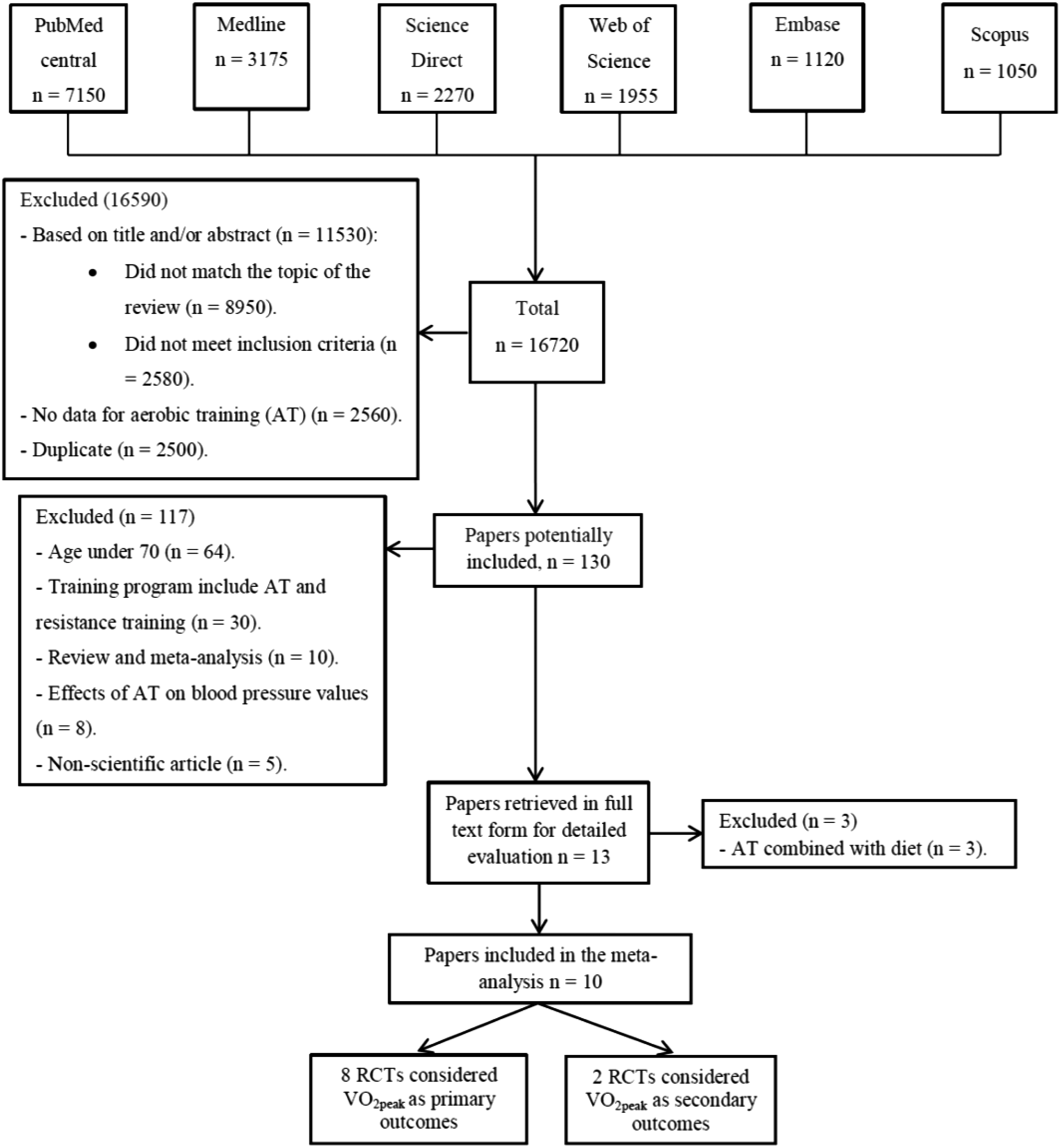
Flow diagram of literature search and study selection. AT, aerobic training; RCT, randomized controlled trial; VO2peak, peak oxygen uptake.
Data extraction and synthesis
Two reviewers (W.B. and T.V.) independently assessed articles for inclusion. Disagreements were first resolved through discussion and, when necessary, the opinion of a third reviewer (P.O.L.) was considered. Articles were extracted according to VO2peak.
Statistical analysis
Analyses were computed using R (version 3.1.2; R Foundation for Statistical Computing, Vienna, Austria). The significant threshold was set at p = 0.05. Data from RCTs were pooled to perform a comparison in a random effect model (Inverse variance method) for VO2peak. Analyses were computed with all RCTs pooled together and adjusted to the health status of participants at the time of randomization according to inclusion and noninclusion criteria (i.e., healthy or unhealthy). Indeed, some health conditions can alter cardiorespiratory fitness capacities. This is particularly true among individuals with diabetes, hypertension, and/or heart disease. They reported lower predicted VO2peak than their healthier counterparts 14 and it could benefit differently from AT.
Results were expressed as mean difference (MD) and 95% confidence interval (CI). Heterogeneity between trials was assessed using the Cochran's χ2 test and I 2 statistic. Cochran's χ 2 test assesses whether the observed differences in results may be due to chance alone, and a low p-value suggests the presence of significant statistical heterogeneity. The l 2 statistic is an alternative test that provides a measure of the inconsistency of the studies' results. It describes the percentage of total variation across the studies due to statistical heterogeneity rather than chance. Although it is difficult to give thresholds for the significance of the l 2 statistic, I 2 was also ascertained. An I2 value <25% was considered low-level heterogeneity, 25%–50% was considered moderate-level heterogeneity, and >50% was considered high-level heterogeneity. However, for all pooled analyses, the random effect model was considered independent of the existence of heterogeneity because we used pooled results of RCTs with different designs and populations.
Funnel plot asymmetries were considered (showing the standard errors and the effect size) to investigate publication bias.
Results
Study inclusion/exclusion
The process of inclusion/exclusion is detailed in Figure 1. Briefly, 13 RCTs were eligible for final inclusion; 3 were secondarily excluded because AT was combined with diet and it was suggested that varying diet influences physical performance and metabolism. 31 The 10 remaining trials 32 –41 consisted of RCTs reporting the effect of AT on VO2peak. Eight studies have considered VO2peak as the primary outcome, 33 –35,37 –41 and two RCTs were not primarily designed for this outcome, but for endothelial function 32 and functional status (muscle strength and risk of falling). 36
Study quality
The quality assessment 30 concluded that 10/10 RCTs specified their inclusion criteria, randomly assigned groups, reported standard deviations or 95% CI, and reported baseline participants' characteristics. None of the RCTs was at high risk of bias, while the allocation concealment and missing data were sometimes not reported. As initially thought, all RCTs had an open-label arm for controls. No significant publication bias was measured.
Adverse events
The occurrence of adverse events was reported in 5/10 RCTs, 32,33,36,39,41 among which 1 study reported no events during the training program. 36 When adverse events were reported, they were for the most related to acute medical conditions, resulting sometimes in the discontinuation of the exercise (e.g., heart failure; cardiovascular or cerebrovascular problem; transient hypoglycemia; and illness) 32,33,39 and even one death. 41
Cohorts characteristics
All the RCTs included in the meta-analysis are presented and detailed in Table 1. Overall, the 10 RCTs totalized 348 patients assigned to either AT (n = 177) or the control group (n = 161). The mean age of samples ranged from 70.0 ± 7.0 to 75.5 ± 11.1 years for 8/10 trials, 32,35 –41 and for 2 RCTs, 33,34 the reported age range was 76–78 and 70–79 years, respectively. According to gender, 2/10 RCTs specifically concerned women 33,38 and 1/10 concerned men. 35 In 6/10 RCTs, participants were relatively healthy independent adults 34 –38,40 ; 4/10 RCTs enrolled people with specific health problems 32,39,41 or a mixed sample of unhealthy participants 33 (i.e., hypertension, heart failure, ischemic heart disease, type-2 diabetes, chronic respiratory disease, and musculoskeletal disorders).
Interpretation: A = positive result (beneficial impact of AT); B = neutral result (no effect of AT).
ACE, angiotensin-converting enzyme; AT, aerobic training; BB, beta-blockers; CCB, calcium channel blockers; DBP, diastolic blood pressure; F, female; HR, heart rate; HRR, heart rate reserve; LAN, long-acting nitrates; M, male; PP, pulse pressure; SBP, systolic blood pressure; SD, standard deviation; VO2peak, peak oxygen uptake.
Training program characteristics
As presented in Table 1, across the 10 RCTs, AT programs lasted from 12 to 26 weeks. Eight RCTs 32 –36,38,40,41 consisted of cycling, walking, or treadmill walking as exercise training modality, and two RCTs, a combination of walking and cycling 39 or walking and running on mini-trampoline. 37 For controls, 8/10 RCTs advised participants to continue with usual daily activities, 32 –36,38 –40 while in 1 RCT, the control group was trained with 47 minutes of continuous treadmill walking at 70% of HRmax every 3 weeks. 41 In the last one study, sessions of stretching, yoga, and light resistance exercise using stretch bands 37 were organized.
As detailed in Table 1, for nearly all the intervention groups, the frequency of AT was set at 3 sessions/week (9/10 studies). 32 –36,38 –41 The training programs were designed over a 12- to 26-week period (18.6 ± 4.7 weeks). The intensity was recorded in all RCTs and was set according to the HR reserve in 4/10 trials, 32,33,36,39 HRmax in 3, 37,38,41 and VO2peak in 3. 34,35,40 Across the studies, different thresholds were considered for the different intensity readouts (Table 1). Nearly half of the RCTs 32,33,37,39 considered 60 minutes as the session duration. This was more heterogeneous among the six other RCTs where the duration ranged from 15 to 45 minutes. 34 –36,38,40,41 Of the 10 RCTs, 2 reported 100% program adherence, 37,38 and among 6, on average, the adherence rate was 89.0% ± 0.1% (median 89%). 32,33,35,36,39,41 Two RCTs did not report the adherence rate. 34,40
Effects of AT on VO2peak
VO2peak was measured during a graded upright electronically braked cycle ergometer test in 6/10 RCTs 32,33,35,36,39,40 and during a treadmill-walking test in 4/10. 34,37,38,41 Only one RCT reported no significant difference between trainees and controls after AT programs. 39 The gain in VO2peak ranged from +6.5% to +30% 32 –38,40,41 as presented in Table 1. In pooled analysis of the 10 RTCs, the VO2peak was significantly higher after training sessions compared to controls (MD = 1.56; 95% CI: 0.90–2.23). When the pooled analysis was adjusted on the health status at enrolment, the effect of AT remains significant in both subgroups (MDHealthy = 1.72; 95% CI: 0.34–3.10; MDUnhealthy = 1.47; 95% CI: 0.60–2.34) as detailed in Figure 2. Significant heterogeneity between the RCTs was detected (I 2 = 83.5%; p < 0.001) in both analyses.
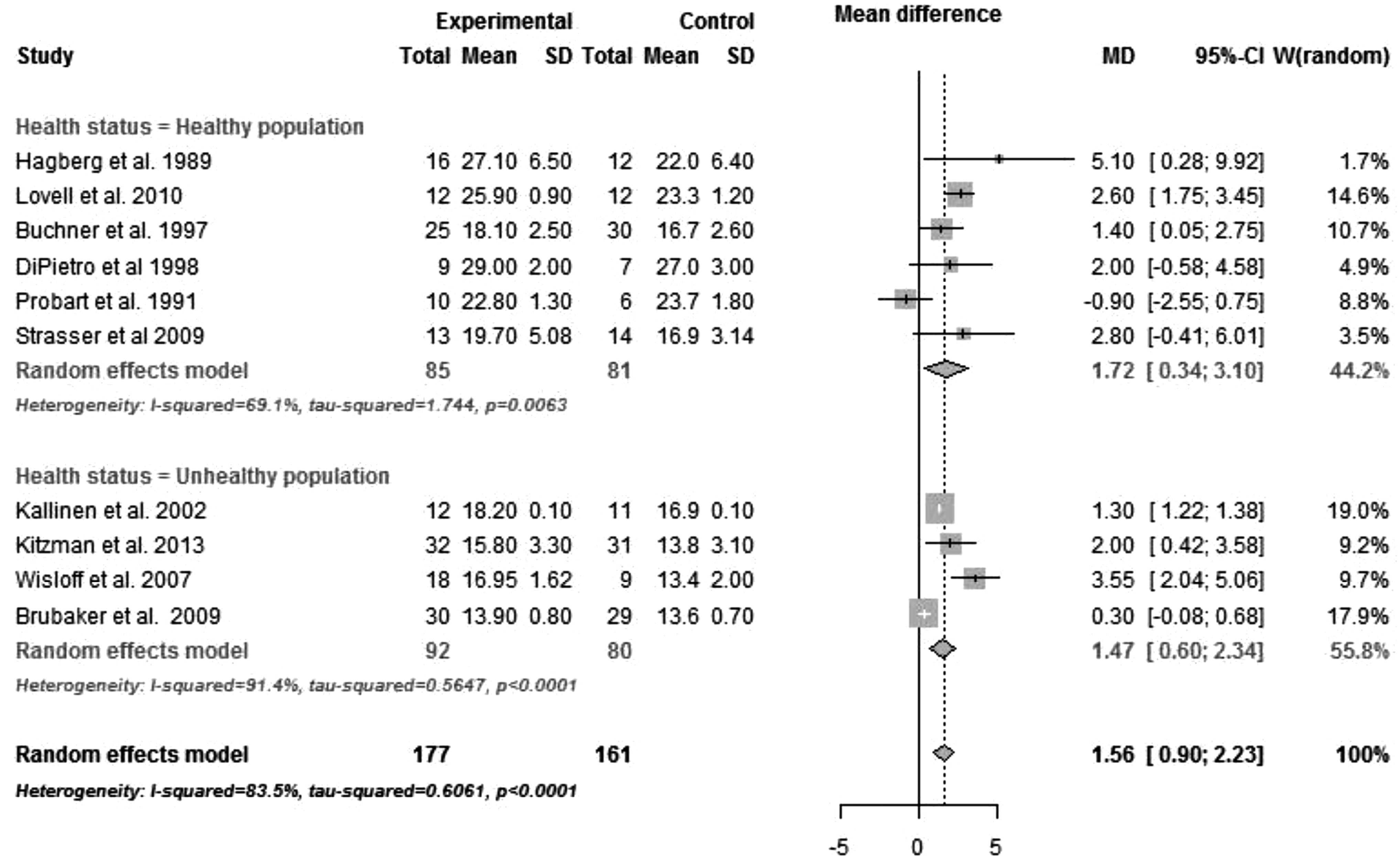
Forest plot presenting the impact of AT on posttraining VO2peak adjusted to the participants' health status (i.e., healthy and unhealthy) in experimental versus control groups. For each study, the small vertical line represents the MD between intervention and control group and the horizontal line represents the 95% CIs. The gray square represents the study weight (random effect model). The center of the gray diamond represents the pooled MD between intervention and control group, and the ends of the diamond represent the limits of CIs. CI, confidence interval; MD, mean difference.
Discussion
This systematic review and meta-analysis of RCTs has quantified the exact benefits of AT in terms of VO2peak value in healthy and unhealthy seniors. Among the heterogeneous population considered, a significant improvement in posttraining was measured (MD = 1.56; 95% CI: 0.90–2.23), which confirms that AT yields cardiorespiratory benefits in seniors as well and provides complementary arguments to the existing body of evidence. 1,42 In addition, we showed that the benefit was significant in healthy seniors (MD = 1.72; 95% CI: 0.34–3.10) and in individuals with chronic comorbid conditions (MD = 1.47; 95% CI: 0.60–2.34).
One previous meta-analysis that targeted adults aged 60 years or older has reported the same trend, but with a greater magnitude. 20 Participants were, however, much younger (participants aged 70 years or older were dramatically missing) and data were also collected from non-RCTs. Thus, by specifically targeting older adults, our main objective was to provide complementary arguments to extend the benefits of AT to the entire aging and aged population where muscle wasting, decline in muscle strength and power, and sedentary behavior are highly prevalent. 43 Adults aged 70 years or older spend ∼80% of awake times (8–12 h/day) in sedentary activities, which require low energy expenditure. 44,45 In addition, we showed that AT is also beneficial for aged adults with chronic comorbid conditions.
Across the 10 RCTs included in the present meta-analysis, AT protocols were very heterogeneous in terms of intensity, duration, and frequency. However, they were all designed to fit the current recommendations edited by the ACSM (i.e., exercise regimen of 150 and 75 min/week of moderate-intensity and vigorous-intensity AT respectively, or equivalent combinations). 9 While for some, this could be interpreted as a weakness, from our point of view, this is not so. Indeed, the benefits of physical activity did not result only from one specifically designed protocol (i.e., specific duration, at a predetermined intensity, or a specific activity), but rather reflected the combination of training intensity, duration and frequency of sessions during a week (i.e., volume of weekly physical activity). 1 None of the 10 RCTs has, however, specifically addressed the volume-outcome dose response, and moreover, the significant heterogeneity between all the RCTs has restricted our capacity to address the question of the minimal volume required to provide benefit for the considered outcome by meta-regression or subgroup analyses.
As evident in the aging and aged population, the combined decline in general function of cardiovascular and skeletal muscle reserves and in VO2peak contributes to an increased perception of effort required for a particular task compared to that required when younger. 8,9 In turn, when tasks are perceived as more difficult, the likelihood to avoid physical effort is increased and finally results in additional physiological decrements in functional reserve capacity and muscle wasting, and to further restriction of physical activity. 46,47 Thus, this constituted vicious cycle significantly alters the resting metabolism with an important reduction of the total energy expenditure. Consequently, the individual's ability to perform everyday activities becomes more and more restricted 15,48 and finally the frailty cycle is completed and self-maintained, 49 however, and even among older adults, not only maintaining but also initiating physical activity leads to better survival and enhancement in cardiorespiratory functions. 50,51 Specifically, AT induces central and peripheral adaptations that improve VO2peak and the ability of skeletal muscles to generate energy by the oxidative metabolism in mitochondria. These bio-physiological adaptations to exercise include enhancement in mitochondrial biogenesis, myoglobin content, capillary density, substrate stores, and oxidative enzyme activities, 52,53 as well as enhancement in maximal cardiac output. 54
In this meta-analysis, the level of evidence was good with 10 RCTs. While the global population was very heterogeneous by considering either healthy sedentary participants 34 –38,40 or patients with chronic health conditions (i.e., hypertension, heart failure, ischemic heart disease, type-2 diabetes mellitus, chronic respiratory disease, and musculoskeletal disorders), 32,33,39,41 9/10 RCTs were positive with respect to VO2peak. 32 –38,40,41 We have also adjusted our pooled analysis to the health status. This was essential because all the central (HR, stroke volume, cardiac output, and blood pressure) and peripheral (muscle fiber type and mitochondrial efficiency) changes associated with physiological aging are not necessarily the same as those induced by some chronic comorbid conditions such as cardiovascular disorders or type-2 diabetes. 14,55 The present meta-analysis confirmed a nearly similar extend in VO2peak improvement in both subgroups with a significant increase by 12.7% and 11.0% in healthy and unhealthy participants. This benefit should be, however, still interpreted with caution. First, because the unhealthy population was very heterogeneous with 3/4 of RCTs including patients with chronic heart failure 32,39,41 and 1/4 of RCTs 33 including patients with hypertension, heart failure, type-2 diabetes, respiratory disorders, or musculoskeletal disorders. Second, unhealthy participants were enrolled according to specific inclusion and noninclusion criteria. This means that the benefit of AT on cardiorespiratory fitness is limited only to unhealthy individuals meeting these criteria and is not yet generalizable to the entire unhealthy aged population. This finding is, however, in line with other reports of studies conducted in patients aged over 70 with coronary disease 56 –58 and chronic heart failure. 59,60
In addition, the total number of participants considered was relatively low, resulting in a moderate mean global effect. When for some, the magnitude of this gain in VO2peak could be interpreted as negligible, from our side, even small gains should be considered of high significance. Indeed, beyond the p-values, it is essential to interpret this result in the light of what gains in VO2peak represent one particular individual. In one study where 6213 men were referred for treadmill exercise testing (with, on average, 6.2 ± 3.7 years of follow-up), each 1-MET (metabolic equivalent of task) increase in exercise capacity conferred a 12% improvement in overall survival. 19 One MET is defined as the amount of O2 consumed while sitting at rest (i.e., measured as milliliters used in 1 min/kg of body weight). 61 On average, the increase in VO2peak across 9/10 positive RCTs was 13.5% and the absolute gain was 2.5 mL/(kg·min) (i.e., 0.73 METs increase). The greater gain was measured when subjects were trained at the intensity of ∼40%–85% of VO2peak. Consequently, in sedentary healthy and even unhealthy individuals (i.e., with some chronic health conditions), AT programs generate benefits in aerobic performance in as little intensity as 40% of their baseline VO2peak. The greater gain in VO2peak was measured after 16 weeks of AT globally and after 24–26 weeks in previously sedentary seniors, but after 12 weeks only in unhealthy seniors. These findings are of immediate practical interest for those who want to design AT protocols not only for efficiency reason but also for safety and cost-effectiveness point of views. In all cases, larger RCTs are necessary to further assess the effect of AT on VO2peak in older populations and also to enable stratified or/and sensitivity analyses according to gender, specific health conditions, and type of exercise intervention (e.g., volume intensity). A large-scale RCT, including 1567 older adults aged 70 or older (4 times the total number of this meta-analysis) randomized to high- and moderate-intensity semistructured activity, is, e.g., currently on going with a 5-year follow-up. 62
While, for this meta-analysis, six electronic databases have been considered for literature search and a wide range of discipline has been scrutinized, some limitations should be highlighted, in that it did not include unpublished data and studies not edited in English or thesis dissertation. In addition, two of the RCTs considered were not very recent 34,38 and thus were unable to consider new computerized techniques and methods that since were developed to improve the accuracy of online ventilation and O2 consumption measurements, and CO2 production during exercise. Out-dated technology and possibly less reliable methods for measuring VO2peak have affected the validity and reliability of the results of both studies. In addition, these studies, although perhaps classic, predate typical CONSORT criteria and the level of scrutiny for quality assessment (e.g., PEDro items) had to be limited (e.g., differential teams for assessment and training). According to the total number of RCTs considered in this meta-analysis, it was not reasonable to not consider these trials.
Finally, the direct measurement of VO2peak is considered the gold standard for evaluating aerobic capacity. However, the procedure is complex, expensive, time-costing, and need human resources such a medical supervision because of the risk associated with the maximal effort method. 63 May be in the future, some alternative methods will be developed to make possible, to some extent, the accurate assessment of exercise capacity in daily practice.
Conclusion
This pooled analysis confirms the beneficial impact of AT on VO2peak values in adults aged 70 years or older and, from that, the current recommendations for physical activity in this population. It was, however, not possible to determine the volume-outcome dose response from the existing literature. Nevertheless, evidence is now strong enough to encourage seniors to continue to be active or return to more active lifestyle and/or engage in AT programs, with no matter of age, to favor healthy aging.
Footnotes
Acknowledgment
We are grateful to Ms. Jacqueline Fétique for her editorial assistance.
Author Disclosure Statement
No competing financial interests exist.