




Abstract
Casein hydrolysate has been shown to improve arterial stiffness as estimated by brachial-ankle pulse wave velocity (baPWV) in untreated hypertensive patients. Facial pigmentation is associated with atherosclerosis, both of which are supposed to be modulated by tissue accumulation of advanced glycation end products (AGEs). However, effects of casein hydrolysate on facial pigmentation and AGEs remain largely unknown. This randomized double-blind placebo-controlled trial evaluated whether and how casein hydrolysate improves facial pigmentation in 80 nonhypertensive Japanese patients. Study participants were randomly assigned to receive either active tablets containing casein hydrolysate or placebo for 48 weeks. Facial pigmentation area, baPWV, and skin accumulation levels of AGEs were evaluated by Robo Skin Analyzer RSA50S II, volume–plethysmographic apparatus, and AGE Reader, respectively, at baseline and at the end of the intervention. Treatment with casein hydrolysate, but not placebo significantly reduced triglycerides and facial pigmentation area. There were significant differences of changes in triglycerides, facial pigmentation area, skin accumulation levels of AGEs, and baPWV between the two groups. Furthermore, changes in triglycerides and skin accumulation levels of AGEs were positively and independently associated with those in facial pigmentation area, whereas changes in baPWV were not. This study suggests that casein hydrolysate reduces facial pigmentation area in nonhypertensive participants partly by decreasing skin accumulation levels of AGEs.
Introduction
Although aging comes to everyone, perceived age of individuals based on the appearance of face is not necessarily correlated with chronological age, and is in fact a better predictor for mortality than chronological age. 1 –3 Some clinical studies have shown an association between perceived age and atherosclerotic cardiovascular disease. 4,5 Subjects who looked young for their chronological age had significantly lower intima-media thickness (IMT) of carotid arteries. 5 In addition, visible age-related signs were associated with future ischemic cardiovascular events in a Danish general population, which was totally independent of chronological age and traditional risk factors. 4 Furthermore, we have previously shown that among various parameters of skin aging, facial pigmentation was independently associated with carotid IMT in middle-aged to elderly Japanese women. 6
Nonenzymatic modification of amino groups of proteins, nucleic acid, and lipids by sugars, such as glucose has progressed during a physiological aging process and at an accelerated rate under hyperglycemic and inflammatory conditions to form senescent macromolecule derivatives, termed advanced glycation end products (AGEs). 7 –9 There is a growing body of evidence to show that AGEs play a crucial role in the pathogenesis of atherosclerosis. 7 –10 Modification by AGEs of extracellular matrix proteins and lipoproteins within the atherosclerotic lesions alter their structural integrity and physiological function, thereby leading to the increase in vascular stiffness and making the lipoproteins more atherogenic, respectively. 7,9,11 Recently, accumulation levels of AGEs in the skin can be noninvasively measured by evaluating skin autofluorescence (SAF) with AGE-READER. 7 SAF has been shown to be correlated with arterial stiffness assessed by brachial-ankle pulse wave velocity (baPWV) and IMT of the carotid arteries, two characteristic functional and morphological changes of atherosclerosis, respectively. 7 In addition, accumulation of AGEs in the skin is correlated with facial aging as well. 12,13
A newly recognized casein hydrolysate that contains milk-derived lactotripeptides Val-Pro-Pro (VPP) and Ile-Pro-Pro (IPP) has been reported to exhibit inhibitory activity against angiotensin-converting enzyme in vitro. 14,15 Furthermore, foods containing VPP and IPP could exert atheroprotective properties as well. Indeed, intake of VPP- and IPP-containing foods reduced PWV in association with the decrease in blood pressure in hypertensive and prehypertensive subjects. 14,15 However, although facial pigmentation, atherosclerosis, and accumulation of AGEs are correlated with each other, 6,7,12,13 effects of casein hydrolysate containing lactotripeptides on facial pigmentation and AGEs accumulation as well as their correlation remain largely unknown. This randomized double-blind placebo-controlled trial evaluated whether casein hydrolysate containing lactotripeptides improved facial pigmentation and reduced SAF, PWV, and IMT in 80 nonhypertensive Japanese patients, and further examined their correlation.
Materials and Methods
Study design
A total of 80 healthy volunteers aged between 45 and 87 years (mean, 71.7 ± 9.2 years) who underwent a complete medical skin checkup at Ehime University's Anti-Aging Center between May 2017 and March 2019 were included in this study. All participants underwent a medical examination, including fasting blood biochemistry, brachial blood pressure, central blood pressure, baPWV, IMT, SAF, and facial skin pigmentation area at baseline and at the end of the 48-week intervention. The study was approved by Institutional Review Board for clinical trial services at Ehime University Graduate School of Medicine (1704011). All participants provided written informed consent.
Blood pressure and blood biochemistry
Participants were seated and rested for 5 minutes in a quiet room, after which time blood pressure was measured over the brachial artery three times at 5-minute intervals using a HEM-9000AI (Omron Healthcare, Kyoto, Japan). The average of the last two measurements was recorded as representative of brachial blood pressure, in accordance with the ASCOT-CAFE study. 16 Central blood pressure was also measured by HEM-9000AI. Biochemical variables were measured as described previously. 5,6
Brachial-ankle pulse wave velocity
baPWV was measured with a volume–plethysmographic apparatus (PWV/ABI; Omron Healthcare) and calculated as the time interval between the wave fronts of the brachial and ankle wave forms (ΔTba) and the path length from the brachium to the ankle. Path lengths from the suprasternal notch to the brachium (Lb) and ankle (La) were obtained using the formulae Lb = 0.2195 × height +2.0734 and La = 0.8129 × height +12.328. baPWV was then obtained as (La−Lb)/ΔTba. 5
Intima-media thickness
To assess IMT, carotid arteries were examined by ultrasound using the 7.5-MHz probe of a Pro Sound α10 (Hitachi Aloka, Tokyo, Japan). Among the three layers on B mode echography of the far wall of common carotid artery, thickness of the two internal layers, which contain the hyper- and lower echoic layers, was designated as IMT. IMT was measured at three contiguous sites at 1-cm intervals proximal to the bulb from three directions each (anterior, lateral, and posterior) for the right and left sides. Results were averaged to obtain the mean IMTs for the right and left sides, which were in turn averaged again to obtain the mean overall IMT, which was used for analysis. 17 Coefficient variation of IMT for intra- and intermeasurements was 3.3% ± 1.6% and 5.8% ± 3.3%, respectively. 5
Facial skin pigmentation area
Facial skin pigmentation was analyzed using a Robo Skin Analyzer RSA50S II (MM&NIIC, Tokyo, Japan). This system consists of a facial imaging capture enclosure picturizing box with a scattered light source and a high-fidelity digital camera. Three digital images of each participants' face (from the front, right 60° oblique projection, and left 60° oblique projection) were analyzed using computer software for the area marked by pigmentation. Facial skin pigmentation was evaluated as the total area of pigmented areas >1.2 mm2. 6
Skin autofluorescence
Accumulation levels of AGEs in the skin were estimated using the AGE-Reader (Diagno Optics Technologies BV, Groningen, the Netherlands), a desktop device that can estimate skin accumulation levels of AGEs by measuring the characteristic fluorescence of AGEs. 7 All measurements were performed at the volar side of the forearm of participants between 10 and 15 cm below the elbow, as described previously. 18 Values were calculated by dividing the mean value of emitted light intensity per nanometer between 420 and 600 nm by the mean value of excitation light intensity per nanometer between 300 and 420 nm, expressed in arbitrary units. An earlier validation study showed an intraindividual Altman error percentage of 5.0% per day and 5.9% due to seasonal change. 19
Test products
The study was conducted under a randomized double-blind placebo-controlled design. The active products were tablets made from casein hydrolysate containing VPP and IPP, whereas placebo products were prepared with sodium caseinate instead of casein hydrolysate. Amount of VPP and IPP in the active products was measured by liquid chromatography–mass spectrometry by Asahi Holdings, Inc., (Tokyo, Japan). Active products were administered by single daily administration of three tablets, each containing 1.5 mg of VPP and 1.9 mg of IPP, taken in the morning after breakfast for 48 weeks (Table 1).
Nutrients of Active and Placebo Products
IPP, Ile-Pro-Pro; ND, not detected; VPP, Val-Pro-Pro.
Randomization
Randomization was performed by an external statistician (CPCC, Tokyo, Japan) using the dynamic allocation procedure with a computer-generated list. Randomization was initiated in May 2017 and completed in March 2018. Participants were instructed not to change their daily lifestyle, such as diet and physical activity throughout the test periods.
Statistical analysis
All continuous variables were expressed as mean ± standard deviation, unless otherwise indicated. Comparisons between the two groups were assessed using the Student's t-test. The Wilcoxon signed-rank test was used to analyze the differences in data between baseline and 48 weeks after the interventions. Correlations between variables were evaluated using Pearson's correlation coefficient. Simple regression and multivariate regression analyses were performed to determine the independent variables of percentage change in facial pigmentation area in the whole study population. In all comparisons, p < 0.05 was considered statistically significant. Analyses were performed using the SPSS software package for Windows version 17 (SPSS, Chicago, IL).
Results
Demographic data and subjects' adherence
A total of 80 participants were randomly assigned to active product group (36 subjects) or placebo product group (44 participants). At baseline, participants were well matched between the groups in terms of gender, age, and body mass index. All randomized participants completed the 48-week intervention without dropouts. Mean compliance with test products among all participants was about 99.0% (99.2% in the active group and 98.8% in the placebo group).
Changes in blood biochemistry, SAF, and facial pigmentation area
Table 2 shows changes in blood biochemistry, SAF, and facial pigmentation area. No significant differences of baseline biochemical variables, SAF, and facial pigmentation area were observed between the groups. In the casein hydrolysate containing lactotripeptides-treated group, estimated glomerular filtration rate, triglycerides, and facial pigmentation area were significantly reduced after 48 weeks of treatment, whereas estimated glomerular filtration rate was comparably decreased in the placebo group. Although other parameters were not affected by either treatment, there were significant differences of changes in triglycerides, SAF, and facial pigmentation area between the two groups.
Changes in Biochemical Variables, Skin Autofluorescence, and Facial Pigmentation During Treatment
Values are expressed as the mean ± SD.
p < 0.05 compared with baseline.
p < 0.05 compared with placebo group.
γ-GTP, γ-glutamyl transpeptidase; ALT, alanine aminotransferase; AST, aspartate aminotransferase; AU, arbitrary unit; BMI; sCr, serum creatinine; BUN, blood urea nitrogen; eGFR, estimated glomerular filtration rate [mL/(min ·1.73 m2)]; Hb, hemoglobin; HbA1c, glycated hemoglobin; HDL-C, high-density lipoprotein cholesterol; LTP, lactoteripeptides; LDL-C, low-density lipoprotein cholesterol; n, number; SAF, skin autofluorescence; SD, standard deviation; TG, triglycerides.
Changes in hemodynamic variables and atherosclerosis parameters
Changes in hemodynamic and atherosclerosis-related variables after 48-week interventions are shown in Table 3. All the parameters were not significantly affected by casein hydrolysate containing lactotripeptides or placebo. Furthermore, there were no significant differences of changes in these parameters except for baPWV between the two groups; treatment with casein hydrolysate containing lactotripeptides for 48 weeks decreased baPWV, whereas baPWV was increased in the placebo group.
Changes in Blood Pressure, Pulse Rate, and Brachial-Ankle Pulse Wave Velocity During Treatment
Values are expressed as the mean ± SD.
p < 0.01 compared with placebo group.
baPWV, brachial-ankle pulse wave velocity; CSBP, central systolic blood pressure; DBP, diastolic blood pressure; IMT, intima-media thickness; LTP, lactotripeptides; SBP, systolic blood pressure; PR, pulse rate.
Relationship between changes in facial pigmentation area and those in baPWV and SAF
Although there was no significant correlation between changes in facial pigmentation area and those in baPWV (Fig. 1), a positive and significant correlation was observed between changes in facial pigmentation and those in SAF (Fig. 2).

Relationship between changes in facial pigmentation and those in PWV. PWV, pulse wave velocity.
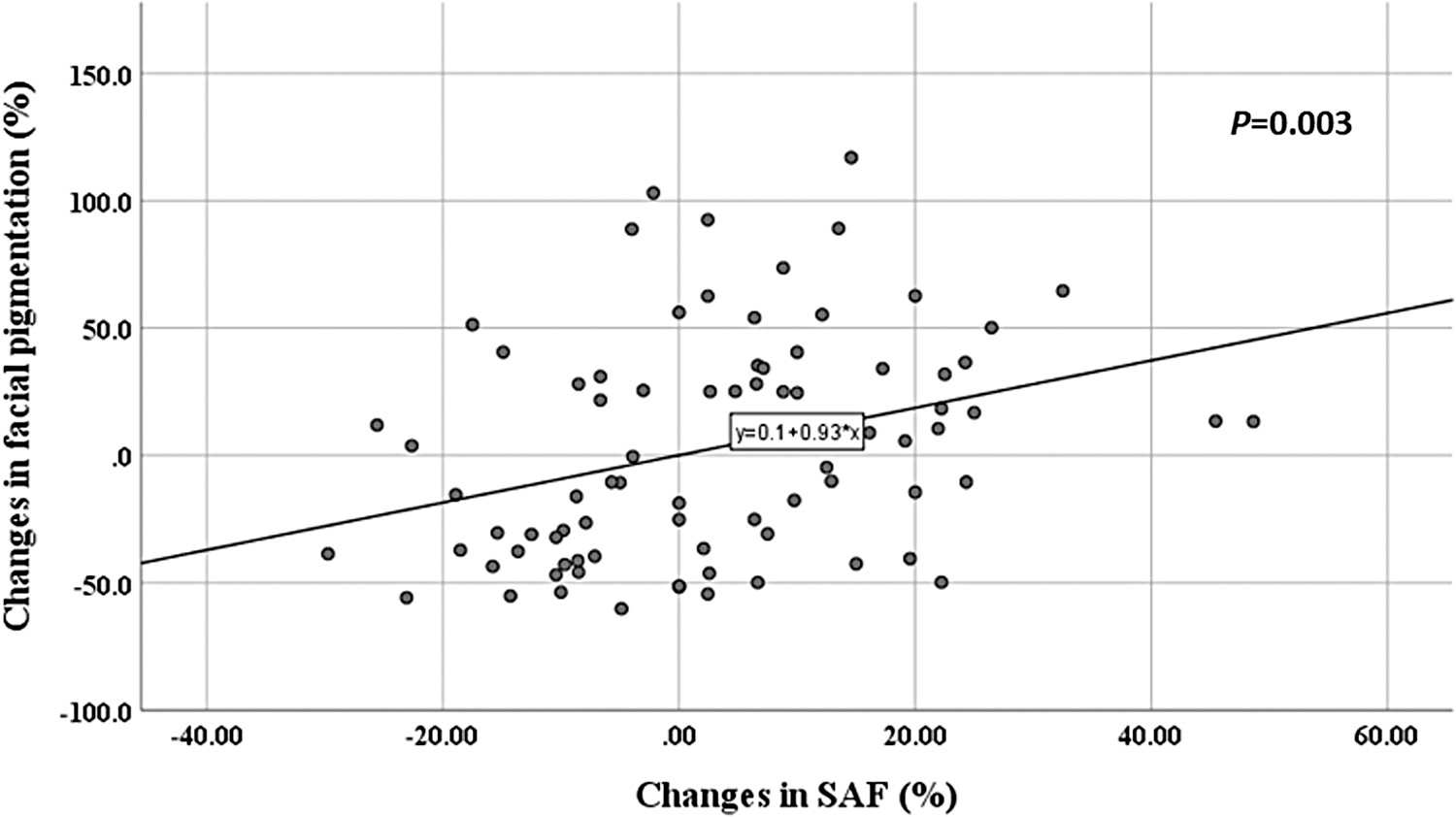
Relationship between changes in facial pigmentation and those in SAF. SAF, skin autofluorescence.
Univariate and multiple stepwise regression analyses for changes in facial pigmentation area
Changes in triglycerides and SAF were positively and independently associated with those in facial pigmentation area (Table 4).
Univariate and Multiple Regression Analyses of Changes in Facial Pigmentation Area
eGFR, estimated glomerular filtration rate [mL/(min ·1.73 m2)].
p-Values represent the results of simple regression and multiple regression analyses.
BMI, body mass index.
Discussion
In this study, we found for the first time that (1) treatment casein hydrolysate containing milk-derived peptides VPP and IPP for 48 weeks significantly reduced facial pigmentation area and triglycerides in healthy volunteers; (2) there were significant differences in changes in facial pigmentation area, triglycerides, and SAF between the active drug and placebo group; and (3) changes in triglycerides and SAF after 48-week interventions were positively and independently correlated with those in facial pigmentation area.
Effects of VPP and IPP on arterial stiffness and IMT
Nakamura et al. demonstrated that intake of VPP and IPP reduced blood pressure, followed by an improvement in arterial stiffness evaluated by PWV in their 8-week intervention study with prehypertensive and hypertensive subjects. 20 The finding suggests the blood pressure-lowering independent-atheroprotective properties of lactotripeptides, VPP and IPP. In this study, although changes in brachial systolic and diastolic blood pressure and central blood pressure from baseline were almost identical between the two groups, there was a significant difference of changes in baPWV, a marker of arterial stiffness and predictor of future cardiovascular disease 7 ; baPWV was modestly decreased by the treatment with casein hydrolysate containing lactotripeptides, whereas it was increased in the placebo group. The reason why casein hydrolysate containing milk-derived peptides, VPP and IPP did not affect blood pressure parameters in this study was unknown. However, the difference of subject population between theirs 20 and ours (hypertensive and prehypertensive subjects versus normotensive healthy subjects) may explain the discrepant result. Therefore, although blood pressure-lowering effects of VPP and IPP could be attenuated in normotensive healthy subjects, their antiatheroprotective property, as evidenced by reduction of baPWV may be spared in these individuals. Furthermore, in this study, no significant difference of changes in IMT was observed between the two groups. These observations suggest that long-term intervention with casein hydrolysate containing VPP and IPP may have induced a functional improvement rather than structural change of artery in normotensive healthy volunteers. Anyway, to our knowledge, this is the first study to demonstrate that effects of casein hydrolysate containing lactotripeptides, VPP, and IPP on IMT and baPWV may differ in normotensive individuals.
Effects of VPP and IPP on facial pigmentation area
We have previously shown that area of facial pigmentation was independently associated with baPWV in middle-aged to elderly nonhypertensive Japanese subjects. 6 In this study, although there was no significant difference in facial pigmentation area at baseline between the active treatment and placebo groups, treatment with casein hydrolysate containing lactotripeptides, but not placebo for 48 weeks significantly reduced the area of facial pigmentation. Nevertheless, we found that there was no significant correlation between changes in baPWV and those in facial pigmentation area. These findings suggest that association of facial pigmentation, a commonly used marker to estimate perceived age 6 with arterial stiffness may differ in hypertensive versus normotensive individuals, which may depend on subjects' clinical characteristics.
Correlations between changes in facial pigmentation area and SAF and triglycerides
In this study, we found that although treatment with casein hydrolysate containing lactotripeptides or placebo did not significantly affect SAF, there was a significant difference of changes in SAF between the two groups. Furthermore, changes in SAF after the interventions were positively correlated with those in the area of facial pigmentation, which was totally independent of HbA1c, a marker of relatively short-term hyperglycemia. There is accumulating evidence to show that accumulation of AGEs in the skin is associated with facial aging and perceived age. 12,13 Moreover, we, along with others, have shown that AGEs in the skin could promote melanogenesis. 21,22 In addition, AGEs have been correlated with yellowish discoloration of the facial skin in healthy middle-aged women. 23 These findings suggest that casein hydrolysate containing VPP and IPP may reduce the area of facial pigmentation partly through reduction of AGEs in the skin. Since changes in baPWV were not associated with those in SAF, effects of VPP and IPP on AGEs may differ in the skin and artery. In other words, AGEs-related facial skin pigmentation may be more sensitive to lactotripeptides than arterial stiffness in normotensive healthy volunteers. In this study, casein hydrolysate containing lactotripeptides significantly reduced triglycerides, and changes in triglycerides were also positively and independently associated with those in facial pigmentation area. The result was consistent with our previous observation showing that triglycerides were correlated with facial pigmentation area. 5,6 Although the underlying mechanisms remain unknown, triglycerides-lowering effects of VPP and IPP may reduce the area of facial pigmentation in our subjects.
Limitations
Several limitations of the study warrant to be mentioned. First, sample size of this study was small and, therefore, confirmation of our findings in a large cohort study is needed. Second, our participants were fitness conscious, and no heavy smokers or heavy alcohol drinkers were included in this study. The present findings may not be generalized to other populations. Casein hydrolysate containing milk-derived peptides VPP and IPP might have a greater effect in preventing the AGEs-related facial pigmentation when combined with lifestyle interventions.
Conclusions
We found in this study for the first time that a 48-week intervention with casein hydrolysate containing milk-derived peptides VPP and IPP significantly reduced facial pigmentation area in normotensive healthy subjects, which changes were independently associated with skin AGEs levels evaluated by SAF. Intake of casein hydrolysate containing VPP and IPP may exert beneficial esthetic effects on humans.
Footnotes
Acknowledgment
We are grateful to Asahi Holdings, Inc., for generously providing us with casein hydrolysate containing milk-derived peptides.
Authors' Contributions
Conceptualization, software, validation, resources, writing—original draft preparation, visualization, and funding acquisition were by M.I.; methodology was by S.M.; formal analysis by K.I.; investigation by M.O.; data curation and writing—review and editing by Y.O.; supervision by S.Y.; project administration was by K.S.
Author Disclosure Statement
No competing financial interests exist.
Funding Information
This study was supported by a Grant-in-Aid for Scientific Research from the Ministry of Education, Culture, Sports, Science and Technology of Japan (18K10105), and financially supported in part by Nitta Gelatin, Inc., Osaka, Japan.