




Abstract
Beneficial genetic or environmental factors that influence the length and quality of life can be evaluated while studying supercentenarians. The oldest-old can withstand serious/fatal illnesses more than their peers and/or their aging rate is decreased. Supercentenarians are an interesting group of individuals whose lifestyle is not particularly healthy according to the common guidelines, namely some of them seem to have similar harmful behaviors, but still manage to stay healthier for longer, and while eventually dying from the same degenerative diseases as the general population, they develop symptoms 20–30 years later. As there are not many supercentenarians by definition, it is worthwhile to diligently collect their data to enable future meta-analyses on larger samples; much can be learned from supercentenarians' habits and lifestyle choices about the aging process. Contributions of genetics, lifestyle choices, and epigenetics to their extended life span are discussed here.
Introduction
Although there are many theories on aging, the primary cause of aging continues to be an enigma for biologists. Supercentenarians are people who have attained at least 110 years of age 1 and are good subjects for studying ways to age healthily, given that they have not succumbed to or have a delayed incidence of chronic diseases such as cardiovascular issues, diabetes, cancer, hypertension, and so on. 2 The age at which 20% of centenarians from one study experienced that the arrival of degenerative diseases was delayed by 18–24 years relative to the control group. 3 It seems that genetics is not the primary cause for longevity since a study on twins 4 revealed that just 25% of twins' longevity was due to genes, while 75% was attributed to lifestyle and environmental factors. In addition, while looking at genetic reasons explaining extraordinary human longevity, Gierman et al., were unable to detect any significant proof of the addition of any rare variant-altering protein or a gene encoding rare protein-modifying variants in the genomes of supercentenarians compared to controls. 5 It is often claimed that longevity depends on the three major factors: genetics, lifestyle choices, and epigenetics, as will be discussed later. How lifestyle factors interact with our genes determines epigenetic pathways, which appear to have a valuable, yet, often overlooked role in delaying the occurrence of chronic diseases related to aging.
Genetic Contribution to the Aging Process
It is still unknown how genetic differences explain departures from the typical aging process and the role played by genes in lowering vulnerability to diseases associated with age. As mentioned, it was estimated in the twin studies that a mere 20%–30% of human lifespan variation is attributable to genetics 6 and around 75% of the span of life is determined by the environment and epigenetics. In contrast, Gubbi et al. 7 investigated the children of parents with great longevity and underscored genetics' possible role in longevity, observing a reduced likelihood of cardiovascular disease, stroke, and hypertension among subjects who had a minimum of one parent still alive beyond the age of 95, compared to the subjects with parents who had died before reaching 95 years of age, independently of a lifestyle.
Multiple genetic variants in the forkhead box O3A (Foxo3a) gene, a transcriptional factor homologous to daf-16, are linked in various studies with extreme longevity. 8 FOXO3A influences various signaling pathways, including an evolutionarily conserved and important key gene in the insulin-IGF1 signaling pathway that affects longevity in different model organisms, including worms, flies, and mice 9 as well as male centenarians. 9,10 FOXO3 gene variants (e.g., the C instead of the T variant at position rs2764264) have been found in people with longer and heathier lifespans. 11,12
Dwarf mice, which have reduced levels of IGF-1 due to a deficiency in the growth hormone receptor (GHR−/−), notwithstanding obesity, were observed as being sensitive to insulin and having lower chances of developing diabetes and cancer. 13 –15 The human IGF-1 receptor gene polymorphisms are partly responsible for raising vulnerability to human longevity, 16 while a low level of insulin-like growth factor-1 (IGF-1) foretells humans with extraordinary longevity. 17 In females, whose families tend to live past 100 years, mutations in IGF-1 and the IGF-1 receptor were found. 18 Besides, numerous animal, preclinical as well as epidemiological, studies show the system of insulin/IGF-1 is vital for the onset of various forms of cancer, 19,20 obesity, and type 2 diabetes. 21
Centenarians have also greater sensitivity to insulin and reduced adipose tissue mass. Apolipoprotein E (ApoE), which is valuable for regulating lipoproteins, is associated with humans living longer in several populations, 22,23 and it is a candidate to influence exceptional longevity according to meta-analysis data and a methodical review. 24,25 The ApoE gene and especially the ApoE4 allele that tracks with higher lipoprotein values 26 are linked with age-related illnesses such as vascular dementia, 27 –29 Alzheimer's, and cardiovascular risk. 30,31 In Japan, mitochondrial DNA haplogroup D4a was shown to be an indicator of extraordinary longevity. 32 SIRT6 was also shown to be a longevity gene in genome-wide association studies (GWAS) as well as in laboratory animals. 33 In particular, the declines in FoxO3a/SIRT6 activity with aging adjust low-density lipoprotein (LDL)-cholesterol homeostasis by controlling the gene expression proprotein convertase subtilisin/kexin type 9 (Pcsk9) and thereby help to lower the risk of developing heart disease. 34 SIRT6 recruits FoxO3a to the promoter of the PCSK9 gene, however, SIRT6 activity declines with age due to decreased NAD+ levels in the cell, leading to greater PCSK9 gene expression. 34 PCSK9 protein levels circulating in the plasma increase with aging in both rodents and humans. 34,35 Elevated levels of sirtuin 1 irrespective of age were detected in supercentenarians' hippocampus. 36
In addition, elevated PARP (Poly ADP ribose polymerase) 37 gene expression was observed in long-living people 38 and was 1.6-times higher among those who had reached 100 years of age. 39 The PARP enzyme detects and signals DNA strand breaks, 40 thus playing an important role in the efficiency and integrity of DNA repair. In 13 mammalian species, PARP activity was shown to be correlated with spans of life that are species-specific. 41 Both sirtuins and PARPs are important for longevity and can only exert their beneficial function when adequate levels of NAD+ exist. 42,43 Yet, PARPs directly compete with sirtuins for the NAD+ bioavailability 44,45 and NAD+ depletion was found to increase oxidative stress and inflammation and can be restored by lifestyle choices like calorie restriction and exercise. 46
Moreover, the human angiotensin II type 1 receptor (AT1R) gene is reported to be a possible candidate among longevity-enabling genes. 47
Further, the genetic features of very low occurrence of APOE-ɛ4 alleles and telomere maintenance are revealed in (semi)-supercentenarians. 48 Besides, it was found that inflammation, rather than the length of telomere, foretells success in the continuing development of semisupercentenarians. 49
Over 200 other gene variants are associated with longevity according to Roger (2010), as shown in the research database of human genetic variants from England and Wales. 50
Lifestyle and the Aging Process – the Roles of Eating Habits and Exercise on Longevity Pathways
An important question arises of whether centenarians intuitively rely on approaches that interfere with pathways shown to extend the lifespan, for example, abiding by a lifestyle that influences target of rapamycin in mammals (mTOR) and GH/IGF-I signaling, sirtuins, and AMPK (AMP-activated protein kinase). There are at least three main pathways by which insulin/IGF-1, TSC/mTOR, and sirtuins 51,52 affect mammals' lifespan and avert a wide range of age-related diseases such as type 2 diabetes cardiovascular disease, cancer, and osteoporosis. 53,54 These pathways act to regulate responses to the environment in terms of cellular stress and adversity, such as adversity in cellular energy, DNA damage and hypoxia. Appropriate lifestyle factors, including various recipes for exercise, body mass index, diet, drinking and smoking habits, and so on are responsible for as much as 10 years of an individual's expected life 55 and can decrease mTOR and GH/IGF-I signaling and activate sirtuins and AMPK. Longevity pathways can be modified to extend life/healthspan by, for example, limiting calorie intake, periodic fasting, and fasting on alternate days. 56 –58 Pathways mediating the benefits of limited calorie intake include sirtuins, the mammalian rapamycin target, insulin/insulin growth factor-1, and AMPK. With respect to most of the tested biological models, today, limited calorie intake continues to be the strategy supported by the greatest evidence for ensuring a prolonged lifespan and health. 59
However, the “Westernised” lifestyle made up of sedentariness and hypercaloric nutrition might accelerate aging processes by disrupting metabolic fitness. 60 For example, while eating, the insulin-pAKT-mTOR pathway is triggered and then initiates gene activities, which stimulate anabolic processes downstream. Still, fasting for several hours initiates AMPK that is responsible for catabolic and repair activities, promotes multisystem regeneration, as well as inhibits the mTOR activity. 61 –63 The mTOR is one of the main controllers of the proliferation and growth of cells. Several signals such as growth factors, amino acids, and cellular energy regulate both mTORC1 and various essential cellular processes such as autophagy, transcription, and translation. 63 To promote longevity, the mTOR pathway should be deactivated by eating less protein and decreasing glucose levels. Glucose-induced insulin signaling deactivates the Insulin/IR/IRS-1/PIP3K/Akt pathway, which, when activated, prevents Foxo3a from migrating into the cell nucleus and stimulating the SIRT1 gene. 64 Many centenarians in Bama County in southern China spend their lives skipping the morning meal, thereby spending 16 hours or more each day without eating, 65 noting that 16 hours fasting increases autophagy by mTOR inhibition and reduces atherosclerosis and cancer. 66,67 Besides diet, exercise also reduces insulin levels, thus influencing the insulin/IGF-1 signaling pathway and reducing PCSK9 levels by as much as 58% compared to the fed conditions. 68
Sleeping Habits and Aging
Older people have an increased prevalence of sleep disorders, predisposing individuals to chronic diseases such as depression, diabetes, and obesity, all shown to be significantly associated with morbidity and mortality. 69,70 Moreover, the elderly have a phase advance, leading to a tendency to go to sleep and wake up at earlier times. 71 On the contrary, sleep quality and survival are reported to be positively associated with aging in centenarians, revealing that healthy sleep habits are important for living longer. 72 It was observed that the oldest old were strict in ensuring a steady pattern of sleeping and waking up. 73
Recently, sleep and sleep deprivation were shown to be impacted by several age-associated issues such as cellular senescence, greater oxidative stress, mitochondrial decline, and inflammation. 74 –78 Those who slept for ≥8 hours were shown to have insulin resistance 79 coupled with reduced levels of high-density lipoprotein cholesterol, whereas too little sleep was linked with obesity, impaired glucose tolerance, and insulin resistance, 80 along with many cardiometabolic diseases. 81 –84
Regular Physical Activity and Sports in Moderation
Premature death can be avoided by engaging in regular physical activity. 85 Supercentenarians mostly do not perform professional sport activities, but move constantly, for example, cycling, walking, gardening, or hiking. A study of 130,000 people 86 found the risk of death was lowered by 28% among those engaging in the recommended 0.5 hour of physical activity per day (2.5 hours per week). People who engaged in physical activity saw a 14% lower risk of all-cause mortality and enjoyed an additional 3 years of life. 87 Regular exercise increases telomere length, as observed by Tucker. 88 A biological age advantage of 9 years was detected among those with high activity compared to their more sedentary counterparts. Running every day for as little as 5–10 minutes (including at a slow pace) markedly lowers the chance of dying from all causes by 45% and from cardiovascular disease by 40%. 89 While sedentary aging is related to both nitric oxide (NO) impairment and endothelial dysfunction, physical exercise increases microvascular distensibility and the availability of nitric oxide, including in the elderly population. 90,91
At the cellular level, constant movement regulates electron flow in mitochondria, thereby reducing reactive oxygen species (ROS) formation. Physical activity consumes ATP and thus influences the more rapid and more effective transport of electrons and smaller production of ROS (reviewed in 92 ). Moreover, limited calorie intake triggers a metabolic change seen in the more effective transport of electrons along the mitochondrial respiratory chain, 93 bringing a 45% lower level of mitochondrial H2O2 generation and a 30% drop in oxidative harm to mtDNA in the heart of rats, 94 together with a 28% lower level of mitochondrial ROS generation and a 30% drop in oxidative harm to mtDNA in the skeletal muscle of rats. 95
Social Relations, a Sense of Purpose, and Integration into the Community as Predictors of Longevity
Social networks, the daily amount of social interactions, being included in family networks and supportive relationships contribute considerably to good quality aging. 96,97 Data from two epidemiological cohorts, including men and women, with a follow-up of 30 years revealed that the subjects' optimism was associated with exceptional longevity. 98 A meta-analytic review of 148 studies (308,849 participants) showed that persons with stronger social relationships, especially those who are well socially integrated, have a 50% higher likelihood of surviving longer. 99 The cross-sectional study of Kato et al. 100 draws attention to the valuable roles of positive emotions, attitudes, and self-rated health in their mental health outcomes of the oldest-old. Besides in Ashkenazi Jewish centenarians, 100,101 similar outcomes were also reported in Brazilian elderly 102 and in centenarians in the Hainan province. 103
Low neuroticism, high extraversion, conscientiousness, and optimism may contribute to successful aging according to a study looking at personality phenotypes of centenarians. 104 Among the oldest-old, having a sense of meaning in one's life was associated with viewing oneself as still having a mission to complete with finding happiness, joy, and beauty along the way. 105
Cold and Heat Shocks
High and low temperatures function as hormesis agents 106,107 and produce the upregulation of metallothioneins, heat shock proteins (HSPs), and antioxidant defence proteins. Extended longevity of animals overexpressing certain HSPs in the mitochondria was observed. 108,109 Further, peroxisome proliferator-activated receptor-γ coactivator (PGC)-1α is upregulated by moderate cold stress and limited calorie intake. Moderate cold stress also induces nonshivering thermogenesis, activates the growth of brown adipose tissue, and adds to the creation of mitochondrial heat in skeletal muscle cells. 110 –113
Food Shown to Affect the Aging Process
A plant-based diet is rich in polyphenols and other antioxidants, naturally low in cholesterol and delivers a hearty dose of fiber, phytochemicals, and other nutrients important for good health. Individuals regularly eating such food incur a smaller risk of developing heart issues, neurological diseases, 114 and cancer. 115 Increased oxidative stress accelerates the process of aging while increasing the likelihood of many chronic diseases. As reported by Belenguer-Varea (2019), compared to controls, 116 long-living persons appear to have reduced oxidative damage, especially lower plasma lipid peroxidation biomarkers, and higher levels of vitamins A and E. Also in a study by Mecocci et al., 117 healthy centenarians had the highest levels of vitamins A and E (from ingested food) compared to younger control groups.
Data from the Chinese Longitudinal Healthy Longevity Survey were analyzed to show a link between the oldest-old's (≥80 years) lifestyle factors, food habits, and all-cause mortality that revealed that the daily intake of fruit and vegetables was inversely linked with mortality. Eating vegetable versus red meat reduces the risk for cardiovascular diseases and cancer 118 due to less intake of amino acids (e.g., methionine, arginine, and BCA) which activate mTOR. Greater consumption of fruit, vegetables, and legumes is also linked with a reduced risk of noncardiovascular and total mortality upon three to four daily portions (around 375–500 g/day). 119 On the contrary, high consumption of carbohydrates is related with a greater risk of total mortality, although total fat and individual fat types were associated with reduced total mortality, except for saturated fat, which has an inverse association with stroke. 120 While full-fat dairy products supply saturated fats and are assumed to have a detrimental impact on blood lipids and exacerbate mortality and cardiovascular disease, the relationship between total dairy and certain dairy product types with serious cardiovascular disease and mortality revealed that consuming greater amounts of total dairy was linked with reduced chances of mortality and serious cardiovascular disease incidents in a varied multinational cohort, especially a higher intake of milk and yogurt. 121
Other nutrients are reported to influence the aging process. For example, frequent consumption of nuts can add 1.5–2.5 years and reduces the risk of cardiovascular disease. 55,122 Protein royalactin, the active ingredient in royal jelly and found in honeybees, causes the cells to remain pluripotent. 123 Consumption of 70%-cacao dark chocolate upregulates several pathways of intracellular signaling that are part of the activation of T cells, the immune response, and the genes used in sensory perception and neural signaling. Flavanols in dark chocolate have antioxidant, blood vessel-relaxing, and anti-inflammatory properties. 124 Moreover, the tea drinking was linked with a reduced mortality risk among the oldest-old Chinese. 125 Also coffee consumption is associated with lower risk of death and to epigenetic modifications. 126 –128
Cardiovascular events may be predicted by higher VLDL-cholesterol, total cholesterol, and triglycerides, and reduced HDL-cholesterol levels, 129 which indicate a drop in lipid metabolism control and increased mortality that are often seen in the elderly. 130
Epigenetics and Aging
Environment and behaviors, such as diet and exercise, as well as disease states, can lead to epigenetic changes that also influence the aging process. Unlike genetic changes, epigenetic changes (chemical modifications of DNA and associated proteins) are reversible and do not alter the DNA sequence, but they do affect gene expression to turn genes on and off. Types of epigenetic modifications include DNA methylation (addition or removal of a methyl group), histone modification (modified by substances such as acetyl groups), and noncoding RNA (ncRNA)-associated gene silencing. 131 Both environment and individual lifestyle can influence epigenetic changes that affect an individual's health status and even later generations, as observed with lower DNA methylation of the insulin-like growth factor II (IGF2) gene due to maternal exposure to famine during early pregnancy, resulting in increased rates of coronary heart disease and obesity in offspring. 132 Dietary habits can influence epigenetics as well. For example, B vitamins have been observed to protect against deleterious epigenetic effects of particulate air pollution, 133 and treatment with a ketogenic (high-fat, low-carbohydrate) diet has been shown to increase levels of beta-hydroxybutyrate, an endogenous histone deacetylases inhibitor, leading to rescue of hippocampal memory defects in a mouse model of Kabuki syndrome. 134 Some epigenetic tags may be added or removed in response to changes in behavior or environment. For example, smoking-associated DNA methylation tags are a consequence of prolonged exposure to cigarette smoke and can be reversed after quitting. 135
The level of DNA methylation decreases with age, and DNA methylation patterns appear to be gene-, tissue-, and organ-specific. 136 DNA methylation in the brain during aging results in global hypomethylation 137,138 and site-specific hypermethylation predominantly in promoter regions. 139 Newborns have the highest DNA methylation, 103-year-olds have the lowest DNA methylation, and 26-year-olds have a DNA methylation level between the newborn and the 103-year-old. 140
Epigenetic or DNA methylation age is used as an accurate biomarker of aging (“epigenetic clock”) and to predict lifespan, providing accurate age estimates for each tissue across the lifespan. 141,142 Various models of the “epigenetic clocks” have been developed that predict chronological age from DNA methylation with high accuracy 143 and have been used in several studies. For example, in a German case cohort of 1863 elderly, age acceleration in the form of the difference between age predicted by DNA methylation and chronological age was an independent predictor of all-cause mortality and cause-specific mortality, such as cancer and cardiovascular incidence. 144 Similarly, in the Sydney Centenarian Study, long-lived individuals showed a young epigenetic age compared to their chronological age using the two epigenetic clocks of Hannum and Horvath. 145 Studies using “epigenetic clocks” have shown that epigenetic age acceleration (i.e., the difference between age predicted by DNA methylation and chronological age) is significantly associated with increased mortality risk for a variety of reasons (reviewed in 144 ).
While the genome cannot be malleable, the epigenome is more plastic and can be influenced by environmental and life-style factors to establish a “healthy” transcriptome. 136 How epigenetics relates to the genetic and environmental elements of the aging process and how epigenetic changes may contribute to longevity is discussed further in the conclusion section.
Supercentenarians' Lifestyle Choices
Method
Data on supercentenarians' lifestyle were sought from Internet search data for 100 supercentenarians with special attention on what they attributed to having achieved a long life. The obtained lifestyle claims were categorized into four segments: alcohol and tobacco assessment, that is, regular alcohol consumption, smoking as well as abstinence from alcohol and/or smoking. The second segment assessed sleeping and stress control, noting sleeping quality, daily activity, exposure to stressors such as cold and heat, and stress management. The third segment analyzed the variety and choice of diet, while the fourth segment examined the amount of food eaten, preferences for (intermittent) fasting, calorie restriction, and vegetarianism. The data are summarized in four charts, with the reported lifestyle data on the x-axis and the individual's age on the y-axis; each symbol represents information of a single person.
Results
Since 100 supercentenarians were evaluated, the numerical values are simultaneously expressed as a percentage (Fig. 1). Eight supercentenarians drank wine (6 specified to drink red wine). The same number reported drinking beer, 9 drank whiskey, and 11 other alcohol beverages on a daily basis. Nine of them claimed to smoke regularly. Three attributed their longevity to never drinking and 22 to abstinence from smoking and alcohol for their entire life. Rajpathak et al. 146 analyzed the drinking and smoking habits of people with exceptional longevity (aged 95 or older) and observed that alcohol was consumed daily by around 24% of males in the older group in contrast to those in the other group at 22%. Nearly 30% of the women with exceptionally long lives were smokers, a little higher than the women in the comparison population who smoked (26%). Among the older men, around 60% smoked, while 74% of those with shorter lives did so. Among the here included supercentenarians, 28% drank alcohol every day and 9% were smokers.

Supercentenarians' attribution to their longevity: Alcohol and tobacco consumption.
Regarding sleeping and stress assessment, four supercentenarians claimed to be “early birds,” 11 attributed their longevity to good, quality sleep, 12 attributed their longevity to being active, exercising regularly at moderate intensity, and 12 to working hard for their entire life (Fig. 2). Just 2 practised cold shocks and 1 hot shock. Stress management as an important contributor to longevity was reported by 20 supercentenarians and, within this, relaxing/stress avoidance and a sense of humor are claimed by 6, happiness and positive thinking by 8, and faith in God by 3 supercentenarians.

Supercentenarians' attribution to their longevity: Lifestyle choices.
Results of Rajpathak et al., study among Ashkenazi Jewish individuals with exceptional longevity, revealed that a mere 19% of those who were older than 95 years believed a “positive attitude” was part of their longevity, whereas only 6% pointed to their spirituality or religious convictions. 146 The same study found that centenarians exercised less, just 43% of the male centenarians indicated that they regularly exercised at mild intensity in contrast with men in the other group (57%). In the group of supercentenarians, only 12 interpret as the reason for their longevity being active or performing regular physical activity and, similarly to the Ashkenazi Jewish, 20% felt stress management was an important reason for their longevity.
When assessing the type of food eaten, it was observed that only 3 supercentenarians claimed that they drank a lot of water and 3 of them reported drinking tea every day (Fig. 3). Coffee drinking was reported by 12, milk use by 13, and fruit juice consumption by 2 individuals. Interestingly, 13 of the supercentenarians preferred to eat regularly chocolate, and 12 supercentenarians ate eggs on a daily basis, with 3 individuals claiming to eat them raw. Bread was eaten by 5 supercentenarians and chicken by 6 individuals routinely. Surprisingly, just 2 reported following a Mediterranean diet, 1 eating sushi, 1 salmon and 17 eating vegetables and 2 fruit regularly. Avoiding fatty food was reported by 1 individual and a preference for fatty food by 3. Only 2 avoided eating sugar, while 14 declared they enjoyed eating sweets routinely.

Supercentenarians' attribution to their longevity: Dietary habits.
As long as the food contains all essential nutrients, the individual food choices seem less relevant than the timing and how much to eat to trigger the metabolic processes and pathways discussed earlier that benefit the aging process (Fig. 4). The eating habits were perceived by 18 supercentenarians to have contributed to their longevity. Ten individuals were eating only small portions of food, 4 performed intermittent fasting, just 3 claimed to be vegetarians, and one person was on calorie restriction.
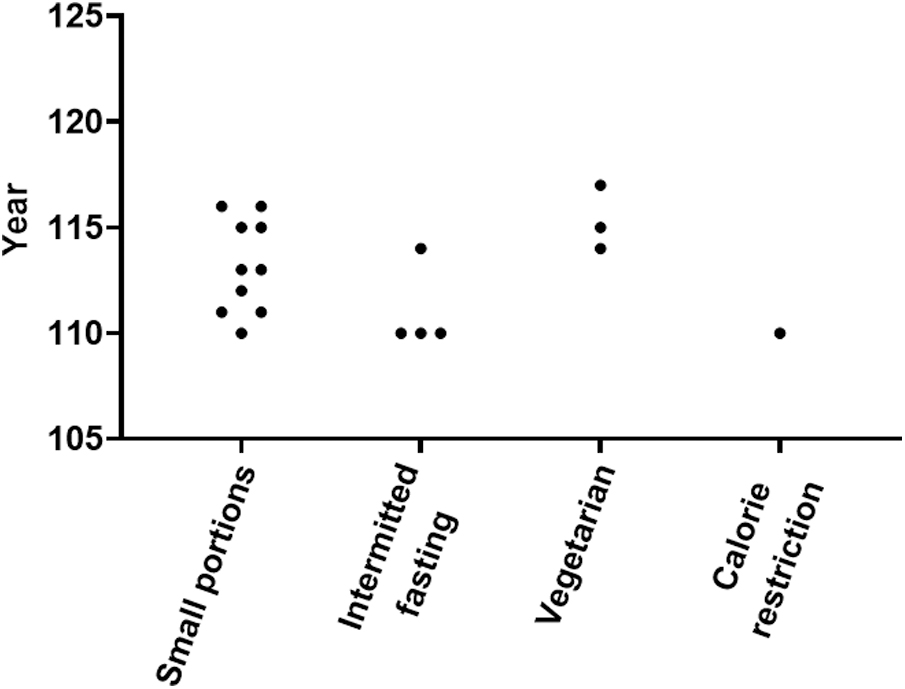
Supercentenarians' attribution to their longevity: Eating habits.
Study limitations
Data on the lifestyle choices of centenarians are scarce and come mainly from the daily press and Internet search sites. Claims about lifestyle factors contributing to longevity are subjective and therefore potentially biased. Also, it is impossible to deduce from the published claims whether centenarians have adhered to the declared lifestyle for their entire life or merely in the few last years. Little information could be obtained concerning supercentenarians' early- and midlife conditions. Nevertheless, all data based on an interview and personal recall are subjective and can be meaningful when analyzed for a large sample. As there are not many supercentenarians by definition, it is worthwhile to diligently collect the existing data to enable future meta-analysis on a larger sample.
Conclusions
It seems that exceptional longevity is the outcome of the intricate interplay of genetic and environmental factors as well as epigenetic means like DNA methylation, histone acetylation, and microRNA expression. 147 According to Sebastiani et al., 148 in first eight decades of life, lifestyle is a stronger determinant of health and life span than genetics, genetic contribution is largest with the oldest ages passing eighties and beyond.
The contribution of genetics of human longevity has been estimated between 15% and 40%. 149 –154 Environmental factors that affect the lifespan, such as accidents and infectious diseases, are much more important at younger ages; during middle age, both environment and genetics contribute to the most common causes of death, such as cancer and cardiovascular disease. At advanced ages (>90), when individuals have already escaped death from chronic diseases, the genetic component (possession of specific longevity genes) becomes dominant over environmental influences on lifespan. 136 The influence of genes is even more pronounced in supercentenarians who live to be over 110 than in those who live to be only 80. The same is true for the role of individual foods and nutrients and the timing of food intake, which are important for average people to promote health span and reduce overall mortality and morbidity, 155 –158 but there is no scientific evidence correlating a particular diet with the ability to live to 110.
As there is limited success in identifying the genes responsible for exceptional longevity, epigenetics can have an important role to play in moderating the interaction of genes and environment. Since different gene variants are found in centenarians, a combination of polymorphic variants or yet unknown genes may contribute to long life spans. Epigenetics can be influenced/modified by environmental agents and lifestyle choices, including working habits, physical activity, nutrition, stress, smoking, and alcohol consumption (reviewed in 159 ). Eating fresh vs. processed food, choosing more fruit, vegetables, legumes, and whole grains while consuming less red meat, dairy products, and sugar is generally considered to be a healthy choice that may beneficially influence epigenetic patterns. However, both the eating habits of centenarians and the type of food consumed by individuals with exceptional longevity are not distinct from the general population. A retrospective cohort study on the Ashkenazi Jews revealed that people aged 95 years or more seemed not to follow healthier lifestyles than people dying younger. 146 Gubbi et al. reported that the dietary patterns of individuals with parental longevity and those whose parents do not display longevity also do not differ. 160 In addition, Rajpathak et al. 146 found that the lifestyle factors of those who live for a great many years are not distinguishable from the population at large since their mean body mass index, proportion of daily alcohol consumption, regular physical activity, and participation in a low-calorie diet were similar to the comparison group. The same study found that supercentenarians mostly smoked little or not at all and had never been obese. Charts 1, 2, and 3 show that only a few supercentenarians fulfil some of the healthy lifestyle criteria like regular exercise, good quality sleep, and eating a healthy balanced diet entailing small amounts of food throughout the day. Rajpathak et al. 146 conclude that those with extraordinary longevity might respond differently to environmental factors than other people. Indeed, long-living persons have a young epigenetic age compared to their chronological age, as shown by an epigenetic age calculation using the Hannum and Horvath epigenetic clocks. 145 Further, Horvath et al. 161 reported that a reduced epigenetic age in semisupercentenarians from Italy as well as in the descendants of semisupercentenarians and that people who lived to be 100 years old are younger than one might expect given their chronological age.
What does this mean? Are there other environmental factors with a considerable impact on epigenetics? Further studies are needed to address this question. In conclusion, inheriting the appropriate genetic variants from one's parents or developing epigenetic variants by epigenetic modifications through healthy life choices is essential to become a supercentenarian. 162
Footnotes
Author Disclosure Statement
No competing financial interests exist.
Funding Information
The authors acknowledge the financial support from the Slovenian Research Agency (research core funding No. P3-0388 and P3-0019).