




Abstract
Several studies claimed C60 fullerenes as a prospective geroprotector drug due to their ability to capture free radicals effectively and caused a profound interest in C60 in life extension communities. Multiple additives are already sold for human consumption despite a small body of evidence supporting the beneficial effects of fullerenes on the lifespan. To test the effect of C60 fullerenes on lifespan and healthspan, we administered C60 fullerenes dissolved in virgin olive oil orally to 10–12 months old CBA/Ca mice of both genders for 7 months and assessed their survival. To uncover C60 and virgin olive effects, we established two control groups: mice treated with virgin olive oil (vehicle) and mice treated with drinking water. To measure healthspan, we conducted daily monitoring of health condition and lethality and monthly bodyweight measurements. We also assessed physical activity, glucose metabolism, and hematological parameters every 3 months. We did not observe health deterioration in the animals treated with C60 compared with the control groups. Treatment of mice with C60 fullerenes resulted in an increased lifespan of males and females compared with the olive oil-treated animals. The lifespan of C60-treated mice was similar to the mice treated with water. These results suggest that the lifespan-extending effect in C60-treated mice appears due to the protective effect of fullerenes in opposition to the negative effect of olive oil in CBA/Ca mice.
Introduction
C60
C60 fullerenes showed beneficial effects in the number of experimental pathologies. Mice treated with hydrated C60 fullerenes show decreased tumor growth. 6 Administration of C60 fullerenol nanoparticles decreases brain lesions in the model of brain ischemia. 7 Aqueous colloidal solution of C60 fullerenes can alleviate the effects of diet-induced obesity in rats. 8 Administration of the colloidal solution of C60 fullerenes can also reduce muscle fatigue. 9 C60 fullerenes show substantial ROS scavenging activity in the model of ROS-dependent liver damage (tetrachloride intoxication in rats) with little to no negative effects. 10,11
The above-mentioned properties make C60 fullerenes an attractive therapeutic remedy, and it is tempting to test the ability of C60 fullerenes to prolong the lifespan of animals. However, such data are scarce and contradictory. Carboxylated C60 fullerenes increased mice's lifespan by 11% compared with the control animals. 12 C60 fullerenes dissolved in virgin olive oil prolonged rats' lifespan almost twice with no signs of toxicity. 10 On the contrary, Grohn et al. reported no significant effect of pristine C60 fullerenes on mean lifespan in C57BL/6J mice in the recent article. 13
These data suggest that C60 fullerenes may have geroprotector properties, and their use may be beneficial for health. In the present study, we repeatedly treated mature mice (10–12 months old) with C60 fullerenes dissolved in virgin olive oil, as described in Baati et al., 10 but with a double dose (3.4 mg/kg, in contrast to 1.7 mg/kg in the original article). We analyzed the lifespan of mice, their major physiological parameters (locomotor activity, blood tests, and blood glucose level), and performed necropsies with a focus on assessing the incidence of tumors.
Materials and Methods
Animals
Male and female CBA/Ca mice 10–12 months old were obtained from the animal facility of the Institute of Gerontology, National Academy of Medical Sciences, Kyiv, Ukraine. Study design, animal selection, handling, and treatment were approved (2014-01/27) by the Ethics Committee of the Gerontology Institute and followed animal care guidelines. Mice were housed in individual cages in the air-conditioned room (22–25°C) on a 12-hour light/dark cycle with ad libitum water and standard food available. The animals were randomly assigned to one of the three groups (drinking water, olive oil, or C60-olive oil solution) for each sex.
C60 dosage and treatment regimen
C60-olive oil solution and olive oil (vehicle) were kindly provided by Prof. Fathi Moussa. C60-olive oil solution was administered daily for 1 week, then weekly until the end of the second month, and then every 2 weeks until the end of the seventh month, 25 doses in total for each mouse. Mice were treated by gavages with drinking water, olive oil (vehicle), or C60 dissolved in olive oil (the administration dose was 3.4 mg/kg).
Lethality and clinical signs of toxicity
Animal survival was checked daily except for weekends and holidays. Throughout the study, cumulative effects of the tested compounds were assessed by visual observations according to the standard procedures. External state of skin and fur, eyes and mucous membranes, as well as the respiratory system, blood circulation, peripheral and central nervous systems, and changes in locomotor activity were evaluated. Such abnormalities as the presence of tremors, seizures, salivation, diarrhea, and apathy were monitored as well. Observations were performed once a day (except weekends) during the treatment period.
The body weight of the experimental animals was measured every 2 weeks till the end of the seventh month to ensure the correct drug dosage. Mice were weighed monthly when the treatment course was finished. Animal behavior, physical performance, glucose tolerance, and hematology were assessed every 3 months. The tests' general order was as follows: open field test, grip strength, and rotarod test; then animals rested for 2 days, fasted overnight, and oral glucose tolerance test (OGTT) was performed; 3 days later, blood was collected for the routine blood tests.
Behavioral tests and grip strength
Animal behavior and spontaneous locomotor activity were assessed with an open field test. In the test, the plastic arena was divided into 16 equal squares. The mouse was carefully placed in the corner of the field, and monitored for 3 minutes. The time before the first move, the number of crossed sectors, and the time spent in the central sectors were measured. After the end of this period, the animal was carefully removed, and the arena was wiped with 70% alcohol.
The grip strength test was performed using the 47200 Grip Strength Meter (Ugo Basil, Italy). Grating was used for all four limbs according to the device instructions. Grip strength was tested at least three times for each animal, and the average value was taken. The force was expressed in gram force (gf) units, which were then converted into Newton using the formula: A × 0.00980665 = N, where A is the average value of the force in gf, N—the average value of the force in Newton.
Blood glucose level and OGTT
Blood glucose was assessed after overnight fasting. On-Call Plus glucometer (Acon Laboratories, Inc.) and specific test strips (REF G133-111) were used to test the blood glucose level and expressed as mmol. Blood was collected from the tail vein by the incision of the tail tip. Five to six microliters of blood were used for each measurement.
For the OGTT, mice were orally treated with 2 g/kg of glucose. Glucose measurements were performed immediately before the test, then 15, 30, 60, and 120 minutes after the glucose administration. The results of measurements were expressed as area under the curve (AUC), which was calculated using the formula of the area of the curvilinear trapezium, limited by the curve, using available online programs.
Hematological parameters
For the hematological studies, 25 μL of the fresh blood were quickly mixed with an equal volume of K2EDTA solution in saline at 0.2%. The hematological parameters were assessed using the hematology analyzer HB7021 and consumable reagents Cormay (Poland) within 2 hours after sampling.
Gross pathology analysis
Detection and recording of the macroscopic alterations in internal and external organs were carried out according to the Institute Gerontology standard procedure. Dead bodies were checked no more than 24 hours after death and without significant body damage. Weight, color, shape, consistency, structural peculiarities of internal organs, and the presence of visible tumors were investigated. We limited our analysis to visible organ pathologies and neoplasia in the peritoneum and the thoracic cavity. Every necropsy was analyzed with a pathologist blindly to ensure conclusions.
Statistical analysis
Numerical parameters were checked for normality and equality of variance. If there was no severe violation of these conditions, parametric two-way analysis of variance (ANOVA) was performed for each time-point with gender and drug treatment as experimental factors. If ANOVA retrieved statistically significant differences between the experimental groups, the post hoc Newman-Keuls test was performed. If the assumptions for parametric tests were violated, nonparametric Kruskal-Wallis ANOVA and Dunn's test were applied. As the number of mice was decreasing throughout the experiment due to their death, all the numerical parameters were not analyzed in dynamics. Instead, the experimental groups were compared at each time-point separately.
Animal survival was analyzed by Kaplan-Meier plots, followed by the Cox-Mantel test. Cumulative hazard plot with Nelson-Aalen estimator was built by lifelines library version 0.29.5, and source code is available at
Results
C60 fullerenes showed a mildly positive impact on life expectancy compared only to the olive oil-treated group
The lifespan expectancy of mice that received drinking water did not have significant sex differences (p = 0.124, Fig. 1). Olive oil had an ambiguous effect on the survival rate of animals of different sexes: it decreased the lifespan in males (p = 0.014), while it did not change the lifespan expectancy (p = 0.688) in females. The survival rate of C60-treated mice was higher than that of the olive oil-treated animals. The effect was more pronounced and statistically significant in females (p = 0.049), while there was a distinct trend (p = 0.063) in males. Two-way ANOVA assessment also revealed a significant increase in mean (F(1, 151) = 5.663; p = 0.019) and maximal (F(1, 12) = 18.82; p = 0.001) lifespan of mice treated with C60, compared to their olive oil-treated counterparts for both males and females (Table 1). The increase in mean lifespan in males was 5.6%, in females 7.0%, and maximal lifespan 9.7% and 6.8%, respectively. We observed a delayed onset of mortality in C60-treated mice compared to the olive oil-treated animals (Fig. 1 and Supplementary Fig. S1). We did not observe a statistically significant increase in the lifespan of C60-treated mice compared to the group of mice treated with drinking water.

Survival rate of CBA/Ca male
Lifespan Statistics of the Experimental Animals
Values given are age in days. Mean and maximal lifespan ± SEM, as well as 25th, 50th, and 75th percentiles are presented.
p < 0.01 compared to the males oil-treated group.
p < 0.05 compared to the females oil-treated group.
SEM, standard error of mean.
C60-fullerene treatment did not have a definite effect on bodyweight, spontaneous locomotor activity, and grip strength
During the study, body weight differed significantly according to gender, but there was no marked effect of treatments with C60 or vehicle on this parameter (Fig. 2). The values of spontaneous horizontal motor activity and grip strength decreased with age in all experimental groups, but the effect of treatments itself was not significant (Fig. 3). Vertical motor activity was not different between all the experimental groups (data not shown). Observed results suggest that repeated treatment with C60 has no significant antiaging effect on the investigated physiological parameters.
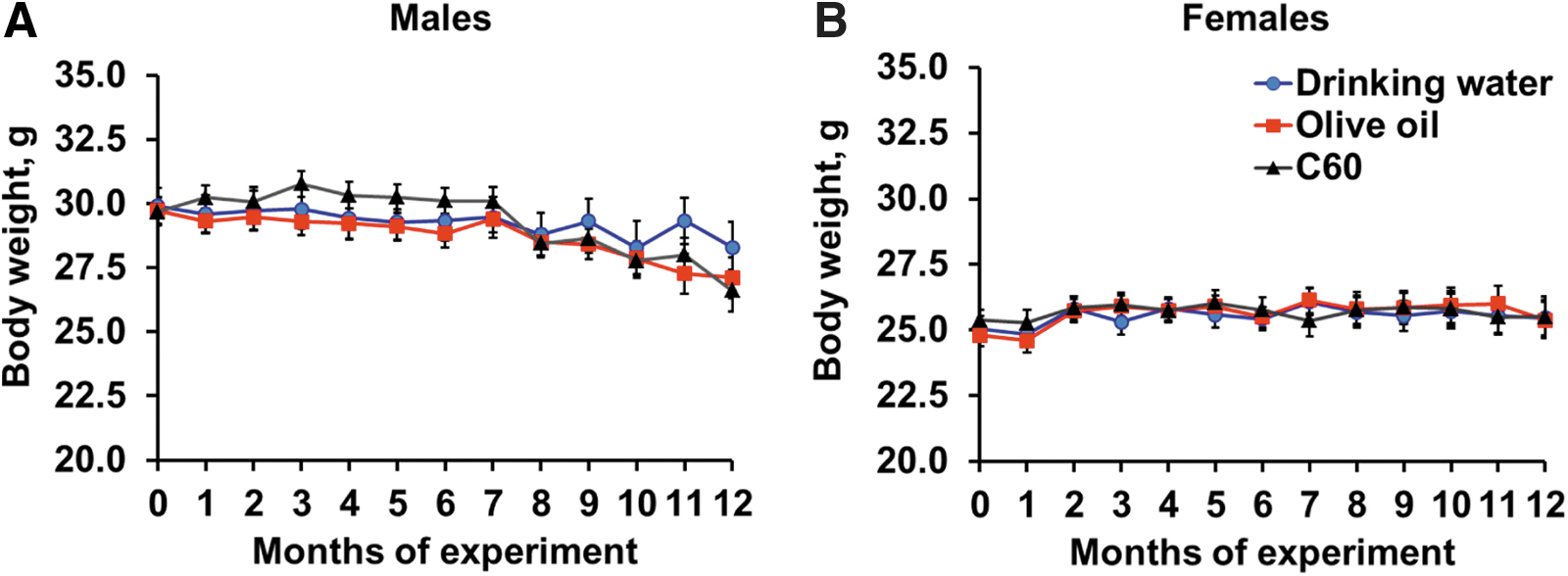
Body weights dynamics of male
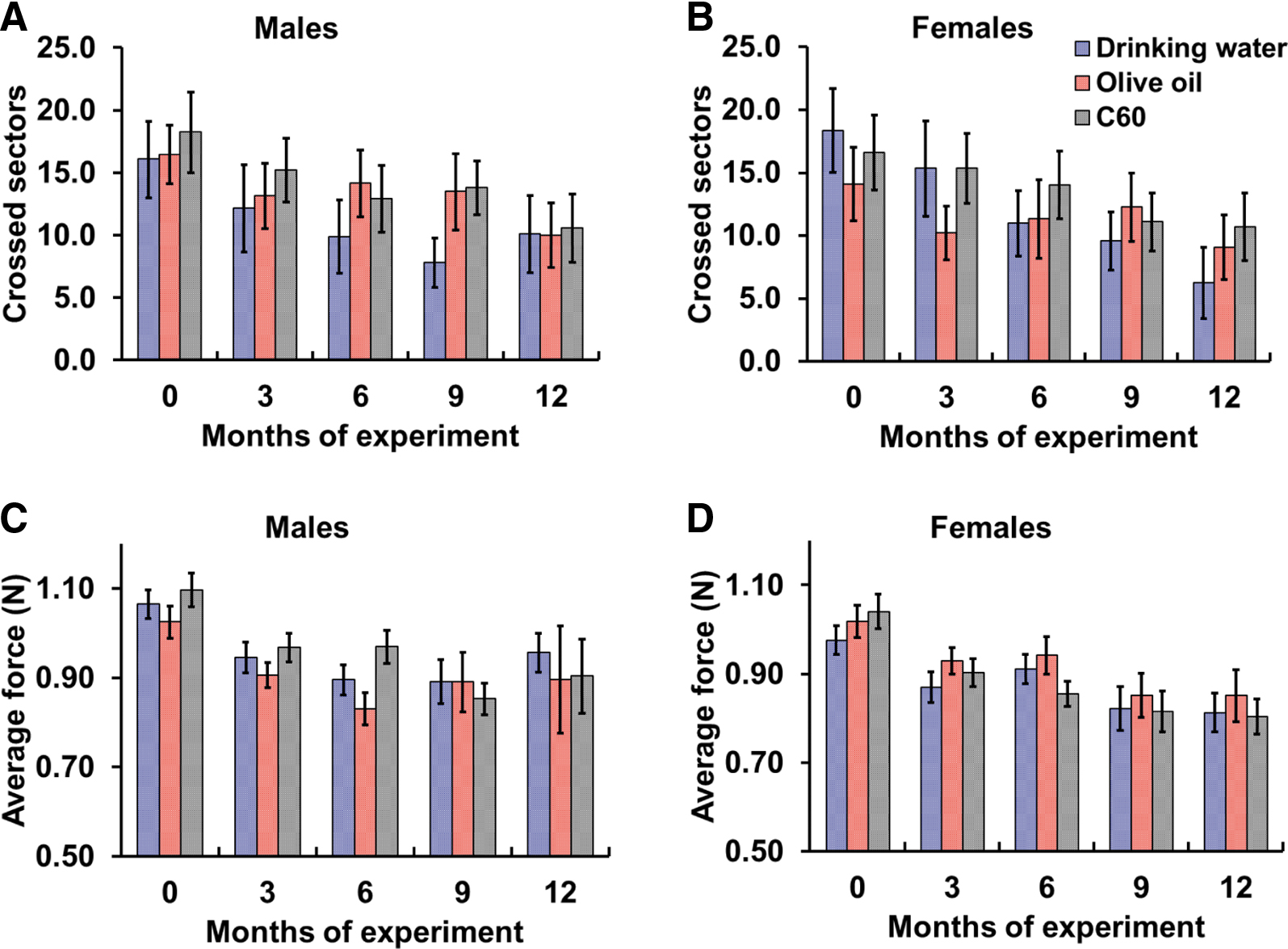
Effects of C60 fullerene treatment (3.4 mg/kg) on spontaneous horizontal motor activity (upper graphs) and forelimb grip strength (lower graphs) of male
Fasting blood glucose and glucose tolerance were not affected by the treatments with C60 fullerenes
The fasting glucose level in mice differed according to gender, with higher values for males and lower values for females. C60-treated male mice had slightly lower glucose levels than male mice treated with drinking water after 3 months of the experiment, but that differences did not reach p < 0.1 significance level (Fig. 4A, B). While glucose tolerance was better in females (AUC values were lower for females than for males) C60 consumption did not affect it (Fig. 4C, D) at any time-point analyzed.

Effects of C60 fullerene treatment (3.4 mg/kg) on fasting glucose level (upper row) and glucose tolerance (lower row) of male
C60 fullerenes did not alter the blood parameters in experimental mice
We observed age-related changes in major blood cell populations and parameters (white blood cells [WBCs, 106/mL], platelets (PLTs, 106/mL), red blood cells (RBCs, 109/mL), and hemoglobin (HGB) level (g/L). All these parameters were not affected by C60 fullerene administration (Fig. 5).

Effects of treatments on the number of white blood cells
Necropsies
CBA/Ca strain is well known for its longevity and high gross tumor incidence with gender-specific diversity: high (55%) tumor frequency in females and relatively low (29%, mainly hepatomas) in males. 14 We did not observe a high tumor burden in any male treatment group analyzed. Surprisingly, we found increased tumor burden in females treated with both olive oil and C60 fullerenes compared with the mice treated with drinking water (Table 2) without a significant influence of C60 fullerenes on this process. However, it should be kept in mind that due to the relatively small sample size, the statistical significance was difficult to achieve. Other visible pathologies were present as single cases across the experimental groups. There was no significant influence of treatments on the organ weight in the groups tested (Table 3) except for a higher kidney weight in males compared with females. C60-treated females tended to have somewhat higher spleen weight, but the difference was still not significant (Table 3, p > 0.1).
Tumor Prevalence in Experimental Animals
Autopsies of dead animals were carried out within 24 hours after death and in case of complete body integrity.
p Fisher < 0.01 compared to the female-drinking water group.
p Fisher < 0.1 compared to the female-drinking water group.
Postmortem Organ Mass of Mice of Different Experimental Animals
Autopsies of dead animals were carried out within 24 hours after death and in case of complete body integrity. Organ mass per body weight is shown in parentheses and expressed as % to the body weight. Data are shown as mean ± SEM.
p (t) < 0.05 compared to the respective female treatment group.
BW, body weight.
Discussion
Aging is an irreversible process, which affects multiple organs, and is the leading cause of age-associated mortality and morbidity. Therefore, a search for efficient ways to correct age-related changes is a task of high importance in the coming decades.
We observed an increase in the lifespan of C60 fullerene-treated mice compared with the olive oil-treated animals. The effect was much less strong than described in the other article, 10,12 however, still evident and statistically significant: 7.0% for mean lifespan in females and 5.6% in males, while the increase in maximal lifespan was 6.8% for females and 9.7% for males. One more important finding was a delayed onset of mortality in C60-treated mice over the olive oil-treated animals. It suggests a protective effect of fullerenes over the treatment with olive oil in mice.
On the contrary, we did not find a statistically significant increase in lifespan in C60-treated mice compared with the mice treated with drinking water. The relatively reduced lifespan of olive oil-treated animals is somewhat unexpected for us since olive oil is considered a dietary supplement that promotes longevity. 15,16 We suggest the higher fat intake as a possible explanation for the effect observed in the olive oil-treated group. Mice kept on the high-fat diet had a reduced lifespan even without becoming obese. 17 We used the CBA/Ca mice strain, which is recommended for diabetes and obesity research, and males tend to develop a mild adult onset diabetes-obesity syndrome. 14 Perhaps this is why the negative effects of the olive oil treatment were more pronounced in males (Table 1). Olive oil might also favor tumor development as observed in the olive oil-treated females (Table 2). The mechanism of this effect is unclear, but some investigations suggest that a high olive oil (or other types of oil) diet may potentiate cancer progression. 18 –20 However, particular types of high-fat diets support the lifespan extension in experimental animals. 20
In the previous report of Baati et al., 10 treatment of rats with C60 resulted in a pronounced lifespan extension. We did not find a strain-specific lifespan extension effect of C60-treatment in our investigation, which contradicts the above-mentioned results. What can be the reason? Different sensitivity of mice and rats to the effects of toxic/medicinal substances may be one of the possible explanations. Rats are more sensitive to many substances, and they need a lower dose to get a significant biological effect than mice. 21 Mice and rats express different cytochrome isoforms, which may affect the drug metabolism, 22 and show species-specific differences in biodistribution and excretion of gold nanoparticles. 23 Therefore, the insufficient dose may explain such a low efficiency of C60 lifespan prolongation observed in our study, although it is just a suggestion and requires further experimental verification.
Aging is associated with a decrease in locomotor activity and atrophy of muscle tissue, impaired glucose metabolism, and decreased immunological functions that may favor tumor development. Fullerenes may theoretically alleviate these effects. 6,8,9,24 We assessed some of these parameters.
Age-related reduction in locomotor activity is a multifactorial process. Loss of muscle mass (sarcopenia) and muscle strength (dynapenia) is an important factor in impaired physical function in both older people 25 and experimental rodents. 26,27 The loss of functionality of motor units (primarily due to impaired innervation of muscle tissue) is an early sign of sarcopenia in aging male and female mice. 28 The size of the muscles and their contractility is directly related to the number of functional motor units, and the loss of motor neuron coherence is an important factor in sarcopenia and dynapenia. 28 C60 treatment can potentially alleviate these changes. 9,29 In our study, mice showed a reduction in muscle strength and spontaneous locomotor activity by the 12th month of the experiment (Fig. 3). These data correspond to the typical age-related changes described in many published sources. 25 –28 Nonetheless, we did not observe the effects of C60 fullerenes on the tested physiological parameters: mice treated with fullerenes did not demonstrate either increased activity in the open field test or increased grip strength over the olive oil-treated animals.
The number of WBCs, RBCs, and the HGB level decreased in all experimental groups with age, while the PLT number increased in old mice compared with the initial values measured before treatment (Fig. 5). These data correspond to the typical age-related changes in hematological blood parameters. 30 Thus, treatment with C60 fullerenes did not affect these parameters in our study.
Unlike humans, the fasting glucose level in mice decreases with age, while its utilization rate in the OGTT increases. 31,32 In our study, fasting glucose level was stable, whereas the AUC values in OGTT decreased with age, especially in males (Fig. 4C, 4D). Again, the studied parameters did not differ between the groups treated with C60 and the vehicle.
The toxicity of fullerenes is a matter of multiple discussions. 33 –35 The high diversity of the fullerene species and experimental models make it difficult to compare different studies directly. In most studies, experimental animals show good tolerance to the fullerene treatment. 10,11,36 –39 Most of the reported cases of fullerene toxicity attribute either to the vigorous chemical modifications or to the use of toxic solvents. 33 –35,40–43 The important source of C60-mediated toxicity is its ability to produce oxygen radicals after irradiation with visible light. 13,40,44 –46 C60 solution in olive oil, illuminated for 8 days before injections, induced significant mortality in mice upon intraperitoneal injections. 13 We did not observe detectable side effects of long-term peroral treatment with C60 fullerenes in our investigation. Female mice treated with C60 fullerenes or vehicle showed an increased tumor burden, which suggests the negative effect of vehicle on mice's health. However, the photo-induced toxicity of C60 fullerenes must be carefully considered before use in humans as the human body has a much larger surface area exposed to light than in mice.
Vegetable oils can dissolve C60 efficiently. 10,13,38,47 We used pristine C60 fullerenes dissolved in olive oil, supplied by Prof. F. Moussa. Mice showed good tolerance toward the C60 fullerene treatment with no major adverse reactions or signs of acute toxicity. The lifespan of C60-treated mice was increased compared with the olive oil-treated animals, and we observed no negative effects of C60 fullerenes on the overall condition of mice.
Conclusion
Mice of CBA/Ca strain orally treated with C60 fullerenes in olive oil (3.4 mg/kg) showed a statistically significant increase of lifespan compared to the olive oil-treated animals and good tolerance toward the C60 fullerene treatment. On the contrary, we did not find a statistically significant increase in lifespan in C60-treated mice compared to the control group (treated with drinking water). These results suggest that delayed onset of mortality in C60-treated mice over the olive oil-treated animals appear due to the protective effect of fullerenes over the negative effect of olive oil in CBA/Ca mice.
Footnotes
Acknowledgments
The authors thank Prof. Fathi Moussa for providing C60 fullerenes and Eduard Debonneuil for valuable inputs and support during the crowdfunding campaign.
Author Disclosure Statement
The authors declare that the research was conducted in the absence of any commercial or financial relationships that could be construed as a potential conflict of interest.
Funding Information
The research was funded by the “I am a little mouse and I want to live longer” crowdfunding campaign, we cordially thank those who donated money, especially David Gobel, Anthony Loera, Phil Kernan Jr, Denis Dmitriev, and Dzmitry Zaitsau. The complete list of donors is in Supplementary Table S1.
Supplementary Material
Supplementary Table S1
Supplementary Figure S1
References
Supplementary Material
Please find the following supplemental material available below.
For Open Access articles published under a Creative Commons License, all supplemental material carries the same license as the article it is associated with.
For non-Open Access articles published, all supplemental material carries a non-exclusive license, and permission requests for re-use of supplemental material or any part of supplemental material shall be sent directly to the copyright owner as specified in the copyright notice associated with the article.
