




Abstract
Anthropogenic climate change currently threatens existing systems of human societies, and psychology has a significant role in exploring and untangling the predictors of sustainable behaviors and environmental concern. The present research identifies several individual demographic factors (age, education, and political ideology) as well as various attitudinal and social factors, such as ecological worldview, social identity, and place attachment, and explores their relationship with pro-environmental concern and behavior. The results of this synthesis indicate that there are complex and dynamic associations between these demographic, attitudinal, and social factors, and environmental variables. Several relevant theoretical models are discussed (e.g., Value Belief Norm theory and the Theory of Planned Behavior), a summative model of behavioral predictors is introduced, and implications for community education and policy support are considered.
Introduction
Industrial capitalism, which has characterized the Western experience of modernity, has been made possible by economic growth, technological development, material prosperity, and urbanization (McCright, 2011). These forces have required an accelerating consumption of fossil fuels and the unforgiving extraction of natural resources. This practice has degraded environmental quality and caused anthropogenic climate change. Disengaging from our intensive use of finite resources requires a shift in thinking and also a transformation of individual and group behaviors. Just as climate change is being caused by the behaviors and systems of human beings, we have the power to create solutions to mitigate its disastrous effects and to establish resilient communities adapted to a changing reality. It is important to study human behavior, emotions, and attitudes to design effective programs and policies to achieve these goals.
While it is valuable to examine individual level variables in relation to environmental behavior, it is also critical to look beyond the individual and investigate the vast and interconnected network of social influences. Environmental progress is achieved through a combination of individual and collective action. The success of efforts to mitigate climate change depends on large numbers of people engaging in coordinated action.
The body of psychological literature related to environmentalism has been evolving and growing since the first research on environmental decline was established decades ago. However, detangling predictors of environmental concern and behavior is complex as goals, policies, and technologies are constantly shifting. While 15 years ago psychologists may have disapproved of the idea, many now view protecting the environment as an appropriate and valuable professional interest (Clayton & Brook, 2005).
The field of conservation psychology, a branch of environmental psychology, has grown out of the recognition of psychology's relevance to environmental sustainability. Various social and attitudinal components form the basis for existing and emerging theories that illustrate pathways of environmental behavior, such as Value-Belief-Norm theory (VBN) and the Theory of Planned Behavior (TPB). These theories, as well as others, have enormous potential to guide future psychological research and interventions that encourage pro-environmental behaviors. An abundance of studies utilize these theories; however there is a need to further explore the complex relationships between the beliefs, attitudes, and experiences that predict sustainable behaviors. Examining the interactions and mediations between these variables will lead to a better understanding of how to encourage pro-environmental behavior.
The Present Review
Recognizing the need for a comprehensive way to bridge various behavioral models, this paper will first discuss two central theoretical models from psychology that aim to predict environmental behavior and concern. It will also propose and extended model that includes social, attitudinal, and contextual factors that are associated with environmental behavior. A final discussion includes the potential relevance of the model for interventions and future research.
Materials and Methods
For this research, a comprehensive review of articles related to environmental psychology was performed. Over the course of several months, the scholarly article database Psych INFO was searched with several combinations of keywords including “environment,” “sustainability,” “climate change and concern,” “climate change and attitude,” and “climate change and behavior,” yielding several thousand results. In scanning the titles of these articles, relevant sources were selected and the abstracts were read. After further selection for applicability, full articles were obtained and thoroughly read. Many sources were gathered from the reference lists of highly relevant peer-reviewed articles.
Demographic and Socioeconomic Factors Related to Environmental Behavior
There are several individual-level demographic and socioeconomic factors that are demonstrated to be associated with environmental behavior, such as age, political ideology, and education. Knowing what segments of the population are more likely to be environmentally conscious has implications for policy and education. This knowledge can also be useful for theoretical advancement and can assist in efforts for designing initiatives and campaigns to promote behavior change.
Research on age and environmental behavior conducted in the 1970s and 1980s found an association between these two variables, namely that younger individuals are more likely to act sustainably (Buttel, 1979; Hines et al., 1986; Liere & Dunlap, 1980). However, more recent research has found negligible effects, and some report the opposite—older individuals are more likely to act sustainably (Wiernik et al., 2013). It could be that the effect of age differences is weakening as climate change becomes more accepted and different generations experience its effects, such as sea-level rise, species loss, and extreme climatic events.
Education as a socioeconomic variable has received much attention as it relates to environmental variables (Berger, 1997; Hines et al., 1986). Higher educational attainment in general is associated with higher levels of environmental concern in studies from several countries, and there is evidence that education is a positive predictor of environmental concern (Gifford & Nilsson, 2014; Liere & Dunlap, 1980). In the United States, Democratic Party affiliation as well as liberal political ideology has been significantly positively associated with environmental concern, a relationship that was demonstrated decades ago and is supported by contemporary research (Cruz, 2017; Liere & Dunlap, 1980; McCright, 2011).
Based on the ample collection of literature published on this subject, one can conclude that demographic and socioeconomic factors are related to attitudes about climate change and to environmentally responsible behaviors, albeit in a complex manner. Factors such as age, education, and political ideology are important to consider. However, to develop a comprehensive understanding of environmental behaviors, attitudes and social factors must be analyzed through the lens of theoretical models. These models can be applied to intervention efforts and utilized to promote environmentally sustainable behaviors and attitudes.
Theoretical Understanding of Environmentalism
Psychologists have adapted existing theoretical models to address the dynamic behaviors related to climate change. However, the multidimensional construct of environmental behavior has proved to be more complex than previously thought and there is demand for a more encompassing model in this field (Gifford & Nilsson, 2014).
Theory of Planned Behavior
The Theory of Planned Behavior (TPB) is fundamental for understanding environmental psychology (Ajen, 1991; Fielding & Hornsey, 2016). The TPB posits that attitudes, subjective norms, and perceived behavioral control are predictors for behavioral intentions, which then predict behavior.
attitudes norms
norms control
 intentions
 behavior
Intention to perform behaviors can be predicted with accuracy by assessing the attitudes toward the behavior, subjective norms around the behavior, and perceived behavioral control an individual has in achieving the behavior (Ajzen, 1991).
The TPB is based on the principle that an individual's intention to perform a behavior encompasses the motivational factors that influence that behavior. This measure of intention is assumed to capture the effort someone is willing to expend to perform that behavior. The more effort one plans on expending, the stronger the intention and the more likely the individual is to perform the behavior. Intention to perform a desired sustainable behavior depends on external factors such as the availability of opportunities and resources. As an illustrative example of this theory, assume an individual intends to ride a bicycle instead of driving their daily commute, to reduce their polluting emissions. According to the TPB, their intention to ride occurs before they actually begin riding, and several factors influence both their intention to ride and their actual behavior: commuting by bike or car.
Motivational Factors: Attitudes and Norms
Attitude toward the behavior and subjective norms are two other determinants of intention according to the TPB. Attitude toward the behavior refers to the favorable or unfavorable evaluation that an individual has of the behavior. The third determinant of intention is the subjective norm surrounding the behavior, referring to the social pressure surrounding that behavior. In the biking example, if the individual has a positive view of biking in general and they see community members biking to work or school, then they are more likely to intend to bike themselves.
The relative degree of importance of these determinants of intention to carry out a particular behavior varies across behaviors and situations, such that for one behavior, attitude could account for intention, while a different behavior may involve all three predictors (Ajzen, 1991). If an individual has favorable attitudes toward the behavior and positive social norms around it, they may intend to engage in a behavior. However, they are more likely to attempt the behavior if they perceive that they are capable of being successful.
Control
Behavioral control and perceived behavioral control are important predictors of behavior according to TPB. Behavioral control is defined as the resources and opportunities available to an individual that will allow them to engage in a particular behavior. Perceived behavioral control refers to the perception of ease or difficulty of performing the behavior. With perceived control, the effort expended to achieve a behavioral outcome is likely to increase, making it more likely that the behavior will be performed. For example, if an individual believes they are a competent bike rider, there are safe bike routes on their commute, and it will be an easy transition from driving, they will work harder to begin their biking habit. In contrast, if the individual believes that they are a poor bike rider (regardless of actual skill) and the transition from driving will be difficult, it follows they will not put as much energy into switching their habit.
The perception of self-efficacy can also be used as a substitute for actual control, assuming that the perceptions are realistic. However, Ajzen (1991) notes that when there are unfamiliar elements introduced to the scenario, or if an individual has little information about the behavior, then assuming someone's perception is equal to the actual control they have is not realistic. Behaviors that involve understanding complex information, for example, tax incentives, payment plans, and building regulations regarding solar panel installation, may induce feelings of low perceived control even for individuals who initially intend to reduce their carbon footprint.
Value of TPB in Environmental Psychology
This theory has been important for environmental psychology and has demonstrated some degree of integration with theoretical insights from other areas of psychology. Social psychologists have incorporated concepts of social identity into this theory and argue that the simplicity of the TPB model allows other relevant variables to be added, which increases its predictive power (Fielding & Hornsey, 2016). For example, the norms of the most behaviorally relevant group are suggested to be the social norms that are most important in the subjective norms variable of the TPB (Fielding & Hornsey, 2016). Following the commuting by bicycle example, seeing members of one's peer or social group biking to work may be more compelling than seeing strangers biking to work. The capacity to integrate the social identity approach to the TPB is a source of strength in understanding environmental decisions and behaviors.
The TPB posits that assessing attitudes, subjective norms, and perceived control can predict intention and behavior. This theory does not address how individual values or worldviews may serve to influence decisions to behave or the perception of control. Another theory explains how beliefs precede intention, leading to behavior, and incorporates the importance of personal values in the causal chain to action.
Value Belief Norm Theory
Building on the idea that attitudes direct intentions, Stern (2000) presents a theory that posits that an individual's position in society precedes their values, which precedes their worldviews, which precedes their attitudes (Oreg & Katz-Gerro, 2006):
The Value Belief Norm theory (VBN) of environmentalism offers one explanatory account of behavioral indicators of nonactivist environmentalism (Stern, 2000). In the context of this theory, types of environmentally significant behaviors are differentiated so that the predictors of each type of behavior may be untangled. Expanding the types of what is considered environmentally significant behavior may be psychologically meaningful and more accurate for conceptual models.
One behavioral focus is environmental activism, which may be defined as one's active involvement in pro-environmental demonstrations or groups. On the other hand, nonactivist behavior in the public sphere can be civic support of environmental objectives, such as policies. Distinguishing between activist and nonactivist environmental behaviors is useful because they may have distinct antecedents (Dietz et al., 1998; Stern, 2000).
Five Variables of VBN Theory
The VBN theory joins value theory, norm-activation theory, and the New Environmental Paradigm (NEP) and describes a causal chain of five variables leading to environmental behavior: personal values (altruism), ecological worldview (assessed by NEP), awareness of adverse consequences for valued objects (AC), ascribing responsibility to one's own actions for negative environmental effects (AR), and personal norms for pro-environmental action.
This theory presents the causal chain that moves from central factors of personality and belief structure to more focused beliefs about the relationship of humans and nature and individual responsibility (Stern, 2000). VBN theory builds upon value theory and norm-activation theory by positing that personal norms are activated by adverse consequences to whatever an individual values, in this case, the environment. In this logic, individuals who value the environment will be concerned by circumstances that threaten the fragile biosphere.
The VBN theory of environmentalism has empirical support that demonstrates a reliable association between three types of nonactivist behaviors: consumer choices, private political activities (like voting), and accepting policy that may require material sacrifice. These values are most strongly connected to activating personal pro-environmental norms, which, as would be expected, are altruistic (or self-transcendent) values (Guagnano et al., 1995; Stern, 2000).
Beliefs as Central Mediating Variable in VBN
A critical element of VBN theory is how particular beliefs mediate the connection between values and environmentalism. The beliefs specified in the theory are the beliefs about what kinds of things are impacted by environmental conditions (AC) and if there are individual actions that can mitigate the threat to valued persons or things (AR). In the bicycle commuting example, the individual would believe that biking instead of driving will reduce their carbon footprint, and also believe decreasing their carbon footprint is a valuable goal with meaningful outcomes related to climate change.
Stern (2000) argues that this part of the theory is important because it assumes that an individual's attitude, and, therefore behaviors, are shaped by their beliefs of consequences and competence in mitigating threats of climate change. Information that shapes these beliefs, such as perceptions of public ability to sway policy decisions and media around climate science, is highly relevant to predicting environmental action through norm activation. If environmental concern and issues are socially constructed, then this process is inextricably linked to individuals' attitude formation regarding climate change and efforts to mitigate and adapt to its damaging effects.
Need for Expanded Model
While the two models described have made important contributions to the fields of conservation and environmental psychology, there may be benefits to integrating more of the models and concepts that have been reliably associated with environmental behavior. Developing an encompassing model that lays out a pathway of pro-environmental behaviors could be a useful endeavor because it may provide the groundwork for identifying areas for successful intervention. In addition, distinguishing between major types of environmentally significant behaviors is valuable for future research, based on empirical evidence that demonstrates that there are distinct motivations and factors that lead to different behaviors (Dietz et al., 1998; Stern, 2000).
Proposed Expanded Model of Environmental Behavior
Analyzing and comparing the models described (TPB and VBN) reveal consistent trends within the variables associated with environmental behavior reported over the decades. These variables can be merged to create a more extensive model of behavior that has the potential to predict more behaviors and offer a richer understanding of the antecedents of individual sustainable actions (see Figure 1). This theoretical model aims to expand on previous models by including more variables relevant to pro-environmental behaviors. This model does not pretend to be exact and it has yet to be empirically tested, but it is one suggestion for future research in environmental and conservation psychology.
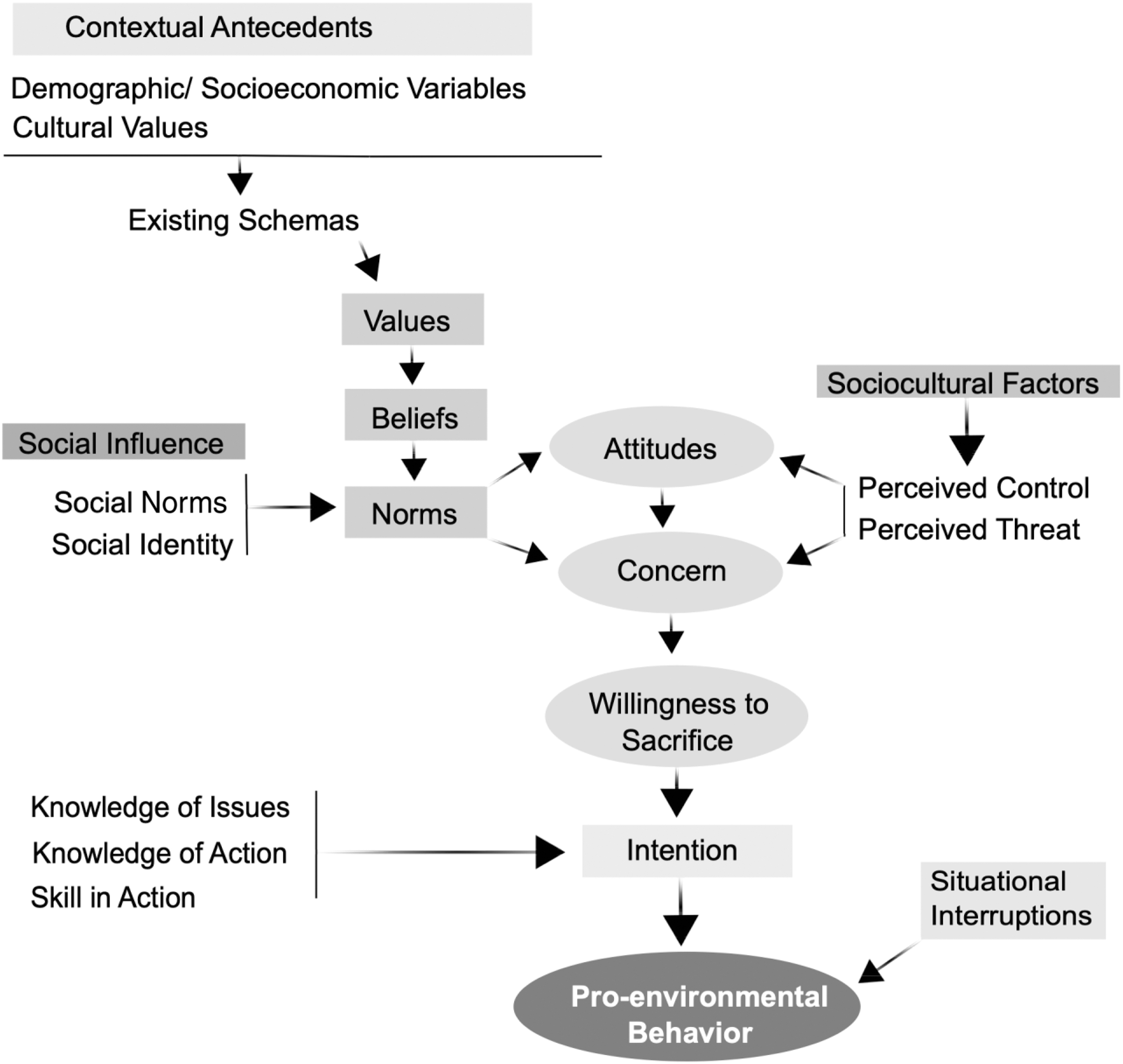
Proposed pathway of social and attitudinal variables that predict pro-environmental behavior, incorporating elements from TPB and VBN theory, among others
While recognizing the value of examining the connections between demographic factors and environmental variables, it may be more useful to focus analysis on broader, more socially based factors to deepen our understanding of environmental behavior.
Antecedents to Environmental Behavior
Values and Mental Schemas
Values are embedded in our cultural contexts (Clayton & Brook, 2005; Oreg & Katz-Guerro, 2006). It is irrational to assume that an individual can operate and make decisions about any element of their life separate from their social context, and environmental behaviors are no different. Cultural values, such as post-materialism, are contextual antecedents that influence individual values and evaluations of climate change and sustainable solutions (Oreg & Katz-Guerro, 2006).
Post-materialism is a cultural value that is adopted by modern industrial societies as a rejection of material values and a focus on advocating values related to quality of life, freedom, and self-expression. For example, if an individual lives in the United States, a modern industrial nation with a degree of post-materialist values, it may be important to them (and they may have the opportunity to choose) to reduce their carbon footprint by commuting by bicycle. It is under the broader background of cultural values in which individual values are shaped, and these values form a part of the first stage of the proposed model.
Both the cultural values and individual demographic and socioeconomic factors, which we can call contextual antecedents, influence a person's existing mental schemas that shape the way they perceive and understand themselves and the world. Schemas are preexisting beliefs that affect how people process information and a highly relevant psychological concept to apply to environmental decision making (Clayton & Brook, 2005). For example, if an individual does not normally associate commuting travel with sustainability, then they are less likely to choose to commute by bike. However, if an individual has incorporated transportation choices with environmental outcomes, such as reduced pollution and emissions, then they are more likely to process new related information with this perspective.
Beliefs
Individual existing mental schemas may affect a person's values and their beliefs. Values and beliefs are both important and related elements of many proposed models of behavior, including the current model. According to VBN theory an individual's values, specifically their altruistic and biospheric values, are related to their beliefs about the environment. In this case, biospheric is a value orientation in which an individual judges phenomena based on costs and benefits to ecosystems (the biosphere) (Stern, 2000). People's values are activated as they realize the consequences to the threatened environment and their obligation to act.
The beliefs that are related to environmental behavior include ecological worldview (NEP), systems thinking, connectedness to nature, and natural place attachment. These are beliefs laden with values and are antecedents of environmental concern and behavior (Stern, 2000). If a person does not value the environment or believe that their actions make a difference, they will be less likely to be concerned about climate change and less likely to act sustainably.
Social Influences on Behavior
There are also social influences, such as social identity and informational and normative factors, which affect an individual's likelihood to perform sustainable actions. An individual's social identity, their identification with a higher social unit, has been linked to group cohesion and willingness to sacrifice for the common welfare, which in this case is to support pro-environmental measures that may have short-term inconveniences or perceived personal loss (Brieger, 2019; Rees & Bamberg, 2014). Another social influence is informational influence, which is how people learn how to act by watching others (Clayton & Brook, 2005). For example, people are much more likely to litter if there is already litter on the ground where they have seen others' behavior and replicate it (Cialdini et al., 1990).
Another part of social influence on individual behavior is normative, that is, people act in accordance with what they perceive others want them to do, or what they perceive others approve of. The incentive of social acceptance is a powerful way of influencing behavior and can be leveraged to increase sustainable behavior (Abrahamse & Steg, 2013). Social norms, or the normative influence of others, has a direct relationship to individual norms (Abrahamse & Steg, 2013; Brieger, 2019; Fielding & Hornsey, 2016; van Zomeren et al., 2008; van Zomeren et al., 2011).
These social influences affect personal norms, which in turn are related to environmental behaviors. The normative influence of others, one's neighbors or friends for example, has an impact on an individual's behaviors. Personal norms are expectations for oneself based on internalized values, which influence behavior when they become activated and “are experienced as feelings of personal obligation to engage in certain behavior” (Harland et al., 1999, p. 2507).
Perceived Control and Perceived Threat
Another principal element of the current model is an individual's perceived control and threat. Included in both VBN theory and the TPB, an individual's perceived control over their behavior and the perceived threat to the environment are influential in determining their concern and intention to act. For example, if an individual thinks that transportation choices do not pose a serious environmental threat, then they will not be likely to be concerned regarding that behavior. On the other hand, if they think there is a serious threat but evaluate their own control as low, then they will be less likely to intend to act, seeing the behavior as inconsequential. This is a crucial point for intervention because people's perceptions of the threats of climate change and their control in contributing to the solution are influenced by media, scientific information, and perception of their ability to sway the political process (Stern, 2000).
Concern for the Environment
All these elements (values, beliefs, norms, attitudes, control, social influence, and contextual factors) are connected to, and impact, environmental concern in some way. Concern for the environment necessarily predicates behavior; if you are not concerned, you will not act. Concern by itself, however, does not always lead to behavior and there are several elements that alter this association. Concern is followed by a willingness to sacrifice for environmental behavior. If someone is not willing to sacrifice (change current habits, spend money and time, etc.), then even though they are concerned about climate change, they may not act sustainably. However, if an individual is willing to sacrifice, then they may have intention to perform the behavior.
Intention
The intention to perform behavior is effected by several prerequisites to action (Hines et al., 1986). An individual needs knowledge about the issue at hand, knowledge about the action strategies, and some degree of skill in the action strategy to perform the behavior. For example, to begin commuting by bike, you must: be aware that biking reduces your carbon footprint (and driving a gas-powered vehicle increases your carbon footprint), know how to ride a bike, and have some degree of competency in safely traveling in your community by bike. This is another area for intervention, where environmental education has enormous potential. Giving people the tools they need to achieve sustainable behaviors includes educating them about the impact of their choices and effective ways to lessen their impact on the environment.
Situational Interruptions: A Barrier to Behavior
Despite having the intention to commute by bicycle, there are always situational interruptions, which stand in the way of performing the behavior. Situational interruptions include financial barriers or limited opportunities or relevant resources. For example, regardless of someone's intention to bike, they may not own a bicycle or have access to bike sharing programs, or they may be located in an area with inadequate or unsafe bike routes.
These external factors are a huge barrier to pro-environmental behaviors and are outside of an individual's sphere of control, which means that governments and community organizations need to decrease these barriers with appropriate solutions (e.g., instituting a bike sharing program, offering free bike riding lessons, or creating safe and accessible bike infrastructure).
The model discussed above proposes a pathway to environmentally significant behavior and attempts to include relevant elements of existing theoretical models. This pathway considers some elements of the larger, contextual setting in addition to closer social influences and attitudinal factors at the individual level. These elements all interact with one another, creating a complex and dynamic web of influence on behavior. Furthermore, for different sustainable behaviors (supporting policies, recycling, buying organic, etc.), these variables may be more or less salient. The vast amount of variation allowed in the current model may be a strength because it expands the possibilities for intervention.
At present, the field of environmental psychology does not have sufficient theoretical models and empirical evidence to claim to accurately predict sustainable behaviors. There is evidence that it is useful to expand on VBN and TPB as a theoretical base and include other relevant insights, and that doing so yields significant results with practical implications (Oreg & Katz-Gerro, 2006). Future research should test the mediating variables within this proposed model to be able to further define the intra-variable relationships. In addition to testing the mediating associations, there is a need to define the salient variables for specific behaviors, or categories of behaviors.
Conclusion
The field of environmental psychology must continue to develop and test theoretical models related to sustainability and climate change. The present model illuminates ways in which psychology may contribute to important sustainability goals, such as educating communities effectively and encouraging policy support. Most relevant to these goals is the research suggesting that individuals are highly driven by their values and social environments. If sustainable initiatives can inspire an ecological worldview, systems thinking, and place attachment within communities, there may be a higher likelihood that community members will act in accordance with sustainable objectives. In addition, increasing knowledge of environmental challenges and solutions as well as reducing situational barriers to action would likely increase pro-environmental behaviors.
The proposed theoretical model highlights the complex nature of predicting pro-environmental behaviors and brings to light the highly emotional, social, and value-based way in which individuals make decisions regarding the environment. Continuing to harness the emotional appeal of climate change outcomes may encourage more sustainable behavior and policy support.
Footnotes
Funding Information
There are no funders to report.
Author Disclosure Statement
No competing financial interests exist.