




Abstract
This article is the outcome of a semester-long course project initiated in the spring 2020 offering of Economics of Sustainability, an economics elective at Northeastern University. The course, which has no prerequisite in economics, is interdisciplinary and highlights the relationship between the present domestic economic system and the sustainability of observable economic outcomes. Course participants worked together to create a 19-question survey instrument, which was administered by class members to individuals both on and in the vicinity of Northeastern University's campus in Boston, Massachusetts. Survey respondents (277) ranged from 18 to 25 years of age, with an average age of 20.7 years. The survey responses provided an opportunity to assess the relationship between pro-environmental behavior and specific awareness and knowledge of characteristics related to the environment. The survey outcomes also provided insight into the relationship between recycling action and climate change perceptions, which is the focus of this article. Survey respondents generally had a strong inclination toward recycling but lacked an understanding of the efficiency of recycling. Given the respondents' sensitivity toward climate change relative to their recycling bias, the results highlight a potential opportunity to promote lasting behavioral change through an educational marketing plan and related convenient access to climate change mitigation and adaptation activities.
Introduction
Evidence suggests that the practice of reusing and recycling has a long history. Bitumen, for example, was recycled in the fourth millennium BCE (Schwartz & Hollander, 2000), while paper has a long history of being both reused and recycled starting with its invention by the Chinese to its initial production in the United States from imported cotton rags (The History of Paper, 1888). In the present period, Satterthwaite (2009) links low income to lower resource use. He notes that reclamation or reuse by low-income populations may equal or exceed the greenhouse gas emissions attributable to their consumption of goods. Given both the cultural history of reusing and recycling along with the income constraints that may contribute to the need for these actions, a question arises: How do we presently have an economy that does not incorporate thrift with respect to resource use? Across the income spectrum, single-use convenience consumption is prevalent, and low cost enables unbridled consumption without reflection.
Since the early 1950s, corporations have increased their financial growth through the marketing of single-use products and implicit planned obsolescence (Gregory, 1947; Guiltinan, 2009). Both strategies maintained a steady flow from production to consumption, but also established new issues: a faster rate of natural resource utilization and growth of post-consumer waste. Unfortunately, prices mostly included only the market values of inputs; producers were able to establish profits and consumers were able to access more goods because the environmental and social costs of production and consumption were not being allocated in the price of the good. Disposal costs, specifically, were related to the market value of elimination (i.e., landfill, incineration) and not necessarily to the qualitative impacts, which arguably surfaced at a later time in the form of environmental reclamation and health care expenses. As long as the impact of burying and burning remained unknown or outside the scope of discussion, consumption and production were subsidized by the earth and air, as well as by the present and future well-being of life. However, as waste became an issue, corporations rechanneled their marketing in support of anti-littering and recycling programs, promoting consumer responsibility for waste management without changing the dynamics related to consumption or production.
In 1953, the packaging industry, along with dominant consumer goods companies including Coca-Cola and the Dixie Cup Company, formed Keep America Beautiful (KAB). The organization, over its multi-decade history, has received the affirmation of presidents and first ladies, and today has corporations such as Nestle Waters, Keurig Dr. Pepper, Coca-Cola, and PepsiCo listed among its corporate sponsors, with the US Environmental Protection Agency (EPA) listed as a nonprofit partner (Keep America Beautiful, 2020). KAB “managed to shift the entire debate about America's garbage problem. No longer was the focus on regulating production—for instance, requiring can and bottle makers to use refillable containers, which are vastly less profitable. Instead, the litterbug became the real villain, and KAB supported fines and jail time for people who carelessly tossed out their trash, despite the fact that, clearly, littering is a relatively tiny part of the garbage problem in this country (not to mention the resource damage and pollution that comes with manufacturing ever more junk in the first place” (Plumer, 2006).
In 2014, the Recycling Partnership was established as a nonprofit entity. Presently, the funders of the organization overlap the corporate sponsors of KAB and include Coca-Cola, Nestle, and Keurig Dr. Pepper, among other multinational companies, such as Amazon (The Recycling Partnership, 2020). The EPA is also included, and through its inclusion arguably provides legitimacy. As a federal organization with direct oversight of environmental regulation, and with states' and municipalities' departments of environmental protection under its authority, the EPA's promotion of recycling to mitigate greenhouse gas emissions not only provides a direct link between recycling and climate change but also indirectly validates use of recyclables as “better for the environment” (Environmental Protection Agency, 2016a). Interestingly, though the agency attributes a significant greenhouse gas footprint to recycling and waste creation, highlighting that packaging waste is directly attributable to 99 million metric tons of CO2 (roughly the equivalent of 83 million acres of pine or fir forest carbon sequestration), it has continued to promote recycling (Environmental Protection Agency, 2016b).
While working to improve recycling and create end markets for recycled plastic, the Recycling Partnership also actively markets recycling through selective disclosure. “In May 2019, the group sent out an e-mail that announced that ‘87% of People Think Recycling is Important,’ failing to mention the reality of single-digit recycling rates” (Lerner, 2019). Further, marketing of recycling has led to the equating of depositing potential recyclables into bins as the act of recycling, leading to a false sense of the efficacy of actual recycling. As noted by Markle (2014), “[R]ecycling behavior dominates the perception of environmental contribution, even when ample evidence exists that recycling is not sufficient and larger behavioral change is necessary to mitigate environmental damage” (p. 260). The perception of recycling as a viable waste reduction process has led to municipal regulations that have mandated recycling. Viscusi et al. (2013) found that where recycling is required and as a result is accessible (e.g., curbside pickup), separation and discarding of waste to promote recycling was strong.
The sections that follow provide details on the greenhouse gas efficiency of recycling followed by a discussion of a course-developed survey instrument. An evaluation of survey respondents related to their perceptions on climate change and their recycling actions is included. The latter provides validation of an education platform in conjunction with regulatory support as a significant two-channel approach to facilitate climate change mitigation actions.
Background
The discussion of recycling considers the impact of the reduction in use of natural resources through substitution with recycled resources, and from this perspective provides an assessment of a lower environmental footprint. However, to the extent that discussions fail to consider a change in convenience consumption itself (in other words, a behavioral change that would favor reuse, reduction, or refuse over single-use and dispose), they are maintaining production and consumption business as usual (BAU). The routine and accessible use of paper products has a significant greenhouse gas footprint from production to waste (Subak & Craighill, 1999). The impact includes the elimination of carbon sequestering trees to landfill biodegradation.
However, not included are unknown costs and impacts resulting from biodiversity loss from tree harvesting, as well as habitat and species loss resulting from their commoditization. Indeed, the discussion is human-centered and promotes the perception of nature as simply a resource for human use. Specific to paper, recycling may appear superior to the creation of a virgin product. But in the comparison, there is no consideration that the BAU in consumption level will require chemical and energy use to recycle existing paper, which results in environmental harm. Education to promote reduced use could result in an added benefit to recycling, leading to an overall reduction in consumption.
With respect to plastic, a petroleum by-product and thereby directly tied to fossil fuel-based greenhouse gas emissions, recycling is not emissions-free, and emissions from plastic are toxic to both human and environmental health (Ecology Center, n.d.). Additionally, since the chemical structure of plastic degrades with recycling, virgin plastic is still needed to create a new single-use plastic bottle from recycled plastic. For this reason, recycling is a downstream consumer-oriented activity; since more waste occurs in the production process, recycling is not sufficient to mitigate overall plastic waste (Monroe, 2014). The EPA characterizes plastic recycling as the least efficient recycling process and as the one having the highest greenhouse gas footprint, followed by glass. Interestingly, the plastics industry itself has promoted plastic recyclability, “while continuing to promote the consumption of single-use plastics” (The Berkley Ecology Center, 1996).
Recycling, just like litter reduction activities, places the burden on the end consumer to eliminate waste but does not offer a solution to the plastic waste problem (Plumer, 2006). Both recycling and anti-litter programs promote an unsustainable production level at the expense of consumer and environmental health in order to promote profit.
Irrespective of the limitations of recycling, the widespread awareness of recycling along with a familiarity of the need to protect the environment has facilitated a social norm related to recycling. Social norms are “nonlegal rules or obligations that certain individuals feel compelled to follow despite the lack of legal sanctions, because defiance would subject them to social sanctions” (Ronayne, 2009). This, in turn, has promoted recycling programs and furthered interest in establishing and strengthening recycling behavior. Social norms have been shown to strengthen the traction and perception of the value of recycling (Derksen & Gartrell, 1993; Ronayne, 2009; Viscusi et al., 2014). However, social norms may also reflect marketed perception of recycling, not necessarily reality.
Method and Rationale
The subject for discussion in this article was inspired by the outcome of a research project that used a survey method approach to collect both qualitative and quantitative data. The survey itself was designed through a classroom collaboration process by the 19 Northeastern University undergraduate students enrolled in the spring 2020 course Economics of Sustainability, taught by coauthor Madhavi Venkatesan.
Initially, every student was tasked with generating three potential survey questions for discussion.
The parameters for question development included addressing factors that influence individual environmental sensitivity and behavior, as well as the connection between the two. The questions had to be designed to provide an understanding of individual awareness, knowledge, and pro-environmental behavior. This task was informed by the class content and students' general knowledge from other classes and experiences.
The class was then split into two groups where the suggested questions were discussed, assessed for relevance, and modified as needed. The questions deemed most relevant within each group were proposed to the entire class. Each question was evaluated through class discussion facilitated by the instructor. Following the first iteration of the process, 22 questions remained. These were shared with the class for an additional review. Again, each question was evaluated and discussed individually to determine whether it should be included, resulting in a 19-question survey. Finally, a literature review was conducted for each question in the survey. Each student was assigned responsibility for one question and reviewed the literature to determine expectations related to the question based on prior research.
In the final form of the survey (see Supplementary Material), the first questions focus on demographic factors while the next portion of the survey assesses whether prior environmental engagement or knowledge influence environmental sensitivity. The last part of the survey examines environmental knowledge, environmental sensitivity, and respondents' willingness to change their behavior when informed about the environmental impact of their consumption choices.
Each student was responsible for administering 20 surveys at a café that uses single-use coffee cups, located on or near Northeastern University's campus in Boston, Massachusetts. Students were paired up with a classmate and asked to coordinate time and location with other pairs to capture a representative sample. As such, every survey had a section in which students recorded the location and time the survey was distributed. The survey was administered in person to ensure full completion, allow for clarifying questions, and record any important notes related to the responses.
Following completion of the surveys, responses were compiled by question in an Excel worksheet, using a template distributed to the class by the instructor. Each student was responsible for entering the results from their respective surveys. Following a review of the data for age outliers and missing values, 277 survey respondents, ranging from 18 to 25 years of age with an average age of 20.7 years, were evaluated; 52 percent of the sample was female and 48 percent male.
Based on the survey, the relationship between age and environmental sensitivity is fairly ambiguous. Though there could be potential bias toward greater understanding of environmental issues among younger cohorts due in large part to widely publicized climate change actions, such as the Paris Agreement and global climate strikes, proximity to and interaction with the environment were not found to be uniform across youth. According to a Pew Research Center survey, active participation in environmental mitigation does appear to have an age bias, as those aged 65 and older are three times as likely as those aged 18 to 29 (36 percent versus 12 percent) to employ environmental protection in their decision making all the time (Anderson, 2017).
Results and Discussion
Of the 19 questions that comprised the survey, three specifically addressed recycling and climate change. Question 6 provides an understanding of the familiarity and engagement with recycling and Question 14 is an indicator of the level of understanding of the relationship between the deposit of a recyclable and the actual process of recycling. Question 12 points to an individual's perception of the degree of significance of climate change. The expectation is that these three questions, taken together, would be determinative of the relationship between recycling and pro-environmental action, that is, if recycling is related to pro-environmental action, there should be a significant overlap between positive expectations from recycling outcomes and the classification of climate change as an issue.
Recycling:
Question 6: Do you participate in routine recycling of trash? Question 14: What percent of materials placed in recycling bins is actually recycled? ___less than 20% ___25% to 50% ___50% to 75% ___all Climate Change: Question 12. To what extent do you believe the present speed of climate change is an issue? ___not an issue___insignificant___unsure___somewhat significant
The rationale for the inclusion of Question 6 was based on the literature that showed that routine recycling of trash tends to be correlated with higher levels of environmental concern or a higher value placed on the importance of recycling of trash. Viscusi et al. (2013) found that individual behavior is tied to private value for recycling. This was corroborated by Schultz and Oskamp (1996), whose research highlighted that only individuals with strong pro-environmental beliefs are likely to participate in recycling programs requiring considerable effort.
Several studies have indicated that perceived and actual distance to recycling facilities are significant factors in determining household recycling behavior (Chen & Tung, 2010; Lange et al., 2014; Sidique et al., 2010a; Viscusi et al., 2013). In an analysis of the rate of recycling in Minnesota counties, Sidique et al. found that curbside and drop-off recycling work as complements rather than substitutes. Specifically, they determined that the variables are significant in increasing the rate of recycling when implemented simultaneously, but insignificant if implemented separately (Sidique et al., 2010b). These findings are aligned to the relationship between social norms and participation in recycling (Derksen & Gartrell, 1993; Ronayne, 2009; Viscusi et al., 2014).
From the course survey, 90 percent of female respondents and 85 percent of male respondents noted participating in recycling (see Figure 1). The survey did not provide an opportunity to evaluate if participation in recycling was related to access or social norms. However, Question 14 provided insight with respect to the respondents' understanding of recycling.
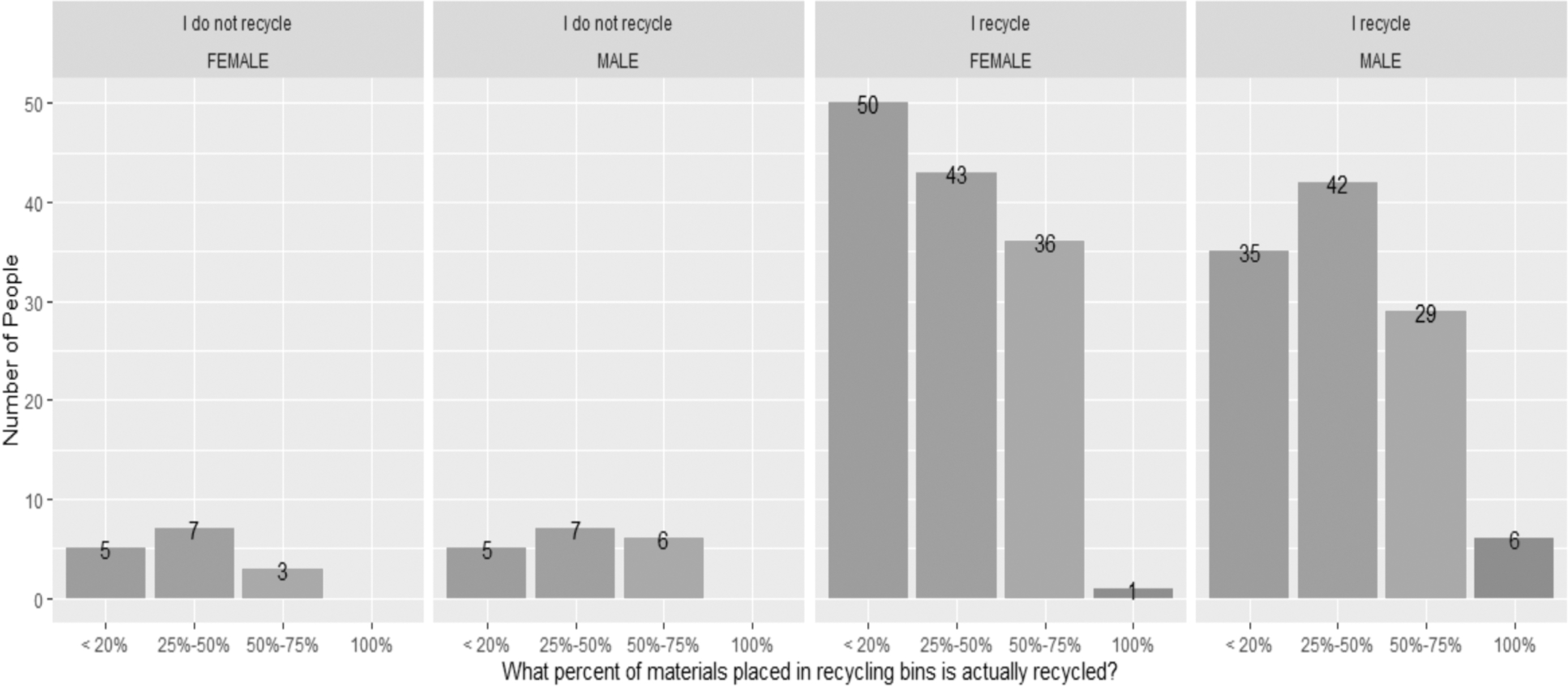
Response to survey Question 14
Question 14 serves as a proxy to assess the level of knowledge of the recycling outcomes. The exact percentage of material intended for recycling that is actually recycled is difficult to measure, partly due to variations across systems and communities. In 2015, of the 8.3 billion metric tons of plastic that were produced, 6.3 billion metric tons became plastic waste. Of that, only 9 percent was recycled; 12 percent was incinerated, and 79 percent accumulated in landfills or the natural environment (Geyer et al., 2017). The United Nations estimates that 80 percent of ocean plastic originates on land, either from storm drains, wastewater treatment plants, or trash (United Nations, 2017).
Specific to survey respondents, both females and males who characterized themselves as actively engaged in recycling, as displayed in Figure 1, 62 percent believed that 25 percent or more of items placed in recycling bins are recycled. Their perception of the success rate of recycling is related to many factors including accessible recycling receptacles, advertising and educational programs, and social norms. However, underlying participation in recycling is likely to be related to a desire to engage in pro-environmental behavior, and this may tie to the perception of the need to engage in behavioral change to affect the present speed of climate change.
Question 12 is useful in mapping the relationship between environmentally related choices and an individual's perception of the speed of climate change. In their 2019 report, Ballew et al. noted that 69 percent of Americans believe global warming is happening, while 59 percent of Americans believe that people in the United States will be harmed by global warming. Similarly, surveys from the Pew Research Center found that about 59 percent of Americans believe global climate change has affected their local community a great deal or to some extent in 2018 (Poushter & Huang, 2019). These reports highlight the current polling data on global warming and the importance of this issue to the American population. Specific to Massachusetts and Suffolk County, where the sample was collected, according to the Yale Program on Climate Change Communication (Marlon et al., 2020), 75 percent of county residents believe that global warming will harm people in the United States, and 72 percent believe that global warming is caused mostly by human activities.
With respect to the course survey and as displayed in Figure 2, 89 percent of the total respondents, males and females, who noted that they do recycle, classified climate change as a significant issue. Interestingly, 85 percent of respondents who stated that they do not recycle also characterized climate change as a significant issue. For this latter group, a question on access to recycling would have been valuable in interpreting the response to climate change given their recycling behavior. However, from the literature (Chen & Tung, 2010; Lange et al., 2014; Sidique et al., 2010a; Viscusi et al., 2013), access to recycling would be expected to be the limitation. For the recycling group, the response of “significant” was expected.

Response to survey Question 12
Next Steps
Perception may be a more significant motivator of recycling activity than reality, in particular because it can be formed through multiple channels. For recycling, there is a clear indication that corporate marketing has been significant and holistic. The Recycling Partnership (2020) has influenced the perception of recycling, lobbied for funding for recycling, and funded recycling programs. Given the EPA's relationship with the Recycling Partnership and the agency's own educational outreach (Environmental Protection Agency, 2018) there is also a direct connection between municipal perception of the environmental benefits of recycling and access to recycling channels. Direct marketing promoting the success of recycling has informed opinion and contributed to perception, while boosting recycling infrastructure and access has established social norms related to recycling.
These outcomes are visible in survey responses as well. The connection between recycling action and perception of climate change highlights that individual action may be directly related to an interest in contributing to climate change mitigation; a direct survey question would have provided more definitive insight and should be included in future survey administration. However, even an inferential relationship provides an indication that marketing to promote pro-environmental behavior may facilitate meaningful behavioral change where access and understanding are provided with respect to the action being sought. More specifically, climate change-mitigating behavior may need to be pursued using the same marketing strategies employed by corporations in pursuit of their goals. The next step for facilitating climate change-mitigating behavior should employ robust stakeholder engagement to eliminate participation barriers, and stakeholder-focused communications to motivate action. Given the traction of recycling, there is precedent that if understood and made accessible, climate change-mitigating behavior can become a social norm.
Footnotes

References
Supplementary Material
Please find the following supplemental material available below.
For Open Access articles published under a Creative Commons License, all supplemental material carries the same license as the article it is associated with.
For non-Open Access articles published, all supplemental material carries a non-exclusive license, and permission requests for re-use of supplemental material or any part of supplemental material shall be sent directly to the copyright owner as specified in the copyright notice associated with the article.
