




Abstract
This study explores youth engagement practices in environmental activities. The evaluation is based on a survey; respondents consisted of 400 youths from two subdistricts located in Muallim, Perak, Malaysia: Slim and Hulu Bernam Timur. The data was analyzed descriptively to obtain the Cronbach alpha values, and Exploratory Factor Analysis (EFA) was performed using SPSS 22 software. The results of the EFA reveal four youth engagement practices: Purchasing Activity Practices (AAP), 3R Activity Practices (AA3R), Energy Saving Practices (APT), and Travel Mode Practices (AMP). These practices may inform environmental education and behavioral targeting to promote sustainability among youth in Malaysia and the evaluation provided in the discussion may be duplicated to assist in similar practices assessment in other areas.
Introduction
Sustainability is defined as a condition that must be maintained for the ongoing needs of future generations (UNESCO, 2014). Therefore, sustainability can act as the impetus for a country to develop and maintain a stable economy, society, and environment (UNESCO 2012). Since the physical environment is the foundation for of all human activities, it needs to be utilized in a manner consistent with stewardship to ensure sustainability for future generations (Zainal Abidin, 2012).
The physical environment is, in fact, embedded in the concept of sustainability, as life depends on the interdependence of humans and ecosystems. However, various actions characterized as “development”, especially those related to infrastructure, have been deployed to meet social and economic needs of the population, such as access to health care, education, and recreation (Mohd Azlan et al., 2012) without sufficient attention to the environment. The outcome is observable rising global temperatures and increased pollution (Er et al., 2015). These issues are widely discussed as they have become a global concern among societies not only in Malaysia but around the world (Hanifah, et al., 2015).
The cognizance of the adverse human impact on the planet has increased interest in global collaboration. The United Nations (UN), for example, has implemented Agenda 2030, which form the 17 Sustainable Development Goals (SDGs) (United Nations, 2018). The SDGs are global in application but dependent on state prioritization with respect to localized focus; they are also non-binding and non-enforceable.
As a country, Malaysia actively pursuing sustainability (Saiyidatina Balkhis, et al., 2017) and is guided by both the SDGs and internal plans, specifically the Eleventh Malaysia Plan (RMK11). These actions recognize that comprehensive SDGs implementation will necessitate the mobilisation of resources such as manpower, capacity building, physical spaces, and funding. Central to Malaysia's implementation is environmental protection. There is optimism that the aspiration for sustainability can be realized through youths (Noor & Fatima, 2013).
In Malaysia, the Ministry of Youth and Sport has defined youths as being between the ages of 15 and 40 (Ministry of Youth and Sports Malaysia, 2006). The roughly 13.3 million youths in Malaysia are the largest population segment of the country, comprising about 44 percent of the population. In line with this, Malaysia has promoted various environmental conservation activities involving youths; these programs are designed to shape sustainable living (Perak State Section Office, 2019). The government has developed various policies and regulations to cover a wide range of ages and to offer programs for the purpose of realizing environmental sustainability in line with the 11th Malaysia Plan goals.
Programs operate in every state and district in Malaysia, for example, the Muallim district, Perak, where an initiative conducted by the Tanjong Malim District Council runs programs like community service and recycling (Tanjong Malim Youth Council, 2018). Other programs seek to raise awareness about environmental protection and adoption of Reuse, Reduce and Recycle (3R) such as the National Blue Ocean Strategy (NBOS) Programme (Ministry of Human Resources, 2017).
To improve ecosystem management, systematic efforts are required (Hanifah et al., 2016). However, practices that contribute to environmental sustainability have not been widely adopted. For example, there remains limited focus on conservation and consumption choices such as, reducing electricity use, reducing solid waste, saving water, recycling, and purchasing eco-friendly products (Ismaila et al., 2016). As environmental issues become increasingly challenging, there is a need to involve the community, especially youths. However, there is still insufficient involvement of youths in environment-related activities (Norhusna, 2014).
The present study was conducted to identify the practice of environmental sustainability in terms of the degree of engagement among youths in the Muallim District, Perak, Malaysia (Youth City). The value of the analysis is in determining how to engage with Malaysian youth. Youths play an important role in shaping the for the country, one that includes sustainability.
Youths and the Practices of Environmental Protection Engagement Activities
Human-made environmental problems such as air pollution, water pollution, solid and toxic waste disposal, uncontrolled or illegal logging, natural resource depletion, among others have led to environmental imbalances. As practices can become habit forming, it can be extrapolated that if a practice is repeated on a regular basis, interest in participating in an activity or a programme would increase, especially in the context of this study regarding youth participation.
According to Hart (1992), there are seven levels of active youth participation in an environmental program, see Figure 1. At the “manipulation” level, the activity is directed by adults without any input from the youths. At this stage, the youths only follow instructions given by older adults. The “tokenism” level is directed by adults with minimal input from the youths. The “assigned but informed” level is directed by adults, but the youths are asked to play a role in decision making, which could lead to greater interest by the youths in the outcome. At the “consulted and informed” level, the activity is directed by adults, but the youths are asked to give feedback. People that are close to youngsters encourage them as collaborators in the process at the next level. The “child-initiated and directed” level is the point at which youths initiate and direct a project or a program independently; adults are just acting as supporters.
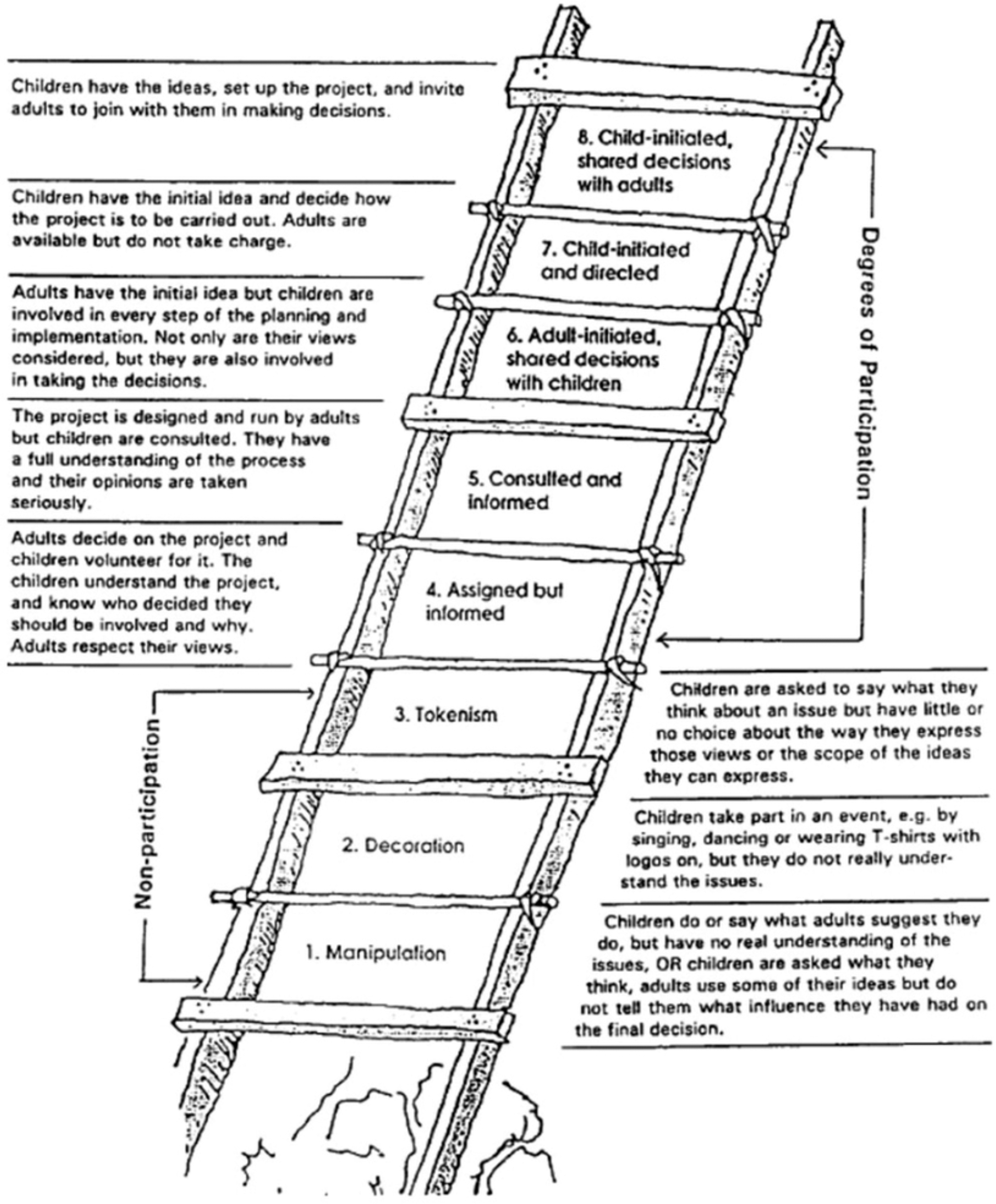
Roger Hart's Ladder of Participation. Source: Hart (1992)
In Malaysia, youth engagement and practices toward environment-related activities are limited for potentially several reasons (Norhusna, 2014). Some youths refuse to engage in environmental protection practices despite understanding their importance, as was found in a study conducted by Abdul Latiff et al. (2012) in Klang Valley involving youths from 18 to 25 years of age. This study showed that, on average, the youths were of the opinion that their individual participation would not change the world.
Norhusna (2014) found that in order to generate environmental engagement practices various parties such as education institutions must play a role in exposing environment-related knowledge, especially through social media. Social media makes it easier for youths who are involved in environmental activities to spread awareness to other peer groups. A study by Riemer et al. (2014) also identified youths as an excellent target group in environmental involvement because of their ability to effectively encourage other youths to engage in environmental activities. In a study by Schusler et al., (2009), people who practiced environmental sustainability and shared their activities facilitated youth participation in these environmental practices.
Many factors may encourage youths to participate in environmental protection activities. A study by Sharififar et al. (2011) highlighted that motivational factors to protect the environment were important in fostering the interest and commitment of youths in carrying out an activity. Phillips and Phillips (2010) noted that appropriate rewards could enhance participation if the current economic conditions affected people's lives, especially for youth. However, Bowman (2009) and Fiorillo (2011) revealed the opposite; these studies found that monetary rewards did not make a person more motivated to engage in environmental activities.
Social factors also affect youths' environmental protection practices (Charlie & Ng Yuen, 2014). Wahid et al. (2011) suggested that social influence is a proxy for subjective norms. Furthermore, DeLamater and Myers (2010) concluded that attitude and behavior can be influenced by the actions of others, such as persuading. Rashotte (2007) suggested that social influence could be defined as a change in the thought, feeling, attitude, or behavior of an individual resulting from interactions with other individuals or groups. Such a change indicates that youths can be influenced by the people around them, including friends, family, and community members.
Materials and Methods
This study adopted a quantitative research approach using a questionnaire to validate the Malaysian youth engagement practices in environmental activities. The sample group was located in the Muallim district of Perak, Malaysia, a district that has the potential to be a Youth City (Perak State Secretary's Office, 2019). A Youth City in Malaysia is an integrated development that gives young people the opportunity to thrive in the realms of work and entrepreneurship and enables them to improve their skills and abilities, while enjoying a prosperous life with recreational facilities, affordable housing, transportation and a harmonious environment (Majlis Daerah Tanjung Malim, 2016).
Study Location
Data was gathered in the Muallim district of Perak, Malaysia, which is the 11th district in the state of Perak, Malaysia. There are three subdistricts (mukim) within the Muallim district: Mukim Slim, Mukim Hulu Bernam Barat, and Mukim Hulu Bernam Timur (Tanjong Malim District Council, 2018). Two subdistricts, the Slim and East Hulu Bernam subdistricts, were included in the study; these were chosen because of their larger population size to ensure more accurate data (Bhasah and Yuslina, 2013).
The Muallim district is located in Hulu Lembangan Sungai Bernam, a unique area located at the foot of the Titiwangsa Range, famous for its green landscape, rivers, waterfalls, and temperate climate. Within this unique environment, the impact of humans on the physical environment, particularly forests affects the ecosystems in Tanjong Malim, and its abiotic and biotic components (Mohamad SuhailyYusri, Mohmadisa, Nasir, Yazid & Zahid, 2012). The study location is shown in Figure 2.

Map of the Study Area
Population and Sample
The youth cohort for this study is defined as those who are at the stage of transition between children and adults (Gill, 2003). The youth population in Muallim consists of 35,400 individuals—18,900 young men and 16,500 young women, between the ages of 19 and 40 (Tanjong Malim District Council, 2018). In selecting the number of people for samples for this study, Krejcie and Morgan's (1970) guide was used: when the population of a study is in the range of 30,000 to 40,000, a total minimum of 380 people in the sample is required to complete the data. In addition, Tabachnick and Fidell's (1996) rule of thumb was followed: the suitable sample size for factor analysis is above 300 respondents. Therefore, the study aimed for 400 respondents who could represent the youths of two subdistricts in Muallim (200 respondents from Slim and 200 respondents from Hulu Bernam Timur). The study used a simple random sampling technique to ensure that every youth in the population had the same chance at being selected as a respondent (Chua, 2006). The selection of respondents was voluntary.
Research Instrument
Content of the questionnaire was reviewed by five validity experts in environment field. The questionnaire used in this study contain two sections: Section A—respondents' demographic information, and Section B—level of engagement in environmental activities. The questions in this section were developed and modified from the environmental activity's guidelines of the Malaysia Ministry of Energy Green Technology and Water (2015). The completed questionnaire information shown in Table 1 and Table 2.
Questionnaire Information
Item Information and Statement for Youth Engagement Environmental Activities Practices
Data Analysis Methods
The questionnaire instrument was used for data collection and was then put through an exploratory factor analysis (EFA) for the grouping of the items that truly represent the study variables. This was needed since the environmental activity's guidelines from Malaysia Ministry of Energy Green Technology and Water are not grouped. According to Hair et al. (2010) the EFA the procedure must follow these rules / cut off point:
Exclude items with values of anti-image correlation matrix below 0.50. Eliminate items that do not belong to any factor. Exclude items that belong to more than one factor. Eliminate items that have two values. Retain in their respective components with the items that the value of factor loadings greater than or equal to 0.50. Eliminate any items that have an abnormal factor loading with the construct formed. Eliminate items that do not meet the Kaiser–Meyer–Olkin (KMO) sample adequacy test, which must be at least 0.60 or above.
KMO was used as a measure of the suitability of the data for factor analysis. The number of factors was based on the correlation of the item. At least three items were required for each factor. Developing each factor was based on theory and previous studies.
Results
Table 3 provides the profile of the respondents, which includes information regarding the respondents' background, such as their subdistrict, age, gender, race, marital status, highest education level, employment sector, and household income. As noted in Table 2, the total number of respondents was 400 individuals. These individuals represented the sub-districts of Slim and Hulu Bernam Timur in the Muallim district, with the distribution evenly divided between the two.
Respondents' Background
Respondents' Profile
Exploratory Factor Analysis (EFA) for the Constructs of Youth Engagement in Environmental Activities Practices
Table 4 shows the sampling adequacy measurement of the KMO test and Bartlett's test of sphericity produced a KMO value of 0.850 (more than 0.60 that indicate the sampling is adequate), while the Bartlett's test of sphericity was significant with a Chi-square value of 1824.797 at 66 degrees of freedom. This value follows these rules / cut off point as stated in methodology.
Suitability Test on the Use of Factor Analysis and the Uniformity of KMO and Bartlett's Test Items on the Constructs of Youth Engagement Environmental Activities Practices
A factor analysis was performed to determine the number of factors in each variable. Table 5 shows the component matrix with varimax rotation. The varimax rotation method was performed to reduce the number of complex constructs and increase the number of estimated outcomes. The analysis found that the loading factor of items a1, a2, and a3 belonged to Component 1, representing the purchasing activity practices (AAP) component. Items a4, a5, and a6 belonged to Component 2, 3R activity practices (AA3R); items a7, a8, and a9 belonged to Component 3, energy-saving practices (APT); and items a10, a11, and a12 belonged to Component 4, travel mode practices (AMP).
Component Matrix with Varimax Rotation of the Constructs of Youth Engagement Practices towards Environmental Activities
Legend:
AAP=Purchasing Activity Practices
AA3R=3R Activity Practices
APT=Energy Saving Practices
AMP=Travel Mode Practices
Discussion and Conclusion
Findings from the study clearly showed that each EFA produced a grouping for each item, based on the requirements. KMO values between 0.8 and 1 indicate that the sampling was adequate. According to EFA, there were three factors discovered for each variable: factors, effects, and ways to overcome environment issues. The findings of this study were directly contrasted to those of Brondi et al. (2012), who found four factors of youth involvement in environmental issues: identification with the region, collective self-esteem, social integration, and social contribution. Environmental measures can be broken down into categories of participation frequency, involvement, desire for change, environment supportiveness, support, and resources, according to Coster et al. (2011), who stated that for psychometric evaluation of study participants, environmental measures can be broken down into participation frequency, involvement, desire for change, environment supportiveness, support, and resources. Therefore, from this study, it can be concluded that youth commitment to environmental protection activities and practices can be measured by spending activity practices (AAP), 3R activity practices (AA3R), energy saving practices (APT) and travel mode practices (AMP).
Conclusion
The study described in this article sought to validate the rationale for youth engagement practices related to environmental activities using EFA. These results can serve as a guideline for further research to identify the elements of commitment to environmental sustainability among youth in Malaysia. It is intended that similar research will provide insight into the importance of environmental sustainability to Malaysian youth and will assist stakeholders in raising awareness as role of youth for a cleaner and greener environment.
Footnotes
Funding Information
This article is based on the research project Pembangunan Model Penglibatan Belia ke Arah Kelestarian Alam Sekitar. The authors would like to extend their gratitude to the Research Management and Innovation Centre (RMIC), Sultan Idris Education University (UPSI) for the University Research Grants (code: GPU 2018-0129-106-01) that helped fund the research.
Author Disclosure Statement
No competing financial interests exist.