




Abstract
Globalization, industrialization, the increase in world population, and the rapid consumption of natural resources are of increasing concern for people all over the world. Consumers have started to show an interest in purchasing products that create less waste, can be reused, and are produced by environmentally friendly methods. Since the concepts of sustainability and green consumption are gaining importance as environmental problems grow, consumer behavior is significant in both fostering change and in limiting it. This article examines the relationship between green consumption values, social appreciation, and green purchasing behavior. To inform these relationships, 1,024 people in Turkey were surveyed and structural equation analysis was carried out on the data collected. Findings indicate that individuals' green consumption values have a very strong positive correlation with green purchasing behavior. The data also show that green consumption values have a weak correlation with social appreciation, and social appreciation has a very weak positive correlation with green purchasing behavior. This study also includes an extensive literature review focused on the three key concepts of the investigation: green consumption values, social appreciation, and purchasing behavior.
Introduction
The increasing rate of industrialization and the development of industrial life have contributed to the destruction of nature and the deterioration of ecological systems. Recognition of this issue has led to an increase in social and political pressure to address the problem and attempt to reverse course. After Turkey's ratification of the Paris Climate Agreement (Yücel & Kurnaz, 2021), in-country studies were conducted on environmental issues related to both public and private sectors. Presidential Decree No. 85, published in the Official Gazette on October 29, 2021 (numbered 31643), changed the name of the Ministry to the Ministry of Environment, Urbanization and Climate Change (Official Gazette of the Presidency of the Repuclic of Turkey, 2021). To address environmental issues in Turkey, mandatory waste management processes in public buildings were implemented, and businesses in the private sector followed suit. In schools, environmental lessons have been added to the curricula.
Environmental legal regulations are strictly enforced by the government and necessary controls are carried out regularly. In addition, the Turkish government encourages investment in environmental activities and environmentally friendly companies. Many companies in Turkey now prepare sustainability reports (Ersoy, 2021; Yücel & Kurnaz, 2021). Because most developing countries don't have the resources to fund research on the environment, this type of research is generally reported in the literature on sustainability and environmental issues. For countries to develop meaningful and effective environmental policies, additional environmental studies are needed.
Specific to consumer activities, as environmental problems are a great and growing concern for societies, individuals express their concern through purchase of products that are considered green. Because increasing global competition is forcing companies to be more responsive in meeting consumer demands, using green processes are gaining importance throughout the supply chain.
This study examines the relationship between green consumption values, social appreciation, and purchasing behavior. While the relationships between social factors and green purchasing behaviors have been investigated in the literature (Khare et al., 2013; Korkmaz, et al., 2017; Sharma & Gadenne, 2014), no study has examined the dynamics of green consumption values, social appreciation, and green purchasing behavior. The research results shared in this article facilitates understanding of the significance of social awareness and offers insight to assist in developing policy within Turkey and countries with similar economic development, in their environmental practices.
Literature Review
The relationship between green consumption values, social appreciation, and purchasing behavior are the key concepts to this study and comprise its theoretical framework. A literature review was conducted for each concept to provide the foundation for the sections that follow.
Green Consumption Values
The issue of green consumption has been addressed in many studies, with aspects of the subject well represented in the literature. Examples include green consumption values of consumers as related to national culture and ethics (Halder et al., 2020); psychological power attributed to consumers who show a preference for green products (Yan et al., 2021); green consumption habits and corresponding personal characteristics (Cleveland et al., 2005; Lu et al., 2015); expenditures on green consumption (Al Mamun, et al., 2018). Some researchers have focused on understanding consumer behavior, for example, Haws et al. (2014); others developed green consumption values scales to better understand green behavior. Haws et al. (2014) define green consumption values as the tendency of consumers to examine the value of environmental protection through their purchasing and consumption behavior.
Bailey et al. (2016) conducted a study evaluating the response of Indian buyers to green marketing and conclude that green consumption values affect consumers’: understanding of and support for green brands; views toward green marketing communications; and buying intentions. Consumers' environmental concern motivates green purchasing behavior (Bamberg, 2003).
Analysis by Uddin and Khan (2016) of young individuals in India found that green purchasing behavior is affected by environmental participation, environmental attitude, environmental awareness, and the perceived effectiveness of environmental behavior. Dagher et al. (2015) found a positive relationship between environmental attitudes and green purchasing behavior, and suggest that for women, this relationship grows stronger with increased positive environmental attitudes. Lee's (2009) study of green consumption behavior in young adolescents in Hong Kong shows that female adolescents have stronger positive environmental attitudes than men. Other gender differences indicate females have more environmental anxiety, they recognize the severity of environmental issues, understand environmental responsibility, have greater peer influence, and engage in more frequent green purchasing behavior. Male adolescents, on the other hand, exhibit greater interest in environmental protection than females. Zhao et al. (2014) show that attitudes toward green consumption have a significant positive effect on purchasing behavior. Buyers who highly value green consumption generally tend to buy more responsibly and respect the natural environment (Haws et al., 2014; Do Paço et al., 2019).
A study conducted in India examines the effect of green consumption values and rationales for purchasing or not purchasing green products, on consumer attitudes toward green products and intent to purchase them (Chatterjee et al., 2021). Researchers Tan et al. (2022) state that context-specific consumption values—including emotional, productive, social benefit (social), and protester (epistemic) values—significantly and positively affect consumers' green consumption values. Their study shows that consumers' green consumption values have a significant and positive effect on economic and practical values.
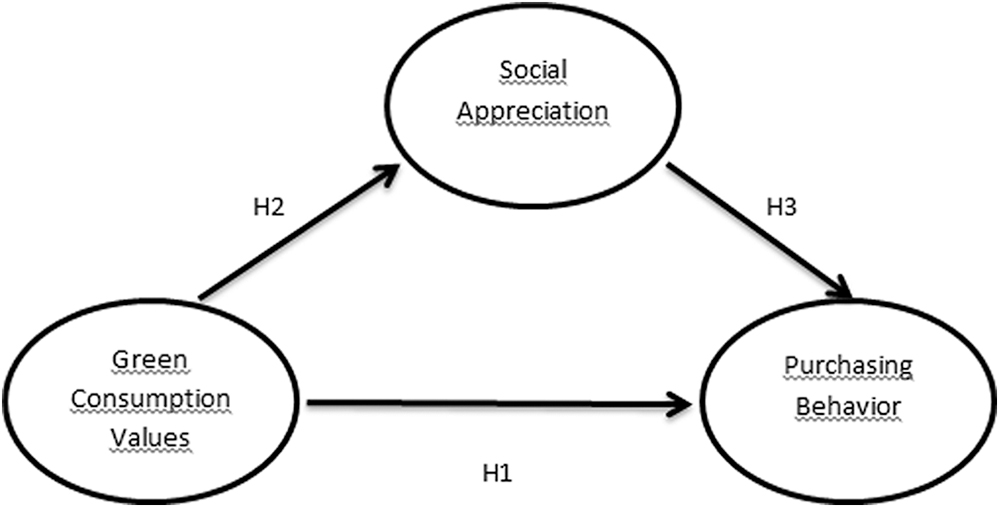
Based on this information, the following hypothesis was formed:
H1: An individual's green consumption values positively affect their green purchasing behavior.
Social Appreciation
To compete in today's market, businesses need to consider many aspects of consumers preferences as well as related social, cultural, and psychological factors. Sustainability research includes the idea that numerous environmental issues can be expressed as social quandaries (Naderi & Strutton, 2015). Increasing concerns about global climate change and environmental degradation are making an appreciation for a sustainable lifestyle and green products social norms around the world (Elkington, 1994, as cited in Wang & Kuah, 2018). According to Cheah and Phau (2011), interpersonal influence and attitudes toward environmentally friendly products have strong correlations. Khare, et al. (2013) conclude that interpersonal influence and social influence affect consumers' green product purchasing behavior. Sharma and Gadenne (2014) reveal positive significant relationships between social effects and consumers' environmental habits, their willingness to contribute money, and voluntarily acting to protect and improve the environment.
In their research, Sivapalan et al. (2021) examine green consumer behavior with two different consumer value systems groups: consumers' personal values (PVs), which refer to altruistic, biospheric, and egoistic values; and consumers' consumption values (CVs), which refer to the functional, psychological, economic, or social benefits that consumers perceive in relation to a green product offer. Because Sivapalan et al. think that the existing models in the literature are insufficient to adequately explain the factors that affect consumers' green purchasing decisions, they present eight testable propositions to fill the relationship gaps between CVs and PVs. The researchers also note that altruistic and biospheric consumers may be motivated to enjoy their pro-environmental resume to feel ethically right and gain social approval.
Mutum et al. (2021) show that the relationship between environmentally friendly self-identity (PESI) and green purchasing behavior (GPB) is mediated by emotional, epistemic, social, and health values. Their study also shows that promoting the advantages of green products and strengthening PESI and consumption values are closely linked to GPBs. Mutum et al. also found that peer referral minimizes the perceived risks associated with purchasing green products.
Korkmaz et al. (2017) determined that there is a favorable relationship between interpersonal impact, social impact, and green product purchasing behavior. Therefore, a potential inference is that green consumption values and purchasing behavior can be a means of acquiring social desirability.
In this context, the following hypotheses were formed:
H2: Green consumption values of individuals positively affect social appreciation.
H3: Social appreciation of individuals positively affects green purchasing behavior.
Purchasing Behavior
In the academic literature, expressions such as “green purchasing” and “green acquisition,” are used to investigate the green purchasing behavior of buyers (Zaremohzzabieh et al., 2021). Green purchasing activity is expressed as the purchase of products and services that have less impact on human health and the environment compared to competing products or services (Joshi & Rahman, 2016). A green purchasing policy is a guide for businesses to consider the environmental and human health impacts when purchasing materials, products, and services (Ghiassi-Farrokhfal et al., 2021).
Green purchases are defined as those that have a low environmental impact and are more sustainable in terms of the materials and production practices from which they are made (Joshi & Rahman, 2016; Nguyen, et al., 2018; Uddin & Khan, 2018). Alternatively, Sarkis & Dou (2017) define green purchasing activity as the purchase of products that have a lesser or decreased negative effect on human health and the environment or the purchase of products that have increased positive effects on the environment and people. While green purchasing behavior is defined by Chan (2001) as purchasing services and goods that minimize the damage to the environment, in many studies, green purchasing behavior is generally expressed as purchasing products that are beneficial to the environment (Guenther et al., 2013; Nguyen et al., 2018; Uddin & Khan, 2018).
In the current century, concerns about global warming, climate change, excessive use of natural resources, and air and water pollution are increasing, and consumers are more aware of environmental degradation (Zaremohzzabieh et al., 2021). Environmental degradation has begun to change the lifestyles and business activities of both consumers and companies and has led to the emergence of green marketing and thus green purchasing behavior (Ghiassi-Farrokhfal et al., 2021; Zaremohzzabieh et al., 2021). Consumers' increasing awareness has led many to adopt green purchasing behaviors (Ahmad & Zhang, 2020; Wei et al., 2021; Xu et al., 2020).
The strategic role of purchasing is crucial because of its potential to foster communication and mutual benefit among supply chain members. Buying companies need to pay attention to the environmental performance of their vendors and suppliers. Green purchasing and sourcing activities enable buyers (companies) to significantly influence their environmental performance.
In their research, Guenther et al. (2013) investigate how to improve the green purchasing behavior of organizations. Their survey involved six municipalities in five European countries, asking: “Why don't institutions practice green purchasing?” Their study suggested that the biggest obstacle is the assumption that the efforts will be in vain, followed by recognition that they don't have enough information to address the question. Chan & Lau (2002) discuss the importance of green purchasing and compare the green buying behavior of Chinese and American consumers. Galeazzo et al., (2021) examine the impact of green purchasing activities on a company's financial performance in the travel sector, emphasizing that tourists have not paid much attention to green purchasing until recently. Their study analyzed data from 122 companies in the travel sector over a period of seven years to determine if an ecological personality mediates the relationship between media exposure and green purchasing behavior and whether gender also manages these relationships.
Yang & Zhang (2021) used structural equation modeling and multiple regression analysis on 530 sample consumers, finding that exposure to media can shape people's ecological personality traits and thereby affect green purchasing behavior. However, green practitioners emphasized the importance of being aware of the need to adopt green information strategies to the personality and gender of their target audiences to carry out green purchasing activities.
Caniels et al. (2021) have determined that green purchasing is more expensive than purchasing non-green products. Similarly, Gupta and Ogden (2009), Barbarossa and Pastore (2015), and Nguyen et al. (2018) found green products to be expensive compared to their non-green counterparts. In addition, green products may be difficult to find in some markets, there are fewer options for purchasing them, and they are not always available (Caniels et al., 2021; Gleim et al., 2013). Further, green products are only sold in certain markets and purchasing them imposes extra time and cost for consumers (Barbarossa & Pastore, 2015; Chan & Lau, 2002; Caniels et al., 2021). In addition, consumers who want to buy green products do not always fully understand the identifying labeling on the products (De Pelsmacker et al., 2015). In effect, purchasing green products is a process that requires special attention by the consumer (Caniels et al., 2021), making more demands on them than other products (Gupta & Ogden, 2009; Sarkis & Dou, 2017). These difficulties have a negative effect on green purchasing (De Pelsmacker et al., 2015), deterring consumers from engaging in green purchasing activities (Barbarossa & De Pelsmacker, 2016).
Young consumers represent a strong driver for the growth of environmentally aware populations and an up-and-coming market for green products. This population is motivation for marketers and institutions as target markets when developing strategic marketing campaigns and environmental training programs (Sarkis & Dou, 2017). Nguyen et al. (2018) conducted research on factors that can simplify or inhibit green purchasing behavior among young consumers in an emerging market in Vietnam. Their research surveyed 289 people to determine the factors affecting their purchasing behavior. Similarly, Uddin & Khan (2018) used a model to test the effect of environmental attitudes on green purchasing behavior and confirmed that environmental attitudes of young consumers affect their green purchasing behaviors. Figure 1 provides a visualization of the research model to be tested.
Research Model
Research Methodology
Sampling and Data Collection
In order to examine the relationship between green consumption values, social appreciation, and green purchasing behavior, an online survey was utilized to reach individuals during the Covid-19 pandemic. The sample population, determined through convenience sampling, was comprised of 1,024 individuals from various parts of Turkey without regard to regional and urban differences.
As a developing country, Turkey has a disproportionately young population, many of whom are interested in environmental issues. Because many environmental impacts will be even more prominent in the future, this population will be most affected, a factor that prompted this study.
The population of Turkey at the time of the study was 83,614,362 (Turkish Statistical Institute, 2021). The sample size was determined using the sample calculation formula of Barlett et al. (2001). Based on their formula, the research confidence level was 95 percent (z value (t)=1.96 for the alpha 0.05 table), the standard deviation value for the population was 0.5 (s), and the research population was 83,614,362. When the numbers were substituted in the formula, the sample size was determined to be 384. This number is considered sufficient when the number of units in the main mass is not known (Gürbüz & Şahin, 2017).
Questionnaires were sent to the sample population with coded data forms that were evaluated and transferred to the computer for analysis in SPSS® Statistics 22 software. The research described for this research is not an experimental study. The individuals in the sample consented to the study and their statements as recorded by the questionnaire were evaluated. There was no institutional ethics committee report on the research.
Scales
A six-item scale developed by Haws et al., (2014) was used to determine the green consumption values of individuals. To measure social appreciation, the Social Appreciation Scale consisting of 15 expressions developed by Erzen et al. (2021) was used. The 10 statements included in the Straughan and Roberts (1999) Ecologically Conscious Consumer Behavior scale, including topics such as energy efficiency, packaging, polluting or recycled products, were used to measure the green purchasing behavior. Do Paço et al. (2013) and Do Paco et al. (2014) tested this scale and included it in consumer behavior models. The scales were measured with a 5-point Likert scale in which 1 represents “Strongly Disagree,” 2 represents “Disagree,” 3 represents “Neither Agree nor Disagree,” 4 represents “Agree,” and 5 represents “Strongly Agree.”
Analysis of the Data
Factor Analysis, Reliability Analysis, Regression and Correlation Analysis, and Structural Equation Model were used to test the connections among green consumption values, social appreciation, and purchasing behavior with the help of the available data.
Results
Descriptive Statistics
To test the relationships among the variables, descriptive statistics of the data collected from the sample population were collected and tabulated (see Table 1). Of the sample 1,024 individuals, 572 individuals were women (56%) and 443 were men (43.2%); 9 individuals did not specify their gender (0.8%). In terms of marital status, 399 respondents were married (39.2%), 599 people were single (58.8%), and 20 people did not want to answer the question (2%).
Characteristics of Sample Population
Respondents age range broke down as follows: 344 were between the ages of 18 and 25 (33.6%), 299 were between the ages of 26 and 36 (29.2%), 208 were between 37 and 47 (20.3%), 144 were between 48 and 58 (14.1%), 25 were between 59 and 69 (2.4%), and 4 individuals did not answer this question (0.4%). There was no one over 70 years old in the study.
Of the total sample, 11 were literate (1.1%), 54 completed primary school (5.3%), 36 completed secondary education (3.5%), 147 were high school graduates (14.4%), 145 held an associate's degree (14.2%), 492 were licensed (48%), 123 completed graduate education (12%), and 16 individuals (1.6%) did not provide information about their educational status. Thus, the majority of the participants had graduated from a higher education institution. The literate group consists of individuals who had not graduated from any educational institution, though they could read and write.
More than half of the participants, 601 out of 1,024 (58.7%), were working. This rate would likely have been even higher without the inclusion of the 18 to 25 group. There were 406 individuals (39.6%) who responded that they were not working, and 17 individuals (1.7%) did not share their employment status.
Factor Analysis
The Kaiser-Meyer-Olkin (KMO) test is a sample adequacy test—a test that shows the suitability of factor analysis. The increase in the KMO value is affected by an increase in sample size, mean correlations, number of variables, and decrease in the number of factors (Kaiser, 1974). A KMO value between 0.5 and 1.0 is considered acceptable, while values below 0.5 indicate that factor analysis is not fit for the data set. Therefore, if the value is lower than 0.50, factor analysis cannot be continued (Cokluk et al., 2012). It is generally agreed that 0.7 is a satisfactory KMO value (Malhotra, 1996 as cited by Coşkun et al., 2015).
The Bartlett test measures whether the data point to a correlation between variables or if they are unrelated. If the p-value is greater than 0.05, the data set is suitable for factor analysis. KMO and Bartlett tests are done together to determine whether factor analysis can be done. The expectation is that the Bartlett Test results will be significant and the KMO Test results will be greater than 0.50 (Coşkun et al., 2015).
The results of the Barlett Test and KMO test are given in Table 2. KMO values were found to be greater than 0.50. so, it can be concluded that the sample size is suitable for factor analysis. The results of the Barlett sphericity test show that the p-value is significant with .00. Since KMO is greater than 0.5 and Bartlett sig is less than 0.05, the data is appropriate for factor analysis.
Results of the Barlett Test and the Kaiser-Meyer-Olkin Test
For this study, factor analysis was applied in line with the results of both the KMO test and the Bartlett Test of Sphericity. If the factor analysis showed a question with a low factor load, it was not included in the analysis. Expressions with factor loadings below 0.3 were excluded from the scale. The result of this analysis shows the relationships between green consumption values, social admiration, and purchasing.
Reliability Analysis
Reliability analysis was conducted to test whether the scales measure consistently or whether there is consistency between scale items (Gürbüz & Şahin, 2018, p. 331).
The reliability analyses indicate that the internal consistency coefficient of the green consumption values scale was 0.957, the internal consistency coefficient of the social appreciation scale was 0.946, and the internal consistency coefficient of the purchasing behavior scale was 0.956. The reliability coefficients in Table 3 for all scales are satisfactory.
Reliability Analysis Results
Correlation Analysis
A correlation test is used to test the connection among two or more variables (Gürbüz & Şahin, 2018, p. 261). The correlation coefficient uses values ranking from -1 to +1 (-1 ≤ r ≤ +1). A coefficient of +1 shows a perfect relationship between the two variables, while -1 shows a perfect inverse relationship between the two variables (Coşkun et al., 2015). In the correlation coefficients, values are categorized as follows: between 0.00 and 0.25, very weak; between 0.26 and 0.49, weak; between 0.50 and 0.69, moderate; between 0.70 and 0.89 high; and between 0.90 and 1.00, very high (Kalaycı, 2008, as cited in Alkan & Arıkboğa, 2017).
The data obtained from SPSS® Statistics 22 analysis revealed that the data exhibited a normal distribution. First, a normality test was performed to determine whether all the data conform to the normal distribution. This test found kurtosis and skewness values between +1.5 and -1.5, showing that the data are convenient for normal distribution (Tabachnick et al., 2007). Similarly, George and Mallery (2010) state that this coefficient remains between ±2.0 and the data do not show significant deviations from the normal distribution. On the other hand, Kim (2013) states that if the number of samples is greater than 300, a coefficient between ±2.0 is acceptable.
The Pearson Correlation test was applied to test the relationship between variables in which the distribution conforms to the normal distribution.
As shown in Table 4, there is a positive and significant correlation among green consumption values and social appreciation and purchasing behavior. In addition, a positive and significant correlation was found among social appreciation and purchasing behavior.
Correlation Analysis Results
Correlation is significant at the 0.01 level (2-tailed).
Regression Analysis
Regression analysis is applied to determine the relationships among two or more variables that have a cause-effect relationship (Gürbüz & Şahin, 2018, p. 268). The study used a regression test to examine the relationship among dependent and independent variables. The purchasing behavior variable was considered the dependent variable, while the social appreciation and green consumption value were considered the independent variables.
Table 5 shows that the green consumption values and social appreciation of individuals have a positive and significant effect on purchasing behavior.
Regression Analysis Results
Structural Equation Analysis
To analyze the hypotheses, the Structural Equation Model was applied to the data and analyzed with the IBM® SPSS® Amos TM statistical program.
The goodness-of-fit values are shown in Table 6. Path analysis and regression weights made within the scope of structural equation modeling are shown in Table 7.
Structural Equation Model Goodness of Fit Values
Structural Equation Model Regression Weights
RMSEA is expected to be 0.05 or less, but a value between 0.05 and 0.08 is also acceptable. If the comparative fit index, CFI, is between 0.97 and 1, it can be said to be a good fit; when its value is between 0.90 and 0.97, the model can be said to be an acceptable fit. While NFI, the normed fit index, has a value between 0 and 1, the model has a good fit if it is greater than 0.95, and an acceptable fit if it is between 0.90 and 0.95 (Brown, 2015; Hu & Bentler, 1999). Using the goodness of fit values of the research model and the data on Table 6, it was determined that the model had a good goodness of fit. Given this, the research hypotheses were tested.
Analysis of the data from results of the path analysis made within the scope of the Structural Equation Model and the data shown on Table 7, indicate that Green Consumption Values have a very weak and negative correlation with Social Appreciation, and a very strong and positive correlation with Purchasing Behavior. As it turns out, Social Appreciation also affects Purchasing Behavior, with a very weak but positive correlation.
Based on this result, hypothesis H1 (Green consumption values of the individual positively affect green purchasing behaviors) was accepted. On the other hand, the data show that Green consumption values have a weak negative correlation with social appreciation. Therefore, the hypothesis H2 (Green consumption values of individuals positively affect social appreciation) was not accepted. Given these results, a fair conclusion is that whether an individual has green consumption values is unrelated to their social appreciation. Rather, individuals have green consumption values because they have environmental awareness and sensitivity, not because it gives them social appreciation. The lack of acceptance of hypothesis 2 may be because environmentally friendly products are often more expensive than other products, as confirmed by the literature (Barbarossa & Pastore, 2015; Gupta & Ogden, 2009; Nguyen et al., 2018). This is not surprising considering the economic situation of developing countries. Since social appreciation appears to have a weak positive effect on purchasing behavior, hypothesis H3 (Social appreciation of individuals positively affects green purchasing behaviors) was accepted.
Limitations of the Research
This research set out to examine the relationships between green consumption values, social appreciation, and individual green purchasing behavior in Turkey. For research purposes, only small slice of a population was included in the survey of 1,024 people. In the survey, no examination was made on the basis of provinces in Turkey, but examinations were made on the basis of individuals who could be reached with the easy data collection method. While considering the attitudes of consumers, no data was collected from managers and employees for sectors.
Future studies could survey populations in other countries and compare data in country-by-country studies. This research could also be improved by including a survey of the attitudes of managers and employees on a sectoral basis. Studies could also focus on a specific age group, especially as environmental attitudes of youths are gaining importance.
Future studies could also develop a model for how an individuals' knowledge about sustainability affects their green consumption. Alternatively, new models could include mediating variables that show indirect and direct effects of social appreciation on green consumption values and green purchasing from the perspective of both consumer and producer. The impact of social appreciation on the difficulties, opportunities, and behavioral changes of consumers in green purchasing tendencies will benefit from additional research that includes those involved in production and logistics.
Discussion and Conclusions
The results of this study indicate that valuing green consumption has a very strong positive effect on green purchasing behavior. This finding is consistent with the literature and like the results found in previous studies (Ahmad & Zhang, 2020; Nguyen et al. 2018; Uddin & Khan, 2018; Wei et al., 2021; Xu et al., 2020). Additionally, results from the present analysis reveal that the more value individuals place on green consumption, the more they engage in green purchasing behavior. This finding supports the importance of green consumption awareness and values in encouraging green purchasing behavior.
Other findings of the present research show a weak negative association between valuing green consumption and receiving social appreciation, similar to the findings in previous studies (Korkmaz et al., 2017; Sharma & Gadenne, 2014). There have been no other studies of these variables in the literature to confirm or refute this data. Future studies may contribute more detailed research to this subject. This study also indicates that consumers' desire for social admiration and appreciation will increase green purchasing behavior.
Overall, the results of this study support raising the environmental awareness of consumers as a very important factor in the formation of green purchasing behavior. From a policy perspective, investment in education related to sustainability could provide a significant catalyst to its adoption.
Footnotes
Funding Information
No funding source (corporate, private, and institutional financial support) was received during this study.
Author Disclosure Statement
No competing financial interests exist.