




Abstract

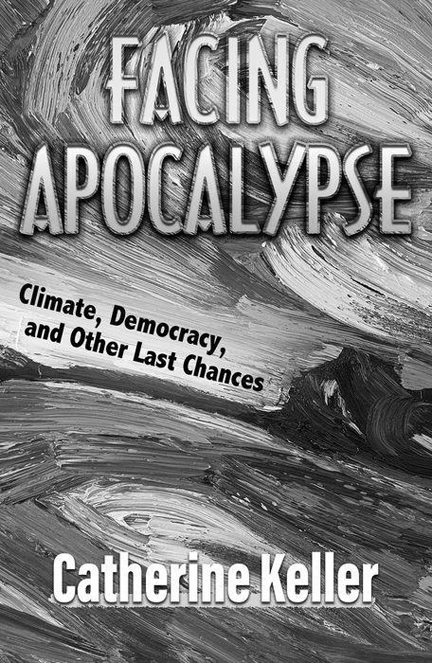
A leading contemporary theologian and feminist author of nine individually authored books and dozens of coauthored works and articles, Catherine Keller serves as our guide as she leads us through the final text of the Christian Bible, the Book of Revelation. She has a heavy lift deconstructing this text, so frequently interpreted, so confounding for many Christians, and yet, so compellingly influential over 2,000 years.
Keller writes that it is scientists who incorporate the language of apocalypse today. A German study found 76 percent of insect life has died off, with untold consequences for our web of life, some calling this “Insect Armageddon.” Keller references an Associated Press newspaper headline: “Earth's Future Is Being Written in Rapidly Melting Greenland Ice” (Borenstein, 2019) and the quotation of a respected air and ocean scientist inferring from that meltdown “the end of the planet” (p. viii).
Keller notes another group engaging in apocalyptic rhetoric consists of right-wing Christian authors who interpret the Book of Revelation literally as prediction rather than prophecy. Identifying McGuire and Anderson's Trumpocalypse_(2018) for example, which hones in on the 45th president as someone who, though flawed, “was chosen by God” for these times, Keller advances an alternative secular prophetic stand emphasizing the centrality of relationship and interdependence in our Homo sapiens situation among Earth's creatures. This is why she writes with urgency.
In Facing Apocalypse Keller employs that interdisciplinary pluralism of contemporary critical thought, with references ranging from bell hooks to John Steinbeck, William Blake to Leonard Cohen to, well, Daniel. Theopoetics characterize her approach to analysis, incorporating a hermeneutic or dialectical methodology for engaging with the last book of the Christian bible. She calls her process “dreamreading.”
Keller launches the discussion of Apocalypse, holding a tension in rhythm between then (i.e., first century CE) and now by introducing us to the subject's author, John of Patmos. He wrote this Book of Revelation, she tells us, as a letter to several young communities, congregations functioning under Roman law, in Asia Minor at the edge of the Roman Empire and at the end of the first century. He was in exile at the time on the Greek island of Patmos. John went about denouncing the economics and politics of his time in a coded language chockablock with imagery that peppers much of what we read today, lo these two millennia on. Keller documents her analysis of that code.
Established immediately are: 1.) Keller is writing for a secular reader, or one of any religious persuasion, not specifically for students of Christian theology; 2.) Any correlation between this biblical Book of Revelation and contemporary science remains strictly coincidental, while eerily synchronous, in her argument; and 3.) Her offering is an exercise in this practice of dreamreading, which is at the center of her endeavor. In the words of Kathryn Tanner, professor of Systematic Theology at Yale Divinity School, “the book plays wonderfully between the overstated and the unspeakable to reveal deep patterns between the world of John's apocalypse and our own, calling us to the possibility of a last chance for our increasingly uninhabitable planet.”
“We just don't have another word with quite the cataclysmic oomph of Apocalypse” Keller tells us. She writes to shake us up so that we might “help each other out of the sleepily creeping patterns of species suicide without just waking in despair” (p. 2). While climate havoc never veers far from her page, neither does the ancient Jewish prophetic tradition of the new creation. Her interest keeps pulling us back to the fact that much social, political, and ecological degradation can still be stopped. Maybe. Even while some things are already irreversible. Yes, we can. Si se puede. Nope, too late. Nothing left but to grieve what is forever lost.
Keller provides the etymology of the word in this way—Apo-kalypso: to unveil; thus to reveal, to disclose, in Greek. We see in the word the possibility for opening, not simply the end. A previous Keller work, Apocalypse Now and Then: A Feminist Guide to the End of the World, is where she establishes that “secular doomsaying, as well as sociological analysis of religious movements, tend to place ‘apocalypse’ at a distance from our sense of self” (1996, p. xi). The interim between her earlier study of apocalypse and this new exploration, a period of 25 years, reveals a dramatic shortening of the distance between apocalypse and self. Direct personal experiences of ecological and social catastrophes are more intimately present in the daily lives of her readers now.
By recapping the Book of Revelation, Keller establishes that her reader is not expected to know the narrative. John of Patmos's dream-like images tell a story through 22 chapters. Keller's abbreviated telling begins when the one who arrives in a cloud announces himself as “the Alpha and the Omega.” The clouds morph into a lamb-like configuration. She continues:
The throne of God appears surrounded by thrones of the elders and…a scroll appears with seven seals.…With the opening of the first four seals appear four differently colored horses bearing diverse plagues, injustices, and violence in a fury of ongoing global devastation. (p. xx)
She tells of seven angels stepping up to blow their trumpets. The first, we learn, reveals fires burning one full-third of the trees. Following the fires is the death of one-third of what lives in the ocean.
With this introduction, Keller joins us in watching the exponentially growing crises that surround us now. We see how collective trauma spreads globally today, like in John's nightmare. “Apocalypse rages out of the heart of systemic suffering” as she told us in her 1996 title Apocalypse Now and Then: A Feminist Guide to the End of the World, (p. 85). We might awaken to collective possibility, she suggests in the current work. Last chances. “Not ‘Endtimes' but narrowing options” (p. 2).
Underpinning what we grapple with coming out of Covid-19 is that very systemic suffering and global grief. Upheavals in society surfacing 50 years ago elicited a flood of apocalyptic literature as well, hatched in fear and exploited by biblical literalists. The New York Times declared Hal Lindsey's The Late Great Planet Earth (1970) to be the best-selling nonfiction book of the 1970s. The author, a friend to President Reagan, anticipated the Christian apocalypse to be imminent toward the end of the 20th century. Books and films on the Book of Revelation have multiplied in the interim, while the end date keeps being pushed forward. Keller studied the historical context of John's biblical letter and concluded that John is not predicting future facts, but instead revealing fatal patterns of human political behavior.
Expanding the lens with Keller's exegesis to position it in the context of process theology, Facing Apocalypse is seen as a philosophical treatise, social commentary, and deep dive into our collective psyche. It is rooted in process philosophy and process theology, an interdisciplinary field of study initiated in the work of the preeminent scholar John B. Cobb, American theologian, philosopher, and environmentalist. Cobb, at 96, has been mentor and colleague to Keller for decades. He taught students at Claremont Theological School and Claremont Graduate School an approach to studying God that, while not synonymous with liberation theology, shares an orientation focused on emancipation struggles. Peruvian philosopher and Dominican priest Gustavo Gutierrez (1971) is regarded as the founder of Liberation Theology in Latin America, addressing oppressed people and communities. Black liberation theology defined by American black theologian James Cone (1969) applies to the distinctly black theology of black churches.
The process theology/philosophy derives from the thinking of philosopher Alfred North Whitehead. “Process is the immanence of the infinite in the finite” and “…philosophy is mystical. Mysticism is direct experience into depths as yet unspoken” (Whitehead, 1974, p. 75). Keller writes here without presuming deep history in process theology.
According to process theologian, scholar-activist Brianna Donaldson:
In Whitehead's process worldview, every event in space-time uniquely creates itself from the past it inherits, always constituted and affected by an array of relationships—from a historical multiplicity—and contributing its own becoming to the future of manifold possibilities. (p. 203)
In the last decades many theologians have been re-conceiving the God–world relationship whereby a mutual immanence of the world and the divine exist. This is panentheism (personal communication with the author; Keller, 2022). During this same period scientists have been getting beyond reductionist thinking to inquire into the ongoing evolutionary process known as emergence.
Both elements—panentheism, or the bi-directionality of the God–world relationship, and emergence—underpin Keller's analysis. Process thought is the water in which she swims; deconstructive analysis is how she dreamreads us through John's Book of Revelation, exploring the “unresolved tension between the healing hope and the gory glory” (p. 143). In process theology, the content of the divine vision for the world, consists of pure possibility.
One of many ways in which Keller delivers is her description of how the voracious violence of John's book may have stirred the warring habit in the centuries since it became part of Christian canon, albeit always a controversial part. In Keller's mesmerizing treatise, she reveals how John's “Apocalypse can be read as an aggressive teaching of nonviolence” (p. 96), her tool of dreamreading informed by the dream we all know today from Martin Luther King, Jr.'s “I Have a Dream” speech.
At times Keller points us to John's “jarringly pure masculinity” (p. 99), as when the 144,000 chosen ones sing a new song. They “have not defiled themselves with women, for they were virgins” (Rev 14:2-3)(p. 98). The purity of these men contrasted with the implicit filth of women, aligns with and promotes a gendered “emergent dualism of good vs. evil” (p. 99). “A normative heterosexism is here morphing into a spiritual misogyny reinforced by abstinence,” proving “endlessly useful to gender hierarchy of the future church” (p. 99). How revealing this is as social analysis, with implications for church culture and repressive political policies on women's issues in our own day.
In her last chapter, “Down to Earth: City, Tree, Water” Keller asks, “Are we nowhere?” “Are we now here?” Keller's aptitude at word play helps us to face the twin burdens of John's terrifying prophecy and our own gloomy moment in light of mounting climate catastrophes and a magnitude of human sorrow and suffering.
While this work provides a compilation of disturbing urgencies regarding human behavior and its effects on our planet's health, the recursiveness to her narrative is convivial, helping readers sustain curiosity. Drawing on the cinematic imagery of John's letter, Keller expresses a calling forth to people of good will to find succor from one another in beloved community. She stirs us to dedicate ourselves to paying attention, to the grieving, to the healing work that might evoke a planet where space remains for members of our species working together to create the world we long for.
The longing behind Keller's broad reach, along with the invitation to urgent collaborative action, implies evolving collective human behavior. This is “a new and ancient solidarity that she calls “a spirit of planetarity” (p. 202). It stands in counterpoint to the popular notion of the descent from heaven of the New Jerusalem. Keller is leading us not to a supernatural solution to our human crises, but to taking responsibility for systemic cultural change.
“Any honest apocalypse faces the future. It does not shut it down. It pries it open” (p. 195). Keller reminds us how to be courageous by facing our circumstances in all their horrifying implications, much as Greta Thunberg has been doing in recent years. Keller engages John of Patmos's letter to aid us in facing the vivid, nightmarish, and very real existential challenges to life on Earth and urges us on to working together with love, in compassionate collaboration, building an ecological civilization! This text reaches out to us in our shared humanity as scholars and as citizens, as readers and lovers of life, to recognize our narrowing options for sustaining human life on our planet. The hope is we might not only face our situation, but rise up together in a multiplicity of actions, initiating festive cohabitation of earthlings, a global medicine dance, perhaps, something yet to bloom among us if we can but summon the metaforce that brings us into loving planetary community.