




Abstract

Introduction
Viral outbreaks have become an alarming threat to human health as a result of current trends in migration, urbanization, and international travel (Stoler et al., 2020). 2020 started with an uncompromising global pandemic which originated in Wuhan, China (Kim & Choi, 2021). However, even before the pandemic, due to the complexity, diversity, and restricted availability of vaccines and antiviral medicines, viral infections have been a great concernin many areas in the world (Haque 2020). In poorer countries, these limitations have fostered epidemics, which have disproportionately affected the poor (Brown, 2021). Additionally, antiviral medications are limited in supply, and the majority of them do not act directly on the virus; rather, they prevent the replication of the virus in a host (Gopikrishnan et al., 2022). This makes it difficult to treat and control viral infections, which are primarily dependent on the availability of antiviral drugs (Felsenstein et al. 2020).
With the emergence of Covid-19 infections around the world, the need for repeated handwashing with clean water, as well as adequate sanitation and wastewater management, exposed the necessity of clean water (Bose et al., 2018). This aligns with the rationale for Sustainable Development Goal (SDG) 6, Clean Water and Sanitation. In areas of the world where clean water access and availability was limited before Covid-19, the limited attainment of SDG 6 exacerbated the adverse outcome of Covid-19 (Anim et al. 2020).
The focus of this discussion addresses the significance of access to clean water and sanitation, SDG 6, in a post-pandemic world. In the following sections, background in provided highlighting SDG 6 and its in connection with the attainment of other SDGs. From a country perspective, India is addressed to provide an example of the application of SDG 6 in a developing country scenario. In concluding, a few approaches related to water accessibility are provided.
Covid-19 Pandemic Impact on Sustainable Development
Prior to the Covid-19 pandemic, progress on all 17 SDGs across countries was inconsistent (World Health Organization, 2016), but Covid-19 was an external shock that set-back progress, especially for developing countries (Workie et al., 2020). The pandemic is projected to have a negative impact on 12 of the 17 goals as shown in Figure 1. These include SDGs 1-8, 11, 13, 16, and 17. Given water plays a major role in achieving progress in these SDGs, any impact on the supply systems or distribution will affect these indicators as well.
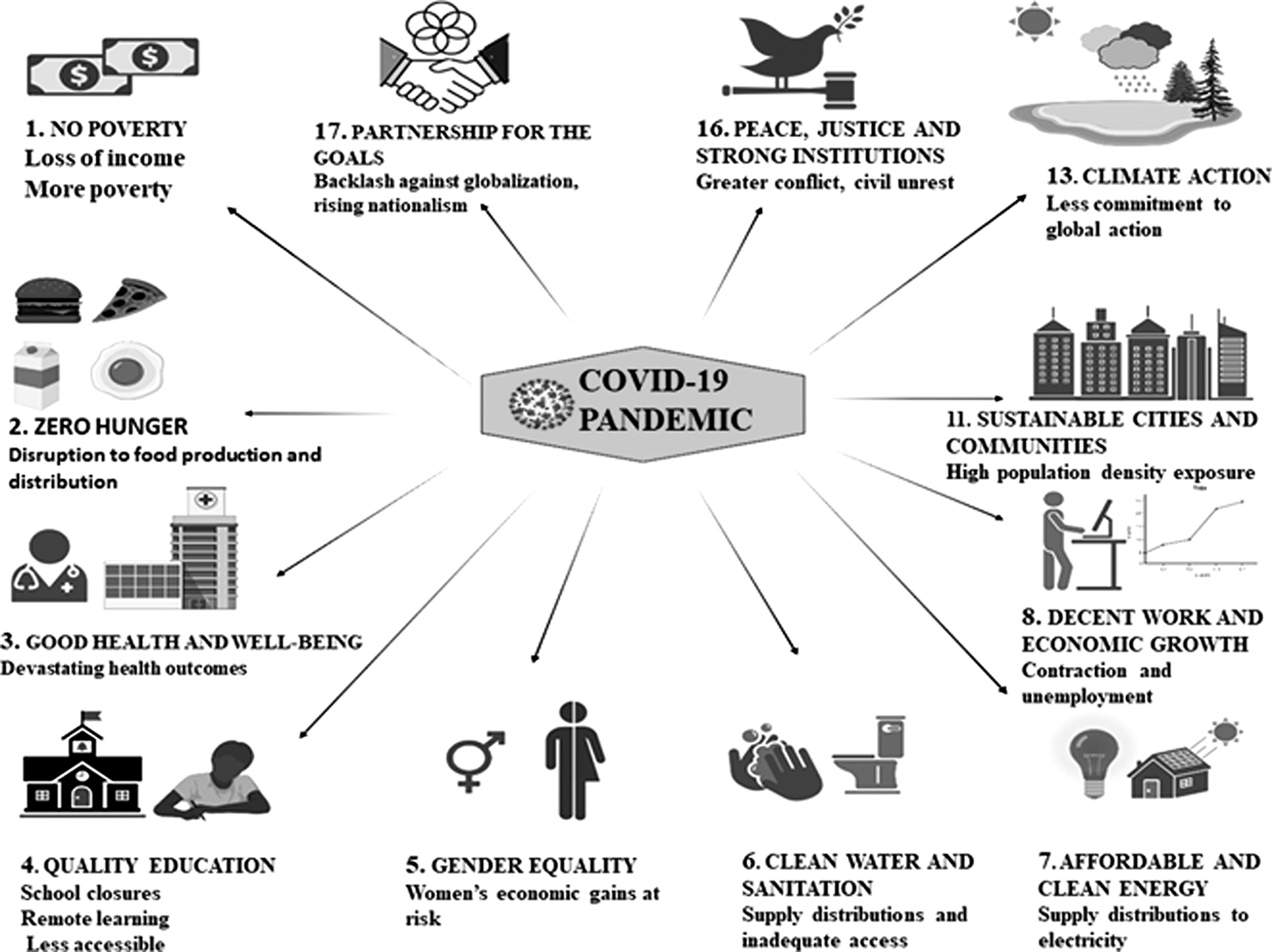
SDGs and how they are presently affected by the COVID-19 pandemic. The number represents the development goal, and below the anomaly is represented.
This occurs at a critical juncture for several of the SDGs: 736 million individuals remain in extreme poverty; 821 million are malnourished; approximately 3 billion people lack access to clean cooking fuels and technology; 87 percent of the 840 million people in rural areas are living without power (Barbier & Burgess, 2020); 785 million people lack access to even basic drinking water; and 673 million continue to defecate in the open (Yulyani et al., 2021). As an example, SDG 6, clean water and sanitation, presents challenges to the supply and distribution of water and the inadequate access in various parts of the world (Runde et al., 2020; United Nations, 2022). By 2030, it is projected that 28 poor nations will be incapable of achieving SDGs 1-4, 6, and 7 (Nurunnabi et al., 2020).
Access to clean water and sanitation are vital for long-term development. More than half of the world's population, especially in economically stressed nations in South Asia and Africa, still lack access to safe drinking water and adequate sanitation (Pan & Zhang, 2020). Additionally, the filthy discharge of feces and other wastes into the environment deeply endanger the drinking water and public health. Waterborne infections such as diarrhea, cholera, and typhoid kill 100,000 people in every year in India alone (Dutta & Chorsiya, 2013). In many places around the globe, the pandemic increased the challenges of meeting clean water and sanitation standards (Mukherjee et al., 2020).
At present and as a result of Covid-19 impacts, the United Nations Development Programme thinks that global human development, which includes health, education, and living standards, could decline for the first time since measurements started in 1990 (Hickel, 2020).
Over the last two decades, the number of undernourished people has decreased by nearly half. Central and East Asia, as well as Latin America and the Caribbean, have made significant strides. Even so, 821 million people were still chronically malnourished in 2017 (Singh & Dutta, 2020), and Covid-19 has revealed flaws in global food supply chains, which have pushed further into distress fragile countries like Yemen, where, despite humanitarian assistance, 15.9 million people wake up hungry every day (Harb, 2019). In 2015, around 736 million people were living on less than $1.90 per day, the standard set by SDG 1, in India and China. By one estimate from Oxfam, the present catastrophe has again pushed more than half a billion people back into poverty (Marcos Barba et al., 2020). SDG 1 is “no poverty,” but the crisis has made this goal more difficult to achieve. On the other hand, it also presents an opportunity to completely transform development.
Relating Covid-19 Pandemic to Exacerbating Water-Related Issues
During the pandemic, a shortage of safe drinking water and basic sanitation became a serious challenge for communities within developing countries, particularly in slums, peri-urban regions, and refugee camps. Access to clean drinkable water was particularly difficult in Africa and South Asia, which combined account for 85 percent of the world's population (Hutton & Varughese, 2016). However, the issue is not limited to these places; developed countries also face the same challenges (Ferronato and Torretta 2018). Due to the financial consequences of the lockdown and rising unemployment millions of people across the globe are struggling to pay their utility bills, including water bills (Berglund, 2021).
To meet with the European Union Drinking Water Guidelines, most EU member states must increase their yearly water supply and sanitation budget by more than 25 percent (World Health Organization, 2016). This increase supports implementation of the SDGs. However, in these difficult times, the EU will have to reconsider how to effectively use limited financial resources to fulfil its objectives. Millions of individuals in both developed and developing countries have seen their living standards and health deteriorate because of the pandemic, and when things will improve is uncertain (Barbier and Burgess 2020).
It is sanitation that provides the first degree of protection from many viruses and bacterial infections (Berglund 2021). Handwashing is commonly regarded as one of the most efficient techniques to reduce Covid-19 transmission (Brauer et al. 2021) However, given access and sanitation issues preceding Covid-19 nearly 3 billion individuals were without the ability to exercise this first defence (Tortajada & Biswas, 2020).
Country Example: India
To keep track of India's progress toward the SDGs, an office of the Indian government referred to as the “Vertical” reports the progress toward key SDGs and their associated targets. Many groups and individuals, including government officials as well as representatives from the private sector and non-governmental organizations (NGOs), work closely with the Vertical. One group, a think tank, created and implemented the SDG India Index and Dashboard (NITI Aayog, 2019). In the 2022 Sustainable Development Goals Global Index, India was ranked 121 out of 163 countries. In 2020, it was ranked 117; in 2021, it was ranked of 120 (Pandey, 2022). Although it has moved up slightly, the nation is not on track to reach the global targets on sustainable development.
Presently, India represents one of the largest national populations on the globe without access to safe drinking water and sanitation (Paul et al., 2020). Groundwater provides the majority of India's clean water, accounting for more than 75 percent of the country's household water supply and 80 percent of agriculture. Further, India has been the largest groundwater user in the world and has been utilizing it for irrigation and domestic usage, resulting in a groundwater drought caused by increased withdrawal in major parts of the nation.
In 2005, India's residual usable groundwater storage (UGWS) was estimated to be over 38,000 km3, ranging from 2,100 km3 in Assam to 300 km3 in Himachal Pradesh (Mukherjee et al., 2020). Over the last 15 years, UGWS has been depleted at a rate of roughly 0.11 percent each year across the country, with the potential to lose 600 km3 (1.5 percent of the overall UGWS) of groundwater per year as of 2020 estimates, leaving about 37,300 km3. Punjab, Haryana, Uttar Pradesh, Bihar, West Bengal, and Assam, all of which are located in one of the world's most abundant groundwater basins, have seen rapid UGWS exhaustion (Sarah et al., 2021). As a result, various government-supported programs are aimed at ensuring the availability and conservation of groundwater for future use. The Government of India has launched many programs for attaining SDG 6 (clean water and sanitation).
Figure 2 shows the trend of access to drinking water in rural communities of India over the last 20 years (United Nations Children's Fund (UNICEF) India, 2022). Water is considered drinkable if it is free from fecal and chemical matter contamination. It can be sourced through pipelines, tube wells or boreholes, safe dug wells, or springs, and bottled or delivered via tankers (Roser, 2022). While access has increased significantly, population growth has also increased, creating further challenges for water supply chain systems especially during the pandemic period but also during times when there is no health crisis.

Availability of clean drinking water from an improved source or accessible on premise to locals for the rural population of India, this considers water free from fecal and chemical matter contamination, and refers to water sourced through pipelines, tube wells or boreholes, safe dug wells, springs, and packaged or water delivered via tankers (Source: Our World in Data, Global Change Data Lab, 2022).
There is recognition that infrastructure is needed and projects are currently underway. Swatch Bharat Abhiyaan, a program started by Prime Minister Modi, is working to optimize sanitation and reduce water pollution caused by improper sanitation; Har Ghar Ko Paani and Jal Jeevan Yojona aims to provide clean water to every Indian household through a piped water supply of 55 liters per capita a day by 2024; and Mahatma Gandhi National Rural Employment Guarantee Act (MNREGA) and Atal Bhujal Yojona aim to rejuvenate and restore groundwater (Mukherjee et al., 2020; Singh & Dutta, 2020). The challenge in these efforts is climate change and ground water contamination; the former has already affected the predictability of the water cycle and the latter is an outcome the anthropocentric economic forces that have contributed to climate change and environmental degradation. Access to water is needed but in conjunction with conservation.
Post-Pandemic Framework for SDG 6
It is imperative that developing countries adopt novel regulatory frameworks to offer urgent socioeconomic assistance to address the Covid-19 crisis and continue to make ongoing progress toward the SDGs. Existing policy inefficiencies and perverse incentives that impede sustainable growth require inclusion in a post-pandemic plan. Policies inducing synergies across many SDGs at the same time, such as increasing economic activity, creating jobs, reducing poverty, improving the environment, and improving health outcomes may be very beneficial to catalyzing sustainable development. However, policies given resource constraints need to be cost-effective and executed swiftly and effectively. This necessitates prioritizing policies that generate substantial progress toward many SDGs without compromising other SDGs.
These objectives may be met by a variety of innovative policies, one of which is a subsidy swap. Presently in many areas of the world water is subsidized. Though on the surface this may appear positive, given that irrigation access may favor agricultural production, the subsidy may fall short of promoting equity and instead lead to misallocation and overuse in the sector. This comes at the cost of access to the general population. An irrigation subsidy swap substitutes the standard subsidy, instead of affecting the price of water, the subsidy focuses on access such as implementing infrastructure and other means to promote equitable water distribution (Barbier & Burgess, 2020).
To upgrade and expand accessibility of water-related facilities in developing countries, strategy could prioritize the needs and income levels of the intended beneficiaries, their ability to pay for improved clean water and sanitation, and the overall costs of providing clean water and sanitation services. Rural water supply programs that provide communities with deep boreholes and public hand pumps, community-led total sanitation campaigns, and biosand filters for household water treatment are three small-scale initiatives that do not require massive infrastructure and supply channels for delivering clean water and sanitation (Mande et al., 2018). These initiatives are not only economical for impoverished homes and communities, but they also provide important health and economic advantages during a pandemic and safeguard women and children, who are the most susceptible to disease from lack of clean water and sanitation (Mako et al. 2018).
Women of color, low-income women, and children are disproportionately impacted by water insecurity, despite it being a worldwide health concern that affects many countries. Around the world, women and girls spend 200 million hours each day gathering water, the majority of which is done alone. UNICEF observed that women and girls are responsible for water collection in 80 percent of households when it is necessary. Women and girls in sub-Saharan Africa typically shoulder the burden of water collection in homes without access to piped supplies. It takes rural Indian women about 16 kilometers per day to walk to water sources. 31percent of individuals in Latin America and the Caribbean, typically women, travel more than 30 minutes to get water. Women and girls make up 59 percent of the people who collect water for their households outside of the home in Paraguay (UNICEF, 2019). U.S. Water Alliance research found that Black, Latinx, Pacific Islander, and Native American households are particularly affected by racial gaps in water security (Asnaani et al. 2022).
Outlook
In the 20th-century, economics treated water as an abundant resource and gave little attention to its scarcity value, opportunity costs, and pollution costs (that is, economic externalities). The emphasis was on reducing the costs of distributing water—seeing capital as the primary scarce resource—rather than on valuing water itself, thereby recognizing water as the primary scarce resource. Water is a limited resource that must be treated as such. However, most governments currently subsidize water, which encourages usage and benefits upper-income groups disproportionately, particularly in countries where the poor have less access to water.
There is a need to rethink approaches to water management and the paradigms that have guided our thinking about it. It is no longer acceptable to consider clean water as an excessively abundant resource that is free for the taking. Solutions that will both protect and develop water resources in a sustainable manner are needed, consistent with SDG 6. The significance of this attainment aligns to multiple SDGs, highlighting the significance of water and the inefficiencies of the market in aligning value with price. Perhaps this latter aspect highlights the need to address the present economic framework and not to be limited to it in addressing sustainable solutions.
Footnotes
Acknowledgments
The authors thank Shoolini University, Solan, Himachal Pradesh, India for the databases that were made available to help complete this study. Additionally, the authors are grateful for the insights received from their peers and senior academicians.
Authors' Contributions
Riya Bhattacharya: ideas; formulation or evolution of overarching research goals and aims; Archana Kumari: management and coordination of the research activity planning and execution; Debajyoti Bose: oversight and leadership of research activity planning and execution.
Funding Information
No funding was received for this work.
Author Disclosure Statement
The authors declare that they have no known competing financial interests or personal relationships that could have appeared to influence the work reported in this paper.