




Abstract
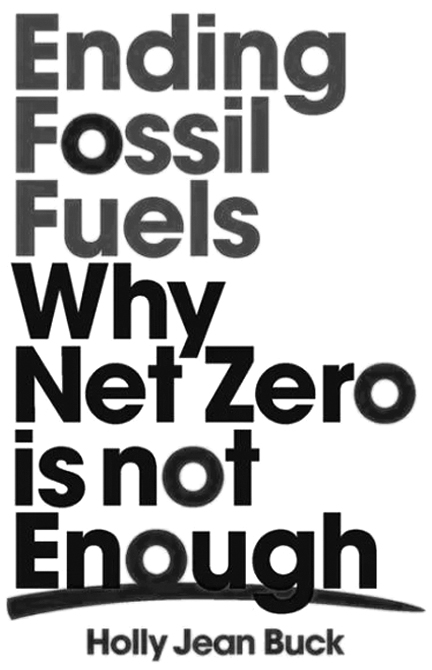
In Ending Fossil Fuels: Why Net Zero Is Not Enough, Holly Jean Buck extensively addresses the topic of fossil fuels as well as the potential of a future without them. The book is divided into three parts: The Cruel Optimism of Net Zero, Five Ways of Looking at Fossil Fuel Phaseout, and A Phaseout Toolbox for the 2020s. These sections successively provide background on fossil fuel dependency, perspectives related to justification of fossil fuel elimination, and a process to attain it.
Throughout the text, Buck introduces various and crucial underlying issues which often are overlooked in the discussion of fossil fuels. This greatly contributes to differentiating the book's value to the overall subject since it ultimately creates a thorough assessment of the topic from which the reader is able to do a deep dive into underlying issues and solutions as Buck boldly addresses and clarifies issues related to fossil fuels.
Buck begins by analyzing the meaning of net zero and its ambiguity. She states that “net zero is supposed to allow for hard-to-decarbonize sectors to keep emitting for a while” but in reality, challenges to attainment remain to address “what is hard to decarbonize, and who gets to decide” (p. 35). Moreover, the controversies associated with net zero are also brought to light. For example, Buck highlights the net accounting system and its limitations, such as “what counts as a forest” and whether the “amount of carbon in a forest can accurately be measured” (p. 31).
Similarly, she describes the existing inequality within the push for carbon removal. This inequality may be in the form of infrastructure, sectors, or geography. In terms of geography, “some countries have forest resources which connote large removal capacities and others do not” (p. 33). Furthermore, Buck addresses the fact that this topic is not black and white, though it may be portrayed that way at times. For instance, “the amount of oil that Ghana produces is important to Ghana [but] it's not important to the climate, … it's a drop in the bucket compared to what the US, Russia, and Saudi Arabia produce” (p. 105). Such contrasts are important as, in this instance, they allow the reader to discern that Ghana's efforts in reducing emissions are not nearly as important as those of the United States or Saudi Arabia. Buck provides a similar example in reference to initiatives to reduce emissions by restricting air travel. As she adds, one should not “put a millionaire with a private jet in the same category as a climate migrant who wants to fly to visit family in another country” (p. 48). These comparisons allow the reader to recognize how literal interpretation of fossil fuel-use targets obscure the issues related to why the targets exist and expose the relationship between responsibility, contribution, and reduction targets.
Buck points out interesting connections, such as the relationship between fossil fuels and corruption, and the relationship between peace and renewables. Another valuable aspect of Buck's analysis is inclusion of counterarguments to her original point, such as noting the negative impact ending the fossil fuel industry can have on the developing world. Specifically, Buck points out that “countries like Kenya and Mozambique have recently discovered fossil fuel resources and are planning to use these resources to increase wealth—but they now run the risk that these new assets will be stranded” (p. 92). Another interesting connection is Buck's comparison of the debate around elimination of tobacco to the debate around elimination of fossil fuels; the similarities lie with both being corrupt industries. As she points out, both fossil fuels and cigarettes are largely “intertwined with advertising and culture in ways that make it hard to end” (p. 133). To conclude, Buck mentions that the tobacco “phaseout” led to the introduction of e-cigarettes and vapes, which raises the question of what a phaseout might introduce as a replacement for fossil fuels.
Although in Ending Fossil Fuels: Why Net Zero Is Not Enough, Holly Jean Buck delves into the complexities of fossil fuels, she also considers that the audience may have limited knowledge and thus provides readers an accessible discussion with tangible examples. Instead of vaguely mentioning next steps, she concludes with a thorough plan of action while also recommending other books and literature for readers to expand their understanding of the topic.
Within this plan of action, there are straightforward solutions, for example implementing more bans on exploration and exploitation as well as subsidy reforms. However, Buck also introduces more complex long-term solutions such as the importance of culture in generating change. In particular, Buck offers specific changes within culture which can be made “through education, media, art, making planning into a cool career, [or] mainstreaming it into childhood” (p. 84). Throughout the book, Buck leaves the reader with looming questions, such as: “Fossil fuels are just one part of a broader problem: How do we develop the political power to refuse and ramp down technologies and practices that are not in the public interest?” (p. 126).
Ending Fossil Fuels: Why Net Zero Is Not Enough is recommended for both individuals who have an interest in the topic even though they may have a limited background, as well as for experts who are interested in challenging their ideas and growing their foundation. On one hand, the book provides a good foundation within 183 pages, making it time accessible in addition to being reader friendly. On the other, the book presents stimulating and complex ideas related to fossil fuel dependency while also making the process of eliminating fossil fuels approachable. As Buck suggests, we do not need all 256 countries around the world to transition at the same time but rather “the bulk of the emissions are in a handful of countries, and if they change their policies, it drives effects through the supply chain” (p. 151).