




Abstract
This article investigates the nexus between social foundations and structural wealth inequality in the United States. The topic has particular relevancy as poverty alleviation is United Nations Sustainable Development Goal (SDG) 1: End poverty in all forms everywhere. Arguably, the reconciliation of the present status of poverty with the prevailing economic system is a significant element for the attainment of SDG #1. The foundation for economic thinking articulated by Adam Smith forms the basis of this discussion, the results of which indicate that the three conspicuous pillars of sustainability are incompatible with the prevailing economic framework. The discussion addresses each: respect and care for fellow nationals, the cultural ramifications of exploitation, and admiration of wealth.
Introduction
The United States remains one of the most culturally complex nations in the developed world, rivaled only by a handful of countries (Fisher, 2013). The social responsibilities inherent in the heterogeneity can be summed up by a quote from one of the founding fathers, George Mason: “That no free government, or the blessings of liberty, can be preserved to any people but by a firm adherence to justice, moderation, temperance, frugality, and virtue and by frequent recurrence to fundamental principles.” (Mason, 1776/1990, p. 2). These broad, diverse, and complex values—community, freedom, meritocracy, democracy, and innovation have been the catalyst for millions of immigrants.
Nevertheless, the early foundations of America are stained with contradictions relative to these more modern objectives. Native Americans were oppressed, and slavery was the norm long after the country's founding; further, discrimination against minorities has remained structural (e.g., Mandle & Geschwender, 1980; Melish, 1998). And nearly 300 years after George Mason, events undermining these values remain evident: the election of Donald Trump, the unprecedented rise of tyrannic conspiracy theories, and the Capital Riot on January 6th, 2021. The U. S. Supreme Court decision on overturning Roe v. Wade recently highlighted that justice reflects the dominance and legitimacy conferred on societal values (Phillips, 2022). While these events tend to be written off as right-wing nationalist incidents, they are linked to the broader state of America's social foundations.
Adam Smith wrote in his seminal work, The Theory of Moral Sentiments, “An earnest desire to render the condition of our fellow-citizens as safe, respectable, and happy as we can,” as a principle for market economies to deliver optimal outcomes (Smith, 1759/1987, p. 138). According to a Pew Research Center study, nearly 80 percent of Americans believe that Americans have too little trust in each other and cite the top reasons as “people are more isolated, lonely, out for themselves” and “people are lazy, greedy, dishonest, and untrustworthy.” Seventy-one percent of respondents believe that trust in one another has declined in the past 20 years, and the number of Americans who reported having no close friends has increased four-fold in the same period (Cox, 2021, p. 3).
However, a high-income earner in the United States is nearly three times as likely to be a “high truster” than a low-income earner (Kennedy et al., 2022). Simultaneously, America has recorded one of the highest levels of wealth inequality since the Gilded Age, a period of high economic inequality between 1870 and 1900 (Telford, 2019).
Global poverty levels have decreased significantly; the bottom 40 percent of income earners have seen significant increases in their wages between 1980 and 2016. This is aligned with SDG #1: End poverty in all forms everywhere (United Nations, 2022 p. 8). However, in the same period, the bottom 50 percent of income earners have captured 12 percent of total growth, while the allocation to the top 1 percent was 27 percent (Alvaredo et al., 2018). This leads one to the question, Is poverty alleviation through trade-induced growth justified?
Typically, economists research the causes of inequality in relatively arcane terms, often hard to grasp by the public; they list rent-seeking behavior, tax policies, antitrust laws, globalization, and technology as the drivers of inequality. However, all the variations embedded in these terms, like the rationale for the policies to correct normative inequalities, have been socially constructed. What has driven managers to outsource operations? What has prompted people to lobby their way into tax cuts? What has occasioned people to combat unionization so fiercely? One begins to wonder how the social foundations of America allowed for all of this to materialize. This article investigates the social foundations of America by employing the framework laid out by the founding father of modern economics, Adam Smith, and analyzes the compatibility of these foundations with a just economic system.
Background
The Gini index, the most widely used measure of inequality, provides an assessment of income inequality within a country: 0 represents perfect equality, and 100 represents perfect inequality. The Gini coefficient of the United States is 48.5 out of 100, the highest measure of inequality of all sizeable, developed nations; the United Kingdom is the next highest with a Gini Coefficient of 36.3 (Atkinson, 2016). Most Americans' real wage has barely increased in the past decade, resulting in many stagnating living standards (Desilver, 2018).
In disaggregating the income data, a color line connected with historical exploitation and oppression highlights that opportunity is disproportionately accessible. The Federal Reserve of Boston released a study in 2015 indicating that the median net worth of a white family was over $200,000, while the median net worth of a black family was just $8 (Muñoz et al., 2015). Further, from an occupational perspective, polarization is also evident across the socioeconomic strata, as the earnings gap between CEOs and the average worker has soared. In the roughly four decades spanning from 1978 to 2015, inflation-adjusted CEO pay increased by more than 940 percent, while a typical worker's pay grew by just 10 percent (Bakija et al., 2010). American segregation has morphed into an economic one, not only divided by cultural and ethnic differences but also apparent in the wealth outcomes of historical and institutionalized discriminatory practices. These are reflected in statistics as a disproportionate representation of marginalized communities.
Figure 1 illustrates the correlative nature between intergenerational mobility and income inequality. While the notion of the American Dream (Lazonick, 2017; Piketty & Saez, 2003) would suggest that American society is highly mobile, more so than many other developed countries, it tracks closer to that of developing nations even though it is the wealthiest country in the world as measured by GDP per capita (Corak, 2013; Krueger, 2012).
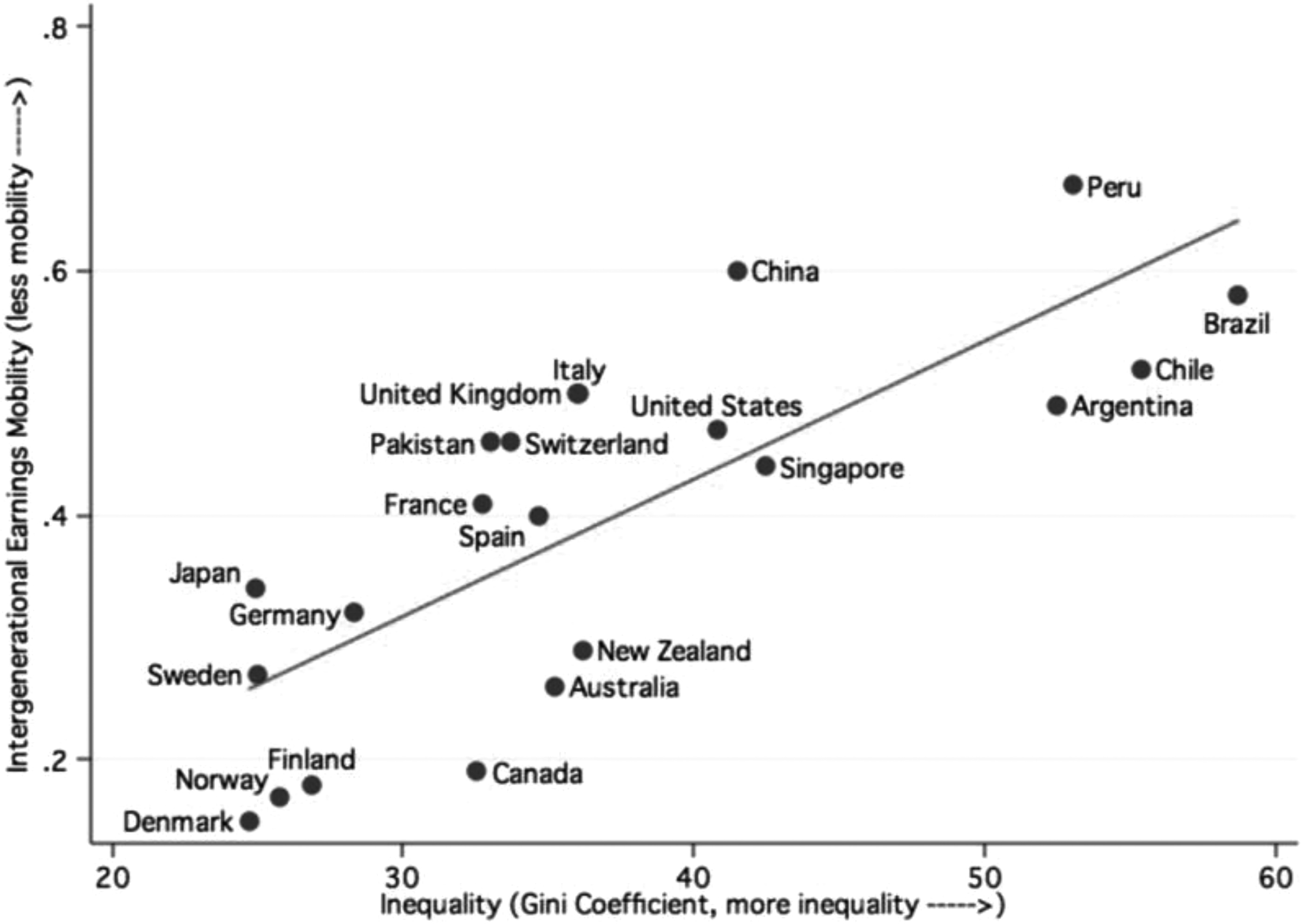
Gini coefficient and intergenerational earnings mobility
Data thus suggest that the American Dream, as defined by access and opportunity, is everything but alive in contemporary times. As former president Barack Obama noted, it is the “defining challenge of our time” (Newell, 2013).
Many scholars have studied inequality and its causes in the developed world (Botta et al., 2021; Kuznets, 1955; Piketty, 2000; Piketty & Saez, 2003). Many of the technical attributes researched, such as the rate of return on capital surpassing economic growth, dwarf the number of economic papers published on social foundations and inequality.
Robert Bellah characterized American culture as unique, following its roots in its Christian heritage, racial divide, rapid immigration, and colonial influence. The core element of American culture has always been individualism and individual freedom. When the Christian Church was most prevalent in the United States, it served as an antidote to immoral individualism and self-promotion. However, Bellah noted that secularistic development created a moral guidance vacuum. Freedom for the church was gradually replaced with freedom with restraint (Bellah et al., 1996).
Michael Sandel and Noam Chomsky are among contemporary scholars focused on culture, inequality, and the corrosion of social cohesion (Eppart et al., 2020; Sandel, 2021a). Sandel wrote that meritocracy has been the governing doctrine in the United States and has created a system that is only compatible with extreme inequality (Sandel, 2021b). The topic has also attracted several journalists finding niche stories of how corporate culture has impacted inequality. This includes management consultants' impact on the middle class and how the top 9.9 percent of income earners have driven disparity (Constantino et al., 2018; Markovits, 2020. Literature also suggests that the American Dream is not what it used to be, “a dream of equality, justice and democracy for the nation” (Diamond, 2018) and intergenerational mobility has declined (Piketty & Saez, 2003; Lazonick, 2017).
Adam Smith, David Ricardo, and John Stuart Mill are some early scholars who studied the relationship between the structure of the economy and culture. For example, it was previously thought that large-scale outsourcing and offshoring would never occur due to a home bias wherein fellow citizens would support each other. David Ricardo famously wrote that such a concept “would lead men of property to be satisfied with the low rate of profits in their own country rather than seek a more advantageous employment for their wealth in foreign nations” (Ricardo, 1821/2005, p. 92). Adam Smith asserted a similar position in The Wealth of Nations (1776). Efforts made to reduce global poverty, however, have broken this principle, which can be seen in global real-income growth levels resembling an elephant in the shape of the curve (Figure 2).
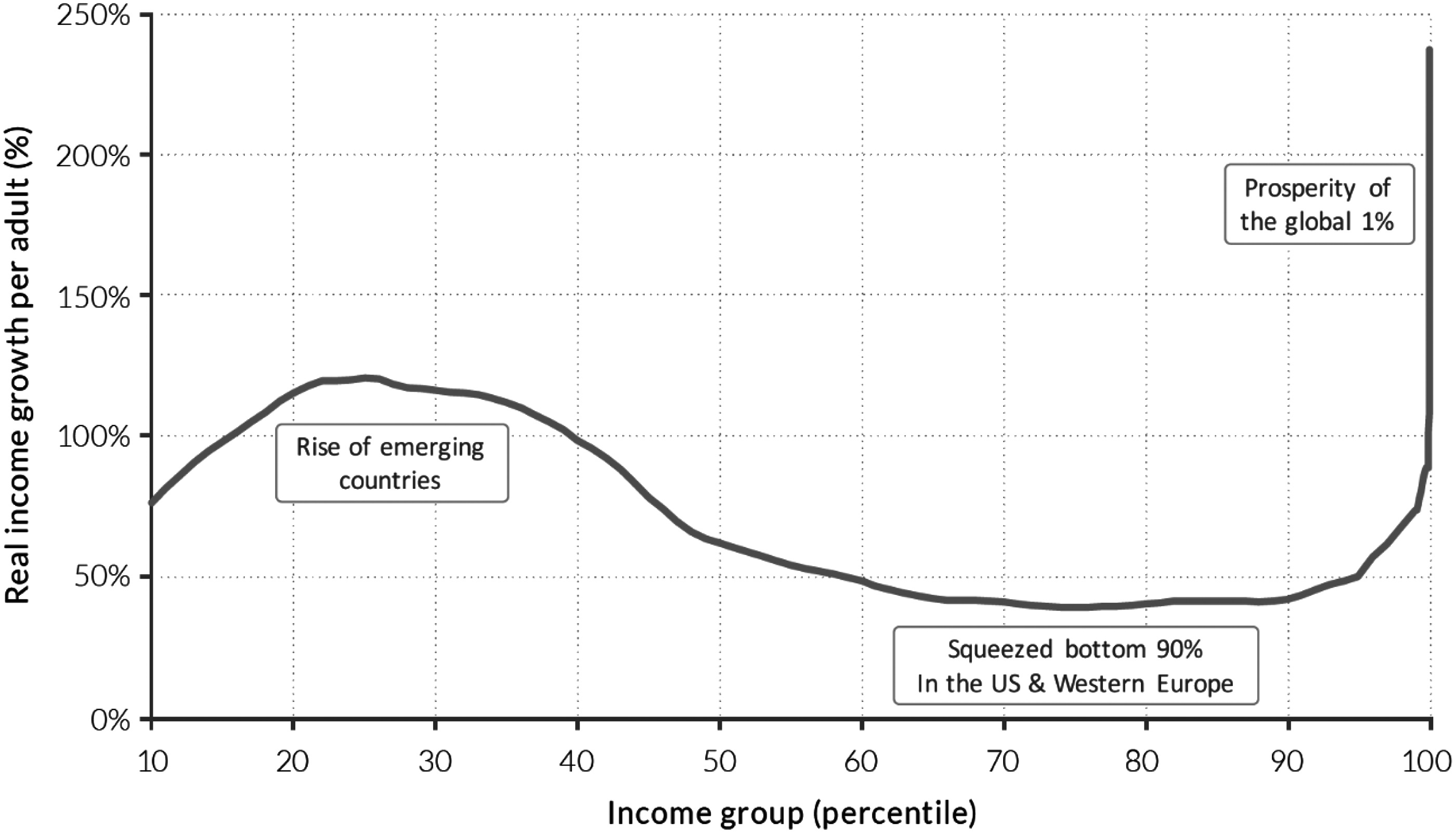
Total income growth by percentile across all world regions, 1980–2016, scaled by population
Given that Smith's social and cultural framework has primarily shaped the perception of economics and can be used to evaluate the social foundations of America (Fleischacker, 2002; Morrison, 2012), this discussion focuses on Smith's Theory of Moral Sentiments and The Wealth of Nations. While these texts were written to assess the economy of 18th-century Scotland, they serve as the foundation of nearly every single economic model and theory. Smith is mainly known for his account of the theoretical and rational human being, Homo economicus. In depicting human nature, he asserts that the primary source of motivation is self-interest, as interpreted by renowned economist Milton Friedman (1977). However, Smith's work spans many more elements of human nature, culture, and society. This article offers an alternative interpretation to that of previous economists who mainly have narrated self-interest from his works. Here the focus is on the broader context of what Smith wrote, with an encapsulation of the human complexities he vividly described.
Method
This study employs two methods to analyze inequality and culture in the United States: first, a structural analysis of the cultural building blocks of American society, including economic thoughts from Smith's seminal works; and second, the use of simple regressions obtained by looking at how various cultural variables are related to inequality in America and globally. The discussion is centered on three social attributes laid out by Smith:
Respect and care for fellow nationals Segmentation of success and the cultural ramifications of exploitation Admiration of the wealthy and abhorrence of the poor
There have been several studies on mentality and the state of social foundations in the United States and the world. The central databases used in this study are the Pew Research Center, the World Value Survey, and the Cato Institute. For a comparative approach to measuring how American culture distinguishes itself from other countries, survey questions from the World Value Survey were used. The Pew Research Center and Cato Institute mainly serve to analyze specific characteristics of American culture.
Smith is widely considered the father of economics, having coined the concept of rational human beings (Homo economicus), maximizing personal utility. However, the same founding father of economics paid close attention to the dimensions of human nature, which he explored in his first work, Theory of Moral Sentiments (1759).
The first of Smith's social attributes was constructed through what he wrote in Theory of Moral Sentiments, which shows his belief in the importance of virtuously educating citizens to act empathetically toward fellow nationals; in other words, to demonstrate respect and care for their fellow citizens.
Suppose he has been virtuously educated, however. In that case, he will often have been made to observe how odious those actions appear, which denote a want of this sentiment, and how amiable the contrary. Though his heart therefore is not warmed with any grateful affection, he will strive to act as if it was, and will endeavor to pay all those regards and attention to his patron which the liveliest gratitude could suggest. He will visit him regularly; he will behave to him respectfully; he will never talk of him but with expressions of the highest esteem, and of the many obligations which he owes to him. (Smith, 1759/1987, p. 111)
While Smith acknowledged that humans are altruistic to some extent by nature, the sentiment is limited to humans' self-interest. Thus, teaching the virtue of respect and care is critical to ensure consistent behavior in treating others with respect. Instilling this virtue in children, therefore, will promote actions that result in a more just society. Corresponding metrics from the World Value Survey are used to map the theory in the developed world, such as the percentage of parents viewing respect and tolerance as important child characteristics.
The second attribute, segmentation of success and the cultural ramifications of exploitation, were derived by considering the following citation of Smith in his Wealth of Nations: “People of the same trade seldom meet together, even for merriment and diversion, but the conversation ends in a conspiracy against the public” (1776/1987, p. 177).
Smith wrote this as he was endeavoring to describe price gouging and cartel formation. However, when combined with another idea from the Theory of Moral Sentiments, the context extends his interpretation of social foundations:
In the race for wealth, and honors, and preferments, he may run as hard as he can, and strain every nerve and every muscle, in order to outstrip all his competitors. However, if he should jostle or throw down any of them, the indulgence of the spectators is entirely at an end. It is a violation of fair play, which they cannot admit of. (1759/1987, p. 142)
This suggests that society will only tolerate or admire monetary ambition and grit as long as it is fair.
Smith continues by saying:
When his [the violator of justice] passion is gratified, and he begins coolly to reflect on his past conduct, he can enter none of the motives which influenced it. They appear now as detestable to him as they did always to other people. By sympathizing with the hatred and abhorrence which other men must entertain for him, he becomes in some measure of the object of his own hatred and abhorrence. The situation of the person who suffered by his injustice, now calls upon his pity. He is grieved at the thought of it … The thought of this perpetually haunts him and fills him with terror and amazement. (1759/1987, p. 142)
Accordingly, this study breaks down the mentality on contemporary political issues regarding taxation and poverty by income levels within the United States. This is meant to quantify Smith's notion that spatial inequality can sustain and even amplify wealth inequality.
Moreover, Smith separated two kinds of people: the honest and principled person who follows the law of gratitude, and the “worthless fellow” who does not abide by the principle of caring for others. Smith took a broader perspective in the next chapter of the book and listed the following two as the most fundamental and critical principles in virtuous citizens who breed a functioning and equitable society:
A certain respect and reverence for that constitution or form of government which is actually established.
An earnest desire to render the condition of our fellow-citizens as safe, respectable, and happy as we can. (1759/1987, p. 138)
Conclusively, Smith argues that all virtuous citizens must respect democratic institutions and wish to promote the welfare of their countrymen to the greatest extent they can. Building on the sentiment described earlier, Smith characterizes the nature of offshoring operations as a solely egotistical phenomenon in the Wealth of Nations:
He generally indeed, neither intends to promote the public interest nor knows how much he is promoting it. By preferring the support of domestic to that of foreign industry, he intends only his security; and by directing that industry in such a manner as its produce may be of the greatest value, he intends only his own gain, and he is in this, as in many other cases, led by an invisible hand to promote an end which was no part of his intention. (1776/1987, p. 220)
The third social attribute—admiration of the wealthy and abhorrence of the poor—was formulated based on Smith's depiction of admiration. Smith describes in a Theory of Moral Sentiments that the notion of merit, whom people admire, is the most significant potential corruptor of a person's moral sentiments. More precisely, marveling at the wealthy over the virtuous creates results in mirroring the footsteps of the wealthy. The meritocratic concept and the American Dream romanticize wealth creation and make Americans inclined to emulate the behavior of the rich at all costs. As noted by Smith:
The disposition to admire, and almost worship, the rich and the powerful, and to despise, or, at least, to neglect persons of poor and mean condition, though necessary both to establish and to maintain the distinction of ranks and the order of society, is, at the same time, the great and most universal cause of the corruption of our moral sentiments. (1759/1987, p. 86)
These proxies are expected to yield results pointing to a correlative nature between these social attributes and the level of income inequality in a society.
Results
Respect and Care for Fellow Nationals
The notion of virtuous education to promote a just society has proven predictable over 200 years later. Figure 3 demonstrates the correlation between income distribution in a country over different periods between 1980 and 2014 and how people view the importance of children exhibiting tolerance and respect for others. The dots represent the United Kingdom, United States, Canada, Sweden, Australia, Germany, and France, from 1990 to 2015. The graph points to a relatively strong correlation between the two variables, and the United States is an outlier relative to similarly developed nations. Inequality comes with lower concern for teaching children the virtue of respect and care for others. This is further supported by a Pew Research study suggesting that 65 percent of Americans aged 18-29 have very little confidence that Americans respect the rights of people from different communities (Rainie et al., 2019)
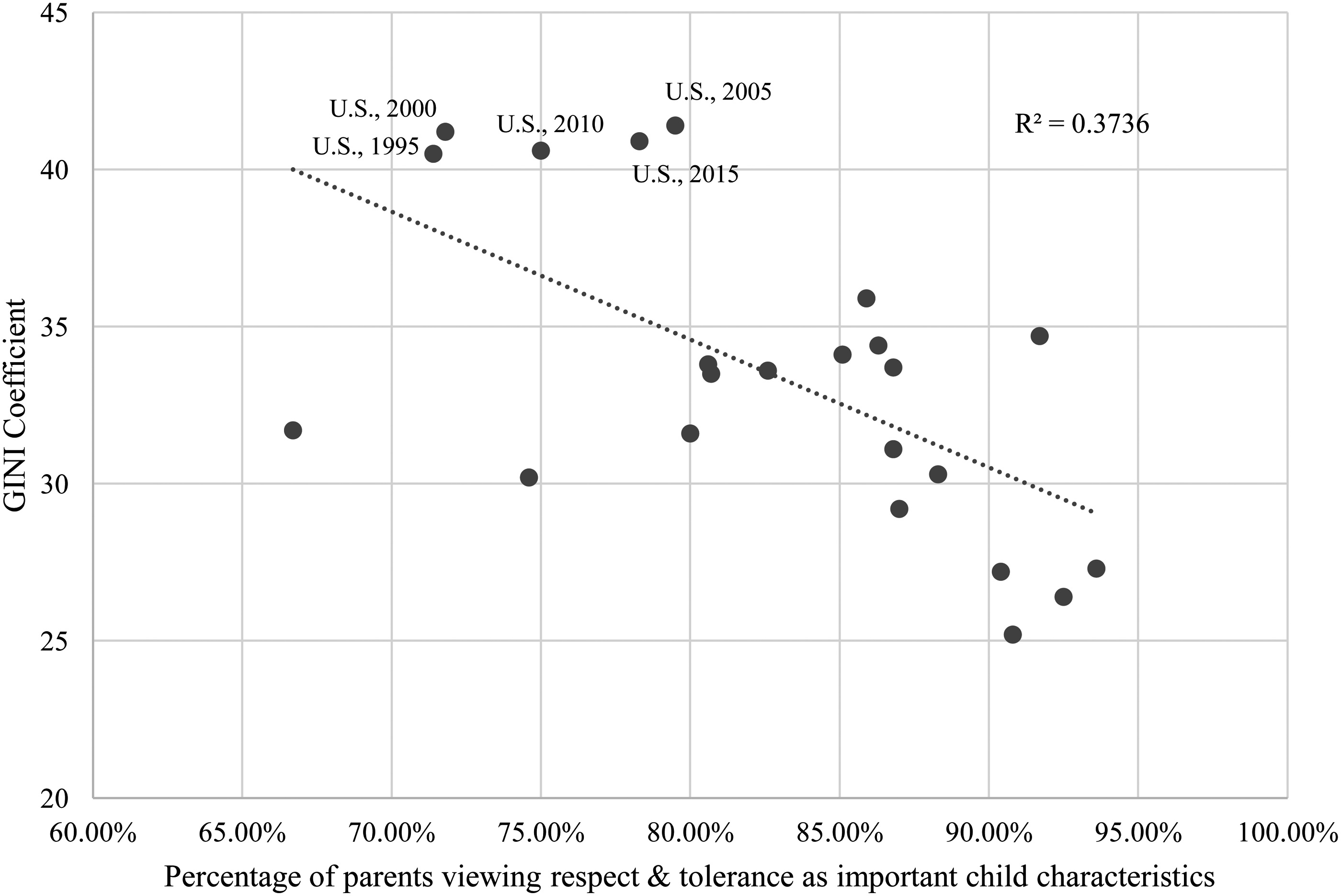
Correlation between wealth inequality and parental attitudes as shown by the GINI coefficient and parental views of respect and tolerance in their children
Segmentation of Success and the Cultural Ramifications of Exploitation
As America been challenged economically over successive periods from 1980 up until arguably the present, the latter parts of Smith's theory on redemption of exploitation through cultural backlash became inapplicable (Carr & Kutty, 2008; Waitzman & Smith, 1998; Widestrom, 2015), and the rise of the multinational promoted anonymity. Further economic segregation meant that exploiters did not have to look the exploited in the face and encounter the consequences of their actions while reaping the monetary reward. Hence, economic disparity created asymmetric scenario chains following exploitative behavior: the benefit of taking advantage of others is unlimited, while the cost in the form of perpetual haunt of terror for the exploiter is limited.
Smith asserted that the behavior of promoting private profits over the public good would not occur as long as citizens care about one another according to the earlier second principle, “An earnest desire to render the condition of our fellow-citizens as safe, respectable, and happy as we can” (1759/1987, p. 138). He wrote, “I have never known much good done by those who affected to trade for the public good. It is an affection, indeed, not very common among merchants, and very few words need be employed in dissuading them from it” (1776/1987, p. 112).
Americans appear to lack care and respect for one another compared to other countries; 84 percent of outsourcing activity has come from the United States, which accounts for 16.3 percent of world GDP (Lepeak & Nair, 2017; Kose et al., 2017). This development has primarily emerged within the last 40 years, as demonstrated by Jackson (2013). Seventy percent of managers in the United States name cost savings as the most crucial reason behind offshoring operations (Bardi & Tracey, 1991). Without emphasizing respect and care for fellow nationals, offshoring to capture private returns at the expense of the public good is no conundrum.
Other proxies exist for understanding whether care is part of a country's social foundation. Figure 4 shows a relatively robust correlation between how people think of wealth redistribution and countries' Gini coefficient.
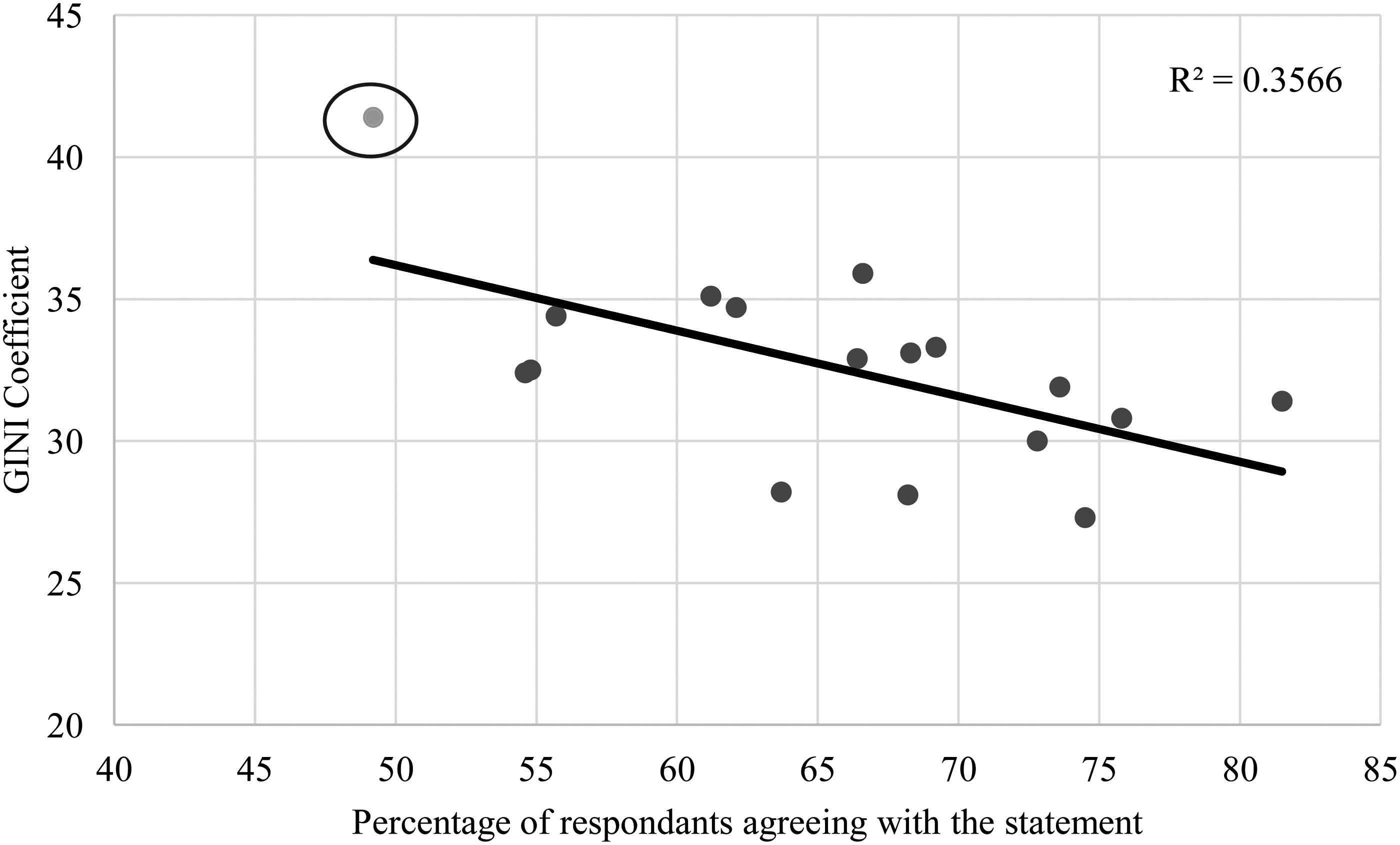
Correlation between attitudes toward government transfers and inequality as shown by GINI Coefficient agreement and respondents agreeing with the statement “Governments should tax the rich and subsidize the poor”
The United States is an outlier in this category. It is represented by the circled dot. This suggests that the lack of moral education has led to an overemphasis on self-interest and promotion of the idea that it's okay for every citizen to focus on their own self-interest above those of others. The unbinding of Smith's second principle is translated into higher inequality.
Home values represent the divide in which wealthy nationals live in spatial distance. By nature, expensive communities are out of the reach of the poor. This exacerbates the wealth gap, as appreciation is determined by the demand of the wealthy to the detriment and adversity of the poor. This can be seen in home values, which between 1980 and 2016, multiplied 7.6 times in Boston, and rose by 156 percent in San Francisco and 115 percent in New York (The Economist, 2016). During the same time, home values increased by 3 percent in St. Louis, 11 percent in Pittsburgh, and decreased by 16 percent in Detroit (The Economist, 2016). This type of gentrification may make inequalities more pronounced, as commutes get longer and opportunities become concentrated in a restricted geographical location (Kawabata & Shen, 2007).
Economic segregation and gentrification are symbolic of two drastically different economic realities. The New York banker never had to look at the person in Detroit who lost their home after 2008; the Silicon Valley tech CEO automating a factory outside St. Louis never had to look at the factory worker they outsourced; the Boston consultant restructuring large companies never had to look at the laid-off Pittsburgh middle-manager. In parallel, in 1982, on average, CEOs made 20 times a production worker's income; in 2000-2001, the top management earned nearly 300 times that of their workers (Bakija et al., 2010).
In the current culture, 84 percent of Americans agree that “there is nothing wrong with a person trying to make as much money as they honestly can” (Ekins, 2019). Most believe that honestly accumulating as much money as possible is acceptable. However, the meaning of honesty is distorted when there are no cultural ramifications for favoring monetary success at the expense of other people, especially when the consequences for that endeavor are never encountered. The cultural ramifications of unjust actions do not exist and allow managers to make micro-decisions to have macro impacts out of their sight. Self-interest has taken place in the medium of internalized honesty, ethics, conscience, or what Adam Smith referred to as “sympathy” (1759/1987).
While the cultural consequences have failed to instill Americans with a sense of remorse for their unjust action, one can even go as far as to say that any endeavor, whether just or not, in clusters of success, is culturally rewarded (Ekins, 2019). Evidence suggests that wealthier Americans do not believe in raising taxes for themselves; however, this perspective is not held by the rest of the country. Similarly, more affluent Americans continue to hold on to internal factors as the most determining for success, while poorer Americans emphasize external factors. This is mirrored in the perception of the American Dream, which is legitimized by wealthier Americans in their status, but discarded by the poorer segments of society whose reality has fallen short of attainment. Unsurprisingly, welfare recipients find it harder to climb the economic ladder than non-recipients. This attitudinal disparity correlates with their levels of trust: A high-income earner in the United States is nearly three times as likely to have high trust in the system than a low-income American (Rainie et al., 2019).
As Smith acknowledges, facing the social externalities originating from one's exploitation is frightening and can lead to a strong sense of abhorrence. The volunteer community exemplifies how wealthy individuals can meet and experience these social disparities. In America, onsite volunteering has significantly declined since 2001. In this same time frame, money for philanthropic endeavors has grown to an all-time high. While there seems to be an awareness of these disparities, the personal cost of facing them is too big to bear. Thus, writing a check is more convenient than directly facing social issues and experiencing the realities firsthand. As Smith describes, by delaying and avoiding facing the externalities caused by oneself, one can delay the sentimental degradation of exploitative behavior.
Affluent US counties appear to have a stronger preference for prioritizing environmental issues over other issues. This suggests that while residents of these communities have been able to accumulate significant wealth, they are more tuned in to the ecological threat than their own impact on social disparities and the problems inherent in them; the environmental impact is more imminent and may directly affect them. Thus, they prioritize environmental protection according to Smith's characterization of human nature, delaying any recognition of their actions. They care about the problems they face themselves. However, a climate disaster spares no one, while a slight uptick in homelessness and unemployment in one part of the country does not change their own lives as obviously. Smith was correct: If humans can stare at the face of the problems they have contributed to, such as climate change, they will be anxious about it. Conversely, social issues are not concerns of people of power because they can reframe their experience through the veil and anonymity of the market.
Admiration of the Wealthy and Abhorrence of the Poor
Smith laid out the following logic: As a person chooses their actions, they will mainly strive to achieve esteem. Smith wrote, “We desire both to be respected and respectable. We dread both to be contemptible and contempt” (1759/1987, p. 86). Smith was aware that one of the main sentiments is our desire to attain some level of respect from others. However, respect from others is not determined by oneself; others determine it. The ranks of society are laid out by the people operating in it. Thus, a person first rationalizes to convey respect and then chooses actions accordingly. Americans respect the hustle, hard work, and merit (Ekins, 2019). For many, these are synonymous with money, so the social ranks and one's standing on the social ladder are ultimately determined by how much money they have made. Consequently, money in the United States has morphed from a vehicle to purchase goods and services into a metric to judge character. As hard work and success have become synonymous with monetary success, the ruthless pursuit of money has normalized; 84 percent of Americans believe that pursuing however much money possible is fine (Ekins, 2019).
Smith also wrote that it is significantly more painful for a human to go down the ladder compared to climbing it. If society had established ranks based on virtue, religion, or intellectual capacity, people would do everything in their power to rise or at least not fall in those metrics. Similarly, affluent Americans do everything they can to maintain their wealth to remain at the top of the social strata. Examples of this behavior range from the legal—tax planning, where wealthy citizens maximize their private gains over public benefit (Cebula, 2004) to the illegal—the 2019 college admissions scandal wherein wealthy Americans effectively bribed their children into admissions at prominent universities; a degree from an esteemed university is often seen as the most effective way to build wealth in America. These behaviors are perhaps the most emblematic of the lengths Americans are willing to go to keep their wealth, social ranking, and sense of being admired.
In one of the most comprehensive studies on attitudes on wealth in America, the majority of respondents suggested that most Americans attribute wealth to hard work (51 percent) (Ekins, 2019). Out of the respondents, poor life choices were the most commonly listed attributes of poverty (42 percent) (Ekins, 2019). This inclines people to brush off the poor as lazy and wealthy people as hardworking and virtuous, typical components of a highly meritocratic system. This leads to confusion in admiring the rich for their honorable hard work and contribution to economic growth. However, this is a myth, symbolized by the fact that the zip code one is born into is the single best predictor of future success (Chetty et al., 2018). Interestingly, 75 percent of Americans agree that “people admire the rich too much” (Ekins, 2019). Paradoxically, while understanding of the situation, they are contributing to part of the problem.
However, this attitude does not stop at hard work, as money has become a tool to whitewash exploitation into virtue. Philanthropic endeavors are shared among the rich, and many billionaires prefer to be called philanthropists over billionaires (Giridharadas, 2020). This creates further confusion in which the wealthy are viewed as admirable rather than deplorable. Americans admire the rich not only for their high ranks and hard work but also for the status they have gained as society-benefiting philanthropists (Giridharadas, 2020). This creates a dilemma wherein the rich are dually admired for their hard work and society-improving philanthropy. Moreover, these high achievers are not resented. Furthermore, there is no difference in resentment that is dependent on educational level or income level; only a quarter of Americans feel anger toward the rich, regardless of educational background (Ekins, 2019).
Conclusion
The attributes that characterize the social foundations of America are: 1.) lack of respect and care for fellow nationals, 2.) segmentation of success and the cultural ramifications of exploitation, and 3.) admiration of the wealthy and abhorrence of the poor. As Smith outlined, they will corrupt individuals and elevate inequality levels over time.
The first and third foundations have been part of a social fabric that has elevated wealth inequality. This constant elevation has been sustained through the second attribute. The observation and conclusion here indicate that the corruption of moral sentiments creates a breeding ground for inequality. This inequality is mainly attributable to a lack of cultural backlash from actions motivated by private profit at public expense, excessive admiration of wealth creation, and a lack of care for fellow citizens, also described as diminishing social cohesion.
Moreover, county-level data in the United States illustrate that views toward one of the main existential threats we face, climate change, correlate with the county's income level. (See Figure 5.) The data demonstrate the behavioral notion that people generally care more about the issues that they can face, meaning that wealth does not lead to less care; rather, it is simply what wealthier people can see as damaging to themselves. Thus, if wealthier households could recognize the social issues they have created, they might better recognize the effects, just as they recognize climate change.

Mean household income and climate change awareness
Integrating communities with varying income levels so that wealthier households might become more aware of social issues, could encourage individuals to refrain from taking actions that further exacerbate those social issues. Conversely, could raising living standards and curbing inequality lead to a more even awareness of climate change among income levels? If so, integration might not only impact awareness of social issues among individuals and lower inequality but might contribute to a broader awareness of climate change. It might also be constructive in improving public debate about climate change policies.
The discussion around social foundations leads to the question of whether these foundations promote social cohesion. Social cohesion can have many faces, and one, notably, is nationalism. This prompts the question, Can nationalism be a source of cohesion, uniting around a flag and culture? Can nationalism lead to greater care and respect for one's fellow citizens and be followed by reduced inequality? This seems unlikely. In the ultimate nationalist nation of Nazi Germany, inequality increased tremendously (Sweezy, 1939). The more nationalistic presidential figures and nationalistic American movements, such as that under President Reagan and Donald Trump, were arguably more dividing than uniting. The outcasts became immigrants, the homeless, the drug abusers, and the poor. As such, nationalist movements are counterproductive movements that fail to restore social cohesion. Future research on how cohesion can improve sustainably without the nationalistic backlash of more division and segmentation in large complex economies would be highly valuable.
Another area of interest is whether large complex economies can exhibit social cohesion. Since the Industrial Revolution, economic integration and following trade patterns have been critical drivers of global growth. The doctrine of free markets and cross-border trade has glorified poverty elimination, defining poverty as $1.90 a day (United Nations, 2022). The meticulous focus on eliminating poverty through free markets and trade has failed to address increased relative poverty and reevaluate the arbitrary objective of SDG #1. Thus, future research should address whether it is possible to have an extensive complex economic system that can remain socially cohesive. Brexit and broader skepticism against European integration are at the core of this. Could the backlash to social cohesion be an argument against trade-driven growth in favor of stability of society?
Moreover, a point of this research is examining the impact of technology and globalization. While it was believed that these changes would integrate and connect people, they have become platforms for people to show their wealth and be admired for it. Is it possible in such a society, where advanced technology has become so integrated into our daily lives, to be integrated with one another? Could that be used as an argument against technological advancement for growth? If we cannot remain socially cohesive in a technologically advanced, highly integrated world, which has more weight: higher, social cohesion and stability or economic growth? Ultimately, technological advancement has allowed for unprecedented globalization and trade-induced economic growth, which has consequently led to reduced global poverty. However, future research should investigate whether we can continue globalization and expansion of economic opportunities without elevating inequality in the developed world.
While this article might seem cynical toward American culture, its goal is to enlighten the public. Inequality cannot be solved without more progressive taxes and antitrust and labor-promoting policies. While public policy remains at the core of promoting justice, addressing culture is a necessary means of combating historically unprecedented wealth inequality. These attributes are much simpler to change for the public. The values of a society, exhibited in accepted social norms, determine its outcomes. Given the increased speed of climate change, heightened poverty, and income polarization, the benefits taken from a few are at the cost of many. This is not sustainable for the continuity of a larger society.
Can we be more respectful toward our fellow citizens and consider that respect when making decisions? Can we be more open in our social circles? Can we strive to emulate the behavior of the virtuous over the rich? John Stuart Mill said, “He who knows only his side of the case knows little of that” (1859/2001, p. 35). George Mason would be appalled at the current state of America, as would John Stuart Mill and Adam Smith. However, teaching children respect, integrating with communities different from our own, and emulating the behavior of the virtuous will go a long way toward a change in direction.
Footnotes
Funding Information
No funding was received for the writing and development of this article.
Author Disclosure Statement
No competing financial interests exist.