




Abstract
Entrepreneurship as a stimulant for modernization is useful for addressing a variety of environmental issues. Sustainable entrepreneurs balance the triple bottom line by reconciling financial strength, social equality, and ecological resilience via their business practices. Considering the significance and opportunity of sustainability in entrepreneurship, it is time to apply more rigorous study approaches and the establishment of large-scale empirical study initiatives to improve the debate on sustainable orientation and entrepreneurial activities including entrepreneurial intensity. This study attempts to ascertain the impact of sustainability orientation on entrepreneurial intensity specifically addressing the manufacturing sector in the Delhi/National Capital Region (NCR). The role of psychological capital as a mediator in the relationship between sustainable orientation and entrepreneurial intensity is also assessed. Empirical results of this study, based on 406 manufacturing-based micro, small, and medium-size enterprises (MSME) entrepreneurs, show that sustainability orientation has a significant impact on both entrepreneurial intensity and psychological capital. The results further illustrate the mediating impact of psychological capital on the relationship between sustainability orientation and entrepreneurial intensity. In essence, the study's results have important ramifications for decision makers and practitioners in the field of MSMEs. This study has implications for researchers, MSME entrepreneurs, policy makers, and educators.
Introduction
Entrepreneurship is viewed as a stimulant for modernization, wealth creation, and innovation, making it useful for addressing a variety of environmental issues (Dickel & Eckardt, 2021). Furthermore, in order to follow through on such assertions, people must be inspired to engage in more sustainable practices (Wu et al., 2020). According to research, having a favorable attitude regarding viable business models is likely to be linked to desirable ecological outcomes, and the scope of the literature has intensified in recent times on entrepreneurial intensity in relationship to sustainable enterprises (Dickel & Eckardt, 2021; Douglas et al., 2021).
The significant body of scholarly work on sustainable entrepreneurship contributes to entrepreneurship's broad perspective. The entrepreneur is more concerned about how to address global environmental degradation and societal challenges as these issues become more serious. From this perspective, entrepreneurship may no longer be characterized as focused on financial return, that is, just about making money. Instead, sustainable entrepreneurs balance the triple bottom line by reconciling financial strength, social equality, and ecological resilience via their business practices.
Entrepreneurship is linked to a slew of promises. According to policy makers, the entrepreneurial conduct of economic players within an economy is meant to boost the economy's competitiveness in worldwide markets and perhaps provide new job possibilities. Leveraging entrepreneurial opportunities might be appealing from the standpoint of an individual entrepreneur since they offer the prospect of a fulfilling career as well as the chance for higher entrepreneurial profits. On the other hand, the trend is far from recent; several examples of entrepreneurs adopting sustainable business structures can be found as early as the 19th century (Anderson & Leal, 1997).
Organizations that emphasize sustainability are referred to as having a sustainability orientation (Roxas & Coetzer (2012). At the microscale, sustainability orientation (SO) refers to a circumstance in which a business owner or management takes a proactive approach to socio-environmental challenges (Diehl et al., 2015). Several theories, such as Ajzen's Theory of Planned Behavior and Shapero's Entrepreneurial Events, propose that inspiration for entrepreneurial activities is compelled by social and psychological elements (Leonelli et al., 2019).
The current research emphasizes the role of psychological capital in the formation of entrepreneurial intensity (EI). Self-efficacy, resilience, hope, and optimism are four distinct dimensions of psychological capital. According to a recent publication, psychological capital is linked to a number of work-related characteristics, namely favorable work attitudes, fulfilment, and psychological well-being. (Baluku et al., 2018; Baluku et al., 2021; Hayek, 2012; Luthans & Youssef-Morgan 2007).
The study addressed in this article adds to the evolving body of knowledge on this essential problem in one specific way: Above all, it examines entrepreneurs who are alarmed about environmental and societal issues—people who are sustainability-oriented and, hence, may be more willing to support initiatives and start enterprises that promote sustainability. To put it differently, this study investigates how sustainability orientation and entrepreneurial intensity are linked in practice. It bridges the gap between sustainability orientation (SO) and theories of entrepreneurship, thereby analyzing the mediating role of the psychological capital of an entrepreneur.
The focus of the evaluation is how sustainability orientation impacts the entrepreneurial intensity (EI) among MSMEs in the manufacturing industry of India. MSMEs are the mainstay of India's socioeconomic growth and development. The MSME sector has emerged as a crucial aspect of the Indian economy, contributing significantly to job creation, exports, and overall economic growth. India's exports and foreign direct investment (FDI) have expanded dramatically in recent years, indicating that the country is becoming a leading manufacturer (Gaur, et al., 2014; Popli et al., 2017).
The manufacturing sector within MSMEs contributes 7.09 percent to GDP and 30.50 percent to services, respectively. This research adds to the body of knowledge on SO, EI, and the impact (positive or negative) of psychological capital (PC) on their relationship. This research is aimed at SO from the standpoint of a developing country wherein empirical work is scarce, especially as it relates to the manufacturing industry with MSMEs. Furthermore, an empirical study on the relationship/influence of SO on EI has shown mixed results. Some research indicates a largely favorable association, while others show a negligible one (Kamal & Jameela, 2017; Sung & Park, 2018). The outcomes of this research can assist institutions, policy makers, and governments in improving their SO through strategic and operational decision-making procedures and policies.
The research gaps addressed in the present study include an examination of the relationship between the independent variable (sustainable orientation) and the dependent variable (entrepreneurial intensity) and the role of a mediating variable (psychological capital) on the proposed relationship. The study data and observations are specific to manufacturing sector, MSMEs in India.
Literature Review
To determine the existing gaps between theory and real-world practices, the knowledge base presented in the literature is analyzed using the structured literature approach described by Gaur & Kumar (2018).
Sustainable practice, or simply sustainability, is a framework that can serve as a guide for finding and implementing strategies to solve today's environmental and societal problems. From the standpoint of entrepreneurship studies, research has highlighted how entrepreneurship principles and theories can reconcile or illuminate the potential of viable growth via sustainable socioenvironmental behaviors.
Accountability and adaptability are two key factors required for sustainable enhancement (Orzes et al., 2018). Sustainability orientation is comprised of elements that focus on the attitudes and personality characteristics that underpin social responsibility and ecological sustainability. The use of green and energy-efficient technologies in well-designed production and distribution operations may reduce operating and maintenance overhead (Rajapakse et al., 2022). According to Aragon-Correa et al. (2008) and Bourlakis et al. (2014), sustainability orientation methods have a considerable significant correlation with overall business results. Studies conducted in the past suggest that sustainability orientation does not have a significant influence on efficiency, productivity, and profitability of micro, small, and medium enterprises (MSMEs), but has a favorable impact on eco-friendly innovativeness (Zhang, & Walton, 2016). As a result, foreign direct investment can help MSMEs become more creative and emphasize eco-friendly company processes (Melane-Lavado et al., 2018). Help from the company's home country is very important for speeding up its operations abroad.
A business or individual who actively incorporates environmental and socioeconomic issues into their policies, operations, and strategies is said to have a sustainability orientation. Sustainability orientations help create standards of conduct that allow an organization to use sustainable practices because they are based on deeply held values and beliefs (Varadarajan, 2017). Moreover, Claudy et al. (2016) have demonstrated that a focus on sustainability is a strong innovation motivator that has inspired numerous businesses to include sustainability in their product development, production, and supply chain processes. Consequently, it is possible to study the factors that influence the purpose of entrepreneurial intensity using sustainability orientation. Although some research has emphasized sustainability orientation at enterprise level with corporate social responsibility (CSR), some research is concerned with the human level and the impact of social responsibility and personal qualities on socioenvironmental issues (Sung & Park, 2018). Ceptureanu et al. (2017) found that SO favorably improves MSME performance.
Entrepreneurial intensity is a relevant phenomenon formulated around five entrepreneurial dimensions: risk-taking, innovativeness, proactiveness, competitive aggressiveness, and autonomy). Innovativeness in EI promotes the creation of novel products and solutions. The proactive attitude, on the other hand, emphasizes taking calculated risks while also exploring strategic options to demonstrate that the individual is adaptable to changing business circumstances. The entrepreneurial aspects contribute to the profitability and expansion of the businesses. These industries enable businesses to seize critical market opportunities, allowing entrepreneurial endeavors to thrive and achieve greatness. The components of SO, however, have not yet been examined in relation to entrepreneurial intensity (Tehseen & Haider, 2021).
Self-efficacy, hope, resilience, and optimism are some of the favorable psychological constructs that have thus far been found to satisfy the inclusion requirements. Together, they constitute psychological capital (PC) (Luthans et al., 2006. These constructs are described as: 1.) Self-Efficacy: the confidence to embark on and engage in activities that require effort to complete a difficult task; 2.) Hope: persevering in pursuit of objectives and, as needed, rerouting paths to objectives in order to flourish; 3.) Resilience: persevering and overcoming difficulties and challenges to achieve success; and 4.) Optimism: believing that you will succeed both now and in the future (Luthans & Youssef, 2004). Because SMEs are indispensable to economy, it is extremely important to look at the sustainability orientation of future business owners and chalk out how SO relates to the intensity of their desire to start a business and their psychological capital.
The theoretical underpinning of psychological capital (PC) in entrepreneurship relates to people's attitudes toward engaging in entrepreneurial activity. PC is a crucial quality that has a significant impact on how employees behave at work. PC refers to a person's positive mental aptitude for carrying out the task at hand, ultimately leading to economic success and entrepreneur sustainability (Zhang et al., 2020). Although the research topic is becoming more pertinent, there has not been much debate in the literature about how PC relates to EI and SO (Elia et al., 2020). Similar to this, the body of extant literature demonstrates that little empirical study on EI and PC has been devoted to achieving economic success and SO (Rigtering et al., 2019).
The analysis provided and the subject of this article closes the gap by analyzing several pertinent elements affecting the success of the firms. It might depict a condensed web of interconnected factors affecting EI. The firm loses out on strategic entrepreneurial chances because of complexity, which accounts for the paucity of research on these factors. Perhaps this gap has prevented knowledge of how the components interact and how this has contributed to the success of the company. Therefore, it is imperative that the following terms be conceptualized into entrepreneurial literature: SO, EI, and PC must be understood in this formal way if you want to know everything about the research.
Overall, this research establishes a theoretical framework for comprehending how SO influences EI. The article establishes the view of SO in the context of EI from a theoretical standpoint. Additionally, this study attempts to investigate how SO and EI relate to PC. However, this study is required mainly because it informs the entrepreneurial community in depth and helps its members understand how certain factors affect the performance of businesses and their sustainability. By methodically presenting the most recent research on the factors influencing EI, the study combines a novel conceptual background. The suggested model demonstrates for the first time the mediating function of PC in this situation. Fundamentally, these modifications set the suggested model apart from the previous research.
Hypotheses Development
Sustainability Orientation and Entrepreneurial Intensity
Khizar et al. (2021) observed that the significance of environmental and social sustainability (termed as sustainable orientation) for the business sector has increased as a means of resolving the contradictions among socioeconomic needs and environmental objectives, serving as a motivator for making corporate practices less harmful to the environment. One of the most popular frameworks for understanding how businesses may contribute to sustainability is the triple bottom line approach (Elkington, 1994). According to the triple bottom line strategy, companies must consider their impact on the economy, the environment, and society if they want to remain viable over the long term. A company's financial dimension means that a company must continue to make money in order to remain operationally viable. Social and environmental dimensions are the primary emphasis of this study. Social sustainability describes the requirement to fulfil many stakeholders' varying expectations; environmental sustainability refers to the necessity for enterprises to control the impact of their ecological or natural environmental (Feroz et al., 2021).
Adopting the triple bottom line strategy implies that companies of all sizes must deal with increased demand to become environmentally friendly in all facets of their operations. As a sign of their overall commitment to preserving the environment, businesses must make their operations more sustainable (such as through innovative products). However, given that past research indicates that many businesses are still unsure about whether and how to include environmental factors in their core business operations, it is not really an easy task to complete (Bapoo et al., 2022). Various studies have been conducted on how major multinational corporations undertake environmental sustainability-related initiatives, frequently under the guise of CSR (Yasir et al., 2021). This may not always be the situation as there seems to be a systematic lack of research on how small- and medium-size businesses create and carry out sustainability initiatives. There is little research on the social-environmental management techniques used by MSMEs, especially in developing economies. Thus, the following hypothesis is proposed:
H1: There is significant impact of sustainability orientation on entrepreneurial intensity.
Sustainable Orientation (SO) and Psychological Capital (PC)
An organization's overall strategic position to include social and environmental considerations in its actions is known as sustainability orientation. As a result, individuals' positive attitudes toward sustainability initiatives may have an impact on society, marketplaces, and economies. In this context, psychological capital is essentially used to refer to a person's capacity for drive as it develops over time as a result of positive psychological concepts like efficacy, optimism, hope, and resilience. Positive emotions and behavioral intentions motivate an individual to design a new product or conduct an environmentally friendly market drive.
The aptitude to see possibilities and take the required steps to get beyond any obstacles that arise during the course of an entrepreneurial journey determines whether it is successful or not. To do this, an entrepreneur must have strong cognitive and motivational abilities (Tang, 2020). Entrepreneurs who practice sustainability are typically observed to maintain a balance among financial, social, and environmental considerations, which serve to protect the interests of all stakeholders. Numerous changes in social, governmental, economic, and technological aspects occur frequently in an entrepreneurial setting. Under such conditions, having a positive attitude makes it easier for firms to adapt to changing environments. Past research highlights the importance of positive cognition for the sustainable orientation of individuals. Based on this criteria, the following hypothesis is proposed:
H2: There is a significant impact of sustainable orientation on psychological capital.
Psychological Capital (PC) and Entrepreneurial Intensity (EI)
This study focuses on the connection between PC and EI, contending that four variables—self-efficacy, hope, optimism, and resilience—related to people's perceptions of their capacity to shape the future have an impact on their intent to launch their own businesses. There is not much research on the connection between PC and EI, but the ones that do exist (Contreras et al., 2015) show that people who consider entrepreneurship as a realistic career path typically have high PC levels. More precisely, it is believed that self-efficacy affects a person's decision to engage in certain behaviors and activities as well as their amount of effort and perseverance in innovative ideas and activities (Chevalier et al., 2022). The power of hope encourages people to take risks, overcome obstacles, and maintain their determination.
Another component of PC is optimism, which is described as a person's expectation of desirable outcomes or assumptions about their chances of success in the immediate or long term. Therefore, individuals must be optimistic in order to embrace the risks associated with establishing or growing a company enterprise. Furthermore, individuals with greater resilience are more likely to act in the face of difficulty than less resilient people, who are more quickly deterred by the difficulties of a risky situation. Resilient individuals are self-directed and self-governed (Bullough et al., 2014). Although this earlier research highlights the significance of the relationship between these psychological resources and EI, less focus has been placed on these elements of the higher order construct of PC as a significant precursor of the entrepreneurial intensity of MSMEs. The following are the proposed hypothesis:
H3: There is significant impact of Psychological Capital (PC) on Entrepreneurial Intensity (EI).
Psychological Capital, Sustainable Orientation, and Entrepreneurial Intensity
Psychological capital often refers to a person's positive behavior. As a result, it represents optimism, originality, hope, resilience, self-efficacy, knowledge, responsibility, and other qualities of the human spirit required for starting a business. The ability to think critically and to come up with new ideas is connected to psychological capital (Welter & Scrimpshire, 2021). Entrepreneurs are often reported to be more equipped to explore all available opportunities and engage in sustainable practices when they have positive PC. An individual's capacity for optimistic evaluation of the result is a crucial component of psychological capital and it encourages entrepreneurship. The capacity to take risks and persevere in difficult conditions is facilitated by a person's significant psychological construct through mental well-being. Thus, optimism as a construct is highlighted as interlinked with the proposed relationship. Moreover, the ability to think strategically and incorporate novel concepts into an organization is made possible by positive PC.
According to research, the procedures ensure the long-term success of the company and contribute to the socioeconomic growth of society. MSMEs rely on society for resources, which in turn forces them to assume certain duties for the community. Furthermore, sustainable orientation typically attempts to achieve a balance between social and environmental factors that will be advantageous for a considerable amount of time. Therefore, it relies on a person's capacity for innovation, detecting opportunities, and choosing the appropriate approach. Additionally, a person's cognitive talents allow them to link the appropriate resources, which makes it easier to introduce new, enhanced procedures. This argument implies that a sustainable-oriented entrepreneur has the ability to build processes in a socially and environmentally responsible way, which is only feasible in the presence of positive PC.
H4: Psychological capital (PC) mediates the relationship between sustainable orientation (SO) and entrepreneurial intensity (EI).
Figure 1 illustrates the suggested conceptual framework for this research. The sustainable orientation (SO) (including social and environmental) has been treated as an independent variable and entrepreneurial intensity (EI) (sub dimensions: risk-taking, innovativeness, pro-activeness, competitive aggressiveness, and autonomy) is preserved as a dependent variable. This research framework also highlights the mediating role of psychological capital (PC) (sub-variables: self-efficacy, hope, resilience, and optimism) in the proposed relationship between SO and EI. Therefore, the main aim of this study is to estimate the value of PC in the scope of EI. Thus, PC is identified as a mediator in the link between the independent and dependent variables.
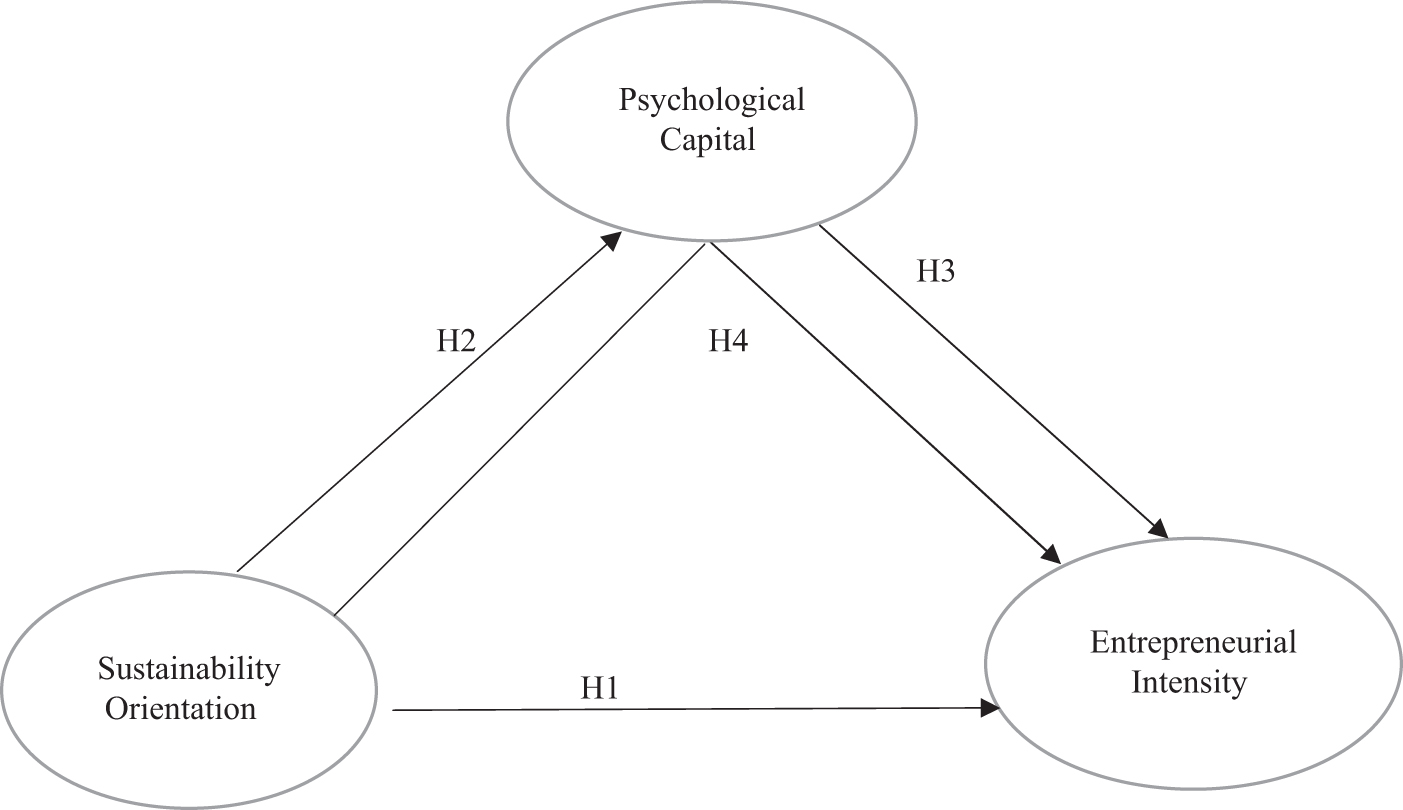
Proposed conceptual framework
Research Methods
This study examines the relationship between sustainability orientation, entrepreneurial intensity, and psychological capital among entrepreneurs running manufacturing-based micro, small, and medium-size businesses in the Delhi/NCR region. Questionnaires based on sustainability orientation (SO), entrepreneurial intensity (EI), and psychological capital (PC) were used for collecting data from 406 MSME entrepreneurs in the Delhi/NCR area. The sample size of 406 was determined using Krejcie & Morgan's (1970) sample size formula. Data was collected through both online (mail survey, 35%) and offline modes (personal visits, 65%) between the months of January and April 2022. The respondent profile is given in Table 1.
Respondent Profiling
Measures
The current study employed established scales with properly defined constructs for measuring variables at hand. For sustainability orientation, a scale was developed from the work of Sung & Park (2018) and Fatoki (2019). Entrepreneurial intensity was measured with the help of the scale developed from the work of Lumpkin et al. 2009) and Wang (2008). Innovativeness, proactiveness, risk-taking, competitive aggressiveness, and autonomy were used to represent entrepreneurial intensity. Psychological capital was measured using the psychological capital questionnaire (PCQ) developed by Fred Luthans and his colleagues in 2006. PCQ measures psychological capital via 4 dimensions: hope, efficacy, resilience, and optimism.
Cronbach's α reliability for all these scales are .880, .628, and .871 for sustainability orientation, entrepreneurial intensity, and psychological capital, respectively. Following the path of recent studies, demographics including experience, gender, age, and education were controlled because of their conflicting interrelationships.
Analytical Approach
The descriptive statistics of the data collected are given in Table 2. The data is free from any skewness and kurtosis. Exploratory factor analysis was done to unveil the loadings of various items at hand. The loadings ranged from .649 to .808 for sustainable orientation, .704 to .868 for entrepreneurial intensity, and from .578 to .868 for psychological capital.
Descriptive Statistics
PA=proactiveness; SO=sustainable orientation; CA=competitive aggressiveness; RT=risk-taking; AUT=autonomy; INN=innovativeness; HO=hope; SE=self-efficiency; RES=resilience; OPT=optimism
In this study, data were analyzed using SPSS and AMOS V. 21. For ensuring the fit of all scales, confirmatory factor analysis (CFA) was done. CFA indicated a relationship between observed variables of the study and their respective factors (latent). Fit indices used include: comparative fit index (CFI), Tucker-Lewis index (TLI), root mean square error of approximation (RMSEA), and CMIN/degrees of freedom.
The values include χ2: 1111.070, degrees of freedom (df): 774, χ2/df: 1.435, CFI: .964, TLI: .959, and RMSEA: 0.033. All values are in prescribed limits thereby representing goodness of fit. The CFA diagram and factor loadings are shown in Figure 2 and Table 3, respectively. Sustainability orientation is subdivided into social and environmental variables denoted by SOs. Entrepreneurial intensity acts as an outcome variable. It is subdivided into five variables: innovativeness (INN), proactiveness (PA), competitive aggressiveness (CA), risk-taking (RT), and autonomy (AUT). Psychological capital is comprised of four sub-variables: self-efficacy (RES), hope (HO), resilience (RES), and optimism (OPT), which when combined act as a mediating variable between sustainability orientation and entrepreneurial intensity.

CFA model
Factor Loadings
SO=sustainable orientation; INN=innovativeness; PA=proactiveness; CA=competitive aggressiveness; RT=risk-taking; AUT=autonomy; HO=Hope; RES=resilience; OPT=optimism; SE=self-efficiency
As per the theoretical foundation, when observed variables correlate with each other, convergent validity is present. Good composite reliability with high loadings demonstrates convergent validity as per researchers Cable & DeRue (2002). Correlation results can be seen in Table 4. The results indicate satisfactory model adaptability.
Correlation Matrix
SO=sustainable orientation; CA=competitive aggressiveness; RT=risk-taking; AUT=autonomy; INN=innovativeness; HO=Hope; SE=self-efficiency RES=resilience; OPT=optimism; PA=proactiveness
For discriminant validity checking, values of maximum shared variance (MSV), average shared variance (ASV), and average variance extracted (AVE) were deciphered. The results are presented in Table 5. For discriminant validity in data, Hair and his colleagues in 2010 proposed that the values of MSV and ASV should be lower than AVE values in all the cases. For convergent validity, AVE values should be more than .5, which Table 5 confirms. Table 5 also confirms the condition of discriminant and convergent validity of the data.
Validity and Reliability Testing a
Source: the authors' notes
CR—composite reliability
AUT=autonomy; RES=resilience; INN=innovativeness; RT=risk-taking; SE=self-efficiency; PA=proactiveness; OPT=optimism; HO=hope; CA=competitive aggressiveness; SO=sustainable orientation
Hypothesis Testing
For testing the hypotheses, structural equation modeling was conducted using a step-wise regression approach. Table 6 shows the results of the various proposed hypotheses. Results indicate that sustainability orientation has a significant impact on both entrepreneurial intensity and psychological capital. The results further stand the mediating impact of psychological capital on the relationship between SO and EI as proposed in the hypothesis.
Structural Paths and Hypotheses Acceptance/Rejection Decision
To test if psychological capital mediates the relationship between sustainability orientation and entrepreneurial intensity, further analyses were carried out. In the initial model depicting association between sustainability orientation and entrepreneurial intensity, a good model fit with all statistically significant relationships was obtained. To this, psychological capital was added to see if it has any mediating effect, leading to model 2. This new model again presented good fit indices and all, including new parameter estimates, were statistically significant, thereby portraying a strong mediating effect of psychological capital in the aforementioned relationship between sustainability orientation and entrepreneurial intensity. The results are given in Table 7.
Model Fit Results for Different Models
This leads to the acceptance of Hypothesis 4 proposed by the study. Effect decomposition in the structural model is narrated in Table 8:
Effect Decomposition in Structural Model
Note: for all effects: p<0.01
The final model with all its loadings and direct and indirect effects is given in Figure 3:
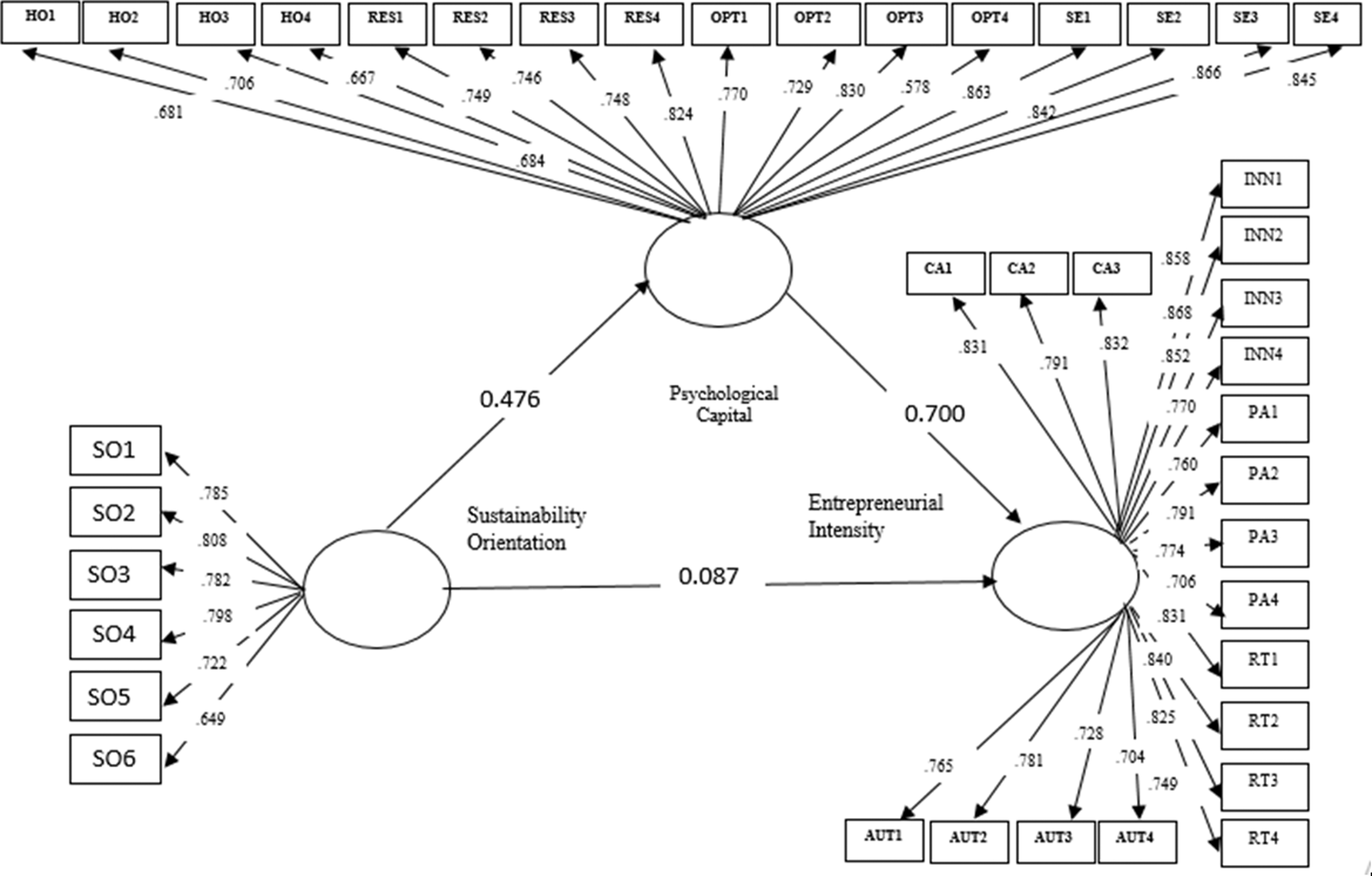
Final model
Figure 3 represents the final research model. Sustainability orientation is subdivided into social and environmental variables denoted by SOs. Entrepreneurial intensity acts as an outcome variable, subdivided into five variables: innovativeness (INN), pro-activeness (PA), competitive aggressiveness (CA), risk-taking (RT), and autonomy (AUT). Moreover, psychological capital is comprise of four sub-variables: self-efficacy (SE), hope (HO), resilience (RES), and optimism (OPT), which when combined act as a mediating variable between sustainability orientation and entrepreneurial intensity. This was confirmed by the empirical results of the study.
Discussion
This study attempts to ascertain the impact of sustainability orientation (SO) on entrepreneurial intensity (EI) in the manufacturing sector of the Delhi/NCR region. The study also explores the role of psychological capital as a mediator in the relationship between sustainable orientation (SO) and entrepreneurial intensity (EI). The hypotheses results are presented in Table 9.
Hypothesis Testing
Figure 4 demonstrates that psychological capital as a mediating factor strengthens the relationship between SO and EI, when added.

The direct and indirect effect of mediating variable
Five factors describe the level of entrepreneurial intensity in this study: risk-taking, innovativeness, competitive aggressiveness, pro-activeness, and autonomy. This study argues that every businessperson needs to have a high entrepreneurial intensity (EI) from a practical standpoint. Numerous elements, including education and innovative perceptions from an entrepreneurial peer group, might increase this intensity.
Due to the fact that these elements boost entrepreneurs' drive, they are crucial for people who want to increase their entrepreneurial intensity. A significant increase in EI, indeed, leads to sustainable businesses. Entrepreneurial managers need to pay more attention to green product innovation than their noncompetitive counterparts, according to this study and previous research on sustainability orientation. This study also shows that in competitive or unpredictable business situations, SO is essential for sustainable businesses. For manufacturing entrepreneurs, adjusting to the changing environment can boost self-confidence and foster the growth of innovative thoughts.
Entrepreneurs prioritize environmental concerns when setting their initial goals in order to gain credibility and, ultimately, a better chance of survival by overcoming the inherent risks of starting a new business. There is general agreement among customers, citizens, and other stakeholders that environmental values must be given first priority while running a small business. Thus, it is necessary for a business to be environmentally oriented. The inclusion of environmental considerations helps prevent and mitigate adverse environmental effects in order to reduce costs associated with maintaining environmental quality and to enhance the environmental and financial results of a company's operations. As an example, a paper manufacturer may choose to implement a water-saving technology to reduce the amount of water needed for paper manufacturing as well as to reduce the cost of waste management. Moreover, using recyclable packaging can help keep waste disposal expenses down. Adopting green product innovation and integrating socioenvironmental aspects can boost efficiency by reducing expenditures. The incorporation of environmental considerations is a growing trend for MSMEs due to the numerous operational and financial benefits it offers.
Apart from a direct relationship between SO and EI, this study investigates the mediating role of psychological capital. Psychological capital (PC) was treated independently from each component in this investigation as a conceptual framework/core structure. According to Luthans et al. (2006), PC is a general term for the basic aggregated positive resource that includes the subdimensions of self-efficacy, optimism, hope, and adaptability. Studies have demonstrated that aggregate PC has a bigger impact than any one of its components, and because of this, it is referred to as having a "core structure."
PC facilitates sustainable orientation, leading to entrepreneurial intensity. The finding of this study suggests a significant role of PC in the proposed relationship. Positive PC is an important mediating variable in increasing the EI of entrepreneurs. Entrepreneurs may face significant challenges when the entrepreneurial process is coupled with a fast-paced, competitive environment and pressure to cater to the stakeholders' needs (Chevalier et al., 2022). The contentment and general well-being, especially of manufacturing entrepreneurs, are impacted by these challenges, which may also have a detrimental impact on EI. Therefore, increasing manufacturing entrepreneurs' PC will have a favorable impact on their EI. Additionally, entrepreneurs with high PC displayed less hesitation, anxiety, and prejudice while taking entrepreneurial action, which raised their EI. Thus, a significant impact of SO on EI was also established.
Implications of the Study
Theoretically, this study provides a model that explains the relationship between sustainability orientation and entrepreneurial intensity in the manufacturing-based micro, small, and medium businesses in the Delhi/NCR region. The study shows the importance of psychological capital as a mediating variable in the relationship between sustainability orientation and entrepreneurial intensity. On the practical front, this study provides insights for MSME practitioners to strengthen their entrepreneurially intensity so as to enhance their overall performance. Practically, this study will be helpful for MSME practitioners and educators to enhance MSMEs sustainable performance in the manufacturing sector in the Delhi/NCR area. Given the fact that there is little empirical knowledge available on the relationship between sustainability orientation, entrepreneurial intensity, and psychological capital among manufacturing MSMEs in India, this research contributes to the literature by addressing the knowledge gap.
This study also has some implications for policy makers. Knowing the determinant of sustainable orientation in entrepreneurship will affect economic development and the environment. Furthermore, by knowing the determinants, policy makers can draft policies that will prompt entrepreneurs to take on sustainable ventures.
For future researchers, this study can act as a stepping stone to exploit further the domain areas of sustainability orientation, entrepreneurial intensity, and psychological capital.
Limitations and Future Directions
While this study is important in proposing certain theoretical and practical contributions, it does have some limitations. The shortcomings of this study must be overcome in follow-up investigations. The cross-sectional design of the study makes it difficult to generalize the results to other similar environments. Research has indicated that cultural factors influence entrepreneurial decisions through social norms, values, and practices, hence additional studies with other samples of MSMEs, particularly in other nations, are required.
This study used the convenience sampling method to collect the samples. As the samples were collected using non-probability convenience sampling, the results cannot be easily generalized to other similar scenarios like industries/locations. In addition, a longitudinal study could provide causal inferences into the relationship between SO and EI. This study was limited to the geographic location of Delhi/NCR and manufacturing MSMEs. Future studies can be directed toward the larger geographical area and additional business sectors, including services. Also, since the study collected data from humans, it is subjected to biases from human nature, which is one more limitation of the study.
Conclusion
This study examines the relationship between sustainability orientation, entrepreneurial intensity, and psychological capital among manufacturing-based MSMEs in the Delhi/NCR area. The study shows the importance of psychological capital as a mediating variable in the relationship between sustainability orientation and entrepreneurial intensity. Psychological capital (PC) was treated independently from each component in this investigation as a conceptual framework/core structure. Results of this study show that sustainability orientation has a significant impact on both entrepreneurial intensity and psychological capital. The results further withstand the mediating impact of psychological capital on the association between sustainability orientation and entrepreneurial intensity.
In essence, the study's results have important ramifications for decision makers and practitioners in the field of MSMEs. It is crucial to keep in mind that this study's findings demonstrate that both innovative and proactive approaches go hand in hand. This study has implications for researchers, MSME entrepreneurs, policy makers, and educators.
Footnotes
Acknowledgment
The authors are grateful to the anonymous referees of the journal for their extremely useful suggestions to improve the quality of the article. Usual disclaimers apply.
Funding Information
The authors received no financial support for the research, authorship, and/or publication of this article.
Author Disclosure Statement
The authors declare no potential conflicts of interest with respect to the research, authorship, and/or publication of this article.