




Abstract

Introduction
According to estimates, Vietnam is the fourth largest discharger of plastic waste into the ocean, with an amount reaching about 0.28 to 0.73 million tons per year. This is equivalent of 6 percent of the total volume of plastic waste discharged into the sea worldwide (Jambeck, 2015; Toan & Anh, 2019).
To deal with this issue, in 2019, the National Action Plan on the Management of Marine Plastic Waste Management by 2030 was approved by Prime Minister's Decision no.1746/QD-TTg of 4 December 2019. The objective of the plan is to successfully implement Vietnam's initiatives and international commitments to address plastic waste issues with a focus on marine plastic waste (Decision no.1746/QD-TTg, 2019). The Action Plan set objectives to reduce plastic waste in the sea and ocean by 50 percent by 2025 and 70 percent by 2030.
To achieve this objective, the plan focuses on education, one of the important tasks to be implemented under the Action Plan. The plan requests the Ministry of Education & Training (MOET) and Ministry of Natural Resources and Environment (MONRE) to take concrete steps to develop and integrate into education and training programs at all levels of education, with appropriate form and content, the topic of minimizing the discharge of plastic waste into the ocean. This discussion addresses the education tasks under the Action Plan and suggests the development of a university-level module on marine plastic pollution (MPP) in Vietnam. Support for such a university-level module is based on the results of a survey conducted in 16 Vietnamese universities and an evaluation of existing examples of university-level modules on MPP. Concrete suggestions relating to the format, method, status, and content of the module are provided.
Support for a University-Level Course on MPP in Vietnam
To assess the current status of teaching MPP in universities and identify the need to develop a new university-level module on MPP in Vietnam, a survey was developed with the aid of the World Wide Fund for Nature in Vietnam (WWF-Vietnam). Surveys were administered to 51 lecturers, 14 of whom are in the field of natural resources and environment, and 892 students representing 16 Vietnamese universities, The findings of the survey indicate that most of the surveyed lecturers (84.3 percent) noted that MPP was mentioned in the curriculum, while five surveyed lecturers (9.8 percent) did not mention MPP in their lectures, despite two of them teaching in the maritime program. One lecturer reported feeling unconcerned about MPP. Notably, all 14 lecturers in the natural resources and environment program revealed that their universities did not provide a specific module on MPP. Similarly, the survey conducted with students resulted in outcomes similar to the results for lecturers, as shown in the chart (see Figure 1).

Student opinions about the status of teaching about MPP at universities
One question on the survey asked respondents to “evaluate the pollution level caused by marine plastic litter in the locality” on a scale from 1 to 10, with 1 being unpolluted and safe and 10 representing severe pollution. Only one out of 51 surveyed lecturers answered “safe,” and five chose “severe pollution.” The average response was 4.5. Similarly, the students mostly evaluated the MPP at the average level or “fairly clean.” Meanwhile, 235 out of 892 surveyed students (26.3 percent) considered MPP severe. Therefore, though most of the lecturers and students acknowledged the existence of MPP in the locality, there is a gross disparity in their evaluations and the reality.
Surveyed lecturers answering the question concerning the potential effects a university-level module might have on MPP, 41.2 percent claimed that such a module would contribute to changing students' awareness and behavior toward environmental protection. Accordingly, the subject needs to be taught to students at all universities since this is an alarming environmental issue in Vietnam.
The survey also asked lecturers to rank the feasibility of including MPP in university curricula. On a scale from 1 to 10, with 1 being “unfeasible,” and 10 being “entirely feasible,” the average score received is 6.7, with 23 lecturers (45.09 percent) scoring between 8 and 10. The lecturers in this group of respondents all had a basic understanding of MPP, and their universities offered environment-related majors. Most of the surveyed students, meanwhile, affirmed the necessity of including a university-level module on MPP and thought such a module would contribute to changes in their awareness, attitude, and behavior (see Figure 2 and Figure 3).
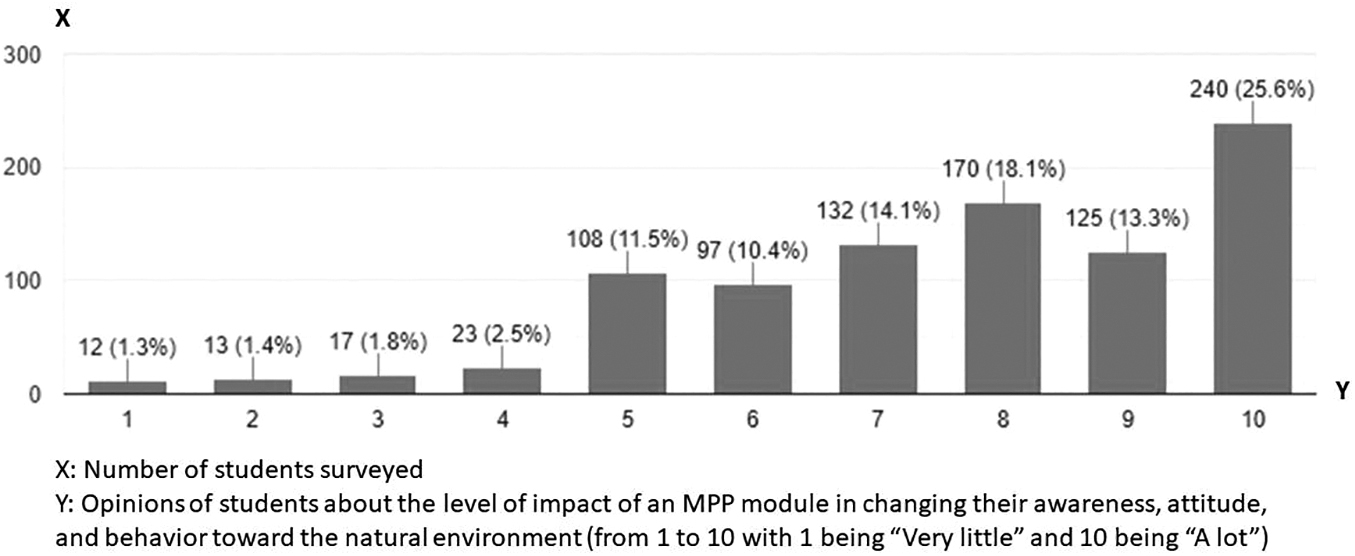
Student evaluations of the effect of an MPP module on changes in their awareness, attitude, and behavior toward the natural environment
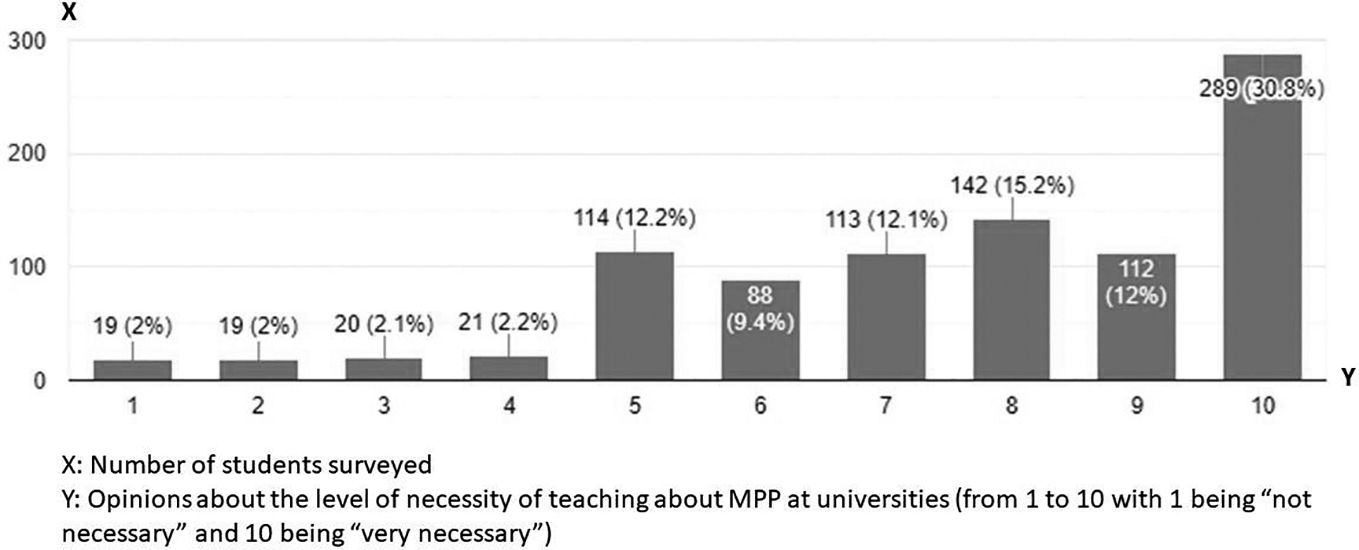
Student evaluations of the necessity of teaching MPP in university
Asked which majors should include an MPP module, surveyed student responses ranged from management, environmental engineering, maritime, as well as law, diplomacy, and social affairs. In contrast, 63.9 percent of surveyed students wanted to learn about MPP through extracurricular activities such as competitions or seminars, and approximately 41.5 percent of students wanted to make this module elective.
Perspectives for Teaching about MPP in Vietnamese Universities
Pre-University Environmental Education in Vietnam about MPP
According to the Ministry of Education & Training (MOET) in the academic year 2019-2020, there were 10,770 secondary schools (including 10,715 public schools and 55 private schools), with a total of 5,599,918 pupils (MOET, 2021a). The number of secondary and high school pupils accounted for about 8.4 percent of the total population of Vietnam. As this group reaches adulthood, it could could become influential and have an impact on environmental issues including MPP.
The pre-university educational program is prescribed by the Ministry of Education & Training (MOET) for schools across the country, along with specific subjects and teaching times for each (MOET, 2018). At the pre-university level, schools are not allowed to offer new subjects, whether elective or compulsory, in their educational programs. Furthermore, neither environmental education nor any MPP-related subject is included in the list of allowed subjects at the pre-university level.
In 2001, Vietnam implemented specifications “to include environmental protection lessons in the national education system” (MOET, 2005). Since then, environmental education (including MPP) has been integrated into specific subjects at the pre-university level, including literature, history, geography, civics, physics, biology, technology, and chemistry. Thus, the environment is a subtopic integrated into other content lessons rather than a separate study of its own. Lessons about environmental protection issues may or may not be included in curricula and textbooks; in some cases, they are just referred to and conveyed in reasonably relevant courses. For high school students, the integrated content mainly focuses on the adverse effects of MPP and is intended to develop exemplary and environment-friendly behavior. Nonetheless, as environmental education is a mere topic integrated into lessons instead of a separate study, students have only a rudimentary knowledge about the detrimental effects of MPP so as not to overload high school students. Vietnam currently does not have a common and unified program on environmental education in high schools.
As an example, the topic of the environment is integrated into high school civics textbooks, though how this is implemented varies widely. A civics textbook for grade 10 published by Vietnam Education Publishing House in 2020 includes a lesson entitled Citizens with Pressing Problems of Humanity (MOET, 2020b). A lesson in the grade 11 civics textbook is entitled Policies on Natural Resources and Environmental Protection (MOET, 2020c), and a lesson in the civics textbook for grade 12, Chemistry and Environment (MOET, 2020d).
Extra-Curricular Educational Activities Relating to MPP in Vietnam
A few schools have organized extracurricular and creative experiential activities to integrate into environmental protection lessons (Ngoc, 2013; Tuong, 2021). Other programs on environmental education have been organized by local communities and have been implemented via public relations campaigns through mass media and through contests for composing, writing, drawing, and studying legislation on the environment. However, these programs are merely at the stage of raising awareness and are insufficient for addressing specific issues such as MPP.
According to a survey of WWF-Vietnam, only 2.3 percent of respondents were aware of state programs and actions to combat MPP. Although 10.8 percent of respondents claimed to know a little about the government's anti-plastic waste programs, 42.6 percent indicated that they knew very little about such programs. Since the topic of plastic pollution, especially MPP, has just been raised in Vietnam in recent years, dissemination primarily focuses on raising awareness instead of government policies and legislation (Nam, 2021).
Existing Courses and Modules Relating to MPP at Vietnamese Universities
According to MOET, Vietnam currently has 237 universities, 127 of which are public and 65 are private; this does not include universities or academies in the Public Security and National Defense sectors. The 237 universities have a total of 1,672.881 undergraduate students and 105,974 postgraduate students (MOET, 2021b), a potential young workforce likely to affect their communities and participate in management decisions and policies about MPP in the future. Universities in Vietnam tend to be in major cities (Yen, 2022), which are centers of development of commercial and residential services, and often where marine plastic waste is most often originally produced.
Resulting from Articles 2.8 under Circular no.08/2021/TT-BGDDT of 18 March 2021 issued by the Minister of Education and Training, promulgating regulations on university-level training, university education programs need to be publicly announced (MOET, 2021c). Official websites of universities in Vietnam provide information about their environment-related programs. The current curriculum framework of the universities includes a separate module called the Management of Solid Waste, into which the topic of MPP is integrated. (See Table 1.)
Environment-Related Educational Programs with a Separate Module on the Management of Solid Waste Provided in Universities in Vietnam
Due to the traditional classification of plastic litter as solid waste, universities tend to integrate the topic of plastic waste management into the Solid Waste Management module. In general, this module provides students with basic concepts of municipal solid waste, industrial solid waste, and hazardous waste; sources, composition, and nature of solid waste; treatment methods and collection, transportation, and landfill systems; designing solid waste treatment systems; and Vietnamese and international law on the management of solid and hazardous waste. The topic of MPP, however, is not explicitly mentioned on the syllabi of every university surveyed. Additionally, since the Solid Waste Management module awards 2 to 3 credits, the integration of MPP has not been intensive and comprehensive. According to the syllabi of the surveyed universities, the topic of solid and municipal waste is taught more frequently than marine plastic litter, confirming inadequate attention of universities to the MPP issue.
Moreover, several universities in Vietnam are now focusing on phased approaches instead of the full life cycle of plastic litter. As an illustration, the program on Management of Natural Resources and Environment at Vinh University, located on the coast, offers a module on Solid Waste Management that only focuses on municipal solid waste. Similarly, the module on Solid Waste Processing Methods at Nha Trang University, also located on the coast, merely covers the selection of an appropriate treatment method for each type of solid waste. In addition to the Solid Waste Management module, others related to the environment and sustainable development also mention marine plastic litter as “environmental issues” without providing knowledge of causes, methods, and measures for its management.
On the other hand, despite not having a separate module on MPP, several universities in Vietnam are providing courses on the environment and sustainable development, and/or policies and laws relating to MPP. In other words, besides common knowledge of the environment, universities have the potential for their students to apply scientific approaches to the treatment of MPP and become specialists. In addition to classes and laboratory practice, extracurricular activities and field trips are likewise offered to provide students with an overview of their future work (HCM University of Natural Resources and Environment, 2014; VNU University of Science, 2022).
Under the Law on Environmental Protection of Vietnam, companies that conduct activities affecting the environment must have staff who are in charge of ensuring adherence to the law and protection of the environment (National Assembly, 2020). As Vietnam is facing labor shortages in the field of management of natural resources and environment (Tung & Hoang, 2021), Vietnamese universities tend to establish new programs in environmental science and sustainable development (Hong, 2021; Phuong, 2022). MPP could potentially become a module to be taught under these programs.
Since 2020, MOET has continuously identified MPP as an urgent environmental issue in need of attention and action (MOET, 2019, 2020a, 2021e). To date, several actions directly related to marine plastic litter have been taken to create additional resources that support the implementation of a university-level module on MPP. Notably, on May 8, 2019, MOET and Ministry of Natural Resources and Environment (MONRE) entered into a cooperative program on environmental protection for the academic terms from 2019 through 2025. The program identifies a task to “continue developing and completing the educational content on environmental protection … including the focus on the reduction, collection, classification, reuse, recycling and treatment of solid waste; restriction of single-use plastic products. …” (MONRE & MOET, 2019).
On February 5, 2021, the Prime Minister Decision no.175/QD-TTg approving the program “Promotion of the dissemination of plastic waste prevention and control in the 2021-2025 period” was issued (Decision no.175/QD-TTg, 2021). According to the Decision, one of the missions for relevant government agencies, mainly the Ministry of Education and Ministry of Natural Resources and Environment, for the period 2021 to 2025 is to educate students about preventing plastic waste. The content for education will cover the State's environmental policies, legislation, and the adverse effects of plastic waste, but also application of advanced technology in production and recycling of plastic waste; the reform of policies to advance the development of biodegradable and environmentally friendly products; and the experience of plastic waste prevention and control in other countries, among others. As per this directive, the Program is implemented with the state budget and other support funding of enterprises and social organizations. Human resources for the Program are experts, lecturers, and students of institutes, universities, and state management agencies proposed by these institutions/universities and selected by the MOET (Decision no.175/QD-TTg, 2021). Developing a university-level course on MPP, thus, is to train the trainers to perform the tasks prescribed in the Decision.
General Requirements for a University Module in Vietnam
Regulations for university-level training, as per Article 2 under Circular no.08/2021/TT-BGDDT, direct that a university educational program consists of subjects and modules (MOET, 2021c). Each module is assigned a number of credits for classroom activities; one credit requires a minimum of 15 hours of lectures or 30 hours of practice, lab work, and seminars, in classes that are 50 minutes each. The training program must be consistent with the minimum requirement of the National Qualification Framework of Vietnam—120 credits for a university program plus physical education and national defense and security education. In accordance with Articles 7 and 8 of Circular no.17/2021/TT-BGDDT of 22 June 2021 issued by the Minister of Education and Training on the standard training program, development, appraisal, and issuance of the training program, each module of the program must specify the content of the course, its objectives, admission requirements and expected results, and the number of credits to be awarded (MOET, 2021d).
Other regulations govern the development and issuance of university educational programs. The head of educational institutions must establish a committee to oversee the development of the program and a committee to assess it. Once approved by committee, it must also pass muster with the Science and Training Committee of the institution; then the head of the institution can sign off on the program. In addition, the program must meet these criteria: it must be consistent with and linked to the community needs; demonstrate the potential to contribute to fulfilling the human resource needs according to the socioeconomic development plan and strategy of the sector, locality, country, as well as labor market needs; and be equal to or or exceed standards of programs of the same level in the same industry that have been verified by either domestic or foreign reputable educational institutions. Universities are authorized to organize online classes with a maximum duration equal to 30 percent of the total volume of the program, which could be extended in case of natural disasters or epidemics, as stipulated under Article 8 of Circular no.08/2021/TT-BGDDT (MOET, 2021c).
Given these parameters, including MPP in the training curricula of Vietnamese universities is not difficult since institutional regulations already permit this type of training. Nonetheless, Vietnamese universities have not had a common model for an MPP module. However, there are several other university-level modules on MPP around the world that can be used as models for Vietnam.
Cases Study of University-Level Modules on MPP in the World
Some course related to plastic waste and marine plastic waste management are offered at universities in India. These include a plastic waste management and recycling techniques module at Anna University, a plastic waste management module offered at the Indian Institute of Technology of Kharagpur, and a recycling of plastic module at Gujarat Technological University. In particular, a master's program in Marine Plastic Abatement is taught at the Asian Institute of Technologies in Thailand.
Plastic Waste Management and Recycling Techniques Module
Plastic Waste Management and Recycling Techniques is an elective module for students pursuing a Bachelor of Technology at Anna University, Chennai, India. The module spans three weeks, with three-hour sessions every week. The module covers the various sources of plastic waste generation, segregation methods for recycling plastics, recycling codes of commodity and engineering plastics, primary recycling techniques, and the recycling of various commodity and engineering plastics. The objective is for students to understand the impact of plastic waste on the environment, the recycling process of both commercial and engineering plastics, the policies related to environmental issues of plastic waste, and legislation relating to environmental issues of plastic waste. Topics taught in the module also include plastic and environment, global policy and regulations relating to plastic, waste energy management, and recycling and recovery of various plastic materials (Anna University, 2013; Inl Labs TN, 2019).
Recycling of Plastic Module
Recycling plastic is a 42-hour module for the diploma (below bachelor's) of Plastics Engineering at Gurajat Technological University, India. The course is designed to help students select sustainable waste disposal methods, select appropriate plastic separation methods, identify primary and secondary recycling methods, analyze various tertiary and quaternary recycling methods, and understand the recycling methods of various plastics. Other topics also include sources of plastic waste and its management (Gujarat Technological University, n.d.).
Plastic Waste Management Module
Plastic waste management is an eight-week module at the Indian Institute of Technology, Kharagpur, India, for students earning a Bachelor of Technology degree in civil and chemical engineering, environmental engineering, and master's and doctoral degrees in environmental science. The module focuses on: the magnitude of plastic pollution as a global problem; the nature and complexity of plastic in the ocean and its impact on sea life, wildlife, human health, the environment, and the economy; the best way to manage plastic waste; and plastic waste management regulation. It also covers: the nature of plastic, sources of plastic waste, alternative materials to plastic, plastic resource recovery, and the circular economy (Indian Institute of Technology Kharagpur, n.d.).
Marine Plastic Abatement Master's Program
The master's degree in Marine Plastic Abatement is a one-year program at the School of Environment, Resources and Development of the Asian Institute of Technology in Thailand (Asian Institute of Technology, n.d.). This program is designed to help students achieve four United Nations Sustainable Development Goals (SDGs): Life Underwater (SDG #14), Sustainable Cities and Communities (SDG #11), Responsible Consumption and Production (SDG #12), and Partnerships for the Goals (SDG #17) (United Nations, n.d.). The program is intended for students who already hold bachelor degrees in subjects relating to waste management, plastic industries, pollution control, the waste recycling business, and marine environment (Asian Institute of Technology, n.d.).
The program is comprised of both compulsory and elective courses. Compulsory courses include: waste composition and characterization, plastic litter and public health, marine ecosystems and emerging pollution, identification and collection of marine plastic wastes, circular economy for plastic waste management, and dumpsite recovery for plastic wastes. Elective subjects include: plastic waste management systems and technology; nonrecyclable plastics and management practices; plastic-to-energy and materials technologies; stakeholders, finance, and leadership in plastic waste management; innovations in plastic waste management; and innovative business models for plastic waste abatement.
Concrete Suggestions for a University-Level Module on MPP in Vietnam
A university-level module on MPP in Vietnam should be designed in line with that of the other nations and the experience of universities in other parts of the world. Suggestions for the framework of this module in Vietnam follow.
Objective(s)
The module should provide students with a broad knowledge of the origin and challenges of MPP, along with approaches to examining, monitoring, and managing marine plastic litter derived from all sources, especially in cities and coastal areas. Students should also be able to identify their knowledge gap, develop strategies to reduce MPP, pioneer the prevention of MPP by raising awareness and promoting creative solutions, and interacting with all stakeholders.
Type and mode of teaching
A university-level module on MPP in Vietnam should be provided to students of all majors, as MPP is an interdisciplinary, multidisciplinary issue, which should be approached and addressed in line with the entire life cycle of plastic. It should be provided in two types: 1.) compulsory courses majors of environmental management and engineering, and 2.) elective courses for students of other majors. The elective module would allow students who desire to study further at the university level to do so. On the other hand, most universities would not have to alter their program to add courses although universities that offer programs in environmental management and engineering might need to amend the training program to include a new compulsory module on MPP. This could be seen as an opportunity for these universities to develop their majors. The module for Vietnam should be in a hybrid format (online and offline) to attract a wide range of participants, regardless of age, level of qualifications, occupation, and location.
Number of credits
Students would earn 2 credits by successfully completing the module. This recommendation is based on international norms and is consistent with current university programs in Vietnam—four to five years for an undergraduate degree and two years for a postgraduate one.
Content
A university-level module on MPP in Vietnam should include: the current extent of MPP and its adverse effects; the management of marine plastic litter (sources, procedures, models, monitoring, and assessment); technical solutions, including alternatives and recycling; methods and approaches to detect and separate marine plastic litter in rivers and coastal areas, including the utilization of digital technology, and methods and standards for monitoring and assessing marine litter at the national level; stakeholders in the plastic value chain and tools for planning and comprehensive management of plastic pollution, including introduction and analysis of participation of stakeholders (i.e., the government, public sector, market, and civil society); introduction of the human rights-based approach to addressing MPP and the role of stakeholders; raising awareness, public education, and approach, and capacity building; and skills in formulating an action plan to reduce MPP. Based on this framework, each university would develop a syllabus in which key content is consistent with its majors and curriculum.
Teaching method
The course should combine a face-to-face format that uses lectures, perhaps using a PowerPoint presentation, including interactive activities and hands-on practices in which students are instructed to do practical experiments with plastics and interact with the environment (such as joint clean-up of marine waste, university programs/projects to separate plastic waste). Education about MPP also includes extracurricular activities, seminars, and contests related to environmental protection. Moreover, promoting programs, public relations campaigns, contests for studying, photo contests, and similar activities about protecting the marine environment, would contribute to extending knowledge and raising students' awareness.
For effective implementation, this module needs three preconditions. First and foremost, specific mechanisms for encouraging universities to actively add MPP to their training programs and students' course choices are essential, including (but not limited to) financial and resource support from the government, such as a pilot university-level course on MPP in the list of environmental protection courses selected by MOET for immediate implementation in 2023; the creation of a “green ranking” of universities, which would rank universities in the country based on their environmentally friendly policies in addition to traditional university rankings based on level of research and education; mechanisms for prioritizing recruitment of students who graduate with green certificates, which could be issued for those who actively participated in extra-curricular activities relating to the protection of the environment. Second, the establishment of a university network is required to promote sustainable education at domestic universities and participation to university alliances in the Asia-Pacific region that are committed to integrating sustainable development into postgraduate courses and training programs. Lastly, connections between universities and localities, international organizations, and companies should be further strengthened to mobilize course-supporting resources. Analyses show that international frameworks, in particular the 2030 Agenda and the Sustainable Development Goals, along with specific national and international networks are invaluable for universities in terms of sharing of practice, field trips, experiences, application of research to practice, and cross-cultural learning.
In general, implementing a university-level module on MPP needs critical scrutiny of these preconditions and a flexible combination of the roles of the local authorities and mass organizations based on the situation at the location of the universities.
Conclusion
Education about MPP contributes to being able to address this urgent environmental issue in Vietnam. However, the education system is insufficient to widely disseminate and raise awareness of MPP. Developing a university-level module on MPP so that students can study the issues surrounding this topic is crucial. Such a module would provide students with the knowledge and skills needed to pioneer ways to prevent further MPP through raising awareness and promoting creative solutions. The module should be provided for students of all majors, compulsory for environmental management and engineering majors and elective for other majors. The hybrid format could make this course attract more participants and at the same time, attain the objective of spreading knowledge of the MPP issue. The contents of the module should include (but not be limited to) the general knowledge of MPP as well as specialized knowledge of managing and processing marine plastic litter, skills in identifying and engaging stakeholders in the plastic value chain, and formulating an action plan to reduce MPP. With a standard foundation, each university remains free to develop a specific syllabus in accordance with their general approach, priorities, and concrete situation. As part of the course, mechanisms could be also established to encourage university students to undertake outreach activities in the community to raise awareness relating to MPP such as participating in collecting litter and plastic litter in the area where the university is located, taking part in knowledge competition relating to MPP, and volunteering in garbage collection and recycling centers.
Footnotes
Acknowledgments
We gratefully acknowledge WWF- Vietnam for allowing us to use the results of the survey on the teaching MPP in universities and the need to develop a new university-level module in MPP. The authors of this article were also involved in its implementation.