




Abstract
Brewer´s spent grain is the highest volume by-product of the brewing industry. When inappropriately disposed of, it represents a serious environmental hazard. Despite the availability and the possibilities that the literature presents, few Brazilian companies use brewer´s spent grain as raw material for composting, animal feed, or energy production. This article describes research evaluating the economic feasibility of reusing brewer´s spent grain in processes not allied with breweries. The study uses data from a cluster of 14 craft breweries in Brazil to model two possible outlets for reuse: production of specialty bread in bakeries and production of biogas and biofertilizer in biorefineries. The evaluation conducted utilizes computational simulation to compare reuse in the two outlets to determine their economic viability and the limiting conditions that ensure feasibility. According to the results, biofertilizer is more profitable than specialty bread production
Introduction
Brewer´s spent grain (BSG) is waste produced in the beer brewing process and represents the largest volume of waste generated by the process, comprising 14 to 20 percent of the final production (Aliyu & Bala, 2011). It is most commonly used as animal feed (Silivong et al., 2018; Sivilai et al., 2018). Usually, breweries do not receive payment for the residue; even so, it is advantageous for breweries to route the waste to another industrial operation, as otherwise they must bear the cost of disposal (Patricio et al., 2018). In Brazil, most craft breweries are small businesses and cannot afford the cost involved in reusing BSG (Colpo et al., 2021). Because Brazilian regulations allow disposing small amounts of nonhazardous industrial waste in landfills (Luz et al., 2006), many companies do not bother to recycle BSG for reuse.
BSG can provoke damage in the environment. If dumped in rivers, it reduces the oxygen concentration, eliminating microorganisms (Karlović et al., 2020). BSG requires up to a hundred times more oxygen to break down carbohydrates, proteins, fats, and fiber than raw domestic sewage. In addition, the large volume of suspended solids in BSG reduces the amount of light and thus affects photosynthetic organisms in rivers (Šarić et al., 2017).
Reusing waste is essential for manufacturing companies as part of a circular economy (Sellitto & Murakami, 2018; Nara et al., 2019). But the reuse of industrial waste involves key uncertainties, such as the available supply, the contamination level of the waste, the rate of conversion of waste in raw material, industrial equipment maintenance requirements, and sale price of the new product derived from the waste, among others. Quantitative models can be used to help reduce these types of uncertainties, as well as to manage risks and test options in a controlled environment (Vandenbroele et al., 2021). A quantitative model also can support decision making by evaluating the economic feasibility of reusing BSG.
Recent studies indicate that there are numerous options for reusing BSG (Sganzerla, Ampese, Mussatto, et al., 2021). For example, BSG can be converted into bioethanol (Luft et al., 2018; Pinheiro et al., 2019; Rojas-Chamorro et al., 2018) or biogas (Dudek et al., 2019; Goberna et al., 2013; Malakhova et al., 2015); the high protein content can be extracted for use in bioactive compounds (Bonifácio-Lopes et al., 2019; Chetrariu & Dabija, 2020; He et al., 2019; Okeyinka et al., 2019; Outeiriño et al., 2019), and as an addition to improve nutritional value in animal feed (Eliopoulos et al., 2022) and food for human consumption (Almeida et al., 2017; Ktenioudaki et al., 2015; Mussatto, 2014; Nocente et al., 2019). BSG can also be used as a secondary fuel (Buller et al., 2022), a step fuel that complements the main fuel and usually provides cost reduction and insures an alternative to the process, as the manufacturing can employ two, instead of a single type of fuel (Sellitto et al., 2013), and to produce activated carbon (Vanreppelen et al., 2014) and raw material (Ferreira et al., 2019; Hussain et al., 2019; Klímek et al., 2016; Mello & Mali, 2014). In addition, Bonato et al. (2022) identified 21 another possible uses of BSG. Nonetheless, most studies address technical issues (Arranz et al., 2021; Fernandes et al., 2022; Mailaram et al., 2022; Muhammed et al., 2015; van Deventer et al., 2020). Only a few studies focus on economic feasibility, relying on indicators such as Net Present Value (NPV) and Internal Rate of Return (IRR).
Colpo et al. (2022) show that using BSG in specialty bread production can have positive economic and financial outcomes. Mussatto et al. (2013) found using BSG in the production of xylitol, lactic acid, activated charcoal, and phenolic acids is economically feasible, with a profit margin of 62.25 percent. In other studies, Sganzerla, Buller, Mussatto, et al. (2021) simulated the production of biofuels, energy, and fertilizer employing BSG waste generated by small, medium, and large breweries as raw material. Every reported application showed a large profit margin that could help to move toward a circular economy, which happens when one company employs the waste of another as raw material (Sellitto & Murakami, 2018).
Despite the numerous studies, none of the literature searched for this article found a feasibility model that could be used to evaluate options for reusing BSG in the production of either specialty bread or biofertilizer. Given that the research question is how to evaluate the feasibility of options to reuse BSG, a quantitative model that encompasses waste availability, investment, profitability, useful life, sales, and price is needed. This study aims to fill in that gap and to that end, used a cluster of 14 small craft breweries located in Southern Brazil to develop a model for evaluating the feasibility of reusing of BSG either to produce specialty bread or to produce biofertilizer. The study developed the model and applied it to the cluster. Using a simulation, the study shows how routing BSG to produce food mitigates the use of land (van Deventer et al., 2020), whereas routing BSG to produce biofertilizer increases overall energy efficiency (Winquist et al., 2019). Both applications mitigate greenhouse gas (GHG) emissions and would help in future implementations of a circular economy in food supply chains.
This study is novel in its use of a simulation model to compare the feasibility of reusing the same waste as raw material for two different products and production systems. The simulation model used in this study can be applied to other businesses and industries within a circular economy. The study is also novel in its approach to the logistics of collection—the 14 small craft breweries are located very close to each other. The maximum distance between any two companies is 10 km, which provides scale to the operation. In fact it is a cluster of small craft breweries, which facilitates both the forwarding for reuse or eventual disposal of the waste. Finally, all the monetary values in this study are shown in US dollars ($).
BSG in the Manufacturing Process
Biorefineries are facilities that employ technology (Ubando et al., 2020) to convert food waste into biofuels and biobased materials such as polymers and biochemical items (Mohan, 2014). Biorefineries can help companies that need to comply with laws (Tsegaye et al., 2021) or internal guidelines designed to help save natural, scarce resources, slowing down the consumption of virgin materials (Konietzko et al., 2020). In this study BSG is used to illustrate the process and feasibility of two reuses—one to produce specialty breads and one to produce biofertilizer. Both reuses reduce the cost of waste disposal (Ramzan et al., 2022), integrate bioeconomy and circular economy (Bijon et al., 2022), and overcome the difficulty of reducing waste sources (Curtis & Mont, 2020). Both reuses boost circular economy initiatives (Trujillo-Gallego et al., 2021) as both convert organic waste into a new product (Sherwood, 2020). Biogas leftover eventual internal usage can also help to decrease variable costs of the biorefinery.
Specialty bread is a type of artisanal bread with a higher nutritional value than the usual product, meeting the requirements of consumers concerned about food quality. Specialty breads usually cost more; therefore, the profit margin should be higher than that achieved by mass produced bread, as the product focus is on a market niche prone to pay more for a differentiated product. Biofertilizer can be produced in a biorefinery that also produces biogas. Nonetheless, preliminary tests confirmed that the BSG available is not sufficient for the biogas production. Therefore, the only option is biofertilizers. Figure 1 summarizes the processes for both models.
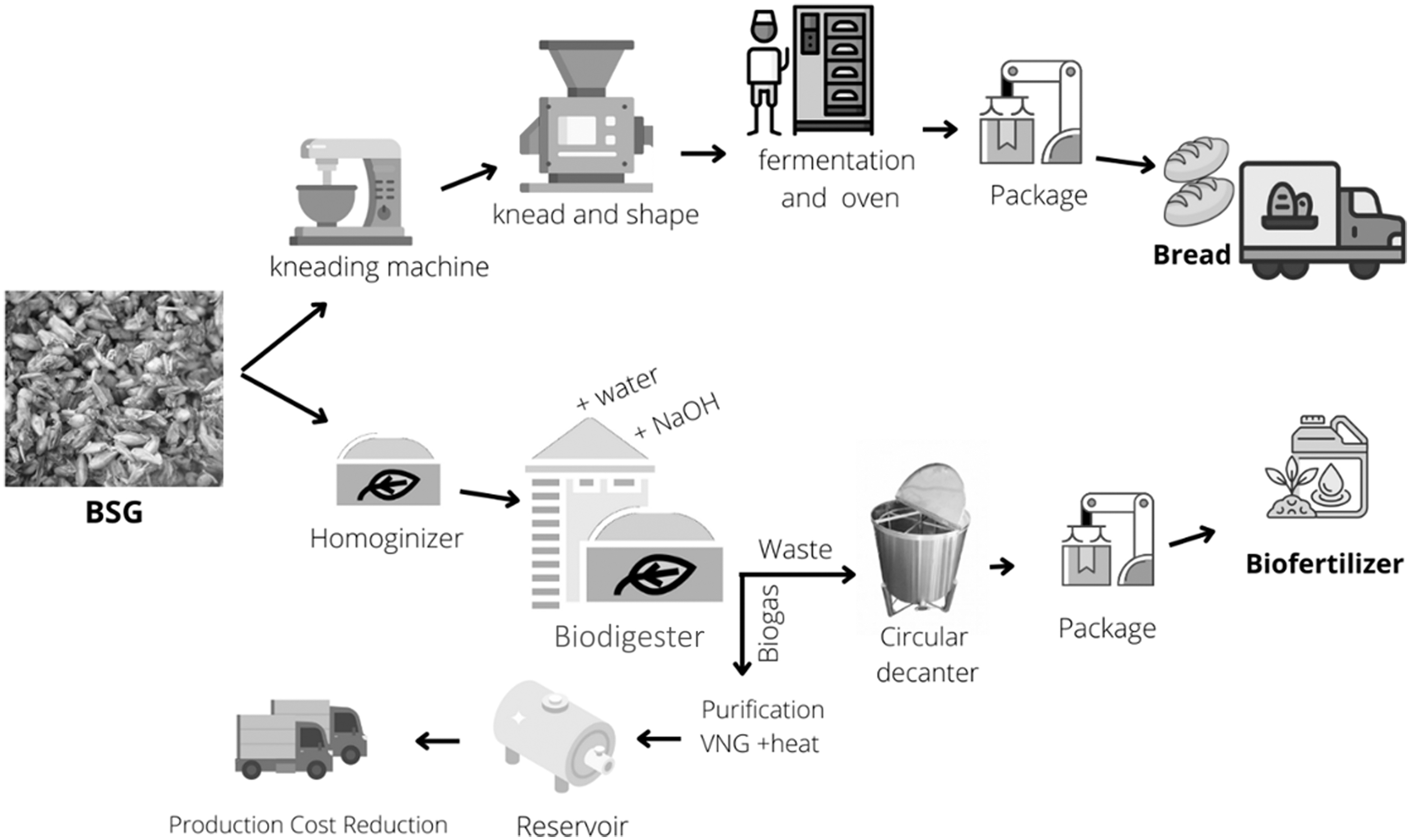
Processes for reusing BSG
The Research
This study used simulation and took the following steps for each model:
Collection of data (historical lower and upper bounds) about BSG availability, fixed costs, variable costs, and sales prices Development of a simulated model for calculation of profit in an Excel spreadsheet; the model assumes uniform distribution between empirical limits Calculation of feasibilities relying on Net Present Value (NPV), Internal Rate of Return (IRR), Profit Rate (PR=NPV/investment, the profit per unit of investment), and Payback Time (PBT) by the internal return rate (IRR) Sensitivity analysis by slightly changing the mean profit, the investment, and the useful life of the project.
Accounting Data
The empirical data regarding both applications include the waste generation by the net beer production of the cluster (14 to 20 percent), craft beer, based on annual production of 1,221,136 liters. This includes consideration of quarterly seasonal variations in the Brazilian market (25%, 22%, 23%, 30%) and the useful lifetime of the equipment (5 years).
For specialty bread, the average production ranges from 1,624,110 to 2,320,158 loaves of 0.45 kilogram per year (4,500 to 6,400 per day). The wholesale price range is between $.67 and $.79 per loaf. The initial investment is $111,300 and the depreciation rate of the equipment is 20 percent, which means that the equipment will depreciate in five years. The variable annual costs include a 5 percent fee for brokers, intermediate agents that sell the waste, a federal tax rate of 5.93 percent on gross sales, and a local rate of 17 percent on the difference between revenue and raw material cost, according to regional law. The calculation also includes the cost of the rest of the ingredients ($0.43 per loaf), and a return rate that follows the most used distribution in life data studies, the exponential distribution (mean=8%), owing to the maximum product shelf life of 15 days. The fixed costs include employee wages (a supervisor and 11 workers whose jobs involve feeding and unfeeding the production process, packaging, administration, and sales). Numbers were retrieved from empirical experience of other similar plants. The local industrial monthly wage ranges from $264 to $381, plus social benefits ensured by the local law, resulting in a final cost ranging from $60,557 to $79,092 per year. Other fixed costs are: rent, the bonus of managers, equipment maintenance, raw material transportation, and depreciation. The expected average revenue and operating costs are $1,438,593 and $1,418,134 per year, respectively. The equipment must have a production capacity compatible with a 7-to-10 day cycle because BSG degrades after 10 days. Therefore, the production cycle is 10 days. The required BSG supply ranges from 8,140 and 4,179 kg every 10 days. Table 1 shows the equipment required to meet capacity.
Equipment Requirement
1,000 units each in use 5 hours: 1000/5=200 units per hour x 0,450 kg=90 kg per hour
240 units per 30 min.: 480 units per hour x 0.450 kg=216 kg per hour
Required only for the second application
The purchase of the equipment was financed and must be paid in 60 installments at an interest rate of 1.35 per cent per month, under the PRICE system. After five years, the equipment used for making biofertilizer is expected to require retrofitting and/or overhauling. In five years, the deterioration of the equipment will require extensive maintenance intervention and this is considered the end of a life cycle.
The production of biofertilizer can be achieved using an existing biorefinery by retrofitting most machines and the acquisition of a single biodigester. The process involves using BSG with added water and sodium hydroxide, which passes through a homogenizer and a biodigester in a process of anaerobic digestion (AD) of the organic matter. Then, two end products are possible.
In addition to production of biofertilizer, BSG can yield two other end products. In one process, the biogas originating from the AD goes through a purification process that extracts hydrogen sulfide, carbon dioxide, and moisture. By applying increased pressure and compression, biomethane is formed. According to Sganzerla, Buller, & Mussatto (2021), each ton of BSG yields 30.76 m3 of biogas and 13.84 m3 of biomethane. The biogas resulting from each processed ton of BSG generates 63.9 kWh of electric energy or 239.31 MJ of thermal energy. The estimated production ranges between 2,366 and 3,380m3 per year, whose local price is estimated at $1.26, as of April/2022. The estimated revenue ranges between $2,988 and $4,297 per year. Possible sales from the resulting products include the use of biomethane as fuel for vehicles.
In the production of biofertilizer, the digestion waste passes through a circular decanter generating 436.66 kg per ton of BSG, returning 917 liters per ton of BSG of reuse water for reuse in the AD process, reducing the need for fresh water. The biofertilizer generated from this process is rich in nitrogen, phosphorus, and potassium (NPK) and is excellent for agricultural use (Buller et al., 2021; Mussatto et al., 2013). The expected production of biofertilizer ranges between 74,650 and 106,644 kg per year. The end product is also an energy source. The estimated energy production from biomethane ranges between 10,924 and 15,606 kW with an average price of $0.37 per KWh. The maximum revenue for the company reaches $1,145 per year. In contrast, thermal energy would reach a maximum of 58,446 MJ with an estimated price of $0.008 per MJ and maximum revenue of $497 per year. Even with the joint sale of biofertilizer and biomethane, the maximum revenue per year does not exceed $6,348, which discourages using the alternative. Energy leftover must be designated for internal use in the biorefinery, not for external sale. Therefore, reuse of BSG is relegated to production of biofertilizer; prices are expected to range between $1.48 and $2.69R per kg. The maximum BSG daily supply from the cluster is 814 kg; thus a daily requirement of 999.41m3 is estimated (1 kg=1m3).
The biodigester design requires a container with a height of 2.88m, a width of 32.70m, and length of 34.60m. Construction, equipment retrofit, working capital, legalization of the company, and other miscellaneous costs require an investment of $63,568 (see Appendix for details). The depreciation rate used is 20 percent since the production is continuous. The variable costs include a 5 percent commission, an 8.87 percent tax, and $.49 per packing unit of 20 kilograms of the product. Five workers are necessary for the manufacturing process, which involves the collection and packaging of the product, administration, and sales. The annual wage for the five workers ranges between $24,871 and $33,296. Other fixed costs are rent, managers' bonus, and other costs of 10 percent, equipment maintenance, and transport of waste to the plant. The average revenue and the operating costs account for $188,509 and $181,145 per year.
Comparing Profitability of Specialty Bread and Biofertilizer
The Appendix presents the equations needed for the calculation of the model. Table 2 shows the outcome of the model after 20 runs of 10,000 executions each.
Outcome of the Model
Using BSG in the production of specialty bread has a higher net profit than the production of biofertilizers (Table 2). However, there are other economic indicators that must also be considered because different indicators may achieve different results and a multiple analysis should entail less uncertainty to the decision. Therefore, a feasibility evaluation was run to complement the profitability evaluation. Table 3 shows the net present value (NPV), internal rate of return (IRR), profit before tax (PBT), and PR for both models (Table 3).
Feasibility Evaluation
The feasibility indicators show that producing biofertilizer is the best solution, but one problem remains, as the option shows a lower net present value. If the company chooses biofertilizer, it should find another investment for the rest of the capital. Otherwise, investing in bread production will provide a larger net value, even if the return rate is lower. As the company does not own resources to the investment and must resort to external financing, there is no surplus capital and the option of manufacturing biofertilizers becomes more attractive.
Calculations were made to determine sensitivity to slight variations in the average profit using the four feasibility parameters. Table 4 shows how the feasibility behaves under variations of ±5 and ±10 percent.
Sensitivity Analysis: Variations in Profit
Numbers in bold indicate scenarios in which reuse of BSG is not sufficiently profitable.
Reductions in profit of 10 percent or more may jeopardize the feasibility of reuse of BSG in both scenarios, whereas a 5 percent reduction jeopardizes only the specialty bread feasibility. Reducing the investment in the business and increasing the useful life of the equipment may reduce such risks. In the biorefinery, most equipment is retrofitted from existing machines and thus there may be room for investment reduction. In the bakery, as the equipment is new, a maintenance strategy relying on preventive and/ or predictive interventions may extend the useful life up to 10 percent. Table 5 shows the options (for simplicity, only IRR appears).
Sensitivity Analysis: Variations in the Investment and Useful Life of Production Equipment
Using the BSG to produce biofertilizer is the best solution according to the investment as well as the useful life criteria.
Final Remarks
Reusing industrial waste may help companies to promote circular economy initiatives (Sellitto & Murakami, 2018). BSG is one type of industrial leftover, among many others, that can be routed to a new use in manufacturing, implementing circular economy. BSG can be reused for production of specialty bread and biofertilizer. This study concluded that routing BSG from 14 small breweries to produce biofertilizers is the most profitable option.
The choice implies some decisions regarding the purchase of equipment, as only part of the equipment is currently available. The study also considered that biogas is not viable and leftovers should be employed in the internal biorefinery process aiming at reducing its fixed costs. Production for external sale is not feasible, unless the amount of production overcomes certain limits (Sganzerla, Buller, Mussatto, et al., 2021), unreachable by the current system, as the waste comes from small craft breweries.
This study adds to the literature in comparing two alternative outlets for resuse of BSG in the small craft beer industry. A novelty in this study is the reuse of waste from a cluster of companies within a radius of no more than 10 km, which confirms the conclusion of Sellitto et al. (2021) that highlights the important role of networks and jointly coordinated actions to implement reuse policies. Finally, the use of a model allowed determination of the feasibility of the reuse as well as identification of boundaries for the feasibility. As most involved business processes are random, the model included a simulator to help handle the uncertainty.
Further research should investigate different types of industrial waste as well as alternative outlets for reuse of BSG.
Footnotes
Authors' Contributions
Iliane Colpo: field research and data collection; Maria Soares de Lima: calculations; Patrícia Schrippe: primary bibliographic research; Denis Rasquin Rabenschlag: final theoretical foundation for the study; Mario Eduardo Santos Martins: defined the methodology of analysis; and Miguel Afonso Sellitto: calculation review, sensitivity analysis, writing the article.
Funding Information
This study was partially funded by CNPq, the Brazilian research agency, under grant number 302570/2019-5.
Author Disclosure Statement
The authors declare that there is no conflict of interest regarding this study.