




Abstract
This article describes how to expand current symbiotic relationships in a network of rural and agro-industrial companies located in the Northeast region of Brazil, within the legal Amazon area. The specific objectives are to describe how companies currently route their waste and identify what type of industrial facilities could be attracted to implement new symbiotic relationships. The research used a case study approach that includes interviews with practitioners, guided visits, and consultation with relevant documents. Findings include the motivations for symbiotic relationships, the type of contracts in place among generators and recipients of waste materials, and systemic implications for the region. Motivation for generators to participate in a new network are compliance with local legislation and cost reduction for disposal, which is now partially dumped to landfills. Recipients are motivated to participate because it can lead to selling new products, mainly biofertilizers, manufactured with low-cost raw materials. This article provides a prescriptive overview of possibilities, including a biorefinery and a recycler's network that could interest local government and private agents. The biorefinery can produce and sell biofertilizers increasing crop productivity in the region, where it is below the Brazilian average. The biorefinery and the recyclers' network could bring new jobs to a vulnerable population as well as savings in public finances due to the reduction of landfill dumping.
Introduction
Modern lifestyles, industrialization, and urbanization, among other factors, have intensified the use of land, energy, water, and other natural resources, contributing to the increase in greenhouse gas (GHG) emissions (Neves et al., 2019). The agricultural sector is among those with the largest contributions to GHG emissions (Mohammed et al., 2020; Mohammed et al., 2021). Rural activities include livestock, which accounts for approximately 14.5 percent of global anthropogenic GHG emissions, mostly attributable to manure, deforestation, methane emissions by animals, and feed production (Lazarus et al., 2021). Rural and agro-industrial activities also generate effluents (Luz et al., 2006), such as sludge, that impact the decomposition process of organic matter and affect local aquatic life (Khairy & Ghany, 2021). Finally, rural activity also generates ashes (Sellitto et al., 2013) that require specific treatment and disposal to avoid adversely impacting productive soil (Prasara & Gheewala, 2017).
In Brazil, the recent expansion of agro-industrial activity has entailed an increase in GHG emissions, particularly in the Amazon and Cerrado regions, in the northern, northeastern, and equatorial zones of the territory. Recent changes in land use and deforestation practices aiming at increasing rural activity account for a significant part of the local gross emissions (Cerri et al., 2018; Dick et al., 2021). Furthermore, meat consumption reduction observed in the pandemic period (2020-2022) entailed a reduction in the slaughter of animals resulting in an increase in the herd, which increased methane emissions during the period. Overall, Brazilian agricultural activities increased GHG emissions by 2.5 percent from 2019 to 2021 (Instituto de Pesquisa Ambiental da Amazônia, 2021).
Waste from rural and agro-industrial activities can entail social and environmental risks (Duque-Acevedo et al., 2020) that can be mitigated by industrial symbiosis (IS) initiatives, which offer alternatives for the reuse of rural and agro-industrial waste. IS is an area of industrial ecology that encompasses studies on how to redirect waste or co-products from one economic activity to others involving materials, energy, water, and other by-products. IS directly promotes the circular economy. IS initiatives avoid disposal costs, increase overall efficiency, reduce the consumption of virgin raw materials, and support regional economic development (Abreu & Ceglia, 2018; Branca et al., 2020; Chertow & Park, 2016; Suzanne et al., 2020; Suzanne et al., 2021). Companies that adopt IS as a collective approach usually gain joint competitive advantage, mainly when operating in a geographically delimited cluster, network, or industrial district (Chertow, 2000). Short distances usually reduce the logistic cost of the operation (Suzanne et al., 2020) and prevent legal restrictions and difficulties that traveling across more than one state usually entails (Sellitto et al., 2021).
This article focuses on a Brazilian application of IS. Colpo et al. (2022) performed a systematic review of industrial symbiosis in Brazil. Freitas and Magrini (2017) addressed IS contributions in the civil construction industry, studying the reuse of materials. Santos and Magrini (2018) analyzed the development of an agro-industrial symbiosis network for the construction of a biorefinery. Sellitto and Murakami (2018) applied IS by reusing waste from a steelmaking plant in various industrial applications. Pavan et al. (2021) approached a model for the sugar-energy sector using the anchor and tenant model.
A search in the Scopus database focusing on the keywords “industrial symbiosis” and “manufacturing” returned 85 articles from 2018 to 2022. A second search focusing on “industrial symbiosis” and “agriculture” returned 21 articles in the same period. Keywords “industrial symbiosis” and “developing countries” and “industrial symbiosis” and “Brazil” returned, respectively, 13 and 11 articles between 2018 and 2022. Given the retrieved information, it is possible to deduce that manufacturing systems are more prone to receiving applications of IS than agricultural systems, mainly in emerging market countries. This study aims to bridge the research gap by describing more empirical applications and possibilities in Brazilian agriculture systems. Although the literature includes manufacturing as well as agricultural systems, a clear, crisp separation is not always possible. Many times, industrial by-products, such as metallic slag, can be useful as fertilizers (Sellitto et al., 2021) whereas rice husks can be useful as secondary fuels in the chemical industry (Sellitto et al., 2013).
The purpose here is to describe how to expand current symbiotic relationships in a network of rural and agro-industrial companies located in the northeast region of Brazil, within the legal Amazon area. The specific objectives of the study are to 1.) describe how companies in the network currently route their waste, and 2.) identify what type of industrial facilities could be attracted to the region to implement more local symbiotic relationships. This article offers a prescriptive overview of the possibilities of the region which could guide local government agents in the application.
Literature Review: Industrial Symbiosis and Symbiotic Networks
Industrial symbiosis (IS) is a subfield of industrial ecology, which involves different industries in a collective approach to gaining competitive advantage through physical exchanges of materials, energy, water, by-products, and information (Fraccascia et al., 2020). Many times, the advantage stems from geographical proximity among members (Wang et al., 2019). Symbiotic exchanges can generate economic benefits for companies and environmental benefits for stakeholders by reducing the consumption of virgin raw materials and simultaneously reducing dumping in landfills (Hein et al., 2017; Sun et al., 2017). Dumping reduction enlarges the useful life of existing landfills and helps to increase efficiency in the application of public financial resources, as municipalities do not need to prepare new sites or build new structures to replace overloaded landfills (Sellitto et al., 2021).
Besides replacing raw materials or fuels, waste and coproducts can be useful in innovation and new product development initiatives based on unique features of specific waste or by-products (Fraccascia & Yazan, 2018). One example is the use of coal fly ash generated by thermoelectric plants and used as filler in the cement industry, which results in cost reduction because it replaces a fraction of the primary raw material (Payá et al., 2002). Cost reduction associated with differentiation usually results in a disruptive jump in competitiveness for manufacturing companies (Fraccascia et al., 2017).
From the IS perspective, an industrial system is not analyzed separately, but takes into account internal subsystems according to a hierarchical structure. The analysis must also consider surrounding systems with which the main system cooperates (Mantese & Amaral, 2018). IS applies in the design, implementation, and evaluation of eco-industrial parks, clusters, or networks. Eco-industrial agglomerations comprise communities of service and manufacturing companies that improve their environmental and economic performance through mutual collaboration, many times boosted by geographical proximity (Baldassarre et al., 2019).
IS has also been identified as a business opportunity and tool for eco-innovation (Morales et al., 2019). In fast fashion supply chains, for example, it is common to find fashion items produced, at least partially, with leftovers from other industries, such as agribusiness (Otoni et al., 2021). An important condition for the development of IS is a balanced relationship between waste supply and demand, which requires shared information about opportunities for use and offers of leftovers. Unbalanced relationships among companies may jeopardize the overall result in the long run, even if companies receive some type of reward or advantage in the short run. Online information-sharing platforms can be useful in finding plausible combinations that ensure long-running, stable relationships (Fraccascia & Yazan, 2018). In certain relationships involving material or energy exchanges, it may be difficult to manage eventual imbalance in benefits. In the long run, imbalance may inhibit the creation of stable cooperation between partners (Song et al., 2022).
To establish an effective IS relationship, the economic benefit must cover the risk of the investment, and the advantage must be greater than without cooperation (Yazan et al., 2020). If both parties benefit, the emergence of an industrial symbiotic relationship is highly likely (Fraccascia et al., 2020). The economic benefit associated with IS consists mainly of the improvement of efficiency due to the reduction of raw material acquisition costs, cost of compliance with legislation, and waste disposal costs. The environmental and social benefits come from reducing resource consumption, increasing the lifespan of landfills, and mitigating environmental pollution caused by industrial activity (Liu et al., 2017; Yazan et al., 2020).
Companies face challenges in creating synergies, both to operate and to expand IS initiatives. Trust between participants is required, which can be facilitated by the geographical proximity between the companies. In the specific case of fluid exchanges, such as water, steam, and heat, investment in engineering infrastructure is necessary, which is only possible among companies in the same neighborhood. Another problem is risk management due to seasonality or natural variability in supplies, which often requires infrastructure for waste storage (Neves et al., 2020). IS relationships are fostered by factors such as resource savings, reduced GHG emissions, and reduced waste going to landfills or incinerators. Given the economic and social role of IS, the study of factors that lead to the formation and development of stable symbiotic relationships is relevant (Fraccascia et al., 2019; Liu et al., 2017; Yazan et al., 2020).
Industrial Symbiosis Networks (ISNs) comprise a group of companies that sustain symbiotic relationships and are independent enough to adopt different strategic approaches. ISNs can emerge from a top-down practice, such as that used in eco-industrial parks, or a bottom-up practice stemming from a self-organized, spontaneous process in which each company aims at specific economic benefits or legal protection (Fraccascia & Giannoccaro, 2020). Empirical cases such as Kalundborg in Denmark and the National Industrial Symbiosis Program (NISP) in the United Kingdom demonstrate that both models can be successful (Faria et al., 2021). Another example is Sotena, Sweden, where the ISN created 20 new jobs and five new companies and also reduced approximately 59 million kilograms of CO2 emissions per year (Martin & Harris, 2018). In Kalundborg, Denmark, since the beginning of the operation until 2018, a saving of more than 30 million cubic meters of groundwater was reported. Between 1990 and 2002, due to the synergy between an electric power generation plant and a fuel refinery, a saving of more than 7.6 million cubic meters of surface water was reported (Martin & Harris, 2018; Neves et al., 2019).
In Brazil, although there is recognition of the potential for IS application, there is still little concern about reusing waste, despite municipalities´ high expenditures for solid waste management and landfills. Practices associated with the circular economy and IS are still poorly developed, and a large part of waste materials are still routed to landfills (Oliveira et al., 2018; Silva, 2018).
In short, the sustainability of IS business plays a key role in supporting circular economy initiatives. ISNs can survive in the long term by developing high resilience to disruptions that lead to operational uncertainties and by promoting gains and advantages, preferably balanced, for all the members of the network. The literature highlights that the resilience of ISNs can be improved by managing information exchange, as well as ensuring high and fast diffusion of IS relationships in which companies exchange the same waste with multiple partners (Fraccascia et al., 2020).
The Research
Methodology
Using a case study, this research utilizes the concept of agent and focuses on evidence and empirical observations (Zyphur & Pierides, 2020) that explore the variety and extent of phenomena (Smith & Hasan, 2020). Case studies that employ agents are especially suitable to represent aspects of interest in a complex adaptive system (Durán, 2021) such as that observed in symbiotic networks (Ghali et al., 2017). The data and information collection technique includes visits guided by practitioners from the companies, consultation of internal reports, comparison with the literature, and feedback meetings with agents' representatives to consolidate results. The main data collected are related to production capacity, quantity and quality of waste generated, and possibilities for local reuse. The network of companies is located in Imperatriz, in the state of Maranhão, in the Brazilian Amazonia region.
Three sources of information were necessary for data collection: 1.) a guided visit to meat and bird slaughterhouses, the animal feed factory, and the dairy; 2.) consultation with internal documents from companies and public documents managed by local and federal government agencies; and 3.) interviews with managers and practitioners of the four companies visited. The interviews took place at the headquarters of the companies and were not recorded at the request of the respondents. In the end, for the triangulation of findings, the data obtained were shared with respondents for corrections, ensuring the reliability of the answers.
The System
The entire system embraces three subsystems. The subsystems comprise agriculture, livestock, and poultry, with local production based on rice and corn; beef, pork, and dairy; and chickens and eggs, respectively. The symbiotic system also interacts with external agents, such as the local landfill; a factory that produces animal feed; a rendering plant associated with the cattle slaughterhouse that produces flour and oils; recyclers; and the local market that receives and consumes items such as rice, meat, and chicken-based products, and supplies raw materials and fuel for the industrial activity.
In the agriculture subsystem in 2021, local production used 52 hectares to yield 923 tons of rice, and 52 hectares for a yield of 92 tons of corn (IBGE, 2022). As the average productivity of Brazil is about 9 tons per hectare for rice (three harvests per year) and 4 tons per hectare for corn, the local overall productivity is low and could be boosted by applying more fertilizers. The corn is essentially destined for animal feed and must be complemented by 500 tons per year from other regions to fully comply with the local needs (Companhia Nacional de Abastecimento, 2022). Rice crop waste includes straw and husk. The waste after the rice harvest corresponds roughly to 150 percent straw (Castro et al., 2019) and 22 percent husk (Silva et al., 2021). Therefore, rice produces almost twice as much waste as crop. Corn crop waste includes straw, stem, leaf, and cob. The waste after the corn harvest corresponds roughly to 78 percent (straw, stem, leaves) and 22 percent cob (Ferreira-Leitão et al., 2010). Therefore, corn produces roughly an equal amount of waste and crop (Mazurkiewicz et al., 2019). There is a strong seasonality in the subsystem. The rice and corn harvests last an average of 150 and 24 days, respectively (Companhia Nacional de Abastecimento, 2022). Projecting this data, the expected amount of rice and corn crops waste in the subsystem is roughly 1,600 and 100 tons per year, respectively. More than half of this waste is expected to be left in the field, without any type of use.
In the livestock subsystem, production is comprised of cattle and pig farms and a slaughterhouse plant. Part of the local generated waste routes to a facility in the region that produces animal feed purchased by local farmers. In 2021, the slaughterhouse plant processed an average of 3,640 pigs and 760 cows per day. Slaughtered animals´ waste includes manure, early dead animals, and other organic leftovers, such as organs (mainly rumen), fat, skin, hoof, horn, feet, abdominal and intestinal contents, bone, and blood. The waste generated by slaughterhouses is roughly 66 percent of the live animal weight for cattle and 52 percent for pigs (Mozhiarasi & Natarajan, 2022). The average weight of an animal for slaughter is roughly 350 kilograms for cattle and 55 kilograms for pigs (Feldpausch et al., 2019; Nieuwamerongen et al., 2017; Schneider et al., 2012). Therefore, the expected amount of waste generated is roughly 63,000 and 37,000 tons per year, respectively. Part of the waste routes to a rendering plant associated with the slaughterhouse, which produces an average of 500 kg of flour and oil per day. The subsystem includes a dairy that receives an average of 2,950 liters of milk per day (IBGE, 2022). The main waste of the dairy is whey which routes to small producers in the region to be used as animal feed. As the dairy does not have drying technology, the whey routes in liquid format, even if only 10 percent is useful for small producers (Piñón-Balderrama et al., 2020). The rest requires adequate disposal (Prestes et al., 2022).
In the poultry subsystem in 2019, local farmers raised 622,733 chickens—448,477 broilers and 174,256 chickens that produced 893,000 dozen eggs. The local slaughterhouse processed an average of 800 broilers per day, slaughtered at an average weight between 2.5 and 2.7 kilograms (Islam et al., 2021; Migliavacca & Yanagihara, 2017). The rest of the production routes to other markets. Chicken and broiler production waste includes manure, poultry litter, early dead animals, and other organic leftovers, such as offal, blood, feathers, and ash. The amount of waste reaches roughly 70 percent of the production. Therefore, the subsystem is expected to generate roughly 1,400 tons of waste per year.
The system also includes external, general-purpose agents, such as a local animal feed factory, a local landfill, and a network of recyclers. The factory produces an average of 50 tons per day of animal feed. The entire amount of inputs come from local waste, mainly corn, rice, and organic waste. Recyclers receive only inorganic waste, such as paper, cartons, or metallic scrap from the local agents.
Suggested Symbiotic Exchanges
There are multiple possibilities of future fruitful symbiotic relationships.
The symbiotic relationship that could be most fruitful is implementation of a local biorefinery facility (BR) to receive vegetal and animal waste. Through a biodigestion process, BR could convert waste into biogas, a secondary fuel to industry, and biofertilizers, which are important for increasing the local crop productivity (Mendonça & Santos, 2022). Biodigestion is a biological process that decomposes organic matter in the absence of oxygen (anaerobic), carried out by bacteria (Beausang et al., 2020). Biofertilizers could return to farmers at a low cost, boosting the local economy and reducing the amount of dumping in the local landfill. Another possibility includes enlarging the activity of the recyclers network (REC) to include organic waste from local agents.
In the agricultural subsystem, rice waste could route to BR as raw material for biofertilizer (Chen et al., 2021), whereas corn straw, stem, and leaf could route to REC to be resold as raw material for carton packaging (Castrillón et al., 2021). Cob already routes to an animal feed factory (AFF) as raw material for animal feed (Li & Cai, 2022; Rekaby et al., 2021). The rice husk ash, which contains nutrient-rich carbonaceous plants (Singh et al., 2019), could route to REC to be resold to farms aiming at increasing soil fertility and crop productivity (Anton et al., 2020). Alternatively, rice husk could route to chicken farmers (ChF) to make litters that, after being used, would definitively route to BR for final reuse. Rice husk and fiber ash could also route to REC to be resold respectively as secondary fuel in cement manufacturing (Sellitto et al., 2013) and filler to mortars and concrete (Ogwang et al., 2021), or to brick manufacturers (Christopher et al., 2017).
In the livestock subsystem, manure and organic leftovers could route to BR for biofertilizer production (Singh et al., 2021; Tápparo et al., 2020), which would help farmers to increase local productivity, which in this region is lower than the country average. Dairy (DY) generates sludge, ash, and whey. Sludge and ash could be destined for BR to reduce the cost of biofertilizers (Ahmad et al., 2019). Whey currently routes to small producers (SP) to produce animal feed. As 90 percent of whey is liquid and the liquid stage is useless for SP, transportation becomes largely inefficient (Pires et al., 2021). The low efficiency in the transport operation results in severe logistical losses. The implementation of spray drier equipment would increase the efficiency of transportation, but it is much too expensive to be of value by the business. Alternatively, whey could route to REC to be used in soil irrigation or fertigation—the injection and spray of fertilizers or compounds for soil correction and water-soluble products by an existing irrigation system (Shi et al., 2021). Part of the waste of the subsystem currently routes to local landfill (LF). Part of the manure routes to local farmers to serve as fertilizer even without further handling procedures. Synthesizing, and adopting integrated solutions for the subsystem would provide not only solutions for environmental concerns but also higher productivity for the agriculture subsystem. Currently, the local agriculture subsystem has lower productivity than expected.
In the poultry subsystem, eggshells could route to REC since they contain calcium carbonate (CaCO3) and can remove heavy metals in efforts for soil correction (Quina et al., 2017). Rotten eggs, early dead chickens, and poultry litter could route to BR for biodigestion (Mu et al., 2017; Pergola et al., 2018). Offal, blood, feathers, and fiber ash currently route to animal feed factories (AFF) to produce chicken feed (Ferreira et al., 2018). If pre-cooked, the waste could also be used to produce ruminant feed (Kazemi-Bonchenari et al., 2017). Chicken slaughterhouses (ChS) also generate sludge that could serve as raw material for biochar (Dias et al., 2010), but such a solution is not possible in the region owing to logistic problems. Part of the waste of the subsystem currently routes to LF. All agents route inorganic leftovers to REC. Again, the agriculture subsystem could benefit from an integrated environmental solution.
Figure 1 summarizes current and suggested symbiotic relationships for the future development of IS in the network (see Table 1 for explanation of acronyms).
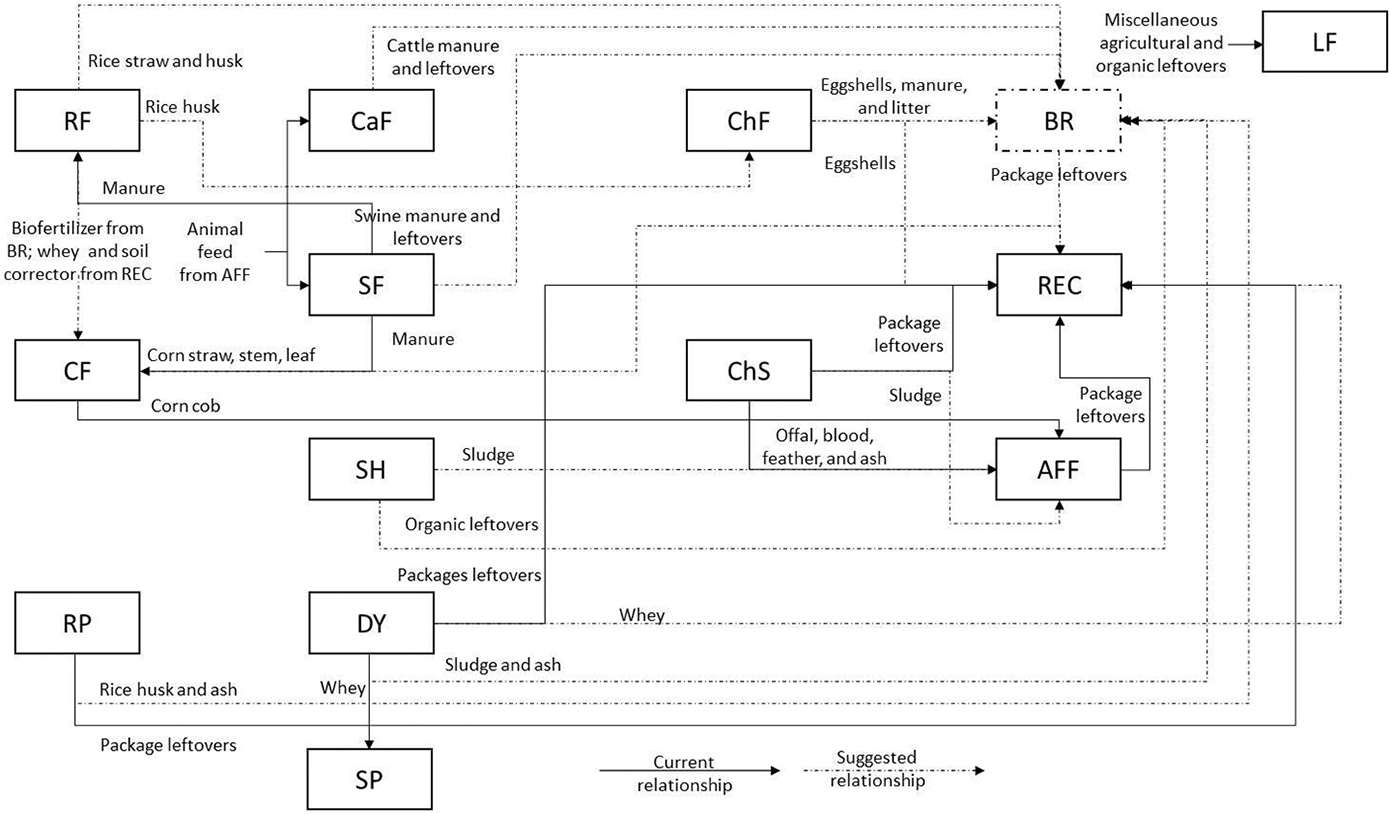
Current and suggested symbiotic relationships for the future development of the network
Acronyms
Discussion: Main Motivations and Type of Contracts
Within the agricultural subsystem, the main reason to handle wastes for RF and CF is avoidance of the legal consequences of not complying with the local legislation. Furthermore, the seasonality of crops requires an unbalanced processing capacity that causes severe idleness of resources over time. Since part of the waste remains in the field, managing it entails risks and costs that are currently supported by farmers. Therefore, new applications are needed to drive reuse and reduce cost and risk. A secondary reason is economic—avoiding the cost of landfill dumping. Currently, because of seasonality, routing agricultural waste requires case-by-case contracts among farmers and receivers.
In the livestock subsystem, the main motivation for cattle farmers (CaF), swine farmers (SF), slaughterhouses (SH), and dairies (DY) is to avoid the consequences of the legal framework that could affect profitability. As the agents have few options for a local adequate destination for their waste, the lack of choices turns the implementation of BR into a good solution. Due to the regular availability of livestock waste, agents could establish long-run contracts that would ensure some predictability and provide better usage of logistic resources, such as trucks, silos, and warehouses. Additionally, all the involved agents would reduce or even eliminate the disposal cost without further investment (Sharara et al., 2018). DY routes whey to SP using case-by-case contracts as their individual total amounts are small and there are a large number of recipients dispersed in the territory. Due to logistic difficulties, enlarging the scale currently is difficult, and routing the liquid phase of whey seems to be, indeed, not only the best but the unique solution for the problem.
The main driver for ChF and ChS in the poultry subsystem is also legal compliance with the local legislation. Since ChF and ChS need to separate waste that is hard to handle under stringent legislation, routing it to an animal feed factory (AFF) and a future BR would be an acceptable solution. Because there is some regularity in the waste generation in this subsystem, long-run contracts are currently the norm, and this would not be expected to change with an eventual implementation of a biorefinery.
Finally, agents who handle miscellaneous inorganic leftovers such as paper, cartons, and other materials, establish case-by-case contracts on demand with the waste owner. Routing to REC is a local solution that allows for reducing the dumping cost and offering job positions to the vulnerable local population. Therefore, the motivations are a by-product of cost reduction and the development of social responsibility actions demanded by the local population. From a systemic perspective, in all the three subsystems the total waste is greater than is currently feasible for the capacity of local processing. Owing to the imbalance, the prices paid to the generators are low and the implementation of a BR would not significantly change the situation. The prices would continue to be low and the relationships more favorable to REC, BF, and AFF than to the waste generators because these agents would be able to sell high-value products manufactured from low-cost raw materials—the ordinary waste. In short, waste generators should not aim to receive large rewards for their waste but should focus on reducing the current disposal cost and avoiding penalties applied by local regulatory agencies. In sum, the motivations for waste generators are cost reduction for the disposal and compliance with the law to avoid penalties. The motivation for waste recipients is profit since they can sell high-value products manufactured from low-cost raw materials and secondary fuel.
Finally, three systemic socio-environmental benefits should appear in the region upon further development of symbiotic relationships. One is increasing the lifespan of landfills by reducing the dumping of organic waste and sludge, which saves financial public resources. The second is employment offered by local recyclers. New job positions should mitigate the social vulnerability of the region and increase economic activity by increasing the consumption capacity of the local population. Lastly is the possibility of increasing crop productivity of the region, which is lower than the national average, attributable to the increased availability of biofertilizer at low cost that an eventual biorefinery plant could bring about. Figure 2 summarizes the systemic implications that the implementation of a biorefinery and the enlargement of the local recyclers' network could entail.
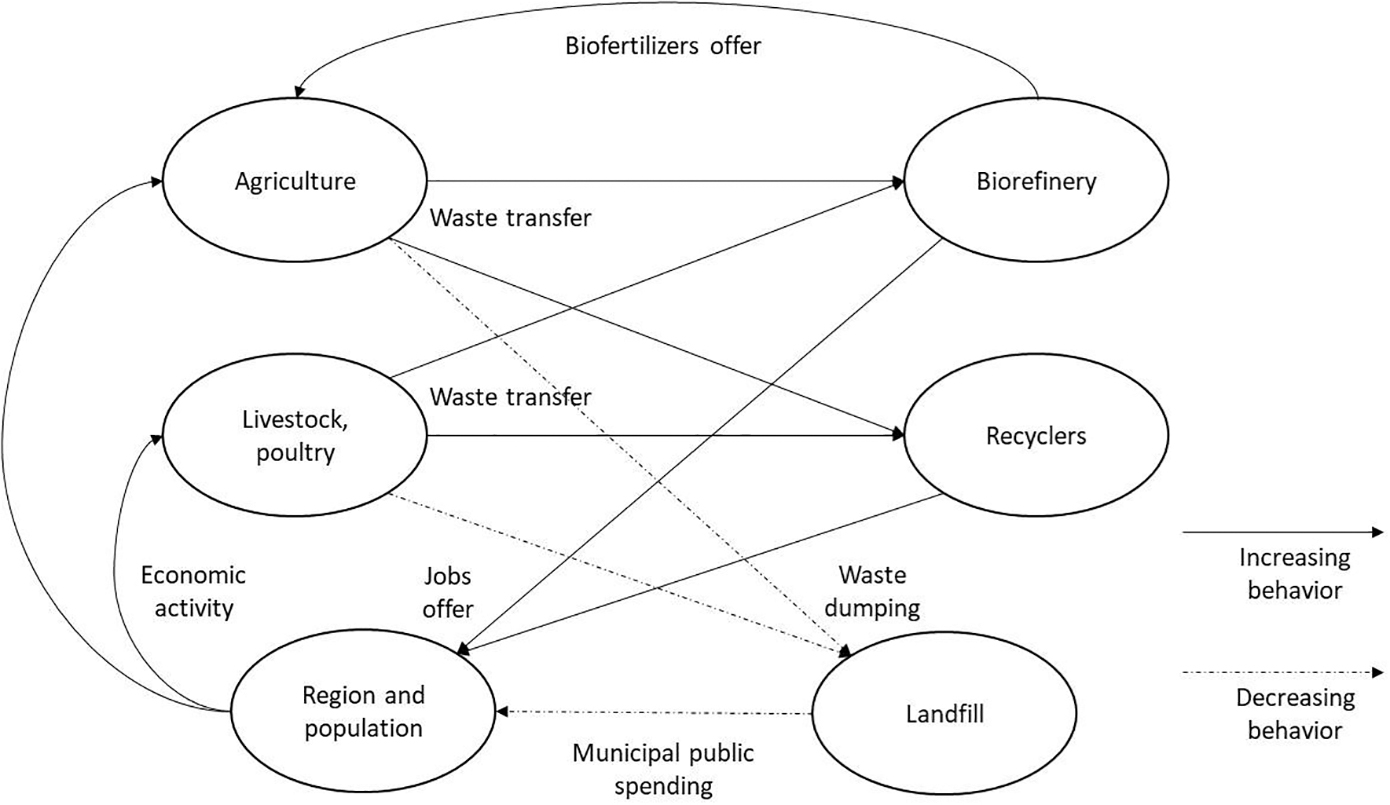
Systemic implications of symbiotic relationships in the network
Conclusion
This study shows that a biorefinery would largely improve the capacity of the region to reuse waste from the local agro-industry. Furthermore, the increase in biofertilizer availability can increase crop productivity in the region, which currently is lower than the Brazilian average. In addition, the study found that in the network, symbiotic relationships aim to meet three objectives: compliance with legislation, disposal cost reduction, and revenues from high-value products manufactured with low-cost raw materials. Waste generators aim at compliance with legislation and disposal cost reduction since their leftovers, even if disposed of in the local landfill, require operations difficult to manage and have environmental impacts, mainly to the soil. Waste recipients aim at economic gains since they could receive low-cost raw materials to use in the manufacture of high-value, readily sellable products.
A problem that could hinder implementation of a biorefinery is the large amount of waste available. Such a large amount results in a lower price for the waste, which reduces the expected revenues for generators. Nonetheless, such imbalance may be desirable since it stimulates reuse activity by recyclers, an eventual future biorefinery, and the animal feed factory. The main purpose of generators should not be to reward revenue from waste, but to find an appropriate destination for leftovers, reducing the disposal cost and eliminating the risk of legal penalties. If waste recipients leave the region or do not expand their facilities, all leftovers would go to the local landfill, with harmful consequences for both the environment and public finance as reducing the useful life will require public investment in a new landfill. Furthermore, the disposal cost would increase for waste generators.
This study is limited because it addresses only qualitative aspects of the problem. The study does not consider economic budgets for the biorefinery implementation, which would include probabilistic variables such as the required investment in equipment and labor force, waste availability, capacity of the local market to buy the products, capacity level of the biorefinery, prices that the market would accept, and production costs. Such limitations make room for an essential development—a simulated model to evaluate the feasibility of the implementation of a local biorefinery, which is the essential element to implement symbiotic relationships in the network. This is the next step of the research.
Footnotes
Authors' Contributions
Wislayne Aires Moreira: field research and data collection; Maria Angela Butturi: bibliographic research and theoretical foundation for the study; Miguel Afonso Sellitto: defined the methodology and wrote the article.
Funding Information
This study was partially funded by CNPq, the Brazilian research agency, under the grant number 302570/2019-5.
Author Disclosure Statement
The authors declare that there is no conflict of interest regarding this study.