




Abstract

Introduction
Cryptocurrencies are developed in a similar manner to the mining of natural resources, which raises questions about their long-term environmental sustainability (Bogna, 2022). In mining natural resources, the costs and efforts increase when approaching the ultimate limit. Similarly, as the capped limit of the particular cryptocurrency approaches, the mining of new cryptocurrency requires more and more of the necessary hardware resources to mine each cryptocurrency (Bogna, 2022; Peplow, 2019).
Cryptocurrencies are based on blockchain technology, which needs users to trust its cryptographic algorithms and peer-to-peer technologies, and these can be hard to attain and spread (Cherry, 2022; Cho, 2021; Kim, 2022).
Cryptocurrency mining involves each node independently validating a group of transactions before adding them to the blockchain. A node computes a block's cryptographic hash once it has accumulated a sufficient number of valid transactions to meet a hard limit. Computing power is required to find a hash that satisfies the specific constraint (Schinckus, 2020; The Tico Times, 2021). The system is elastic in that the number of hashing attempts needed to generate a valid block varies with the entire network's computing power (Murthy et al., 2020).
Proof-of-work, using supercomputers in cryptocurrency mining, has far-reaching effects on the climate and environment (Cherry, 2022). Mining for cryptocurrencies generates waste heat that is discharged into the atmosphere, polluting air and water supplies and resulting in a rise in carbon footprints (Nambiampurath, 2022; Simus, 2018). To produce new cryptocurrencies, supercomputers are engaged in a process that requires an enormous amount of energy and computing power, and it also produces huge amounts of physical and electronic waste (Cho, 2021).
Energy-intensive operations used for each transaction and to mine new coins are the primary sources of cryptocurrency's negative environmental impact (Lobo, 2022). Most cryptocurrencies demand relatively high energy, and there is a significant chance that crypto mining will need even more energy to function going forward (Fauzi et al., 2020). As an example, a lone bitcoin transaction is said to need about 2,100 kilowatt hours (kWh), or about as much energy as a typical Indian household over the course of 380 days (Jain, 2022). Cryptocurrencies like Bitcoin can produce enormous amounts of greenhouse gas emissions if the energy they utilize comes from nonrenewable sources (Cho, 2021 Lobo, 2022).
Despite digital technology's widespread impact on global sustainability, its role as a primary carbon producer is often downplayed (Cho, 2021; Schinckus, 2020). The term digital activity now encompasses a wide range of pursuits, from watching videos online and playing video games to trading cryptocurrencies and conducting financial transactions online (Kim, 2022).
A decade ago, Bitcoin was the only cryptocurrency that existed in the blockchain system. But given the fast pace of technology and digital advancement, individual countries and other institutions have already introduced, or are on the way to introducing, new cryptocurrencies in the market for the sake of cashless or digital economies (Bogna, 2022; Cherry, 2022; Cho, 2022). At present more than 200 cryptocurrencies are already circulating in the world economy. Some of the top cryptocurrencies presently trading in are Bitcoin (BTC), Bitcoin cash (BCH), Ether (ETH), Tether (USDT), Binance Coin (BNB), Litecoin (LTC), EOS (EOS), Steller (XLM), and NEO (NEO).
Cryptocurrencies are in high demand from crypto investors due to a combination of circumstances, one of which is the possibility of high returns on investment. Unlike equities and bonds, cryptocurrencies have seen exponential growth over a short period (Kwapień et al., 2022). The promise of financial success has attracted seasoned traders and newbies to the crypto market. Decentralization, supported by blockchain technology, is another major demand-driver (Alshawi, 2020). In addition, financial autonomy and security are appealing to those who value privacy and mistrust conventional financial institutions due to decentralization (Gramlich et al., 2023). Cryptocurrencies, particularly Bitcoin, are becoming an inflation hedge. Concerns about depreciating fiat currencies have grown as central banks globally issue money. Bitcoin's fixed supply cap and reputation as digital gold appeal to investors seeking inflation-protection (Morillon, 2021).
Portfolio diversification is key, and cryptocurrencies are a new asset class that fits the bill. Cryptocurrencies can disperse risk and minimize portfolio volatility due to their minimal correlation with traditional financial markets (Díaz et al., 2023). Cryptocurrency demand is driven by accessibility. These digital assets are accessible to anybody with an Internet connection, providing a financial lifeline to those in areas without traditional banking services. This inclusivity promotes participation and highlights the democratizing potential of cryptocurrencies. Finally, cryptocurrency innovation and technology keep investors interested (Hossain, 2021) and this contributes to the environmental and sustainability issues related to their development in spite of their energy-intensive mining operations which contribute to carbon emissions, potentially undermining sustainability efforts.
This Viewpoint assesses the impact of crypto mining on the environment and on the well-being of the people on the planet. The growing usage of digital currencies in daily life impedes efforts to make the Earth more sustainable (Agur et al, 2022). Excessive cryptocurrency mining exploits mining machinery and energy sources, resulting in an unsustainable world with consequences for carbon footprints, unclean energy production and consumption, and rising temperatures.
Alignment with Sustainability
Achieving the Sustainable Development Goals (SDGs) by 2030, as outlined in the UN agenda, heavily relies on technological innovation, including the adoption of cashless economies (United Nations, 2015). The shift toward cashless transactions, driven by technological advancements like blockchain-based technologies such as cryptocurrency, has the potential to significantly reduce paper waste and promote environmental sustainability (Rochemont, 2018).
Cryptocurrency, a digital or virtual form of currency, emerged in the late 2000s with the introduction of Bitcoin, the first decentralized cryptocurrency, by an anonymous person or group known as Satoshi Nakamoto (Chohan, 2022; Pathak & Pawar, 2023). Since then, the cryptocurrency market has witnessed significant traction and growth (Figure 1), with the creation of numerous alternative cryptocurrencies, often referred to as altcoins (Scharfman, 2021). Cryptocurrencies offer various use cases, including facilitating peer-to-peer transactions, serving as investment assets, and enabling decentralized applications through blockchain technology (Chohan, 2022). On the surface, cryptocurrencies can contribute to sustainability through their potential to promote financial inclusivity and reduce reliance on traditional banking infrastructure (Starnawska, 2020). By providing access to financial services for individuals in remote regions, cryptocurrencies can empower marginalized communities economically and can play a role in building social and solidarity finance (Scott, 2016). Moreover, the transparent and immutable nature of blockchain technology can aid in tracking and verifying sustainable supply chains, reducing fraud and promoting ethical business practices (Li et al., 2021). These aspects highlight the potential for cryptocurrencies to align with sustainability.
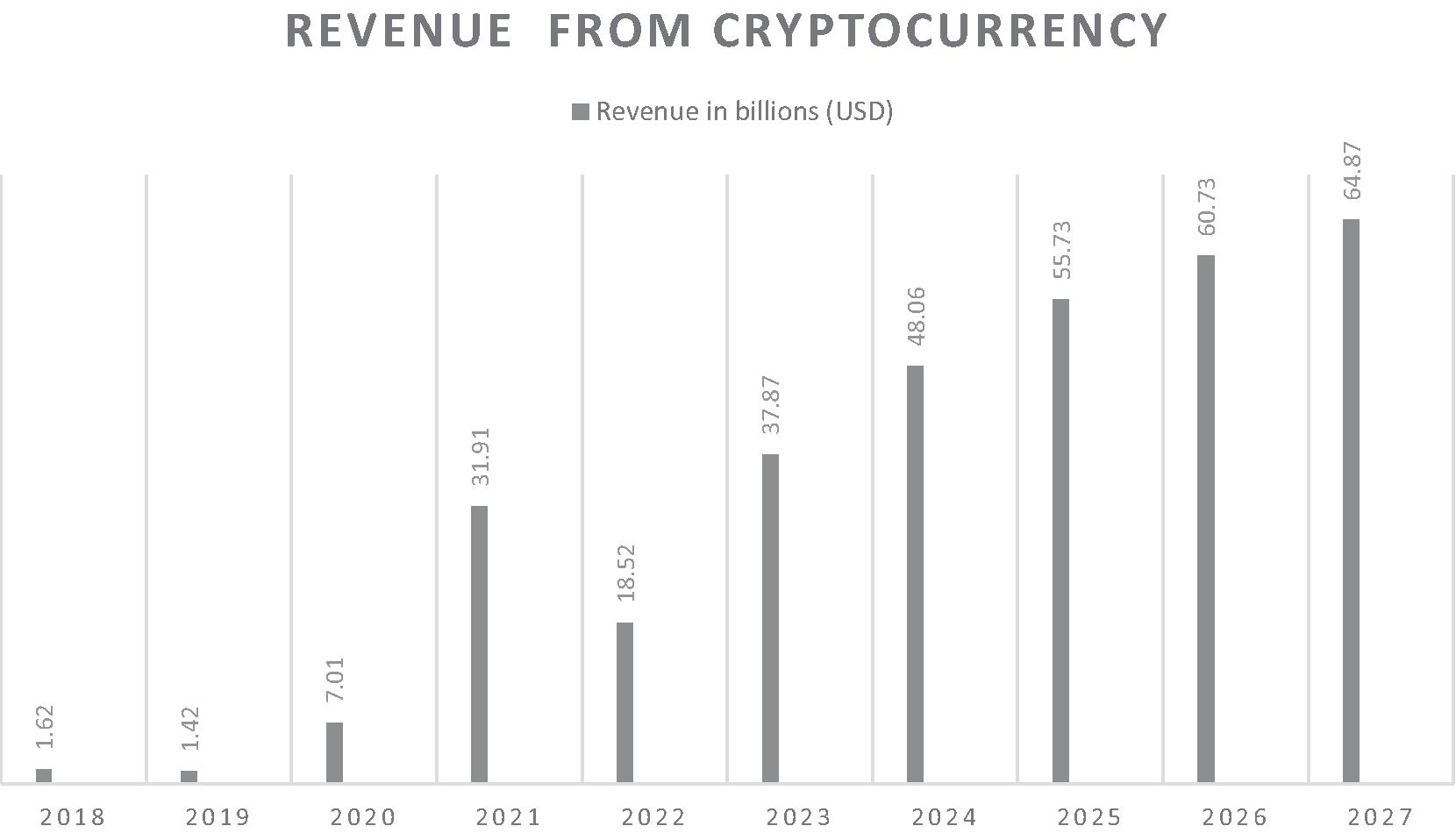
Historical trend of revenue productions from cryptocurrency as forecast projections through 2027
The data shown in Figure 1 takes into account the influence on cryptocurrency of exchange rates as well as the Russia-Ukraine conflict. With increasing revenue, the worldwide cryptocurrency mining market also rose, valued at USD $1.92 billion in 2022 and predicted to reach USD $7 billion by 2032, growing at a compound annual growth rate of 12.90 percent from 2023 to 2032 (Precedence Research, 2023).
Life Cycle Assessment: Extraction and Production
Cryptocurrencies and other blockchain networks have been dragged into a larger discourse about sustainability because of their enormous electricity consumption (Nambiampurath, 2022). Mining cryptocurrencies requires Proof of Work (PoW), a consensus process that allows users to validate cryptocurrency transactions generated by specialized computers by making trillions of guesses per second (Mukhopadhyay et al., 2016). The winner receives a new Bitcoin or Ethereum as payment for this processing. This information is then rapidly verified by the other computers in the network and added to the blockchain in the form of a new block (Gemeliarana & Sari, 2018). After a lot of effort and energy, the new block is created and mining operations resume (Lasla et al., 2022). More processing power and energy are used as crypto miners increase the number of tries per block in an effort to boost their chances of finding the correct solution to the algorithm (Hayes, 2017).
PoW miners need a large quantity of application-specific integrated circuits (ASICS) to have any hope of dependable earnings through cryptocurrency rewards on the major cryptocurrency networks (Jung & Lee, 2020). Further, more and more electricity is needed to run and cool mining machines as the profitability of mining and the value of PoW coins rise (Krishnan et al., 2015). The use of graphic cards (GUI) and mining rigs to validate, protect, and maintain the data is extremely energy intensive and operates around the clock. A single mining rig utilizes two to three graphical processing units (GPU) that consume 1,000 kilowatts of energy and emit carbon footprints equivalent to one barrel of oil consumed (Monserrate, 2022).
However, major cryptocurrencies are increasingly shifting from the energy-intensive PoW consensus mechanism to the eco-friendlier proof of stake (PoS) system (De Vries, 2023). PoS allows validators to create new blocks and validate transactions based on the number of coins they hold and are willing to stake as collateral (Sanda et al., 2023). While this transition represents a step toward reducing energy consumption, achieving a complete transition would be challenging (De Vries, 2023). PoS still requires a substantial amount of energy for network maintenance, and its full adoption would necessitate significant adjustments to existing infrastructures and security protocols, though significantly less than PoW (Zhang, et al., 2021).
Life Cycle Assessment: Consumption
The enormous expansion of crypto mining activities directly contributes to the rising profitability of the crypto industry, which causes a surge in demand for energy (Yuan et al., 2022). According to Joshua D. Rhodes of the Center on Global Energy Policy, “Cryptocurrency mining companies are in an arms race between time, the number of miners, and the efficiency of the devices they use” (Hinsdale, 2022; Garcia & Fastenberg, 2023). The current wildcatter market for bitcoin mining projects a six-gigawatt increase in cryptocurrency energy consumption by the middle of 2023 (Hinsdale, 2022).
The blockchain method of Bitcoin mining consumes more energy than any other coins on the Bitcoin/Ethereum Energy Consumption Index, which measures the ecological footprint of blockchain transactions (Goldin & Muggah, 2020; Krause & Tolaymat, 2018). Bitcoin, the largest cryptocurrency in circulation, uses more electricity annually than Argentina, a country of 45 million people, by an estimated 150 terawatt-hours (Bogna, 2022; Chen et al., 2022; Kim, 2022). Generating that much energy requires the operation of 17 coal-fired power plants annually and results in a 64,889,145 metric ton increase in annual carbon dioxide emissions as per the calculation of United States Environmental Protection Agency. Thus, cryptocurrency is a major source of pollution and climate change worldwide (Goodkind et al., 2020).
The environmental impact of blockchain mining can be minimized by a change in its source of energy; instead of using nonrenewable sources, a renewable source of energy should be utilized for mining cryptocurrency (De Vries, 2023). Bitcoin's energy consumption increased nearly 62-fold between 2015 and March of 2021, and according to Cambridge University, only 39 percent of this energy originates from renewable sources, primarily hydropower (Cho, 2021). Apart from carbon-footprints, the process also requires water for cooling hardware/cryptocurrency mining machines or fossil-fueled electricity generation. The Fortistar North Tonawanda gas plant in New York uses 500,000 gallons of water per day for cooling once mining operations begin, 12 percent of the city's total water consumption (DeRoche et al., 2022). Similarly, the Greenidge Power Plant in New York consumes substantial quantities of water. It draws up to 139 million gallons of fresh water per day from Seneca Lake to cool the plant, and then releases the water, which can be anywhere between 0 and 10 degrees Celsius hotter than the lake's average temperature, endangering the lake's fauna and ecology (McKenzie, 2022). In addition to sucking in and suffocating larvae, fish, and other wildlife, its massive intake pipes also ingest and destroy them (Cho, 2021).
Toward Low Carbon Economy
Most of the developing world is experiencing an increase in their carbon footprint production (Liu et al., 2019; Mott et al., 2021). Technological advancements and innovations often come with increases in the production of carbon footprints. This is especially true for technologies such as blockchain and cryptocurrency. While these technologies offer various benefits and opportunities, it is crucial to acknowledge their environmental impact. In the era of intense technological disruption and global competition, developing nations can't accept or reject innovations only based on environmental harm (Cho, 2021). The optimal approach for all nations is to carefully evaluate the impact of technology, especially high energy intensive technology such as cryptocurrency, on the environment, society, and economy. A comprehensive range of factors should be considered before making decisions (Petkovski et al., 2022). When bitcoin was introduced by Satoshi Nakamoto as a cryptocurrency, its operational cost was much greater than today because they did not consider its environmental impact (Song & Aste, 2020). As a result, from its inception to 2014, energy used for bitcoin mining cost $3.97 million and produced 0.66 million tons of carbon (McCook, 2015).
China is a case in point as it races to become the world's most powerful country. To be in the race, it enthusiastically accepted crypto mining (PCQuest Bureau, 2022) in the decade between 2011 and 2021. During that time frame, China was the world's capital for trading and mining bitcoin. In 2020, China solved around 67 percent of bitcoin mining hash rate of the world (Yicai Global, 2021). In 2021, it imposed restrictions on cryptocurrency trading and mining because of the country's financial instability and energy consumption (Tabuchi, 2022). China also faced certain months of energy shortages in 2021 (Tabuchi, 2022; Outlook, 2022).
In July 2021, China's cryptocurrency landscape witnessed a significant shift as regulators took decisive action against illicit cryptocurrency activity. This marked a historic moment as 10 agencies, encompassing entities such as the central bank, financial regulators, securities authorities, and foreign exchange regulators, came together in a unified effort. Their shared commitment was clear: to collectively eliminate what they deemed “illegal” cryptocurrency activity. However crypto mining was banned due to environmental concerns given its high energy consumption (Tabuchi, 2022). A substantial portion of China's energy supply, approximately 60 percent, is derived from coal, which is recognized as a major source of pollution, an impediment to China achieving its target of a carbon-neutral economy by 2060 (Browne, 2022). Currently, operations in China are shifting to Canada, the next potential cryptocurrency mining hub (Tabuchi, 2022).
According to the Paris Agreement, countries should formulate low carbon emission strategies and technological improvements to prevent the predicted temperature rise of 2 degrees Celsius. But mining data from various researchers shows that cryptocurrency is counterproductive to reaching that goal (Klaassen & Stoll, 2021).
Is the Benefit Worth the Cost?
Cryptocurrency mining, driven by energy-intensive computing processes, undeniably exacts a substantial toll on the environment. Excessive energy consumption predominantly reliant on fossil fuels contributes significantly to carbon emissions, further intensifying climate change and its associated adverse effects. Beyond the realm of climate, the biodiversity of our planet faces peril, as mining operations disrupt natural habitats, potentially leading to the extinction of numerous plant and animal species. This loss of biodiversity disrupts the delicate equilibrium of ecosystems, threatening the services they offer humanity.
Moreover, the proliferation of big computers in cryptocurrency mining generates a substantial amount of electronic waste, exacerbating the environmental challenge. E-waste disposal and mismanagement introduce hazardous substances into soil and water, compounding environmental degradation. While cryptocurrency mining presents economic advantages for various stakeholders, these gains must be carefully assessed against the significant environmental costs.
On the economic front, cryptocurrency mining has indeed showcased the potential for substantial financial benefits for individuals, businesses, and the blockchain industry as a whole. Decentralized cryptocurrencies have democratized investment and financial inclusion, enabling miners to profit from transaction validation and digital asset creation. Additionally, the growth of blockchain technology has fostered job creation, technological advancements, and innovation in financial services.
However, as the world grapples with pressing environmental challenges, it becomes imperative to shift toward more sustainable mining practices that mitigate energy consumption and carbon emissions. Policy makers, industry players, and the broader community must collaborate to establish and enforce regulations that promote environmentally responsible cryptocurrency mining. Encouraging the adoption of renewable energy sources and incentivizing energy-efficient mining techniques can pave the way toward a more sustainable future for the cryptocurrency industry.
Ultimately, a thorough cost-benefit analysis highlights the undeniable negative environmental impacts of cryptocurrency mining. The pursuit of profit must be thoughtfully balanced with the urgent need to safeguard and conserve our planet's fragile ecosystems. By acknowledging these challenges and taking proactive measures, we can strive to find a harmonious equilibrium between technological advancement and environmental stewardship within the cryptocurrency mining sector.
When evaluating technology's sustainability through a life cycle perspective, it becomes evident that technological advancements often bring both benefits and environmental costs. Cryptocurrency mining serves as a stark example of this dichotomy, showcasing the potential for economic gains alongside substantial environmental consequences. To achieve true sustainability, it is imperative to integrate environmental considerations into the entire life cycle of technology, from extraction and production to use and disposal. By doing so, we can work toward minimizing the negative environmental impacts and maximizing the benefits of technological innovation.
Footnotes
Authors' Contributions
Basit Ali Bhat and Manpreet Kaur Makkar contributed equally in all parts of this article, from content writing to references framing. Nitin Gupta selected the content area for the article and the title and did all proofreading during the writing process.