




Abstract

Introduction
We currently stand on the cusp of a new era which makes the interaction between digital technology and sustainability as significant as it is today (Feroz et al., 2021). The transition to a green economy, which promotes social inclusivity and reduces environmental risks, is not merely desirable but has become a pressing necessity. The reality of our world today necessitates that the environmental, economic, and social dimensions are intertwined and cannot be treated in isolation. In this complex and interdependent relationship, digital sustainability emerges as a key concept (George et al., 2016).
Digital sustainability refers to the capacity to utilize digital technology and infrastructure in a way that fulfils current needs without compromising the ability of future generations to meet their own needs (George et al., 2016; Seele, 2016; Sparviero & Ragnedda, 2021; Stuermer et al., 2017). This concept has diverse applications, encompassing economic viability, social justice, and environmental responsibility within the digital domain (Rosário & Dias, 2022).
As we grapple with global challenges such as climate change, resource scarcity, and growing digitalization, it becomes clear that our journey forward must integrate digital progress with sustainable practices (George & Schillebeeckx, 2022). We cannot simply strive to maximize our technological sophistication; we must also ensure that our digital infrastructure and practices do not undermine the ecological foundations of our society (Gomez-Trujillo & Gonzales-Perez, 2022).
Therefore, digital sustainability is not merely an additional consideration, but becomes a central pillar in our efforts to build a greener and fairer economy. Digital sustainability ought to bridge the gap between the digital and physical worlds, harnessing the power of digital innovation while acknowledging and mitigating its potential environmental impacts, especially with respect to various stakeholders (Lock & Seele, 2017).
This Perspective delves into the importance of digital sustainability in the broader context of the green economy, unravelling the challenges and opportunities it offers. The exploration into the core of digital sustainability will provide valuable insights into how this vital concept is reshaping the world and how it holds the key to a more sustainable and prosperous future. This discourse is intended to guide us forward in navigating the digital revolution and the sustainability revolution in tandem.
Understanding Digital Sustainability
When we speak about sustainability, the conversation often revolves around physical resources: renewable energy, efficient transportation, and zero-waste initiatives (Iman, 2019). However, in this multilayered and hyper-connected world, we cannot overlook the digital domain, the pulsating heart of modern society. Thus, the question, what exactly is digital sustainability, and why is it so crucial for our future?
In its simplest form, digital sustainability pertains to the capacity to maintain and enhance our digital resources, infrastructure, and capabilities in a manner that aligns with long-term environmental, social, and economic prosperity (Bradley, 2007; George et al., 2016; Seele, 2016; Sparviero & Ragnedda, 2021; Stuermer et al., 2017). Digital sustainability is about leveraging digital technologies for societal and planetary improvement while ensuring these technologies are designed, implemented, and disposed of sustainably (Osburg & Lohrmann, 2017; Seele, 2016).
Digital sustainability acknowledges that the digital domain, though intangible, has concrete impacts on the physical world (Pan et al., 2022). Digital transformation (Vial, 2019), if not guided by sustainability principles, can contribute to the depletion of natural resources, increased energy consumption, and carbon emissions resulting from data center operations, device production, and electronic waste (e-waste). Conversely, it can also offer unprecedented solutions to environmental challenges, enhance resource efficiency, and democratize access to services and opportunities, thereby reducing inequality (Imran, 2023).
Digital sustainability is vital for our future as it stands at the crossroads of two defining narratives of our time: the digital revolution and the sustainability revolution. As we strive to address critical global challenges such as climate change, biodiversity loss, and social inequality, digital technology will undoubtedly play a central role. However, without a sustainable approach to digitalization, today's solutions may well become tomorrow's problems (George et al., 2021).
For instance, the increasing digitalization of our world might enable enhanced efficiency and reduce the need for physical resources, leading to decreased environmental impacts. However, paradoxically, this increased efficiency can stimulate increased overall consumption, a phenomenon known as the Jevons paradox (Alcott, 2005). Understanding and mitigating such paradoxes is one of the challenges of digital sustainability.
The aim of digital sustainability is not to halt digital progress and technology in general, but rather to guide it along a path that respects the boundaries of our planet and the aspirations of all its inhabitants (George et al., 2021; Ribeiro et al., 2021). It is about creating a digital world that reflects the resilience, diversity, and interconnectedness of the natural world. Digital sustainability, ultimately, is about designing and actualizing a future in which digital and physical sustainability go hand in hand, each empowering the other in a reinforcing cycle of innovation and stewardship (Stuermer et al., 2017).
The Intersection of Digital Technology and the Green Revolution
At first glance, digital technology and the green economy may seem like two distinct worlds, running parallel to each other but never intersecting. However, upon closer examination, we find that they are deeply intertwined, with digital technology serving as a catalyst to accelerate the transition to a green economy (Cricelli & Strazzullo, 2021). Taking a closer look at the interaction between these domains not only reveals their tight interconnection but also underscores the transformative potential lying at their intersection (Seele, 2016).
Digital technology has significant potential to support the green economy, promoting growth and prosperity while respecting the boundaries of our planet (Rosário & Dias, 2022). In an era characterized by climate change and resource scarcity, the need for efficiency is paramount. Here, digital technology can play a decisive role. Through advanced data analytics, machine learning, and artificial intelligence, we can optimize processes and resource allocation in ways unimaginable just a few years ago (Guandalini, 2022). From precision farming reducing water and fertilizer use while increasing crop yields, to smart grids optimizing energy use and promoting renewable resources, digital technology enhances efficiency across all economic sectors (Cricelli & Strazzullo, 2021; Tiago et al., 2021).
At the same time, digital technology plays a vital role in waste reduction. The Internet of Things (IoT), for instance, allows us to monitor and control resources in real-time, minimizing waste and maximizing utility (Zhang et al., 2022). Digital platforms facilitate the sharing economy, enabling us to get more use out of fewer goods (Puschmann & Alt, 2016). Shared mobility solutions can also reduce the need for car ownership while digital marketplaces for second-hand goods extend product lifespans, helping us transition from a linear take-make-waste economy to a circular economy that keeps resources in use for as long as possible (Corona et al., 2019).
Digital technology also provides powerful tools for environmental management. Through satellite imagery and remote sensing, we can monitor deforestation, detect illegal fishing, and track biodiversity loss on a global scale (Bologna & Aquino, 2020). Blockchain technology can trace a product's environmental footprint along the supply chain, enabling conscious consumption and promoting fair trade (Queiroz et al., 2020). Citizen science platforms can gather environmental data and engage the public in conservation efforts. By democratizing access to environmental information, digital technology empowers us all to become better custodians of our planet (Stuermer et al., 2017).
However, as we navigate the frontier between digital technology and the green economy, we must not overlook the environmental impact of digital technology itself (Konys, 2020). The production, use, and disposal of digital devices contribute to electronic waste, energy consumption, and carbon emissions. Consequently, digital sustainability—the pursuit of digital progress that respects environmental boundaries and social equity—is not merely nice to have, but an imperative.
The Jevons Paradox and Digital Sustainability
In understanding the challenges of digital sustainability, it is crucial to comprehend an economic principle known as the Jevons paradox. Named after the 19th-century British economist, William Stanley Jevons, this paradox states that technological improvements that increase the efficiency of resource usage can, paradoxically, result in an increased consumption of that resource (Alcott, 2005).
Jevons's original observation pertained to the consumption of coal during the Industrial Revolution. He noted that as improvements in steam engines made the use of coal more efficient, the demand for coal instead increased—not decreased—because the cost of using coal fell (York & McGee, 2016). The accessibility and affordability of coal, in turn, spurred further industrial growth and coal consumption, which effectively negated the efficiency gains.
The Jevons paradox applies to digital sustainability (see Table 1). Take the case of data centers. As the heart of our digital universe, data centers use a significant amount of energy. Innovation has made these centers more energy-efficient than ever before. However, with the growth in digital service usage—driven by streaming, cloud computing, and artificial intelligence—the total energy consumption of data centers worldwide continues to increase (Edwards, 2022). Thus, efficiency gains in digital technology do not result in a decrease, but an increase in energy use.
Global Trends in Digital and Energy Indicators
Source: International Energy Agency, 2022.
A similar scenario also unfolds in our everyday lives. Smartphones, with their ability to replace several devices, from cameras and GPS systems to music players, should intuitively reduce resource usage. However, the exponential growth in smartphone production and built-in rapid obsolescence cycles have resulted in an enormous amount of electronic waste. Once again, we observe Jevons paradox at play as increased efficiency is offset by even higher levels of consumption.
Jevons paradox underscores the fact that digital sustainability cannot solely rely on technical efficiency improvements (Townsend & Coroama, 2018). While making devices more energy-efficient and designing software to use fewer resources is important, such efforts alone will not suffice. We also need systemic changes in how we produce, use, and dispose of digital devices (Trkman & Černe, 2022). This includes a shift toward a circular economy, one in which devices are designed for durability, repairability, and recyclability, and a shift in consumption patterns toward digital services that align with the carrying capacity of our planet.
In conclusion, Jevons paradox serves as a stark reminder of the complexities inherent in the journey toward digital sustainability. Once again, while digital technology is a critical part of the solution, it is not the solution in its entirety. To truly harness the potential of digital technology for a green economy, we need to address the paradoxical dynamics of resource use and find a balance between technological advancement and sustainable consumption (York & McGee, 2016).
An Overlooked Issue: e-Waste
It is a widely acknowledged fact that, over the past few decades, producers of electronic devices have tended to design their products to become obsolete or nonfunctional after a certain period of time (Iizuka, 2007). In practice, planned obsolescence can be implemented in several ways. One example is making spare parts or product repairs difficult or costly, thus making it more economical for consumers to buy new products. Another way is to release new versions of products with enhanced features, thereby making older versions seem outdated or less efficient. In addition, companies design their Electrical and Electronic Equipment (EEE) with components that have a limited lifespan, ensuring the product will break or become nonfunctional after a certain period of time—even though it may still be perfectly usable (Rivera & Lallmahomed, 2016).
Such planned obsolescence strategies often result in excessive consumer waste and promote overconsumption (Maitre-Ekern & Dalhammar, 2016). Consequently, electronic waste, or e-waste, has seen significant increases. The subsequent challenge lies in managing this waste to minimize environmental impact and align with the principles of digital sustainability.
E-waste generally contains a mixture of valuable materials that could be recycled (but usually are not), and toxic substances such as lead, mercury, and cadmium that can be hazardous to our health and environment. Ruiz (2023) reports that a staggering 57.4 million metric tonnes (Mt) of e-waste were produced in 2021. The total volume is increasing by an average of 2 Mt per year. More than 347 Mt of unrecycled e-waste existed on Earth in 2023. China, the United States, and India are the largest producers of e-waste. Only 17.4 percent of e-waste is known to be properly collected and recycled. Estonia, Norway, and Iceland have the highest rates of e-waste recycling. The e-waste recycling market was valued at $49.88 billion in 2020 (Ruiz, 2023).
We know that since data were first collected in 2014 until the end of 2022, an estimated total of 420.3 million metric tonnes of e-waste have been produced. We also know that, on average, only a small percentage is recycled. From this, we can estimate that at least 347 Mt of e-waste still remains. The volume of global e-waste is projected to grow to 74.7 Mt by 2030—almost doubling in just 16 years, and this projected figure is expected to increase dramatically in the coming years.
Ruiz (2023) also notes that Asia (24.9 Mt), the Americas (13.1 Mt), and Europe (12 Mt) produce the majority of e-waste by total weight. On a per capita basis, Europeans (16.2 kg) produce the most e-waste per person, followed by Oceania (16.1 kg) and the Americas (13.3 kg). African inhabitants produce the least amount of e-waste per capita. The countries producing the most electronic waste are China (10,129 kt), the United States (6,918 kt), and India (3,230 kt). Indonesia ranks seventh, producing 1,618 kt (see Table 2).
E-Waste Production in Leading Countries
Source: Forti et al., 2020.
Reflecting upon the aforementioned data and facts, it is imperative that we revisit the rampant use-and-discard culture of our digital era, which is fueled by rapid technological advancements and the replacement of devices with newer and superior models (Kiddee et al., 2013). With the acceleration of technological innovation, devices are replaced more frequently, contributing to a surge in e-waste generation. When improperly managed, e-waste can leach toxic substances into the environment, contaminating air, soil, and water sources. Moreover, e-waste represents a wasteful disposal of valuable resources. Precious metals such as gold, silver, and copper, found in small quantities in many electronic devices, could and should be recycled and reused, not discarded.
A sustainable digital economy requires not only the efficient and equitable use of digital technology but also responsible disposal and recycling of this technology at the end of its life (Rivera & Lallmahomed, 2016). Furthermore, in the context of developing countries, effective e-waste management is a pillar of digital sustainability, aiming to reduce the negative environmental impacts of digital technology and promote a circular economy with as much resource reuse and recycling as possible (Osibanjo & Nnorom, 2007).
Ultimately, addressing e-waste is an essential part of achieving digital sustainability. As we continue to rely on digital technology, we must also evolve our practices to effectively manage the waste produced, ensuring our digital future is both sustainable and inclusive (Guandalini, 2022). Digital sustainability is not just about how we utilize digital tools, but also how we dispose of them responsibly and innovatively.
Toward Digital Sustainability
The world stands at a crossroads. With the digital revolution, on one hand, we possess the capacity to connect, innovate, and enrich our lives in ways previously unimaginable. On the other hand, the environmental impact of these advancements is substantial. The intersection of digital technology and environmental stewardship—digital sustainability—abounds with challenges and opportunities (Wut et al., 2021).
For instance, energy consumption in the digital realm is significant and will invariably continue to grow. Data centers, with their constant cooling needs, consume vast amounts of energy. The number of digital devices we use also contributes to increased energy usage and creates large amounts of electronic waste. Another consequence of our increasing use of technology is the need for strong data protection. As more aspects of our lives and businesses transition online, ensuring data security and privacy become vitally important. The environmental costs of strong data protection—both in terms of energy consumption and the physical infrastructure required—represent another facet of digital sustainability that needs to be factored in.
Nevertheless, these dynamics also offer opportunities for innovation and growth. Alongside the burgeoning demand for digital services, the market for technologies that can provide these services energy-efficiently is highly promising, from low-energy server technologies to more efficient cooling systems for data centers. The e-waste issue also presents opportunities through longer-lasting products, ease of repair, and efficient recycling. Moreover, digital sustainability itself provides attractive opportunities for innovative business models and job creation, such as energy efficiency audits, e-waste management, and sustainable supply chain management.
Promoting digital sustainability necessitates a collective endeavor from diverse stakeholders, including governments, businesses, and individuals through various means, such as policy implementation, development of innovative technologies, or alterations to personal habits and business practices. (See Figure 1.) Digital sustainability can be achieved through responsible digital transformation, environmentally friendlier digital lifecycles, efficiency in digital resources, and supportive policy and regulation. With a combination of effective policies, innovative business practices, and responsible individual actions, we can leverage digital technology not merely as a tool for economic growth but as a catalyst for sustainable development.
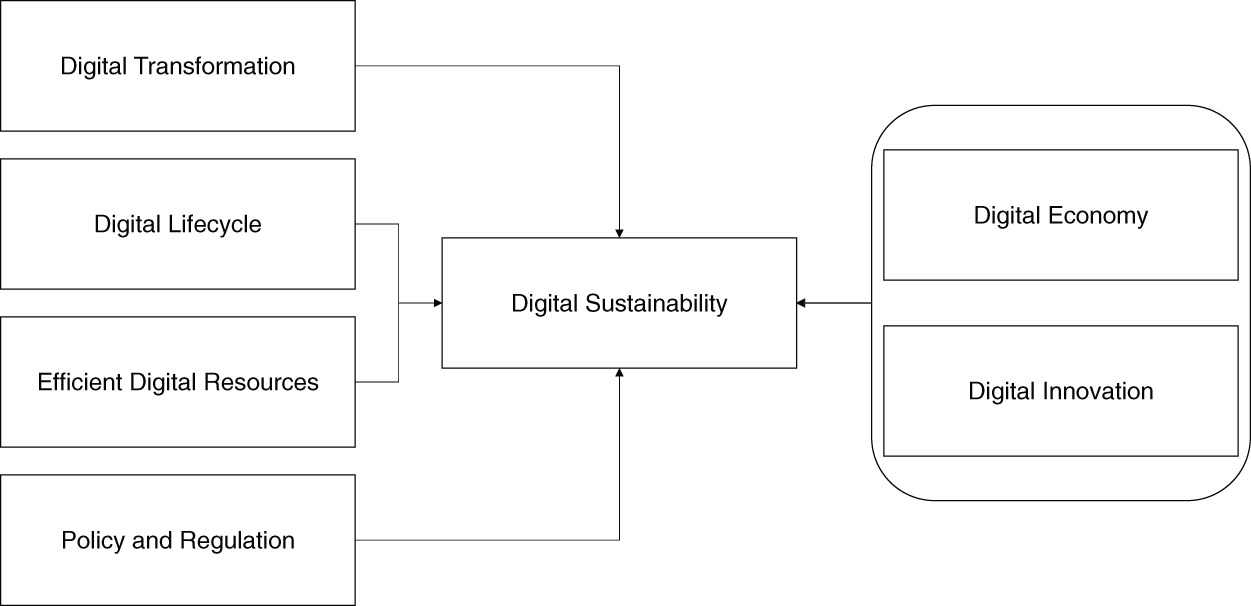
Conceptual framework of digital sustainability
Governments worldwide, aligned with the Sustainable Development Goals (SDGs), are well-positioned to set the tone and direction for digital sustainability through the formulation of effective policies for businesses to reduce their digital carbon footprint, regulating the management of e-waste, or investing in renewable energy sources to power digital infrastructure. The business sector stands at the forefront of innovation and holds the potential to drive significant change toward digital sustainability through energy-efficient production, minimizing waste in their operations, and investing in renewable energy sources.
Every individual also has a role in promoting digital sustainability. Consumers can choose to purchase from companies that prioritize sustainability, which will encourage more businesses to implement sustainable practices. They can take steps to reduce their digital carbon footprint by doing things such as minimizing unnecessary data usage, extending the lifespan of their devices, or responsibly recycling old electronic devices. They can also contribute to a greener lifestyle, for example by using apps to track their carbon footprint or participating in virtual meetings instead of traveling.
Concluding Remarks
The marriage of two transformative trends—green economy and digital revolution—has fundamentally shaped our world in distinct ways (George et al., 2016). First, we can anticipate further advancements that could propel the green economy forward. The digital sector stands poised for continuous innovation, with novel technologies such as artificial intelligence (AI), Internet of Things (IoT), blockchain, and quantum computing offering exciting potential.
However, it is essential to recognize and consider the potential downsides of such novel technologies. For example, some digital technologies that are employed to drive the green economy can themselves have substantial environmental footprints. Technologies like IoT and blockchain might also introduce new vulnerabilities into systems, making them susceptible to cyberattacks, data breaches, and other security threats. Moreover, not all regions or communities have equal access to or can afford such technologies. This disparity might lead to further economic divisions and could hinder the inclusive growth of the green economy.
The reliance on complex technologies may lead to loss of traditional knowledge and skills, making societies more vulnerable to technological failures or malicious attacks. Technologies such as AI can operate as “black boxes,” making decision-making processes opaque and potentially biased. Regulating these technologies and ensuring that they align with societal values and norms is a Mount Everest to climb. Just like any powerful tool, these technologies can also be misused or manipulated for purposes that are not aligned with the goals of a green economy, such as enhancing control over populations, fostering monopolies, or promoting unsustainable consumption patterns.
Second, in the future, the concept of circular economy is expected to increasingly permeate the digital realm. The idea of digital circularity may encompass the creation of software designed for durability, reduction of electronic waste, and even the dematerialization of physical goods into digital services, thereby lessening the strain on our planet's carrying capacity. A digitally sustainable future may also signify a more holistically sustainable economy.
On one hand, the green economy stands to benefit tremendously from digital sustainability, with increased efficiency, waste reduction, and novel business models. On the other hand, there are challenges to be surmounted, such as ensuring fair distribution of digital resources and managing the environmental impact of digital infrastructure. In this regard, digital sustainability and the green economy are two sides of the same coin, each influencing the other.
Third, digital sustainability will play a pivotal role in shaping the future green economy. As digital technology becomes increasingly integrated into our lives, its sustainability will determine the extent to which our economy can genuinely turn green. Digital sustainability is not merely about reducing the negative impact of our digital world but also about harnessing its potential for good. By capitalizing on digital technology, we can stimulate innovation, drive economic growth, and promote environmental preservation. The promise of a green, prosperous, and inclusive future is within our grasp, and digital sustainability will be the key to unlocking it.
It is evident that digital sustainability is not merely a good-to-have; it is an imperative for our future. The path to a sustainable world is inseparable from the path to digital sustainability. It is the responsibility of each of us—policy makers, business leaders, technologists, and individuals—to help shape this path. The hope of a more sustainable, prosperous, and inclusive future rests on all our shoulders, and the key to unlocking it might be in our digital devices. Ultimately, the choices we make today will shape the digital economy, and by extension, the green economy of tomorrow.
Footnotes
Funding Information
This research received no specific grant from any funding agency in the public, commercial, or not-for-profit sectors.
Author Disclosure Statement
Author declares there are no conflicts of interest.