




Abstract
Mismanagement of existing water supplies is threatening the sustainability of these resources, resulting in the degradation of source water quality and decreasing water supplies. Notably, substantial amounts of source water are withdrawn and treated for industrial use, irrigation, thermoelectric power, and mining purposes; only a small portion is allocated for municipal and domestic purposes. The increasing incidence of extreme weather events further accentuates both water quality and quantity concerns, stressing the need for increased efficiency to improve water supply sustainability. To that end, substituting source water with recycled water can help improve water supply sustainability in many places across the United States and the rest of the world. In this article, we focus on the case of Joliet, a town in Illinois where the supporting aquifer verges on the point of nonviability. To assist Joliet, Chicago's City Council approved a plan for the Chicago Department of Water Management to reallocate Lake Michigan drinking water from the Chicago basin to Joliet. In this study, we evaluate the environmental sustainability of four possible scenarios: 1.) proposed water-use cycle from the water treatment process, with delivery to all users, 2.) supplying recycled water to industries and other potential non-potable uses without additional treatment, 3.) supplying recycled water treated with additional disinfection to industrial and other non-potable uses, and 4.) supplying recycled water from an alternative water reclamation plant with an existing disinfection unit. We perform a life cycle assessment to compare the environmental impacts in each scenario. Findings of the study show that treated wastewater in industrial applications would significantly reduce environmental emissions compared to the proposed no-reuse scenario. The results suggest that water reuse can help save energy, reduce potable water consumption, generate revenue, and reduce the environmental load on water bodies.
Introduction
Mismanagement of existing water supplies and the increasing incidence of extreme weather events undermine water security, creating the need to address the sustainability of water supplies in terms of quantity and quality (Garcia & Alamanos, 2023). Notably, substantial amounts of source water are withdrawn and treated each year for industrial, irrigation, thermoelectric power, and mining purposes; only a small portion is allocated for municipal and domestic purposes (Garcia & Alamanos, 2023; Grzegorzek et al., 2023). The continuous and substantial withdrawal of water resources results in groundwater depletion. Of the 143,070 water systems in the United States, 128,362 rely primarily on groundwater, according to the Environmental Protection Agency (Rojanasakul et al., 2023). Because the vast majority of water systems in the United States rely on groundwater as the primary or sole source of water, groundwater depletion creates a pressing need to reevaluate water usage practices as the existing water infrastructures are witnessing degradation due to climate change, and the unpredictable nature of extreme weather events is infusing uncertainties into water supply models (Reddy et al., 2023).
In this study, we demonstrate the impact of water reuse on environmental sustainability using the town of Joliet, Illinois, as a case study. Joliet is the third largest city in Illinois and is a particularly appealing case to study because the supporting aquifer verges on the point of nonviability. The main objective of this study is to present a comparative analysis of the sustainability of the various water use scenarios in Joliet to identify the best possible case that has minimal environmental impacts. Our approach consists of performing a life cycle assessment (LCA) to compare the environmental benefits of water reuse under four different scenarios. This approach is particularly useful because it allows us to compare the results across scenarios to ascertain the environmental benefits of water reuse without or with additional treatment.
Our scenario assessment approach allows us to quantify how properly redesigning the supply system would increase efficiency and environmental sustainability. In the first (baseline) scenario, we assume the status quo—the current water use cycle including the water treatment process—and delivery to Joliet. In the second scenario, we assume that Joliet's industrial users are supplied with recycled water treated at the Stickney Water Reclamation Plant (SWRP) without any disinfection owing to the absence of a disinfection unit at the plant. The third scenario supplies recycled water to industrial uses in Joliet with disinfected recycled water from Stickney (SWRP) and considers the construction and operation of a new disinfection unit. The fourth scenario supplies Joliet's industrial users with recycled water from the Calumet Water Reclamation Plant (CWRP), which is already equipped with an in-house disinfection unit.
Using recycled water has emerged as a viable solution to effectively address the pressing issue of water scarcity and ensure the long-term sustainability of local water supplies for communities facing severe water shortages. A crucial aspect that warrants scrutiny is the historical patterns of water allocation, wherein only 12 percent of the water extracted from the freshwater supply is earmarked for public needs, and a mere 1 percent is set aside for domestic use. The remaining 87 percent of the freshwater supply is consumed through six endeavors: thermoelectric power, irrigation, industrial applications, aquaculture, livestock, and mining (Dieter et al., 2018). By significantly replacing the drinking water allocated to some of these six sectors with recycled water, not only will the utilization of precious water resources be optimized but the long-term sustainability of these resources will also be enhanced, thereby safeguarding water resources and reducing the related environmental impacts in the process (Bonton et al., 2012; Meneses et al., 2010).
Our study sheds light on the long-run sustainability implications of water reuse: implementing water reuse not only contributes to the reduction of potable water demand in non-potable applications but also conserves energy, thereby presenting a pragmatic solution to the prevailing water challenges. Reusing treated wastewater offers a promising solution for enhancing the water-energy nexus. By substituting freshwater sources with treated wastewater for non-potable purposes like irrigation, industrial processes, and cooling systems, it is possible to reduce the energy-intensive treatment and transportation of fresh water. This conservation of energy resources not only boosts efficiency but also reduces the environmental footprint associated with water management, fostering a more sustainable and resilient water-energy relationship. Our current water use cycle is inefficient, considering the whole process of freshwater treatment, consumption, wastewater treatment, and disposal of treated wastewater. The quality of treated wastewater currently discharged has some potential value that can be further assessed.
Project Background
Joliet presently sources its water from deep wells and deep sandstone aquifers (City of Joliet, 2019). The persistent excessive extraction by communities, industries, and other water consumers in Joliet, coupled with a lack of consistent aquifer recharge due to the existence of fault line in this area, has resulted in the water level in the aquifer plummeting by as much as 800 feet (Reddy et al., 2023). Given the absence of recharge and the ongoing rate of withdrawal, it is projected that Joliet's deep sandstone aquifer will soon be inadequate to meet the city's water demands (City of Joliet, 2019). In anticipation of this pressing issue, Joliet has entered into a formal agreement with the City of Chicago to receive treated water from Lake Michigan, transported via pipelines, beginning from 2030, and extending over the next 100 years. The significance of this agreement lies in the possibility that it may serve as a precedent for other towns facing water stress (Havrelock et al., 2023).
The depletion issue is particularly severe in Joliet and southwestern Chicago suburbs, including Will, Kendall, Kane, and DuPage counties (Reddy et al., 2023). Assessments indicate that the underlying aquifers that supply these communities will no longer be sustainable as early as 2030 (Illinois State Water Survey, 2023), necessitating a shift to Lake Michigan as a primary water supplier. Following the precedent set by the Joliet-Chicago deal would add significant load to Lake Michigan and soon put the lake at its water withdrawal limit (Havrelock et al., 2023). This imminent challenge underscores the necessity to examine the implications of water reuse on environmental sustainability. To this end, we aim to analyze the sustainability of four different scenarios, as shown in Figure 1, each exploring a different water use scenario to serve Joliet's needs.

Project background for Joliet city water supply (adapted from Havrelock et al., 2023)
Scenario 1
All of Joliet's water needs, both residential and industrial, will be sourced from Lake Michigan after treatment at the Eugene Sawyer Water Purification Plant (ESWPP) (Figure 2a). This water will be pumped to the Southwest (SW) Pumping Station through an existing 11.2-mile long pipeline. To ensure a consistent and efficient transfer of treated water from the Southwest (SW) Pumping Station to Joliet, a new 60-inch diameter, 30-mile-long precast concrete pipeline will be established between the two locations, as delineated in Figure 1. The 60-inch diameter of the pipe caters to future needs of Joliet and the surrounding suburbs, standing at 60 MGD (City of Joliet, 2020).
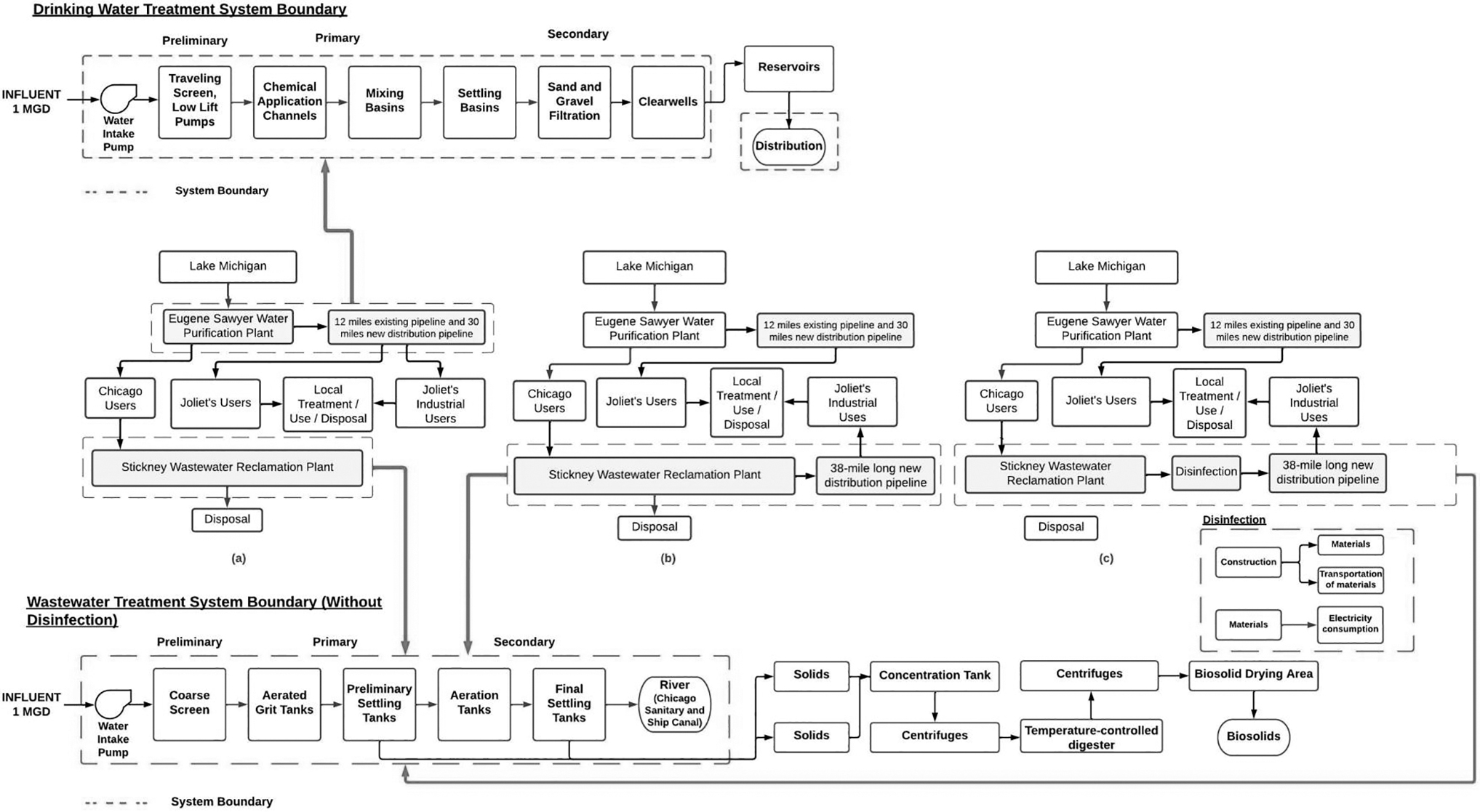
Summary of different scenarios considered in this study:
Scenario 2
This case involves reusing treated wastewater from the SWRP for Joliet's industrial needs, assuming it meets industrial water quality standards (Figure 2b). A 48-inch, 38-mile-long precast concrete pipeline will transport this water, covering 8 miles from SWRP to the Southwest Pumping Station and 30 miles to Joliet's receiving pumping station (City of Joliet, 2019) as represented in Figure 1. In addition, the 60-inch, 30-mile long pipeline will still be built from the SW Pumping Station to Joliet to supply drinking water from ESWPP to Joliet. Hence, this case considers a dual pipeline system to supply recycled water and drinking water through separate lines.
Scenario 3
Considering that industrial water needs demand disinfection of recycled water, this scenario covers the additional process of disinfection before supplying the water to Joliet's industrial users (Figure 2c). Since SWRP lacks a disinfection unit, this scenario proposes the addition of a UV disinfection unit tailored to Joliet's industrial demand of 15 MGD, assuming that 25 percent of the total demand will cater to commercial and industrial needs.
Scenario 4
Although for recycled water supply the SWRP is a closer source to Joliet's industrial users, it lacks a disinfection unit. Because CWRP already has a disinfection unit, it may be more efficient to supply disinfected recycled water from CWRP without the need to construct a new disinfection unit as in the third scenario. A new 48-inch pipeline will transport the treated wastewater from CWRP to Joliet, spanning approximately 11 miles between CWRP and the Southwest Pumping Station, and 30 miles to Joliet, akin to the second and third scenarios. We identify two potential options to transport water from CWRP to SW Pumping Station, as shown in figure 1 and assume that an approximately 11-mile long pipe (as in option 1) would suffice. Each of these scenarios offers different environmental implications, which our study aims to meticulously evaluate and compare.
Life Cycle Assessment (LCA) Methodology
We quantify environmental emissions associated with supplying treated water to Joliet. We assess emissions associated with different processes using a methodological framework consistent with ISO 14040 (International Organization for Standardization, 2006a) and ISO 14044 (International Organization for Standardization, 2006b). As stated by ISO, the LCA methodology framework is divided into 1.) goal and scope definition, 2.) inventory analysis, 3.) impact assessment, and 4.) interpretation.
For the analysis, the project's life cycle is considered from cradle to gate, which is a partial life cycle approach considering processes involved from raw material extraction to the factory gate (before the product is supplied to the consumer) (Reddy et al., 2019). The water life cycle starting from intake of water by the water intake pump (referred to here as cradle) to the final delivery of treated fresh water or recycled water to the city of Joliet (referred to here as gate) is considered for the present study. In assessing the distribution of water in the city of Joliet, we do not consider post-consumption, wastewater treatment, and disposal. We assess the environmental impacts of each of the aforementioned scenarios using SimaPro and Ecoinvent 3.0 database.
Goal and Scope
The overarching goal of the present study is to identify a sustainable water use scenario that can be implemented in Joliet, Illinois. The detailed aims are to: 1.) evaluate the environmental impact of the status quo (Scenario 1), 2.) evaluate the environmental impact caused by the water reuse scenario without disinfection process (Scenario 2), 3.) evaluate the environmental impact associated with introducing water reuse with a disinfection process and installing a new disinfection unit at SWRP (Scenario 3), 4.) compare the LCA of the three scenarios, 5.) evaluate the environmental impacts of supplying recycled water from alternative source CWRP, which has an existing disinfection unit, avoiding construction of a new disinfection unit (Scenario 4), and (6.) compare the environmental impacts of Scenario 4 with that of Scenarios 1 and 3.
The scope of the present study starts with the identification of all the major processing segments, which include civil works, water, and wastewater treatment (only disinfection), and conveyance to the city of Joliet. Thereafter, input from the technosphere related to subsegment processing, which covers material, energy, fuel, and transportation, are identified for the different scenarios for building up the inventory. For our analysis, we consider inventory, feasible functional units, and system boundaries and discuss each of these in turn.
Functional Unit
A functional unit is a quantity of a product or product system based on the performance it delivers in its end-use application. The functional unit enables different products or systems to be objectively compared. In this study, the functional unit is supply of 1 million gallons per day (MGD) of water treated from a drinking water treatment plant or recycled at a WRP, to Joliet for 100 years, which is the duration of supply as per the preliminary agreement (City of Chicago and City of Joliet, 2021).
However, this functional unit is for operational components such as water intake, electricity and chemical consumption for treatment processes, and the energy required to pump this water to the city of Joliet. The distribution pipelines were designed at 30 MGD for recycled water supply (48-inch diameter pipe) (City of Joliet, 2020), and the main treated water pipeline from SW pumping station to Joliet is designed at 60 MGD (60-inch diameter pipe) (City of Joliet, 2020). The 60 MGD capacity is expected to fulfill the needs of Joliet and six surrounding suburban communities that fall under the Grand Prairie Water Commission (GPWC) formed by the city of Joliet. The design for the new disinfection unit at SWRP considers 25 percent of the current total demand, 15 MGD, and assumes that the future commercial and industrial demands of the City of Joliet and surrounding areas will be fulfilled at this rate.
System Boundaries and Inventory Analysis
Within the scope of this study, system boundaries are meticulously defined to encompass distinct unit processes or activities that are the subject of examination. Figure 2 represents these boundaries as they pertain to the scenarios formulated to assess environmental sustainability. In Scenario 1, the system incorporates a newly constructed 30-mile pipeline, 60 inches in diameter, linking the Southwest Pumping Station to the Joliet receiving pumping station. In addition, consideration is given to the treatment process at the ESWPP and the energy consumption required to pump the water from ESWPP to SW Pumping Station and then to the city of Joliet. Table 1 presents a comprehensive inventory relating to Scenario 1. This data is organized into two main segments: construction and operation.
Inventory for No Reuse Scenario
Notes: Abbreviations—SW=Southwest; ESWPP=Eugene Sawyer Water Purification Plant
For the construction segment, we compute detailed estimates for the requisite materials needed for the 30-mile, 60-inch diameter pipeline (1,475 lbs. precast concrete per foot of pipe length), and the gravel needed for backfilling around the pipe (outer diameter (OD) +3 foot-square fill) to ensure the stability of the pipe (City of Joliet, 2020). The mass of gravel required is calculated by assuming a 1,500 kg/m3 bulk density for gravel fill. Concurrently, energy consumption estimates consider the processes of trench excavation and backfilling where the pipeline is placed, as well as the logistics of transporting the pipeline and gravel to the construction site.
The volume of the excavated and backfilled material is calculated assuming an average OD +10-foot deep and OD +3-foot wide trench, in all areas. However, this depth can change based on the demographics of an area (urban density), utilities surrounding the excavation site, and whether the site is located under a freeway (City of Joliet, 2020). Final alignment of the pipeline and the areas covered have not been finalized yet, hence an average 7-foot depth in addition to OD +3 foot-square gravel backfill is considered for preliminary assessment.
We obtain information on the energy needed for excavation from the study by Devi and Palaniappan (2017); we obtain information on the energy needed for compaction of backfill from the supplemental information of Josa et al. (2023). The transport of gravel and precast concrete to site is calculated based on an assumption that all the required materials will be available within a 10-mile distance from the site. The operation segment focuses on the energy computations required for water treatment at ESWPP and for water transport: from Lake Michigan to the water purification plant, then from the purification plant to the Southwest Pumping Station, and subsequently from the Southwest Pumping Station to Joliet. In the context of the water intake pump, a head difference of approximately 25 feet was assumed between Lake Michigan and the water purification plant.
The energy determination for the water conveyance from the purification plant to pump station and from pump station to Joliet was based on the elevation difference between the two points, and the anticipated friction and other head losses. The City of Joliet (2020) preliminary designs consider a pump of 120-psi pressure rating to pump the water from SW Pumping Station to Joliet. Assuming that this pressure is enough to overcome all the head losses during the conveyance between SW Pump Station to Joliet, the energy requirement to pump from ESWPP to pump station is interpolated based on the distance and adjusted for elevation difference.
The electricity required to operate the ESWPP is assumed based on various sources: Rodriguez et al., (2016), United States Environmental Protection Agency (2013), and Melton, (2015). The electricity consumption calculated was then divided into various forms of electricity use (nuclear, 52 percent; coal, 21.5 percent; natural gas, 13 percent; wind, 12 percent; and solar, 1.5 percent) as per the electricity mix in Illinois in 2022, obtained from electricity data browser of Energy Information Administration (EIA), U.S. Energy Information Administration.
In addition to energy calculations, this segment also examines the chemical constituents required to treat 1 MGD of water. Insights from prior studies have identified these chemicals to include hydrated lime (for pH stabilization), alum (coagulation agent), ferric sulfate (flocculation agent), and chlorine (disinfectant) (Rodriguez et al., 2016; Gilmore, 2016).
Table 2 provides a summary of the inventory needs required for Scenarios 2 and 3 where recycled water from SWRP is supplied for Joliet's industrial uses. A detailed outline of the processes involved in Scenarios 2 and 3 is presented in Figure 2 (b and c). The materials required for the construction of a UV disinfection unit and the electricity consumption for the same were calculated for a design capacity of 15 MGD, based on the design estimates provided by Gilmore (2016). To meet the ultimate industrial and non-potable water use demand of the GPWC communities, we assume a 48-inch pipeline for recycled water supply at 30 MGD capacity (City of Joliet, 2020). In addition to the 60-inch diameter drinking water pipeline from SW Pump Station to Joliet, the 48-inch diameter with a capacity to carry 30 MGD of water is designed to supply recycled water in a separate pipeline, as shown in the reuse cases.
Inventory for Recycled Water Use Scenarios
Notes: Abbreviations—SW=Southwest; SWRP=Stickney Water Reclamation Plant; CWRP=Calumet Water Reclamation Plant
A preliminary 8-mile long pipe is assumed between SWRP and SW Pump Station; however, the final layout, lengths, and excavation depths for these pipelines are yet to be decided for these cases. The calculations for material consumption, transportation, excavation, backfilling, and conveyance energy consumption are consistent with that of the no-reuse case, with the assumptions as described. In Scenario 4, where the recycled water from CWRP is supplied to Joliet's industries, we estimate that an 11-mile long pipeline would suffice. The distribution pipeline was designed similar to that of Scenarios 2 and 3, except that the length of pipeline is increased to 11 miles. The design numbers used as the inventory for this case are provided in Table 2. The inventory so-obtained is then used to perform a comprehensive environmental impact assessment.
Impact Assessment
We use the Tool for the Reduction and Assessment of Chemical and Other Environmental Impacts (TRACI), an environmental impact assessment tool developed by the US Environmental Protection Agency National Risk Management Research Laboratory (NRMRL), to quantify the environmental impacts of the systems. TRACI is a midpoint approach tool commonly used in North America (Bare, 2011). The emissions are summarized in 10 midpoint impact categories that include ozone depletion (ODP), global warming potential (GWP), smog, acidification potential (AP), eutrophication potential (EP), carcinogenic, non-carcinogenic, respiratory effect, ecotoxicity, and fossil fuel depletion.
Results and Discussion
Comparison of No Reuse Case With Reuse from Stickney Water Reclamation Plant (SWRP) Cases
The inventories provided in Tables 1 and 2 are derived from input into the SimaPro software to quantify the environmental impacts. We conduct the environmental impact assessment separately for the construction phase and the operation phase. We then assess the combined impacts considering both construction and operation for each scenario. The construction considered construction of pipelines required for each scenario and the additional disinfection unit required for Scenario 3. The operation phase considered pumping of water and the water treatment process at a rate of 1 MGD for 100 years, which is the proposed supply duration as per the preliminary agreement between the City of Chicago and the City of Joliet (2021).
Table 3 shows the detailed impacts of each of the scenarios on different impact categories and presents the relative impacts of each scenario detailed in Figure 3. As observed in Figure 3a, the construction impacts of the reuse case are significantly higher for reuse cases compared to no-reuse case. This is because of the additional 8-mile pipeline construction and the dual pipeline construction from SW Pumping Station to Joliet, which add additional materials and corresponding transportation impacts as well as additional energy required for excavation and backfilling. However, operation at 1 MGD for 100 years in the case of no reuse has substantially higher impacts as compared to the other two scenarios, as seen in Figure 3b. The cumulative impacts of construction and operation at 1 MGD for 100 years are presented in Figure 3c, where it is evident that the relative impacts of the no-reuse scenario are significantly higher in all the impact categories except ozone depletion, in which case the impacts of all three scenarios are comparable.

Relative impacts of
Comparative Environmental Impacts Caused by All Three Scenarios 1, 2, and 3 (TRACI Method)
Notes: Abbreviation—SWRP=Stickney Water Reclamation Plant
The individual values of the overall environmental impacts of the first three scenarios are presented in Table 3. The impacts in Scenarios 2 and 3 are almost the same, as the impacts of operation are almost minimal while the impacts of constructing a disinfection unit has minimal contribution (Figures 3b and 3c). As seen from Table 3, the ozone depletion potential of the no-reuse case is 1.92 kg CFC-11 eq, while for the other two scenarios, it is approximately 1.87 kg CFC-11 eq. The ozone depletion potential of Scenario 1 is slightly higher than the other two scenarios. These impacts on the ozone depletion category are equally distributed between construction and operation, at 0.952 kg CFC-11 eq from construction activities, and 0.944 kg CFC-11 eq from operations, as seen in Figure 4 for the no-reuse scenario.
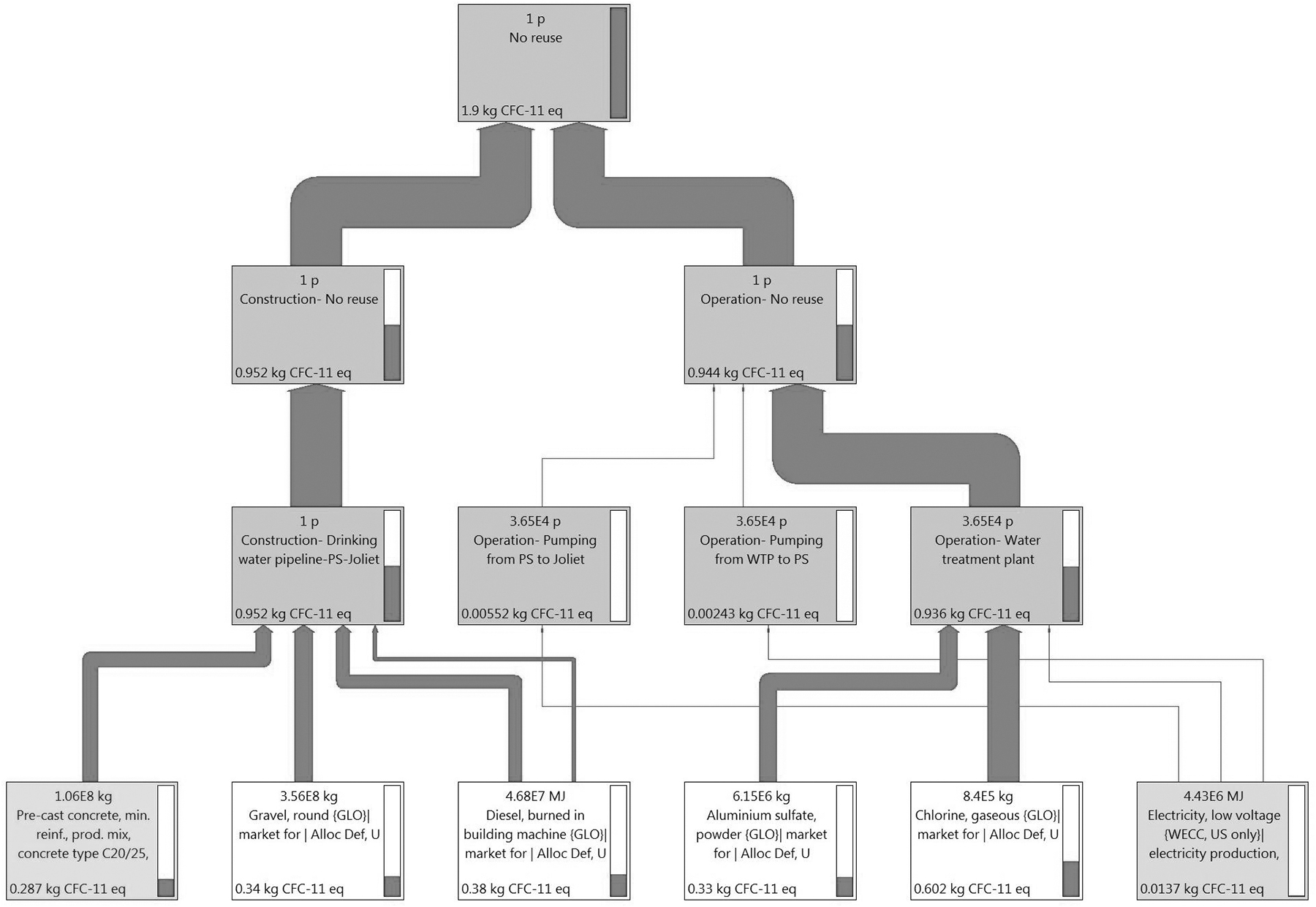
Process contribution chart for ozone depletion in no-reuse scenario
With respect to construction, precast concrete material used for the pipe, gravel used in trenches, and the diesel used for excavation and backfilling had the most impacts on ozone depletion potential, as seen in Figure 4. Furthermore, the use of chlorine gas as a disinfectant and the use of alum as a coagulation agent during water treatment contributed to the high ozone depletion potential in the operation of no-reuse scenario (Figure 4). It is important to note that since the operation inventory is calculated for 1 MGD of water treatment for 100 years, these impacts of operations in the no-reuse scenario will multiply with each MGD increase in the treatment volume for industrial purposes. In contrast, in case of Scenarios 2 and 3 the ozone depletion potential impacts were mainly due to the construction of different pipelines as seen in Figures 5 and 6.
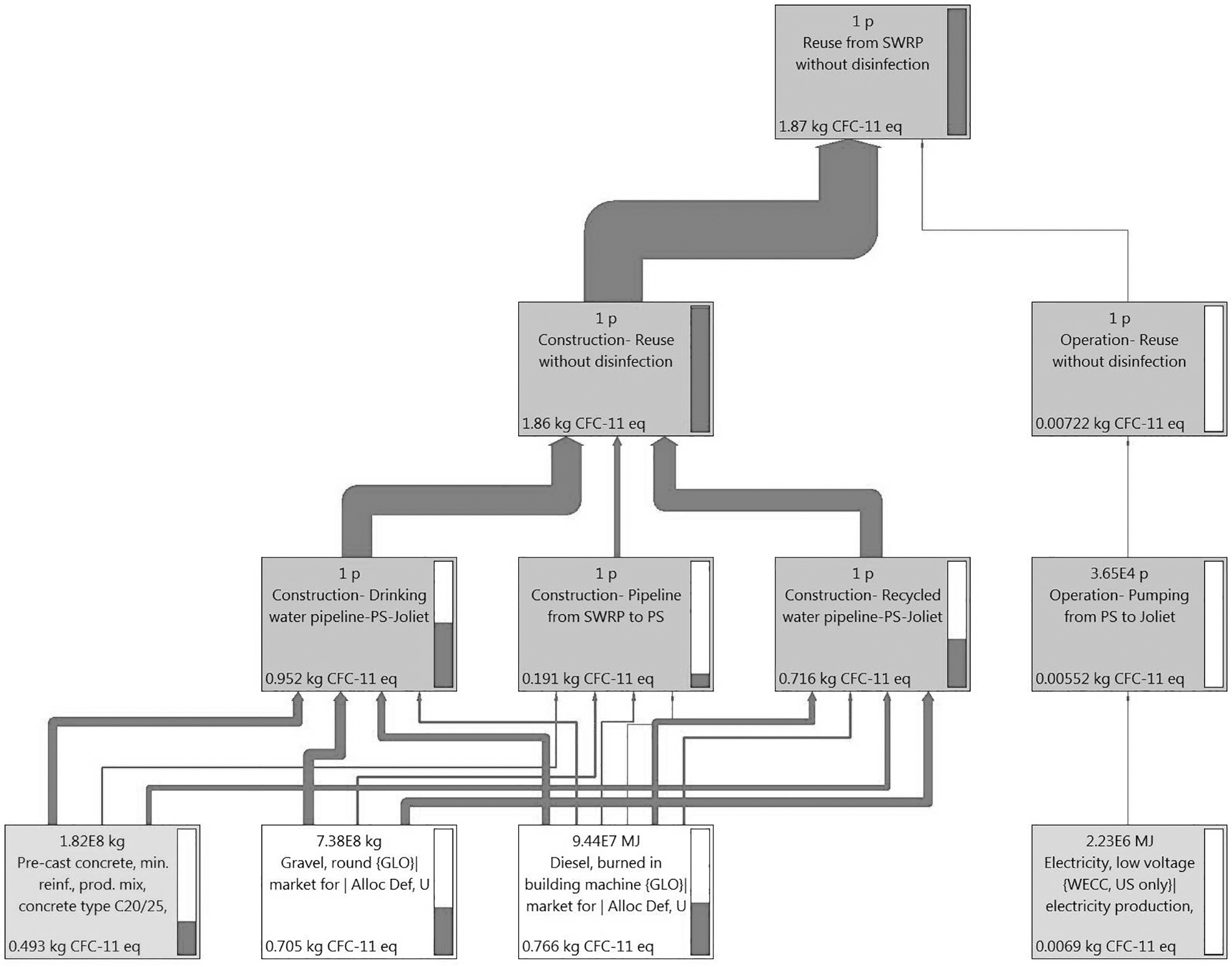
Process contribution chart for ozone depletion in reuse from SWRP without disinfection scenario

Process contribution chart for ozone depletion in no reuse scenario reuse from SWRP with new disinfection unit scenario
The ozone depletion potential attributable to the additional construction of pipelines in Scenarios 2 and 3 is high, at 1.86 kg CFC-11 eq of the total 1.87 kg CFC-11 eq, making the relative impact on this category comparable to that of no-reuse case. However, the data show that the operation in reuse cases has negligible impacts on the ozone depletion category with less than 1 percent contribution to the overall impacts. Furthermore, the addition of an extra disinfection unit in Scenario 3 has a negligible influence on this impact category, as evident in Figure 6. Additionally, the energy usage for operating the disinfection unit remains minimal, accounting for less than 0.05 percent of the total ozone depletion potential—a figure well below the 0.1 percent threshold, the baseline used in these flowcharts.
The smog category is the next relatively high impact category for the reuse cases as compared to the no-reuse case with values at 6,138.8 and 6,210.9 ton-O3-eq, for the reuse cases as compared to 7,658.4 in no-reuse scenario. Smog is mainly caused by emissions from excavation and backfilling as well as the transportation of construction materials to the site. Similarly, the impacts on the fossil fuel depletion category are relatively higher for Scenarios 2 and 3 compared to other impact categories. The significantly higher impacts of the no-reuse scenario stemmed from the fact that water treatment has to be carried out at a high power consumption rate, and different chemicals have to be added during the water treatment process for an operational phase of 100 years. These impacts multiplied for 100 years of operation increase the relative environmental impacts disproportionately for the no-reuse scenario compared to the other two scenarios.
Our data show that the additional impacts of constructing and operating a new disinfection unit at SWRP are negligible. As seen in Table 2, these impacts are negligible because the materials required for constructing a 15 MGD disinfection unit are quite small in comparison to that of materials required for laying the pipelines. In addition, the operational energy of 90 kWh per MGD of disinfection is significantly lower than that of pumping energy for all the cases and the operational energy requirement of ESWPP, as seen in Tables 1 and 2.
Also, the electricity mix used for the state of Illinois consists of sustainable energy sources such as nuclear (52%) and wind energy (12%), further reducing the impacts of additional energy consumption. Overall, from the assessment conducted it can be concluded that reusing treated wastewater from SWRP, with or without disinfection for industrial purposes, in Joliet is environmentally more sustainable in the long-term compared to the use of treated water from Lake Michigan, despite having to construct additional pipelines to convey treated wastewater.
Comparison of Reuse from CWRP With No Reuse and Reuse from SWRP Scenarios
Although reuse from SWRP is relatively more sustainable compared to the no-reuse case, the construction of a disinfection unit can be a reason for public bodies to halt acceptance of water reuse. To address this, we consider an additional scenario, Scenario 4. In this scenario treated wastewater from CWRP, which already has a disinfection unit in place, is to be supplied to Joliet's industrial users. The additional inventory used for this case is presented in Table 2. Based on preliminary approximate estimates, it is assumed that an 11-mile long pipeline is to be laid to connect CWRP to the SW Pump Station. The final layout and design for this case will be further analyzed to get an accurate estimate for the inventory. Corresponding calculations were performed based on preliminary estimates to determine the raw materials required, energy consumption for the construction process, and electricity required to pump the water to SW Pump Station. From SW Pump Station to Joliet, the supply scenario is the same as that of reuse from SWRP scenario.
The findings from the environmental impact assessment, as depicted in Figure 7, indicate that though there is a requirement to build and operate an extra disinfection system for SWRP in order to meet specific water quality standards, the introduction of an 11-mile long pipeline from CWRP to the SW Pump Station, in contrast to the 8-mile pipeline for the SWRP scenario, results in more pronounced environmental impacts compared to the supplementary disinfection measures for SWRP. Consequently, the overall relative environmental impacts of Scenario 4 exceed those of Scenario 3. Nonetheless, these relative impacts remained lower than those of Scenario 1, in which all of Joliet's water needs are met exclusively from Lake Michigan, without any reuse of treated wastewater.
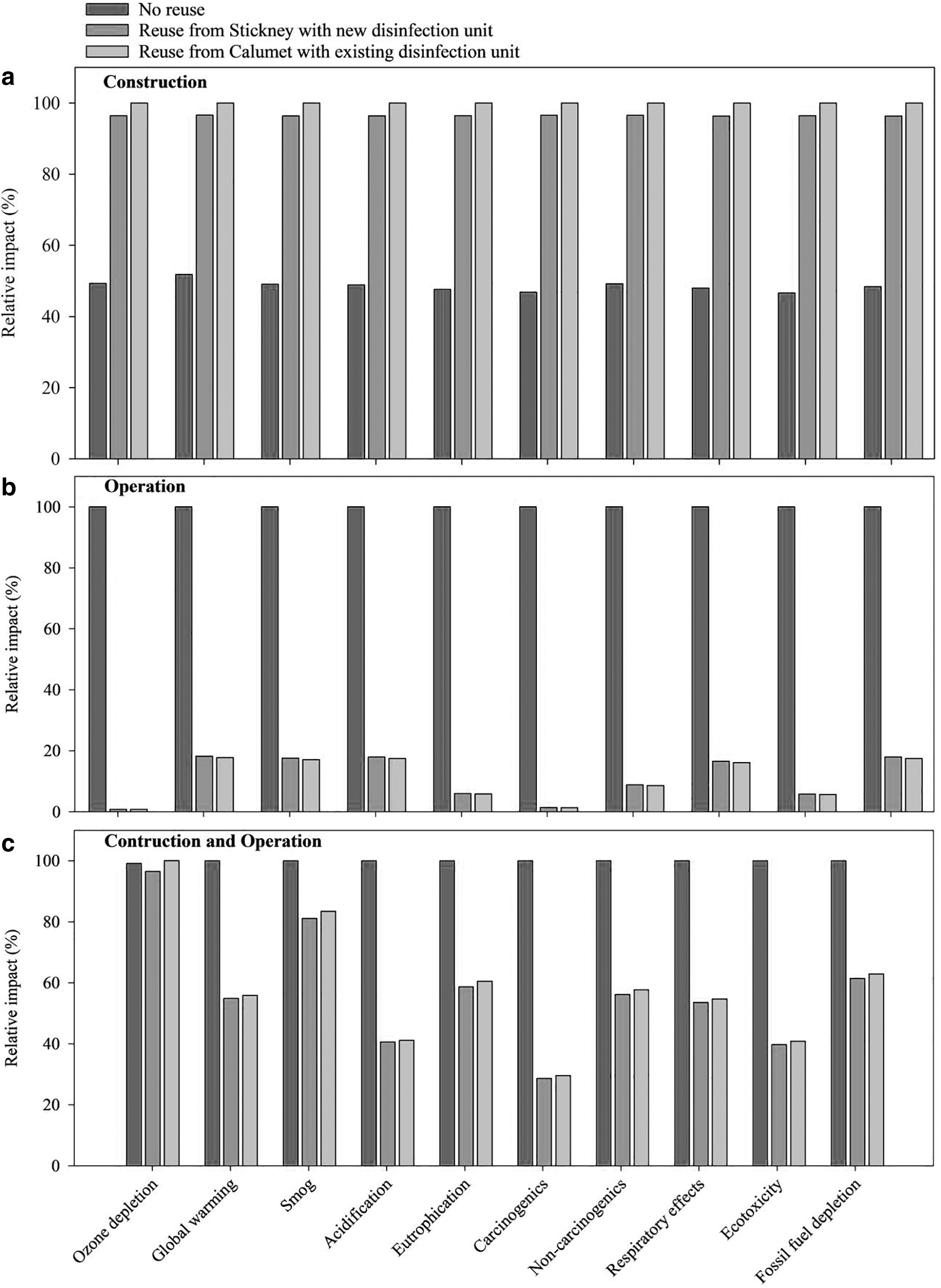
Relative impacts of
It should be noted that the final pipeline lengths and other design components for the SWRP and CWRP scenarios might change during detailed investigations and final design phases. Nevertheless, all the reuse scenarios will still be significantly more sustainable compared to that of the no-reuse scenario. Additionally, there are other intangible benefits, such as conserving water from precious freshwater sources like Lake Michigan and reducing the discharge of wastewater into natural water bodies, which further underscores the compelling nature of wastewater reuse. Furthermore, the potential revenue generated from selling wastewater adds to its advantages. Therefore, it is recommended that water from either SWRP or CWRP be utilized for Joliet's commercial and industrial non-potable needs, rather than relying solely on fresh treated water from Lake Michigan, which is proven to be unsustainable in the long term.
Study Limitations
The scope of the current assessment is limited to the delivery of water to the City of Joliet and is based on preliminary design lengths for the supply systems. Further studies that encompass the actual design lengths of distribution systems considering all relevant factors, like demographics, surrounding utilities, and the existence of pavements or expressways in the distribution path, can provide a more accurate assessment of the relevant environmental impacts.
The current study considers UV disinfection as the only additional treatment component. Though this approach is appropriate as a general overview; a more thorough sustainability evaluation is be needed to select appropriate technologies that align with the intended application and desired water quality when limited data are available. For instance, membrane filtration, reverse osmosis, and other advanced treatment technologies can further improve recycled water quality.
These treatment units can be at the WRPs or at the site of intended use. Impact assessments considering such scenarios can provide a more specific overview. By selecting the appropriate technologies, achieving further significant reductions in environmental impact can be possible. Future studies should also include a sensitivity analysis given the uncertainties in the water and wastewater treatment and distribution processes. Sensitivity analysis is a valuable tool for examining the robustness of results and their sensitivity to uncertain factors in life cycle assessment. Performing a sensitivity analysis would allow for identifying areas of the evaluation that may be particularly sensitive to variability in the data or assumptions used. Moreover, it would improve the accuracy and reliability of the assessment, which will be critical for making informed decisions about water reuse in the future.
In addition, considering sustainability as a multipronged concept encompassing triple bottom line aspects (environmental, economic, and social), a detailed analysis of the impacts of different scenarios on each of the triple bottom line aspects and an integration of all these aspects can account for a comprehensive sustainability analysis. Also, because water reuse improves the resilience of available natural water resources to climate change and other uncertain factors, a resilience assessment quantifying these benefits and integration of the same into the sustainability analysis can help promote the benefits of water recycling and reuse further.
Conclusions
The goal of this life cycle assessment is to discover ways to reduce the environmental impacts of supplying water with the addition of recycled water for industrial use. This study builds and models our envisioned scenarios using detailed data from different literature sources. Though this environmental sustainability assessment relies on data from past studies, it provides valuable insights into the potential benefits of water reuse. In considering these benefits, an important caveat is that site-specific data and desired water quality requirements must be considered when assessing the feasibility of water reuse for specific reuse applications.
Based on the life cycle assessment of different scenarios using the Ecoinvent 3.0 database and TRACI impact assessment method, we find that:
The current water use cycle (No Reuse) has a higher environmental impact. It is energy inefficient compared to water reuse from SWRP without disinfection (Scenario 2), water reuse from SWRP with disinfection (Scenario 3), and reuse from an alternative source with in-built disinfection (Scenario 4). Water reuse provides a more sustainable and secure water supply. Water reuse for various non-potable applications can further reduce the need for potable water and thus minimize the environmental impacts associated with water treatment plant/processes. Although the potential for water reuse was explored, more advanced wastewater treatment technologies and further sustainability assessments (considering broader economic and social impacts) are recommended.
Overall, we conclude that water reuse can significantly reduce greenhouse gas emissions and other environmental impacts compared to traditional water supply and treatment methods. Water reuse has the potential to provide a sustainable and secure water supply option while also reducing potable water consumption, energy use, and environmental impact.
Footnotes
Authors' Contributions
Valeria Kandou: conceptualization, methodology, formal analysis, writing original draft; Jagadeesh Kumar Janga, Gaurav Verma, and Anshumali Mishra: conceptualization, methodology, validation, visualization, writing review and editing; Krishna R. Reddy: conceptualization, investigation, methodology, project administration, resources, software, supervision, validation, writing review and editing; Rachel Havrelock: conceptualization, funding acquisition, methodology, project administration, resources, writing review and editing; Rachid El- Khattabi: formal analysis, methodology, writing review and editing.
Funding Information
This study was funded by the Metropolitan Water Reclamation District of Greater Chicago (MWRDGC) and the University of Illinois Chicago (UIC).
Author Disclosure Statement
The authors declare that there is no conflict of interest regarding this study.