




Abstract
Emotions play a significant role in motivating climate action, but the nature and the direction of the relationship between emotions and attitudes toward climate policy are relatively understudied. We conducted a survey experiment (United Kingdom, n = 1,330) in which we experimentally manipulated incidental emotions to consider the effects of fear, anger, and sadness on support for different climate policies. In terms of informative policies, the results show that inducing sadness significantly increases support for early warning systems for disaster predictions but has no notable effect on providing health risk information concerning climate change. Regarding protective policies, inducing fear positively and significantly influences support for banning petrol cars, while an immediate ban on coal plants shows no statistically significant effect. Interestingly, contrary to the expectations and findings in the literature, we found the negative effect of anger treatment on the support for punitive measures oriented toward high-electricity-consuming households and no effect on punitive measures against businesses and frequent flyers. Our findings highlight the potent influence of emotions in motivating support for specific climate policies, revealing their intricate nature. At times, certain emotions such as anger can even cause reduced support for climate policies.
Introduction
Public support is central to the adoption of effective climate policies (Bechtel et al., 2020). Public acceptance of and compliance with climate policies make their enforcement by the governments more effective and less costly (Ostrom, 2009). Climate skepticism is relatively low in the United Kingdom, and there is widespread support for the government’s responsibility to adopt policies to address climate change (BEIS, 2021). However, determinants of public preferences over particular climate policies still constitute an important research area (Crawley et al., 2021).
To address this important issue, an emerging literature focuses on the impact of emotions on public support for climate policies. Emotions affect how information is processed by individuals (Lu & Schuldt, 2016), and the intensity of emotions can help bring climate change close to home (Salama & Aboukoura, 2018, p. 141). Some studies have found that the effect of emotions on support for climate policies might be stronger than cognitive factors such as belief in human-induced climate change (Bouman et al., 2020; Feldman & Hart, 2018). However, the nature and the direction of the relationship between emotions and public support for particular types of climate policies are still debated (Leiserowitz, 2006; O’Neill & Nicholson-Cole, 2009; Feldman & Hart, 2018; Smith & Leiserowitz, 2014; Chapman et al., 2017). Accordingly, several studies address whether some emotions are more effective in increasing support for climate policies (Leiserowitz, 2006; O’Neill & Nicholson-Cole, 2009; Feldman & Hart, 2018; Smith & Leiserowitz, 2014) while showing that emotions do have causal impact on support for climate change policies (Feldman & Hart, 2018). As many scholars also acknowledge, the impact of discrete emotions on climate policy support has not been thoroughly examined and needs further investigation (see Baek & Yoon, 2017; Brosch, 2021; Chapman et al., 2017; Russell & Ashkanasy, 2021). In addition, not much research has looked into whether different discrete emotions influence support for specific policies aimed to address climate change.
Our study makes several contributions to the existing literature. We analyze the effects of discrete negative emotions on different types of climate policies with different aims and tools rather than measuring policy support by using a single variable where different policies are lumped together. Second, our study focuses on the effects of incidental emotions instead of emotions aroused by presenting climate change-related information. The literature usually analyzes the effects of climate change-related integral emotions on policy support, which are often highly correlated with preexisting attitudes toward climate (see, e.g., Lu & Schuldt, 2015). In addition, recent studies revealed that incidental emotions and integral emotions can have effects of different directions and magnitudes (Ferrer & Ellis, 2021). Therefore, more studies are needed that focus on incidental emotions in the context of climate policy support to shed light on such differences. Incidental emotions may yield results that are less influenced by the information they receive since participants are not given any climate change-related information that may affect their policy support. Our study also considers the effect of sadness, the effects of which on public support for climate policies have not been studied in detail before.
In the remainder of the article, we outline the conceptual framework of the analysis; explain our data and methods; and conclude with a discussion of our findings.
Emotions and Attitudes Toward Climate Policies
A growing literature on public opinion toward climate change explores the role of emotions (Brosch, 2021). Even though there are a large number of studies that consider the influence of positive and negative emotions, most of these studies focus on outcomes such as climate action (Taylor et al., 2014; Nabi et al., 2018; Harth, 2021; Bouman et al., 2020; Feldman & Hart, 2016; Marlon et al., 2019) and climate risk perception (von Mossner, 2012; Roeser, 2012; Harada et al., 2022) rather than policy (see, e.g., Goldberg, 2020; Smith & Leiserowitz, 2014; Wang, 2018; Feldman & Hart, 2018; Lu & Schuldt, 2016; Lu & Schuldt, 2015). Some of these approaches are grounded in the appraisal theories that make finer distinctions among emotions (Nabi et al., 2018; Harth, 2021; Feldman & Hart, 2016). Appraisal theories (e.g., Lazarus, 1991; Roseman, 1991; Smith & Ellsworth, 1985) argue that emotions are elicited as a result of the interaction between the stimulus and the individual’s (automatic or conscious) evaluation or appraisal of that stimulus, going beyond the simple positive or negative affective evaluation. Different appraisal theories vary regarding the number of appraisal dimensions, but some common ones are the pleasantness (approach or rejection) of the situation, whether the person is able to control the consequences of the stimulus (control), the degree of certainty concerning the situation, or whether a stimulus (certainty) or the extent to which a stimulus is relevant for (goal relevance) and congruent with a person’s goals/concerns (goal congruence) (Kim & Cameron, 2011; Brader & Marcus, 2013). The number of discrete emotions considered also depends on the theory.
Literature on climate change-related attitudes has considered the effects of various discrete emotions, including fear, shame, guilt, anger, and compassion. In this study, our focus is on three negative universal emotions (cf. Ekman, 1992): fear, anger, and sadness. We chose to study these emotions as they are common reactions to different types of climate change-related losses (Curnock et al., 2019). Among these three emotions, anger and fear are emotions that have frequently been studied in the context of climate change (Novoselov & Hayes, 2022; Fischer et al., 2012; Stanley et al., 2021; Kleres & Wettergren, 2017; Feldman & Hart, 2016), while sadness is increasingly being identified as another emotion arising in relation to climate change (Stanley et al., 2021; Schultz et al., 2018), but its effects on public opinion on climate change have been relatively less studied (except Myers et al., 2024).
There is a dearth of studies that focus on the effects of discrete emotions on policy support (see, e.g., Feldman & Hart, 2018; Lu, 2020; Myers et al., 2024). Existing literature on the effects of anger focused on the effect of anger on collective climate action (Feldman & Hart, 2016; Kleres & Wettergren, 2017) and on climate risk perceptions (Graybill, 2013; Jovarauskaite & Böhm, 2020; Tam & McDaniels, 2013). There are a limited number of studies that consider whether anger increases the likelihood to support certain policies. For example, Lu and Shuldt (2015) found that experimental treatments that increased anger led to greater willingness to punish businesses that obstruct climate efforts among Democrats, although the effects of anger did not extend to other climate change mitigation policies they considered. Similarly, in their study on the effects of emotions on group-based emotions, Harth et al. (2013) found that anger increased the intention to punish environmental wrongdoers. Furthermore, Myers et al. (2024) found in their study that anger was most strongly associated with support for climate policies that are costly for the individuals themselves. In another study, Landmann and Rohmann (2020) found that in the presence of appraisals of injustice, anger elicited the intention to punish authorities responsible for a forest clearing. Gregersen et al. (2023) highlighted how the content of climate anger, such as anger due to human actions or qualities and anger due to consequences of climate change on the natural environment, can lead to varying levels of support for climate policies. Yet, there is need for more studies looking into the effect of anger on punishment of wrongdoers in climate change-specific cases.
The effect of fear and sadness on climate policy support has not been extensively studied. Smith and Leiserowitz (2014) found no effect of fear on policy support, while Myers et al. (2024) found that fear was most strongly associated with support for climate regulations. Myers et al. (2024) also found that sadness had the strongest association with support for future-oriented policies to address climate change such as investment in new technologies of infrastructure. Notably, Myers et al. (2023) identified that climate information can elicit a range of emotions, which may conflict when promoting support for climate change mitigation policies. This study specifically utilized stimuli designed to evoke climate-related emotions. Discrete emotions such as anger, fear, hope, and sadness were positively correlated with support for climate policies. Notably, anger directed at climate change deniers was most strongly associated with increased support, followed by hope, fear, and sadness. These findings reinforce previous research indicating that a variety of discrete emotions, both independently and collectively, serve as strong predictors of support for climate policy (Myers et al., 2023).
While some studies argue that incidental sadness from arbitrary events in one’s past could have an impact on policy preferences (Small & Lerner, 2008), most studies on emotion and climate-related attitudes have focused on integral emotions (see, e.g., Lu & Schuldt, 2015), which refer to emotions arising from the decision or stimuli itself. In the context of climate change, this means that the emotions considered in these studies might be highly correlated with individuals’ prior beliefs about climate change. Diverging from existing studies on the effects on integral emotions on climate policy support, we analyze the effect of incidental emotions, because the benefit of studying experimentally induced incidental emotions is that they allow us to test whether discrete emotions such as fear, anger, or sadness uncorrelated with prior climate beliefs influence support for different climate change policies in ways consistent with the predictions of appraisal theories of emotion (e.g., Lu & Schuldt, 2015).
A Typology of Climate Policies
Many existing studies on the effect of emotions on climate policy support use an additive index of different climate policies, including mostly mitigation policies, in measuring the change in their dependent variable. Exceptions include a few studies that differentiate between public support for adaptation policies and mitigation policies (Hagen et al., 2016; Brügger et al., 2015). Other studies distinguish between the level of costs associated with different policies. For example, Tvinnereim and Ivarsflaten (2016) analyzed individual support for climate policies with high expected costs and opportunities for the respondents and found that individual support is associated with expected costs and benefits of the policy (cf. Beiser McGrath & Bernauer, 2017). Harth et al. (2013) also distinguished among environmental intentions to repair the damage, punish wrongdoers, and favor environmental protection in a study on the effects of anger, pride, and guilt. Myers et al. (2024) also analyzed a typology of policies that included policies with personal costs, regulatory policies, proactive policies, and climate justice policies and found that different integral emotions were uniquely associated with support for particular types of climate policy preferences.
We analyze a different typology of climate policies based on the goals of the policy. Considering that there is a lack of consensus on a clear conceptualization of policy goals, we adopt a broad definition of policy goals as “governmental statements about desired futures in relation to specific sectoral purposes, values, and principles in democratic political systems, policymaking process improvements, necessary instrumental innovations, and evaluation standards” (Petek et al., 2021, p. 465). We consider climate policies with different goals, namely protective policies, punitive policies, and informative policies. These policies use different policy instruments, that is, state authority, direct provision by the state, treasury measures, and information provision (Howlett, 2009). Protective policies refer to those policies aimed to safeguard people from the hazardous effects of climate change. In fact, preparing for extreme weather events is increasingly identified as a subject matter of civilian protection systems (Alexander, 2002). We identify those policies as protective that have the goal of the state to protect individuals from the negative effects of climate change-related natural disasters by shielding individuals from disasters in the short run, that is, adaptation (protective adaptation), or by adopting measures that are effective immediately to stop greenhouse gas (GHG) emissions to prevent future deterioration of climate conditions in the long run, that is, mitigation (protective mitigation). Punitive policies are those aimed by the state at individuals, groups, and actors that stand out as responsible for climate change through their disproportionate consumption of fossil fuels (cf. Chen et al., 2022; Wang et al., 2022). We consider those climate policies as informative that have a goal to disseminate climate change-related information and risk assessments to the individuals and households to protect themselves from the effects of climate change (Davidovic & Harring, 2020).
Theory and Hypotheses
The appraisal tendency framework (ATF) argues that appraisal tendencies associated with emotions affect perceptions of subsequent stimuli and guide ensuing decisions and behaviors in line with the appraisal patterns characterizing these emotions (Lerner & Keltner, 2000; Lerner & Keltner, 2001). For example, anger is associated with a high sense of control over events and the tendency to perceive negative events as controllable. The ATF predicts that, once this appraisal pattern is activated by basically any stimuli, risk will tend to be perceived as lower compared with a neutral emotional state. This may lead individuals to engage in risk-seeing behavior, including joining backlash protests (e.g., Aytaç et al., 2018). Below, we discuss how the appraisals relevant to the emotions that we study might be related to different climate policies.
Fear
Fear centers on appraisals of threat and uncertainty—“a sense that even such basic needs as safety are uncertain” (Lerner & Keltner, 2000, p. 480). Fear is also associated with a sense of lack of control over the situation (Lerner & Keltner, 2001; Smith & Ellsworth, 1985). According to the ATF, appraisals of uncertainty and low sense of control lead fearful people to make pessimistic risk assessments and prefer more risk-averse policies (Lerner & Keltner, 2000; Lerner & Keltner, 2001). Many studies provide evidence concerning the effect of fear on perceptions of risk. For example, Lerner et al. show that fear increases estimates of risk from terrorism (Lerner et al., 2003) . Pessimistic risk assessments arising from fear also lead to support for more protective policies that promote a sense of control. For instance, Nabi (2003) found that fearful respondents preferred protective policies such as police controls, roadblocks, and the expansion of preventive programs over retributive policies as response to drunk driving (p. 238). (Meijnders et al. (2001) found that inducing fear about atmospheric carbon dioxide levels led more support for energy conservation, which was perceived as being a risk-reducing strategy. Direct provision of certain goods is considered a “safety net” for those who do not have the ability to provide for themselves due to reasons beyond their control (Chopra, 2009). Therefore, it can be conceptualized as a risk reduction strategy. Since fearful individuals prefer to reduce risk and increase protection from the negative effects of climate change, we hypothesize that: Fear increases support for protective policies aimed at adaptation (protective adaptation).
Because fearful individuals tend to be supportive of risk aversion and risk reduction strategies, we also predict that they would prefer climate policies that reduce the risks immediately. For example, stopping GHG emissions is one strategy to protect humanity from the negative effects of climate change. Some policy alternatives propose tackling the effects of climate change by stopping GHG emissions immediately. We therefore suggest that fearful individuals would be more willing to support policies that propose such immediate solutions: Fear increases support for protective policies aimed at mitigation of climate change (protective mitigation).
Fear centers on appraisals of threat, which activates the surveillance system and increases the need for information in order to cope with the threat (Marcus et al., 2000; Vasilopoulos et al., 2019). Several studies have found that fear motivates individuals to scan the environment and thus increases attention and enhances information seeking (Marcus et al., 2000; Valentino et al., 2008; Vasilopoulos et al., 2019). For example, fear stemming from terror attacks increases attention to news and facilitates learning about the threat (Valentino et al., 2008; ). Greater fear was also associated with conducting more search during the COVID-19 pandemic (Baerg & Bruchmann, 2022). Accordingly, we predict that: Fear increases support for policies that involve the dissemination of information (informative).
Anger
Anger is also associated with situational threats, but people clearly experience anger as distinct from fear (Brader & Marcus, 2013, p. 179). Anger is generally triggered by events or circumstances that frustrate a personally relevant or desired goal, resulting in undesirable consequences for oneself or others. Anger is usually directed against an agent who has been accused of causing deliberate harm or posing obstacles to one’s desired goals (Harth et al., 2013). Anger is also produced by appraisals of injustice and unfairness and could be elicited as a response to moral and social norm violations (Brader & Marcus, 2013).
Anger rises with certainty about the cause of the threat and is therefore associated with the tendency to perceive certainty and individual control over the situation (Lerner & Keltner, 2000). Thus, while fear is associated with appraisals of uncertainty lack of control, anger is associated with appraisals of certainty and individual control. The sense of certainty and individual control that characterize anger appraisals lead angry people to make relatively optimistic risk assessments (Fischhoff et al., 2005; Lerner & Keltner, 2000; Lerner & Keltner, 2001; Smith & Ellsworth, 1985). For instance, while fear increases perceived risk from terrorism, anger decreases estimates of risk from terrorism (Lerner et al., 2003). Ferrer and Ellis (2021) found that this is especially the case for incidental anger. While incidental anger reduces risk perception, integral anger that is related to the issue at hand increases risk perception (Ferrer & Ellis, 2021, p. 283). We therefore expect anger to reduce perceived risk from climate change and lead to reduced support for climate policies. Thus, we expect that the effect of anger on climate policies would be the opposite of fear: Anger decreases support for adaptive protective policies (protective adaptation). Anger decreases support for protective policies aimed at mitigation of climate change (protective mitigation).
Anger also motivates people to take action against the causal agent seen responsible for obstructing one’s goals or engaging in social norm violations (see Leach et al., 2006; Harth et al., 2013; Lerner et al., 2015; Lu & Schuldt, 2015). Angry people are often motivated to seek revenge, hurt, or punish the agent (Redlawsk & Mattes, 2022, p. 141). Various studies provide evidence that higher levels of anger are associated with support for harsher punishments and tougher law-and-order policies (Nabi, 2003). Due to anger’s association with the desire for retribution, we predict that it could also increase support for mitigation policies that impose costs on those seen as causing the problem (i.e., punitive). Accordingly, we hypothesize that: Anger increases support for punitive policies that impose cost/punishments on those seen as causing the problem (punitive).
Sadness
Sadness is associated with the appraisal of experiencing “irrevocable loss” and “a sense of helplessness about restoration of the loss” (Lazarus, 1991, p. 248). Sadness is associated with an increased tendency to perceive situational circumstances as responsible for outcomes and accompanies the tendency to change one’s circumstances (Lerner et al., 2015). Sadness is also associated with a lower sense of personal control over the situation (Lerner & Keltner, 2000; Lerner et al., 2015). In contrast to high-certainty emotions such as anger, low-certainty emotions such as sadness give people the impression that they should carefully analyze information before making a decision (Small & Lerner, 2008; Smith & Ellsworth, 1985). Sadness, as a low-certainty emotion,can influence information-seeking behaviour. (Kuhlthau, 1991). Thus, as in the case of fear, we expect sadness to lead to higher levels of information seeking due to appraisals of uncertainty. Sadness increases support for climate policies that involve the dissemination of information (informative).
Data and Methods
Data were collected by Lucid Holdings Ltd. using a quota sample (based on age, gender, education, and ethnicity) of residents in the United Kingdom. We monitored the quality of open-ended responses and total response time during the data collection and discarded the data from respondents who did not meaningfully engage with the experimental prompts. These responses did not count toward our target completeness. The achieved sample size was 1,330.
A comparison of our sample’s characteristics with the 2011 UK Census indicates that females are slightly overrepresented in our sample (53.2% as opposed to 50.8% in the census) and the low education categories (level 1 and below) were slightly underrepresented (28.87% as opposed to 37.36% in the census). About 31 percent of the sample has an undergraduate, professional, or postgraduate degree, and an additional 60 percent has secondary qualifications (see Supplementary Appendix S1).
We used a between-group experimental design where participants were randomly assigned to fear, anger, sadness, and control (neutral, relaxed) conditions (for randomization checks, see Supplementary Appendix S2). Before the experimental treatments, respondents answered questions on demographics, climate change beliefs (concern with climate change, climate change skepticism), ecological dominance orientation, interpersonal and government trust, and left–right self-placements (Supplementary Appendixes S3 and S4). Our study analyzes the effects of incidental emotions that are unrelated to climate change. Yet, the order in which respondents received questions could trigger emotions related to climate change. Indeed, when we asked respondents to write down what makes them feel angry/sad/fearful, some of them mentioned climate change and environmental degradation. However, the overwhelming majority mentioned non-climate-related things such as COVID, spiders, not being listened to, fighting with a loved one, and crime. Only 0.38 percent of total words written in response to that question is climate related.
For the experimental treatments, we used a direct emotion induction technique where participants were asked to recall and focus on events or occurrences that led them to experience a specific emotion while viewing an image of a person with a facial expression corresponding to that emotion (Ekman, 1992; Lerner & Keltner, 2001; also see Lu & Schuldt, 2015). Participants were asked to write down what makes them feel the emotion that they were assigned and describe what it feels like to experience that emotion (with “relaxed” representing the control condition).
The facial expressions were taken from the RADIATE Emotional Face Stimulus Set (Conley et al., 2018). Following the open-ended response, we presented the respondents with a list of emotions (in a randomized order). We asked them to indicate the intensity of each emotion they felt on a 7-point Likert scale ranging from “not at all” to “extremely.” These were as follows: “angry, bitter,” “calm, relaxed,” “fearful, scared,” “happy, joyful,” “sad, grieved.”
Respondents then answered the questions concerning support for different climate change policies (see Supplementary Appendix S5 for descriptive statistics for policy support items). We considered three types of climate policies according to their goals as discussed above: protective (aimed at adaptation or mitigation), punitive, and informative. We considered two adaptive protective policies (support for building storm shelters and water reservoirs), two immediate mitigation policies aimed at protection (support for banning coal plants and petrol cars), three punitive policies that impose costs on those seen as contributing to climate change (e.g., additional charges for frequent flyers, households that consume electricity above a government-mandated quota, and businesses whose activities contribute to climate change), and two informative policies (providing information about the health risks of climate change and early warning systems for disaster predictions).
Measures
The outcome variables in our study are support for different types of climate policies. Questions concerning support for climate change policies may suffer from desirability bias, where respondents may utter strong support for policies in the absence of reminders of cost implications of such policies (Beiser-McGrath & Bernauer, 2017). As a result, when asking our questions, we reminded respondents of such costs that may be associated with enacting these policies. Respondents were asked, “To what extent do you support the following government actions even if some may cost the average household additional annual expenses?” All items are measured on a 1–5 Likert scale as follows: (1) strongly support, (2) somewhat support, (3) neither support nor oppose, (4) somewhat oppose, and (5) strongly oppose.
The wordings for protective policies that provide direct protection from the immediate negative effects of climate change are “building new reservoirs to store water for use during periods of drought or water scarcity” and “building new storm shelters to protect against increasing storm activity in the United Kingdom.” For protective policies aiming to stop climate change immediately, items included support for “banning the sale of new petrol/diesel cars immediately” and “banning coal plants immediately.” Informative policies that disseminate information for self-protection included “developing early warning systems so that individuals can be notified of disaster predictions” and “providing more information on health risks associated with extreme weather events.”
The prompt for the punitive policies was: “To what extent do you favor or oppose the following policies?” The policy items were “additional charges for households that consume electricity above a government-mandated quota,” “additional charges for those who fly above a government-mandated quota.” and “applying financial penalties toward businesses whose activities contribute to climate change even if it causes an increase in consumer prices.”
Control variables and variables for which moderation effects were considered include age, gender, level of education, ethnicity, income level, left–right self-identification, postmaterialism, interpersonal trust, trust in government, climate change skepticism, concern with climate change, ecological dominance, and perceived distance of climate change. All control variables and demographics were measured before the experimental treatments were presented.
Results and Discussion
Manipulation checks indicate that the treatments increased the intensity of manipulated emotions reported by the respondents. Reported fear in the fear condition (M = 3.88, s (standard deviation) = 1.77) was higher than in the control condition (M = 2.73, s = 1.67; p < 0.05) as well as in the anger (M = 3.23, s = 1.67; p < 0.05) and sadness (M = 3.53, s = 1.75; p < 0.05) conditions. Reported anger in the anger condition (M = 3.41, s = 1.75) was higher than in the control condition (M = 2.41; s = 1.61; p < 0.05), although reported anger in this condition and the fear (M = 3.37, s = 1.78, p > 0.05) and sadness (M = 3.41, s = 1.77; p > 0.05) conditions was not statistically different from 0. Finally, reported sadness in the sadness condition (M = 4.05, s = 1.81) was higher than in the control condition (M = 2.58, s = 1.61; p < 0.05) as well as in the fear (M = 3.58, s = 1.73, p < 0.05) and anger (M = 3.47, s = 1.79; p < 0.05) conditions.
Treatment Effects
First, we compared the level of support for protective policies between the emotion conditions and the control condition using pairwise t-tests (Fig. 1). We found that the effect of fear treatment on banning petrol cars is positive and statistically significant when compared with the control condition, indicating that fear positively affects support for protective mitigation policies that propose urgent solutions (Mfear = 3.08, sfear = 1.30; Mcontrol = 2.87, scontrol = 1.28; p = 0.03; Cohen’s d = 0.16, 95% confidence interval or CI [0.010, 0.32]). This effect is robust to the addition of control variables (β = 0.227, σ = 0.099, p < 0.05). However, the effect of fear treatment on the other protective mitigation policy item, that is, banning coal plants immediately, is statistically null.
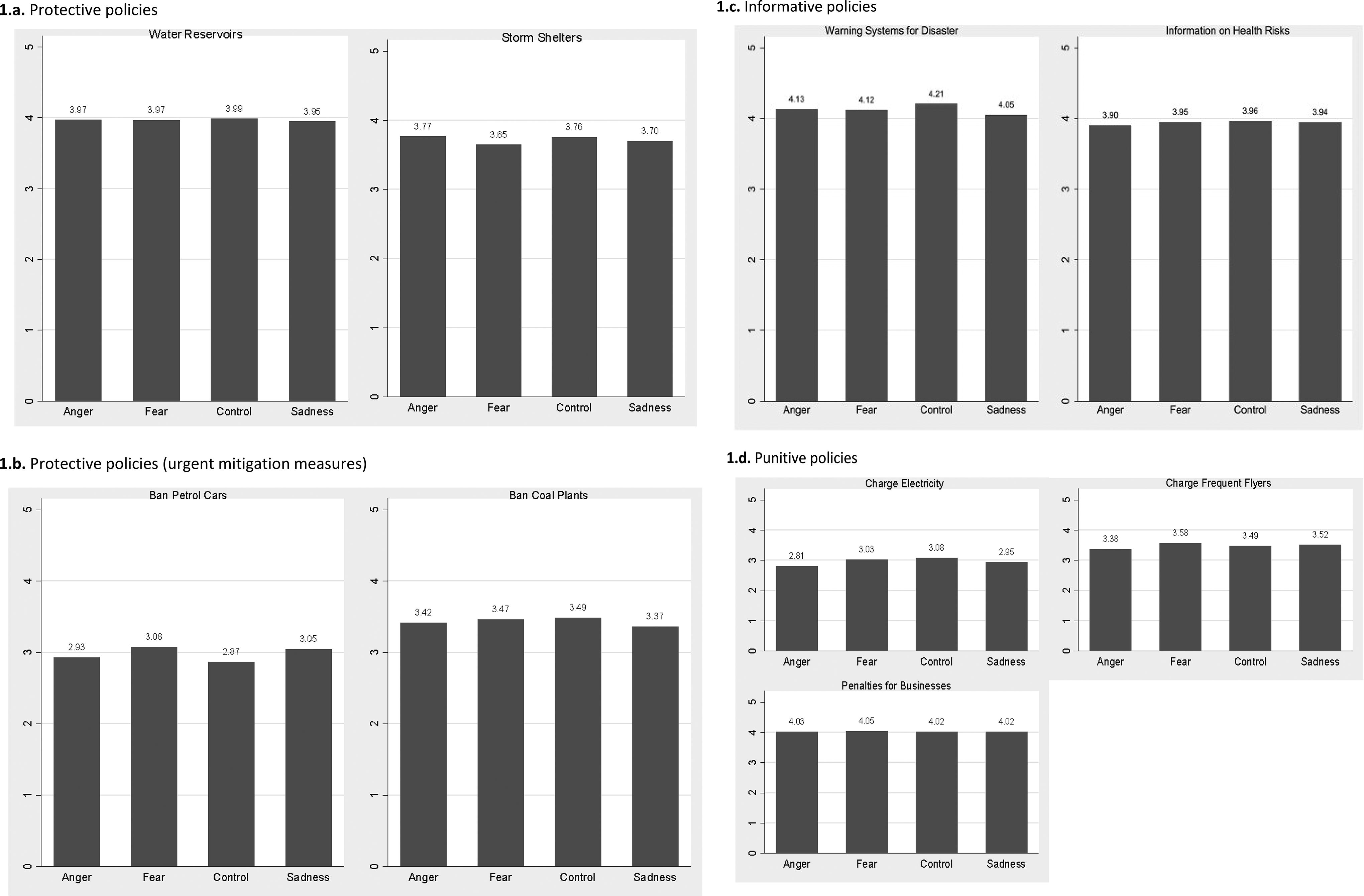
Mean levels of support for different climate change policies across experimental and control groups. All items were measured on a 1–5 Likert scale. Higher values indicate higher support for policies. n = 1,330.
Sadness treatment had a statistically significant effect on support for developing early warning systems to notify individuals of disaster predictions when compared with the control condition (Msadness = 4.05, ssadness = 0.84, Mcontrol = 4.21, scontrol = 0.81; p = < 0.05; Cohen’s d = 0.16, 95% CI [0.01, 0.31]). However, sadness treatment did not have a significant effect on the other informative policy, that is, providing information on health risks related to climate change. (For insignificant results see Supplementary Appendix S6).
Therefore, H2 and H7 were partially confirmed, while other hypotheses are refuted by our results based on an analysis of treatment effects. In addition, we found a negative and statistically significant effect of the anger treatment on support for additional charges for households that consume electricity above the government-mandated quota (Manger = 2.81, sanger = 1.19, Mcontrol = 3.08, scontrol = 1.26; p < 0.05; Cohen’s d = −0.217, 95% CI [−0.369, −0.065]). Again, this effect was robust when tested against control variables (β = −0.272, σ = 0.096, p < 0.05).
First, contrary to the findings of several existing studies (Lu and Schuldt 2015; Harth et al. 2013), we found almost no positive effect of anger treatment on support for punitive policy items that we considered. This could be explained by the fact that we aroused incidental anger that is not related to climate change, and as Gregersen et al. (2023) found, the content of anger influences its effect on policy support. It is possible that incidental anger that we aroused may not have focused respondents’ attention to climate change as opposed to climate anger that is directly exerting influence on climate preference formation of the respondents (Ferrer & Ellis, 2021).
Furthermore, anger treatment reduced support for punitive policies aimed at households that consume more electricity than the government-mandated quota. This supports the existing finding that individuals refrain from supporting policies that have costly implications on themselves (Dechezleprêtre et al., 2022). Poortinga et al. (2023) found that perceived fairness of a climate policy is a factor that increases support for a climate policy in the United Kingdom. Due to the fact that this measure has direct costs on the consumers, the respondents might have considered the punitive measures unfair, which might have led them not to support these policies despite their anger. Future research can further explore the effect of anger on punitive measures directed against politicians, thereby eliminating the potential influence of factors such as perceived fairness and costs for individuals themselves (Arikan et al, 2022).
Another interesting finding is the positive and significant effect of fear treatment on support for banning petrol cars immediately. People tend to oppose climate policies with costs to themselves (Jagers et al., 2021; Dechezleprêtre et al., 2022). Yet, fear treatment increased support for banning petrol cars, demonstrating the potential of fear for changing attitudes toward relatively undesirable climate policies.
Our finding that sadness treatment increased support for early warning systems, while the same effect was not observed for supporting dissemination of information relating to health risks of climate change, requires further investigation in the future. A possible explanation for this divergence in the sadness treatment’s effects on our two informative policy items can be due to the different extent to which each one of them increases perceived self-efficacy. Past research identified perceived self-efficacy, which is the individual’s belief that they can take the relevant adaptive actions, as an important predictor of climate change adaptation behavior (Van Valkengoed and Steg, 2019 ). While the item on early warning systems may have provided a clearer guide to act for the respondents to protect themselves, information on health risks item might have been less clear in providing a course of adaptive action and therefore may have reduced support for that item in the sadness treatment. Furthermore, future research on the effect of sadness on climate policy support can focus on the relationship between sadness and support for climate compensation schemes, such as the Loss and Damage Fund, as sadness leads to compensatory tendencies (Garg & Lerner, 2013).
Conclusion
While existing works demonstrate that emotions increase public support for climate policies (Smith & Leiserowitz, 2014; Brosch, 2021), our findings indicate that, in some instances, emotions may have negative effects on support for these policies (cf. Marlon et al., 2019). We found that this was sometimes the case regarding anger. Furthermore, we did not find that the effects of the treatments were conditional on existing predispositions concerning climate change, such as climate change worry or postmaterialist values.
Our findings reveal that fear treatment increased support for banning petrol cars immediately aimed at protection from further negative effects of climate change, which is in accordance with the existing literature showing that fear increases risk perception and motivates self-protective actions. However, this effect did not extend to the other protective policy items. Another significant finding is that sadness treatment increased support for informative policy, that is, early warning systems for disaster predictions. Although the same effect was not observed in the other informative policy item, that is, information on health risks of climate change, this finding partially supports our hypothesis that sadness, as a low-certainty emotion, leads individuals to seek information.
Our experiment explored the role of incidental emotions in support of climate policies. While the treatments aroused certain emotions among participants, not all participants may have linked these emotions with climate change. Therefore, future studies could explore the impact of climate change communication by using emotional frames in news stories to study the impact of climate-related emotions on the public’s motivation to support specific policies. Moreover, cross-cultural studies can further shed light as culture shapes how emotions are aroused and expressed in different contexts (Lim, 2016). More comparative studies are necessary to identify the common universal effects of these emotions.
Footnotes
Authors’ Contributions
D.G.: Grant holder, grant manager, conceptualization, literature review, and data analysis. G.M.: Grant holder, grant manager, literature review, and data analysis. G.A.: Literature review, data collection, and data analysis. C.F.M.: Literature review.
Institutional Review Board Approval Statement
Ethics approval for this study was received from the Yaşar University Ethics Review Board on May 3, 2021, Decision no: 18. Written participant consent was received.
Author Disclosure Statement
The author(s) declare no conflicts of interest.
Funding Information
This study received support from Yasar University’s Project Evaluation Commission under Project BAP088, titled “The Role of Emotions in Climate Policy Support: The Case of the United Kingdom.”

References
Supplementary Material
Please find the following supplemental material available below.
For Open Access articles published under a Creative Commons License, all supplemental material carries the same license as the article it is associated with.
For non-Open Access articles published, all supplemental material carries a non-exclusive license, and permission requests for re-use of supplemental material or any part of supplemental material shall be sent directly to the copyright owner as specified in the copyright notice associated with the article.
