




Abstract

It may seem strange for the author to write a review of his own book to this journal, especially given that the book is a work of literary criticism of contemporary science fiction and fantasy (SF/F). Its rationale, however, is grounded in the conviction that we are living in a SF world (Yanarella, 2024)—and that the conventional belief that the literary field of SF/F is devoted to the exploration of technological possibilities and imagined futures is wrong—or at least terribly distorted. Instead, The Cross, the Plow, and the Skyline (second edition; Yanarella, 2022) questions this widely held assumption and argues that SF/F is better understood as offering a vista on the present rather than crafting a vision of the future. As SF/F investigates forces shaping the everyday world of today and prompts alternative scenarios of the world of tomorrow, it always turns back on the dangerous and unsettled present, as twentieth-century literary critic and radical theorist Frederic Jameson (2007) has convincingly argued.
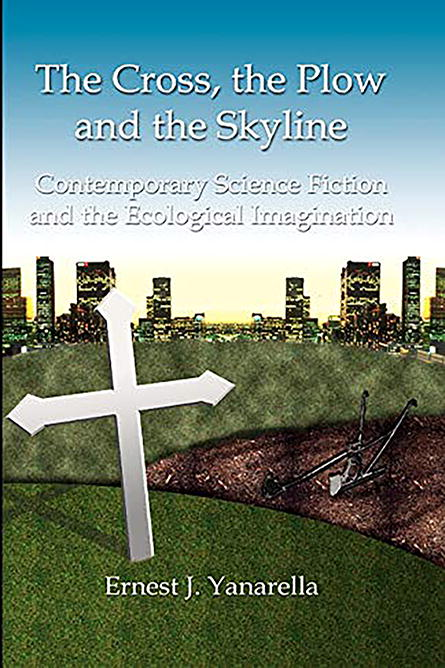
For this journal’s readers, a second reason for this authorial book review essay resides in the original book’s thesis (Yanarella, 2001) and the revised arguments of its updated reworking 20 years later concerning the salient changes that have taken place in the cultural dimension of writing SF in the English-speaking world and increasingly flourishing in other parts of the globe. These two justifications lead to its driving claim that a major research journal focusing on sustainability research and climate change offering scientific contributions to present-day concerns would benefit from the speculations of SF/F writers of these subjects of a living present camouflaged by its apparent future-oriented utopias and dystopias. So, what does this book of SF literary criticism have to say to the expanding community of researchers contributing to this journal?
The Cross, the Plow, and the Skyline (Yanarella, 2001) grew out of my specialty in political theory and critical policy studies and my avocational interest in the contemporary SF/F genre as a medium of personal enjoyment and political pedagogy. Based upon a stack of conference papers in SF works delivered over 5 years in the mid to late 1990s, I found myself examining the apocalyptic, pastoral, and urban traditions in eighteenth- and nineteenth-century American and (less so British) literature and poetry and the evolving history of contemporary SF. As I discovered, SF/F was not only a literary genre of wonder and novelty, but it was also, in some respects, a bellwether of emergent cultural trends and popular hopes and fears that were often a little ahead of its time.
The main takeaway from this initially uncoordinated process of matching Anglo-American SF novels largely from the 1950s onward with recognized literary traditions symbolized by The Cross, the Plow, and the Skyline was that these five conference papers (175 or so pages) amounted to the basis for a book-length article if I could piece them together and find a larger critical-theoretical framework in which to meaningfully house them. Marshalling scholarly resources from my disciplinary specialties, urban sustainability studies, and literary resources, I managed to achieve the above two tasks within a year or two. The connections that I uncovered by juxtaposing the apocalyptic, the pastoral, and the urban traditions were greatly assisted by undertaking a serious rereading of David Ketterer’s classical work, New Worlds for Old: The Apocalyptic Imagination, Science Fiction, and American Literature (Ketterer, 1974); Leo Marx’s literary study, The Machine in the Garden: Technology and the Pastoral Ideal in America (Marx, 1964); and Raymond Williams’ The Country and the City (Williams, 1973). These classics opened my eyes to the scholarly glue that would allow me to demonstrate how these three literary heritages were indeed not solely separate streams of literature but at deeper levels were linked to one another. I daresay that those sustainability researchers and urban policymakers seeking to convert empirical studies and policy research into sustainable urban design and practice will find in these works, as well as in the writings by Paul (Goodman, P&P. 1960), (Sennett, 1970), (Lynch, 1960), and even (Murray Bookchin 1974), grist for the mill for new hypotheses and methodical research.
The Cross
In both the original and updated versions of the book, a major concern was to start from the Old and New Testament treatments of the apocalyptic tradition as a prelude to unearthing how SF/F assimilated end-of-time themes from fears of nuclear war and postapocalyptic imaginings of a conflictual present populated by nuclear dust, fragile human enclaves, and roaming marauders. Exemplary of pre-2000 apocalyptic SF/F is Walter Miller, Jr.’s popular A Canticle for Leibowitz (Miller, 1959).
The second edition then engaged in an initial interlude that assumed new twists and turns of apocalyptic visions worrying new millennial SF artisans. These portraits ranged from Will McIntosh’s Soft Apocalypse (2011)–a “cozy catastrophe” subgenre—which leaves the protagonist relatively unscathed while the fate of the world remains uncertain amid a slow, pitched battle between scientists and the irrational forces of the violent hoards living for the moment—to James Smythe’s The Testimony (Smythe, 2012), which blends a religious and secular apocalypse triggered by a series of global messages apparently sent from God that creates social chaos, political disorder, religious upheaval, and eventually a changed and diminished world.
The Plow
More hopeful in important ways is the pastoral tradition, although even this literary heritage for a time has veered toward the frustration of democratic hopes and eruption of political terrors. Beginning with Leo Marx’s theme of the “machine in the garden,” this section revisited this green theme by showing how the pastoral ideal has surfaced and resurfaced in Western culture and American history as a recurring image of peaceful earthly existence and an unfulfilled dream. It then explores the democratic populist vision and politics of the fin de siècle Farmers Alliance that was thwarted by the rise and dominance of the corporate state and the emergence of authoritarian populism populating the margins of twentieth-century American politics and now gaining a hegemonic grip on the Republican Party in the twenty-first century. The failure of the democratic Farmers Alliance, as I show, is reflected in one of the literary responses to that defeat—the ambiguous legacy of Ignatius Donnelly’s novel of political nihilism and dystopian horror, Caesar’s Column (Donnelly, 1890) and his attempted redemption of hope and utopian possibility, The Golden Bottle (Donnelly, 1892). Competing with Donnelly’s work and even more popular within the American reading public is Edward Bellamy’s Looking Backward and his sequel, Equality—a vision of an industrial technocracy built upon consumerism and technocratic management misunderstood as a benign form of socialism.
The second interlude spotlighting twenty-first century pastoral SF/F selects the several recent representatives of this waning tradition in the New Millennium. One of the best examples is Chris Beckett’s Dark Eden trilogy (Beckett, 2012, 2015, 2016), which acknowledges the fading light of pastoral SF/F as a theme of hope and possibility. The blackness of the dark planet—the key trope of the novel—is relieved only by the bioluminescence of its plant and animal life. The primitive religion triggered by the apparent abandonment of Eden’s family over 163 years by the earth’s political elites is challenged, and its social structure is upended by its main protagonist, John Redlantern, who is banished and then pursued by conservative family members. This pursuit sets in motion the plot of the first novel and the unfolding of new communities, at once maturing beyond the original religion and yet holding fast to an evolved, even more egalitarian, religious faith that settles into a new mythology fusing undeniable truths with elements of the old dogma emanating from older, governing stories.
More hopeful are Ursula Le Guin’s Daoist-informed The Telling (Le Guin, 2000) and Sue Burke’s Semiosis (Burke, 2018), Interference (Burke, 2019), and Usurpation (forthcoming). In this respect, Le Guin’s novel and Burke’s trilogy go far to redeem the sparse offerings sustaining the pastoral SF/F and form a bridge from pastoral tradition to its metamorphosis into ecological SF.
Skyline
The main argument of this work of social science/SF literary criticism, to recapitulate, is that the apocalyptic, pastoral, and urban literary traditions in American and (less so) British literature and culture are really interwoven at more entrenched subterranean levels—that is, scratch one, and the other two pop up like a Whack-A-Mole. Within the social sciences, Karl Marx, Max Weber, and George Simmel have offered their own contributions to urban theory. Marx theorized on the historic antagonism between city and country; Weber constructed an ideal-type city and speculated about its political autonomy; Simmel’s writing on the city raised a central concern to protect and enhance individual creativity in the face of encroachments of urban capitalism in metropolitan life. Their musings have been picked up or been assimilated through cultural osmosis by SF/F writers into at least three images of the city: the city as social pathology, the city as megamachine, and the city as humanity’s home.
At least since Harry Harrison’s book, Make Room! Make Room! (1966)—the basis of the film, Soylent Green—the perniciousness of the overcrowded city has been fodder for pre-2000 fiction. There, overpopulation is eased by individual suicide that converts the dead into food for hungry mouths! Robert Silverberg’s The World Inside (Silverberg, 1971) solves the problem of the megalopolis by imagining the construction of skyscraper-sized urban monads to contain population growth that only creates new and seeming intractable problems of social life within these constructs.
Worries over the pathological effects of urbanization run amok leads to the city’s second image: the city as megamachine. James Blish in his tetrology, Cities in Flight (Blish, 1970), has imagined anti-gravity technology and anti-death drugs that allow cities called “spindizzys” to leave terra firma and comb the galaxy. Identifying the stability of the computerized urban megamachine of Diaspar with stagnation, Arthur C. Clarke’s The City and the Stars (Clarke, 1956) adds the novum of a programmed solution to boredom and perfection by the computer, producing a Unique named Alvin whose responsibility is to upset the apple cart and introduce upheaval and novelty into an otherwise utopian urban habitat.
By far, the most attractive and least developed of urban metaphors in the twin genre is the city as humankind’s home. This image has figured prominently in Greek political thought with the polis, Christianity in the New Jerusalem in the apocalyptic imagery in the Book of Revelation, and the medieval Italy in its hill towns. Frederick Pohl’s The Years of the City (Pohl, 1980) has imagined a future New York City governed by a Universal Town Meeting (UTM) modeled after the Greek agora and the New England town meeting. Perhaps anticipating Zoom software, the UTM is intended to offer citizens across a sprawling Big Apple opportunity for communications-mediated face-to-face contact where strongly felt beliefs and arguments can be ventilated and open bargaining at the grassroots level can ensue. An underlying theme of much of this subgenre and its promising metaphor is exhibited in Scott Russell Sanders’ Terrarium (Sanders, 1985), a work that places cities under a literal dome to prevent the pollution and industrial toxins surrounding it from harming its inhabitants until the environment is cleaned up. There, Sanders shows that no amount of terraforming of other alien-planets will be an adequate substitute for humanity’s life-giving planet.
The third interlude of the later version of the book summarizes and interprets the highly creative new millennial SF/F novels of China Miéville and N.K. Jemison, two of the most recognized and awarded writers of the SF/F genre. Miéville’s The City & The City (Miéville, 2009) offers a plot too complex to summarize. Miéville’s extraordinary talent as one of contemporary SF’s most inventive novelists produces a work that reimagines a traditional detective story fastened onto an urban fantasy. There, a murder is committed in twin city-states of Besźel and UlQoma—both sharing the same geographical space that is bound by rules overseen by a government agency called Breach that require their dwellers to strive to unsee and unsense facets of the other city in order not to breach the boundaries of that other city. Those who violate the rules forbidding breach are subject to severe justice for such infractions. The primary detective’s efforts to solve the murder are complicated by two matters: the possibility that a shadowy third city—Orciny—is somehow wedged between Besźel and UlQoma and the existence of international political-economic forces manipulating the competing political groups in each city to gain resources.
Though known for her Broken Earth series (2015, 2016, 2017) that won successive Hugo Awards, N.K. Jemisin plowed new science fantasy ground with her next novel, The City We Became (Jemisin, 2019), the first of a projected Great Cities trilogy. No less creative than Miéville’s book, this work posits a cosmological Enemy hell-bent on undermining and absorbing under its power and command the New York City’s five boroughs manifested through avatar of each borough. In the process, Jemison exhibits extensive knowledge of the Big Apple as the Battle of the Boroughs is contested and utilizes a repertoire material and fantastical instruments to vanquish the sophisticated dark and sinister adversary. As the highly entertaining and informative tale ends, the victory of the boroughs prompts their avatars to prepare other great cities around the globe for the Enemy’s future challenges by calling upon a central global agency to meet and assist in planning ity-specific strategies to thwart further encroachments.
The Ecological Imagination
The fourth section, titled, “The Ecological Imagination,” places themes of the Cross, the Plow, and the Skyline into a more encompassing theoretical framework opening onto a twenty-first century platform. This ecological framework marks the anticipation and then shifting of gears by SF/F’s promising greater attention to gender matters, a more global writing horizon, and darker vistas bubbling up from incipient millennial elements shaping our material world. One strand of this developing ecological SF/F paradigm is the Gaia hypothesis introduced by James Lovelock in the last decades of the previous century (Lovelock, 1979). It is evidenced by its pre-millennial SF/F assimilation by Allaby and Lovelock (1984) in their speculative novel on the greening of Mars and Frederick Turner’s epic poem, Genesis (Turner, 1988), heralding its positive potential.
More troubling are SF/F novels of the period pointing to the dark side of the Gaia hypothesis. There, I begin by deconstructing the shadow of self and otherness in inner/outer space in transitional SF/F novels foreshadowing key post-millennial trends and shifts that will emerge full-on after 2000. The shadow of Gaia figures most prominently in hard SF, such as Gregory Benford and David Brin’s Heart of the Comet (Brin, 1986) and Brin’s Earth (Brin, 1990). Softer, more humanistic, and ecological renditions of Gaia-like planets in works such as Stanislaw Lem’s Solaris (Lem, 1961) and Brian Aldiss’ Helliconia trilogy (Aldiss, 1982, 1983, 1985) run counter to hard SF’s more Enlightenment tropes and scientistic constructions of Gaia.
While recognizing Kim Stanley Robinson’s craftmanship and literary genius, I received pushback from some longtime interpreters of SF and SF/F, who deemed my critique of his fascination of terraforming in his early Martian stories and his Mars trilogy (Robinson, 1993, 1994, 1996) beyond questioning and criticism. Although his solution to balancing the humanistic and ecological impulses in terraforming other planets and other solar system objects involved preserving some measure of wildness in these efforts to make them habitable to human beings, he suppressed the industrial-strength technological means would-be planetary engineers would require, which to my mind transformed terraforming into terror-forming!
My chapter-length deconstruction of Robinson’s anti-ecological uses of the Gaia hypothesis was compensated in the fourth interlude of post-2000 SF/F by my favorable assessment of Robinson’s highly acclaimed Ministry for the Future (Robinson, 2020). What he achieved in this novel was success in crafting a frightening depiction of near-term earth in the throes of mounting climate change that fashioned a plausible, even realistic solution to abating eco-disaster and achieving global control over our current folly of incremental policy meliorism. He did so by imagining the instituting of a global agency, the Ministry for the Future, to frontally engage climate change and to generate a solution using novel, but apparently feasible, economic instruments such as the carbon coin introduced by national central banks; covert, quasi-violent means performed by a shadow government of that agency; and fending off and undercutting terrorist groups initiating a “War for the Earth” by targeting destructive assaults against privileged elites and groups profiting from policy inaction and private strongholds.
Concluding Comments
This review essay of a personal book documents the shift from the twentieth century to new millennial SF/F shaped partly by its loose community of practitioners in their writings and partly informed by the cultural zeitgeist of our times. These are some of the major emergent trends:
The turn toward darkness that alternately dims the light of knowledge; eliminates the sunlit day and night oscillations of planets; fades the candle of hope; changes the meaning and mood of ecology; and virtually extinguishes the glowing warmth of human community. The emphasis on slowness that slows and complicates plot development; underlines the value of relaxed and unhurried patterns of everyday life over accelerationism and deadly speed; and ponders over the gradual pace of worsening conditions and casual growth of new terrors. The growth of gender, racial, and global diversity in authorship, plot, and subgenre creation such that heterosexual women and members of the LBGTQ+ community have assumed increasing public roles and responsibilities in SF/F writing and publishing; women now represent over half of SF/F readership; and perceptible growth in authorship by female, LGBTQ+, and racial minority categories has broadened the topics and tropes of SF/F writing and newly generated subgenres (e.g., Afrofuturism). The deconstruction of the anchor concepts of the city, wilderness, and domesticated landscape grounding Marx’s “machine in the garden” thesis increasingly questioned and exposed in their covert internal assumptions and contradictions, undermining their fundamental categories, and subverting their presumed interrelationships and apparent significance or unity. The ascendancy of an inchoate hegemony of the dystopian and the critical dystopian in SF/F, given the looming and already-existing threats to the human species and the earth being sensed by mounting numbers of this planet’s inhabitants only weakly rebuffed by a counter-campaign within the SF/F community to write more positive and hopeful novels. The increasing fluidity of past boundaries across popular fiction genres, including literary fiction, such that the line separating SF from other genres and subgenres has been “evaporating” as SF/F genres are coming to permeate literary culture, and a kind of hybridization or co-mingling with other genres such as horror, police procedurals, comedy, and even westerns has taken place.
The conclusion to this literary criticism of late twentieth-century SF/F from the perspective of its author reiterates the ineluctability of the politics flowing from the engagement of SF/F writers in the portentous, life-threatening challenges posed by the cultural influence of The Cross, the Plow, and the Skyline. It thus treats the apocalyptic fervor in our new millennial times as an eminently political problem taking a variety of forms that call for concerted collective action by groups, coalitions, movements, sociopolitical institutions, and human reason and ingenuity. That includes professional researchers, including those reading and contributing to this journal. We are, after all, both knowers and actors who by our action or inaction play our part in shaping the health and well-being of our ecosystem from our neighborhood and community to our most encompassing global economy and shaky international institutions.
Recalling Frederic Jameson’s insight into SF/F’s focus on the present, one should be moved to take SF writer William Gibson’s observation seriously that “the future is already here (Gibson, 2003). It’s just not evenly distributed yet.” I would prefer to substitute the idea that one of many possible futures is already unevenly scattered in our midst such that many resources and potential anchors of other future scenarios exist today if we but imagine them within our everyday lives and research domains and, I would argue, listen critically to our most talented and ecologically savvy SF/F seers.