




Abstract

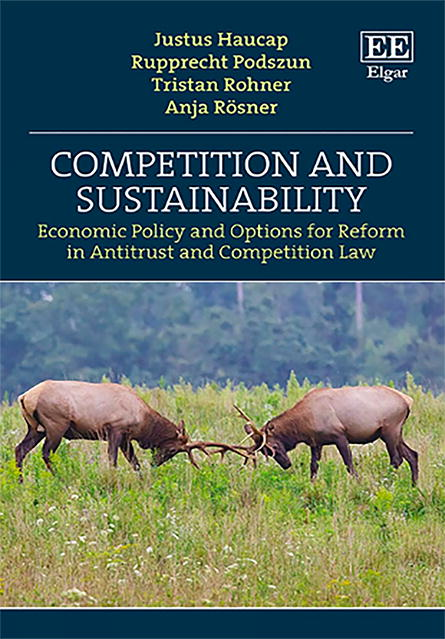
Competition and Sustainability: Economic Policy and Options for Reform in Antitrust and Competition Law is a highly relevant and important work in the context of today’s global challenges, where sustainability issues increasingly dominate discussions in various sectors, including economics and law. Written by a group of leading academics from Heinrich Heine University Düsseldorf, the book presents an in-depth analysis of the relationship between competition law and sustainability goals and how they can support each other in creating a more sustainable economy. The authors underline that free markets are often perceived as the cause of environmental problems, such as climate change, and therefore, there is an urgent need to integrate sustainability considerations into the legal framework governing competition. The authors also argue that despite skeptical views on the ability of markets to address sustainability issues, there is great potential to utilize competition principles as a tool to achieve sustainability goals. As such, this book serves not only as a critique of the existing system but also as a guide for necessary reforms in competition law.
The authors are a group of leading academics, known for their expertise in law, economics, and public policy. Justus Haucap, Rupprecht Podszun, Tristan Rohner, and Anja Rösner are familiar names in discussions on the interaction between competition law and sustainability issues. Justus Haucap, as one of the lead authors, has a strong background in economics and competition law, as well as extensive experience in research and teaching. Rupprecht Podszun, also a lead author, is known for his innovative approach in analyzing competition law in Europe. Tristan Rohner and Anja Rösner, as younger authors, bring fresh and relevant perspectives to the discussion. They have been involved in research focusing on the social and environmental impacts of economic policies, as well as how law can serve as a tool to foster positive change.
Competition and Sustainability is comprised of three parts, each with additional chapters that provide insights into the themes comprising the partitions of the book: Basics: the relationship between competition and sustainability; Policy options for a better integration of sustainability: status quo and possible developments in competition law; and Overarching issues.
Part 1, Basics: the relationship between competition and sustainability, provides an in-depth introduction to the interaction between two concepts that are often perceived as contradictory: competition and sustainability. In this section, the authors endeavor to explain how these two elements can complement each other and contribute to the achievement of broader economic goals. The discussion begins by defining sustainability in a broader context, referring to the Sustainable Development Goals set by the United Nations. This provides a clear framework for understanding sustainability not only as an environmental issue but also as an integral social and economic aspect. With this approach, the discussion emphasizes that sustainability should be part of business strategy and public policy, not just an add-on or secondary consideration. Next, the discussion outlines how competition can serve as a driver of innovation and efficiency, which, in turn, can support sustainability goals. In a competitive market, companies are encouraged to innovate and adopt more sustainable practices to meet the demands of consumers who are increasingly aware of environmental issues. However, the authors do not ignore the challenges. The authors recognize that in some cases, competition can lead to adverse outcomes for sustainability. For example, in an effort to minimize costs and increase profits, companies may neglect their social and environmental responsibilities. This points to the need for appropriate regulation to ensure that markets function in a way that supports sustainability rather than the other way around.
In Part 2, Policy options for a better integration of sustainability: status quo and possible developments in competition law, the authors present an in-depth analysis of how competition law currently interacts with sustainability objectives and explores possible reforms to improve such integration. The authors begin by describing the status quo of competition law in Europe and Germany, highlighting how sustainability is often overlooked in the application of competition law. The discussion also points out that despite increasing recognition of the importance of sustainability, many legal practices still focus on economic efficiency alone, without considering social and environmental impacts. This creates a gap between sustainability goals and existing legal practices, which can hinder efforts to achieve those goals. Furthermore, the authors identify various policy options that can be used to improve the integration of sustainability in competition law. One proposed approach is the development of clearer criteria to assess the sustainability impact of business practices. The authors argue that by setting higher standards for sustainability, regulators can encourage companies to adopt more socially and environmentally responsible practices. This includes the introduction of sustainability indicators that can be measured and applied in the assessment of mergers, acquisitions, and business agreements. However, the authors also recognize the challenges faced in implementing such reforms. The authors note that there is a risk of greenwashing, where companies may claim that they are committed to sustainability without taking meaningful steps. Therefore, the authors emphasize the need for strong oversight mechanisms to ensure that companies’ sustainability claims can be accounted for and verified.
Part 3, Overarching issues, presents an in-depth analysis of the broader challenges and considerations that arise when integrating sustainability into the competition law framework. In this section, the authors not only address technical issues relating to competition law but also raise more fundamental philosophical and ethical questions about how society should define and pursue sustainability in an economic context. One of the main issues raised is the potential conflict between sustainability goals and the fundamental principles of competition law. The authors observe that traditional competition law often focuses on economic efficiency and consumer protection, which can conflict with efforts to achieve broader sustainability goals. For example, in some cases, business practices deemed anticompetitive may be necessary to achieve better sustainability outcomes, such as collaboration between companies to reduce carbon emissions. The discussion emphasizes the need to rethink how competition law can adapt to accommodate sustainability goals without compromising the basic principles of fair competition. In addition, the authors again raise the issue of greenwashing, where companies may seek to capitalize on sustainability trends without making meaningful changes in their practices. This creates challenges for regulators in assessing sustainability claims and ensuring that companies are not simply undertaking cosmetic measures to improve their image. In discussing these issues, the authors also highlight the importance of education and awareness among stakeholders, including regulators, companies, and the general public. By increasing understanding of the relationship between competition law and sustainability, it is hoped that there will be greater support for necessary reforms and more effective policy implementation.
One of the main strengths of Competition and Sustainability lies in its interdisciplinary approach combining economic, legal, and public policy perspectives. The book manages to present a holistic picture of the challenges faced in integrating sustainability goals into the competition law framework. Another strength of the book is its ability to identify and analyze various reform options that can be undertaken in competition law to support sustainability.
Competition and Sustainability is intended for a wide range of readers who have an interest in issues of law, economics, and public policy, particularly those relating to sustainability. The main target audience includes academics and students in the fields of law, economics, and environmental studies, who want to understand more about the interaction between competition law and sustainability goals. In addition, the book is also relevant to legal practitioners, lawyers, and consultants working in the fields of antitrust and competition policy, who seek guidance on how the law can be adapted to support sustainability initiatives.