




Abstract
In this work, we evaluated the expansion of human hematopoietic stem cells from umbilical cord blood in roller bottles. The Iscove's modified Dulbecco's medium, the Stem Pro 34-SFM medium, and the L-15 Leibovitz's medium for cultures in CO2-free atmosphere were assessed. At day 5 of culture, total colony forming unit expansions of 14.44 ± 3.74, 11.20 ± 6.37, and 17.25 ± 3.65-folds were attained, respectively. The expansion reached using L-15 medium in roller bottles was around 10 times higher than that achieved in the static control cultures. To our knowledge, this is the first report of cultures in CO2-free atmosphere to expand cord blood human hematopoietic stem cells and it opens a new branch of possibilities for culturing and clinical applications.
Introduction
H
A wide range of possible therapeutic applications for HHSCs is being studied; therefore, strategies to exploit the UCB potential, such as in vitro expansion, are increasingly needed. In vitro expansion of HHSCs has been proven viable and safe, because expanded cells can be transplanted to patients without risk [5,6]. Therefore, several studies have been focused on the culture and expansion of HHSCs. The proposed strategies include from 2-dimensional and 3-dimensional static cultures to different types of bioreactors, including airlift, perfusion chambers, stirred tanks, spinner flasks, and rotating wall vessels, with promising results [7 –9]. Unlike most animal cell cultures where cell products are harvested and cells are disposable, the major interest of HHSC culture are the cells themselves. HHSCs require adequate oxygen and nutrient flow, which may be achieved with agitated bioreactors, but as they grow in suspension they are sensitive to shear stress and the mechanisms used to sparge oxygen can cause cell damage. A lower agitation rate could minimize shear stress [10]. Roller bottles (RBs) are a simple tool for culturing adherent and suspended cells, because they can be operated without specialized training, are easily scalable for clinical purposes, and involve very low capital investment [11]. RBs have been used for a long time to culture animal cells [12] and are now being used to culture various types of cells, including hybridoma [11]. RBs provide a good choice to culture suspension cells that are sensitive to shear stress because they can be operated at very low agitation rates.
In this work, we evaluated the utility of RBs to expand HHSCs from UCB, comparing the nonstatic and static cultures in different culture media with recombinant cytokines.
Materials and Methods
UCB collection and processing
UCB samples from full-term deliveries were kindly provided by local hospitals, according to their ethic committee's guidelines. The UCB-mononuclear cells (MNC) separation procedure has been described elsewhere [13]. Briefly, 40–80 mL blood samples were centrifuged for 30 min at 850 g, and then 5–7 mL of white interphase cells and plasma were transferred into a 15-mL falcon tube and diluted 1:2 with phosphate-buffered saline (pH 7.2). Cells were transferred to 15-mL Falcon tubes containing 7 mL of Ficoll-Paque Plus (Pharmacia) at room temperature and centrifuged for 30 min at 1,250 g. MNC ring was aspirated and transferred to a clean tube, washed twice with phosphate-buffered saline, and resuspended in 1 mL of Iscove's modified Dulbecco's medium (IMDM).
Culture media
Three culture media were tested: IMDM (Gibco), Leibovitz's L-15 (L-15; Gibco), and Stem-Pro® 34-SFM (Stem Pro/Gibco). IMDM and L-15 were supplemented with 10% fetal bovine serum (Gibco). The media were supplemented with human recombinant cytokines (Peprotech): 2 ng/mL interleukin-3 (IL-3), 5 ng/mL IL-6, 5 ng/mL stem cell factor (SCF), 5 ng/mL granulocyte colony stimulating factor (G-CSF), 5 ng/mL granulocyte–macrophage colony stimulating factor (GM-CSF), 5 ng/mL flt3 ligand (Flt-3), and 3 U/mL erythropoietin.
RB cell culture
RB batch cultures were started with 0.5 × 10⁶ MNC/mL in 500-mL glass RBs (Wheaton) containing up to 25 mL of culture medium. Cultures were maintained for 14 days at 37°C in an incubator (Shel Lab) at 5% CO2 atmosphere for the IMDM and Stem Prom cultures, whereas experiments in L-15 medium were maintained in a CO2-free incubator (Shel Lab). RBs were set in a bottle bench top roller (Wheaton) at 1 rpm. Twenty-four-well plates with 1 mL of the respective culture medium were used as control. The RB caps were tightly closed for the L-15 cultures, whereas they remained slightly open for the cultures requiring CO2. Sampling was performed by taking out the RBs from the incubator, removing the caps, and washing out the RB walls with the same culture media to recover attached cells. Samples of 0.3 mL were taken for the colony-forming cell assay and MNC counting. The medium was not added, removed, or altered in any way during these cultures.
Fed-batch cultures were performed in IMDM as described above. The cultures were started in batch mode and then 25 mL of fresh medium was added at day 3 or 7. Therefore, the final volume was twice of the initial volume of the cultures.
Colony-forming cell assay and mononuclear cell counting
Number of colony-forming cell (CFC) was determined from methylcellulose-based semisolid cultures (Metho Culture; StemCell Technologies) containing (per milliliter) 50 ng stem cell factor, 10 ng IL-3, 10 ng granulocyte-macrophage CSF, and 3U erythropoietin. Plates were inoculated with 10,000–40,000 cells/mL and incubated for 14 days at 37°C and 5% CO2. Hematopoietic colonies were classified as described previously [14]. MNC concentration and viability were determined by cell counting with the Trypan Blue exclusion method using a hemacytometer.
Data processing
Error bars in all graphs represent the standard error of the mean.
Results
Total cell expansion
The total cell growth kinetics for the cultures of HHSCs under static and dynamic conditions is illustrated in Fig. 1. Panel A shows a typical static culture using IMDM. For this sample, the maximum cell concentration was 1.22 × 10⁶ cells/mL at day 13 and 0.063 × 10⁶ cells/mL at day 10 for the static and RB cultures, respectively. Fig. 1B shows the cell growth of 1 representative sample cultured in Stem Pro. After the initial death phase of 5 days, the maximum cell concentration was reached at day 10 of culture, with 1.07 × 10⁶ and 2.83 × 10⁶ cells/mL for the static and RB cultures, respectively. The cultures in Stem Pro reached higher total cell numbers, which can be confirmed by comparing panel B to panel A, which is the same sample cultured in IMDM. Figure 1C shows the total cell growth of a culture in L-15. Nearly all controls showed a death phase of only 3 days, but most RB cultures pass through this phase by starting the total cell growth from the beginning of the experiment. In this case, the maximum cell concentration, achieved at day 10 of culture, was 1.23 × 10⁶ and 1.21 × 10⁶ cells/mL for the static and RB cultures, respectively.
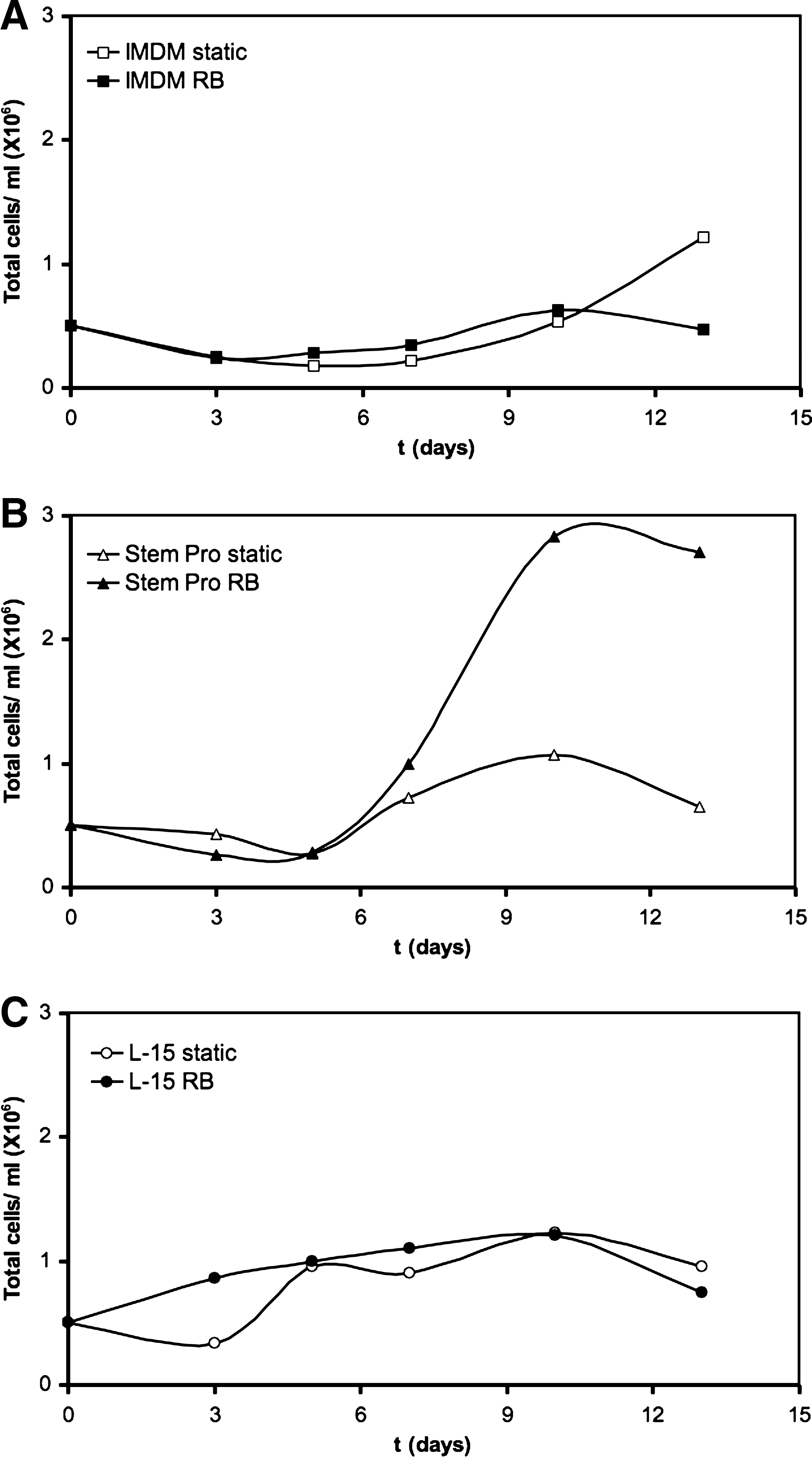
Typical growth kinetics of human hematopoietic cells from umbilical cord blood in static and RB cultures.
Fig. 2 illustrates the total cell fold expansion in our cultures. Panel A shows the IMDM cultures. Some cultures showed a death phase of 5 days; subsequently, most control cultures showed continuous growth reaching a maximum cell concentration between days 5 and 13 ranging from 2.44- to 5.30-folds, with a mean of 3.30 ± 0.97-folds at day 13 of culture. However, in the RB cultures, each sample showed a unique behavior, indicating even a decrease on total cells during the experiment ranging from 0.47- to 5.40-fold expansion on different days of culture, with a mean of 1.85 ± 0.51-folds at day 13 of culture. Both static and RB cultures showed the same tendency: at days 3, 5, and 7 the growth was increasing equivalently in both systems, and by days 10 and 13 we observed the same trend of increasing total cell numbers but in the static controls at a major extent.

Maximum total cell expansion in static and RB cultures.
Fig. 2B shows the total cell fold expansion in the Stem Pro cultures. The maximum expansion ranged from 0.5- to 2.14-folds in the controls and from 0.35 to 5.66 in RBs on different days for each sample. For this medium, the growth was comparable for both systems from days 0 to 7, with a slightly higher growth for the static cultures. At days 10 and 13 we observed a huge variability in the total cell numbers. The mean maximum fold expansion, achieved at day 13 of culture, was 1.18 ± 0.23 and 1.17 ± 1.06 for the static and RB cultures, respectively.
Total cell fold expansion achieved in L-15 cultures is shown in Fig. 2C. The maximum expansion attained ranged from 0.67- to 3.3-folds and 0.75- to 2.50-folds for the static and RB cultures, respectively, on different days depending on the samples. The growth in both static and RB cultures provided comparable results of total cells for the same samples. For this medium, we observed the maximum growth between days 7 and 10 of culture, but the total increase in cells was lower than for the other 2 media. The maximum fold expansion in L-15 cultures was 1.35 ± 0.49 and 1.31 ± 0.39 for the static and RB cultures, respectively. Comparing panels A and C, the control IMDM cultures showed a higher average total cell expansion than the L-15 controls at days 10 and 13, but for days 3–7, both systems showed approximately the same fold expansion in IMDM and L-15 media. The Stem Pro cultures had a lower total cell expansion from day 3 to 13 in both static and RB systems compared with the IMDM cultures.
Expansion of total hematopoietic progenitors
The progenitor expansion achieved in static and RB cultures in IMDM is shown in Fig. 3A. For RB cultures, we found a mean CFC fold expansion of 14.44 ± 3.74, 16.87 ± 5.30, and 9.16 ± 4.15 at days 5, 10, and 13, respectively, whereas the static controls achieved 10.10 ± 2.58, 14.02 ± 3.21, and 10.96 ± 4.10, respectively, at the same days. Progenitor expansion was observed in this work as early as day 3 of culture (data not shown) despite the fact that the cultures showed a total cell decrease. Confirming these, at day 5, even when the total cell number was still lower than the initial, the progenitors in RB cultures were already expanded.

Total progenitor expansion in static and RB cultures.
The mean CFC fold expansion for the samples cultured in Stem Pro is shown in Fig. 3B; in these cultures, we achieved an 11.20 ± 6.37 CFC fold expansion on day 5 in RB cultures, whereas for the static control the expansion was 7.74 ± 1.67. However, for days 10 and 13, the progenitor expansion achieved in RB was almost a half of the static controls. Fig. 3C shows the total progenitor fold expansion attained in L-15 cultures of different samples. On day 5, the mean total progenitor fold expansion in RB was 17.25 ± 3.65, on day 10 it was 17.35 ± 8.81, and on day 13 it remained the same with an 18.39 ± 9.49-fold expansion.
Fed-batch cultures using RBs
We also performed 15 days of fed-batch cultures in IMDM, providing the cultures with fresh media and cytokines to support a longer expansion. Fig. 4 shows the mean progenitor fold expansion achieved in 2 fed-batch cultures of the same sample. Feeding the culture on day 3 resulted in a progenitor fold expansion increase from 17.84 to 27.47 on day 5 and from 0.28 to 19.99 on day 13, but on day 10 it decreased from 24.43 to 18.17. Feeding the culture on day 7 did not increase total progenitor expansion in any of the days tested. The static control cultures showed the same behavior than the RB cultures (data not shown).

Progenitor expansion in fed-batch culture of mononuclear stem cells.
Discussion
RB cultures in all media tested allowed a 15–20 total progenitor fold expansion on day 5 of culture. Progenitor expansion may be affected by the individual variation because samples were not related at all. IMDM is an improved synthetic medium created for rapidly multiplying cell cultures. This medium, supplemented with different amounts of FBS and cytokines, has been widely used for the culture and expansion of HHSCs [7,10,13,14], showing good results for CFC expansion in most experiments. We used IMDM for our RB system, obtaining expansion results comparable to other cell culture strategies (Table 1). Our RBs mimic the expansion found in the controls, but they have the advantage of being able to support larger volumes.
RB, roller bottle; IMDM, Iscove's modified Dulbecco's medium.
We also tested 2 other media: Stem Pro and L-15. Stem Pro is a serum-free medium created to support the growth of CD34+ hematopoietic cells and total cells in static cultures of BM CD34+ hematopoietic cells [15]. The use of Stem Pro may reduce the risk of immune reactions and infection due to serum [16]. However, Stem Pro-RB cultures showed reduced total cell growth and progenitor expansion in most of our experiments. L-15 medium is buffered by phosphates and free-base amino acids instead of the sodium bicarbonate system used by IMDM. It can be used in nonsealed containers as our RB. We found that IMDM and L-15 cultures reached similar progenitor expansion on day 5, but L-15 permitted the longest total CFC expansion, remaining for around 17 times, for all the days tested; therefore, it allows a higher and longer CFC expansion than IMDM.
The initial decrease in the MNC observed during the first 5 days could be explain by the death of remaining mature cells in the inocula. Mammalian cells are affected by shear stress, because generally high agitation rates cause a decrease in concentration and cell viability [17 –19], and therefore, a lower agitation rate could minimize shear stress. Interestingly, it has been reported that a shear stress of 5 dyn/cm2 increased the hematopoietic colony-forming potential of embryonic stem cells [20]. Thus, changing to low shear stress conditions could be useful for the HHSCs during RB cultures.
Commercial spinner flask bioreactors are available to expand HHSCs; for example, the Dideco Pluricell system with a limit volume of 38 mL achieved a maximum mean expansion of 230-fold in MNC and 21-fold in CD34+ cells [21]. A lower agitation rate could minimize shear stress. For instance, rotating wall vessel bioreactors have been used up to 6 rpm to culture HHSCs, achieving 21.7 ± 4.9-fold progenitor expansion [22]. It is important to develop new methodologies to culture HHSCs, which are easy to perform, are safe, and do not promote progenitor cell differentiation. This is the first report on expansion of HHSC-UCB in RBs. We showed that RBs are suitable for the expansion of hematopoietic progenitors because they had a slightly higher total cell expansion than the static cultures and they allowed progenitor expansion to a greater extent. We used 1 mL control cultures because it has been demonstrated that T-flasks with larger volumes do not show significant cell expansion [22]. We attained total cell expansions comparable to those reported using Spinner flask or stirred bioreactors [13,23,24], but below the cell expansion attained in Pluricel system or other RB-like devices [10,21]. RBs can be an alternative to the use of culture bags, where up to 31-fold CFC expansion has been attained, but the reduced volume and the nutrient rechange and oxygen made difficult the scaling up [25].
In this work, we demonstrated that RB short-term UCB-MNC cultures allow progenitor expansion up to 18.39 times in L-15 medium. RBs are suitable to culture MNC from human UCB in all media tested in this work (L-15, Stem Pro, and IMDM). We demonstrated that L-15 medium is a good choice to culture HHSCs and it does not require CO2 control. RBs without CO2 atmosphere are simple to operate, have low requirements of cytokines, and favor HHSC expansion. The L-15 RB cultures would be easily scalable, and therefore, they could have a great potential for clinical applications. Nevertheless, expanded progenitors must be evaluated for safety, engraftment, and utility in transplants.
Footnotes
Acknowledgments
The authors thank Leandro G. Ordoñez for the technical support and Sydney Robertson (Peace Corps USA) for English correction. This work was partially supported by a CONACYT-Fondos Sectoriales Sector Salud Grant (13993) and Ph.D. scholarship (103403).
Author Disclosure Statement
No competing financial interests exist.