




Abstract

E
The hA-MSCs-miRNome was analyzed by small RNA deep sequencing (Small RNA-Seq) (Supplementary Data; Supplementary Data are available online at
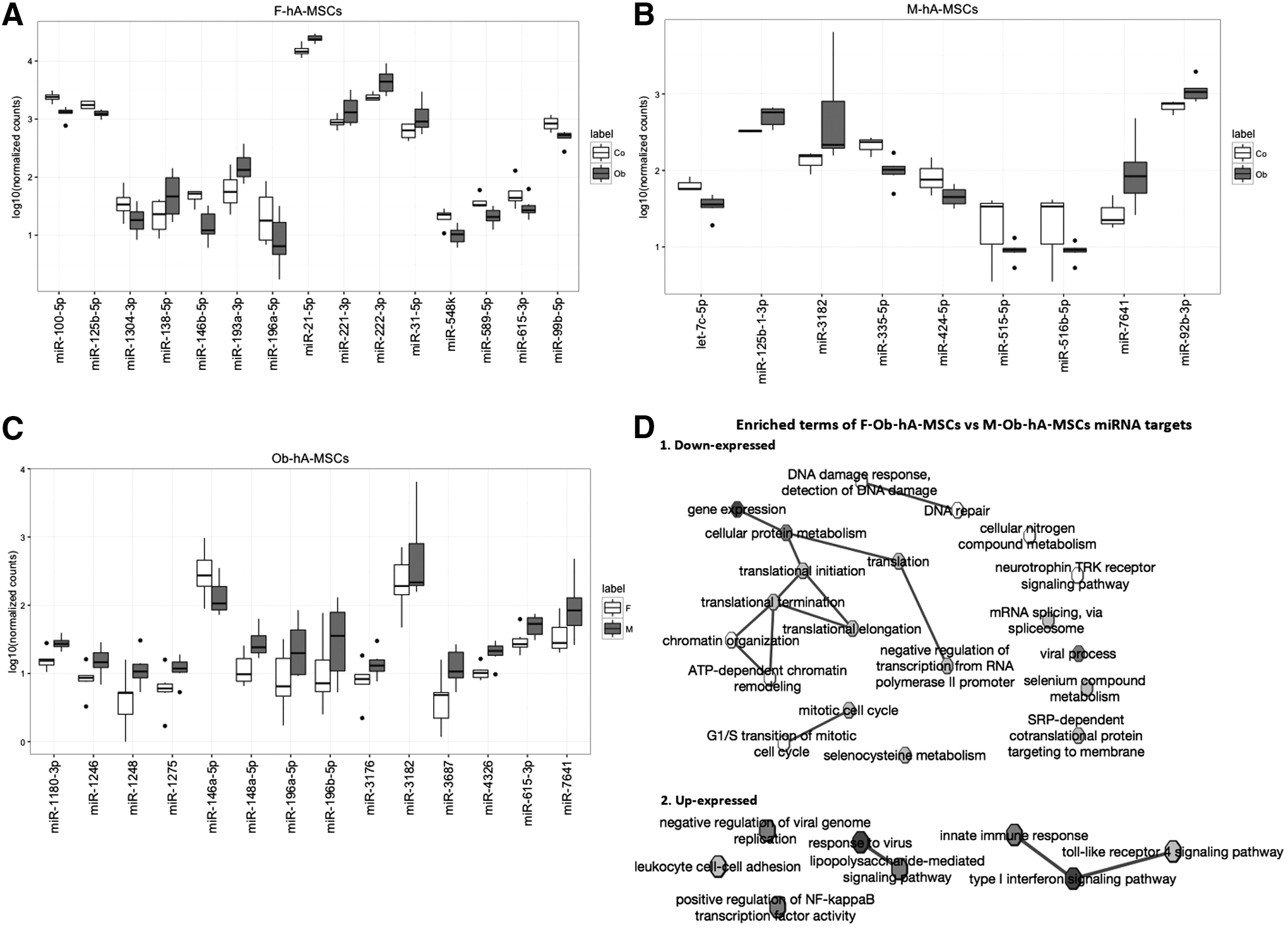
Gender-related comparison of the miRNomes of hA-MSCs isolated from normal weight and obese women who gave birth to males or females. miRNA expression was obtained by small RNA deep sequencing (Supplementary Data). Differentially expressed (DE) miRNAs both from edgeR and Fisher's test were selected. The distribution of DE miRNA levels in all the samples is indicated as log10 of normalized read counts. The boxes represent the median (black middle line) limited by the 25th (Q1) and 75th (Q3) percentiles. The whiskers are the upper and lower adjacent values, which are the most extreme values within Q3 + 1.5 (Q3−Q1) and Q1-1.5 (Q3−Q1), respectively. The black dots represent outliers.
Analysis of the gene targets of the gender-deregulated miRNAs predicted miR-146-mediated alterations in inflammatory and immune responses. Down-expressed miRNAs may impair three major metabolic clusters: (i) transcriptional and post-transcriptional RNA machinery, together with chromatin remodeling and protein metabolisms, (ii) mitotic phase of cell cycle, and (iii) response to DNA damage (Fig. 1D and Supplementary Table S1).
Thus, in healthy pregnancy, the miRNome of hA-MSCs is not affected by the gender of the offspring, except for the androgen-regulated miR-125b-5p that is up-expressed in F-Co- versus M-Co-hA-MSCs. In contrast, we observed that in hA-MSCs from obese women, altered miRNA expression was more frequent when the offspring was female as opposed to male (15 vs. 9 deregulated miRNAs, respectively). Notably, some deregulated miRNAs are under direct estrogen control (miR-21-5p/miR-92b-3p/miR-31-5p) or located on chromosome X (miR-221-3p/miR-222-3p). In a previous study, we found that several proteins from predicted impaired pathways were targeted by gender-specific miRNAs and were deregulated in the proteome of Ob- versus Co-hA-MSCs [4] (Supplementary Table S2).
In conclusion, although the postpartum implications of the gender-related miRNA differences identified in Ob-hA-MSCs are far from being completely elucidated, we provide the first evidence that the obesogenic environment can affect fetal hA-MSC epigenetics in a gender-specific manner, which also implies that caution be exerted in interpreting miRNA expression data when gender is not reported.
Footnotes
Acknowledgments
The authors thank Jean Ann Gilder (Scientific Communication srl, Naples, Italy) for editing the text and Vittorio Lucignano, CEINGE–Biotecnologie Avanzate, for technical assistance related to graphics. This work was supported by Grant POR CAMPANIA FSER 2007–2013 Project DIAINTECH and Grant CAMPUS-Bioframe from Regione Campania, Italy and Grant PON02_00677 (BIOGENE) Pot. lab.8 A/B −2012 from the Italian Ministry of University and Research. Centro di Ricerca per lo studio di malattie genetiche dell'uomo e loro modelli cellulari e animali–Progetto: Terapia genica delle malattie metaboliche.
Author Disclosure Statement
No competing financial interests exist.
References
Supplementary Material
Please find the following supplemental material available below.
For Open Access articles published under a Creative Commons License, all supplemental material carries the same license as the article it is associated with.
For non-Open Access articles published, all supplemental material carries a non-exclusive license, and permission requests for re-use of supplemental material or any part of supplemental material shall be sent directly to the copyright owner as specified in the copyright notice associated with the article.
