




Abstract
Inflammatory bowel disease (IBD) is characterized by periods of flare-ups and remission. It is likely to be an autoimmune in origin, presenting persistent therapeutic challenges despite current therapies. This study aims to investigate the potential of umbilical cord mesenchymal stromal cells (UCMSCs) in treating ulcerative colitis (UC). This study is a prospective phase 1 pilot, open-label, single-arm, and single-center study. UCMSCs were cultured under current Good Manufacturing Practice (cGMP) conditions and intravenously administered to six patients with UC. Safety and efficacy were evaluated using the Mayo Score/Disease Activity Index. Among the six enrolled adult patients, five completed long-term follow-ups. All exhibited at diagnosis active UC confirmed through comprehensive assessment methods. Each patient received three injections intravenously 2 weeks apart with a dose of 100 million UCMSC each. No significant short-term or intermediate-term adverse events were detected post-UCMSC administration. Long-term follow-up at 12 and 24 months showed sustained safety and no adverse events. Notably, three out of five patients achieved a Mayo score of 0 for UC, maintained at both 12 and 24 months, indicating a highly significant response (P < 0.001). This study demonstrates the safety and potential efficacy of UCMSCs in active UC. However, larger trials are warranted to validate these preliminary findings and to establish the role of UCMSC therapy as an option for managing UC.
Introduction
Ulcerative colitis (UC) is a chronic inflammatory bowel disease (IBD) affecting millions worldwide. It is particularly prevalent at various ages in Jordan, with the highest prevalence in the third decade of life. 1 Characterized by recurring episodes of inflammation and ulceration in the mucosal lining of the colon and rectum, UC places a significant burden on patients’ quality of life and health care. Stability in patients with UC is frequently maintained by conventional medications including biologics, corticosteroids, aminosalicylates, and immunomodulators. These treatments might not work for everyone, though, and they come with a host of negative side effects. 23 Consequently, there is an urgent need for innovative and more effective strategies for the treatment of UC.
Although the precise pathophysiology of UC is unknown, it is thought to be a multifactorial condition. UC is caused by immunological dysregulation in the colon’s mucosal lining, which manifests as an imbalance between regulatory and effector T cells. 2 In patients with UC, the immune system is dominated by a T-helper 2 response, which is characterized by increased humoral immunity, immunoglobulin levels, and autoantibodies. These immunological factors contribute to the chronic inflammation and epithelial damage that characterize UC. UC is also linked to an inflammatory cascade triggered by leukocyte recruitment, infection, and genetic changes. The influx of leukocytes, particularly neutrophils, into the mucosal layer of the colon causes significant epithelial damage and the creation of crypt abscesses. Inflammatory mediators, such as interleukin-5 (IL-5) and tumor necrosis factor-alpha (TNF-α), play an important role in aggravating inflammation. In addition, genetic, and environmental factors play a role in the pathogenesis of UC through the disruption of the epithelial barrier and the promotion of inflammation. 3
Mesenchymal stromal cells (MSCs) emerged as a potential therapy in the treatment of UC, introducing a paradigm shift in IBD management. MSCs are multipotent adult stem cells present in various tissues such as bone marrow, adipose tissue, and the umbilical cord. 4 Due to their ability to differentiate into many cell types, and their excellent immunomodulatory and anti-inflammatory properties, MSCs are potentially useful agents for many different disorders, including autoimmune disorders, inflammatory diseases, and tissue injuries.
The human allogeneic adipose-derived mesenchymal stem cell therapy, Alofisel (Darvadstrocel), has been approved for commercial use in treating complex perianal fistulas in patients with Crohn’s disease. 5 Nevertheless, based on previous research conducted by colleagues in our group, we opted for umbilical cord-derived MSCs (UCMSCs) due to their demonstrated superior immunomodulatory properties. 6
Numerous ongoing clinical trials are exploring the application of MSCs in regenerative medicine and cell therapy, with a focus on IBD, including UC. 7 In addition, encouraging results from case reports, systematic reviews, and meta-analyses suggest the potential of MSC-based therapies for managing UC. 8 Nonetheless, the safety and effectiveness of MSC use in treating UC remains a topic of debate.
The aim of our study is to further contribute to the ongoing discussion regarding the safety and efficacy of novel therapeutic interventions for UC by investigating the outcomes of three intravenous injections of allogeneic expanded UCMSC in a case series of patients with UC. By exploring the potential of MSC-based therapies, we intend to advance our understanding of the safety and efficacy of these interventions and offer a promising alternative to address the needs of patients with UC.
Materials and Methods
Study design and approval
This is a prospective phase 1 pilot, open-label, single-arm, and single-center study. This study was approved by the institutional review board at the Cell Therapy Center, University of Jordan. The participants signed a written informed consent as per the declaration of Helsinki. The trial was prospectively registered on ClinicalTrials.gov (NCT03299413).
Inclusion and exclusion criteria
As this is a proof-of-concept pilot study, patients with a previous diagnosis of UC based on endoscopic and medical history features, with moderate to severe colitis based on partial Mayo score, 28 were included. The inclusion and exclusion criteria are described in Table 1.
Inclusion and Exclusion Criteria for Patient Selection
IV, intravenous; UC, ulcerative colitis.
Cell isolation, culture, and expansion
Umbilical cords were collected from uncomplicated cesarean deliveries from healthy pregnant females with a negative history of inherited diseases or cancer in first degree family members and a negative past history of transmissible diseases. The samples were processed and expanded within 24 h as previously described by our group. 9–10 Briefly, the cord was processed under cGMP-compliant conditions to obtain small pieces and cultured as explants in Minimum Essential Medium Eagle–Alpha Modification (Gibco) supplemented with 5% platelet lysate, 1% penicillin–streptomycin (Gibco), 3U heparin (Innohep; LEO Pharma), and 4 mML glutamine and incubated in a humidified atmosphere containing 5% CO2 at 37°C. Subconfluent cells were subcultured and expanded to prepare cell banks. For the preparation of master and working cell banks, first- and third-passage cells were cryopreserved, respectively. Cells at passage 4 were used for the injections.
MSCs characterization and release
Cells were subjected to quality control tests adhering to European Commission Guidelines on Good Clinical Practice specific to Advanced Therapy Medicinal Products before release. This included MSC phenotypical characterization for MSC markers by flow cytometry (BD FACSCanto II; BD Biosciences) using BD Stemflow hMSC Analysis Kit, viability testing using trypan blue exclusion dye on the Countess automated cell counter system (Thermo), mycoplasma using nucleic acid testing (MycoSEQ™ Mycoplasma Detection Kit, Thermo) by real-time PCR, endotoxin using LAL method (Endosafe, Charles River), bacterial contamination using growth method BactecAlert, Biomeuriex), and manual karyotyping. All methods and set criteria were described previously by our group and are summarized in Table 2. In addition, MSCs were tested for multilineage differentiation potential. For osteogenic and adipogenic differentiation, cells were cultured in Stempro Osteogenesis differentiation media and Stempro Adipogenesis differentiation media, respectively, as per the manufacturer’s recommendation. Following osteogenic induction, cultures were stained using Alazarin Red (Sigma-Aldrich), and following adipogenic differentiation, cultures were stained using Oil Red O (Sigma-Aldrich), to assess extracellular deposits.
Quality Control Tests Performed as Part of Release and Acceptance for UCMSCs
Performed as part of the conditional release procedure.
UCMSCs, umbilical cord mesenchymal stromal cells; NAT, Nucleic acid testing.
Clinical procedures, assessment, and follow-up
The clinical procedures timeline is charted in Figure 1. A baseline colonoscopy was done the day before the first injection, and a follow-up colonoscopy was done 3 months after the third injection at Jordan University Hospital. Full Mayo scores (including stool frequency, rectal bleeding, mucosal appearance at endoscopy, and physician rating of the disease) were determined at baseline and the 3-month follow-up mark. Partial Mayo scores (excluding endoscopic assessment) were determined at the 1-month, 2-month, and 1-year follow-up marks. The Mayo sub-scores for stool frequency and rectal bleeding were calculated based on entries from patient diaries using the worst diary entry from the 3 days before each study visit for each sub-score. The final evaluation before the first infusion of UCMSC was used as a baseline for all analyses. The patients were allowed to continue their standard treatment at the discretion of the gastroenterologist. On subsequent follow up they were asked about the use of these medications (Supplementary Table S1). The treatment interventional protocol was three doses of intravenous allogeneic UCMSCs infusion administered 14 days apart.
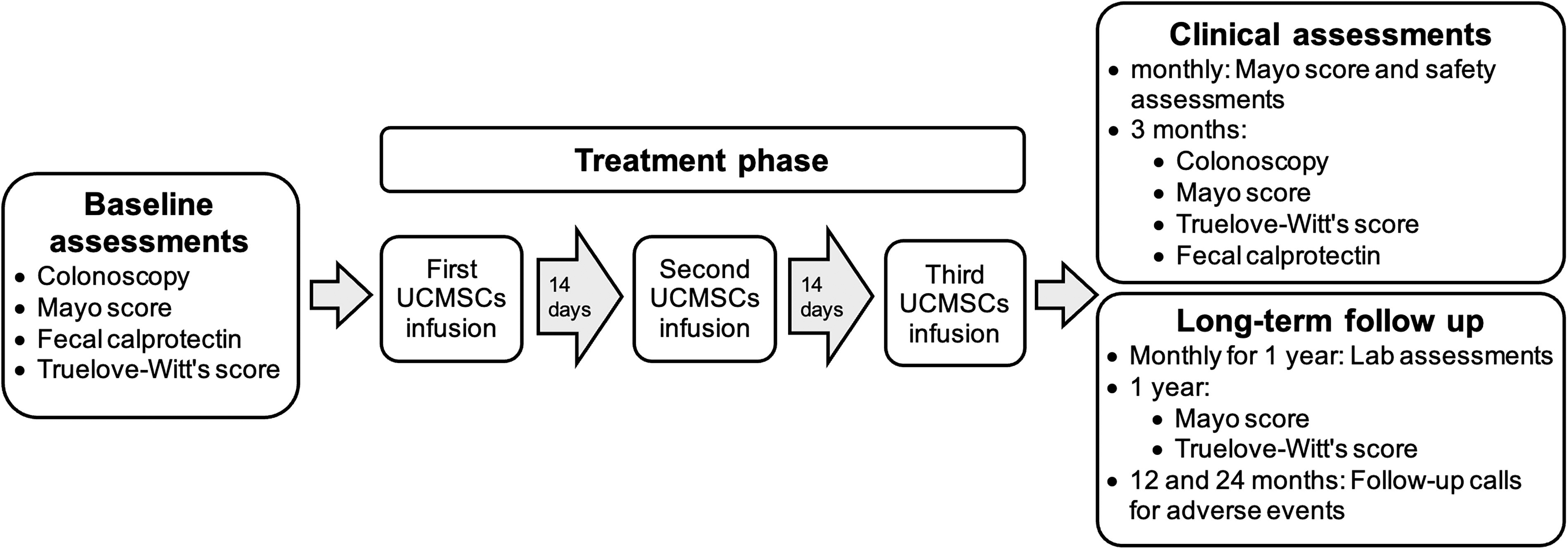
Graphical representation of clinical procedures and follow-up.
As follow-up, safety was assessed by observing the site of intravenous injection for (bleeding, bruising, pain, swelling, hypo and hyperthermia, erythema, and urticarial, priapism), by measuring the vital signs (body temperature, heart rate, respiratory rate, and blood pressure) and by interviewing patients for adverse events monthly for nervous system symptoms (headache, dizziness, and loss of consciousness), cardiovascular symptoms (chest pain, palpitation, shortness of breath, fainting, swelling in the legs, weakness, and fatigue), respiratory symptoms (cough, nasal discharge, and fever), gastrointestinal symptoms (abdominal pain, nausea, vomiting, bloating, and diarrhea), and urinary tract symptoms (hematuria, frequency, urgency, poor flow, and burning sensation on micturition). Patients were also encouraged to report any finding immediately to their treating physician or the principal investigator in this trial. Laboratory assessments of C-reactive protein, erythrocyte sedimentation rate, complete blood counts, liver enzymes, total protein, albumin, total cholesterol, serum urea nitrogen, creatinine, electrolytes, and urine analysis were performed in The Cell Therapy Center diagnostic labs every month for 1 year. Clinical response was defined as a decrease from baseline in the total Mayo score of ≥3 points with an accompanying decrease in the sub-score for rectal bleeding of at least 1 point or an absolute sub-score for rectal bleeding of 0 or 1. Clinical remission was defined as a total Mayo score of ≤2 points, with no individual sub-score exceeding 1 point.
Results
Patients and injection protocol
The participants enrolled in a clinical trial at the Cell Therapy Center/University of Jordan following an assessment for inclusion and exclusion criteria by two gastroenterologists. All patients had moderate to severe disease based on partial Mayo score with stool frequency sub-score of 2 or more, and rectal bleeding sub-score of 2. All patients suffered from annoying urgency with anal seepage with significant disease impact on quality of life. The planned number of patients was 20. However, due to multiple logistic issues, and the lockdown associated with the COVID pandemic, only 6 patients were enrolled and only 5 patients were available for long-term follow-up. Patients’ demographic data including age of onset of the disease and duration of the disease at the beginning of therapy are included in Supplementary Table S1. One hundred twenty million allogeneic UCMSC were given as one single intravenous 30-min infusion without premedication. Each subject was given three doses of UCMSC separated by 14 days. Patients continued their medication therapy without interruption and the cellular therapy was added on top of their current treatment.
Primary outcome
The primary outcome measure was safety and tolerability. At the site of intravenous injection, there was no bleeding, bruising, pain, swelling, hypo and hyperthermia, erythema, urticarial, or priapism. On physical examination, there was no increase or decrease in body temperature, blood pressure, heart rate, or respiratory rate from baseline.
None of the six patients reported significant adverse events related to the nervous, cardiovascular, respiratory, and gastrointestinal systems. No significant changes were detected for liver function tests (LFT), kidney function tests (KFT), complete blood count, and urine analysis. On further follow-up calls using a checklist at 12 and 24 months, none of the patients reported any adverse event.
Secondary outcome
The assessment of the response was done by endoscopy and Mayo score system for UC at 3 months, However, follow-up assessment up to 1 year was done by partial Mayo score (excluding endoscopy sub-score). Fecal calprotectin was tested before and after the treatment, and Truelove–Witt’s score was performed at baseline, after treatment and at 1-year follow-up.
Endoscopy was performed and evaluated before and 3 months after the last dose of treatment by an experienced gastroenterologist. Table 3 details the endoscopy results, which show an overall improvement in mucosal inflammation.
Endoscopy Results at Baseline and After 3 Months of the Last Dose
Fecal calprotectin test showed a change from positive to negative in three out of five patients (negative in our lab equals <50 µg/g of stool), indicating a reduction in intestinal inflammation. The Truelove and Witt score showed an overall improvement in the severity of UC. Table 4 shows Calprotectin test and Truelove–Witt’s score.
Fecal Calprotectin and Truelove-Witt’s Score at Baseline and Post-Injection
Calprotectin is considered positive when the value is 50 ug/g.
Partial Mayo score showed significant improvement following treatments, as described in Table 5. Mean partial Mayo score was 6 at baseline and reduced to 1.8 and 0.6 at 3 months and 1 year, respectively (P < 0.01 and P < 0.0001, respectively). Patients continued to report positive feedback up to 1-year follow-up post treatment.
Mayo Endoscopic Score at Baseline and Follow-Ups
Mayo score did not include endoscopy results.
Long-term follow-up was performed by personal interviews and patient reported events. There were no late adverse events reported. We could not perform endoscopic evaluation on patients beyond the 3-month follow-up for the reasons indicated above. Of note, four patients were not using any medications for UC at 1-year follow-up.
Discussion
In this series, we established the efficacy and safety of intravenous UCMSCs as a treatment of symptomatic UC, demonstrated by markedly decreased Mayo scores and improved endoscopy assessment results.
When opting for intravenous infusion as opposed to the more popular approach of direct injury site delivery as a method for administering MSCs therapy, the question of MSCs innate ability for homing becomes an important one. The exact mechanisms and interactions governing the migration and successful integration of MSCs into injured tissues once infused remain unclear. It is hypothesized that the process is influenced by intricate interactions among many signaling pathways that vary according to the origin of MSCs. 11 In animal models when specific cues during tissue inflammation are received, MSCs might travel to damaged regions within the colon, contributing to the healing process. While less cells reach the injury site via intravenous administration rather than site-directed administration, the desired effect and safety profile was found to be comparable in animal studies, and our results further support these findings. 12 –15
The significant positive clinical results reported in our study could be explained by the vast immunomodulatory and anti-inflammatory capacities of MSCs in UC as previously described in the literature. Across both animal models and in vitro cultures, MSCs demonstrated active suppression of pro-inflammatory cytokines such as TNF-α, IL-6, and IL-17 while enhancing the release of anti-inflammatory mediators such as transforming growth factor beta and IL-10. Furthermore, the mesenchymal cells appear to modulate T cell activity by inhibiting T cell proliferation and polarizing them towards a regulatory phenotype. 16,17 Evidence in other diseases of autoimmune origin, such as rheumatoid arthritis, further strengthen this theory by demonstrating that the MSCs’ anti-inflammatory effects are responsible for the subsequent immunosuppression within an inflammatory milieu, specifically by reducing levels of pro-inflammatory cytokines such as IL-1β, IL-12, IL-17, and TNF-α while increasing regulatory T cells expressing CD4+CD25+Foxp3+. 18 These immunological shifts highlight the potential for MSCs not only as immunosuppressive agents but also as immunomodulators that can balance pro-inflammatory and anti-inflammatory pathways which are responsible for the recurrent inflammatory bouts of ulcerative colitis. A recent study by Yang et al. even demonstrated a potential gut microbiome-modifying role of MSCs that could help regulate inflammation in mice with experimental colitis. 19
There are few published clinical trials in the literature that study the safety and efficacy of bone marrow-derived mesenchymal stem cells (BM-MSCs) in treating UC. A meta-analysis by Shi et al. on seven clinical trials provided a broad comparison of BM-MSCs with traditional therapies like 5-ASA and azathioprine reported a generally favorable safety profile for MSCs, corroborating our findings where no significant adverse events were observed in any of the parameters. Specifically, no significant alterations were observed in vital signs such as heart rate, blood pressure, or oxygen saturation. LFT and KFT, including markers such as ALT, AST, and creatinine, remained stable post-therapy. 20 On the efficacy front, Shi et al. found a significant increase in 1-year healing rates (79%) (P < 0.005) with MSC therapy across all four trials lacking a control-arm. Surprisingly, our study observed even more significant improvements in the 12-month total remission rate (100%) (P < 0.001), even with a more stringent focus on UCMSCs specifically. More importantly, our long-term follow-up at 24 months extends the time frame considered by six out of seven trials reported by Shi et al., revealing not just transient improvements but potentially sustained benefits of UCMSC therapy. A recent trial by Lightner et al. used endoscopically delivered BM-MSCs in four patients with medically refractory UC and reported dramatic improvement in both clinical and endoscopic Mayo scores at the 6-week interval, but scores crept back up to near baseline levels at the 3-month point. 21 Our group opted for a systemic administration over a local one for several reasons, mainly due to concern over flaring-up the inflammatory response within the region. In addition, there were reports that local administration of Dravastrocel in peri-anal fistulas resulted in allo-sensitization. 24 Even though lung entrapment of cultured MSCs is a concern, 25 several trials—including our group—in different diseases showed positive immunemodulation and anti-inflammatory responses following systemic administration. We, and others, 26,27 hypothesize that the effect might be due to cell secretomes including exosomes released, which would function regardless of the physical distance of cells from the site of injury. In this trial, the choice of WJ-mesenchymal cells is based on our group’s work on the transcriptome analysis profiling of different cell types, 6 indicating a more potent immune-modulating effect of WJ cells.
We can observe that our findings across both the clinical Mayo score and endoscopic assessment did not show the relapsing trend reported by Lightner et al. at the 3-month point, as the Mayo clinical score revealed a consistent downward trends from the first month onwards, while the endoscopy revealed toning down of inflammation of all five patients at the same interval, which could hint at a more sustainable effect of UCMSCs.
To our knowledge, only one trial in the literature today utilized UCMSCs in combination of 5-ASA instead of BM-MSCs in the treatment of UC assessed clinical outcomes at the same time points and demonstrated a similar safety and efficacy profiles to our findings, but it is important to note that one of the two doses of the UCMSCs Hu et al. administered to his patients was infused into the superior mesenteric artery by interventional catheterization. 22 Our study avoids this invasive procedure and thus provides a cheaper, easier, more tolerable, and potentially safer option to patients with UC without compromising any of the desired efficacy. It is also worthy to highlight that our study is the first to use UCMSCs alone without any adjuvant immunosuppressive medication, decreasing the overall burden of disease and possibly the hazards of long-term immunosuppression.
Although this study presents encouraging results in the use of UCMSCs for treating active UC, several limitations must be acknowledged. First, the small sample size (N = 6, with only 5 available for long-term follow-up) limits the generalizability of the findings. In addition, the open-label, single-arm design without a control group raises concerns about the placebo effect and experimenter bias. Furthermore, the study does not include a direct comparison of UCMSCs with other immunomodulatory agents or standard therapies for UC, making it difficult to establish its relative efficacy. Another limitation is that the study was confined to a single center, potentially leading to patient selection bias. Future multicenter large randomized clinical trials should be conducted to further investigate our results.
Conclusion
While our study was limited by its sample size and lacked a control arm, the promising results in safety and efficacy align well with the broader findings of literature, thereby adding depth and temporal perspective to the growing body of evidence supporting MSC therapy in UC. Our studied intervention is available, is disease-modifying, and requires minimal intervention to administer making it a potential favorite for patients with UC.
Footnotes
Author Disclosure Statement
The authors have no conflicts of interest to declare.
Funding Information
This work was supported by the Scientific Research Fund/Ministry of Higher Education, Amman, Jordan, grant number MPH/1/18/2015.
Supplementary Material
Supplementary Table S1