




Abstract
Soft robotic hands are inherently safer and more compliant in robot–environment interaction than rigid manipulators, but their flexibility and versatility still need improving. In this article, a gesture adaptive soft-rigid robotic hand is proposed. The robotic hand has three pneumatic two-segment fingers. Each finger segment is driven independently for flexible gesture adjustment to match up with different object shapes. The palm is constructed by a rigid skeleton driven by a soft pneumatic spring. It provides a firm support, large workspace, and independent force control for the fingers. Geometry model of the robotic hand is established, based on which a grasping gesture optimization algorithm is adopted. The fingers achieve optimal contact with objects by performing maximal curving similarity with the object outlines. Experiment shows that the soft-rigid robotic hand provides adaptive and reliable grasping for objects of different sizes, shapes, and materials with optimized gestures.
Introduction
Soft robotic hands have been extensively studied during the past decades and are proved to have advantages in dexterous manipulation,1,2 compliant grasping,3–6 and safe robot–environment or robot–human interaction.7,8 Since real-life objects are highly diverse in structures, sizes, and materials, soft robotic hands are eagerly expected to be more adaptive and versatile to become essential tools for the industry and our daily life. 9 Just like the skillful human hands, soft robotic hands with good grasping adaptability should be able to use different hand gestures to grasp numerous kinds of objects, such as small bottles, large plates, and soft cake.
In recent years, numerous kinds of soft robotic hands with complex structures have been investigated to improve manipulating dexterity and adaptability.7,10,11 Dexterity can be improved by adding more degrees of freedom (DOFs) to the soft actuators. For example, DOFs of a pneumatic finger or actuator in a soft gripper are commonly increased by adding independent air chambers together with corresponding pneumatic channels or pipelines.8,12,13 Such an increase in the finger DOFs also increases the system complexity and the model uncertainties. 11 The complexity of a soft actuator is also limited by manufacturing techniques. Current soft robotic hands are still far beneath the human hands in dexterity and versatility 14 and, thus, have a large room for improvement. Different tasks usually cannot be accomplished by a single type of robotic hand. Structures and scales are often designed by task-oriented methodologies to match up with specific objects,1,15,16 for example, robotic hands designed for grasping small marbles or thin disks may look significantly different.
Gesture control is important for grasping objects with different physical properties. Despite the inherent compliance of the soft finger materials, inappropriate gestures can still cause unstable grasping or even damage fragile or highly deformable objects. Especially when the robotic hands are manufactured using high stiffness materials to achieve high payload, the gap between soft and rigid grippers becomes blurred,5,16,17 and safety and passive compliance cannot be fully guaranteed by the inherent properties of the materials. On these occasions, gesture control becomes more indispensable. For many pneumatic soft hand configurations, gripping force and gesture control are coupled. Gripping forces are commonly adjusted by changing actuating pressure inside the finger chambers,1,18,19 which simultaneously affects the finger stiffnesses and shapes.
However, a proper finger shape may not accompany with a proper gripping force. Therefore, using an active palm which is driven independently of the fingers becomes a feasible solution to enhance the gesture and force control ability. 20 In this article, a soft-rigid palm design is introduced to mitigate the dependency between the force and finger gesture control. Hand gestures are optimized for adaptive and compliant grasping before applying appropriate gripping force.
Grasping adaptivity can be improved by force and finger gesture control based on the models of the objects and robotic hands.21–23 However, models of soft robotics are much more complicated than those of rigid bodies. Some remarkable attempts on soft robotic modeling have been made in the literature,24–27 and there is still much interest in exploring universal and systematic modeling methodologies. Current model-based control strategies are mainly adopted for individual soft actuators or only the soft actuator parts of the whole robotics.28–31 Facing a more complex soft-rigid coupled configuration, this article investigates an optimal model-based gesture control method to improve the grasping adaptivity and reliability.
In this article, a prototype soft-rigid robotic hand is designed to meet the practical needs of dexterous and adaptive grasping. It is able to grasp varieties of objects that widely differ in sizes, shapes, and material properties. Both hardware construction and geometric modeling are included. To achieve optimal grasping of a variety of objects, a model-based gesture optimization method is discussed. The soft fingers achieve optimal contact with objects by performing maximal curving similarity with the object outlines. Finally, a grasping experiment is conducted on the prototype robotic hand using common real-world objects. The gesture optimization strategy is validated, and the grasping adaptability and dexterity are demonstrated.
Design Approach
System overview
This article focuses on performing adaptive grasping for objects with different sizes, shapes, and materials, and ensuring both firm and compliant grasping. Inspired by the human hand which is constructed of skeletons and muscles, a prototype soft-rigid robotic hand is constructed, as illustrated in Figure 1. The prototype robotic hand contains three double-segment soft pneumatic fingers; each finger has two segments connected in series—a proximal segment connected to the palm and a distal segment on the bottom. Driven by two independent bidirectional pumps, the double-segment fingers are able to bend in a much flexible manner according to different object outlines. The palm is driven by a linear pneumatic spring on its center and provides a large workspace and independent gripping force control for the fingers. The soft spring can be pressurized to set a desired palm gesture and be further pressurized to provide a controllable gripping force when the fingers touch the object surface. The gesture optimization will be fully discussed in Model Based Gesture Optimization section.

The prototype soft-rigid robotic hand.
Soft finger design
Both the proximal and distal finger segments are designed based on the typical bellow actuator concept, as illustrated in Figure 2a. Both of the finger segments have half round cross sections. The finger has a half round bellow side and a flat side. The bellow side elongates or shrinks under positive or negative actuation pressure, while the flat side almost keeps its original length, causing a positive or negative bending to the whole actuator. A thin air tunnel is mounted on the flat side of the proximal segment and then connected to the air chamber of the distal segment. The air tunnel is thin enough to minimize the influence on the bending performance.

Detailed structure of the soft finger and the soft-rigid palm.
The soft fingers are molded by polyurethane of a 60 shore-A hardness. The proximal and distal segments are fabricated separately and then glued together with epoxy glue. Each soft finger is connected to the rigid palm skeleton by a rigid plastic connector. The plastic connector has two separated air tunnels, one of which is connected directly to the air chamber of the proximal segment, while the other one is connected to the distal segment through the thin air tunnel on the bottom of the proximal segment. Finally, two external air pipes are connected to two pneumatic fittings mounted on the rigid connector to drive the proximal and distal segments, respectively. With this structural setup, both air pipes of each finger are set on top of each finger far away from the fingertip, and the finger bending is therefore avoided being disturbed by the air pipes.
Soft-rigid palm construction
Given that the soft fingers in this article provide enough grasping compliance, the palm is constructed to be more rigid to enable firm support and enough gripping force. The palm has three symmetrical branches to connect with the three soft fingers. Figure 2b shows the cross section of one single branch.
The rigid palm skeleton is formed by a palm base, two rods, and a support ring made of aluminum alloy. A soft finger is connected to the end of the upper rod by a finger connector with an adjustable opening angle. A linear soft pneumatic spring is installed on the center of the palm, with one side mounted on the center of the palm base and the other side in the support ring. The linear soft spring is molded by polyurethane with a 75 shore-A hardness, which is stiffer than the soft finger material. The vertical linear motion of the soft spring is converted to horizontal clamping of the soft fingers. The initial finger spacing is adjusted by connecting a pair of desired hinge holes on the upper and lower rods. Direction of the gripping force is then adjusted by setting the angle between the upper rod and the finger connector. Combining the rigid skeleton with the soft driving spring, the palm provides a firm support, large workspace, and wide force adjusting range for the soft fingers.
Modeling and Characterization
The kinematic model of the robotic hand is the basis of the model-based grasping gesture and force control. Owing to the circular symmetric structure of the prototype hand, a single finger branch model is established for simplicity, as illustrated in Figure 3. The hollow circle denotes the hinges, and the black circle denotes fixed connections. r1 and r2 denote the horizontal distances between the hinges and the central axis. h denotes the vertical distance between the palm base center and the support ring center, which is regarded as the equivalent soft spring length in this article for convenience.

Kinematic model of the prototype hand.
Palm kinematics
The grasping gesture and force are controlled independently. Specifically, for a known object, the soft finger performs a desired gesture to achieve optimal fitting with the object in the touching state, and the gripping force is majorly provided by the soft spring. Displacement of the soft spring is therefore regarded as an input in the kinematic. Assuming an initial length h of the spring, the following geometric relationship of the palm is established:
Where all the lengths are measured and known, β and la are adjustable in this design. Each soft finger is fixed at point C. An extension or compression dh on h causes an angle variation on α1 and α2, which are described by differential equations derived from Equation (1):
Solving Equation (2) yields:
Therefore, the variation of Δα1 caused by Δh is derived using Taylor expansion and Equation (3):
Where o(Δh
2
) indicates infinitely small quantities of second or higher order terms. The position of the fixed connection point C can then be derived from the integral of Equation (4) and the hand geometry in Figure 3. Neglecting the friction on the hinges, an infinitesimal input work caused by the spring force Fs and a displacement dh causes an equal output work at the point C in all the 3 branches, which gives:
Where FC is the gripping force at point C, and dlC is the corresponding displacement. Therefore, according to the geometry model in Figure 3, Equation (5) becomes:
Where the length
Equation (7) indicates that the converting ratio from Fs to FC is a function of the palm opening angle. The gripping force can therefore be estimated using FC and the geometry of the soft fingers. The soft spring is described using a linearized model given by:
Where ps and S denote the actuation pressure and effective cross section area of the spring, respectively. ks is the elastic coefficient, and h0 is the spring length in its natural state.
Soft finger characterization
Unlike traditional rigid robotics, soft robotics are much more difficult to be described by explicit analytical models due to their complex deformations. 25 Especially for those soft actuators with irregular shapes and structures, analytical models are neither efficient nor accurate. As an alternative, this article directly utilizes the measured bending curvatures to characterize the soft finger performance. Geometry models are then established using the function between finger deformation and input pressure and are further utilized in the gesture optimization introduced in Model Based Gesture Optimization section. Characterizations of the soft finger segments are plotted in Figure 4.

Characterization of the soft finger segments.
Figure 4 indicates that the bending curvatures are almost linear dependent on actuation pressures within the rated pressure range. The pressure limits are set to prevent the fingers from being damaged and to guarantee linear actuation performances. Operating in low pressure region from −10 to 10 kPa is also avoided to guarantee enough stiffness of the soft fingers. The proximal and distal segments have almost identical bellow structures except for the lengths, so that their bending trends versus pressures are much similar. Bending radius versus actuation pressure is fitted by linear functions according to the measured results. For calculation convenience, bending radii R1 and R2 are directly utilized as optimization variables in the gesture optimization and are then converted to actuation pressures in the experiment.
Model Based Gesture Optimization
Humans grasp real-world objects with a variety of different hand gestures. To achieve maximal grasping stability, humans usually intend to hold objects with palms and entire fingers instead of pinching with fingertips. Finger gestures are also adjusted according to the object shapes. Similarly, the robotic hand is expected to have a maximal contact area with the object surface to improve grasping stability and compliance. Therefore, a geometry model-based gesture optimization is adopted to find optimal grasping gestures for different object outlines. Given that the prototype hand is symmetrical in each finger, similar to the previous section, here we consider the planar geometry of a single finger, as shown in Figure 5.

Geometric model and parameters applied in the gesture optimization.
For a common real-world object with a regular shape, we use a smooth envelope convex to represent its outline.
Taking the center of the palm base as the coordinate origin O, point C(xC, yC) on the finger connector is located at:
The arc
Where:
The end point D of
Where:
The end point E of the joint
Similarly, the arc
Where:
Given all the key point positions, the location of an arbitrary point Q on curve
Where lQS1, lQJ, and lQS2 denote the curve length from point Q to the endpoint of each segment C, D, and E as illustrated in Figure 5.
The outline curve segment
Where

Where denotes the curve length between two points. When the sample points are intensively chosen, the curves can be approximated by polylines that connect all the sample points.
Ideally, when {
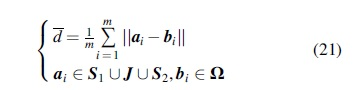
Where the average distance is defined by Equation (21). p > 0 and q > 0 are coefficients indicating a preference for the finger stiffness. Larger coefficients result in larger bending curvatures and finger stiffness. The optimal value of h is calculated from α1 by solving Equation (1), which gives:
The optimal geometry parameters R1, R2, and h are then converted to the input pressures of the soft actuators according to Equation (25) which is derived from Equation (8) and Figure 4:
Where kpi > 0 and kni < 0 are coefficients for positive and negative pressures, respectively. The objective function has three discontinuous feasible regions depending on whether the proximal and distal segments are driven by positive (P) or negative (N) pressure, respectively, which are named PP, PN, and NP for short. Optimal solutions are first calculated in the three different regions and then compared by their minimum values to choose a global solution. In some cases, preliminary decisions can also be made empirically to determine a specific searching range, for example, PN is preferred when grasping small objects. This is further validated by simulation and experiment in the later section.
Each of the solutions indicates an optimal gesture just when the fingers get in contact with the object surface. If the finger curves intersect with the object outline surface, such interference is handled by the inherent compliance of the soft material. After picking up objects, external forces such as gripping force and gravity cause extra deformation on the soft actuators. With a proper hand gesture, the contact stress and deformation caused by external forces are uniformly distributed on the contact surface. Consequently, stress concentration is avoided, and maximal grasping compliance and stability are achieved.
Simulation and Experiment
The proposed robotic hand definitely has the ability to grasp irregular objects, but with a more complicated gesture optimization algorithm which is out of the scope of this article. As mentioned above, this article takes rotational symmetric typical goods in daily life as examples to test the grasping performance of the robotic hand, and thus, all the three finger branches have an identical optimization process. Contours of the objects are identified using image processing techniques, and sample points are then extracted from the contours, as shown in Figure 6. The sample points are extracted on one side of each object on the potential contact regions with the soft fingers. Feasibility of the gesture optimization algorithm is validated by both simulation and experiment. The simulation results are plotted in Figure 7.

Objects with extracted sample points on the contours.

Optimized hand gestures for different objects.
Figure 7 describes the optimized bending curves of the finger surface together with the target outlines of the objects. The finger and object curves are formed by the sample points introduced in Model Based Gesture Optimization section. The target object outlines are chosen at the expected contact areas on the objects. Because the objects are assumed to be picked up from the desktop, the fingertip cannot exceed the object bottom lines.
In general, the object outlines overlap well with the fingertip in Figure 7, indicating a maximal contact between the finger and the objects. As shown in Figure 7a–c, the optimal hand gesture lies in the PN region for the small objects. Large contact surface is provided with the inner flat side of the finger. The distal segment keeps a vertical pose to get contact with the bottles when picking up with their cylindrical sides. For the paper cup with an inverted taper side, however, the distal finger segment is set in an inclined manner for better contact. For the medium size balls, as shown in Figure 7d and e, minimal average distance is achieved with the PP configuration. The distal finger segment bends according to the object radius to achieve maximal contact areas. A large size foam tape is tested and shown in Figure 7f. The robotic hand performs an NP gesture to handle the large horizontal size, which can hardly be accomplished by traditional single segment soft finger setups.
An experiment is conducted to validate the simulation results, as illustrated in Figure 8. The finger curvatures are first set to achieve optimal gestures according to Figure 7, and extra positive pressures are then added to the soft spring to exert extra gripping forces on the objects. The measured grasping parameters are listed in Table 1.

Grasping with optimized gestures for different objects.
Measured Grasping Parameters for Different Objects
It can be observed from Figure 8a to c that the PN gestures make contact with the cup and bottles in a very stable manner with a fairly large contact surface, just like the finger pulps of humans. Gripping forces are uniformly distributed on the object surfaces. Figure 8d and e show the PP gestures for toy balls with different sizes. The distal finger segments bend to match up with the curvature of the balls. NP gesture for the large foam tape is shown in Figure 8f. The hand is widely opened with this kind of gesture to handle the large size, and the distal segments bend positively to capture the edge of the tape. Notice that all the optimal gestures are chosen to set the soft spring close to its original length, leaving enough adjusting space for the palm opening and closing, and also the gripping force in practical applications.
Finger deformations caused by the extra gripping forces can be observed by comparing the finger curvatures in Figure 8 with the optimal curvatures in Figure 7. When grasping small and lightweight objects such as Figure 8a and c, small gripping forces are added, and the gestures are hardly affected by the extra forces. Large gripping force is added and causes moderate deformations on the proximal segments when grasping the large ball in Figure 8e, but the curvatures of the distal segments almost remain stable. It can be observed from Figure 8b and d that the proximal segment deformation is closely related to its stiffness. When similar gripping force is applied, the proximal segments deform slightly larger in Figure 8d, because lower required actuation pressure in the proximal segments results in a lower finger stiffness. In general, the finger deformations caused by extra spring forces are small and merely occur in the proximal segments, and the fingers keep clinging to the objects with constant distal segment curvatures, so that adding extra gripping force has little effect on the gesture optimality and the grasping performance.
The experiment also indicates that the hand gestures generally cannot be improved by increasing the gripping force to passively deform the fingers. If an inappropriate gesture is applied for grasping an object, simply enlarging the gripping force may cause unstable grasping performance or even damage the object or the hand instead of improving the gesture. Therefore, finding an optimal gesture for each object is the basis of stable and compliant grasping.
Conclusion
This article develops a soft-rigid robotic hand for adaptive and reliable grasping. The robotic hand controls the finger curvature and gripping force separately for more flexible gesture adjustment. The double-segment fingers perform different gestures to match up with various kinds of objects. Optimal contact between the object surfaces and the fingers is achieved by adopting a gesture optimization algorithm, during which the curvatures of the finger segments achieve maximal similarity with the object outlines. The results of the gesture optimization algorithm are demonstrated in the experiment. Adaptive and reliable grasping for objects with different sizes, shapes, and materials are all validated.
Future work will extend the gesture optimization method from rotational symmetric objects to irregular-shaped objects. Flexible sensors will be adopted to perform close-loop force and gesture control. Future work will also combine the robotic hand with robotic arms to conduct deeper research on automatic grasping. Authors believe that the proposed soft robotic hand will have broad applications in the industry and our daily life.
Footnotes
Author Disclosure Statement
No competing financial interests exist.
Funding Information
This work was supported by the National Natural Science Foundation of China (Grant No. 52201398), the Natural Science Foundation of Jiangsu Province, China (Grant No. BK20220343), the National Natural Science Foundation of China (Grant No. 61903186), and the Natural Science Foundation of Jiangsu Province, China (Grant No. BK20190665).