




Abstract
Abstract
This article attempts to show how the procurement methods employed by Japan Aerospace Exploration Agency (JAXA) affect new entries in procurements in Japan. The authors analyzed and aggregated data associated with the transition of the procurement system at the aerospace agency and studied how the transition stimulated new entrants to participate in JAXA's research and development (R&D) procurements. Before fiscal year 2008, JAXA depended mostly on noncompetitive contracts and conducted only a few bids. After the government's recommendation in 2008, JAXA introduced more “competition” in its procurement system. Opportunities for new entrants seem to have increased since this event. However, the actual data show that additional competition for R&D procurements has not had a significant impact on new entries. To promote new entries in R&D procurements at the aerospace agency, the procurement system needs to be reformed.
Introduction
Hoping to expand the aerospace industry, the Government of Japan encourages new entries into the aerospace sector. 1 A typical example of a new entry into the space industry is the Space Exploration Technologies Corporation's (SpaceX) launch of services in 2009. The oligopoly in the aerospace industry in Japan needs to be overcome, and new integrators and also new subsystem and component manufacturers need to be encouraged to enter the market. The issue is how to encourage new entries into the aerospace industry.
The Japanese space industry's market is largely the government. 2 Demand comes mainly from the Japan Aerospace Exploration Agency (JAXA), which spends most of its budget on aerospace. 3 Assessing JAXA's procurements and analyzing new entries in procurement promises to help explain the Japanese aerospace industry.
Thus, this article analyzes the status of new entries for JAXA's procurements. Consequent to the analysis, the authors concluded that using competitive methods in JAXA's research and development (R&D) procurements did not significantly influence new entries into R&D procurements. The authors suggest that providing sufficient opportunities for competition and designing a sourcing selection method for the aerospace industry and R&D is needed, principally to reduce private companies' risk.
The Way of Analysis
The data used in the analysis are as follows: the number of sole-source contracts, contractors, new entries, and single-company bids, which were obtained from JAXA's procurement record. The authors analyzed these parameters in relation to the transition of JAXA's procurement system.
To analyze new entrants into the Japanese aerospace industry, the authors aggregated and assessed JAXA's R&D procurements. In this article, R&D procurements represent a type of procurement that conducts research and/or development of satellites, launch vehicles, aircraft, ground equipment, experimental equipment, and other types of complex machinery. JAXA entrusts its design and testing to the contractor, who delivers the results and related information to JAXA.
Changes or increase in contractors that was not attributed to the changes of JAXA's procurement system are eliminated from the study. For example, the order changes because of R&D policy changes. The purpose of this article is to examine the relationships between the procurement system and new entry in JAXA's procurements.
The Transition of JAXA's Procurement System
JAXA's sole-source contract revision plan (SCRP) (zuiikeiyaku minaoshi keikaku) lowers the rates of sole-source contracts. A sole-source contract is a noncompetitive contract without solicitation, offering, or bid. 4 In December 2007, the independent administrative institutions rationalization plan was enacted as a cabinet decision of the government. As part of this plan, the government recommended that every independent administrative institution, including JAXA, establish a SCRP. JAXA aimed at lowering the rate of sole-source contracts and introducing more competitive methods for its procurements. Following this policy, in 2007 JAXA made the requirements for sole-source contracts stricter. Two more cabinet decisions 5 tightened and enforced the SCRPs of the agencies. JAXA has reacted to these policies and adopted competitive methods and stricter standards to reduce sole-source contracts in its procurements (as shown in Fig. 1). 6
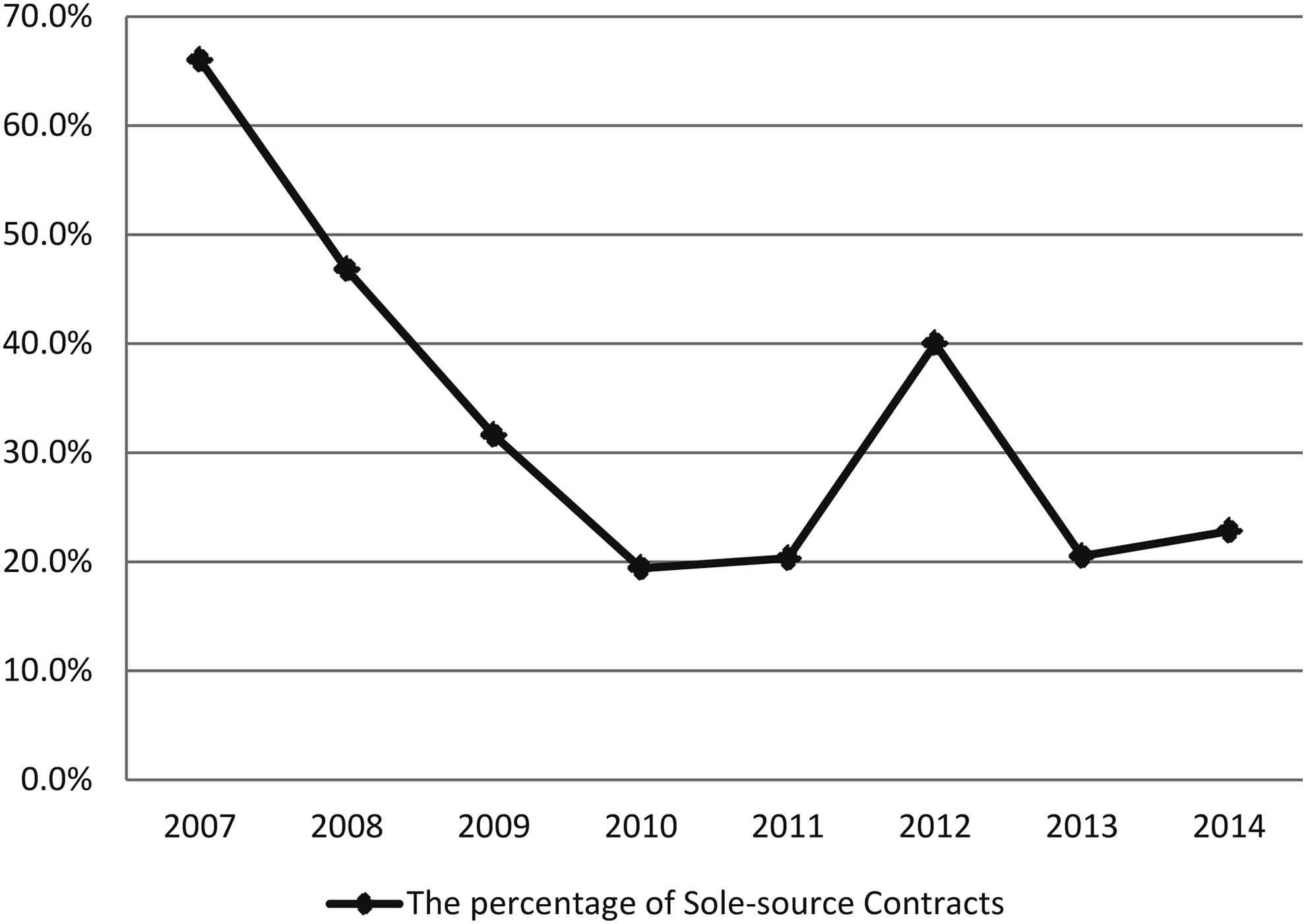
Rate changes for sole-source contracts in JAXA's procurements. 27 JAXA, Japan Aerospace Exploration Agency.
SCRP did not consider differences between R&D procurements and general procurements. The characteristics of Figure 1 show that the rates of sole-source contracts in JAXA plummeted from 2007 to 2010. 7 This can be explained by the SCRP's effect. 8
Data Analysis
Rates of Sole-Source Contracts in R&D Procurements
The authors analyzed the rates of sole-source contracts in R&D procurements. 9
Figure 2 shows that the rates of sole-source contracts in R&D procurements decreased from 2007 to 2010. The trend is similar to that of the transition of sole-source contract rates in whole procurements, as shown in Figure 1 . JAXA has introduced more competitive contracts regardless of the type of procurements. This policy change seems to have encouraged more companies to participate in JAXA's R&D procurements. However, the data hereunder show that JAXA's active utilization of competitive methods has not translated into a growth in the number of new companies participating in such procurements.
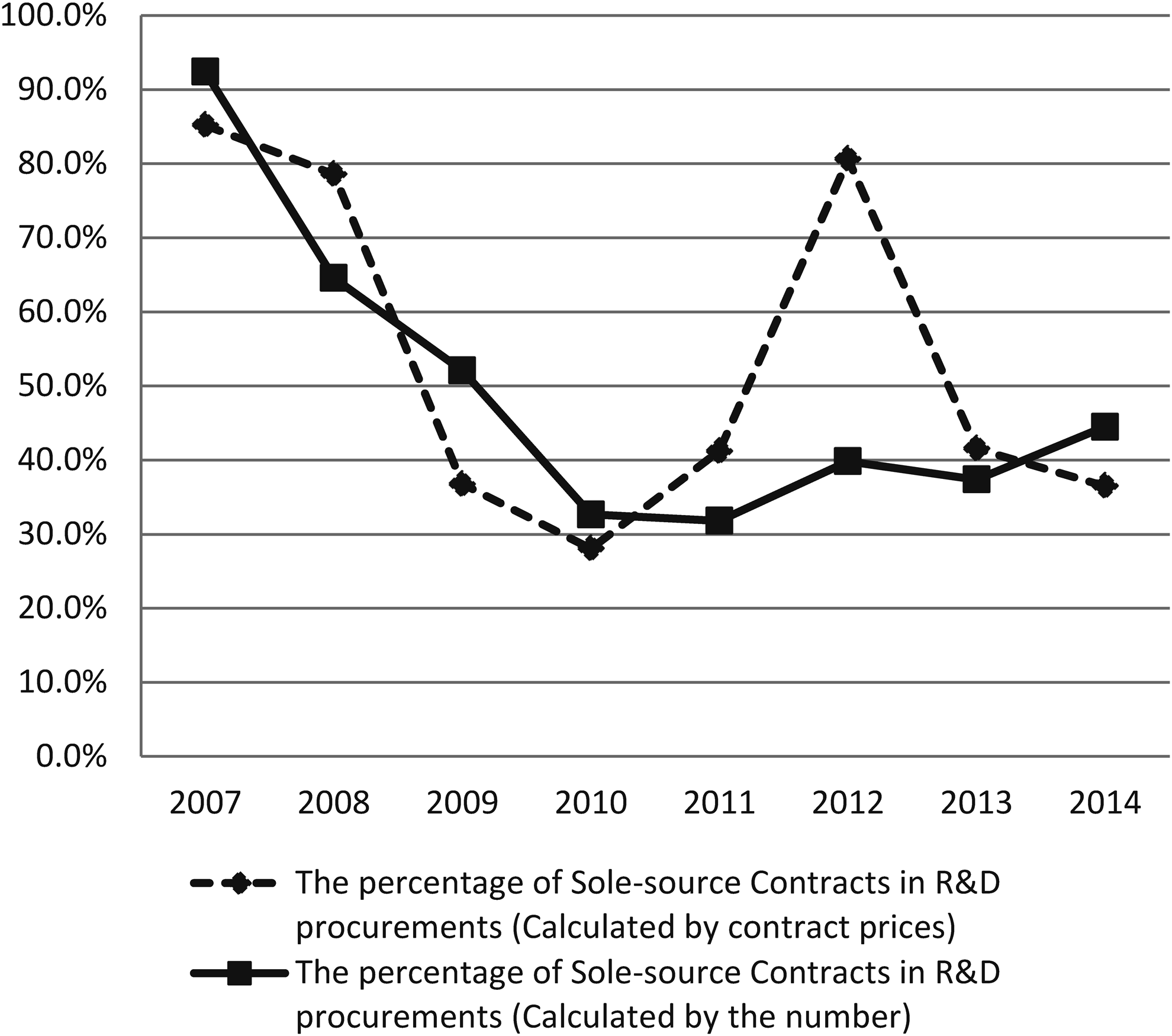
Transition of rates of sole-source contracts in JAXA's R&D procurements. 28 R&D, research and development.
New Entrants into R&D
This section explains how, by analyzing the circumstances of new entries into JAXA's R&D procurements, the authors found that JAXA's active utilization of competitive methods had not contributed to a higher number of companies in such procurements. The reason for this is that SCRP has little effect on the actions of companies to enter the competition for such procurements.
The authors verified this inference by using four kinds of data: the rates of sole-source contracts, number of JAXA's contractors, rates of new entrants, and rates of single-company bids in R&D procurements.
The number of JAXA contractors
The authors analyzed the number of contractors in JAXA's R&D procurements. Increase in the contractors could be analyzed that new entry has occurred.
Figure 3 shows that the number of contractors in R&D procurements remains roughly constant, whereas the rates of sole-source contracts decrease.
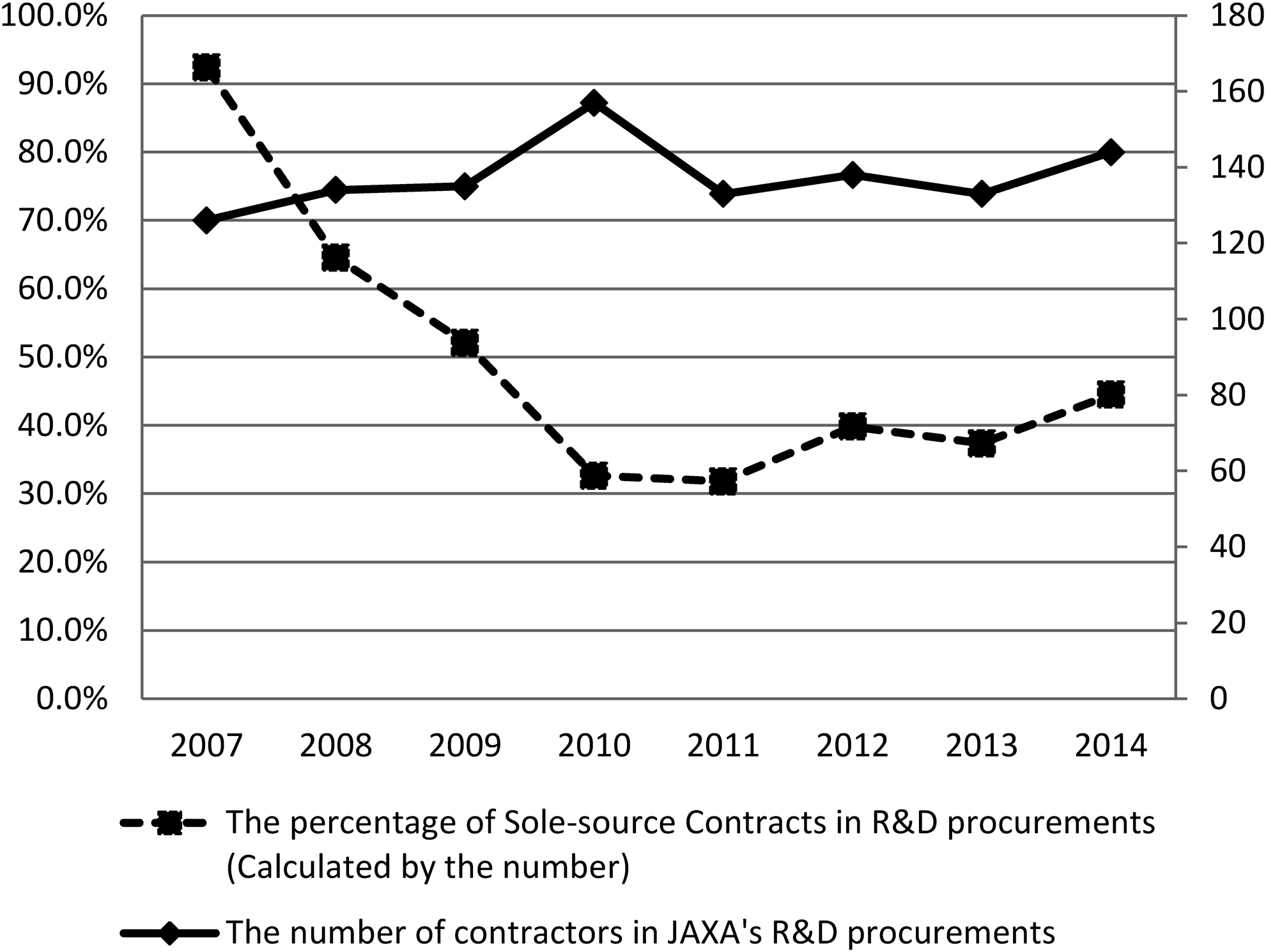
Sole-source contract rate changes and the number of contractors in JAXA's R&D procurements. 29
Rates of new entrants
Although the number of contractors has remained roughly constant, there remains the possibility of entries and exits having cancelled each other out. To confirm this, the authors analyzed the new entry rates in R&D procurements in 2009—when competitive methods began to be used more regularly. Contractors for JAXA's R&D procurements (excluding sole-source contracts) from 2012 to 2014 who were not contractors from 2009 to 2011 are considered “new entrants.” The authors analyzed the rates of the new entrants with R&D procurements (excluding sole-source contracts) from 2012 to 2014 (as shown in Table 1).
Rates of New Entrants in R&D Procurements 22
R&D, research and development.
The data show both entries and exits. However, the contract amount won by new entrants constitutes only a small percentage of the total.
Rates of single-company bids
Using single-company bid rates, the authors also analyzed whether small-scale new entries were stimulated by competitive methods. 10 The conclusion was negative. The phrasing “new entries stimulated by competitive methods” refers to new entrants participating and winning bids while competing against existing companies.
A single-company bid refers to a bid 11 by only one company despite the bid being public. The low rate of single-company bids means that more companies are participating in bids. It also means that there are more potential contractors.
Figure 4 can be interpreted as the decrease in rates for sole-source contracts being inversely correlated with the increase in rates of single-company bids.
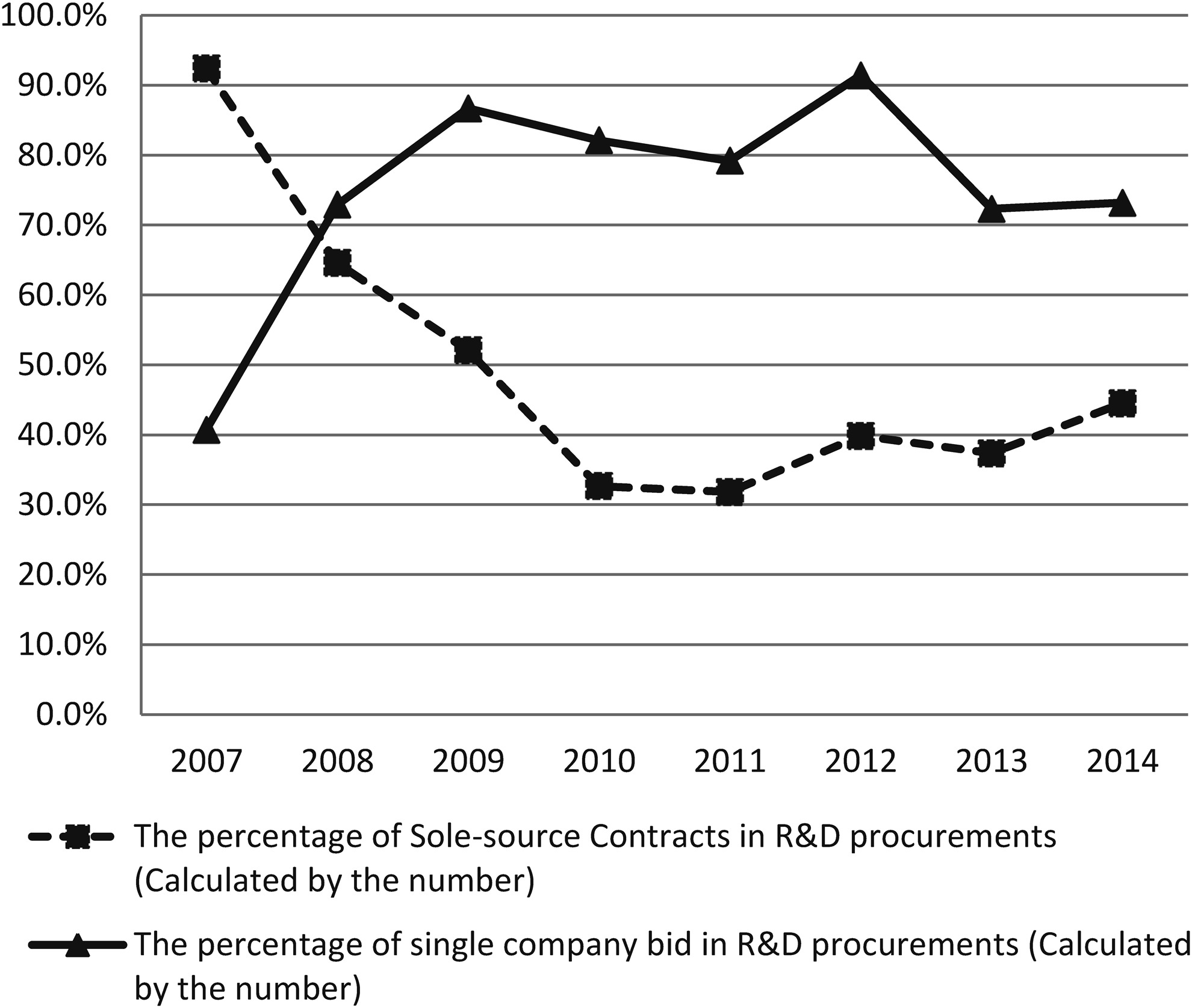
Transition of rates for sole-source contracts in R&D procurements and the rates of single-company bids in R&D procurements. 30
Although JAXA provided more opportunities to participate in its R&D procurements, few companies entered into competition against other companies. The high rate of single-company bids means that there are only a few actual competitors. Hence, it can be assumed that small-scale new entries and exits are not caused by competition. This can be explained by the fact that among new entrants in R&D procurement, the rate 12 of the number of companies that participated in competition and actually competed with other companies for R&D procurements, that is, those not corresponding to single-company bids, was only about 23%. It can be deduced from this rate that most new entrants have signed contracts without actually competing.
Therefore, utilizing competitive methods has added few new entrants into R&D procurements.
New entries into general procurements
The effect of competition on R&D procurements is small, but how do competitive methods stimulate new entries into general procurements? The stimulative effects of competitive methods have been confirmed in general goods and services procurements by JAXA. 13 Thus, depending on the type of procurement, introducing competitive methods has different effects on new entries.
JAXA's general procurements have the following features. The contents are similar over a long period of time because they are not significantly affected by JAXA's R&D plan and are often general rather than aerospace specific. Therefore, if there is no competition, the same company could often win contracts continually. Conversely, when contractors are replaced, new entries and exits take place through competition. Consequently, general procurements at JAXA help to measure the effect of competitive methods.
Using the same analytical way in R&D procurements, the authors analyzed the rate of new entrants in general procurements and whether the new entries were stimulated by introducing competitive methods. The rate 14 of new entrants 15 to the number of contractors involved in general procurements (excluding sole-source contracts) from 2012 to 2014 was about 35% (as shown in Table 2). This rate was almost the same as the rate in R&D procurements. This shows that new entries and exits took place in general procurements as well as in R&D procurements.
Rates of New Entries in General Procurements 25
Next, the average rate of sole-source contracts in general procurements from 2012 to 2014 was about 12%, and the average rate of single-company bids in general procurements from 2012 to 2014 was about 48%, both of which were calculated by the number of contracts. 16 These results are lower than those for R&D procurements, which show that bids for general procurements were more competitive.
The low number of single-company bids suggests that, with the introduction of more competitive methods, JAXA has secured opportunities for new companies to participate in general procurements.
Among the new entrants, the rate 17 of companies actually competing against other companies adds up to about 81%. This high rate means that many new entrants participated in and won competitions against existing companies in general procurements.
In conclusion, competitive methods have stimulated new entries into JAXA's general procurements. Therefore, differences in the characteristics of R&D procurements and general procurements (other than competitiveness) seem to limit the effect on competition for R&D procurement.
Promotion of New Entries
Factors in Procurement Systems Necessary for Promotion of New Entries into R&D Procurements
Why did competitive methods not have a significant effect on new entries in R&D procurements compared with general procurements? Why are only a few new companies willing to compete in bids for R&D procurements? The authors analyzed these questions by focusing on the procurement system and found that one factor necessary to promote new entries is to design a system that reduces risks for contractors.
The conclusion of New Entries into General Procurements section suggests that additional factors, other than competition, should be considered in R&D procurements to promote participation by new companies. The authors surmise that the characteristics of the aerospace industry and its R&D activities are some of possible reasons for this. It should be noted that SCRP did not consider these factors in the “recommendation” of competitive methods.
JAXA conducted a questionnaire survey 18 in 2009 for corporations that showed interest in biddings but in fact did not participate. Approximately half of the respondents said that “they could not expect to win the bid or that it was difficult to perform the order.” Among these responses, the largest proportion was to the effect that “there were risks in fulfilling the order.” From the questionnaire's results, the characteristics of the aerospace industry can be analyzed. The high technical requirements of procurements, including reliability, suggest that technological risk is one of the factors that makes companies reluctant to bid.
In addition to advanced and special technology, special equipment is necessary for R&D activities. 19 In general, such special equipment requires large investment. Large investment is accompanied by high risk. This investment risk may prevent companies from participating in JAXA's R&D procurements. 20
These characteristics of the aerospace industry and its R&D activities could be preventing new entries. 21 Countermeasures for these risks are necessary for the promotion of new entries.
Specific Actions
Here, the authors propose specific plans to lower the risks mentioned in the previous section.
Considering the high reliability and technical capabilities required by the aerospace industry, the authors propose to utilize partnership schemes, such as public–private partnerships. Thereby, companies might be able to meet the high standards of services required in the aerospace industry. It will also become easier for companies to acquire aerospace technology with technical support from aerospace agencies, and partnerships could reduce private companies' technological risks.
In addition, the authors suggest that investment risks could be reduced if the scope of each contract for R&D procurements became wider, for example, by using anchor tenancy, which could stabilize the returns of future participants. Also, if aerospace agencies' facilities could be utilized more flexibly, it could reduce the necessary investment and risks. It is conjectured that designing a more investment-friendly environment could promote new entries.
Conclusion
In this article, the authors analyzed transitions by using the data of sole-source contracts, new entries, single-company bids, and number of contractors in relation to JAXA's procurement system and examined the impact of competitive methods on aerospace R&D procurements.
Utilizing competitive methods in JAXA's R&D procurement has had no significant influence on new entries. The characteristics of the aerospace industry and its R&D activities are some of possible reasons for this. To overcome the challenge posed by these characteristics, it is necessary to adopt a system to reduce private companies' risks. Finally, the authors proposed the following specific plans to reduce risk: utilizing partnership schemes, widening the scope of R&D procurement contracts, and letting companies utilize the agency's facilities more flexibly.
Footnotes
Disclaimer
The views expressed in this article are solely those of the authors in their personal capacities and do not in any way represent those of the organization to which the authors belong or any other entity of the Japanese Government.
Author Disclosure Statement
No competing financial interests exist.