




Abstract
Abstract
A prediction of future directions and trends of the satellite propulsion market could be helpful in the formation of technology development agendas proposed by various global entities such as commercial companies, space agencies, or research institutions. Possible market evolutions are presented, in light of past and present technology development, and the authors' estimation of the upcoming development tracks of the various forms and subclasses of electric propulsion (EP). The history of EP is reviewed in the context of a technology life cycle, with the conclusion that EP is in its early majority pragmatist phase. Specific applications for in-space propulsion, including geostationary communication satellites, low Earth orbit mega constellations, CubeSats, interplanetary missions, and Earth observation satellites, are paired with the appropriate corresponding EP technologies. Rising developers and major influences are noted. It is predicted that EP technologies will likely fragment and diversify to cater more closely to each specific future mission need.
Introduction
During recent years, electric propulsion (EP) has increasingly become the solution of choice for propulsion systems onboard many types of satellites. The most noticeable sign of this trend is the ever-growing inclusion of EP onboard commercial telecommunication satellites that fuels both an increasing demand for existing EP systems and the development of new EP systems and components. In parallel, less traditional more diverse applications of EP are under constant development, such as asteroid redirect missions, CubeSat propulsion, on-orbit satellite servicing, and more.
This article presents our evaluation of future market directions and trends, in light of past and present technology development paths, and our estimation of the development routes of the various forms and subclasses of EP. Our goal is to predict which specific EP technologies will excel in fulfilling particular mission needs, which could aid in the formation of technology development roadmaps proposed by various global entities, whether commercial companies, space agencies, or research institutions.
This article is divided into 2 segments. Our technology maturation analysis based on a simplified technology life cycle model is presented in the first segment. The analysis includes a historical overview of EP technology and market development from its early years to the present day. In the second segment, the implications of these historical trends are given along with our prediction of possible EP market evolutions. Although this prediction is based on our interpretations, and will inevitably be speculative, an attempt will be made to predict the directions that EP might take in the future in light of commercial market niche needs. The following 2 segments are further organized, making use of the phases of the technology life cycle,
1
namely
1. Research and Development where technology is born and many variations developed. 2. Ascent where technology proves itself in various applications, although it does not yet cover its own cost. 3. Maturity where the usefulness of the technology is acknowledged by the relevant market and diffusion into the market follows. 4. Decline where newer technologies slowly replace the old ones.
Segment I: The Early Life Cycle of EP
Research and Development
While the concept of EP has been documented since the early 1900s, the research and development phase was delayed until the ‘50s and ‘60s in both the United States of America and the Soviet Union, around the same time when appropriate in-space power source technology had satisfactorily matured.2–4 Already, in these 2 decades, there were several models of thrusters developed, employing electrothermal, electrostatic, steady-state electromagnetic, and pulsed electromagnetic acceleration mechanisms. Only about a dozen proof-of-concept missions were executed such as the American SERT-1 (1964) to flight-prove ion engines, the Russian Zond-2 (1965) to flight-prove pulsed plasma thrusters (PPTs), and the Russian Meteor 1–10 (1972) to flight-prove Hall thrusters. This section is concluded here as a brief summary of this period of EP in recognition of excellent descriptions appearing in other texts.2–4
Ascent
In the following 3 decades, EP had entered the ascent phase wherein it faced test after test of its worthiness as a technology and consistently passed. Unfortunately, the companies involved in this period were mainly experienced in rocket production and therefore much more familiar with chemical propulsion technologies. The relative complexity of EP systems, combined with the very limited power available on early satellites and the natural risk aversion of the space industry, kept the technology hidden from the mainstream in a relatively experimental state.
In his book Crossing the Chasm, 5 G. Moore describes a technology life cycle, a graphical representation of which is shown in Figure 1. The chasm is the weakest point in this life cycle and is defined in Ref. 5 as the transition between early development and commercial assimilation. It is characterized as the endpoint of many technology developments, yet it can be breached by the introduction of a superior technology with clear qualitative advantages over existing ones, as in the case of EP, and to a significant extent by aggressive marketing support.
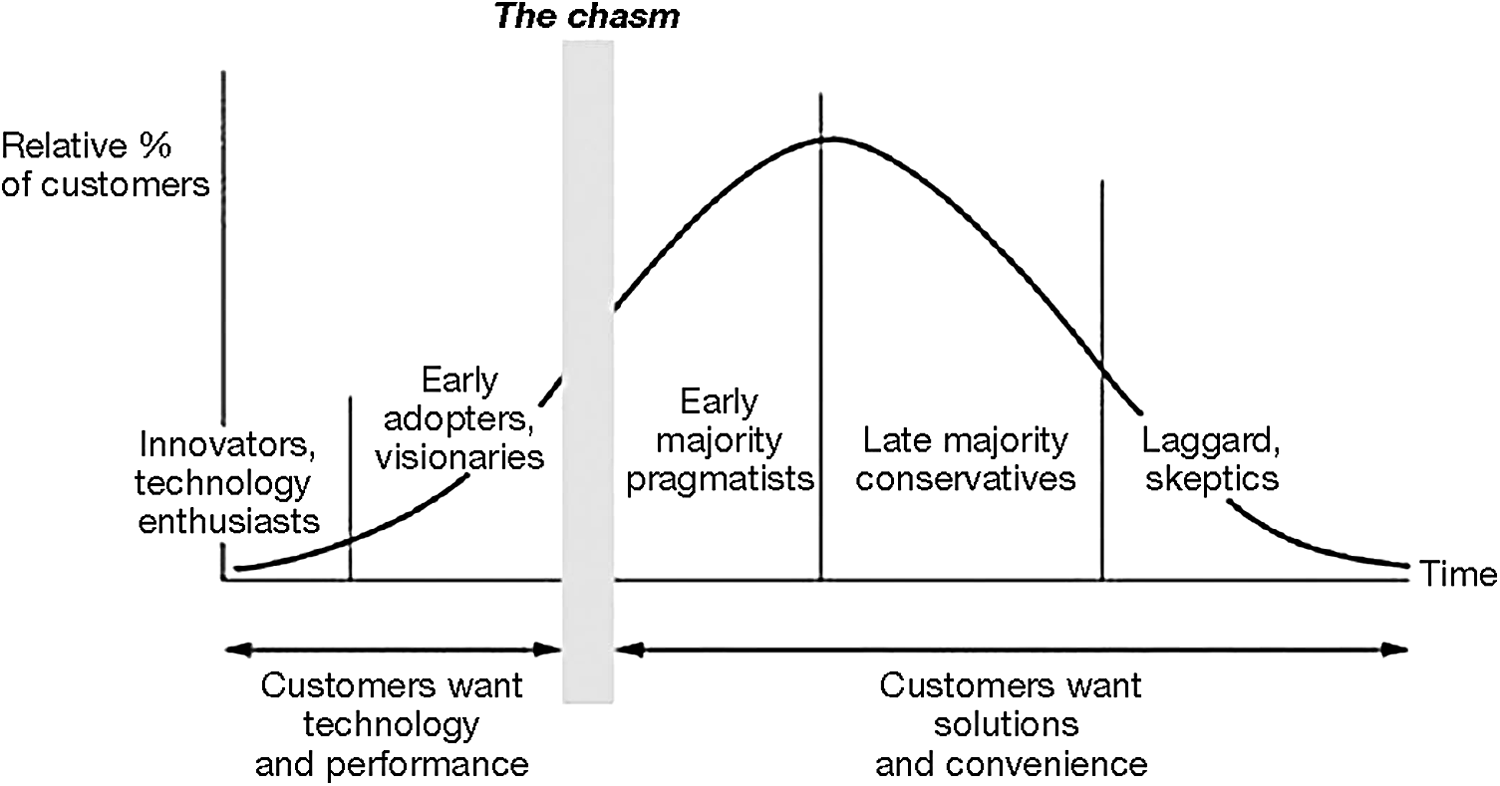
The chasm is difficult to overcome because the target customers necessary for the success of the technology, the late adopters, have a very different mindset compared with the early adopters, the enthusiasts. Early adopters more readily view a new technology as positive either because they value novelty for itself or they value the new capability as more important than the lack of maturity. Conversely, the late adopters do not value novelty as a positive in and of itself. Late adopters may furthermore view novelty as negative and require convincing that the risk of a lack in heritage is outweighed by the capabilities enabled by the new technology. The recent evolution in the adoption of EP is an excellent illustration of this life cycle staging.
During the ascent phase, all missions utilizing EP were funded and executed by governments around the world. The tendency of space agencies to favor exquisite, highly mission-optimized systems versus off-the-shelf ones was an integral part of the problem that hindered the expansion of EP technology and kept it at prototype level, unable to breach the chasm. The other reason the technology did not expand is the fact that Russian technology, in particular Hall thruster technology, was very effectively covered by patents and therefore was not exported out of Russia. All Russian Hall thruster research and development could only be legally used in Russia through a licensing agreement with state-owned Russian entities.
The breakthrough came in the ’90s when EP developments migrated from the former Soviet Union to Europe and the United States through licensing of the proven Stationary Plasma Thruster (SPT) design to Western propulsion companies. This decade was characterized by the development of myriad subclasses of EP with an emphasis on Hall thruster and ion engine research, specifically performance improvement and qualification. Gradually, academia and research institutes became more and more involved such as Princeton University, Snecma Moteurs, Moscow Aviation Institute (MAI), and National Aeronautics and Space Administration's Jet Propulsion Laboratory (NASA JPL), to name a few of those pioneers.
In spite of a few EP vocal enthusiasts who advocated for wider use of those technologies, many commercial satellite manufacturers were skeptical of the ability of EP to reliably serve as the main propulsion. Some even thought that EP technology would be used only in long interplanetary missions where feasibility is crucially dependent on high specific impulse. By the end of the decade, in part, buoyed by the steady growth of satellite size, mass, and most importantly available onboard electrical power, they would be proven wrong.
The ‘90s also introduced the 2 most popular standardized electric thrusters—the SPT-100 (Gals in 1994) and the Xenon Ion Propulsion System (XIPS) (PAS-5 in 1997). 6 Follow-up missions where these thrusters were used were especially important since the customers of the technology were not the early visionaries; these customers were the potential future customers from the other side of the chasm. These customers saw not only the technological potential of EP but also its financial potential, that is to say—they choose EP based on the superior risk-adjusted return on investment (or lower effective capex) offered by satellite featuring EP systems (even only for station keeping). It also became obvious that the winds of change would come from the West, namely the United States and Europe, since these regions of the world had a good grip on the commercial telecommunication satellite market.
The first decade of the new millennium brought with it strong evidence of the advantages of EP in many applications where benefits of a higher specific impulse outweighed any decrease in thrust—an increasing number of communication satellites, as well as a mission to the Moon (SMART-1 in 2003), asteroid sampling (Hayabusa-1 in 2003), and a technology demonstration mission (TacSat-2 in 2006, which qualified an American-built Hall thruster, Busek's BHT-200) and more. Particular success was achieved thanks to a series of communication satellites integrated by Boeing and utilizing the XIPS. This success established the American capability of using EP for geostationary station-keeping maneuvers. Although the use of EP in all of the abovementioned missions almost never recovered the EP system cost, this is not unusual for technologies in the ascent phase.
It is important to mention 2 particular missions in which the EP systems were given an unexpected opportunity to prove their capabilities beyond station keeping and did so with remarkable success. In both the Artemis (2001) and AEHF-1 (2010) (Advanced Extremely High Frequency) geostationary satellites, a malfunction in the chemical propulsion system occurred, which would have meant an entire loss of mission for a satellite with an all-chemical propulsion subsystem. However, both satellites had an EP subsystem in addition to the chemical propulsion subsystem. Without having even been designed for it, the EP subsystem was brought online early and successfully used to fulfill the function of the chemical propulsion subsystem, leading to recovery of part of the mission.
By the end of the first decade of the new millennium, the Western world along with Japan and South Korea was ready for the first mainstream commercialization of EP for commercial telecommunication satellites. A graph showing the monotonically increasing number of telecommunication satellites using EP for the purpose of station keeping from 1995 to 2010 is shown in Figure 2.
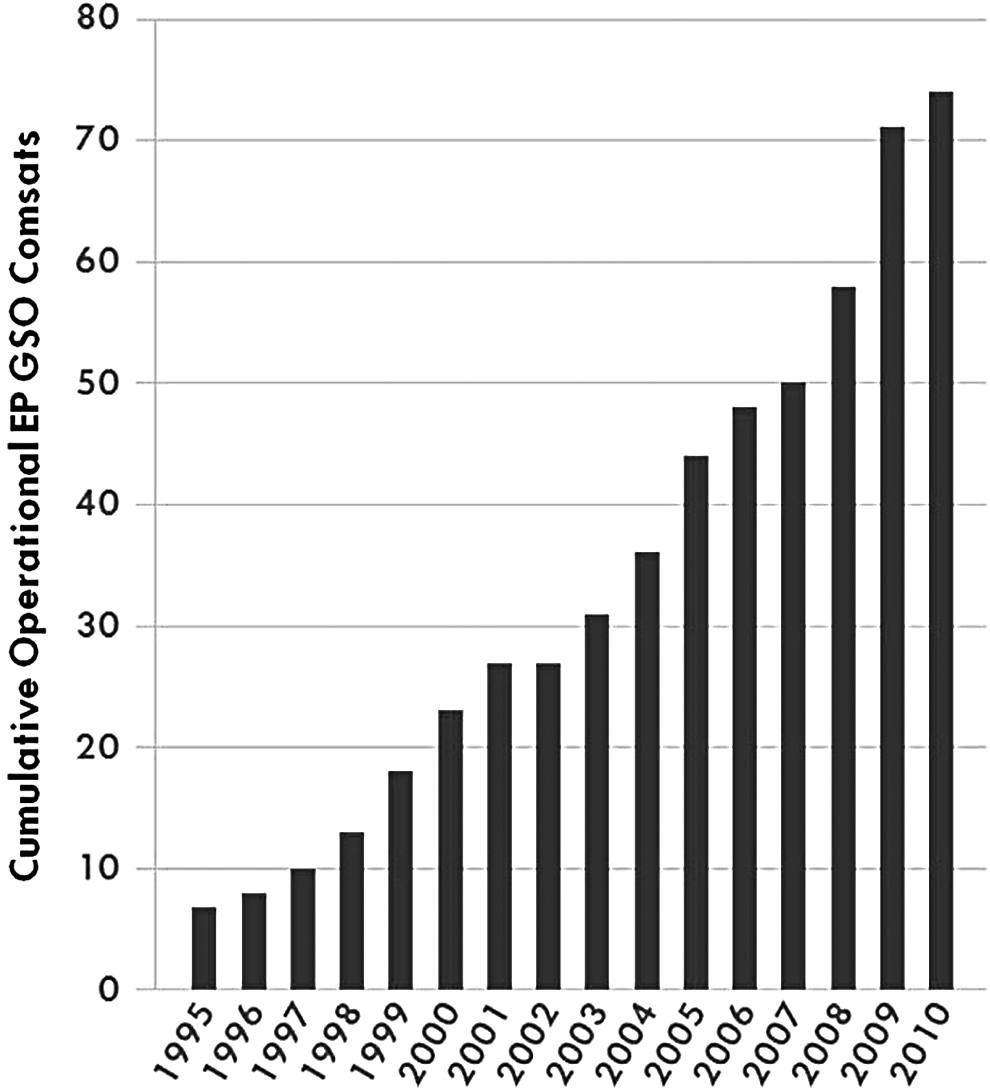
Diagram showing the increasing number of satellites using EP for station keeping in recent decades. 41 EP, electric propulsion.
In the early 2010s, the trend continued with an increasing number of communication satellites utilizing EP. Fakel was still in the lead with the most extensive propulsion system experience, leaning on the long and impressive flight heritage of the SPT family, while Boeing, and later L3, enjoyed the record of launching the highest number of EP systems on telecom satellites using the XIPS. Snecma Moteurs finally entered the Hall thruster telecom satellite market with their European-produced PPS-1350 (AlphaSat in 2013 7 ) after years of attempting to leverage on the success of the SMART-1 mission.
Maybe the most compelling evidence of the accelerating commercialization of EP is the AEHF missions that employ the BPT-4000 Hall thruster, also known today as the XR-5. The AEHF satellite missions were the first time that 5 kW Hall thrusters were flight proven, an endeavor that pushed the bar higher and laid the groundwork for EP—orbit raising, although at the cost of significantly longer transfer times.
For commercial satellites, the use of electric thrusters to transfer geostationary satellites from geostationary transfer orbit (GTO) to geostationary Earth orbit (GEO) delivers more mass savings compared with when EP is used solely for less time-critical station keeping. Indeed, when chemical propulsion propellant requires about half the weight of a classic GEO satcom platform (about 2.5 tons of propellant on a 5 ton satellite), 2/3 of it is used for orbit injection and only 1/3 for station keeping. EP systems typically reduce the mass of required propellant by a factor of 5 for either use. Therefore, using EP saves about 500 kg of propellant for station keeping versus 2 tons of propellant if also used for orbit raising.
The main shortcoming of using EP for orbit raising is the long operation time required to perform the maneuver, 6 months for the first electric satellites built by Boeing for ABS, 8 making a higher thrust electric thruster solution the preferred candidate for such a task. Even with the performance of present technology, the massive mass savings and proportional lowering of overall capex per unit bandwidth are what made the all-electric satellites so attractive to the space industry. 9 While chemical propulsion may initially persevere due to the present lack of significant flight heritage for all-EP satellites, the authors see no reason why EP development will not continue in the direction of higher thrust density with EP, eventually replacing chemical propulsion as the main propulsion subsystem in telecom satellites, dramatically reducing the satellites’ launching mass for similar payload sizes.
Boeing was the first to capitalize on this idea (in 2012) by selling 4 all-electric satellites, the first 2 of which (702SP platform) launched in March 2015. 8 Other satellite manufacturing companies are not far behind with some orders for all-electric satellites in their backlog and will launch their own attempt at all-electric satellites in the near future. This undoubtedly marks the beginning of the maturation phase of EP. From this point onward, the customers, namely the satellite operators, will lead the flock and determine the direction of the development of mainstream EP. The tides have turned.
Maturity
EP has reached its maturation phase. Over half a dozen all-electric telecom satellite orders, to date, from various prime satellite manufacturers support this claim. The expansion process is likely just beginning considering that the trend could become a new baseline within the next 5 years (the typical cycle length of the commercial satellite market). As EP gains flight heritage as the main propulsion system, satellite manufacturers offering chemical propulsion-based platforms will find it difficult to compete with those offering an EP-based main propulsion subsystem.
As Eric Beranger, head of space systems at Airbus Defense and Space, put it in a recent interview 10 : “There is a real interest among customers for all-electric spacecraft. Sometimes it is even the baseline requirement in the request for proposals. In our view, eventually at least 50% of the market will use electric in one way or another.” Considering the premium placed on flight heritage in the satellite business, those companies that have already begun to accumulate successful operational hours in space and develop next-generation all-EP platforms will have a marketing advantage over companies that later try to compete with either their first-generation all-EP platforms or their heritage platforms based on chemical propulsion with comparatively limited payload and launch configuration capabilities.
In light of the historical overview, one might ask: Why did it take so many years to bring EP technology to its maturity phase? There are several reasons (in order of significance):
1. Heritage, Heritage, and Heritage—The space industry is highly conservative and slow to adopt new products, to say the least, new technologies. It is somewhat of a catch-22, in that few will dare to use a new propulsion technology unless it already has flight heritage. With this logic, no new technology can ever gain flight heritage. The conventional way to break this circle is with the help of government-funded missions. For this reason, the spread of the use of EP technology was dependent on government funding to progress it, therefore progress was slow at least until the users, especially the commercial ones, determined they were ready to take part in the risk to acquire new capabilities beyond what legacy technology could offer. This conservatism is greatly amplified by the fact that satellite manufacturers are financially responsible for the performance of their platform, whereas the majority of the value added is captured by the operator. This creates a situation where the financial interests of satellite manufacturers and satellite operators are in direct opposition, except for the elusive potential upside of breaking the mold and using mastery of EP as a tool to conquer a larger market share in the competition among manufacturers. 2. Small Initial Market—The space industry is still fairly young and has relied solely on government expenditures for decades. Only during the past 2 decades or so has the commercial space market constantly grown and become more privatized. A more privatized market leads to more financial incentives, leading us to expect an accelerated market growth. Although initially the potential for profit is low, satellite manufacturers who accept this risk to offer cutting-edge technology could gain a significant competitive advantage as more companies fight for a share of the expanding satellite manufacturing opportunities. 3. Long Characteristic Time—Whether it is a satellite or an interplanetary mission, it takes several years to plan, prepare, and execute a space mission. For this reason, the characteristic time step for technology evolution is historically about 10 to 12 years. In the case of existing EP, this means evolution spanned several decades. 4. Low Available Power—Electrical power in space is obtained using solar power. Fifty years ago, harvesting over 1 kW of net electrical power was almost unattainable. This fact constrained the EP-using spacecraft to low power, thus low-thrust electric thrusters. At these low-power levels, EP was limited and could not manifest its true potential.
Some of the reasons mentioned here are much less relevant today and some of the reasons still exist. For example, today the commercial telecommunication market is larger and expanding, comprising on average of over 30 satellites per year for a manufacturing value of about 15 billion USD. 11 The obstacle of low available power is also quickly disappearing as the average beginning of life bus power is now above 10 kW and heading steadily higher. However, the problem of lack of power is somehow being replaced by increasing heat management demands. A larger total power generated by high-thrust propulsion subsystems and their high-power power processing units must be radiated away from ever so delicate high-value payload. Understanding the obstacles in the way of further technology maturation may assist in the determination of future directions of development.
Despite new obstacles replacing old ones, the future of EP has never looked brighter. The technology is in its early majority pragmatist phase. However, what is next? What directions is the market moving toward? Would EP systems predominate in other types of missions?
One should note that EP is not a panacea for any and all space propulsion challenges or needs. Chemical propulsion still dominates the space propulsion market and will be used for years to come. There will always be applications where chemical propulsion is preferable or even the only option, for example, in missions requiring high-thrust and duration-constrained maneuvers or in missions where electrical power is scarce. Nonetheless, more and more missions are utilizing EP as their main means of propulsion and ultimately EP technology is bound to take its rightful place in the propulsion solution arsenal, while the chemical propulsion market share will slowly shrink.
Segment II: The Future of EP
What does the future hold for EP and what directions will the EP market and technology take? Herein, we review a few evolutions, which could favor or hinder the adoption of EP systems as a new standard. This section begins with a discussion of different applications, continues with a mention of rising developers, and ends with a list of major influences.
Applications
Geostationary communication satellites
The market trends for this activity are clearly dominated by the RoI and capex/Mbauds. Geostationary communication satellite services are a large market, with high margin and a unique resilience. Not surprisingly, it is also currently where the fastest EP market growth is. At this early stage of adoption, 2 types of electric thrusters serve this market—gridded ion thrusters and Hall thrusters. Both have been used for station keeping and recently also for orbit raising. 8
As the market shifts toward all-electric satellite platforms, a higher thrust higher power version of both types of EP systems has been developed, utilizing about kW per thruster. This increase in power and thrust is mainly to ensure a reasonable GTO to GEO orbit transfer duration. Accordingly, the 1.5 kW EP workhorse used in communication satellites for over 2 decades, the SPT-100, will most likely lose its place to a higher power version as the default EP option within several years.
Specific EP technology for geostationary communication satellites
Boeing is using L-3 XIPS-25 on its 702SP platform. Lockheed Martin, Thales Group, and Airbus are currently offering Aerojets XR-5 on the AEHF missions 12 and Snecma's PPS-5000 on the NeoSat platform, 13 respectively. Airbus also offers the PPS-5000 on the Eurostar E3000 EOR platform. 14 SS/L offers Fakel's SPT-140 that recently completed qualification 15 and will start integrating their first platform soon. All satellites use 5 kW EP thrusters for the purpose of orbit raising and station keeping.
It is reasonable to assume that since thrust plays such an important role in reducing orbit raising duration, Hall thrusters will have more potential to gain traction in the all-electric platforms at the expense of ion thrusters. Still, L-3 has a proven solution and a talented enough team to develop a credible alternative and currently holds a significant historical lead. In addition, the XR-5 has a promising head start over its competitors after being flight proven in 2010. Aerojet will naturally try to play this advantage. Still, Europe has an interest to possess electric orbit-raising capability and make sure the PPS-5000 will be flight proven. Proof for that can be found in the form of about €25M invested by the French space agency, CNES, 16 and recent orders from the French defense procurement agency. 16
To date, the XR-5 has more orders than its competitors and could likely take a lead in near-term all-electric satellite platforms, at least until the other thrusters gain their flight heritage. The short-term situation in the Japanese market is comparatively unclear. Mitsubishi offers its DS2000 telecom platform with ion engine availability, yet nowhere the exact type of thruster is specified. It seems like the Japanese satellite sector is a bit more conservative than the others. This approach is depicted in the recent words of Yutaka Nagai, senior executive VP for Japans Sky Perfect JSat Corp., who is quoted as saying 17 “We would need to see it operating over a number of years before ordering one for the companys fleet.” In parallel with the traditionally weak private commercial ventures, the Japanese Aerospace Exploration Agency (JAXA) shows an increased interest in the development of Hall thrusters, and in particular 5 kW (and above) thrusters, under The High-Power In-Space Propulsion program initiated in 2011. 18 However, it will take years before any operational or qualified products will be available and their competitive advantage in terms of thruster performance, if any, is unclear.
Challenges that lie ahead
In the coming decades, it is unlikely that development of EP will produce a thruster technology that allows for all-EP transfer times comparable with those achievable with chemical propulsion. Catering to the future development of geostationary telecommunication satellite platforms to all-EP is therefore dependent on widespread acceptance of a longer transfer time by satellite operators and their financial backers. If this hurdle is passed, satellite manufacturers will be left with the challenge of pushing the operational envelope of Hall effect and ion thrusters to develop higher power and higher thrust EP subsystems and minimize the increase in orbit transfer time. To overcome the fundamental physical limitations of Hall and ion thrusters, development of new technologies will be required to address, for example, increased wall/grid erosion, decreased cathode lifetime at higher current, and more demanding subsystem-wide thermal management requirements.
Low earth orbit mega constellations
Recently, interest has been high in large low earth orbit (LEO) constellations. In 2015, both Elon Musk and Greg Wyler announced their intentions to launch hundreds to thousands of small satellites to LEO. The purpose of those mega satellite constellations is to provide global satellite internet coverage. At least Greg Wyler is very serious since OneWeb has already secured substantial funding. They have the means and they do intend to use them.
The target orbit of the satellites is higher than the natural target injection orbit of LEO satellites, therefore each satellite would have to be equipped with a propulsion system to perform a minor orbit transfer maneuver. Furthermore, since this armada of satellites cannot just stay in LEO after the satellites have been decommissioned, the satellites would have to deorbit using their propulsion systems. Given the size limit of these satellites combined with this multimaneuver requirement, the only viable option for the propulsion system is an EP system.
The most compelling evidence for the likely use of EP in the LEO mega constellations is Elon Musk's words who stated 19 “…the main propulsion system we have in mind for the satellite is a Hall effect thruster, which, not to trivialize it too much, but it's basically like a loudspeaker. It's like a magnetic field, accelerating ions, it's pretty easy to make. Theres degrees of Hall thruster, how good it is, but at the end of the day it's not that hard.” While there is no doubt that Musk expresses an exciting vision of the use of EP, most experts would not agree with the view that Hall thrusters are simple to produce, even less so when contemplating the total investment in R&D by agencies over many decades to bring the few existing, and widely considered imperfect, devices to the market in about half a century.
A few specific obstacles remain in the development of EP systems for LEO mega constellations. The IP landscape around Hall thrusters has been meticulously mined by a number of companies, so any new development will entail the purchasing of existing IP or accepting hefty royalty payments. Even when taking into account the economies of scale allowed by mass production, the production is delicate and requires a high level of quality control. Furthermore, none of the flight-proven thrusters available are able to completely satisfy the requirements of LEO mega constellations. The development of dedicated EP systems, while possible, is anything but cheap or fast and can easily rival the price of purchasing a low-end satellite.
Whichever EP company that designs, manufactures, and supplies the EP system for any one of the LEO mega constellations, it will have the upper hand in any future deal that includes low-power thrusters. It is now well known that the EP company that will deliver the EP system for the OneWeb satellite fleet is Airbus, while Musk already declared that SpaceX will build its satellite constellation in-house, yet in both cases, doubt will remain until at least a few first batches are operating as designed and the price of those is disclosed.
It is interesting to note that even in the space industry, there can always be heavy hitters such as Musk and Wyler who, with the right intention and capital, can sweep the market and create a new necessity for existing technologies or brand new ones.
CubeSats
The CubeSat market has experienced a meteoric growth in the past few years. Nanosatellites have attracted the attention of numerous space-involved agencies for their potential for faster development and maturation and overall reduced need for risk mitigation. According to the SpaceWorks Enterprises market assessment report on nano/microsatellites, the number of nano/microsatellites (1–50 kg) launched in 2012 (36 satellites) almost tripled in 2013 (92 satellites) with an astonishing projected number of over 400 satellites in 2020. 20 The thing that makes the market analysis even more remarkable is the fact that almost all satellites are commercial nanosatellites.
Along with market growth, came the appetite for improved mission performance leading to a demand for reasonably capable propulsion systems. However, this is challenging since small satellites, and in particular CubeSats, have strictly limited volume and mass, an obstacle when it comes to propellant storage. An interesting potential solution is to use high specific impulse propulsion systems, EP systems, to cut down on propellant mass. Since electro-magnetic pulse requirements for most nanosats are considerably more relaxed than for traditional satellites (because their payloads are often unpowered during the mission), pulsed propulsion systems have a real chance for these applications despite their typically high EMI emission. 21
Since the nanosatellite business is a commercial market, the relevant propulsion technology was quickly developed, with many ideas such as the Micro-Cathode Arc Thruster (by the George Washington University) with recent flight heritage, 22 the BIT-3 tiny ion thruster (by Busek) designated for the lunar IceCube mission, 23 the CubeSat Ambipolar Thruster (by The University of Michigan), 24 the MAX-1 electrospray thruster (by Accion System), 25 the German cathode arc thruster designated for the UWE-4 satellite (by Apcon AeroSpace & Defense GmbH), 26 the Micro-PPT (by Mars Space), 27 and many more. From this list, one company, Busek, stands out as an experienced and well-established EP company that has expanded their already extensive lineup of conventional EP technology to develop CubeSat propulsion systems. In early 2015, Busek received NASA funding to supply the BIT-3 tiny ion thruster for the Deep Space Probe lunar orbiter.
Most EP ventures described above have a low-technology readiness level and require further development, qualification, and actual space examination. Given the low costs and relatively short development time of CubeSat hardware, it is reasonable to assume that the CubeSat EP market will rapidly increase. It seems that this growing market is geared toward the hi-tech startup sector of EP companies, and as it expands, various versions of CubeSat-tailored EP systems will gain flight heritage. It will be interesting to see if the big EP companies will find a way to conquer this EP market sector.
Interplanetary missions
Thanks to the high specific impulse associated with EP, the majority of interplanetary missions use, and will continue to use, EP. Be that as it may, these missions are very rare and cannot produce return on investment. As a result, interplanetary missions are all government funded and very slow to be prepared and integrated. Still, the advantage of executing such missions is that they serve as a stepping stone for developing and qualifying new state-of-the-art propulsion technologies. For instance, the NASA Evolutionary Xenon Thruster (NEXT) qualification involved operation of the thruster under strict laboratory conditions for about 5 years—an enormous expense. Now, the NEXT has an easier path to be used for commercial purposes in addition to interplanetary missions.
In early 2015, NASA, the biggest investor in the world in interplanetary missions, initiated the NextSTEP program in which private companies are funded to develop next-generation propulsion technologies. The funding that goes to Ad-Astra, MSNW, and Aerojet will support technology that eventually will purportedly mature to electric thrusters that serve very high-power far–future endeavors at power levels of well above 100-kW. In parallel with the NextSTEP program, NASA is also running the asteroid redirect mission, in which a 30 kW Hall thruster will alter the trajectory of an asterod so that it passes close to the Earth.
The JAXA and the European Space Agency (ESA) are currently executing quite a few discovery missions using EP such as Hayabusa-2 and Bepi-colombo, respectively. In the same manner as the NextSTEP program, these 2 space agencies are trying to lay the groundwork for future high-power interplanetary missions by funding the development of high-power thrusters, specifically the SPT Hall thruster and the TAL Hall thruster, under the High-Power In-Space Propulsion program.
All the abovementioned technologies are already under development; however, they still have to overcome deep fundamental and technological challenges to demonstrate even simple feasibility at those power levels. Even more effort remains to make them viable solutions for interplanetary missions, especially when the qualification targets for such missions are so ambitious. For now, they also serve as test beds for uncommon subclasses of EP.
Any advancement gained by an EP technology from integration on interplanetary missions, except those based on low-cost spacecraft, is bound to be slow as the characteristic time associated with major long-term governmental deep space missions is extremely long, on the order of decades. Technology developments for interplanetary endeavors are very long-term investments, and as such, the EP commercial sector will not benefit from these technologies within the next 10 years.
Earth observation satellites
The conventional DeltaV requirement for observation satellites, derived from the required typical orbit maintenance maneuvers at 400–700 km altitude, does not require high specific impulse propulsion systems. This is why only a few observation satellite platforms have been equipped with an EP system, for example, EO-1 (2000), TacSat-2 (2006), and GOCE (2009). All were technology demonstration missions, thus government funded, and none of them is planned to be assimilated on a regular LEO platform.
Most of these satellites are small and power constrained, making it difficult to produce sufficient power for an EP system. As of today, no EP system has successfully been fully qualified at low power. These satellites also tend to have shorter mission lifetimes, generally reducing any gross propellant mass savings compared with the savings enjoyed in the geostationary telecommunication satellite market.
In light of the above, it seems like the rationale should be—if there is no need, there should not be any use for EP technology for Earth observation satellites. Before addressing this seemingly logical statement, we would like to cite Prof. David E. Nye, a recognized expert on the social history of technology, who wrote in his book Technology Matters 28 : “Necessity is often not the mother of invention. In many cases, it surely has been just the opposite. When humans possess a tool, they excel at finding new uses for it. The tool often exists before the problem to be solved.”
To project Prof. Nye's words on the case of Earth observation satellites: once the EP tool is developed, new necessities will rise. Currently, all observation satellites are orbiting the Earth like rocks in space, with no change of orbit or time period. This is because currently there is no need for something else—the ground track is steady and sensor resolution is constant. Nonetheless, the possible applications that these satellites could fulfill with greater maneuverability are endless. The potential uses for EP on Earth observation satellites include, but are not limited to, the following:
• occasional altitude change to achieve better resolution • orbit inclination change • formation flying keeping • drag compensation for maintaining very low altitude orbits
Imagine an observation satellite comfortably hovering at an altitude of 600 km until a natural disaster happens somewhere on Earth. The satellite could operate its propulsion system and lower its altitude, for close monitoring, to 400 km where its resolution is about twice as high. Today, this type of mission is a one-time technology demonstration mission, for example, the Venus satellite set to launch in a couple of years. It is a joint French–Israeli project wherein the satellite will use a pair of Hall thrusters (IHET-300) operating at 300–600 watts to change its altitude from 700 km to about 400 km to closely monitor vegetation growth. This type of mission has a wide range of potential applications, and it is quite possible that the market for EP systems tailored to LEO satellites could see significant growth, leading to a driver for EP technology development.
Due to their relative small satellite platform size, LEO satellites produce low electrical power, on the order of several hundred watts. For this reason, an EP system designed for LEO satellites must be able to operate at a power within this limit. This fact limits the choice of possible EP systems to either low-power ion thrusters, low-power Hall thrusters, or some other form of low-power EP such as PPTs or small arcjets.
Actually, these technologies are already under development by multiple EP providers. For example, L-3 has the XIPS-13 ion thruster, Fakel has the famous flight-proven SPT-70 and SPT-50 Hall thrusters, Busek has the BHT-200 Hall thruster with its space heritage, Rafael has the space-qualified IHET-300 Hall thruster, 29 ISAS (Japan) has the flight-proven μ-10 ion thruster, Astrium Airbus (Germany) has the flight-proven RIT-10 ion thruster, and Aerojet has the flight-proven MR-510 veteran arcjet. All of the abovementioned thrusters are capable to operate on any of the existing and future LEO satellite platforms. Unfortunately, the growth of integration of EP onto LEO platforms will most likely be slow until the necessity evolves sufficiently. The question is which commercial satellite provider will make the first step, an unlikely move considering the low thrust-to-power ratio of these thrusters.
It is reasonable to assume that the market for EP technology catered to LEO satellites will take over a decade to fully develop, in which time the requirements for various maneuvers of LEO satellites would increase. The market growth will likely continue in the beginning with more government satellites and gradually penetrate into the private sector. There are probably no fast tracks here.
All others
Other applications not mentioned above are gathered in this section because of the small share they are likely to take in the near or far future. These applications include the interesting on-orbit service concept in which a service satellite rams decommissioned satellites off-orbit or refuels existing satellites.30–33 Both are ambitious endeavors and both require high specific impulse propulsion systems and high thrust at different phases of the mission. In the same manner, EP could serve more exotic future concepts such as propulsion for asteroid mining missions 34 or emitter–receiver stabilizers for power transfer posts in space. EP systems could also perform existing dull tasks such as International Space Station (ISS) orbit maintenance. Given the smaller market size for these uncommon missions, it is reasonable to assume that they will not become main drivers for EP technology development.
Rising Developers
Before we conclude, it is essential to acknowledge one of the promising rising space powers—China. EP has been a part of the Chinese effort in space to varying degrees starting in the late 1960s with early investigations into ion thrusters and PPTs. Since the 1990s, interest in EP was renewed in China with the development of many different types of EP thrusters, with engineering models produced for Hall and ion thrusters. 35
Today, the Chinese space program is growing fast with many developing activities such as Moon mission plans, space station construction plans, and various satellite deliveries. China has announced plans to enter the telecommunication satellite market with a hybrid platform in 2016 and an all-EP platform in 2020.36,37 It has even been announced that China plans to develop a 50 kW Hall thruster by 2020. 38 It is still unclear when such technologies will be available as China is occupied with bridging the existing knowledge gaps with massive academic investments. 39 Despite China's current preliminary state in the field of EP, it is advancing quickly toward fully functioning EP systems 40 and interesting results should be expected.
Influences
The development of future EP systems, specifically the selection of solutions to be developed, may be heavily influenced by a few key factors, of which we will highlight.
First, there has been a rise of public–private partnerships (PPPs). These are partnerships between states and private satellite operators tasked with the development of new satellite technologies. Private corporations invest in opportunities for significant increases in capability, while their capital expenditure and incurred risk of an unproven technology is offset through funding from public agencies. This business structure could drastically reduce the time to market for these new EP technologies, developed based on the requirements of the PPPs, from 10 to 15 years down to as little as 3–5 years.
Second, the long-term stability of the xenon market is uncertain due to constrained production and a lag between the growing demand and the capabilities of the compressed gas industry. Presently, xenon is produced as a by-product of production of other gases, meaning that the demand for xenon does not yet influence the rate at which it is produced. The demand for xenon is growing across multiple disciplines, with the largest consumers coming from the commercial lighting industry. As xenon is the most efficient propellant for conventional EP systems restricted to operation on noble gases, a (further) spike in the price of xenon would reduce their appeal compared with alternate technologies capable of efficient operation on alternate propellants.
Last, there are a growing number of new concepts (helicon, plasmoid, ambipolar, electrodeless, electronegative, or colloidal and so on) that could potentially mature and occupy some or many of the niches defined above, such as high thrust or small satellites. Unlike the second half of the 1900s where funding for the development of new EP concepts was scarce due to, among other factors, risk aversion and limited in-space power, the emergence of new space-based activities, such as asteroid tracking, asteroid mining, satellite servicing, or active debris removal, combined with a broad acceptance of the flight worthiness of EP technology, could quickly motivate the investment necessary to mature any of these new EP concepts.
Conclusions
EP was first conceived at the beginning of the 1900s, with research and development following half a century later due to delays in complementary space technology essential to the feasibility of EP technology. The ascent of EP gained momentum at the end of the last century after information began once again to cross political barriers between East and West, while the maturity phase arrived relatively quickly afterward at the beginning of this century with market-wide acceptance of EP as an acceptably reliable and sufficiently profitable technology for multiple functions onboard multiple types of satellites, particularly telecommunication satellites. While during the transition these new needs may be fulfilled by existing legacy EP technologies, it can reasonably be considered that as the use of EP becomes more common, EP technologies will likely fragment and diversify to cater more closely to each specific need.
This diversification and selection of solutions will likely be molded by the arrival of new EP concepts and novel applications for old and new EP technology. Development of selected solutions will likely be driven by evolving in-space propulsion markets and funding opportunities. Indeed, these are exciting times for the advancements of EP technology. Its maturity should be noticed more and more with time until the basic view of propulsion systems in space transitions and EP becomes the natural solution for many challenges.
Footnotes
Author Disclosure Statement
No competing financial interests exist.