




Abstract
Abstract
The first human missions to Mars are scheduled for the 2030s. Besides the already known physical and psychological challenges related to spaceflights, a mission to Mars will pose even more health threats to astronauts and increase the need for maintaining a rigorous lifestyle for years. Mission control has always played the key role in providing care for the flight crew with advanced medical technologies. However, the need for medical assistance will increase due to the length of the mission, the time delay in communication, and the limited medical resources on board. Similar to how “digital health” is shaping healthcare with disruptive technologies, a new approach could be required in diagnosing, treating, and monitoring crew members' health on board. Healthcare is transitioning from a hierarchy to a collaborative partnership between patients and caregivers. Just as empowered patients are getting involved in their care, astronauts also need to gain experience in using new technologies to keep a rigorously healthy lifestyle and participate in medical decision-making. The aim of this article is to provide a comprehensive and practical overview of how digital health technologies could help reduce the health risks and potential medical consequences related to human spaceflights to Mars by making astronauts the point-of-care.
Introduction
There are plans for human missions to Mars by the United States, China, and Russia by the 2030s, the 2040–2060, and the 2040–2045 timeframes, respectively. 1 Private companies such as SpaceX also plan to bring people to Mars and eventually colonize it. 2 These missions, besides significant developments in rocket science and engineering, will require advanced medical and health technologies to find the most suited astronauts, bring them to their destination, and keep them healthy there or during their return trip that might take years.
A human mission to Mars will pose new challenges because of the length of the mission, the limited resources on board, and the time delay of between 4 and 24 minutes that takes radio signals to reach mission control. The medical background of the crew cannot cover all specialties while remote care or telemedicine is also limited due to the time lag, especially during emergencies. Therefore, medical and health problems will also have to be dealt with on board. 3
Mission control has always played the key role in providing medical assistance and emergency care for the flight crew. However, the need for medical assistance will increase in long spaceflights and mission control will not be able to make all medical decisions with the time delay in communication.
This article argues that a new approach is needed in diagnosing, treating, and monitoring crew members on long duration missions that is similar to how digital health is transforming healthcare. The traditionally paternalistic model of healthcare is shifting toward an equal-level partnership between patients and caregivers, both being able to access and act on information and health data, by using disruptive technologies.
Such a cultural transformation might lead to better health outcomes and more successful interventions in human missions to Mars. This article also discusses the potential digital health developments that could be available for human flights in the next 5–10 years.
Dealing With Risks and Health-Related Consequences of Spaceflights
Spaceflights pose health risks, as well as lead to short- and long-term health consequences to astronauts. Short-term effects on health include space orientation syndrome, injuries, limited access to medical facilities and emergency care services, and a possible failure of life support systems.
Long-term effects and risks are certain types of cancer due to exposure to radiation, weightlessness-induced muscular and vertebral changes, psychological effects from fatigue to sleep deprivation, bone and calcium loss, renal stone risk, effects of isolation, social effects due to cultural differences, cardiovascular risks, the change in the circadian shifts, increased stress, atmospheric changes, and other operational stressors such as extravehicular activities and performing scientific experiments. 4
Preventing and treating these require planning, ensuring the ability for acute interventions and methods for monitoring and managing chronic conditions.
For every mission, the National Aeronautics and Space Administration's (NASA's) ground medical team of physicians, biomedical engineers, nurses, imaging specialists, and psychologists evaluates medical care needs, means of prevention, and potential risks. They decide what drugs, equipment, consumables, and exercise devices belong to material assets, as well as what medical expertise will be needed on board and on the ground. They test telemedicine communication systems to securely transmit medical data in both directions. 5 The ground medical team periodically evaluates NASA's procedures and medical kits to make them up-to-date with recent best practices and studies in both terrestrial and space medicine.
In contrast, astronauts undergo extensive screening and medical examinations before selection to identify candidates optimally suited for careers in spaceflight. 6 Also, all astronauts are trained to use the medical assets on board; some astronauts even undergo 40 hours of paramedic-level training to qualify as a crew medical officer to become familiar with a checklist of foreseeable medical problems and emergency responses. In such scenarios, a crew member relies on training and on-board checklists to intervene immediately. If needed, they can also establish a private medical conference with a specialist on the ground.
To address all medical needs, NASA's Exploration Medical Capabilities research program has launched investigations into developing a flexible ultrasound imaging system and track medical equipment with radio-frequency identification (RFID) chips 7 among others. The exploratory symposium, Surgical Capabilities for Exploration and Colonization Spaceflight, discussed the limitations of performing surgical operations on a spaceflight as well as critical care in extreme environments, the effect of transmission latency, and medical supplies needed for surgery in reduced gravity. 8
NASA also released an evidence report about the Risk of Adverse Health Outcomes and Decrements in Performance due to Inflight Medical Conditions. The report discusses the limitations and current uses of personalized medicine, imaging techniques, risk assessment, and medical record systems. 9 The needs for remote care in deep spaceflights and how telemedicine technologies are being applied to solve challenges have also been addressed. 10
The Johnson Space Center in collaboration with Henry Ford Hospital and Wyle Laboratories developed a general-purpose ultrasound technique that could also evaluate tooth or sinus infections, and the effects of spaceflight on astronauts' central nervous systems by measuring changes in the diameter of the eye's optic nerve sheath. 11
Spaceflights have also led to the development of medical technologies and procedures used in healthcare today. Sensors and devices for measuring intracranial pressure, 12 body temperature, 13 asthma, 14 or eye movements 15 were developed in spaceflights and led to new procedures and treatments in healthcare.
Space agencies are clearly aware of the medical challenges of long missions; however, it seems astronauts are not fully engaged in their care. Also, companies developing digital health technologies have experience with large patient cohorts that could further augment the efforts of agencies.
Keeping a Rigorously Healthy Lifestyle Requires the Involvement of Patients
Besides medical challenges, astronauts are also required to keep up with their tight schedule and an extremely healthy lifestyle that might even lead to better life expectancy. The “Twin study” performed by NASA that compared the health, molecular, and medical background of astronauts Mark and Scott Kelly to examine the effects a long spaceflight has on astronauts found that the telomere regions of the white blood cells of Scott Kelly who spent a year in space elongated, which is associated with longer life expectancy. 16 This could be linked to increased exercise and reduced caloric intake, in overall a healthy lifestyle, during the mission.17,18
However, a healthy lifestyle is hard to keep and motivation declines over time when the use of technology does not involve active participation of the user.19,20 In contrast, when patients can access data about their lifestyle or management of their medical condition, they become more involved and motivated. As an example, patients with sleep apnea showed a higher compliancy with the therapy after they were able to access the results of their sleep analysis on their smartphone. 21
Although astronauts are known for their discipline and integrity, the motivation of crew members for keeping healthy lifestyles might only be sustained for long spaceflights that can take several years if the crew is involved in decision-making and can access the data collected about their health.
Digital Health Makes Astronauts the Point-Of-Care
A new phenomenon called “digital health” initiated a scale of changes in healthcare and the practice of medicine. 22 It is defined as “the cultural transformation of how disruptive technologies that provide digitized and objective data accessible to both caregivers and patients leads to an equal level doctor–patient relationship with shared decision-making and the democratization of care.” In short, digital health makes patients the point-of-care and can lead to improved outcomes.
It has made comfortable, accurate, and small medical devices available that provide both the user and those monitoring the user's health from a distance with objective, high-quality digital data. 23 Basic vital signs such as heart rate, breathing rate, blood oxygen level, electrodermal activity (EDA) (stress), body temperature, physical activity, and sleep quality are readily accessible. Portable diagnostic devices can provide more thorough analysis including one or multichannel electrocardiogram (ECG), blood pressure, or cardiac and lung sounds (Table 1).
List of Health Parameters and Vital Signs Digital Health Technologies Can Measure and Determine
ECG, electrocardiogram; EEG, electroencephalogram.
Disruptive technologies that support this transition include artificial intelligence (AI) algorithms, robotics, genomics, virtual and augmented reality, wearable sensors, and portable diagnostics devices, among others. 24
The driving force behind this transition is the notion that the ivory tower of medicine is vanishing, the excessive use of technology is required to serve patients' needs, and the fact that patient participation leads to better outcomes.25,26
Digital health technologies would allow astronauts to access data about their vital signs and health status, predict whether any major medical conditions are imminent, and participate in the shared decision-making process about their care. It could support the prevention, diagnoses, interventions, and monitoring of health conditions and injuries of the crew to avoid unnecessary risks and minimize others. Thus, astronauts themselves could become the point-of-care.
How Digital Health Technologies Could Support a Mars Mission
A range of disruptive technologies could prepare astronauts for and keep them healthy during the mission (Table 2; Fig. 1).
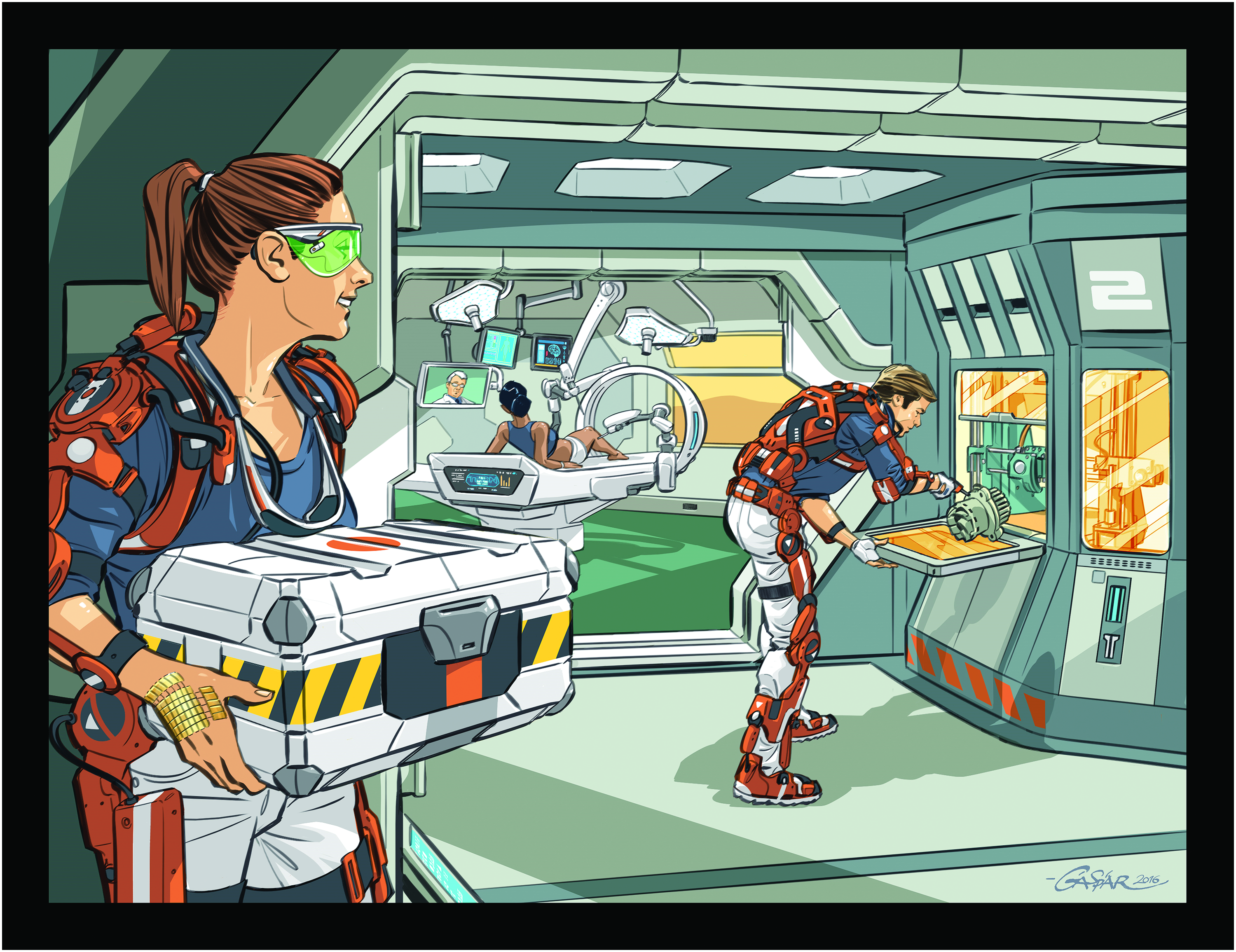
Concept art about a Mars base with disruptive medical technologies. Featured technologies include augmented reality glasses, a digital tattoo serving as a health tracker, an exoskeleton, a 3D printer, a surgical robot, and telemedicine. Color images available online at www.liebertpub.com/space
List of Disruptive Technologies in Digital Health That Could Support a Manned Mission to Mars and Has Been Evaluated in at Least One Medical Study
Personalized Medicine and Biotechnology
Genomic analyses of crew members can identify the major risk factors regarding lifestyle diseases, 27 determine what clinically relevant mutations they carry, or what medications they would have a side effect to. 28 Predictive algorithms would help prevent diseases or prepare for them in time. 29
There also have been experiments with DNA sequencing in space30,31 with the conclusion that nanopore-based sequencers could be made flight ready with only minimal modifications. As the cost of genome sequencing has been declining and hand-held technologies have become accessible, astronauts might be able to routinely sequence DNA and analyze other biomaterials such as bodily fluids too. This could augment therapeutic precision in case of treating infections.
Biotechnology methods including the genome editing technique CRISPR would allow astronauts to perform basic scientific experiments and engineer microbes that can produce antibiotics and insulin, among others. 32
Deep learning algorithms could mine the genomic databases of astronauts and suggest lifestyle changes to avoid diseases or help catch them early. With the advances in nutrigenomics, dietary habits could be fine tuned to meet the special metabolic needs of every crew member. This way, the diet, lifestyle choices, and treatments would all be tailored to the needs of astronauts.
Virtual Reality
While preparing astronauts, virtual reality simulations could reveal the stressors that affect them the most individually. 33 During missions, virtual reality could help reduce anxiety and deal with social issues. As an example, when patients staying at a hospital could experience virtual reality by using head-mounted devices, most of them described the experience as pleasant and it was capable of reducing pain and anxiety. 34
As virtual reality devices become more comfortable to wear and smaller in size, these could become helpful in managing the psychological well-being of the crew to avoid the many mental health challenges past missions have had to face.
Augmented Reality
Augmented reality projects digital information onto real-life scenes through head-mounted devices or digital contact lenses. There are experiments with implanted lenses too that provide augmented reality. 35
These could help access and digest more information on the go compared with traditional screens and hand-held devices. To help with tasks that are difficult to perform in space, vein scanners help find a vein for a blood test through augmented reality and a device can take blood in a safe way under such augmented supervision.36,37
Health Sensors
Astronauts and mission control should be able to assess the health of the crew at any time with enough details to make informed decisions. Health sensors that determine sleep quality, physical activity, relieve stress, or aid meditation could help crew members develop a rigorously healthy lifestyle before the mission, which could facilitate a similarly healthy behavior during the flight itself. 38
Sleep sensors can determine sleep quality including the length of light sleep, deep sleep, and REM stages. There are sensors that measure heart rate, breath rate, and blood oxygen levels too in the form of a smartwatch. The smart alarm can wake the user up at the most convenient time within a predefined time frame by vibrating at the end of a sleep cycle. 39 Digital health sensors can already measure plenty of parameters and can be used even by laypeople.
Fitness trackers including smartwatches, chest strips, and muscle sensors 40 can measure physical activity as well as how many calories the user burnt, besides constantly monitoring heart rate. Stress can be quantified by measuring changes in the skin's ability to conduct an electrical current known as EDA. 41 Headbands can record electroencephalograms and transform the data into digestible sort of information, for example, whether the user's brain is active or calm or how much it can focus on a given task. 42
During missions, a myriad of technologies offers insights about the state of health of the crew as well as assist in acute interventions. Wireless, wearable sensors thin as a digital tattoo measure vital signs and physical activity. 43 By connecting to a device through Bluetooth, it can also send notifications about health events that require attention and seamlessly record every measurements. Even blood glucose sensors can be implanted right under the skin with a tiny needle to allow continuous monitoring. 44
Carré Technologies have developed Astroskin, a biomonitoring system for use aboard the International Space Station, for The Canadian Space Agency. Consisting of a smart shirt and remote health monitoring software, Astroskin can collect scientific data on astronauts' vital signs, sleep quality, and activity levels during their missions. Testing it during a 6-month mission aboard the International Space Station is expected in 2018–2019. 45
Extrapolating from current health trackers, one could expect that a digital tattoo would measure all required vital signs and health parameters, notify mission control and the user if something needs medical attention, and would allow constant analysis of data to provide suggestions about fine-tuning lifestyle, completely engaging the user.
Portable Diagnostic Devices
Portable, point-of-care diagnostic devices provide clinical data on demand from cardiac and lung sounds to ECG and the related automatic analyses. 46 Such devices are currently available and the inclusion of laboratory tests into hand-held devices is expected to happen in the next 5 years.
There are two finalists in the Tricorder XPRIZE competition that aimed to develop a device similar to the medical tricorder in the Star Trek TV series. The winner device could measure heart rate, blood pressure, respiratory rate, body temperature, and oxygen saturation. It offered a biotechnology test kit, an ECG monitor, a thermometer, and a stethoscope. The other finalist presented various blood tests in the kit alongside sensors measuring vital signs. Clinical trials testing their efficiency are needed to confirm their claims. 47
These devices would obtain medical data about the crew's health and provide immediate medical analysis before information could reach the medical team on the ground. This is similar to how modern ambulances are equipped with portable diagnostic devices to aid diagnoses and make interventions faster even before arriving at the hospital.
Artificial Intelligence
NASA has used medical record systems to analyze health and medical data of astronauts. As a sign of significant progress, narrow AI algorithms such as IBM Watson or DeepMind support medical decision-making by mining the medical literature and suggesting the treatment option with the highest probability of success.48,49
Chatbots supported by AI could answer basic medical questions from a constantly updated database. 50 These could also diagnose medical conditions such as coronary artery disease or depression by using vocal biomarkers.51,52 The use of chatbots that are powered by AI could facilitate the diagnosis and treatments of simpler medical conditions when time delay would not allow rapid conversation with the medical staff on the ground.
Telemedicine
Telemedical services such as American Well connect patients to caregivers through video. 53 InTouch Health develops robots that can move autonomously and provide telemedical services from a distance. 54
As crew members might have experience in only a few medical specialties, such telemedical robots could fill the gaps and serve as health assistants on board.
3D Printing
3D printers can print out customized finger splints and casts for broken limbs that can also facilitate rehabilitation with a device that stimulates muscles inside the cast. It was shown that certain biomaterials such as bone, cartilage, liver tissue, and others can be printed out with a 3D printer by using special scaffolds.
Hand-held devices would allow astronauts in about 5–10 years to replace basic tissue types from skin to bone in case of injuries.
The first drug printed out with a 3D printer was approved by the U.S. Food and Drug Administration in 2015. Drugs with a few components can be printed out in shapes designed in a software.55,56
Based on these developments, medical equipment, parts of exoskeletons, casts for injuries, basic drugs, and certain living tissues could be printed out in a future Mars mission on board.
Radiology
Currently, ultrasound is the only imaging technique on board due to limitations in size and other parameters. The first handheld ultrasound scanner that works with a mobile application and allows remote analysis of the results was introduced in 2016. 57 The way imaging results are analyzed is changing too. IBM launched an algorithm called Medical Sieve qualified to assist in clinical decision-making in radiology and cardiology. The “cognitive health assistant” is able to analyze radiology images to spot and detect problems faster and more reliably. 58
In case of emergency, this could help provide a preview of the medical problem until the imaging results reach the medical team on ground.
Robotics
Exoskeletons support the physical strength of its user and might also decrease fatigue. 59 With advancements in 3D printing, such exoskeletons gradually become more comfortable to wear and simpler to create or replace.
Surgical robots can be controlled from a distance and eventually become fully autonomous for certain, simpler procedures.60,61 It would also be crucial to include such robots on board during emergencies.
Finally, brain computer interfaces would make it possible to interact with computers in a more efficient way. 62
Conclusion
Digital health offers a vast network of technologies that could support human mission to Mars. Certain companies developing such technologies even have experience and more importantly data of millions of patients. 63 It also introduces the concept that involving the end users of these technologies is a crucial component in maintaining their motivation of living a rigorously healthy lifestyle. The transition from astronauts' regular lifestyle to a data-based lifestyle should start before the mission to ensure the necessary habits are built on time, resulting in active use of the necessary technologies and leading to seamless collaboration between the crew and mission control.
Regarding the digital health technologies, although some of them such as virtual reality and genomic analyses have been tested by space agencies, more analyses are needed to determine whether they can function properly even under the special circumstances of long spaceflights.
By 2020–2030, when the first expected Mars missions would take place, significant developments are expected to become available. 3D printing, robotics, AI, genomic analysis, virtual, and augmented reality could all get to a stage wherein their use would be unquestionable on board in preventing diseases, catching them early, allowing quick intervention, and constant monitoring of medical problems.
This article suggests the idea that the digital health revolution should be applied to the care provided for the crew on human missions to Mars. It also described a range of technological solutions already in use in healthcare or in the prototype stage that would be needed to support the prevention, diagnoses, treatment, and monitoring of crew members on missions that take years to complete. Certain trusted online resources help keep track of changes and new developments for every disruptive technology (Table 3).
List of Online Resources That Help Keep Track of Changes and Developments of Digital Health Technologies
As a conclusion, a higher synergy between developers and researchers in digital health and space technologies would help avoid astronauts facing unnecessary risks in hostile environments. Furthermore, more detailed studies are needed to test whether specialized digital health technologies need to be developed to work effectively in high-radiation environments and in microgravity, and to fully exploit their potential in supporting human missions to Mars and beyond.
Footnotes
Author Disclosure Statement
No competing financial interests exist.