




Abstract
Abstract
An analysis of cost savings that could be realized on active debris removal (ADR) missions through the use of reusable launch vehicles (RLVs) has been performed. Launch vehicle price estimates were established for three levels of RLV development, based on varying levels of technological development and market competition. An expendable launch vehicle (ELV) price estimate was also established as a point of comparison. These price estimates were used to form two separate debris removal mission cost estimates, based on previously proposed debris removal mission concepts. The results of this analysis indicate that RLVs could reduce launch prices to levels between 19.6% and 92.8% cheaper than ELVs, depending on the level of RLV maturity. It was also determined that a RLV could be used to realize total ADR mission cost savings of between 2.8% (for a partially RLV in an uncompetitive market) and 21.7% (for a fully RLV in a competitive market).
Introduction
Background
In coming decades, reusable launch vehicles (RLVs) could improve access to space by reducing cost barriers and improving availability of space transportation services. 1 This can be achieved through the amortization of launch vehicle manufacturing costs over multiple flights, which is impossible, by definition for single-use expendable launch vehicles (ELVs). Such a development would reduce risk and improve viability of current commercial space operations, whereas also improving the feasibility of proposed new ventures. As a result, missions and business plans that are currently considered impractical from a cost perspective could become feasible. 2 The idea of RLVs of reducing space transportation costs and fostering growth in the space economy is not new, with proposals for reusable rocket boosters dating back to the late 1950s. 3 However, the high costs of the world's first partial RLV program, the Space Shuttle (Fig. 1), highlighted the challenges associated with developing a low-cost RLV. 4

Space Shuttle. Source: Ref. 5
Despite these challenges, development of RLVs has continued in the private sector after the retirement of the shuttle. In March 2017, the SES-10 communications satellite was launched aboard a SpaceX Falcon 9 rocket with a flight-proven booster stage (Fig. 2), which was previously used for an International Space Station cargo resupply mission.7,8 The SES-10 launch demonstrated for the first time that RLVs could be commercially viable. 9

SpaceX Falcon 9 launches SES-10. Source: Ref. 6
With commercial RLV operations now underway, the long-term implications of this technology on both the space transportation industry and the wider space sector should be considered. A common concern associated with RLV economics is the high demand for space transportation and subsequent frequent launch rates required to make RLVs commercially sustainable in the long term.1,2. Opening up new markets and economic opportunities through RLV-enabled low-cost, high-availability space transportation is considered to be crucial to stimulating this required growth. 2
Active debris removal (ADR) missions represent an application wherein RLVs could reduce costs and improve economic feasibility. Even with a high rate of postmission disposal for future space missions, the amount of space debris in Earth orbit is expected to increase due to collisions and fragmentation in coming decades. The commensurate increased risk to all manner of orbital assets poses a significant space environmental hazard to continuing space operations. 10 ADR is now considered to be necessary for managing the orbital debris population to ensure continued access to space in the future. 11
Presently, there are several significant issues associated with the development and operation of ADR missions, including but not limited to technical, legal, political, and economic challenges. 10 Lower space transportation costs, enabled by RLVs, could reduce the overall cost of proposed ADR missions, improving their economic feasibility. In turn, increased demand for space transportation from ADR missions could improve the long-term business case for RLVs.
Objectives
The aim of this study described in this article is to investigate the level of economic benefit that RLVs could deliver to ADR mission concepts. Space transportation price estimates are established based on extrapolation of current RLV operations. ADR mission cost estimates are established using parametric cost estimating applied to detailed mission architectures established in previous studies. These estimates are used to forecast potential cost reductions ADR missions could achieve through RLVs as a proportion of total mission costs. Other potential impacts of RLVs on the orbital debris problem are also considered in a qualitative analysis.
Launch Price Estimates
In this section, estimates for RLV prices are established. Several different RLV price estimates are established based on varying level of market and technological maturity. An ELV price is also established as a baseline for comparison. All prices are adjusted to fiscal year (FY) 2020 U. S. dollars (USD) for compatibility with ADR mission cost estimates. As discussed in Background section, historical RLV price estimates have been overly optimistic. However, with recent developments, it is possible to establish more realistic estimates of RLV prices based on information from industry.
Both the ELV and RLV price estimates in this section are based on the SpaceX Falcon 9 launch vehicle. As the only orbital partial RLV currently used in commercial operations, the Falcon 9 is an ideal basis for RLV price modeling. Furthermore, even as an ELV, the Falcon 9 is currently the most cost-effective medium-lift launch vehicle on the global space transportation market. 9 Thus, comparison between ELV and RLV prices will be conservative, as opposed to comparing the reusable Falcon 9 RLV to a more expensive ELV.
ELV Price Estimate
Establishing an ELV price estimate for the Falcon 9 is relatively straightforward, as this information is available in the public domain. According to SpaceX, 12 a Falcon 9 ELV costs USD 62 million. Converting this value to FY2020 USD using the inflation factors from Ref. 13 results in an ELV price estimate of USD 66.2 million.
Low-Maturity RLV Price Estimate
For the purposes of this study, a “low-maturity” RLV price assumes both low market and technological maturity. “Low market maturity” refers to a situation in which there is only one RLV operator in the space transportation industry, allowing them to pass some cost savings on to clients, while at the same time retaining a significant portion of the cost savings as increased earnings. Without competition from other low-cost RLVs, the operator can still undercut ELV prices, while maintaining high-profit margins.
“Low technological maturity” refers to a situation in which the RLV is only partially reusable. In this situation, the first stage is reused, but other components such as upper stages and payload faring are expendable. Furthermore, reusable booster service life is limited to a low number of flights.
The aforementioned conditions reflect the current state of RLV development—the Falcon 9 is currently the only RLV in commercial operation, and its reusability is currently limited to the booster stage. A 2016 analysis performed by investment bank Jefferies International LLC describes in which the launch price of a Falcon 9 RLV is estimated, under assumptions similar to the aforementioned “low maturity” conditions. 14
Specifically, the analysis described in Ref. 14 assumes an expendable launch price of USD 61.2 million, a gross margin of 40% on expendable Falcon 9 flights, that the booster represents 75% of total launch costs (based on public statements by SpaceX executives), that the booster has a service life of 15 flights, and that SpaceX passes on 50% of reusability cost savings, retaining the other 50% as earnings. Based on these assumptions, the reduced launch price determined in Ref. 14 is USD 48.3 million, with SpaceX's gross margin for an RLV flight increasing to 77%.
However, some of these assumptions have since been proven to be outdated. Specifically, the launch price for an expendable Falcon 9 is now listed as USD 62 million, and SpaceX executives have claimed that the booster represents closer to 70% of total launch costs. 15 Thus, it is necessary to modify the analysis described in Ref. 14 using these updated figures. This modified analysis process is described hereunder.
The direct cost of an expendable launch can be determined as shown in Equation (1).
The cost of an expendable first stage can be estimated based on a proportion of the direct cost, as shown in Equation (2).
It follows that the recurring launch costs not associated with a reusable booster can be determined as shown in Equation (3).
The cost of a reusable booster stage can then be estimated as shown in Equation (4).
Using this value, the direct cost of a reusable launch can be determined as shown in Equation (5).
Using the same cost saving assumptions from Ref.
14
(i.e., cost savings split evenly between reducing prices for clients, and increasing retained earnings for the operator), the price of an RLV can be determined as shown in Equation (6).
Finally, the gross margin for an RLV can be determined as shown in Equation (7).
The only difference between this estimate and the analysis described by de Selding 14 is the values used for some of the parameters in Equations (1)–(7) have been updated. The values assigned to these parameters are described in Table 1.
Low-Maturity Reusable Launch Vehicle Price Estimate Analysis Input Parameters
FY, fiscal year; USD, U. S. dollars.
Using the data from Table 1 with the solution methods described in Equations (1)–(7) and converting to FY2020 USD result in a low-maturity RLV price estimate of USD 53.2 million, and a corresponding gross margin for RLV of 74.1%. This represents a saving of 19.6% over comparable ELV prices.
Intermediate-Maturity RLV Price Estimate
For the purposes of this study, an “intermediate-maturity” RLV price assumes high market maturity, but low technological maturity. “High market maturity” refers to a situation in which there are two or more RLV operators in the space transportation industry, resulting in competition that reduces profit margins, and lowers costs for clients. At the same time, the “low technological maturity” assumption remains in effect, indicating that reusable technology would still only extend to a first or booster stage with a short service life. With rival partial RLVs like the Blue Origin New Glenn expected to enter service in the near future, 16 competition between SpaceX and Blue Origin will likely result in this “intermediate-maturity” scenario coming to pass.
As demonstrated in Low-Maturity RLV Price Estimate section, low market maturity can result in significant profit margins. It is assumed that high market maturity will result in profit margins more aligned with industry averages. Economic data indicate that the average gross margins in the U.S. aerospace and defense sector are ∼20%.
17
Using this lower gross margin value for RLV operations, the analysis described in Low-Maturity RLV Price Estimate section can be replicated for a high market maturity scenario. In this case, gross margin is specified as an input and used to determine RLV price. Thus, Equations (6) and (7) are replaced with Equation (8).
The parameter input values used in this analysis are described in Table 2. Using Equations (1)–(5) and (8), along with the values in Table 2, and converting to FY2020 USD, the intermediate-maturity RLV price can be estimated as USD 17.5 million. This represents a saving of 73.4% over comparable ELV prices.
Intermediate-Maturity Reusable Launch Vehicle Price Estimate Analysis Input Parameters
High-Maturity RLV Price Estimate
For the purposes of this study, a “high-maturity” RLV price assumes both high market and technological maturity. “High technological maturity” refers to a situation in which technology has progressed to a point wherein the RLV is fully reusable. For the Falcon 9, this would mean a reusable upper stage and payload faring—future developments that SpaceX executives have discussed publicly. 18 High technological maturity will also likely include an extension in reusable component service life. As described in Intermediate-Maturity RLV Price Estimate section, “high market maturity” refers to a situation in which price competition between RLV operators forces gross margins down to industry-average levels for the aerospace and defense sectors.
To estimate the direct costs for a “high technological maturity” Falcon 9 RLV, it is necessary to estimate the cost and reuse rates for all three potentially reusable components: the booster stage, the payload faring, and the second stage. As described in Low-Maturity RLV Price Estimate section, the booster stage represents ∼70% of total launch costs. However, for a technologically mature reusable booster, service life could potentially be extended to 40 reuse flights. 19 SpaceX has stated publicly that the payload faring costs about USD 6 million. 18 As a service life for this component has not been established in the public domain, the conservative estimate of 15 reuse flights from Ref. 14 is used.
SpaceX considers reusing the second stage of the Falcon to be a stretch goal, and has not publicly described the potential rate of reuse, or the cost of the stage. As a service life for this component has not been established in the public domain, the estimate of 15 reuse flights from Ref.
14
is used. The cost of the second stage is estimated based on proportional scaling of the booster stage. Both stages use variants of the Merlin engine—nine of the engines are used in the first stage, and one vacuum-optimized variant is used in the second stage. Rocket engines are typically one of the most expensive components in a launch vehicle stage.
3
Thus, assuming stage costs are roughly proportional to engine costs, the cost of the second stage can be estimated as shown in Equation (9):
To account for their reuse, it is necessary to determine the reusable costs for the payload faring and second stage, as shown in Equations (10) and (11).
The reuse of the faring and second stage, in addition to the booster stage, must be accounted for in determining recurring costs and RLV direct costs. Thus, Equations (3) and (5) must be amended for this analysis, as shown in Equations (12) and (13), respectively.
The parameter input values used in this analysis are described in Table 3. Using Equations (1), (2), (4), and (8)–(13), along with the values in Table 3, and converting to FY2020 USD, the high-maturity RLV price can be estimated as USD 4.8 million. This represents a saving of 92.8% over comparable ELV prices.
High-Maturity Reusable Launch Vehicle Price Estimate Analysis Input Parameters
Adr Mission Cost Estimates
To determine the proportional cost savings that RLVs could enable on an ADR mission, it is necessary to estimate the total cost of an ADR mission. Existing architectures for two different ADR missions are used as baselines for these cost estimates: the Autonomous Debris Removal Satellite-A (ADReS-A) mission, 20 and a foam-based debris removal mission. 21 These missions were selected as baselines due to their detailed mission architectures that have been published in the public domain. These detailed architectures enable cost estimates for these missions to be developed. The cost estimation methodology used in this study is described in this section.
Cost estimates have been established using parametric cost models from Ref. 13 These models use mass breakdowns to estimate the cost of the spacecraft bus, which, in turn, is used to calculate payload, integration, assembly & test (IA&T), program, ground support equipment (GSE), and operations support costs. Cost estimates are provided for both research, development, test & evaluation (RDT&E) and theoretical first unit (TFU).
Launch costs are calculated based on the launch mass of the spacecraft, and the various price estimates are established in Launch Price Estimates section. The payload capacity to low Earth orbit (LEO) for an expendable Falcon 9 is 22,800 kg. 12 This capacity is likely to be lower for RLV flights, due to the need to carry additional propellant for re-entry, descent, and landing. Thus, the payload capacity for a Falcon 9 RLV was assumed to be 15,000 kg. It was assumed that, if capacity allowed, multiple ADR spacecraft would be carried on a single launch flight to reduce costs.
This study also assumes that ADR operations are conducted on a commercial basis, and a private sector reduction in RDT&E costs of 20% is applied, as described in Ref.
13
Both systems are scaled to remove 50 individual debris targets for a 10-year period, to meet the five debris per year goal required to stabilize the debris population.
10
A learning curve is assumed, as described in Ref.,
13
whereby the total production costs for all spacecraft manufactured under the program are determined based on a gradual decrease in costs from the TFU, as efficiency improves over time. The learning curve formula is given in Equation (11).
ADReS-A Mission Cost Estimate
The proposed ADReS-A uses a large main spacecraft to rendezvous with expended rocket bodies in LEO, attach a smaller spacecraft, referred to as a “deorbit kit” to the rocket body, and then uses the deorbit kits propulsion system to deorbit the rocket body. 20 The main spacecraft carries five deorbit kits, 20 hence five main spacecraft and 50 deorbit kits would need to be manufactured and launched to meet the specified debris removal goals of 50 targets for a 10-year period.
The total RDT&E and TFU costs of the two types of spacecraft required for this mission have been estimated based on separate estimates for their individual subsystems. Specifically, estimates have been developed for the cost of the structure, thermal protection system (TPS), electrical power system (EPS), command & data handling (C&DH), attitude determination and control system (ADCS), and propulsion systems, based on parametric cost models from Ref. 13 These cost models use subsystem mass as input parameters. In some cases, estimates for the two spacecraft are based on different cost models, due to the differing scales of the subsystems. All cost models described in this section take inputs in kilograms and give outputs in FY2000 USD.
For the main spacecraft, the RDT&E and TFU costs of the structure are estimated as shown in Equations (15) and (16), respectively.
For the deorbit kit, the RDT&E and TFU costs of the structure are estimated as shown in Equations (17) and (18), respectively.
For the main spacecraft, the RDT&E and TFU costs of the TPS are estimated as shown in Equations (19) and (20), respectively.
For the deorbit kit, the RDT&E and TFU costs of the TPS are estimated as shown in Equations (21) and (22), respectively.
For both the main spacecraft and the deorbit kit, the RDT&E and TFU costs of the EPS are estimated as shown in Equations (23) and (24), respectively.
For both the main spacecraft and the deorbit kit, the RDT&E and TFU costs of the C&DH system are estimated as shown in Equations (25) and (26), respectively.
For the main spacecraft, the RDT&E and TFU costs of the ADCS are estimated as shown in Equations (27) and (28), respectively.
For the deorbit kit, the RDT&E and TFU costs of the ADCS are estimated as shown in Equations (29) and (30), respectively.
For both the main spacecraft and the deorbit kit, the RDT&E and TFU costs of the propulsion system are estimated as shown in Equations (31) and (32), respectively.
For both the main spacecraft and the deorbit kit, the RDT&E and TFU costs of the payload are estimated as shown in Equations (33) and (34), respectively.
For both the main spacecraft and the deorbit kit, wraps are applied to the spacecraft bus cost to estimate the various IA&T, program, GSE, and operations support costs. These costs for both RDT&E and TFU are estimated as shown in Equations (35) and (36), respectively.
The ADReS-A spacecraft specifications used to develop the cost estimate are detailed in Table 4. Based on the combined total launch mass of both spacecraft (QTY 1 main spacecraft and QTY 5 deorbit kits) of 2,443 kg, it was assumed that six missions could be launched into LEO on a single Falcon 9 flight.
Autonomous Debris Removal Satellite-A Spacecraft Specifications
Source: Ref. 20
ADCS, attitude determination and control system; C&DH, command & data handling; EPS, electrical power system; TPS, thermal protection system.
Using the specifications detailed in Table 4, along with the cost models described in this section, the total cost (excluding launch costs) of all missions for a 10-year, 50-target ADR program converted into FY2020 USD has been estimated as $677.8 million. Based on a single mission costing one-sixth of a full launch cost (assuming manifesting of multiple payloads can be used to reduce launch costs), the launch costs have been estimated for an ELV, and for RLVs at various maturity levels, as described in Launch Price Estimates section. The total mission costs for the various launch scenarios are detailed in Table 5.
Autonomous Debris Removal Satellite-A Mission Total Cost Estimates
ELV, expendable launch vehicle; RLV, reusable launch vehicle.
Foam-Based Debris Removal Mission Cost Estimate
The proposed foam-based debris removal mission uses a spacecraft to rendezvous with debris in LEO, and spray the target debris with expanding foam, which increases the debris drag coefficient and accelerates its orbital decay rate. 21 According to Ref., 21 seven spacecraft would need to be launched to meet the specified debris removal goals of 50 targets for a 10-year period.
As with the ADReS-A cost estimate described in ADReS-A Mission Cost Estimate section, the total RDT&E and TFU costs of the spacecraft have been estimated based on estimates for their individual subsystems. Specifically, estimates have been developed for the cost of the structure, TPS, EPS, C&DH, ADCS, and propulsion systems, based on parametric cost models from Ref. 13 These cost models use subsystem mass as input parameters. All cost models described in this section take inputs in kilograms and give outputs in FY2000 USD.
The costs of the structure are estimated using the same formulas for the ADReS-A main spacecraft cost estimate in ADReS-A Mission Cost Estimate section, namely Equation (15) for RDT&E costs and Equation (16) for TFU costs. Likewise, the costs of the TPS are estimated using the same formulas for the ADReS-A spacecraft cost estimate in ADReS-A Mission Cost Estimate section, namely Equations (19) and (15) for RDT&E costs and Equation (20) for TFU costs.
The RDT&E and TFU costs of the EPS are estimated as shown in Equations (37) and (38), respectively.
The costs of the C&DH system are estimated using the same formulas for the ADReS-A spacecraft cost estimate in ADReS-A Mission Cost Estimate section: Equation (25) for RDT&E costs and Equation (26) for TFU costs. Likewise, the costs of the ADCS are estimated using the same formulas for the ADReS-A main spacecraft cost estimate in ADReS-A Mission Cost Estimate section, namely Equations (27) and (15) for RDT&E costs and Equation (28) for TFU costs.
The RDT&E and TFU costs of the propulsion system are estimated as shown in Equations (39) and (40), respectively.
The costs of the payload are estimated using the same formulas for the ADReS-A spacecraft cost estimate in ADReS-A Mission Cost Estimate section, namely Equations (33) and (15) for RDT&E costs and Equation (34) for TFU costs.
The foam-based debris removal spacecraft specifications used to develop this cost estimate are detailed in Table 6. Based on the total launch mass of the spacecraft of 4,600 kg, it was assumed that three missions could be launched into LEO on a single Falcon 9 flight.
Foam-Based Debris Removal Spacecraft Specifications
Source: Ref. 21
Using the specifications detailed in Table 6, along with the cost models described in this section, the total cost (excluding launch costs) of all missions for a 10-year, 50-target ADR program converted into FY2020 USD has been estimated as $650.0 million. Based on a single mission costing one-third of a full launch cost (assuming manifesting of multiple payloads can be used to reduce launch costs), the launch costs have been estimated for an ELV, and for RLVs at various maturity levels, as described in Launch Price Estimates section. The total mission costs for the various launch scenarios are detailed in Table 7.
Foam-Based Debris Removal Mission Total Cost Estimates
Consolidated Results
Launch Price Estimates
The launch price estimates for an ELV, as well as low-, intermediate-, and high-maturity RLVs, are shown in Figure 3. RLV price reductions range from 19.6% for a low-maturity RLV to 92.8% for a high-maturity RLV. Although a high-maturity (i.e., commercially competitive, fully reusable) RLV might not be feasible with current technology, this analysis indicates that significant cost reductions can be achieved with an intermediate-maturity (i.e., commercially competitive partially reusable) RLV. This result highlights the importance of a competitive RLV market in lowering space transportation costs. A single launch operator developing RLV technology is insufficient. Unless operators are motivated by competition to reduce RLV price margins, it is unlikely that significant space transportation cost reductions can be achieved.
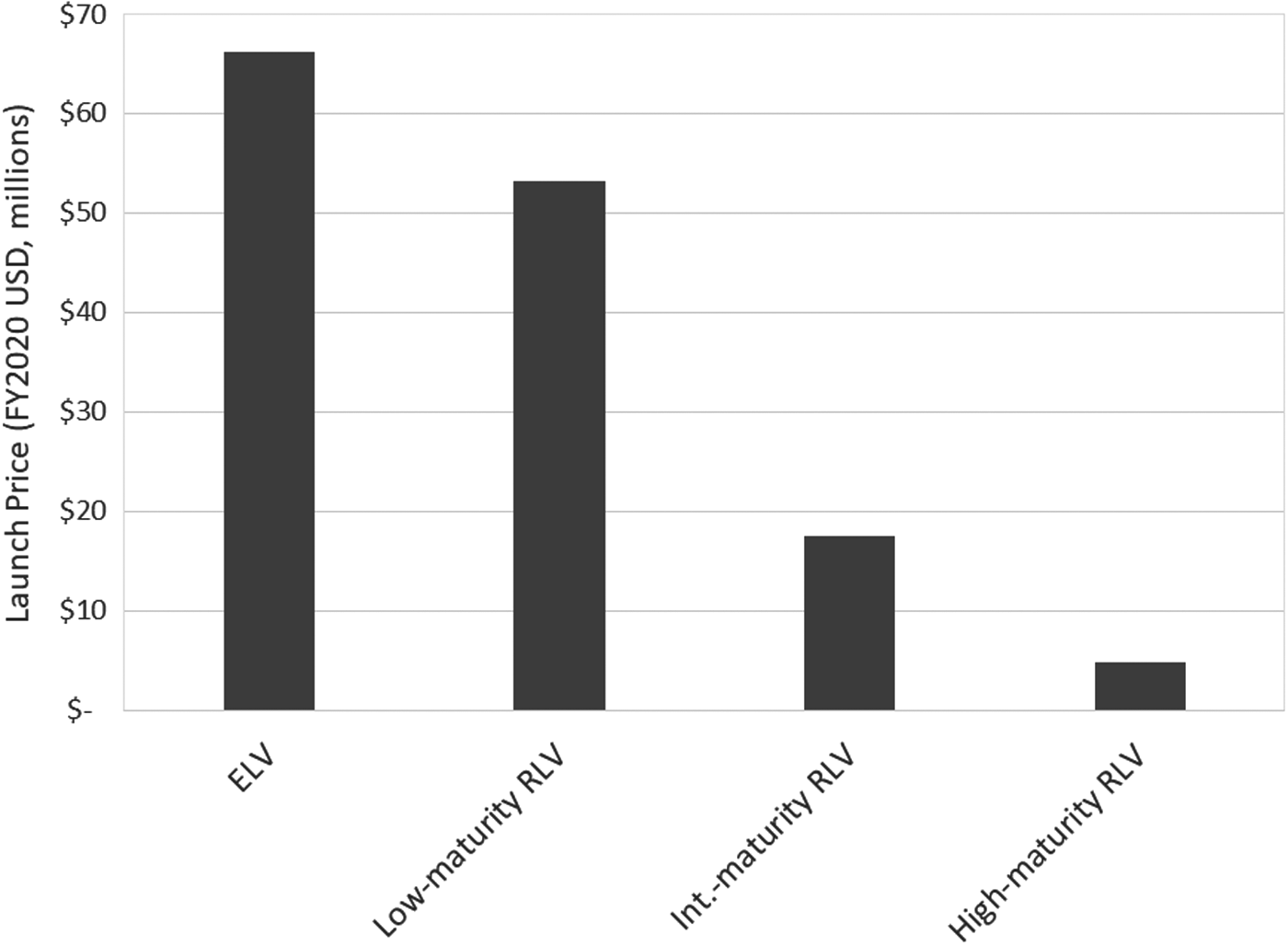
Launch price estimates. ELV, expendable launch vehicle; FY, fiscal year; Int., intermediate; RLV, reusable launch vehicle; USD, U.S. dollars.
ADR Mission Costs
Total mission costs for the two ADR missions, with different launch price scenarios, are shown in Figure 4. Potential savings from employing RLV technology range from 2.8% for a low-maturity RLV used on the ADReS-A mission to 21.7% for a high-maturity RLV used on the foam-based debris removal mission. The results indicate that, due to higher total launch mass requirements, greater savings can generally be achieved by using RLVs on the foam-based debris removal mission in comparison with the ADReS-A mission.

Total mission cost estimates. ADR, active debris removal; ADReS-A, Autonomous Debris Removal Satellite-A.
As shown in Figure 4, for ELVs or low-maturity RLVs, the ADReS-A mission has a lower total mission cost. However, for a case wherein intermediate- or high-maturity RLV is used, the foam-based debris removal mission becomes the more cost-effective option. This result demonstrates the impact that RLV technology can have on the feasibility of ADR mission architectures.
Other Considerations
The development and proliferation of RLV technology could have significant impacts on the orbital debris environment outside of ADR mission feasibility. For example, expended launch vehicle upper stages constitute almost half of total debris in orbit by mass. 10 If RLV development reaches the “high-maturity” level described in this article (i.e., fully reusable), then the act of recovering upper stages for reuse will remove them from the orbital debris environment by definition, eliminating a significant source of debris in LEO.
However, there are also significant orbital debris risks associated with the maturity of RLV technology. By significantly reducing costs, RLVs could lower barriers to accessing space, leading to increased development, and orbital traffic. If this growth is allowed to accelerate without sufficient accounting for long-term sustainability, then the risk of on-orbit collisions and fragmentation could increase significantly. This risk highlights the need to meet any growth in space transportation demand with commensurate legal, policy, and regulatory frameworks to mitigate this risk and ensure continued access to space in the future.
Conclusions
The study described in this article attempts to quantify the economic benefit that RLVs could deliver to space transportation industry clients, and subsequently the impact this technology could have on the overall cost of ADR missions. The SpaceX Falcon 9 is used as a baseline for ELV and RLV price estimates, and two ADR mission architectures from previous studies were used as baselines for ADR mission cost estimates. The results of this study indicate that RLV technology could significantly reduce ADR mission costs.
As a caveat, it is important to note that factors other than price, such as availability, target orbit, and geopolitical concerns, can also affect the launch vehicle selection process. In addition, although the results of the economic analysis in this study provide some quantitative insight into how RLVs could reduce costs and improve feasibility for future ADR missions, it is important to note that errors, although unquantified, could be present in this analysis. Launch price estimates rely heavily on assumptions and public statements from space transportation industry executives, rather than detailed financial breakdowns. ADR mission cost estimates rely on “broad strokes” parametric cost models and preliminary, undetailed mission architectures. Although the general trend of the results indicates the magnitude of potential cost reductions through RLV development, only time will tell the exact value of these cost reductions.
Footnotes
Acknowledgment
The authors thank the Secure World Foundation for its support of this study through the SWF 2017 IAC Young Professionals Scholarship.
Author Disclosure Statement
No competing financial interests exist.