




Abstract
Abstract
In 1963, Russia sent Valentina Tereshkova, the first woman astronaut into space, followed 20 years later by the U.S.'s Sally Ride. In 1996, Claudie Haignerè was the first French woman to go into orbit. Today, half of the astronauts in the United States are women. All of the 11 astronauts sent by Germany on missions into space were men. In Germany, there are women with outstanding qualifications working in engineering and aerospace. In German auditoriums, >300,000 women are currently attending lectures in so-called science, technology, engineering, mathematics subjects. This untapped potential now needs to be exploited and society must continue to attract women and girls to space and technology. We want to turn the vision to fly a first female German astronaut (Astronautin) to International Space Station in 2020 into reality. The project will be financed by crowdfunding, in-kind contributions of major players in the space field, and sponsors from the business sector. The project pursues three goals: (1) A woman astronaut will bring new life to Germany's aerospace sector by attracting more women to engineering jobs. (2) This female astronaut will become a role model who will encourage women and girls to set their sights on aviation and aerospace. (3) During the mission, she will also conduct scientific experiments, focusing on medical tests designed to examine the female body's response to zero gravity. As a first step toward a first female German astronaut, a selection process has been conducted in 2016. A total of 400 female engineers and scientists have applied to become the first female German astronaut. “Astronautin” is a completely new way of conducting a human spaceflight project. “Astronautin” is a pilot project for a new type of human spaceflight mission. With the Astronautin project, we demonstrate that this new way of conducting space projects is also possible in Europe.
“I never went into physics or the astronaut corps to become a role model. But after my first flight, it became clear to me that I was one. And I began to understand the importance of that to people. Young girls need to see role models in whatever careers they may choose, just so they can picture themselves doing those jobs someday. You can't be what you can't see.”
—Sally Ride, first female American astronaut to go into space, speaking in 2012
Introduction
The Astronautin program has two overall objectives—one practical and the other cultural perspectives:
At a practical level: fly the first female German astronaut on a mission to the International Space Station (ISS) around 2020. At a broader cultural level: demonstrate that a private entity in Europe can initiate and carry out a scientifically oriented human spaceflight mission.
The astronaut will stay on board the ISS for a short mission of around 7 to 10 days. She will conduct experiments, mainly in human physiology, for commercial sponsors of the mission.
The project has a commercial character. It has been initiated, and is being run, privately.
Program Goals
The specific goals of the program and its constituent projects also fall into the same two categories:
Practical
□ Collect scientific data on the physiological and psychological responses of a woman in space
□ Perform experiments under microgravity for education and outreach
□ Conduct commercial experiments and other sponsored activities.
Heart and minds
□ Create a role model for women and girls, and inspire them to pursue careers in human spaceflight and in the space industry more broadly
□ Conduct and complete a privately organized and managed human spaceflight project as a means of paving the way for future commercial spaceflight initiatives in Europe.
It will include novel characteristics such as:
commercial sponsorships,
commercial investments,
crowdfunding, and
private initiatives.
Naturally, the space agencies, which own the ISS, and other international partners will be involved as required and as appropriate: their input and advice will be sought at regular intervals, and they will be kept up to date on all major developments, including the achievement of major milestones.
The Selection Process
The selection process started on March 1, 2016 with a call for application. By the end date, April 30, 2016, 408 applications were received.
Job Announcement
The following job description was published:
As the first female German astronaut, you will perform the following activities:
Participate in the psychological and physical selection process;
Participate in a multiyear astronaut training in Star City near Moscow and/or in Houston, Texas;
Prepare and conduct scientific experiments on the ISS to study health and psychological behavior of women in space;
Media fundraising activities, during and after the flight;
Public outreach presentations for schools, etc.
The selection criteria were similar to those from previous European Space Agency (ESA) missions:
University degree in engineering or science or equivalent military education;
Several years of experience in science, aerospace, technology, medicine, or other relevant field;
Experience with presentations and working with media;
Medical fitness certificate, pilot license, diving license, and/or similar qualifications are an advantage;
Excellent physical and psychological fitness;
Excellent communication and teamwork skills;
German citizenship;
Fluency in English is mandatory, knowledge of Russian is an advantage.
Together with the curriculum vitae (CV) we were asking for a motivation letter, certificates, and a short video introducing the applicant (ca. 60 s).
Media interest after the publication of this job announcement was massive. It was made clear from the beginning that this will be a commercial privately financed mission and that financing the mission depended on finding enough sponsors to buy a ticket to ISS.
Preselection
Preselection was performed by the HE Space recruitment team. A database was created to evaluate the CVs and special capabilities such as parabolic flight experience, diving, and public speaking (Fig. 1).
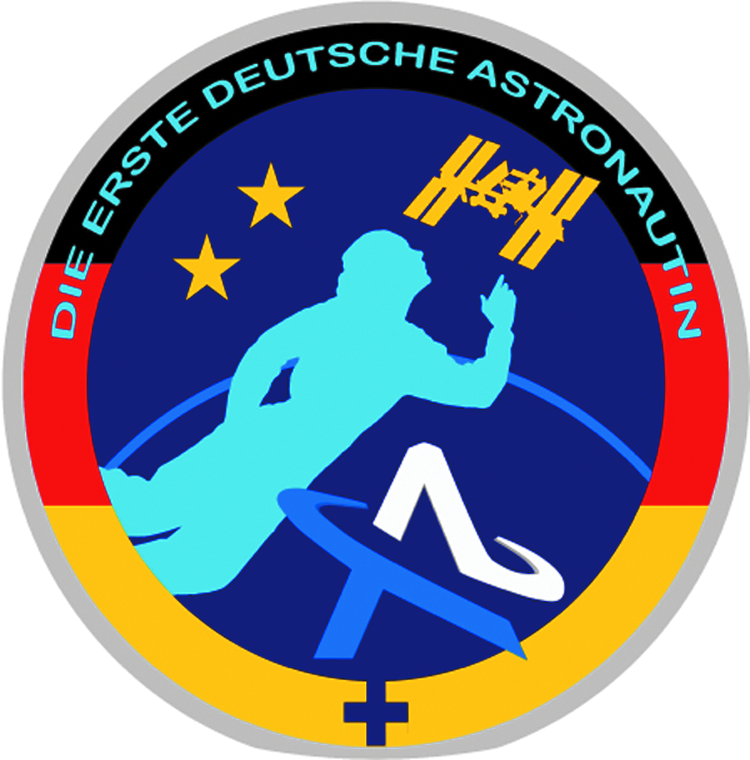
Mission patch. ©Astronautin GmbH.
With this method, the best 250 candidates out of 408 candidates were selected. A questionnaire asking for more details on nonprofessional activities, examples of experiences, and some high-level medical and legal data was sent to these 250 candidates; the result was added to the database.
A committee composed of volunteers (Prof. emeritus Rosemarie Mielke, Psychologist; Peter Eichler, retired Astronautin Trainer; Herwig Renkwitz; sports coach; and Sabine Ritter, Chief Operating Officer HE Space) watched the 250 videos and made a ranking based on six different criteria. The result was discussed in a joint meeting and the points were added to the database, leading to a new ranking and a selection of the best 150 candidates.
From mid-July to mid-August, the HE Space recruitment team interviewed the remaining 150 candidates through skype; points were given for the answers and added to the database. A new ranking was established afterward.
The best 120 candidates were invited to a media day in Berlin on September 14, which led to a huge wave of media relations, five TV stations reported live from the event, media attention was still high >1 month after the event. The event was sponsored by the Berlin office of Airbus Defence and Space. A detailed press clipping was produced and is used to attract sponsors and to show the media value of the initiative.
Psychological and Medical Selection
A cooperation agreement with Deutsches Zentrum für Luft- und Raumfahrt (DLR) was signed in June 2016. In this agreement, DLR declared to conduct the psychological and medical examination as a scientific in-house research project.
The DLR contribution started with a medial questionnaire that was sent to the best 120 candidates.
Of the 120 candidates, 86 passed this selection step and were invited in two groups to the first psychological examination at the DLR Institute of Aerospace Medicine in Hamburg on October 20 and November 9, 2016.
The best 30 candidates were invited in five groups of six persons each to a 1.5 day assessment center at the DLR Institute of Aerospace Medicine in Hamburg in December.
The best eight candidates were invited to the medical examination at the DLR Institute of Aerospace Medicine in Cologne in January/February 2017.
Final Selection
The names of the six finalists were released to us by DLR on February 21, 2017.
A media day was organized on March 1, 2017 at Airbus in Bremen to present the finalists to the press and the public. This will also be the kick-off date for the crowdfunding campaign.
The final selection was conducted by a jury of four experts:
Prof. Pascale Ehrenfreund, Chairwomen of DLR,
Prof. Ulrich Walther, Chair of Aerospace Institute of Technical University Munich and former Astronaut,
Johannes von Thadden, Airbus, and
Claudia Kessler, Chief Executive Officer of HE Space.
Two Astronautin trainees were selected to start training mid-2017 and one of them shall fly to ISS in 2020.
Selection process as pilot project for future space missions
All the elements of the selection process are documented and evaluated. The mission of the first female German Astronautin serves as a pilot project for future privately managed human spaceflight missions.
Crowdfunding Campaign
A crowdfunding campaign was conducted from March 1, 2017, to April 30, 2017, to support the first training modules. The funding goal of € 50,000 was reached, mainly by small contributions from many personal supporters. This funding is being used to conduct a first parabolic flight campaign in the Gagarin Cosmonaut Training Centre near Moskau in August 2017.
Organization of the Astronautin Program
The program is implemented with methods, policies, and procedures that have been tried and tested within the space industry, and that will thus help ensure that all program requirements are met on time and within budget.
The team for the Astronautin program is managed and led by the Astronautin GmbH, a private company that was incorporated in Bremen in March 2017.
A nonprofit company “Stiftung erste deutsche Astronautin” is incorporated to cover education, science, and public involvement in the mission.
The management team of the project is composed of specialists from various disciplines to ensure the program's success from start to finish.
Stakeholders and Roles
Table 1 gives a high-level stakeholder–engagement map for the program.
Stakeholders
Note that a stakeholder can appear in more than one category.
PR, public relations.
Requirements and Constraints
This section discusses requirements and constraints for the various components of the mission. Many of them depend on the form of cooperation with space agencies and will be clarified only in the next phases of the project.
Training
Training will be tailored to the needs of the two Astronautinnen and their background and experience. The first phase of training will start in July 2017. The following questions need to be answered before that:
Which parts of the training can be conducted online or remotely?
Who will organize the training?
What budget is needed for training, and how will it be financed?
What role will ESA play in the training?
What role will DLR play in the training?
The second training phase will start in July 2018, by which time a decision on the launcher and the mission should have been taken. The questions that need to be answered before that are which launch vehicle will be used, what activities the Astronautin will conduct on board the ISS, and which agency will approve and certify the Astronautin?
Transport to ISS and Back
The flight to ISS is the most expensive part to the project. According to information available today, the cost of a launch with a Russian Soyuz will be around €50 million.
Choosing a transport vehicle
It is assumed that between now and 2020, three commercial transport vehicles will become available to transport astronauts to the ISS. That could also lead to a drop in prices.
The three vehicles, which are thus expected to be available in 2020 itself, are:
A Russian Soyuz MS spacecraft
The Space X Crew Dragon
The Boeing Starliner CST-100.
Soyuz MS
The Russian Soyuz MS is the newest model in the Soyuz line, which has been used for human spaceflight since 1967. It is thus the most reliable spaceship, but it may also be the most expensive to use.
Soyuz MS is launched with three crew members in Kazakhstan on board a Russian Soyuz rocket.
Nine spaceflight participants have flown to the ISS with Soyuz spacecraft up to now.
Negotiations with the Russian space agency could start as soon as a significant part of the funding is secured.
Boeing starliner CST-100
CST-100 will be launched on board an Atlas 5 rocket from Cape Canaveral, FL. It is being developed by Boeing under a contract with NASA. In 2018 it will bring its first astronauts to the ISS.
It will be able to carry three crew members and one spaceflight participant to the ISS. In August 2016, a first meeting with Boeing representatives took place. Although they were able to make no firm commitments at this early stage, the signals they gave were both positive and encouraging.
Crew Dragon
In competition with Boeing, Crew Dragon is being developed by SpaceX, also under contract to NASA. It is also expected to bring its first astronauts to the ISS in 2018, but since technical problems have for the moment grounded the Falcon, the rocket it will be launched on, that schedule may need to be changed.
Negotiations with launch providers will take place in June 2018. It is hoped that, by October 2018, a launch provider will be selected and that the funding required to book a flight will be available.
Experiments on Board the ISS
On Board the ISS, the Astronautin will conduct various experiments for technological research, commercial activities, and scientific experiments, and a special focus on life sciences shall be conducted.
It is foreseen to use the Columbus module and other elements of the ISS for these research activities. Agreements with ESA and other partners have to be signed for the use of the ISS.
Nanoracks, one of the commercial providers for ISS experiments in the United States, has already indicated an interest in cooperation.
The experiments on board the ISS extend, on the one hand, to all the essential scientific areas of female physiology and biology:
Influence of gravity and space conditions on the (female) body, for example, muscles, bones, the hormonal system, the cardiovascular system, and the brain functions.
Influence of radiation on the female body to include the cellular level of physiology and possible self-healing effects.
Even if a single astronaut can examine many parameters only once, invaluable data can be gathered from these experiments and many researchers and scientists have expressed very strong and specific interest in this particular research.
Selected partner universities (Charite Berlin, Universities Braunschweig and Bonn, Purdue University) will be given the opportunity to send their experiments to the ISS. This can cover the entire spectrum of scientific research (material science, biology, physiology, and fluid dynamics). If large sponsors wish to have their own experiments carried out, this is also made possible.
As another mission, objectives are to incite enthusiasm in children and young people for space and technological issues. Therefore, pupil and student experiments will also to be carried out during this mission. An eighth grade physics lesson “Physics in Space” as a Livestream is envisaged.
Scientific findings are generally free of charge and freely accessible. In commercial experiments, this must be considered and decided on a case-by-case basis.
Cooperation with Airbus, and with DLR and/or ESA, is envisaged to prepare and manage the research program.
A major critical success factor in finding sponsors for the program will be to guarantee a number of live transmissions from the ISS to various sponsorship events. Operational planning will start once the launch to the ISS is scheduled and booked.
Financial Constraints
A major constraint facing the Astronautin project is that it will, for the most part, be privately financed.
Several sources of income are envisaged for program funding (Table 2).
Source of Income
Public Relations and Media Outreach
Media interest in the initiative has been overwhelming since day 1.
The initial focus was on the announcement of the initiative and the selection of candidates. It then shifted to the lives and portraits of the candidates. This has already contributed to one of the goals of the project: to generate public awareness of how many brilliant female engineers and scientists are living and working in Germany.
A press agency that is cooperating with the program is coordinating and managing all press requests, drafting and publishing regular press releases, and coordinating the press at events.
The final election event in Berlin on April 19, 2017, resulted in the following media coverage:
164 TV reports, with a total length of 9 h, reaching a total of 45 million people,
309 print reports reaching 47.8 million people,
811 online reports creating >1 billion page impressions, and
128 radio reports with a total length of 5 h, reaching 26.1 million.
These numbers show that there is a tremendous public interest in the mission of the first female German astronaut.
Social Media
Facebook, Twitter, XING, and LinkedIn are used on a daily basis to inform the followers about new developments in the project.
The main social media channel is on Facebook: (https://www.facebook.com/DieAstronautin/?fref=ts).
Social Media Channels
Astronautin Trainees
Nicola Baumann left the Astronautin team in December 2017 and was replaced by Dr. Suzanna Randall.
Dr. Suzanna Randall
Dr. Suzanna Randall was born in Cologne, on December 6, 1979. She is an astrophysicist and works at the European Southern Observatory in Garching near Munich. She is concerned with the evolution of stars and also works for the Atacama Large Millimeter Array project in Chile.
Suzanna Randall studied astronomy at the University of London and has a doctorate in astrophysics at the University of Montreal in Canada. During her career, Suzanna Randall has lived and worked on three continents. Today she lives in Munich. In her spare time, she goes paragliding and diving, plays piano, and sings in the choir.
Dr. Insa Thiele-Eich
Dr. Insa Thiele-Eich, born 1983 in Heidelberg, is a meteorologist and scientific coordinator at the Meteorological Institute of the University of Bonn. She conducts fundamental research for improved weather and climate prediction as well as the water or energy exchange between soil, vegetation, and atmosphere.
In her doctoral thesis, she analyzes the effects of climate change on Bangladesh. She is a mother of two and a passionate athlete.
Conclusions
There are women with outstanding qualifications working in engineering and aerospace. The international “Women in Aerospace—Europe” association alone has 500 women members with close to 30% of them from Germany. And there are plenty of young talented people waiting for their chance. In German auditoriums, >300,000 women are currently attending lectures in so-called science, technology, engineering, mathematics (STEM) subjects that include mathematics, computer science, biomedical science, and technology.
The project pursues three goals: (1) A woman astronaut will bring a new dynamic to Germany's aerospace sector and the public interest in it. (2) The female astronaut will be a role model who will encourage women and girls to set their sights on aviation and aerospace. (3) During the mission, she will also conduct high-class scientific and medical tests designed to examine the female body's response to zero gravity.
We want to turn the vision to fly a first female German astronaut (Astronautin) to ISS in 2020 into reality. The project shall be financed by crowdfunding, in-kind contributions of major players in the space field, and sponsors from the business sector.
Footnotes
Author Disclosure Statement
No competing financial interests exist.