




Abstract
The Colorado School of Mines has developed a system architecture for a lunar permanently shadowed region (PSR) mining operation to extract and process water ice into liquid oxygen/liquid hydrogen propellant. The availability of space-sourced propellants dramatically lowers the cost of space transportation beyond low Earth orbit, enabling the development of a robust commercial economy in cislunar space. A key component of the architecture is an ice extraction method called thermal mining. In thermal mining, ice is sublimated by applying heat directly to the surface and the near subsurface of the PSR, the vapor is captured under a dome-like tent, then directed toward cold traps where it refreezes for transport to a processing system. A simple business case analysis indicates thermal mining of propellants on the Moon can be a profitable commercial enterprise.
Introduction
The key to a sustainable future in space is developing and utilizing space resources. The use of space resources will both significantly reduce the cost of planned or anticipated commercial, science, and exploration missions and enable commercial businesses as well as science and exploration missions not possible otherwise. Furthermore, space resources will anchor a robust commercial economy in cislunar space, 1 adding trillions of dollars into Earth's economy in this century and further enabling science and exploration.
The closest and most accessible source of resources beyond Earth is the Moon. The Moon has been viewed as a source of resources for many decades. In the 1970s, Gerard O'Neill imagined building a space colony at the first Earth–Moon Lagrange point using 10 million tons of materials mined on the Moon. 2 In 1984, NASA conducted a 10-week summer study on space resources, focusing on the Moon and Mars. 3 Harrison Schmitt has promoted the use of 3 He implanted by the solar wind on the surface of the Moon as a fuel for fusion power on Earth. 4 But interest in lunar resources has accelerated recently with the discovery of water ice on the Moon.
One of the first economically viable uses of resources from the Moon might be propellant from water. The permanently shadowed regions (PSRs) near the poles of the Moon harbor significant quantities of water in the form of ice.5–8 Figure 1 shows a map of surface water indications at the lunar poles. Up to 30 wt% ice on the surface is indicated at some locations.
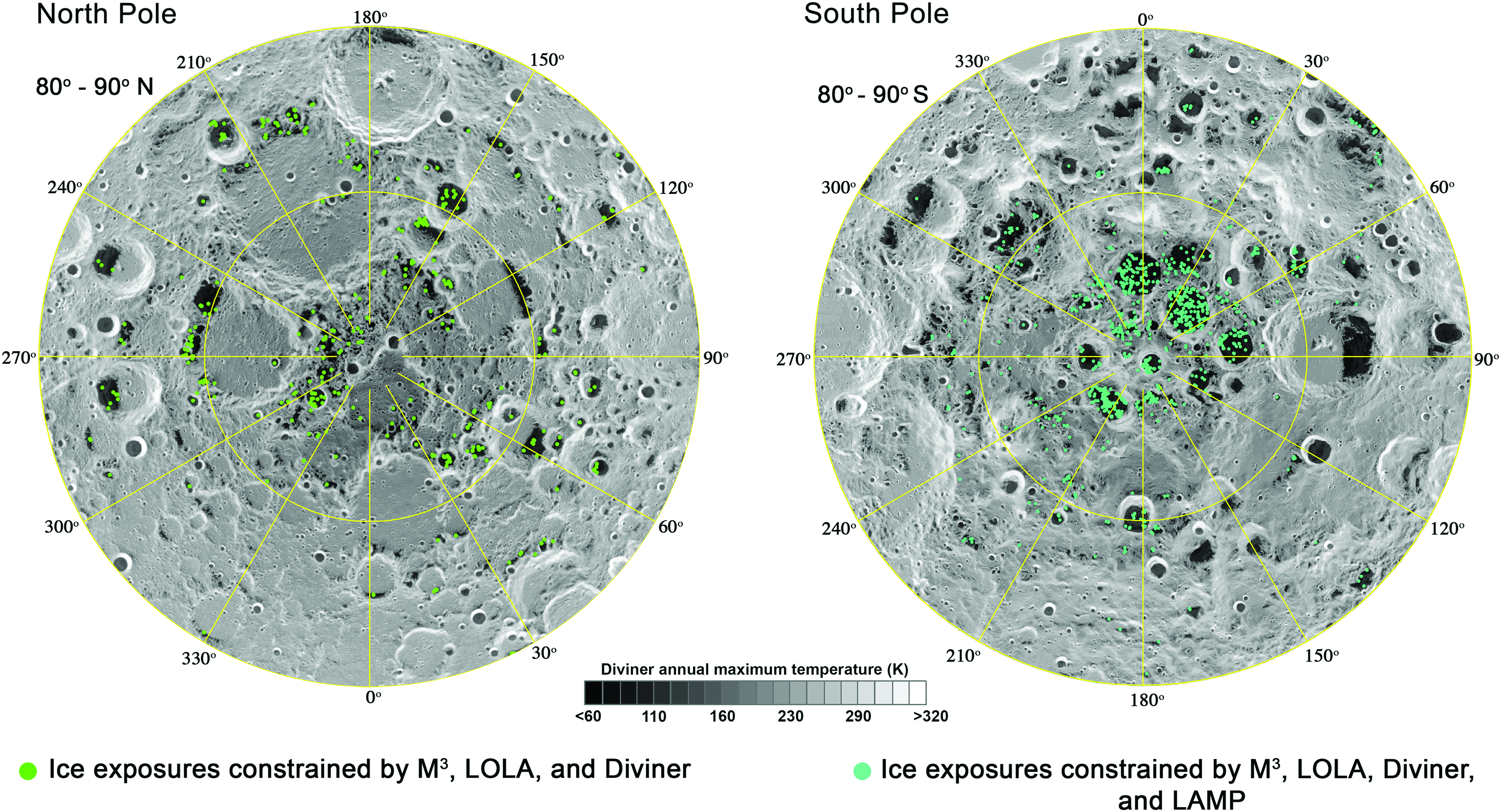
Water ice indications at the lunar poles. 8 Color images are available online.
In 2016, the United Launch Alliance (ULA) became the first commercial company to offer to buy liquid oxygen (LO2)/liquid hydrogen (LH2) propellant in cislunar space. 1 ULA set a price (it would be willing to pay) and quantities at various locations within cislunar space, for example, $500/kg on the surface of the Moon for 1,100 mT of propellant per year. In 2017, the Colorado School of Mines (CSM) performed an architecture study 9 to determine whether the stated price of $500/kg was feasible. This article documents the results of the study. As is shown hereunder, a price point of $500/kg is indeed feasible under a set of plausible assumptions about the nature and quantities of water ice available.
Study Methodology and Results
The CSM study utilized the systems engineering processes of concept development and feasibility determination. A wide number of potential candidate architectures for ice extraction and processing into propellant were first brainstormed. The 3 most promising concepts were selected for further analysis. An overall functional architecture was created (Fig. 2), showing a strong convergence in many of the functional elements for the candidate architectures. It was decided to make most of the architecture common between the 3 alternatives to focus more study effort on the ice extraction options. The common elements are transport ice, purify ice, split ice into hydrogen and oxygen, liquify hydrogen and oxygen into LO2/LH2 propellants and store, provide heat, and power, and provide communications. Three different ice extraction options were evaluated:

Propellant production functional architecture.
Regolith excavated and transported to a central location for heating to sublimate water vapor and collect in a cold trap as ice.
Regolith heated in place from heaters within boreholes drilled into the ice field. Ice collected on tarps across surface, tarps reheated at central location to transfer ice to cold traps.
Sunlight directed from rim to dome-shaped capture tent for direct heating of the surface. Sublimated water captured in cold traps connected to tent.
For each option, the ice extraction concept was developed in enough detail to demonstrate feasibility, estimate power requirements, system masses, and costs. The systems were sized to provide the production rate of 1,100 mT of propellant per year specified by ULA.
Concepts for the common architecture elements were developed to enable mass and cost estimates. The overall architecture concept is shown in Figure 3. Power for both ice extraction and propellant processing comes from a system of large heliostats located in the areas of nearly permanent sunlight located near the selected PSR. Stoica et al. 10 have shown that 3 locations are sufficient to provide full coverage for some geometries. The redirected sunlight is used for 2 main purposes: powering the ice extraction operation and powering the propellant production plant. This requires 2 heliostats at each location: one directed at the ice extraction operation, and the other illuminating a photovoltaic array to produce power for the propellant production operations. This power plant also generates power for the other architecture elements, such as communications and ice transport.

Propellant production system architecture. Plan view.
The propellant production plant is located adjacent to a landing and launch pad. For sizing, transport was assumed to use ULA's ACES lander concept (formerly known as XEUS). 1 The input to the propellant processing plant is ice sublimated from the icy regolith and refrozen into cold traps. These cold traps are mounted to ice haulers envisioned to be teleoperated from Earth. The ice is expected to be contaminated with a number of volatile species, including hydrogen sulfide, ammonia, and sulfur dioxide. 11 At the processing plant, the ice is melted and purified using a system like that currently in development by Paragon. 12 The purified water is then electrolyzed into H2 and O2 using a standard process. Finally, the O2 and H2 are liquified into LO2 and LH2 propellants and stored. Though on Earth, liquifying LO2 and LH2 is a power-intensive process, in the cold of a lunar PSR, this operation will require much less power. The storage tanks will be spent ACES landers used to deliver the propellant production hardware. Three were assumed with a storage capacity of 70 mT each. The propellants will be used to fuel the ACES or other landers and exported into cislunar space using ACES or other vehicles equipped with propellant storage tanks as the payload (tankers).
The 3 architectures differed only in the method for ice extraction. Masses were estimated for the common elements and the ice extraction systems based on publicly available data on similar systems. Detailed mass calculations were not performed. The masses are given in Table 1. Simple mass-based cost estimating relationships were used for hardware development and build, operations, transportation to the Moon, and operations and maintenance. Table 2 gives the values used and rationale. Table 3 provides a comparison of the 3 ice extraction methods across several criteria. As can be seen, the excavation method requires much more mass that does either of the other 2 methods. Furthermore, excavation requires more moving parts and generates much more dust, decreasing maintainability and availability of the system. However, excavation may make sense in a second phase of extraction once more easily extracted ice is exhausted, leveraging already emplaced processing and transportation infrastructure. Furthermore, excavation technology will likely prove useful in developing other resources as well as habitat construction.
Ice Mining Option Mass Comparison
Cost Estimating Relationships
Option Comparison
There are a number of risks, some of which are common to all options, some are unique. The common risks include the size and complexity of the mirror systems, the harsh environments that include cold, vacuum and dust, and reliability and maintainability. With the large number of moving parts and the propensity for dust generation, the excavation option will be particularly susceptible to reliability and maintainability concerns. The primary risk for options 2 and 3 is the effectiveness of direct heating to sublimate ice at a sufficient rate to be economical. More detail on these options, collectively referred to as thermal mining, will be the subject of the rest of the article.
Thermal Mining
Adapting the processes of terrestrial extractive industries to space applications may prove challenging or have limited utility. For example, the terrestrial mining industry employs massive machines impractical to be launched into space although newer robotic technologies may be more readily adaptable. The extractive techniques of the oil and gas industries are uniquely tuned to the geology of the Earth and the nature of fossil fuel deposits, unlikely to be found elsewhere in the solar system.
To make progress in space resources, we must find new methods and look for other analogies to adapt terrestrial technologies. One such analogy is the terrestrial environmental remediation industry. In particular, the method of thermal desorption 13 shows promise for the extraction of an important class of space resources, volatile materials frozen in the form of ices often mixed with nonvolatile rocky materials. In the environmental remediation application, thermal desorption uses heat to increase the volatility of contaminants so they can be removed from the solid matrix, often soil. The technique of thermal mining (embodied in options 2 and 3) uses heat to extract water for processing into propellant.
The thermal mining concept is shown in Figure 4. Heat is applied either directly on the surface through concentrated sunlight or on the subsurface through conducting rods or heaters placed in boreholes or both depending on the local conditions. The heat sublimates ice into vapor that escapes from the surface. Vapor is captured by a dome-shaped tent, the capture tent, covering the heated surface. Vapor in the tent is vented through openings into cold traps outside the tent where it refreezes. Once the cold traps are full of refrozen ice, they are removed and replaced with empty cold traps. The ice-filled cold traps are transported to a central processing plant for refinement into purified water, oxygen, or LH2–LO2 propellants. The entire operation can be teleoperated from Earth.
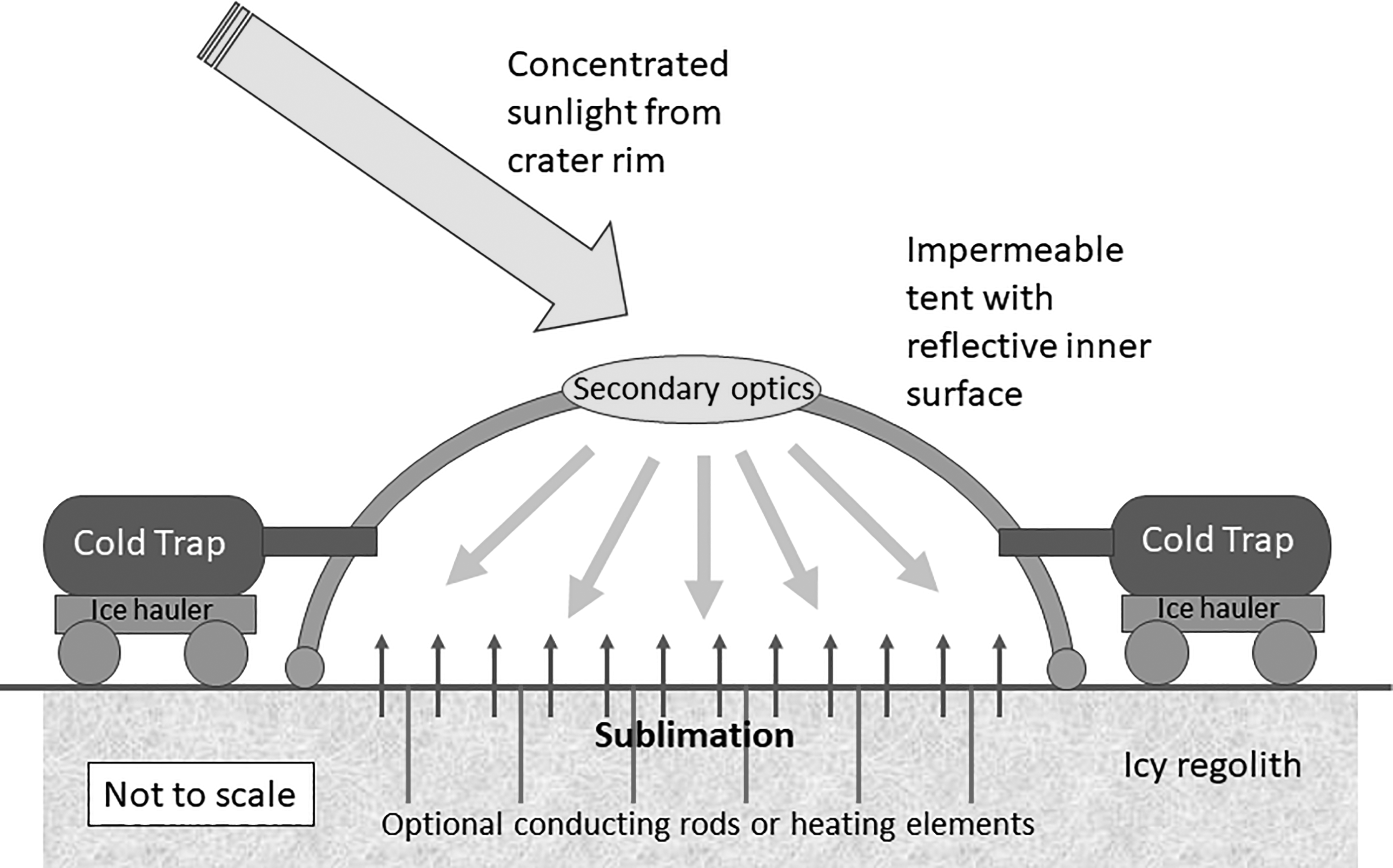
Thermal mining concept.
The overall concept of operations is shown in Figure 5. The details of the tent repositioning step are shown in Figure 6.
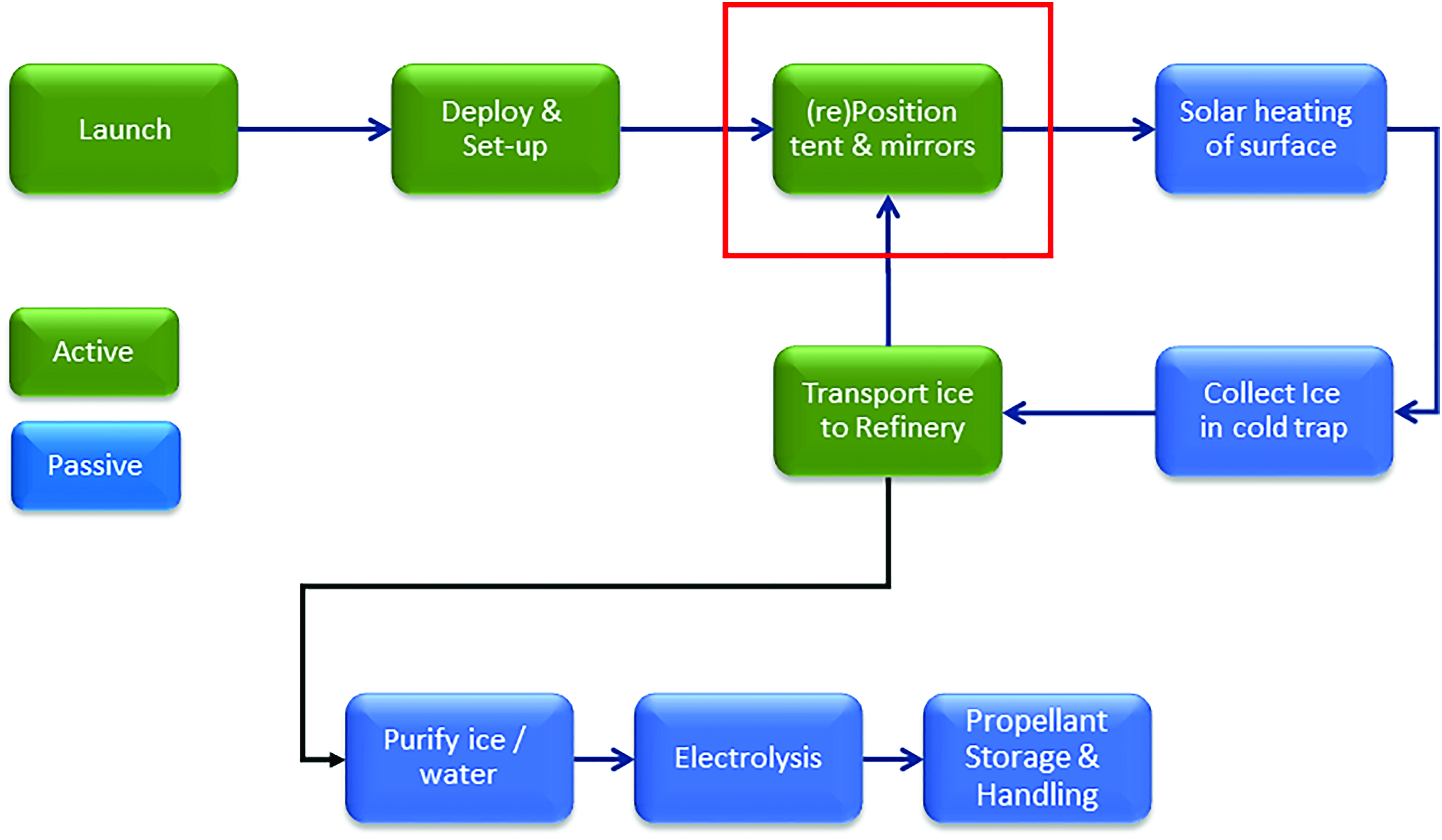
Thermal mining concept of operations. Color images are available online.
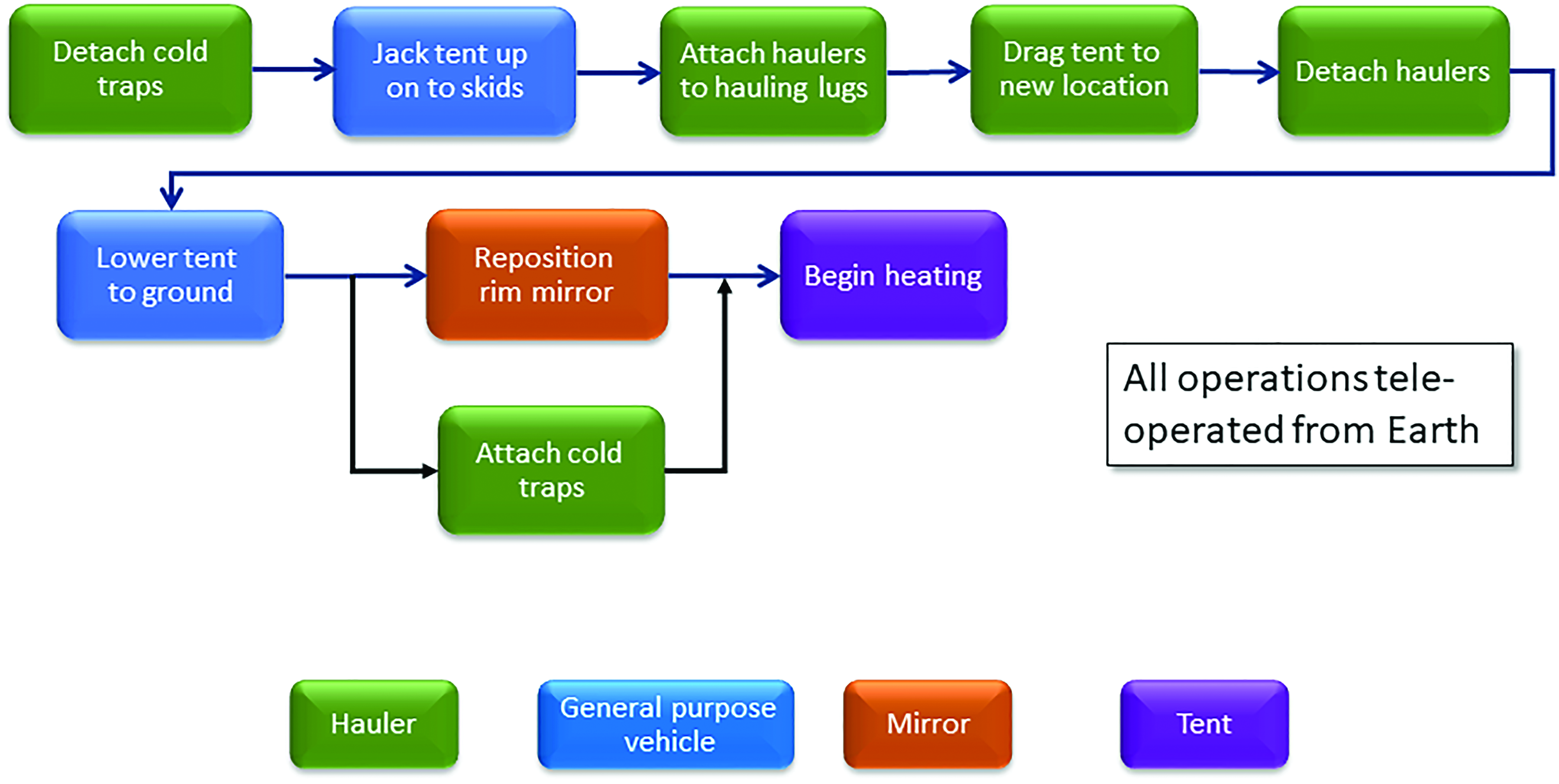
Capture tent repositioning details. Color images are available online.
The critical functional steps of thermal mining are:
Sublimation of ice and transport of water vapor through the subsurface. Confinement and transport of the vapor to cold traps. Passive cooling of the cold traps. Power delivery for surface and (optional) subsurface heating.
Each of these steps is discussed in detail hereunder.
Sublimation and Vapor Transport
In thermal mining, the surface of the PSR is heated to sublimate ice and transport vapor through the surface. The goal is to cause a sufficient rate of water vapor transport out of the surface to meet overall system production rates. The process is governed by heat transfer through the surface, vapor generation through sublimation, and vapor transport through the surface. An adequate rate of vapor transport out of the PSR surface can be generated due to several factors: (1) some ice appears to be deposited on the surface, 8 (2) depending on ice concentration, the heat transfer rate of icy regolith is significantly greater than dry regolith, (3) sublimation of water increases to high rates >200 K, and (4) LCROSS data suggest the surfaces in the PSRs are porous, thus vapor can diffuse through the subsurface. Metzger et al. 14 has suggested that the regolith within the PSRs is relatively unconsolidated compared with that at lower latitudes due to the lack of the diurnal thermal cycling.
One critical parameter in thermal mining is the dwell time for the positioning of the tent. This time parameter can be adjusted within the operations as conditions require, but will affect ice production rate. At a given temperature and for idealized spherical grains of ice, the sublimation rate is a function of the radius of the sphere. 15 The smaller the sphere the greater the sublimation rate. Figure 7 shows the time to completely sublimate a sphere of ice as a function of temperature. The horizontal line represents a time of 44 h, chosen as a nominal dwell time for the capture tent to meet the required production rate. As shown, at a temperature of 220 K, this time is sufficient to consume any grains <100 μm.

Sublimation time versus temperature for ice spheres of different radii. Color images are available online.
Confinement and Transport of the Vapor
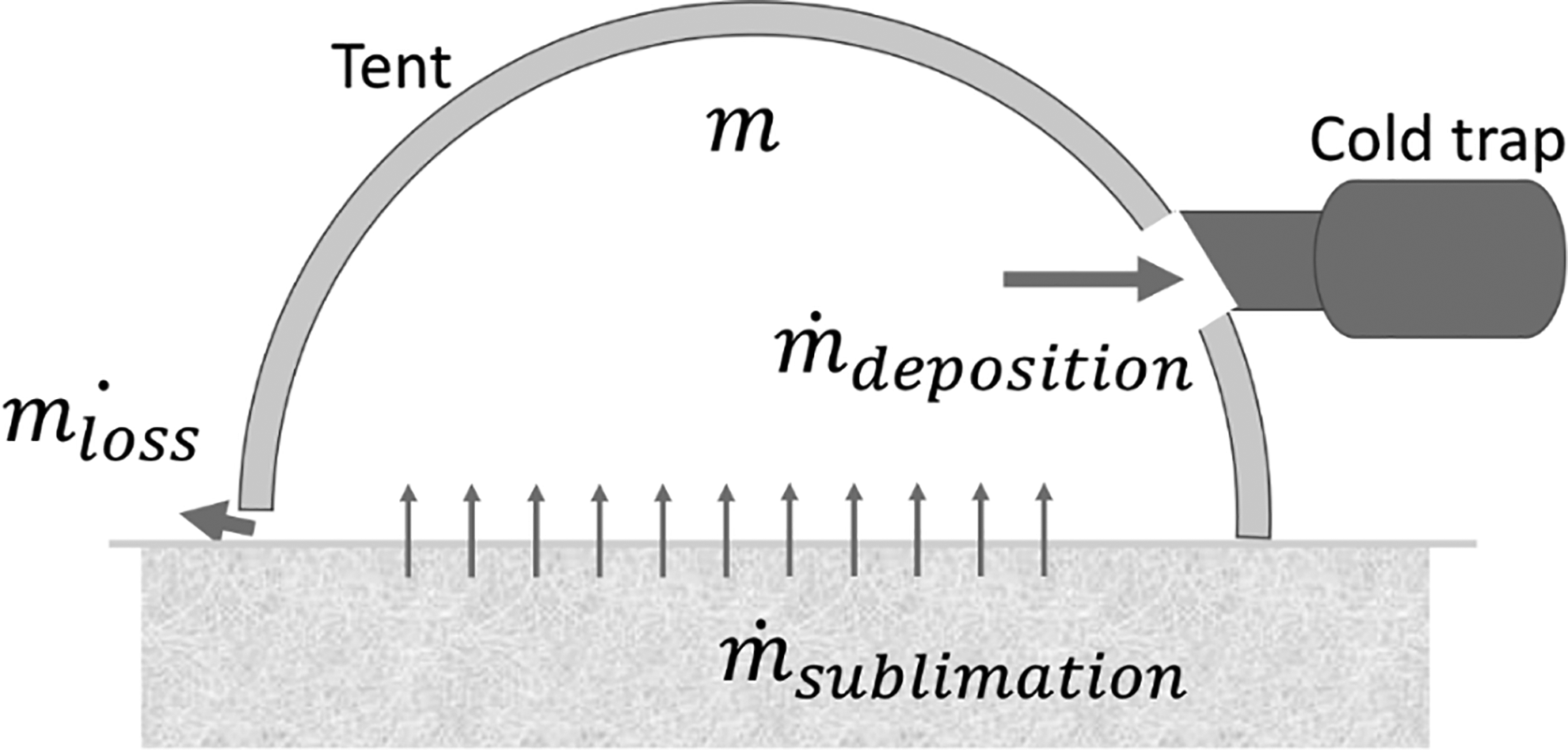
Figure 8 shows a schematic of the thermal mining ice extraction process indicating the mass transport (of water vapor) through the tent to the cold trap. The process can be described by a differential equation that expresses the rate of change of the mass in the tent as the mass entering the tent (from sublimation) minus the mass exiting the tent either into the cold trap to be deposited or to the vacuum of space through leaks in the tent due to any gaps between the tent and the surface:
Thermal mining ice extraction process.
where m is the mass of water vapor in the tent at any time, ṁ sublimation is the mass flow rate of water vapor emerging from the PSR surface through sublimation, ṁ deposition is the mass flow rate at which water is frozen in the cold trap, and ṁ loss is the rate water vapor is lost through leaks in the tent, which is primarily due to the imperfect seal between the tent and the PSR surface. We assume that ṁ loss can be kept to <10% of ṁ sublimation , which requires that the surface area of the tent-to-surface gap be <10% of the cold trap entrance area. In this analysis, we assume the cold trap has sufficient internal surface area to capture ice and sufficient thermal mass and heat dissipation through radiation to the environment to freeze ice at ṁ deposition .
Given the vacuum conditions on the lunar surface, and the anticipated very low pressures within the tent, mass transport from the tent to the cold traps and losses due to leaks may behave as an effusion-like process:
where p is the pressure in the tent, Acoldtrap, loss are the entrance area of the cold trap and the area of the leaks, respectively, and T is the temperature of a water molecule. Using the ideal gas law, the mass of water vapor under the tent, m, can be written in terms of the pressure, volume, and temperature of gas under the tent. The differential equation then becomes a first order ordinary differential equation for pressure as a function of time. A detailed investigation (test and analysis) into the mass transport from the surface, through the capture tent, and into the cold traps to verify these assumptions and refine the design will be the subject of future research.
The surface must be heated to a temperature such that sublimation proceeds at a rate sufficient to meet production goals. Kossacki and Leliwa-Kopystynski 16 show that the sublimation rate increases rapidly >200 K and Andreas 15 shows that 100 μm diameter ice grains loose mass rapidly >170 K. Surface temperature for sublimation was set at 220 K. In addition, it is important that the vapor not condense or freeze on the inner surface of the tent. To preclude this, it is assumed that the inner surface of the tent is reflective, trapping radiative energy within the tent and warming the surface.
At this temperature, the system goes to steady state in minutes, and the tent pressure will equilibrate at 15–20 Pa for a cold trap entrance area of 3 m2 and leak area of 0.3 m2. The rapid approach to steady state means that the tent transfer dynamics will essentially be in steady state throughout operation and the transients in the overall system are governed by heat transfer, sublimation, and vapor transport through the surface. Low operating pressure ensures that the tent does not lift off the surface. Losses due to leaks are directly proportional to the ratio of leak area to cold trap inlet area. Losses should be minimized, but perfect sealing of the tent is not necessary.
Passive Cooling of the Cold Traps
Thermal mining employs 1 or more cold traps that are passively cooled by radiation to the ambient PSR environment. The design intent for the cold trap(s) is that every water vapor molecule that enters the trap freezes. This is aided by the very cold ambient temperature within the PSR. The surface temperatures of the PSRs are as low as 40 K, while temperature of space is 2.7 K. The cold trap must provide sufficient cooling capacity to absorb and dissipate the heat of deposition (equal to the heat of sublimation). This can be provided by the thermal mass of the cold trap and sufficient radiative surface area on the cold trap.
At the beginning of each tent placement, it is assumed that the cold traps are at the ambient temperature. The cold trap temperature will cool to near the ambient environment during transport between the tent(s) and gas processing system. In addition, the thermal mass of the cold traps was sized so that their temperature would remain <100 K after freezing a full load of ice. Finally, the cold traps will have a full view to space during the entire collection period. A combination of thermal mass, radiative surface area on the cold trap, and the operations of the cold trap ice haulers will provide sufficient passive cooling.
Power Delivery
The hard work of ice extraction is performed by heat. The delivery of this heat and the quantity of heat required are key design considerations for the system. Figure 9 shows the power needed to extract ice by sublimation from the PSRs for a constant annual quantity of ice produced. Power requirements to sublimate a given quantity of ice increase exponentially as ice content falls <2 wt% ice because it is dominated by the power needed to heat regolith; whereas, >5 wt% the power becomes relatively insensitive to ice content. Extracting the ice is a 2-step process: heating the icy regolith mixture from 40 K to 220 K followed by sublimation of the ice. Based on these data, a lower bound on acceptable ice concentration was placed at 4 wt%. This then becomes a requirement on the prospecting campaign: identify ice fields of sufficient area with sufficient average concentration.

Power to extract 1,600 mT of water ice per year with 70% solar availability as a function of water weight percentage.
Although not conclusive, existing data suggest that such ice fields exist on the Moon. The best estimate of lunar PSR water ice content comes from LCROSS at 5.6 wt% ice, whereas other estimates put the ice content at 30 wt% with the most pessimistic estimates at 1 wt%.7,8,17
To meet the annual propellant production requirement of 1,100 mT stated earlier, 1,600 mT of ice is required to be extracted. This is due to the fact that a typical rocket engine, like the RL10 used by ULA, uses LO2/LH2 propellants in the mass ratio of 5.5:1, oxygen to hydrogen, where water contains oxygen and hydrogen in the mass ratio of 8:1. In the current system design, the excess oxygen produced is waste. In the future operations of the system, the excess oxygen could be a salable product, improving the business case. As shown in Figure 9, for the minimum required ice concentration of 4 wt%, 350 kW of power is required. To provide margin for unknowns and the potential nonuniform heating of the regolith, the system was sized at 500 kW.
Thermal Mining System Requirements
Requirements for the capture tent for ice extraction of 1,600 mT per year are given in Table 4. Thermal mining can be scaled to meet any water extraction goal, larger or smaller by scaling the tent or adding more tents, cold traps, and other thermal mining system elements. Extractable ice per surface area is required to be at least 16 kg/m2. This solution includes a single tent of 29 m diameter. A single tent would need to be placed 156 times per year. Additional tents would provide additional margin. The number of ice haulers depends on the density of ice in the cold trap, volume of cold trap, ice hauler traverse speed, distance between ice field and processing station, and transfer time at the processing station. Estimated masses for the capture tent as well as the other system elements are given in Table 1.
Capture Tent Requirements
Next Steps
Since the CSM propellant architecture study was completed, additional work on the overall architecture has continued. ULA facilitated a workshop involving 25 academic, industry, and government entities to drive additional detail into the overall architecture, including propellant storage and distribution systems within cislunar space. This effort resulted in a large report available to the public. 12 A rigorous business case was developed for the thermal mining architecture described in this article, showing positive business returns under both a purely commercial scenario and a public–private-partnership scenario. 18 Finally, since much of the risk inherent in the thermal mining approach for lunar ice extraction is traceable to the uncertainty in the locations, quantities, and characteristics of the ice deposits, a Lunar Polar Prospecting workshop was conducted at CSM in June 2018. Cosponsored by the Space Resources Roundtable (SRR) and the Lunar Exploration Analysis Group, the workshop created a roadmap for a prospecting campaign leading to industrial scale propellant production within a decade. 19
The availability of low-cost propellant on the Moon and throughout cislunar space dramatically lowers the cost of transportation beyond low Earth orbit. For example, use of lunar propellant lowers the cost per kilogram from Earth to a high Earth orbit like EML1 by a factor of 2 and lowers the cost per kilogram to the lunar surface by a factor of 3. The cost to return to Earth from the Moon can be reduced by a factor of 50. These dramatically reduced transportation costs improve the business case for any potential commercial business in cislunar space or on the lunar surface. It enables the commercialization of cislunar space.
The next logical step in furthering the development of the thermal mining system is laboratory testing to validate the effectiveness of both surface and subsurface heating in sublimating ice embedded in regolith. This would need to take place in cryogenic vacuum conditions. This should be followed by proof-of-concept testing on the capture tent and cold traps. Development of the other subsystems of the architecture can occur in parallel. 12
Conclusions
Thermal mining is an efficient scalable sustainable method of ice mining at the lunar poles. Thermal mining works well in any ice type as long as there is pour space for vapor transport. It is adaptable with options for conducting rods or subsurface heaters. The thermal mining method benefits from direct solar energy transfer while using variable heating to control production rate. With lower weight and fewer moving parts, thermal mining provides a significant improvement to traditional excavation concepts. The efficiency of thermal mining enables the establishment of a commercial mining operation on the Moon whose business case closes without government participation.
Footnotes
Author Disclosure Statement
No competing financial interests exist
Funding Information
The authors thank the United Launch Alliance for funding some of this research.