




Abstract
In spaceflight as in any other field, measuring progress is a necessary component of making progress. Given multiple proposals for missions and programs, some means for comparison between them must be used to inform spending decisions. Metrics can be used to instil a useful sense of competition between different groups or nations, such as in the case of the early space race and the Ansari X-Prize. I present a metric—mass value—that can be used in decision-making and competition at scales ranging from individual space missions to proposals for large scale settlement of the solar system by humans. A metric-based policy would give commercial and nongovernment entities freedom to pursue mission objectives how they see fit and enable an acceleration of space exploration and space settlement.
Introduction
Given the increasing role of the commercial sector in space exploration, and its presumed future role in space settlement, it is important to discuss how national space agencies can best support this. The ideal would be to define some goal for which the public is willing to pay, and then pay whoever achieves that goal with minimal interference in how this gets done. The question is how this might be realized in practice.
Many past successful government-led space initiatives have been goal driven, for example, the drive to place the first satellite in orbit or the first man on the Moon. More recently, the Ansari X-Prize has demonstrated that this principle also applies to private efforts. Such goal-driven programs can produce results in themselves, but as goals are achieved, new goals must be defined. Sometimes this does not happen, as seen at the end of the Apollo program.
There have historically been some quantitative metrics of performance in spaceflight, for example take off thrust or payload delivered to a particular orbit. The payload deliverable to a geosynchronous transfer orbit (GTO) is an obviously useful metric for commercial launch customers. Another sometimes relevant number is dollar per kilogram—used in the context of developing cheaper launch system, and normally referring to kilogram delivered to low Earth orbit (LEO) or GTO.
None of these goals or metrics is fully satisfying as a way to measure progress in space exploration or settlement. Engineering specifications for launch vehicles are agnostic as to what those vehicles are used for and racing for firsts quickly runs into a shortage of meaningful firsts, as the space race shows. A metric that can continuously and meaningfully be used to say that one program or mission has greater or lesser value than another program or mission is required.
The goal of this article is to produce a rational method of policy making that will accelerate space settlement, by decentralizing decision-making and rewarding results. I will show how a single figure of merit can be produced for any space initiative, with minimal human judgment required, and that in principle the highest level of political decision-makers would not need to understand anything besides knowing that an increasing value of this metric is desirable.
Mass Value
My proposal is to define the mass value of a mission as the mass that would be required to be delivered to 300 km circular Earth orbit to accomplish the same mission, using the most basic methods. The rationale being that anything that allowed the mission to be accomplished with less mass in LEO must add value, and we want to capture this in the metric.
The definition requires some expansion; I define accomplishing the same mission in this context as determining the useful payload, and the point at which it is the farthest Δv from LEO and when it is at its largest mass at that point, and then taking the “mission” to be putting that payload there. For example, the mission for one of the Apollo flights would be defined by placing the lunar module (LM) on the surface of the Moon and the command and service modules (CSMs) in lunar orbit, each with the largest fuel load they had at these locations. When, as in this case, there are multiple payloads, the mass value for the complete mission is calculated through simple summation of the mass value for each payload.
The mass value of the payload is contingent on how the payload is delivered, and this is where a basic method must be defined such that improvements on this method always correspond to increases in mass value. The basic method uses only minimum energy transfers to the final destination and uses a propulsion system with a specific impulse Isp = 300 s. The only remaining question to fill in here to complete the rocket equation and find the mass value is that of the assumed mass fraction of the imagined booster. This presents a minor complication.
A fixed mass fraction would result in an asymptote—there is a Δv at which a booster of 300 s specific impulse simply cannot reach with the attached payload, no matter how massive the fuel tank is. For physical realistic mass fractions—and for this metric to make sense the basic method ought to be credible—this Δv will lie within potentially useful parts of the solar system and exclude them from calculation. Giving the total mass fraction as
where m is the payload mass, M is the dry mass of the basic booster, and f the mass fraction of the booster alone, as M increases the expression tends toward f which is fixed. Applying this to the rocket equation, we have
which for a mass fraction for the booster of 10 would give a maximum Δv of 6.78 km/s. To push this further would require increasingly incredible mass fractions, or a specific impulse that would begin to encroach on that of commonly used liquid fuelled upper stages.
Using instead a fixed dry mass removes the asymptote—but this has the drawback that the mass value does not equal the mass in LEO when Δv is set to 0, which is not consistent. Neither of these are very realistic as the mass scales up. In practice, the mass fraction of the tank is driven by a square cube law. Assuming the entire mass of the booster is a spherical fuel tank, we can write an expression for such a mass fraction
where k is a constant that, for a tank with walls 1cm thick, fuel density equal to that of water, and tank density ∼3 times that, can be taken to be ∼1.5. This assumes no additional engines are required beyond whatever the payload has, so the booster is essentially a drop tank. I do not have a neat analytical solution to this cubic equation, and in any case, it still reaches an asymptote—although one that is monotonic with the mass of the payload, and usually occurs at higher Δv than the asymptote for the fixed mass fraction.
A first order approximation to this is to assume that for large masses and large Δv, the mass of the tank is small (k tends toward 0) and the dry mass is simply equal to m. This gives an estimate for the dry mass M0 of
This is not especially accurate, as the mass of the tank is only small relative to the fuel mass. An improvement can be found if we add a small mass ΔM to this and work out the value of this by a Taylor expansion around M0. The first term of the expansion gives an estimate of the dry mass
which, as is shown in Figure 1, matches the numerical solution well throughout the range of useful values of Δv.
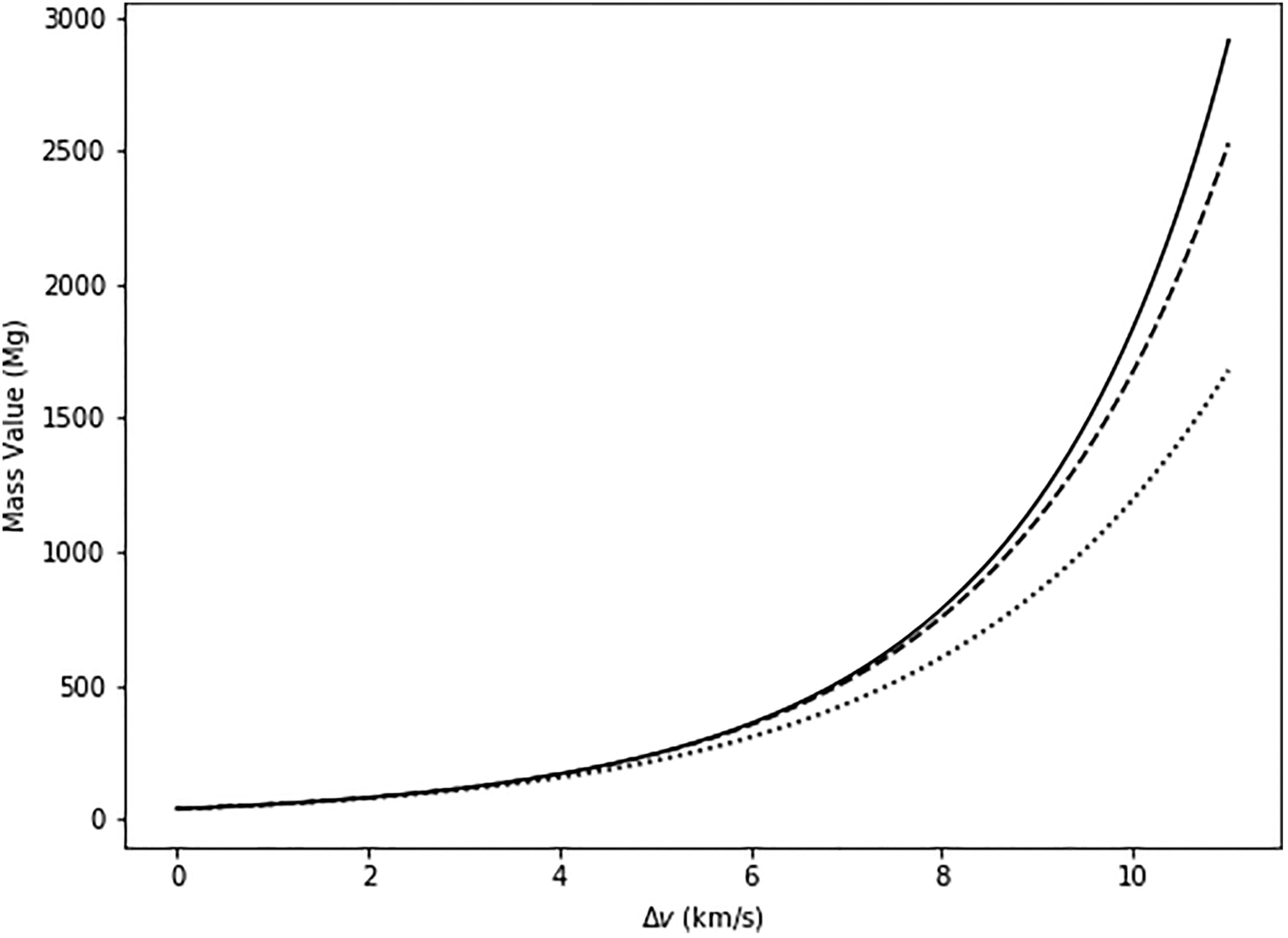
Relation between Δv and mass value for a payload mass of 40 metric tons. The numerical solution (solid black line), the first approximation (dotted black line), and the second approximation (dashed black line) are shown.
The mass value is the dry mass Mdry added to the payload mass m. This formulation fits the definition of mass value, is physically realistic, does not have a problematic asymptote, becomes equal to the payload mass at LEO, and is straightforward to calculate. Using M0 as an approximation is also sufficient for smaller Δv values.
If both launch costs and payload costs are a flat per kilogram rate, this metric maximizes capability per cost, and the reality is close enough that it can be taken to do so—provided that the orders of magnitude variation in possible mass value is larger than the variation in payload costs.
Larger mass values can be achieved through higher specific impulse propulsion than the basic method—so missions utilizing cryogenic propellants or solar electric propulsion will be advantaged. The largest values, however, can be obtained when in situ resource utilization (ISRU) is used to increase the effective payload without having to transport any more mass from Earth.
Examples
The objective of formulating mass value is to provide a metric for decision-making, and so it is useful to assess how it would have guided historical decisions—and see whether it can replicate what are seen, with the benefit of hindsight, as the correct answers in each case.
First, we will examine the Apollo 11 moon landing. The masses
1
of the spacecraft at their furthest destinations are m = 7.3 tons for the LM on the surface, and 16.8 tons for the CSM in low lunar orbit (LLO). If we take for LLO Δv = 4.8 km/s and for the surface Δv = 6.4 km/s, then for the LM
repeating the calculation for the CSM gives Mv = 105 tons. So, the total mass value of the Apollo 11 launch is calculated at 189 tons. The mass of the partially fuelled SIV-B stage (plus CSM/LM combination) when it was in LEO before translunar injection was around 133 tons. The difference in this case is due to the use of high-performance liquid hydrogen/liquid oxygen propulsion in that stage.
Through this we can see two things—first the quantitative value of the United States investing heavily in the development of liquid hydrogen technology over the decade before the Moon landing. Also, we can see that the performance of Saturn V in this application was even more superior to the Space Shuttle than can be seen with LEO numbers, casting an even dimmer light on the choice made to abandon Saturn V.
The Mars Direct program, proposed by Zubrin et al., 2 aimed at providing a simple and cost-effective path to Mars exploration based on ISRU. Each expedition would send first an unmanned Earth Return Vehicle (ERV) with a propellant production plant, which would manufacture 107 tons of propellant from 6 tons of hydrogen feedstock. The crew would then be sent later in a “hab” module, with both modules flying on the same rocket, capable of sending 121 tons to LEO. To calculate the mass value of the mission, we must acknowledge that the manufactured propellant falls under the definition of the useful payload. Thus, the mass value of the ERV launch is the mass required to send its final wet mass to the martian surface using the basic method. Some of the propellant generated is for surface operations, and not used by the ERV itself—but it still counts as payload for the mission.
So for the ERV, m = 129.5 tons and placing it on the surface of Mars through minimum energy transfer from LEO requires Δv = 10.2 km/s, we have mass value M0 = 4,015 tons and Mv = 5,319 tons. This may on the face of it seem an absurd value—it is >40 times the LEO payload capability of the rocket that was to launch the ERV. However, it does accurately represent the gains of aerocapture and especially ISRU. Doing without these would indeed require a mission of such enormous mass. The mass value of the “hab” module is harder to calculate; on its own it would be much smaller than that of the ERV, but the human crew in this scenario would have 500 days on the surface and will likely use local resources in that time. Per launch maximization of mass value would suggest merely a string of ERVs—but a wider view of program level maximization would take into consideration the mass value of things such as the crew locating and extracting ice to supplement the propellant production process, and base building.
Caveats
Very large Δv can be achieved through gravity assists, and whether or not to permit this in calculations depends on what the particular application of mass value is. For scientific missions, such maneuvers can be considered to add value. For the case of solar system development, they may not. The fact that good gravity assist opportunities are rare, and that missions that exploit them take many years, means that it should not be possible for the rate of mass value that can be generated this way—or through more efficient propulsion or anything else—to exceed what is possible through the utilization of solar system resources.
A mass value may be inflated by stretching the definition of what constitutes the payload. Does an expedition to the Moon or Mars that places its habitat in a lava tube get to classify all the rock above their heads, which is useful for radiation shielding, as mission payload? Clearly, an objective line must be drawn between what is and is not payload mass. If some mass could be substituted with generic material—something that only adds mass and possesses no special properties that the mission depends on—it cannot be considered payload mass. Objects which would be present whether or not a mission were performed—such as a space station—cannot be counted towards payload mass.
This shows there is still some requirement for human judgment when applying mass value calculations to real-world situations. Such cases should be adjudicated by peer review of calculations, in situations wherein the relative mass value of competing projects is relevant.
Mapping Future Development
A growth in mass value is a necessary but not sufficient condition for large-scale development of the solar system. For instance, an O'Neill type habitat has a certain mass, and a mass value can be calculated based on that mass and the Δv required to reach the location of the habitat. The creation of such a habitat implies the generation of that mass value. The construction in a certain period of time implies a minimum average rate of mass value creation over that time. Similar calculations can be made for a colony on the surface of Mars, although they would rapidly become complicated by the utilization of local resources. In such a case, mass value would have to be derived from the internal economic activity of the settlement, something that will be covered in future studies.
To extend the concept of mass value usefully into later stages of development, it is necessary to introduce a depth parameter. Depth in this context refers to the Δv required to escape the gravity of all bodies besides the Sun. A depth parameter applied to mass value means that anything with an escape velocity greater than that parameter cannot be included in the calculation, and if a mission involves moving through interplanetary space into another gravity well, then the mass must be taken at the point where it passes the specified depth. The depth parameter should be presumed to be arbitrarily large or infinite initially, as it is in the mentioned calculations.
The case of a depth parameter of 0 km/s is the case when only what is placed in solar orbit adds mass value. Increasing mass value under this constraint must necessarily increase the amount of solar flux captured by useful payloads, as without extraordinary and pointless measures, masses cannot remain in conjunction with each other. So the amount of solar flux captured—and thus the Kardashev level of humanity 3 —is monotonic with respect to mass value with depth parameter 0 km/s, and faster rates of mass value creation will entail faster rates of solar energy capture.
When the depth parameter is nonzero, the mass value must have a corresponding mass value at zero depth, as the payload must have to move through space. It may be the case that a mission or program has a higher mass value than another at nonzero depth, but a lower mass value at zero depth. On the face of it, this would make the alternative solution better in the long term in terms of capturing solar output. However, the generation of mass value on planetary surfaces will likely lead to settlements that can themselves autonomously contribute mass value—calculated relative to a low orbit around their own world. Mass value calculation alone cannot fully guide this trade-off, but it can illuminate it by showing what a settlement would have to produce in the long term to match the mass value of an alternative scheme. Ultimately, the figure that must always be maximized is the zero depth mass value, but nonzero depth calculations are likely to be a more useful short-term measurement.
Conclusion
In space exploration and settlement, the problem of moving mass around the solar system comes before all other problems. Reductions in the cost of launching to Earth orbit are part of the solution to this problem, but not in itself sufficient as there are better and worse ways to use a certain level of launch capability. Calculations of mass value can discriminate between various uses of this launch capability, and optimize the value for money of missions, programs, and agencies or commercial ventures. The ability to produce a single figure of merit for competing proposals also removes the need or temptation for nonexpert decision-makers to involve themselves too much in engineering specifics.
This metric is almost certainly not the last word on the matter; as the solar system is developed, different ways of measuring the economy, and planning accordingly, will be devised. Mass value as conceived here will have served its purpose if humanity reaches that point.
Footnotes
Acknowledgments
The author thanks Kingsley Gale-Sides and Danielle Fenech for proof reading a feedback.
Author Disclosure Statement
No competing financial interests exist.
Funding Information
No funding was received for this article.