




Abstract
Human–systems integration (HSI) is progressively becoming a central discipline. HSI is grounded on the coconstruction of technology, organizations, and people's activities and jobs. HSI also requires the association of physics, cognitive engineering, and arts. Physics provides necessary knowledge, rules, and constraints that an engineer needs to build a system that works. Cognitive engineering provides knowledge, rules, and constraints that are necessary to safely, efficiently, and comfortably use a system. However, neither physics nor cognitive engineering provides insights or methods that support creativity. Consequently, arts should be integrated into science, technology, engineering, and mathematics (STEM) to make STEAM (with an “A” for arts). In this article, integration will be presented as creativity and abduction. Visualization supports integration by making abstract constructs more tangible and facilitating effective learning. We will see how during the design of what became NASA Space Exploration Vehicle, we worked with artists and cartoonists, who helped us visualize possible scenarios. They first drew cartoons that were displayed around a room and developed animations. We used them not only as tangible visualizations of our concepts but also as mediating representations that integrated multiple participants' views. This article is also based on the experience of International Space University Space Studies Program 2012 where we carried out a project on “what space can contribute to global STEM education,” which clearly anticipated the shift from STEM to STEAM. We will advocate that space leaders of tomorrow should physically, cognitively, and creatively investigate a specific planet, that is Earth in addition to the other planets. This development is true for both governmental and commercial space activities. We will conclude on the fact that HSI is both a technique and an art, and qualifies for being a STEAM discipline.
In 2017, we carried out a study 1 on Human–systems integration (HSI) verification principles for commercial space transportation (CST). CST HSI safety, efficiency, and comfort were analyzed with respect to 4 critical areas: (1) design and layout of displays and controls (we assume that displays and controls are computer based), (2) mission planning, (3) restraint and stowage, and (4) human factors in vehicle operations. We used the most recent approaches in human-centered design, which integrates technology, organization, and people from the very beginning of the design process and all along the life cycle of systems, including manufacturing, delivery, training, operations, and dismantling. This was an interdisciplinary effort mixing science, technology, engineering, and mathematics (STEM * ). We realized how much STEM was useful, and we realized how much it should be better considered in engineering education, training, and practice. We also realized how much creativity and design thinking are important in a new field such as CST, and more generally commercial space. This is the reason why arts (A) should be integrated into STEM to make STEAM.
Engineers know how to develop logical reasoning based on physics theories and mathematics to make new systems. More recently, human factors and ergonomics penetrated engineering to make these systems more usable and useful. In addition, current systems include large amounts of software that makes them more artificially intelligent. Human factors in computing systems led to considering cognition seriously in the design of human–machine systems. Cognitive engineering was born in the 80s to support such design. 2 Cognitive engineering was specifically considered during the development of increasingly automated commercial aircraft. 3 Furthermore, we have come to a point where systems' complexity, maturity, flexibility, stability, and sustainability have to be considered during the whole life cycle of a system. 4 Everything changes rapidly, and it is very difficult to predict what will happen next. This is the reason why HSI is progressively becoming a central discipline. HSI is grounded on the coconstruction of technology, organizations, and people's activities and jobs.5, † HSI also requires the association of physics, cognitive engineering, and arts. Physics provides necessary knowledge, rules, and constraints that an engineer needs to build a system that works. Cognitive engineering provides knowledge, rules, and constraints that are necessary to safely, efficiently, and comfortably use a system. However, neither physics nor cognitive engineering provides insights or methods that support creativity.
The shift from STEM to STEAM, anticipated by designers,6, ‡ can be described as a drastic evolution from local linear engineering of complicated systems, such as cars, airplanes, and chemical plants, to holistic nonlinear design of complex systems, such as the Internet and air traffic management. § Indeed, it takes creativity to elaborate something complex that works. For example, making wine involves physics (e.g., knowledge of weather, soil, and chemistry) and cognition (i.e., knowledge of various combinations of grapes, awareness of correlations between rain, sunshine, and soil). But these kinds of knowledge are not enough because you always have to make decisions and act. It takes abduction. ** “There is no difference (at the highest level) between cold speculative intelligence and artist's intuition. There is something artistic in scientific discovery and something scientific in what naïve people denote ‘artist's genius intuitions.’ What they have in common is the beauty of abduction.” 7
Since this article is dedicated to the very specific topic of “STEAM for Space Leaders of Tomorrow,” we have to address the difficult process, and talent, of industrial integration, and more specifically †† HSI. When a painter creates a new color, orange, for example, the artist takes a bit of red and a bit of yellow, mixes them, observes the result, assesses if it is close to a satisfactory target, adds a bit of red, and so on until the artist makes a final decision: the kind of orange that he or she has in mind! This is creativity as integration. This is precisely what current engineering and science education miss today. Why? First, engineers are very well educated and trained in physics and mathematics. However, they do not usually have enough creativity insight and abduction inference capabilities. Therefore, STEAM education programs should bring such creativity and abduction skills and knowledge. We are talking about risk taking here. 8 Risk taking is a matter of abduction (i.e., trial and error) based on recurring preparation in a variety of contexts. In commercial space, for example, we need to create and play a large number of missions in human-in-the-loop simulation (HITLS) setups, which we will make progressively more tangible. Note that HITLSs are not only related to human spaceflights, since in commercial space in general (manned and unmanned) there will be mission control rooms that will need to be analyzed, designed, tested, and used. Commercial space requires agile developments incrementally tested based on safety, efficiency, and comfort principles and criteria.
Consequently, schools and education systems should develop human-centered programs that enable harmonious codevelopment of technology, organizations, and people (Fig. 1), where students have the opportunity to try, make errors, and correct until they understand how a system works and can be used appropriately. Design thinking, which involves ideation, storytelling, actual design, agile development, and delivery of solutions, should be articulated with systems thinking, which articulates structures and functions of systems being developed. Design thinking provides a method; systems thinking provides conceptual support. Our approach is problem driven, that is a problem should be stated first and solved second. Problem stating is often more an art than a technique. We need sometimes to create new syntax and semantics to enable a problem to be well stated and further solved. Let us present a few famous examples.
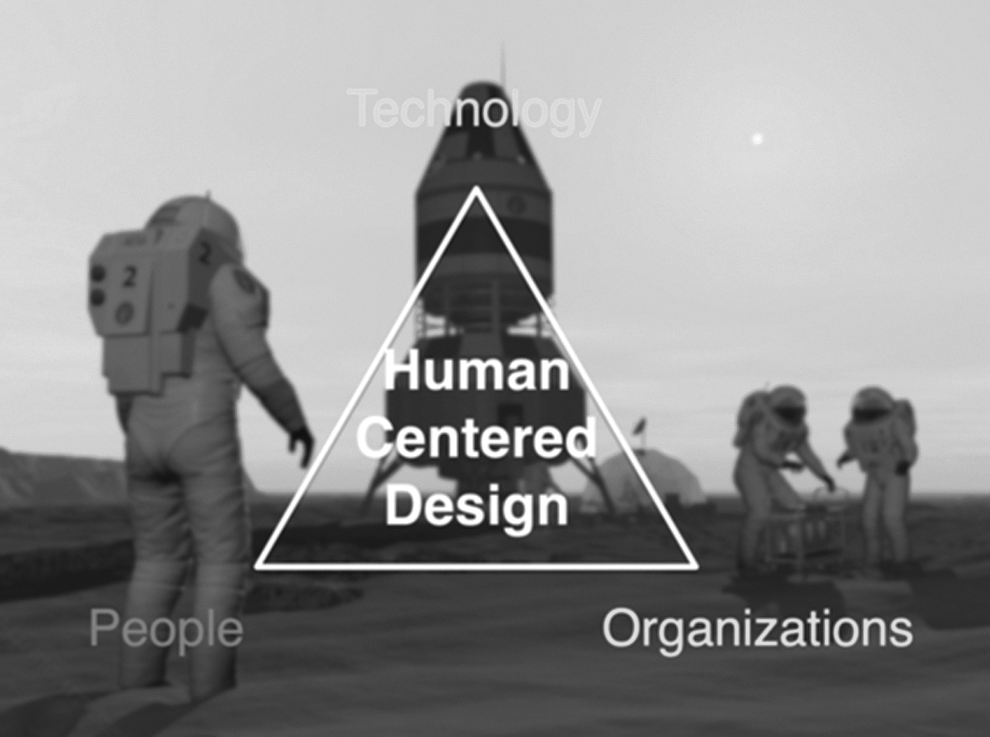
Technology, organizations, and people (The TOP model) for space leaders.
Sir Isaac Newton (1643–1727), known as one of the most influential physicists, was also a great mathematician and natural philosopher. One of his main questions was, “why are the orbits of the planets in an ellipse?” From this question, he derived differential and integral calculus. ‡‡ This piece of mathematics was the basis of the construction of vehicles. For example, velocity “V” is the derivative of a space variable “x,” expressed as “dx/dt.” Most of us learned that at school, often in an abstract manner! However, now we can see this derivative directly on the speed indicator of our car or motorcycle, and quickly understand what it is (Fig. 2). Visualization makes abstract constructs more tangible and facilitates effective learning. Learning them that way should not remove the need for rationalization. This is why I believe that technology provides us with concrete trivial answers to theoretical fundamental questions.
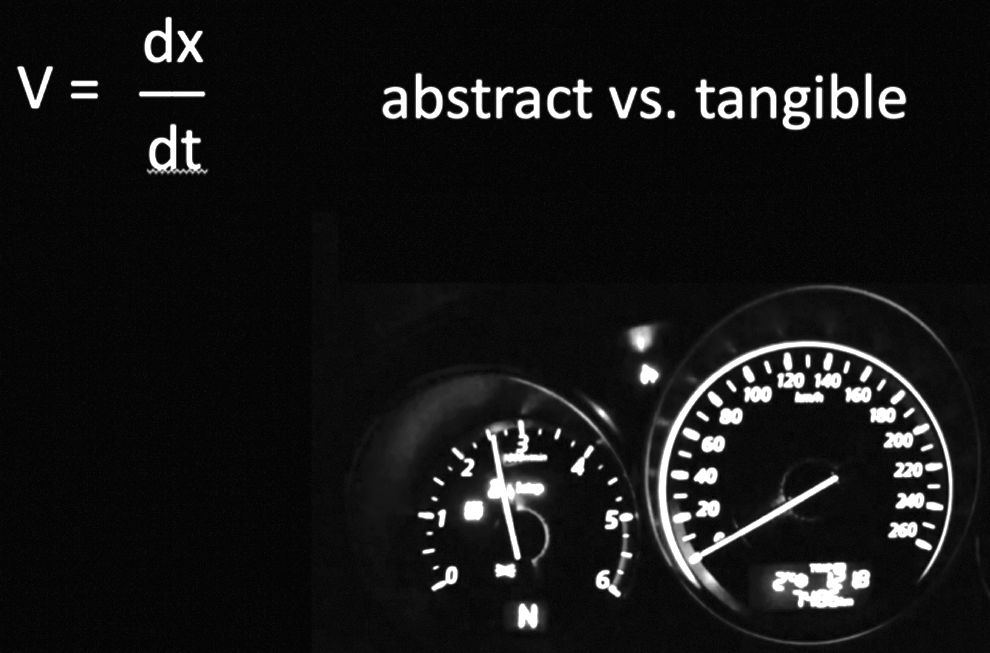
Abstract representation versus tangible visualization of speed.
Let us take another example demonstrating that engineering, mathematics, and art can be successfully associated. Computer graphics designers currently use Bézier parametric curves and surfaces in their complex drawings. A few know that Dr. Pierre Bézier, their inventor, was an engineer with Renault cars. He contributed to design the Renault 4CV car bodies. He associated physics and mathematics (i.e., physical tangibility and figurative tangibility §§ ). I learned corresponding mathematical functions during my undergraduate studies in mathematics as abstract constructs. Today, we can present them visually on a screen, vary parameters, and ultimately show their tangibility (i.e., purpose, possibilities, and forms). Beyond obvious use of Bézier curves in engineering, the same mathematical construct can be used in art, and produce beautiful drawings—real pieces of art.
If we just saw that physicists, mathematicians, and engineers can help artists expressing new worlds, art can help technological design also. During the design of what became NASA Space Exploration Vehicle, we worked with artists and cartoonists, who helped us visualize possible scenarios. They first drew cartoons that were displayed around a room. We not only used them as tangible visualizations of our concepts, but also a mediating representation of views other participants had (Fig. 3). They also developed animations that played exactly the same role, immensely facilitating cooperation among design team members. Designing technology is not only a matter of introspection, using personal knowledge and experience to produce concrete artifacts, it is also and foremost a matter of outrospection, *** using others' knowledge and experience. It is a matter of empathy, which is the power of understanding and imaginatively entering into another person's feelings. When the artist is able to express such feelings, the result is valuable for the entire design team. Such a participatory design approach is certainly very valuable for commercial space.
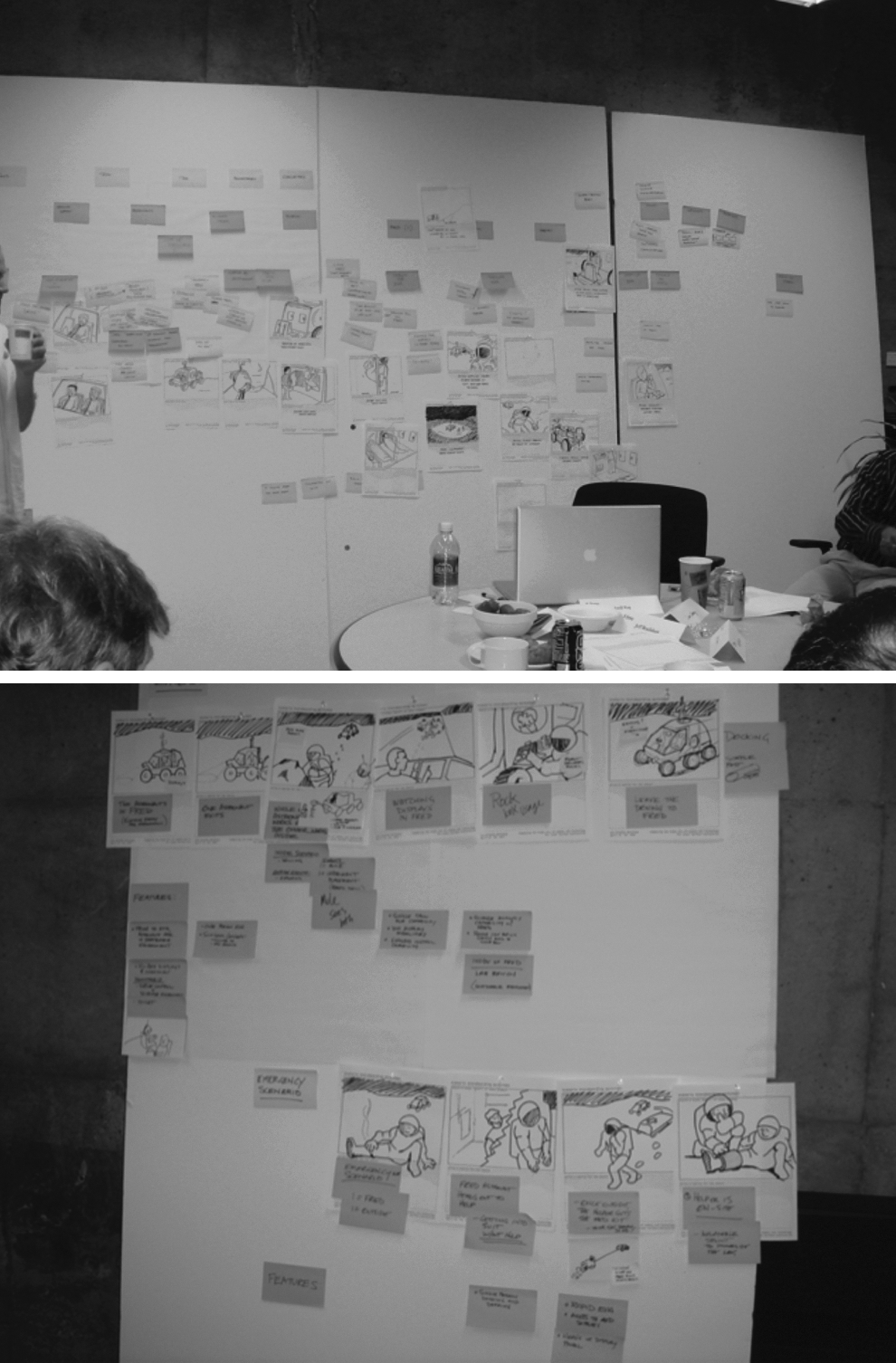
Outrospection and design thinking process for the development of NASA Lunar Rover.
Working in such a creative and open environment, mediated by appropriate technology, possible futures are developed and tested. If it is impossible to predict the future, it is possible to create it and test it. It is interesting today to read again Jules Verne's books, and see how much we have done since then. For example, Jules Verne, a French science-fiction writer of the 19th century, wrote a novel, “Around the world in eighty days.” 9 Today, astronauts in the Space Station “fly” around the world in 90 min! This looks like transforming dreams into reality. The opposite turned out to be true, that is transforming technology reality into dreams. The Lumière brothers invented the cinematograph that enables great movie directors to make us dream. With computing visualization means that we have today, imagine what a group of artists together with designers, engineers, and computer scientists can do! Think about using this kind of technology for commercial space scenario-based design.
During the summer of 2012, I was in charge of a team project within the framework of the International Space University Space Studies Program, “what space can contribute to global STEM education.” ††† A total of 34 students coming from 17 countries worked on this topic for 9 weeks.
They were all graduates and most of them professionals in a variety of domains related to space and astronautics. We had lectures from renowned specialists, including astronauts, engineers, philosophers, artists, physicians, and of course educators. A report was produced. 10 It includes positions on what STEM could be in the 21st century, mutual influences among technology, organizations, and people in current and future societal changes, best time to learn STEM, literacy, and mathematics and other things. Space experience was used to analyze how cognition, innovation, and risk taking helped going beyond what we could do on planet Earth, and discover new kinds of knowledge. The Apollo experience, for example, is a tremendous legacy to humanity in terms of knowledge design by doing. One of the first photos of the Earth rising over the moon's horizon, taken during the Apollo 8 mission, constitutes a tangible expression of the fact that the Earth is a spherical object! Today, we have the confirmation of gravitational waves that Albert Einstein predicted mathematically 100 years ago. STEM enables this incremental knowledge design by associating abstract concepts and concrete objects. Without NASA and other space agencies, we could go further than what we knew before. Again, technology provides us with concrete trivial answers to theoretical fundamental questions. Therefore, STEAM education programs should bring such creativity and abduction skills and knowledge, more specifically for commercial space.
This reflection will be extended to the evolution of our everyday life on planet Earth. Technology never stops to evolve. New codes and practices are emerging from the use of technology. The speed of changes is increasing. No surprise that some people get lost. It is, therefore, excellent timing to discuss and improve our understanding of what these changes really are, why they are happening, how they happen, who is concerned and how, what can we do to better master these changes… and so many other issues that all of us have in mind related to these changes. What are the main descriptors of these changes? Planet Earth evolves. We need to take care of it and adapt to it, and not only use it for our own short-term benefits. Climate change and all sorts of diversity disorders will soon or later push us to explore our planet like we would explore the Moon or Mars.
The 21st century started with a new worldwide economy, Internet and terrorism, among other things. Linear STEM approaches are proving their inefficiency facing resulting new challenges. We have entered into the era of complexity science. Reductionism worked during the 20th century as a primary framework for STEM to build washing machines, cars, aircraft, and nuclear power plants. However, current exponential growth of Earth population and interconnectivity induces emerging phenomena, typical to complex systems. Consequently, complexity has to be taken seriously. Reductionist simplicity is not the only remedy to handle complexity. We need to become more familiar with complexity instead. We need to relearn to see the world from various angles. This is why we need to move from Cartesian thinking to Leonardo da Vinci's thinking.
It is not unusual to see people facing a screen nowadays, whether it is a television, a laptop, a tablet, or a smartphone—so will be astronauts on the Moon or planet Mars. They interact with data, information, and knowledge, which could be natural or artificial. Indeed, they may interact with various kinds of computer programs, databases, or other people through computer networks. No matter where they are, the location does not matter any longer, as long as they have access to the cloud! Computer-supported communication is replacing face-to-face communication. What are the advantages and drawbacks of such a change?
Experience and expertise are crucial. This reminds me the time when I was a child living in the countryside during the summer with shepherds. I more specifically remember one of them who taught me some basic rules of thumb that enabled him to anticipate weather. An example was, “Red sky at night, shepherd's delight.” Of course, I put this kind of knowledge at work and watched the sky at night, a beautiful red sky! I concluded that we would have a beautiful sunny day! The day after unfortunately, the sky was gray and it rained. I came back to the shepherd, telling him about my experience. He just smiled and told me, “you did not watch the sky correctly, and you did not choose the right rule of thumb!” It took me a while before I started to understand how to observe the sky and associate the right rules of thumb. A long time after, I learned about meteorology and other things, and I associated these shepherd's heuristics with scientific knowledge. In fact, shepherds were using the arts of memory that the old Greeks practiced to transfer knowledge. 11 Old Greeks associated concrete objects and abstract concepts. In modern terms, we could say that they associate virtual things with tangible things. Making sense about something whether by grasping it physically and/or figuratively (i.e., cognitively) is a matter of tangibility. 4 This is exactly what we should consider when we design virtual artifacts that are intended to model and simulate real things. On the one hand, they are functionally testable—good news from an HSI point of view—but not necessarily tangible structurally. On the other hand, modeling and simulation enable participatory design (i.e., mix experience, expertise, and creativity). Commercial space requires this kind of approach.
Knowledge is a small contributor to understanding. It is the first time in the history of humanity that our individual memory is no longer only in our head, but extended in the cloud easily reachable with a few clicks on our favorite computing device. This new extended memory is tremendously more complete that what we can learn in our life. However, knowledge access does not guarantee understanding. Understanding requires critical thinking, reflective processes, and experience. Understanding requires that we put these data, information, and knowledge into action. Knowledge needs to be constantly viewed from many angles and transformed with respect to various contexts to be useful and finally tangible. Experiencing knowledge is crucial for us to conduct an effective and harmonious life.
Michel de Montaigne (1533–1592), one of the most significant philosophers of the French Renaissance, had a direct influence on Bacon, Descartes, Rousseau, Asimov, and Shakespeare. He wrote, “we are better to have a well-made rather than a well-filled head.” This is what I mean when I bring the distinction between knowledge and understanding. The gap between knowledge and understanding can be filled through experience and action. This is why learning by doing is so important. Students are currently trained to perform well for examinations. Most of the time, they do not have enough time to learn and there is too much to absorb. Quantity is often preferred to quality of learning. Consequently, what remains in the end is a poor capacity to handle real-world situations. It takes time to understand, and this precious time cannot be scarified. Understanding is linking concepts and things among each other, and using them to solve problems. Quality learning is about personal knowledge design. Knowledge is better used when it is personally designed and tested, like when you design and test a concrete object (e.g., designing a house). Abstractions are more solid when they are designed in action. That way, they are not only cognitive constructs but also embodied skills.
Finally, the following points
‡‡‡
are open for discussion to support the development of STEAM for space leaders of tomorrow both in government and in commercial space:
Communication is crucial (people should be more aware of the STEAM movement, and STEAM should be made more tangible to public; STEAM motivation should be more developed; promote delivery, e.g., posters, articles, visualization, marketing, and exhibition); Action is crucial (ideas should be transformed into actions,; STEAM should be made fun, joyful, and effective; STEAM environments should be set up locally; collaborative STEAM programs should be developed, e.g., a “Learning by Design” project should be implemented; transportation resources should be developed; redesign existing spaces into creative spaces; empathy in early education; develop interdisciplinary programs and exchanges; write a STEAM proposal and send it to science regional and national authorities; find out STEAM jobs needs [i.e., employability; getting children interested in STEAM by developing hands on activities, and improving learning effectivity]); A STEAM home (a building should be allocated to STEAM activities within the organization or community that takes care of it); Programs should be developed associating Art and STEM (promote same weight for art and science, immersion into STEAM activities and environments); Teachers' motivation (incentives, salaries, STEAM workshops, financial resources, and grants); Collaborative work (Space Centers-Universities STEAM experts, school events, STEAM think tank, cooperative development of STEAM products, online platform for exchanges, share STEAM products, collaborative projects, set up an experience feedback on STEAM content use); Intensify institutional relations (industry, research, academia, FabLab, Maker Space; promote STEAM in industry).
Summarizing, HSI is a new discipline that involves traditional human factors and ergonomics, human–computer interaction, complexity science, organization design and management, life-critical systems, modeling and simulation (mainly HITLSs), and cognitive engineering. HSI is a combination of human-centered design and systems engineering. 12 It also requires to consider artificial intelligence as an important resource for the development of autonomy and flexibility on both human and machine sides. Finally, HSI would not be possible without creativity, design thinking, and systems thinking. HSI is both a technique and an art, and qualifies for being a STEAM discipline.
This article started with an example on STEAM for commercial space leaders. At this point, we can see that HSI, considered as a technique and an art, is crucial for commercial space in many ways: (1) stakeholders should be creative, (2) they should be able to cooperate in terms of teams, and (3) design and development teams should have both a technical background and a human and organizational sciences background. What they should have the most is critical thinking and collaborative spirit. As an example, California Association for STEAM Education currently develops programs for students to learn and apply critical skills in highly immersive and inspiring space STEAM activities. §§§ Commercial space will require such education that considers at the forefront disciplines such as automation, robotic, artificial intelligence, globalization, collaboration, and human-centered design expertise and experience.
Footnotes
Author Disclosure Statement
No competing financial interests exist.
Funding Information
No funding was received for this article.