




Abstract
This article discusses the conclusions and implications of Nanoracks' NASA-Commissioned Low Earth Orbit Commercialization Study, or LEOCOM. The objective of LEOCOM was to leverage Nanoracks' decade of expertise as a user of the International Space Station as a commercial platform to describe the commercial future of the low Earth orbit (LEO) economic ecosystem. To complete this study, Nanoracks collected a team of 13 commercial suppliers, service providers, users, and consultants. The data these partners provided were utilized by Nanoracks and combined with existing information on current markets to generate a set of key policy and market recommendations. The LEOCOM study specifically focused on the role that platforms play as lynchpins in the LEO economy. In particular, Nanoracks used the Outpost platform as a baseline. Outposts are a Nanoracks concept for creating habitable volume from spent upper stages of multiple launch vehicles, in the case of the LEOCOM study, from United Launch Alliance (ULA) Centaur III and Centaur V stages. Once on orbit, robotic arms autonomously convert the stages after fuel venting, utilizing materials brought up to orbit in mission modules to complete full repurposing of the tanks before astronaut ingress. Although this is one among several platforms being considered by Nanoracks for future crewed platforms, costs associated with repurposing provide the core inputs to the financial model. As a result of this study, Nanoracks generated a higher resolution view of complexities involved in ensuring the sustainability of a LEO commercial marketplace. Coloring these conclusions was an underlining assumption that most actors would require some amount of government investment before attaining true sustainability, since a self-sustaining LEO economy does not yet exist in any appreciable form analogous to vibrant terrestrial markets. In this context, various critical insights were gleaned about the manner in which public and commercial actors could work together to efficiently set appropriate and long-term expectations of stability for government and private investor participation. Along with this analysis, Nanoracks took the unprecedented step of engaging key NASA staff in a Policy Simulation. This simulation focused on 3 hypothetical scenarios that Nanoracks wrote in consultation with NASA, and those were composed with Nanoracks' best assumptions about what forms future real-world policy challenges might take. The purpose of this exercise was not necessarily to receive a response from NASA regarding any particular challenge, but rather to analyze the processes that NASA undertook to answer policy questions likely to arise in the operation of a commercial LEO space station.
Introduction
While engaging in the NASA Low Earth Orbit Commercialization Study (LEOCOM) from August to December 2018, Nanoracks encountered a competitive domain of high expectations. The New Space sector, an ill-defined agglomeration of suppliers of space services, hardware, and capability, was expected to generate multiple billions of dollars (if not trillions) in revenue for savvy investors in the order of a few short decades. 1 General agreement existed that this sector would present a growth market unlike any other, save perhaps the digital revolution. 2 As of this writing, this perception largely persists, although it has been tempered by macroeconomic, political, and international competitive factors, but is inconsistently elucidated throughout much available existing scholarship.
Nanoracks' LEOCOM study represented an attempt at drawing analytical borders, in the form of commercially owned and operated space platforms, around this economy in attempt to better define and analyze it. In attempt to bound the scope of the study to something that would be analytically useful for policy makers and industry, Nanoracks bounded the definition of “economy” at those elements and acts of commercial exchange that could be supported by (and would support) the proliferation of habitable and robotically tended platforms in low Earth orbit (LEO). For example, although the potential for space tourism and the cost of launching supplies would be considered in cost and revenue calculations for economic exchange, the proliferation of telecommunication satellites would not. As such, the fundamental unit of an economy would be the individual platform, or Outpost. Against this definition, Nanoracks laid out a set of basic principles that could allow such an economy, built around commercial space stations, to flourish in the coming decades. The study focused on the Nanoracks Outpost as an enabling element of LEO infrastructure, and noted the need to contextualize such infrastructure within an ecosystem of services, collaborations, and hardware. Nanoracks and its partners worked to define the elements that could make such ecosystems successful, and which actors (including the government) would need to intervene to secure that success.
Nanoracks found, as a result of its own research, modeling, and primary sources from its partners' studies, as well as interviews with NASA personnel, that the state of the current LEO economy is little understood, and more fragile than typically presented in financial forecasting. The principal reasons being:
True commercialization requires extensive infrastructure, which as yet does not exist in LEO. Such infrastructure requires large (if not outright massive, state-level) initial investment provided on a consistent predictable basis. Drawing on the first point, previous commercial revolutions yielding high profits for multiple players (like the personal computing revolution of the 80s and 90s) required multiple preliminary assumptions (e.g., electricity, microprocessors, and Internet, among others) that the new space sector has no analogues for. Such parallels are, therefore, incomplete and require more nuanced analysis into the role of government and how it facilitates commercialization. No single-point solution for commercialization does, or can, exist. A greater degree of sophistication is necessary to understand how markets evolved, with a nuanced approach to how they would grow over time. It is unrealistic to assume that an “if you build it they will come” approach would work in a domain with so few proven business models.
This article does not discuss the Nanoracks Outpost solution so much as it discusses the motivation that underlines it: the creation of a viable new space ecosystem that is capable of sustaining economic activity to the extent that it becomes self-reinforcing, in support of a true LEO economy.
Materials and Methods
This article draws primarily from work conducted in LEOCOM. As a study, LEOCOM took note of ongoing discussions within NASA and the US government on the model for International Space Station (ISS) commercial utilization. It was further colored by current debates on the extension of the ISS beyond the 2024 time frame. It posited that the creation of a sustainable LEO commercial ecosystem is not a foregone conclusion, as growing customer utilization of in-space assets is itself not guaranteed.
Results of LEOCOM were gleaned from a combination of research conducted by Nanoracks and its team of 13 industry collaborators. Nanoracks' approach to describing the business case and financial viability of the Outpost architecture followed a 3-pronged strategy: analyzing contributions from commercial partners and Nanoracks experience, developing a detailed financial model relying on Nanoracks' market overview and commercial partner inputs, and conducting a policy simulation with NASA staff. The interrelation of data points is shown visually in Figure 1, with accompanying section numbers pertaining to the study listed above each input.
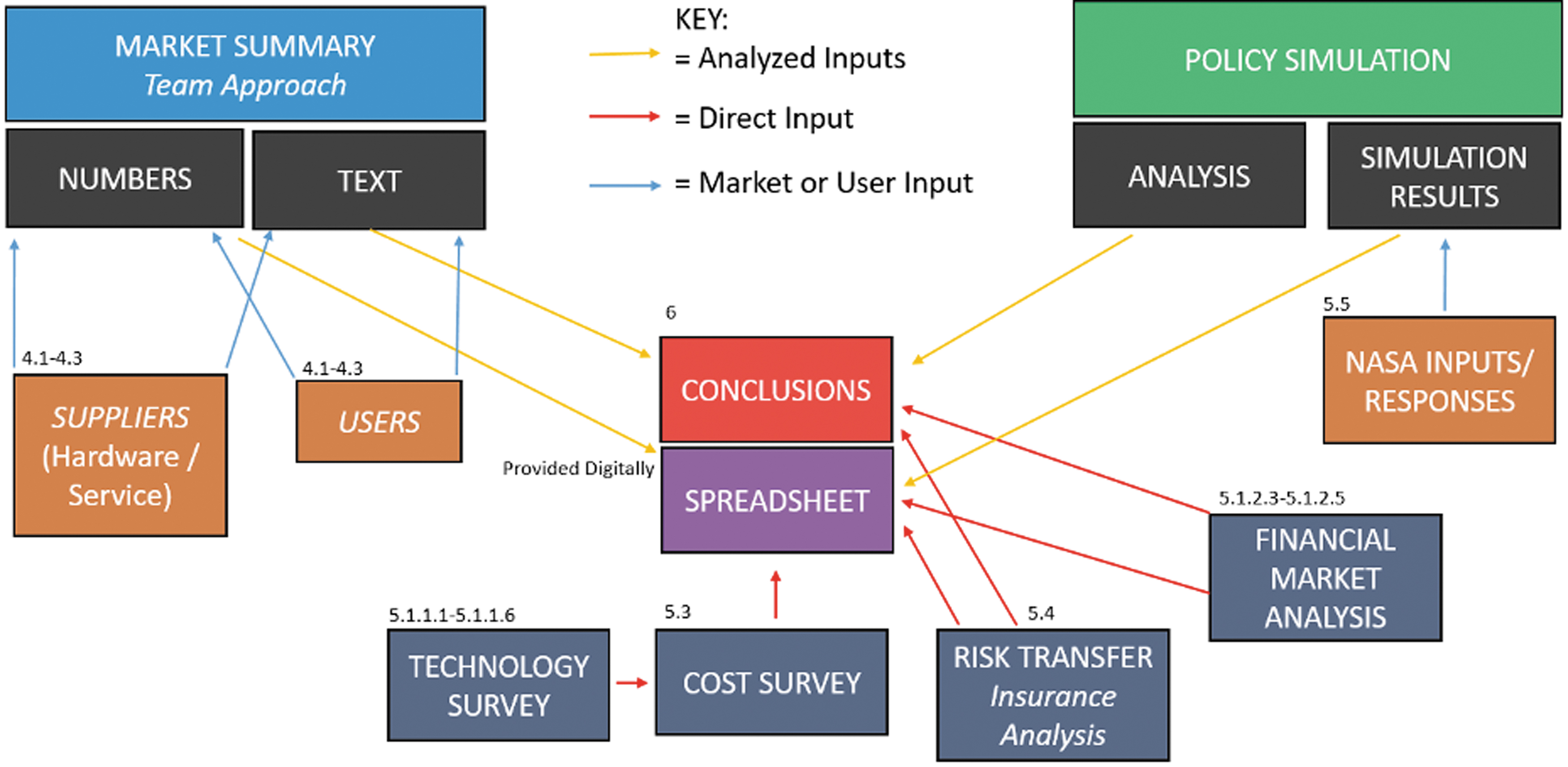
LEOCOM study structure and information flow. LEOCOM, Low Earth Orbit Commercialization Study. Color images are available online.
Nanoracks requested that 11 of its commercial partners contribute their views on how their technologies may work with the Outpost System or might otherwise benefit from the lowered price for in-space volume afforded by a repurposed upper stage. These partners' proposed uses of a hypothetical Outpost infrastructure yielded conclusions about ideal policy paths forward to enable such a commercial economy to flourish. They also contributed to Nanoracks' business model by stating assumptions of future revenue and providing expectations of what levels of station operating expenses could be sustained by differing levels of future demand.
Theory
In response to the primary weaknesses in existing market analyses identified in the introduction, Nanoracks worked to develop a coherent description of various market forces acting on the LEO economy and applied this description of market forces to information provided by the primary sources surveyed in this study: the 11 commercial entities that comprised the team, as well as NASA. To begin, Nanoracks divided those commercial entities into 3 categories as follows:
Users: entities that generate a profit from services provided to them within the bounds of the ecosystem being described, in this case a free-flying Outpost (Space BD, Space Adventures, Made in Space, Lunar Resources). Many users themselves provide services to end users, or rather consumers of products or services dependent on space such as ZBLAN optical fiber, or personal or sovereign space tourism. These consumers are not considered themselves users, but rather constituents of the marketplace.
Service providers: entities that conduct an activity onboard Outpost, or add to the critical infrastructure of Outpost, and generate revenue from the provision of those services to users (so, e.g., robotic arm operators, payload return services, and communications ground architecture providers) (Olis Robotics, Kongsberg Satellite Services, Deep Space Industries, Altius, Terminal Velocity).
Hardware providers: entities that provide the critical Outpost infrastructure, such as the upper stage itself, ECLSS systems, and solar panels (ULA, Stratolaunch).
Nanoracks described flows of capital between these entities, and then applied this analysis to a financial model that yielded insights into:
…how Outpost would become a financially feasible platform, and how much NASA involvement would be required in order to make it sustainable. This model combined factors including assumptions about future revenues and investments based on commercial partner research and Nanoracks historical data. This assisted the Study in determining how assumed costs would line up with future revenues, thereby allowing for probabilistic conclusions on (1) how much a future Outpost could cost in terms of non-recurring and recurring investment, (2) how much funding would be required from NASA and the U.S. government to close the business case, and (3) how much future revenue would be required to close a business case for Outpost.
3
Model
Costs associated with repurposing upper stages into usable habitats then provided insights used to generate Figure 2, which shows the probability that an Outpost station would fall into a price range below the 2 axes. In Figure 2, the Y-axis corresponds to recurring investment per station on a yearly basis and the X-axis corresponds to nonrecurring investment.

Probability of NRE and unit costs being below values—per station. NRE, non-recurring engineering. Color images are available online.
This study also sought to define when the operation of such space stations would reach commercial sustainability, and how operations could become cash flow positive. The LEOCOM financial analysis, therefore, drew heavily from Nanoracks' commercial partners assumptions of their own market shares and dates of profitability, as well as Nanoracks' own historical services. Nanoracks also worked with insurance providers and underwriters to account for how fluctuating insurance costs might affect various markets associated with commercial spaceflight such as tourism.
To plot how these multiple revenue streams would affect profitability of Outpost, based on assumed required investment rates, Nanoracks conducted a Monte Carlo simulation utilizing ∼5,000 test cases, accounting for a diversity of users, service, and hardware providers. Included in the potential users were revenues from biopharma, materials research, commercial astronaut, tourism, government (NASA and non-NASA), and manufacturing sources. Service providers included robotics, satellite servicing, additive manufacturing, and research hardware.
This simulation was then run against station financing assumptions, noted in Figure 2. Costs (both non-recurring engineering [NRE] and recurring) of financing stations were placed into the revenue assumptions, and internal rates of return (IRRs) were plotted against each probability. Following along with Figure 3, therefore it follows that at a recurring (yearly) investment per station module (X-axis) of $325 million and a nonrecurring investment (Y-axis) of $450 million yield a 26.36% IRR, corresponding to a 55.1% probability as shown in Figure 2. According to Nanoracks' research in commercial, venture, sovereign, and other investment markets, this business case would be considered investable for a 10-year period, given that IRRs of 20%–30% are attractive to such investors.

Ten years IRR sensitivity. IRR, internal rates of return. Color images are available online.
Financial flow detail
By working with the data released by Nanoracks' collection of commercial partners, a description of how a future LEO economy might work began to emerge. Nanoracks' conclusions drew from an investigation of a hypothetical mature LEO economy where all the technologies (those of its suppliers, customers, and station service providers) had attained a high degree of technological readiness. LEOCOM did not describe how these nodes in the LEO economy, brought together by Outpost, would actually attain their expected rates of production or profitability. Those assumptions were left to the partners themselves.
Given the current immature state of today's in-space economic, policy, and hardware infrastructure, in which few business models are sustainable or scalable due to the general lack of high volume, capacity, and throughput commercial in-space platforms, all these components would have to develop simultaneously to combine into a sustainable commercial ecosystem. This represents the root cause of Nanoracks' repeated calls for continued government-wide investment across multiple capabilities. The idealized ecosystem is generally described in the figures, and split into prelaunch and operational instances, and it was this end-state sustainable economy that was ultimately analyzed (Figs. 4 and 5 ):

Funding flows between Outpost partners (preflight, during construction phase). Color images are available online.
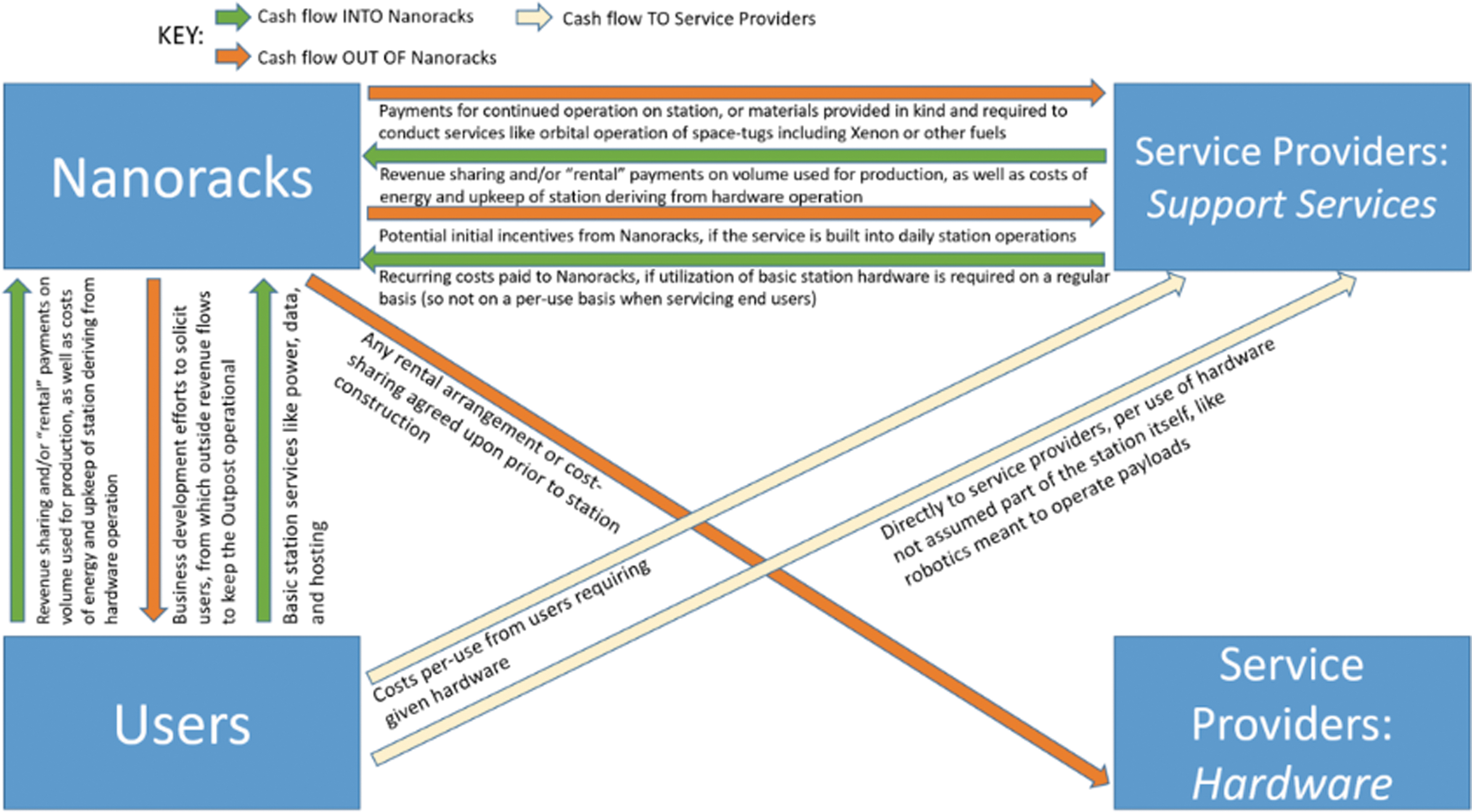
Funding flows between Outpost partners (preflight, during construction phase). Color images are available online.
To arrive at this state of exchanges, no single actor would have enough capital to take the required financial risks, and even if they did, they would be met by little demand for their services. Besides government intervention, Nanoracks also investigated the structures of financing available to allow these services to attain commercial sustainability.
NASA Policy Simulation
To add shape to these assumptions, Nanoracks conducted a policy simulation with various stakeholders at NASA. According to the LEOCOM study,
This simulation would be based around three hypothetical scenarios that Nanoracks wrote in consultation with NASA, and that were composed with Nanoracks' best assumptions about what form future real-world policy challenges might take. These scenarios were composed based both on Nanoracks' past experience and views of what issues might arise over the duration of managing a commercial space station in LEO, as related to both NASA and the market generally.
3
This exercise yielded valuable insights into the decision-making processes at NASA that might affect the outcome of commercialization, in particular, across 3 separate scenarios. Those scenarios and their equities included one in which the intergovernmental agreement (IGA) might cover a commercial free-flying space platform (equities: IGA/investment/CRS-2); another in which a commercial company would be allowed to draw power from the ISS (equities: use of NASA resources); and a final in which a non-IGA partner astronaut would request coverage under the IGA given their visiting vehicle would potentially be temporarily docked to the ISS (equities: allowable nationalities).
The purpose of the policy simulation was to gain an anecdotal understanding of how decision making would normally be conducted within NASA and between NASA and other U.S. government entities related to critical policy questions likely to come about during the drive toward commercialization. Nanoracks was not so much interested in what the answers to any particular hypothetical scenario would be, but rather in the process NASA engaged in, and who the stakeholders engaged were for each specific question. Nanoracks has published all hypothetical scenarios and NASA's responses to them in full.
Overall, Nanoracks concluded that NASA generally consults multiple agencies and international partners where commercial questions are raised, generally valuing a collaborative and consultative approach over a prescribed internal set of pre-existing and ready responses. Nanoracks did note that extensive opportunity existed for explanation and clarification of approaches with respect to commercial operation and procurement. For instance, Nanoracks found that NASA must more carefully consider the issue that favoring 1 space platform solution over others may constitute subsidy for commercial efforts. Potentially difficult questions regarding how to allow competition while not generating false competition (by for instance soliciting proposals for already-existing hardware) were identified as requiring further discussion. This proved especially true for mitigating potential competition between NASA-supported commercial space platforms and privately owned and operated services.
Results
The LEOCOM study concluded that commercial space markets, as they are currently set up, do not produce enough financial output, nor generate enough demand for services, to sustainably finance a fully commercial space station without some guarantee of stable government demand. Initial capital investments are required to bridge such funding gaps, combined with government support in the form of a public private partnership (PPP). Much as the government finances critical infrastructure on Earth such as highways and airports, such funding should, therefore, be extended to space infrastructure in the interest of the national economy.
Toward this conclusion, however, Nanoracks also found expectation setting would be critical to engendering sustainability in the commercial investment sector—the other critical source of required startup capital. Such expectation setting generally focused on 3 areas. First, the government would have to confirm that the ISS would be the final government owned and operated space station in LEO to allay private sector fears of potential public competition. Second, there would need to be acknowledgment that there is no single point solution to commercialization, meaning that having multiple LEO platforms would help mitigate important technical and commercial market risks and be able to service a plurality of customers in cases where, for example, manufacturing activities would be incompatible with crew presence onboard. Finally, investors in ISS hardware would need to have access to that hardware, meaning that the government should not step in to decide which commercial activities have merit and which do not (within the bounds of safety and operational concerns).
The policy simulation echoed these findings. It described a NASA bureaucracy that fundamentally understood the importance of setting policy transparently and only after extensive consultation. Ultimately, it concluded that scalability could only occur if NASA and industry worked together to secure reasonable expectations of consistent application of policies across a familiar ecosystem of services and available hardware.
Discussion
One of the initial challenges Nanoracks faced in performance of this contract was the sheer size of the commercial team. This challenge ended up yielding invaluable insights. By the end of the study, this diverse group proved LEOCOM's greatest strength given the trove of valuable insights into a multiplicity of business models, market assumptions, and associated concerns they brought. The sheer complexity of a full business case for a commercial space station element began to show definition: from ground architectures to insurance, from payload manufacturing to pressurized and uncrewed return capabilities.
Beyond the market itself, NASA's high degree of transparency in answering Nanoracks' hypothetical questions assisted immensely in the ability to understand internal government decision-making processes. As an important source of support for future LEO infrastructure, understanding which agencies were involved in NASA's calculus helped Nanoracks arrive at conclusions about how various revenue streams would be affected by potential slowdowns in licensing, approval, or any other processes that the U.S. government had equities in. That said, there was no readily available proxy to estimate the effect that increased (or decreased) efficiency or decision-making timelines would have on station profitability.
Critically, Nanoracks specifically utilized a case study of a free flying Outpost in LEO, built from a repurposed Centaur III upper stage. These assumptions included volume and cost considerations, but also the development of several critical technologies (such as robotic cutting of tanks) in the critical path of the further development of repurposing. Nanoracks acknowledges that a great many capabilities would need to be developed before arriving at the first unit costs described by Figures 2 and 3 . These technologies would themselves have associated development cycles and costs, and would necessarily push up the cost of full space station development—hence the added need for government support and buy-in.
Conclusion
Nanoracks' experience on the NASA LEOCOM study catalyzed an important new phase in the company's development, in that it drew into sharp relief the nascent state of the “New Space” economy. Nanoracks believes that a major advocacy push is necessary on the part of the entire space industry for renewed whole-of-government interest in supporting space infrastructure for the purpose of establishing and nurturing sustainable business models. No 1 space company has the appropriate incentives to pursue such action independently, including larger actors that themselves have benefited from significant government investments early in their development cycles.
The complex commercial ecosystem described in the LEOCOM study requires that investment occur in all sectors of infrastructure simultaneously, affecting both the demand (users) and supply (launch providers and platform builders) sides. This investment may come from both the government and commercial sectors—Nanoracks characterized these investor classes in detail—but such investments must be consistent and build a set of expectations that indicates long-term commitment to markets to make them investable. This presents an immense challenge, perhaps the greatest the space industry now faces, and it is absolutely essential that the government understands the critical role it will need to continue playing in establishing long-term PPPs with the space industry to ensure the sustainability of the LEO economy.
Footnotes
Acknowledgments
Nanoracks would like to thank the personnel at NASA Johnson Spaceflight Center who played a role in the LEOCOM study, including all the individuals who agreed to provide answers to the questions posed in the policy simulations. Their cross-cutting input, including from legal, policy, and functional teams, proved invaluable to the final analyses presented in Nanoracks' study. Nanoracks would also like to acknowledge the extraordinary efforts of its commercial study partners including Altius Space Machines, Deep Space Industries, Kongsberg Satellite Services, Lunar Resources, Made in Space, Olis Robotics, Space Adventures, Space BD, Stratolaunch, Terminal Velocity, ULA, Oliver Wyman & Marsh Mclennan, and the University of Chicago Booth School of Business. This study would not have been possible without their insights and efforts.
Author Disclosure Statement
No competing financial interests exist.
Funding Information
Funding Source for the LEO Commercialization Study was the National Aeronautics and Space Administration. The contract number was: 80JSC018C0024