




Abstract
Education is the key for the development of a nation or group of nations. Unfortunately, at a world scale, in particular, Sub-Saharan African countries are still lagging behind in terms of education, mainly due to not only financial but also sociocultural reasons. The Millennium Development Goals initiated by the United Nations had as one of its main goals to ensure that all children would be able to benefit from education by 2015. Although major progress was made, this goal was not achieved in Africa and is now replaced by another target for 2030. Recently, the coronavirus disease 2019 pandemic has unfortunately also delayed progress due to closed schools and lack of informatics infrastructure in some countries, in particular in Africa. A secondary issue is the lack of solid Science, Technology, Engineering and Mathematics (STEM) education and interest. Here, space can play a paramount role, not as a purpose to create more space engineers and scientists, but also to foster the interest in STEM via space examples and, as such, encourage to start tertiary-cycle studies in engineering or science. Several initiatives will be discussed in this article on how space education could be able to support the technological development in Sub-Saharan Africa.
The Importance of Education for Emerging Countries
In his now classical work on the competitivity of nations,
1
Michael Porter clearly states:
There is little doubt from our research that education and training are decisive in national competitive advantage. (…) Education and training constitute perhaps the single greatest long-term leverage point available to all levels of government in upgrading industry. Improving the general education system is an essential priority of government, and a matter of economic and not just social policy.
The Asante Africa Foundation has been studying the needs for education for developing countries in general and for Africa in particular and has summarized these needs as per Figure 1. 2

Positive effects of education.
We can translate these effects in real terms as follows:
Peaceful Voice: Internal wars have harmed the development within Africa considerably over the past decades, as they also lead to migration and destroy infrastructures. Violence is generated admittedly by economic factors and power struggles, but education can remedy this in the mid-term by creating awareness of long-term prosperity. Education for all is leading to an equitable and sustainable society. As long as chances for education are determined by financial means, roots, or gender, no country can reach a satisfactory level of social stability as there will remain a gap between the different parties, leading to a deep dissatisfaction generated by unequal chances. Health and hygiene are obvious aspects, and they even play a paramount role in developed countries (incl. medical checks at schools). Proper hygienic principles, taught in schools, will not only be of benefit for the person her/himself, but will also be propagated in the direct environment (like in families). This aspect has been very paramount during the recent coronavirus disease 2019 (COVID-19) pandemic and the measures taken in schools Innovation nowadays often requires a sound technical and scientific knowledge. Even if research may initially be beyond the scope of many emerging countries, already a solid secondary Science, Technology, Engineering and Mathematics (STEM) oriented education can lead to a workforce that is open for novel situations and will be able to make innovative suggestions. Each study and forecast of economic growth considers a number of essential prerequisites, and (higher) education is one of the important ones. As long as nations need external help to exploit resources, a lot of the profits will unavoidably leave the country and will not be of benefit to the local economy. Lack of economic growth also unavoidably leads to brain-drain effects, with scientists emigrating to countries where their work and research can be funded. This can only be remedied by skilled labor that is well educated and able to cope with the challenges of an ever-increasing complex society based on, for example, increased informatics applications. Such workforce will then be able to earn better and consume or save in the country itself, becoming a catalyst for economic growth.
The importance of education cannot be better worded as Nelson Mandela did, with extensive experience in this area, with his famous quote 3 :
Education Is the Most Powerful Weapon That You Can Use to Change the World
On a world scale, we can easily see that the situation in sub-Saharan Africa is worse than in other parts of the world, with in particular in Sub-Saharan Africa illiteracy rates higher than 35% (in 2019), although down from 43% in 2000. 4 It is, therefore, clear that a number of the aforementioned goals, only distributed by ways of printed media, cannot be achieved in the near term in Africa. It is, therefore, important to develop a system whereby all children can receive education and are encouraged to do further studies, in particular in STEM areas that are a major shortage in Sub-Saharan Africa.
Secondary Education in Africa
Although general and primary education are of paramount importance to reach some of the aforementioned goals and will create a society that is easier to communicate with via written press, they are less effective in view of the economic and industrial development of a country in an attempt to become competitive with other countries, in particular in an increasingly technological-driven environment.
In particular, the second layer goals in Figure 1, namely Innovation, Economic Growth, and, as a result, higher wages and welfare, are strongly relying on a workforce with at least education at secondary level, in the fields of importance for the country, such as technicians and IT specialists.
In September 2000, 189 countries agreed on a set of quantified goals, the Millennium Development Goals (MDG) under the auspices of the United Nations, which are summarized in a document known as the Millennium Declaration. 5 The Declaration was presented as a roadmap with the quantified goals for eight objectives, to be reached in 2015.
The eight goals were:
Goal 1: Eradicate extreme poverty and hunger
Goal 2: Achieve universal primary education
Goal 3: Promote gender equality and empower women
Goal 4: Reduce child mortality
Goal 5: Improve maternal health
Goal 6: Combat HIV/AIDS, malaria and other diseases
Goal 7: Ensure environmental sustainability
Goal 8: Develop a global partnership for development
In particular, goal 2 of the MDG reads as follows:
Ensure That, by 2015, Children Everywhere, Boys and Girls Alike, Will Be Able to Complete a Full Course of Primary Schooling
Although there is no doubt that a lot of progress has been made, it is clear that the 2015 target date has not been successfully reached, also due to the many geopolitical developments, conflicts, and resulting migrations in the region. Indeed, overall, the number of enrolment worldwide in primary and secondary schools in emerging countries was measured at 91% in 2015 compared with 83% in 2000. 6
In particular, the report pointed out that in the Sub-Saharan countries considerable progress was measured, with this enrolment at 80% in 2015, compared with 60% in 2000 and only 54% in 1990.
As can be noted from Figure 2, the good news is that the gap between percentage school enrolment of children in (Sub-Saharan) Africa compared with other countries is gradually being closed.
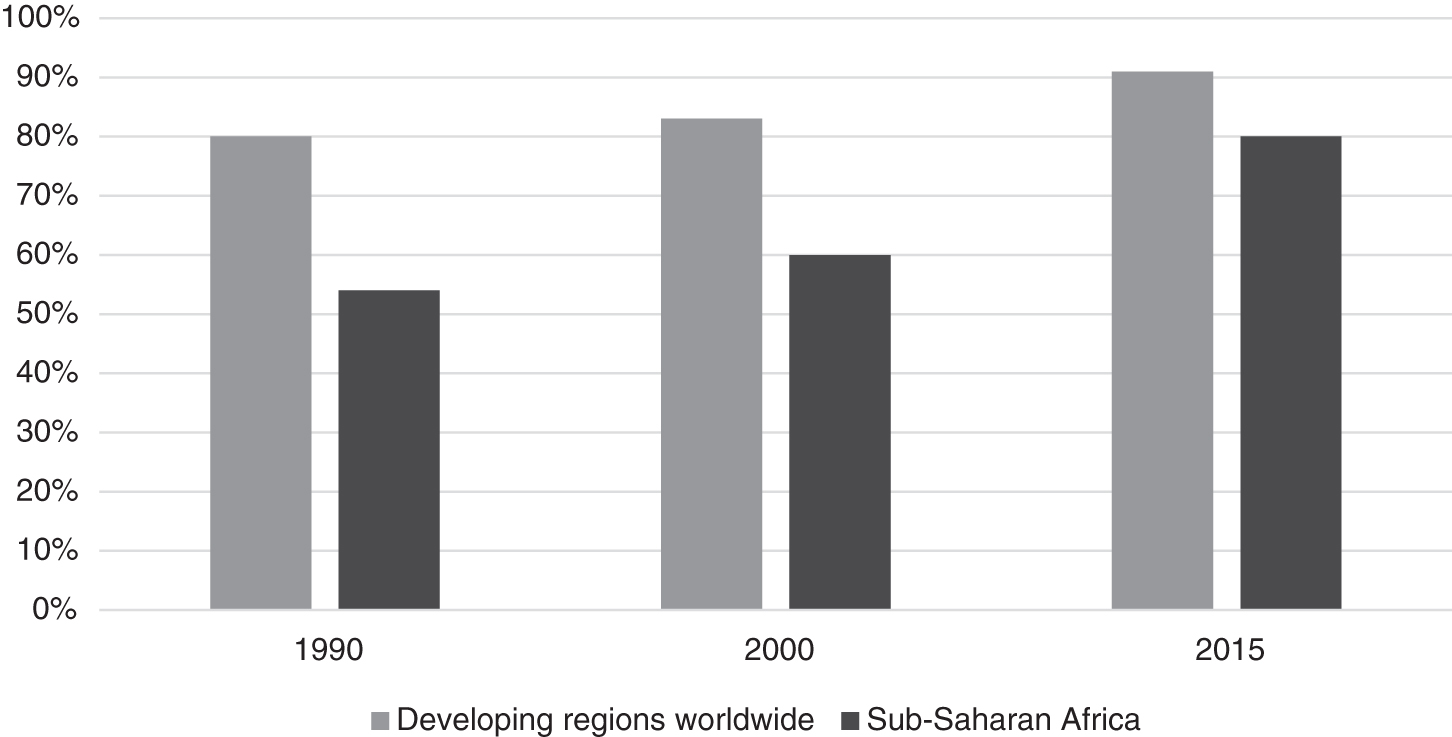
Positive evolution of school enrollment in Sub-Saharan African countries (based on [6]).
An evaluation report in 20156 came to the conclusion that the goals for 2015, although there was a considerable improvement, were not reached. It was, therefore, decided to continue these efforts with a new set of 17 targets for 2030, now referred to as Sustainable Development Goals (SDGs).
Goal 4 of these targets, which is related to education, has now been enhanced and worded as 7
Ensure Inclusive and Equitable Quality Education and Promote Lifelong Learning for All
In comparison to the original goal, which concentrated on primary education, the scope has now been extended to all education categories, including professional development.
Although since 2015 progress was continuing at a good level, the COVID-19 pandemic has unfortunately rather abruptly hindered this process. Indeed, many schools were closed, which created a new disadvantage for low-income countries. Although countries with a good internet infrastructure could partially remedy this by virtual classrooms and remote education, this could only be implemented to a limited extent in Africa and other emerging countries.
To illustrate the barriers, Figure 3 compares the availability of informatics tools in 2019, comparing Europe and Africa.

Comparison of informatics access in 2019 between European and African households (based on [7]).
It goes without saying that this immense difference, often also referred to as “digital divide,” is a considerable obstacle to close the education gap between both societies. We can only hope that internet-from-space constellations will become soon operational, but those constellations require a large amount of smallsats to be launched, such as OneWeb (648 satellites), Kuiper (Amazon, 3,236 satellites), and the Starlink constellation of SpaceX with even more than 12,000 satellites planned. Also, here the pandemic has clearly induced delays and even financial problems.
Stem Education in Africa
Africa is a very rich continent with a wealth of resources. Two factors lead to the fact that this continent is not benefiting from this:
Lack of Modern Techniques to Increase Efficiency
As far as primary resources are concerned, such as agriculture and forestry, the lack of skills in the population, as a result of the low level of training in modern tools, is hindering the introduction of the usual aids, such as the Global Positioning System (GPS) and the use of Earth Observation data. Even with cheap labor, this does not allow many of the African countries to become competitive.
Necessity of Outsourcing to Foreign Specialists
As far as more complex operations such as mining and in situ processing of the raw materials are concerned, the local population lacked, due to lacking STEM education, the necessary know-how and became dependent on outsourcing to specialized labor and engineers, for example, from Asian countries.
It is, therefore, essential to start early to bring STEM in the secondary curricula as:
a. It allows to generate a workforce that is able to work in an environment where modern techniques are used and applied (use of computers, GPS equipment, …).
b. It opens the way for tertiary education in those areas that are in high demand in Africa, such as applied scientists (e.g., geologists, chemists) as well as engineers and medical doctors.
The next Figure 4 compares the situation in Africa with a few emerging countries that are considered as potential follow-up countries in the post-BRIC (Brazil, Russia, India and China) era. With the exception of South-Africa, most sub-Saharan countries have only around 30%–35% of the students with secondary degrees studying in STEM-related curricula, a strong contrast with industrial directed countries such as Vietnam and Malaysia, where this figure is in the 60%–70% region, comparable with western industrialized countries. 8
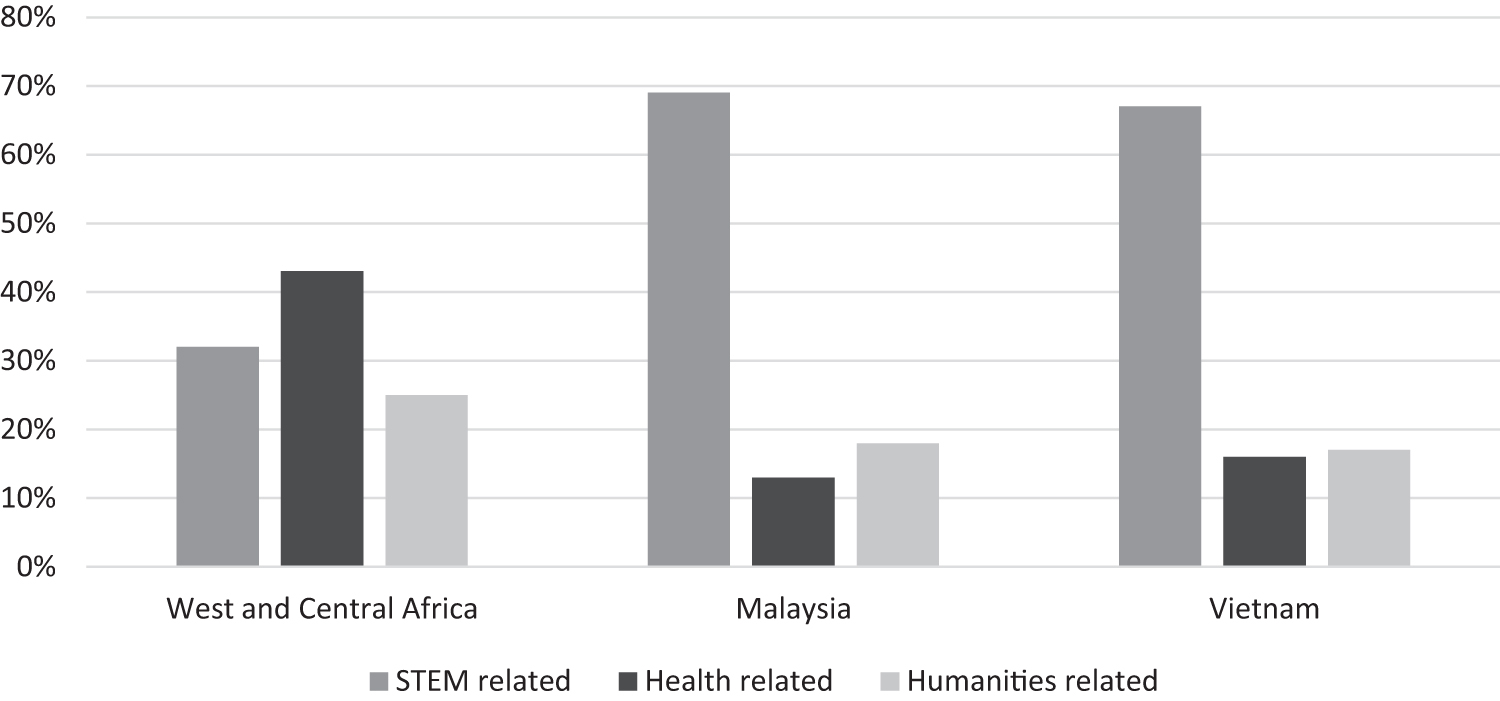
Percentage of Science, Technology, Engineering and Mathematics (STEM) students in Africa compared with other emerging countries (Source: World Bank, 2016).
The authors of the report are strongly warning that this lack of engineers and scientists, compared with other emerging countries, will hinder the technological developments in Africa, facing a rapidly changing technological environment.
One of the very important factors is the strong lack of science and mathematics teachers in African countries. This is not stimulating young students to direct their studies in scientific and technical areas. The result is an over-proportion of students in humanities/social science disciplines and, unfortunately, a very high level of unemployment in these sectors with, at the same time, an enormous lack of engineers and scientists. As an example to illustrate this, already alone in Nigeria, it is estimated that more than 50,000 engineers are needed (in addition to the ones under training) in the electrical power sector. 9 )
As recently reported in a survey, 10 gender bias is also still considered a socio-cultural issue, with, in many African countries, less than 10% of female participants in STEM-related curricula. This is strongly contributing to this unfavorable situation compared with other emerging countries.
Over the past three decades, changes in regulatory frameworks have led to a global, interconnected world economy. Countries that cannot master this change and use STEM as a facilitator will not be able to participate in this and miss out on the key determinants of economic growth and development.
It is evident that this vicious circle needs to be remedied. Internet-based tools and tele-education could be means to remedy this, and will gain in importance with the availability of satellite networks serving the southern hemisphere, such as O3B at present and the other planned constellations under development.
Use of Space as Educational Tool in Africa
There are two different aspects linked to this:
Stimulating STEM Education
Space generates scientific and technical interest. It is not immediately essential to generate a generation interested in space careers, but in secondary schools, space examples can be used as exercises for elementary physics and mathematics teaching. An example of this is the European Space Agency (ESA) Lift-off publication, 11 shown in Fig. 5, providing interesting space-related questions with the solutions explained to the teachers. Also, the National Aeronautics and Space Administration (NASA) provides free of charge a list of materials and publications that can be used in the classrooms. 12
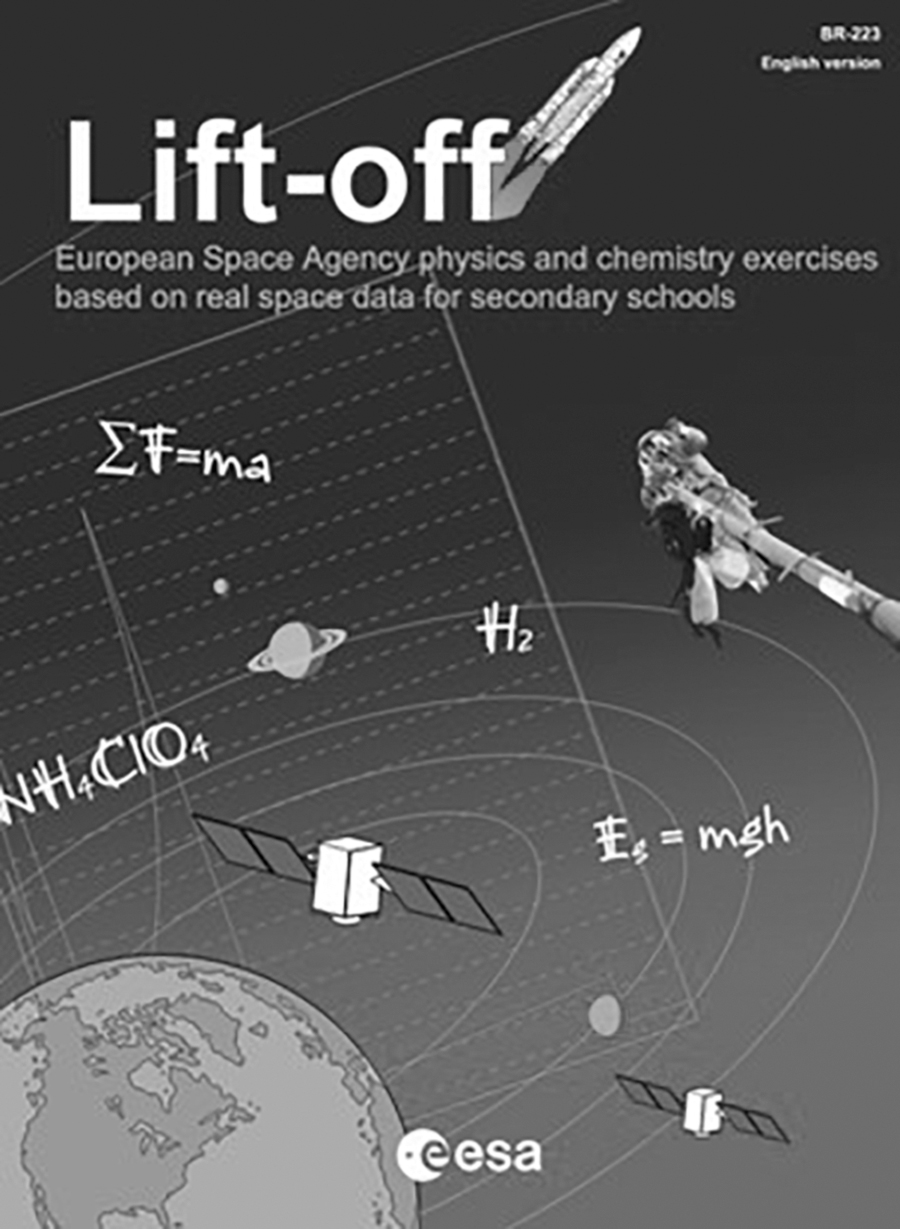
Example of a European Space Agency (ESA) publication with space-based exercises for secondary schools. Copyright: ESA.
The objective is to make the science and technology education attractive, as space continues to speak to the imagination, in particular in Africa. Publications of this kind can support teaching efficiently and encourage children to continue education in STEM-related disciplines.
In addition to this, we have to mention the provision of hands-on material such as telescopes and displays, which are now increasingly provided by organizations to schools in Africa. Last but not least, also in view of the aforementioned possibility for remote education, provision of laptops at very low prices is an associated priority, such as the One Laptop Per Child initiative, aiming at developing laptops of <100 USD per piece.
Although there have been various field initiatives in Africa such as Teacher Education in Sub-Saharan Africa and Teacher Training Initiative for Sub-Saharan Africa, a pedagogical study 13 stresses the paramount point that more qualified and confident STEM teachers are an important key for further development. Not only will teachers who are not feeling fully confident not use, even if excellent, the material they are given, but also they will have a negative impact as a “role model” for STEM-related careers. Local programs such as Science Circus Africa (traveling exhibitions, science shows, and teacher workshops), African Maths Initiative (week-long residential math camps) are, no doubt, helpful but cannot be a substitute for local, sustainable STEM education on a yearly, permanent, basis. This is a vicious circle that needs to be remedied as it is the catalyst to encourage secondary school students to go toward engineering and scientific tertiary education in Africa.
Education in the Field of Space Applications
A strategy needs to be developed which provides for tertiary education in a number of fields which have a direct impact on the needs in Africa. Whereas introduction in basic science and technology are important cornerstones, emphasis shall be given to space applications which can be applied immediately. The African Union is working on a uniform plan for space policy and strategy and has expressed the immediate space application needs in Africa as follows 14 :
Earth observation: the development of integrated Earth observation services and products that respond to user needs and addresses Africa's socioeconomic opportunities and challenges;
Navigation and Positioning: the development of a sustainable space-based augmentation system in Africa that enhances navigation and positioning applications and improves safety-of-life applications;
Satellite Communications: the development of technologies and applications to improve information communications technologies for commercial purposes and for the broader public good, especially in rural areas;
Space Science and Astronomy: the development of mission-driven initiatives that assist in understanding our solar–terrestrial environment and the universe and to leverage the related human capital and technological spinoffs.
The idea to use space as a motivator for Africa has developed since the starting of the space age as an aspiration; already in 1999, a visionary author reflected this idea in an article 15 with the slightly provocative title “From Slave Ship to Space Ship.”
If we project toward the future, it can be assumed that in the long term education will gradually extend toward the construction of CubeSats and possibly small launch systems. However, in view of budgetary limitations, priority should be given to space applications using existing space infrastructures. Students from the International Space University, with the participation of African students, worked out a proposal 16 to establish regional space-oriented educational institutions called African Space Education Centers, emphasizing these fields for the betterment of life quality in Africa, using space technologies.
Conclusion
Thanks to United Nations (UN) awareness creating initiatives such as the MDG covering the period 2000–2015, and the follow-up SDGs, covering 2015–2030, we can note a considerable improvement in the educational situation in Sub-Saharan Africa. Indeed, the number of children enrolled in schools has now reached 80% in 2015, compared with 60% in 2000. This will have a gradual effect on the literacy of adults in the coming decennia.
A second objective is now to concentrate on secondary and tertiary education, in particular in the field of STEM-related disciplines. Indeed, compared with the evolution in other emerging countries, there is still a considerable gap to be filled in Sub-Saharan Africa. Only if this gap can be filled during the next decade, the area will be able to progress in capacity building in an increasing technological environment.
Unfortunately, the present COVID-19 pandemic has shown another drawback. Virtual education has been able to remedy this situation in developed countries, whereas the lack of internet access in Africa (in 2019 only 18% of all Sub-Saharan households have internet access) has clearly demonstrated to be a hindrance to substitute for closed schools.
With respect to STEM, space examples could play an important role to motivate students at secondary schools. Several programs have been initiated to provide space-related material and tools, such as telescopes to schools. One of the major problems noted remains the lack of qualified STEM-related educators. However, with space examples as a catalyst, STEM education in Africa could be enhanced considerably, bridging the technological gap faster by creating more interest, in particular for girls, to continue studies in STEM-related disciplines as engineers, scientists, or educators.
Footnotes
Author Disclosure Statement
No competing financial interests exist.
Funding Information
No external funding was received for this article.