




Abstract
The 21st century is an era of new dynamic growth and disruptive trends in the space sector. First, there is the growing pragmatic focus based mostly on a wide range of new possibilities of space data utilization, creating new markets within the space economy. Just as significant is the trend of a growing number of companies involved, including small and medium-sized enterprises and even start-ups. And last but not least, seeing the sector as a good socioeconomic investment, there are a growing number of countries getting interested in direct involvement in space activities. Slovakia is one of these emerging space countries. Despite having several decades of experience in space research, it only now enters this new era, putting significant emphasis on topics of space legislation and support of the space industry. Slovakia needs to overcome the challenges of a relatively small and young space business environment and even smaller international awareness of its existing capabilities. To do so, the country needs to unlock the full potential of both research and development institutions and universities (with a strong history and current competencies, e.g., involvement in various international missions such as Rosetta, BepiColombo, The Jupiter Icy Moons Explorer [JUICE], and Joint Experiment Missions for Extreme Universe Space Observatory [JEM-EUSO]), and companies with spin-in capabilities—working in related sectors (e.g., precise machinery, electronics, information and communication technologies). In summer 2019, the Slovak Investment and Trade Development Agency (working under the Ministry of Economy of the Slovak Republic) launched an initiative aimed at providing comprehensive support to the Slovak space industry, primarily focused on helping new companies to enter the sector and growing their partnership network. This article outlines a quantitative and qualitative study of this process, mapping it from the early stage of analyzing the existing space industry environment and identifying its strengths as well as weak points to introducing specific measures helping the companies efficiently enter new international projects and value chains by creating procurement opportunities. At the same time, it follows the exploration of related fields and searching for companies possessing relevant technology and experience and subsequently helping them to utilize those in the space sector. The purpose of this article is to share the experience gathered over the past year with other emerging space countries currently going through similar industry development processes as well as with countries that will be dealing with these issues in the future. It also provides a generally valuable insight into Slovakia's space industry potential and core areas for prospective international cooperation.
Introduction
One of the main trends in today's global space economy is the increasing number of players involved. Now, partly thanks to the constantly decreasing costs of access to space, as well as overall technological progress and growing business-oriented focus of the sector, it is not an area only for large countries and corporations anymore. New or so-called “emerging” space countries and their small and medium-sized enterprises (SMEs) and even start-ups are joining the sector and thus significantly reshaping the whole space environment.
Slovakia is one of these “emerging space countries.” Despite having several decades of experience in space research, including space hardware research and development (R&D), it only now enters this new era of comprehensively developing its space legislation and industry. This is partly caused by Slovakia not being a member state of the European Space Agency (ESA). Being a so-called European cooperating state of ESA, however, created an initial incentive in this area and motivated the government to launch new legislative activity as well as to actively support the formation of a new space business ecosystem. As Slovakia's ESA Programme for European Cooperating States (PECS) is now ending and opening door to a new phase of the cooperation with more intensive involvement of industry, the government is also speeding up its involvement.
Slovak Investment and Trade Development Agency (SARIO) is a governmental agency working under the Ministry of Economy of the Slovak Republic. Its task is to attract foreign investments and provide consultancy support to investment projects in Slovakia, as well as to help Slovak companies with their export activities.
In summer 2019, SARIO launched diversification services within the agency aimed at supporting the diversification of Slovak companies toward high-tech high-growth sectors. Today it is systematically focused on 4 promising areas: space industry, aviation industry, innovative mobility, and medical technology. Through these activities, SARIO has become the leading stakeholder in the development of the space industry in Slovakia providing comprehensive support to the Slovak space industry, primarily focused on helping new companies to enter the sector (mostly through spinning-in), as well as on growing their partnership network and opportunities of getting involved in procurement activities of larger and more mature business partners.
This article outlines a quantitative and qualitative study of this process, mapping it from the early stage of analyzing the existing space industry environment and identifying its strengths as well as weak points to introducing specific measures helping the companies efficiently enter new international projects and value chains by creating procurement opportunities. At the same time, it follows the process of exploration of related fields and identification of companies possessing relevant technology and experience and subsequently, the process of helping them to utilize those in the space sector.
Materials and Methods
The data were collected through quantitative as well as qualitative research. The quantitative research consisted of a survey focused on the categorization of space and space-related companies. The qualitative research consisted of open question interviews with companies gathering information on their competences and experience.
Results
The whole process can be divided into three parts: identification of the potential, identification of the challenges, and setting up the support measures.
Identification of the Potential
The first step of the whole process consisted of identifying the potential within the ecosystem. There are approximately 30 companies involved in various segments of the space economy. As shown in Figure 1, the areas with the strongest representation of Slovak companies are Earth observation, navigation and positioning, as well as spacecraft components.
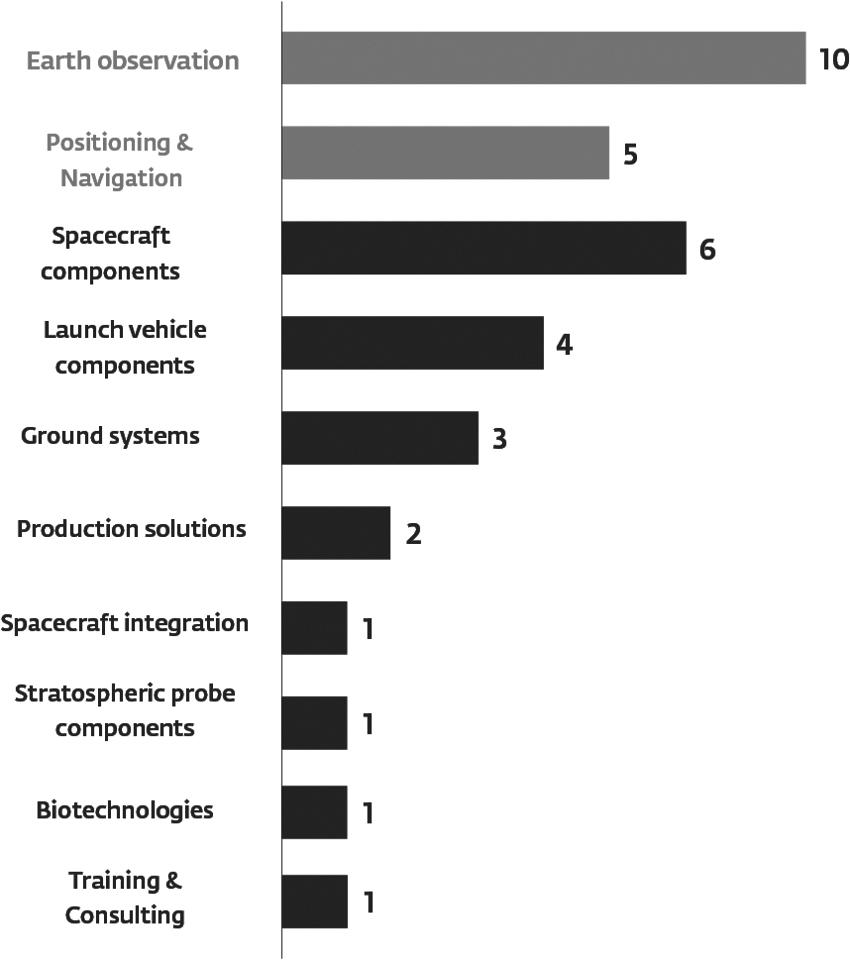
Number of companies already involved in respective segments of the space economy in Slovakia (red—downstream, blue—upstream).
On top of that, SARIO has identified two strong sources of untapped potential for the space industry in Slovakia. The first one originates in decades of relevant experience gathered by R&D institutions—the Slovak Academy of Sciences and several universities, such as Slovak University of Technology in Bratislava, Technical University of Košice, or Comenius University in Bratislava. Probably the single strongest one of these sources is the Institute of Experimental Physics of the Slovak Academy of Sciences, which has been taking an active part in a variety of international space missions, including Rosetta, BepiColombo, The Jupiter Icy Moons Explorer (JUICE), and Joint Experiment Missions for Extreme Universe Space Observatory (JEM-EUSO). 1
The second valuable source originates in Slovakia's current (and traditional) industry sectors. Over the 20th century, the country has acquired high competences in machinery, electronics, and progressive materials R&D, which many companies have preserved till these days. On top of that, more recently such sectors as automotive and information and communication technologies (ICT) have grown in significance. All these areas provide an excellent base for innovative technological companies aiming at expanding to new niches of the market.
Identification of the Challenges
The next step was to identify the challenges the space industry ecosystem has been facing. Emerging space countries by definition share a common trait of having a relatively small and young space business environment with insufficient interconnectivity. Slovakia is no exception here. Generally, low number of companies active in the sector was demonstrated also by the prevalence of academic institutions in Slovakia's first ESA PECS calls (however, later there were more and more successful projects submitted by companies, and in the last call business even took the lead). 2
This situation makes it more difficult to find relevant partners and create synergy between various stakeholders. It also means that there is a lack of companies capable of driving technology transfer from research institutions and, therefore, also lack of experience among R&D institutions in doing so. In a survey organized by SARIO in June 2020, only half of companies active in space stated they were collaborating with R&D institutions. At the same time, every one of them wanted to launch/increase this kind of collaboration. 3
Another issue, also common for emerging space countries (and smaller countries in general), is the brand recognition problem causing an overall lack of international awareness of existing capabilities. Subsequently, the companies have to try harder to get the attention necessary to initiate new partnerships and create international networks. In the same survey SARIO conducted, all the participating companies stated they would like to launch/increase international collaboration, whereas only three quarters of companies were already involved in it. 3
Setting Up the Support Measures
The funding part still plays a key role among governmental support mechanisms, and space will most probably still be highly dependent on public funding at least in the near future. However, the new space trends (partly mentioned in the Introduction) make it necessary for governments to rethink their approach to support the sector. Growing commercialization, as well as the rising number of companies, including start-ups, creates a need for new consultancy-based support, which is exactly the domain of institutions such as SARIO.
The first area of this support consists of unlocking the hidden potential. The nature of this activity may slightly differ from country to country, depending on what sources of potential have been identified. In Slovakia, it means not only supporting the creation of start-ups but also fostering the technology transfer from academia to business and helping existing non-space companies with the spin-in potential to enter the sector. Especially, the latter has shown to be a highly fruitful activity with around a dozen companies from such areas as machinery, electronics, progressive material R&D, ICT, or even automotive working on (or even already accomplishing) the diversification of their activities and finding new business opportunities in the space sector.
SARIO has adopted a comprehensive approach toward spinning-in consisting of three main steps. The first step is dedicated to the analytical work necessary to identify relevant non-space companies possessing technological capabilities useful in space sector (described previously in Identification of the Potential and Identification of the Challenges sections of this article). The second step consists of providing these companies with introductory information about the specifics and opportunities within the space sector—either on a basis of ad hoc individual meetings or through outreach events. This is all followed by the third step dedicated to in-depth sector-entry consultancy provided to those companies that pass the first two steps showing sufficient technological potential and interest. This consultancy helps them figure out their potential focus area within the space sector, receive feedback on technical aspects and feasibility, identify funding opportunities, and get access to local ecosystem partners that can assist them with the first steps.
The second area focuses on “opening the door”—helping companies grow their international network and identify suitable cooperation opportunities. The biggest challenge (that can, however, bring significant results not only to a single entity, but also to the whole business ecosystem) is helping companies enter the procurement network of strong industry players, especially large integrators or their tier 1 suppliers. It is mutually beneficial cooperation where this strong industry player receives valuable local insight and support, whereas the emerging space country significantly boosts the chances of its companies to get the necessary attention and opportunity to showcase their competences.
This activity can be done both by developing bilateral contacts and organizing events such as the Slovak Space Tech Day that was held for the second time in September 2020 and attracted more than a 100 participants from >20 countries. The list of speakers included such names as Pascal Claudel (European Global Navigation Satellite System Agency, Chief Operating Officer and Acting Executive Director), Olivier Lemaitre (AeroSpace and Defence Industries Association of Europe Eurospace, Secretary General), Pete Worden (Breakthrough Prize Foundation, Chairman; National Aeronautics and Space Administration Ames Research Center, Former Director), as well as high-profile representatives of Thales Alenia Space and Airbus showing growing international interest in Slovakia's space industry development. 4
As for the development of bilateral contacts to help companies penetrate the foreign procurement networks, SARIO has so far focused mostly on providing partner identification and matchmaking services to the European large system integrators and space SMEs, but it has also actively worked with other space offices and agencies as well as various industrial associations.
Discussion
This section includes several observations made by SARIO during the first year of conducting space-focused activities. These can help other emerging space countries and their respective governmental agencies with setting up the support measures efficiently or simply serve as an inspiration.
The first observation made is that space is in most cases highly appealing to technological companies. Even though they are often hesitant at first, seeing the sector as very distant from what they are currently doing, they are still curious to find out more about its potential and possibilities of entry.
The second observation is a reaffirmation regarding the sectors suitable for entering space based on the practical experience of Slovak companies. As expected, software companies, making up roughly a half of the dozen newcomers to the space sector in Slovakia, are the most interested in diversification toward space as it is relatively easier for them to access (especially the downstream segment, which has an overall lower requirement on previous space-related experience). Strong interest was also observed among companies working in machinery and electronic sector with a potential for space hardware development. Most recently, even industry 4.0 and automotive companies are starting to look toward space, finding their application in such segments as supply chain management or ground systems.
The third observation consists of the overall boost space can bring to non-space companies and can, therefore, serve as a strong motivation for them. Entering the space sector can provide a competitive advantage, for example, in the human resources (HR) area and in the process of hiring highly qualified and skilled engineers and other experts who along with working on other projects are also able to take part in space-related projects, which can serve as an attractive motivation for them. Moreover, being involved in the space industry brings the possibility of an overall qualitative boost for technological companies as they naturally adopt the higher quality standards and apply newly acquired high-tech knowledge in their original field of expertise.
The fourth observation is yet another reaffirmation of the assumption that many starting space companies lack the proper network. They often possess a technology interesting for potential partners, however, do not have the necessary contacts and connections to properly present it.
The fifth and “last but not least” observation may seem rather obvious—cooperation is the key to success. This is something that is clear to any business in any sector; however, in such a difficult and expensive area as space, the requirement of being collaborative is even stronger. In the case of emerging space countries, this means boosting not only international cooperation, but also the interconnectivity of the whole national ecosystem—businesses, academia, the public sector, as well as relevant nongovernmental organizations.
Conclusions
Today's space sector with its growing orientation on business requires rethinking the governmental approach toward the space industry development. Especially the emerging space countries can no more rely only on providing funding. They also have to drive the process of unlocking the hidden potential within the ecosystem and help the companies and R&D institutions to penetrate global networks to create new partnerships.
SARIO has been actively involved in such activities for more than a year. During this time, the agency has gathered several practical observations that can serve as a useful insight for other emerging space countries:
Technological companies are curious about the new possibilities space can bring them. Software companies are the most interested in diversification toward space. Strong interest was also observed among companies working in machinery, electronics, and even industry 4.0 or automotive. Space can provide a boost for non-space companies in such areas as quality standards and HR. Starting space companies lack the proper network. International cooperation as well as interconnectivity of the whole national ecosystem is the key to success.
Building up on these findings, SARIO has launched a systematic support mechanism that has helped the Slovak space ecosystem to grow in number and increase its international involvement. Most recently, this activity has resulted in establishment of Slovak Space Office with SARIO being the key part of this project. Now under the space office umbrella, SARIO continues to utilize the tools outlined in this article (which proved to be useful) and at the same time it broadens its scope of activities aimed at further development of the Slovak space ecosystem, offering yet another interesting topic for a possible future research.
Footnotes
Acknowledgments
I would like to express my deep gratitude to Dominik Susa, the Deputy CEO of SARIO, for his valuable and constructive suggestions. I would also like to offer my special thanks to Daniel Šagath, PhD, for his valuable insight and suggestions.
Author Disclosure Statement
No competing financial interests exist.
Funding Information
No funding/grant received to write this paper.