




Abstract
This article investigates how the implementation of a national space strategy in partnership with supranational organizations affects the development of service ecosystems of Earth Observation (EO) applications. The subject is studied through the lens of a service-dominant logic perspective, a meta-theory that seeks to explain how economic value is cocreated in business-to-business markets. Qualitative empirical research was conducted in three emerging space countries—Slovakia, Latvia, and Estonia—to understand how value-creating resource integration processes involving space downstream companies and their potential end-users are affected by adding the European Space Agency (ESA) to the ecosystem. The study's findings showed that the catalytic procurement of prototypes of new EO applications through ESA is connected to multilevel institutional changes in relevant service ecosystems. ESA's involvement facilitates more intensive interaction between EO companies and their targeted customers in dyadic relationships. Value cocreation processes are influenced by micro-, meso-, and macrolevel institutions. The study highlights the linkages between ESA's involvement and the purposeful entrepreneurial efforts of EO companies to change prevailing institutional arrangements. This institutional work is aimed at reconfiguring institutional arrangement at the mesolevel to make it more supportive to value-creating resource integration activities between actors in a service ecosystem.
INTRODUCTION
The global space economy is thriving. According to the Organisation for Economic Co-operation and Development estimates, the size of public budgets for space programs exceeded 75 billion USD in 2018, while the number of countries with a satellite in orbit increased from 50 in 2008 to 82 in 2018. 1
Governments invest in space research and development (R&D) with broad socioeconomic motivations. The rationale behind public space investments has often been derived from the neoclassical market failure approach, which is based on the seminal contributions of Nelson 2 and Arrow.3.4 Along this line of thinking, the public good properties (the nonrivalry and nonexcludability) of information generated by space infrastructure would lead to the suboptimal provision of such information. Therefore, governments must intervene to push an economy's investments in space R&D toward the socially optimal level. The nonexcludability property of new information is also a source of knowledge spillovers from space R&D. Knowledge created in public space programs is expected to be freely transmitted to the terrestrial economy, where it materializes in novel products and technologies and supports the long-term growth of nations. The knowledge spillovers from space R&D have been shown to be substantial. 5
European countries support space-related R&D through various national and supranational mechanisms. The countries have national space programs, and they also participate in the space programs of the European Space Agency (ESA) and the European Union. 6 Some authors even note that midsized European countries, such as Austria and Switzerland, de facto identify their national space programs with ESA programs. 7 For successful space missions, leading space agencies typically purchase R&D works at lower technology readiness levels and small series and often single units of bespoke products. Unique features and superior specifications of the products are based on the integration of advanced technologies. 8 Such purchases by the public agency correspond to the early definition of public procurement of innovation (PPI): “the purchase of a not-yet existing product or system whose design and production will require further, if not completely novel, technological development work.”9(p.5)
Generally speaking, public procurement aims to obtain the goods and services necessary to deliver public services. However, public procurement may also serve needs outside the government domain; the term “catalytic procurement” denotes this type of procurement. 10 The ESA is engaged in both direct and catalytic procurement, as it also promotes small-scale projects to develop customized space solutions for end-users outside the ESA. 11
The implementation of national space strategies in collaboration with ESA is an example of the multilevel governance of PPI. 12 The ESA member states delegate the procurement of innovative products for space missions and solutions based on satellite data to the supranational level. ESA manages the technical and contractual aspects of the space programs following its regulations and internal practices. An obvious question arises: What could be the economic rationale for European governments to make their public space investments through an international organization instead of running space programs at the national level? The market failure argument does not indicate where the social loci of public investment in knowledge production should be.13,14 Thus, it needs to be complemented with ideas from other theories to explain the multilevel governance of PPI in the space domain.
One possible explanation is that supranational PPI offers the involved economic actors better conditions for value creation than other institutional arrangements. Florio and Morretta point at two observations from the extant studies on the value of information of Earth Observation (EO) applications. 15 First, the value of information derived from satellite data is strictly linked to its use (value-in-use). Second, the subjective value of information estimates by economic actors is affected by institutions. Both ideas are central to service-dominant logic (SDL),16,17 a theoretical framework that aims to provide “a more holistic, dynamic, and realistic perspective of value creation, through exchange, among a wider, more comprehensive (than firm and customer) configuration of actors.”18(p.5) SDL describes and analyzes the evolutionary processes through which networks of economic actors form, reform, and are influenced by endogenously created institutions—laws, rules, norms, values, beliefs, and perceptions—that support value cocreation in service ecosystems. The emergence of SDL has contributed significantly to the recent rapid progress in research on the institutional aspects of service ecosystems and service innovation. 19
Institutional aspects have also been addressed in space studies, 20 but the discussion is somewhat narrow as, so far, researchers have mainly focused on the legitimacy problem for new entrepreneurs, start-ups, and small- and medium-sized enterprises. Previous research mentions the dynamic nature of institutions and the role of entrepreneurial behavior in changing the institutional order. 20 Still, a deeper insight into these changes and their link to the literature on space governance is lacking. In response to calls for more research on the topic, 21 this study focuses on institutional change in the context of multilevel governance of PPI. The article aims to answer the following research question: What is the role of supranational-level procurement in institutional change in an evolving service ecosystem?
This article applies the SDL framework to study institutional dynamics related to the transfer of PPI function from the national level to the supranational level. Institutional change is analyzed from the perspective of ESA contractors enmeshed in the service ecosystem of EO applications. Qualitative empirical data were collected from eight companies in the following three European countries: Slovakia, Latvia, and Estonia. These countries are emerging space nations; they have only recently integrated into the international space community, that is, they have had established cooperative ties with ESA for <15 years.
This study contributes an understanding of the role that the implementation of a national space strategy in partnership with the supranational organization, such as ESA, plays in the institutional development of emerging space nations. The study's findings show that engaging with ESA results in more intensive interaction between the EO companies and (potential) end-users in the service ecosystem. This interaction triggers endogenous institutional change, leading to an institutional arrangement that is supportive of value cocreating resource integration activities between actors in the service ecosystem.
The remainder of this article is organized as follows. First, we review the existing literature about value cocreation in service ecosystems and the role that actor-generated institutions play in steering value cocreation processes. Next, we describe the methodology and data, following which we present the findings. Finally, we discuss the findings and suggest policy implications of the results in relation to public procurement of space downstream applications, proposing themes for further research.
LITERATURE REVIEW
Value Cocreation in Service Ecosystems
SDL argues that “the creation of value is the core purpose and central process of economic exchange.”22(p.145) Specialization, fast technological progress, growing knowledge intensiveness, and the internationalization of businesses have contributed to the emergence of more complex contexts for value creation. To comprehend value creation, one must understand the dynamics of relationships and processes in complex networks of actors engaged in mutual service exchange and value cocreation. 23
The central foundational premise of SDL states that “service is the fundamental basis of exchange.”17(p.6) Service is the act of doing something for the benefit of another party by applying operant resources, that is, resources capable of acting on other resources, such as knowledge, skills, 16 and technology. 24 SDL assumes that value is phenomenologically determined by the beneficiary of a service in a relational context (value-in-context). Furthermore, value is embedded in a collective social context subject to cultural norms and shared meanings (value-in-social-context). 25
Thus, value is always cocreated, jointly and reciprocally, in interactions among suppliers (providers), customers (beneficiaries), and other actors through the integration of resources and application of competences. 22 In this context, the reciprocity of service exchange means that when a company provides service to a customer, it may obtain a reciprocal input (e.g., information) into the product or process development, that is, it receives service enabling it to gain financial value in the future. 26
A service ecosystem is defined as “a relatively self-contained, self-adjusting system of resource-integrating actors connected by shared institutional arrangements and mutual value creation through service exchange.”18(pp.10–11) The markets for EO applications constitute a set of service ecosystems that, in Europe, include various public sector actors * ranging from local and national authorities to the European Commission and ESA. The definition of a service ecosystem stresses the systemic and institutional nature of value cocreation and resource integration. Actors in service ecosystems are guided by institutional arrangements, † that is, “interrelated sets of institutions that together constitute a relatively coherent assemblage that facilitates coordination of activity in value-co-creating service ecosystems.”18(p.18) Actors belong simultaneously to various service ecosystems and are typically confronted with different institutional arrangements.
SDL research also has strong links to resource-based thinking. 29 Resources and multiple actors in the service ecosystem are connected by resource integration mechanisms. All economic actors are resource integrators, 17 and resource integration practices are the means through which actors cocreate value in a service ecosystem. Therefore, it is crucial to understand which resources are integrated and how. 30 EO applications are knowledge-intensive business services (KIBS) that feed knowledge inputs into the business processes of other organizations, including private and public sector clients, for better decision-making. 31
For the provision of KIBS, resource integration is driven by operant resources. In each dyadic relationship in the ecosystem of EO applications, service providers' knowledge resources (including accumulated specialist domain knowledge about satellite imagery processing, customer insight, and project management skills) are combined with customers' knowledge about the usage context (e.g., in the case of public sector customers, information on related public service delivery processes; training needs for prospective end-users of the solution; legal and regulatory issues; or data interoperability issues) and access to other data resources complementing the satellite data to cocreate value. 32
Value cocreation in each dyad is dependent on the broader context in which the dyad is embedded. For example, in the case of the dyad consisting of a supplier of a satellite-based solution that enables estimating crop nutrient deficit and a farmer using such information for variable rate fertilization, value cocreation practices are dependent on the presence of providers of specific knowledge resources (such as agronomic research institutes) and various agricultural inputs and technologies in the service ecosystem. 33
Resource integration requires processes and forms of collaboration 30 such as interaction and integration. 34 The service ecosystems view stresses the importance of interaction within and across service ecosystems. 24 The relational nature of value implies that value is also subject to asymmetrical access to resources and disparities in skills and knowledge. 25 Uneven distribution of knowledge resources challenges value creation in dyadic relationships. 32 In the case of PPI, intermediation, that is, setting up dedicated, decentralized, and autonomous agencies has been proposed as an institutional solution to address the problem of asymmetry.35–37
The ESA is the primary intermediary in the European space ecosystem, and it accumulates deep knowledge about existing markets and emerging market opportunities. 36 It may act as a broker or mediator by passing this knowledge on to relevant actors and facilitating knowledge exchange. Implementing national space programs in close cooperation with ESA embodies an institutional arrangement that is quite different from direct procurement at the national level. By adding an intermediary to a service ecosystem, new configurations of knowledge resources emerge in the respective service ecosystem. In addition, new relationships between actors are established and/or existing relationships are renewed.
When including the intermediary in our analysis of the service ecosystem, a triad emerges, consisting of the ties between ESA, a supplier of EO applications, and its customers (Fig. 1). The triad is embedded in a broader network of value cocreating actors.38,39 As a triad is the smallest unit of analysis for a network, triadic analysis is useful in investigating the systemic nature of value cocreation in any system of at least three actors. 40

Resource integration in the triad, which consists of the ties between ESA, a supplier of EO applications, and the latter's customers. In each dyadic relationship, the knowledge resources of involved parties, such as accumulated specialist domain knowledge, customer insight, project management skills, industry knowledge, and contextual knowledge, are combined to cocreate value in the service ecosystem. EO, Earth Observation; ESA, European Space Agency.
Figure 1 illustrates the structure of value creation in the context of EO applications. The supplier is committed to creating value for various end-user groups, such as governmental agencies. However, because of the contextual nature of value, the end-user, who may have limited knowledge about technologies for processing satellite imagery, may not be ready to interact for resource integration to cocreate value. Therefore, as a result of public intervention by national-level decision makers, a third party—the ESA—is engaged in the process through catalytic PPI and facilitates interactions between the other actors.
Institutions and Institutional Change
Service ecosystems are multilevel in structure. Institutional arrangements can be viewed at various levels of aggregation. Three analytical levels of social interactions—micro, meso, and macro—have been proposed to describe relationships between actors. 41 The microlevel consists of individual and dyadic structures and activities, while the mesolevel comprises midrange structures such as industries. As a multiactor system with distinctive dynamics of relationships among its parties, a triad is a mesolevel structure. 40 Mesolevel context frames dyadic relationships. Broader societal structures and activities are placed at the macrolevel. Vargo and Lusch 18 concede that these analytical levels are not absolute but rather represent different perspectives about institutions.
Scott divides institutions, that is, rules, norms, meanings, symbols, and practices, into three institutional pillars according to their regulative, normative, or cultural-cognitive nature. 42 The regulative pillar reflects economists' (e.g., North 43 ) early understanding of institutions as rules of play. Regulative institutions such as laws and rules ensure that actors behave according to certain regulated standards out of fear of sanctions. In the case of PPI, the regulative pillar refers to procurement regulations on different levels of governance, from the European Union (EU) directives and codified procurement policies of the intermediary agency to any pertinent national-level legal framework. 44
The normative pillar consists of norms and values that allow actors to perceive the social implications of a particular behavior. It represents assumptions and expectations about what is appropriate or expected in social interactions. 42 Normative institutions are upheld because actors feel an internal commitment to them. Risk aversion in public administration is mentioned as one of the normative institutions that prevents PPI from fulfilling its innovation potential. 35
Cognitive institutions refer to “ways, perceptions, and descriptions, theories and models, empirical data about reality and thus, the understanding of a business reality as a basis for operating as a successful business.”45(p.302) The cognitive pillar consists of sets of beliefs that depend on the actors' perceptions of their environment, such as beliefs about appropriate business models ‡ and how to convert technologies into market outcomes. 48
The foundational premises of SDL stress the dynamic and actor-generated (endogenous) nature of institutions. The systemic and evolutionary processes that create and recreate institutions unfold over time to support the joint survival of actors in a service ecosystem. 18 Institutional arrangements evolve endogenously from ongoing practices throughout resource integration processes. 45
Actors in a service ecosystem differ in their opinions, beliefs, values, or norms. Some actors in the ecosystem derive value from a prevalent institutional arrangement and do not have the incentive to change it. Institutional pressures arise in a service ecosystem if actors feel that the current institutional arrangement fails to serve the actors' interests and is poorly suited to value cocreation. 49 The perception of the institutional arrangement's nature as disadvantageous is formed on the basis of the actors' own and the other actors' unfavorable outcomes from resource integration. 45 Experiential learning may change the actors' perceptions and expectations, and, ultimately, the actors engage in institutional work, which is defined by Lawrence and Suddaby as “purposive actions to create and disrupt institutions.”50(p.215)
For enduring institutional change, several actors need to join forces and reconcile dissonant institutions. As a result of the complementary reconciliation efforts of the actors in the ecosystem, nascent institutionalized norms and rules emerge. 49 These nascent institutions, or proto-institutions, 51 have the potential to become full-fledged institutions. This can happen if their development, diffusion, and adoption by the actors of the service ecosystem are supported by the social processes at play in the ecosystem. The emergence of proto-institutions is an important transition phase in the process of institutional change. The proto-institutions are related to all three institutional pillars—regulative, normative, and cognitive—and are eventually combined with the prevailing institutional arrangement to form the new institutional arrangement. 52
Returning to the triad in Figure 1, interactions between the triad members and between the triad and other actors in the service ecosystem are steered by a diversity of micro-, meso-, and macrolevel institutions. On top of the macro- and mesolevels of the regulative pillar, there are microlevel institutions belonging to the regulative pillar, such as the general clauses and conditions of procurement contracts. Some microlevel institutions reside in the cognitive pillar; for example, actors' perceptions of the value potential of offerings that are based on the processing of satellite data. End-users have ingrained expectations about how things should be done, for example, how certain public sector functions need to be performed. These expectations are grounded in the micro- and mesolevel normative pillar. Mesolevel cognitive institutions include prevailing industry standards, for instance, shared beliefs about the usability frontiers of new technology and business models to reach out to actors with unmet needs.
Actors gain access to the ESA procurement system if the host country concludes formal cooperation agreements with ESA or becomes an ESA member state. Such events discontinue the prevalent institutional arrangements in the related ecosystems. New configurations of knowledge and competences emerge in the ecosystem. This institutional disruption, which is the result of a national-level policy-making decision to outsource PPI function to the supranational level, provides fertile ground for endogenous institutional change through self-adjusting processes in the ecosystem. 18 This change is also the focus of our research question: What is the role of supranational-level procurement in institutional change in an evolving service ecosystem?
The SDL perspective predicates that institutional change is multidimensional. Higher (lower) level proto-institutions emerge from lower (higher) level interactions between the actors in the ecosystem. These nascent institutions shape resource integration and value cocreation activities in dyads and the triad (Fig. 2). Some proto-institutions fade away, but others prove their usefulness as structures that support resource integration and later fully institutionalize. As an outcome of institutional change, service innovations can arise in the ecosystem. 53 Furthermore, decision makers may even be able to identify areas of improvement in the institutional arrangement, and tackling these challenges could help to unlock the ecosystem's full innovation potential.
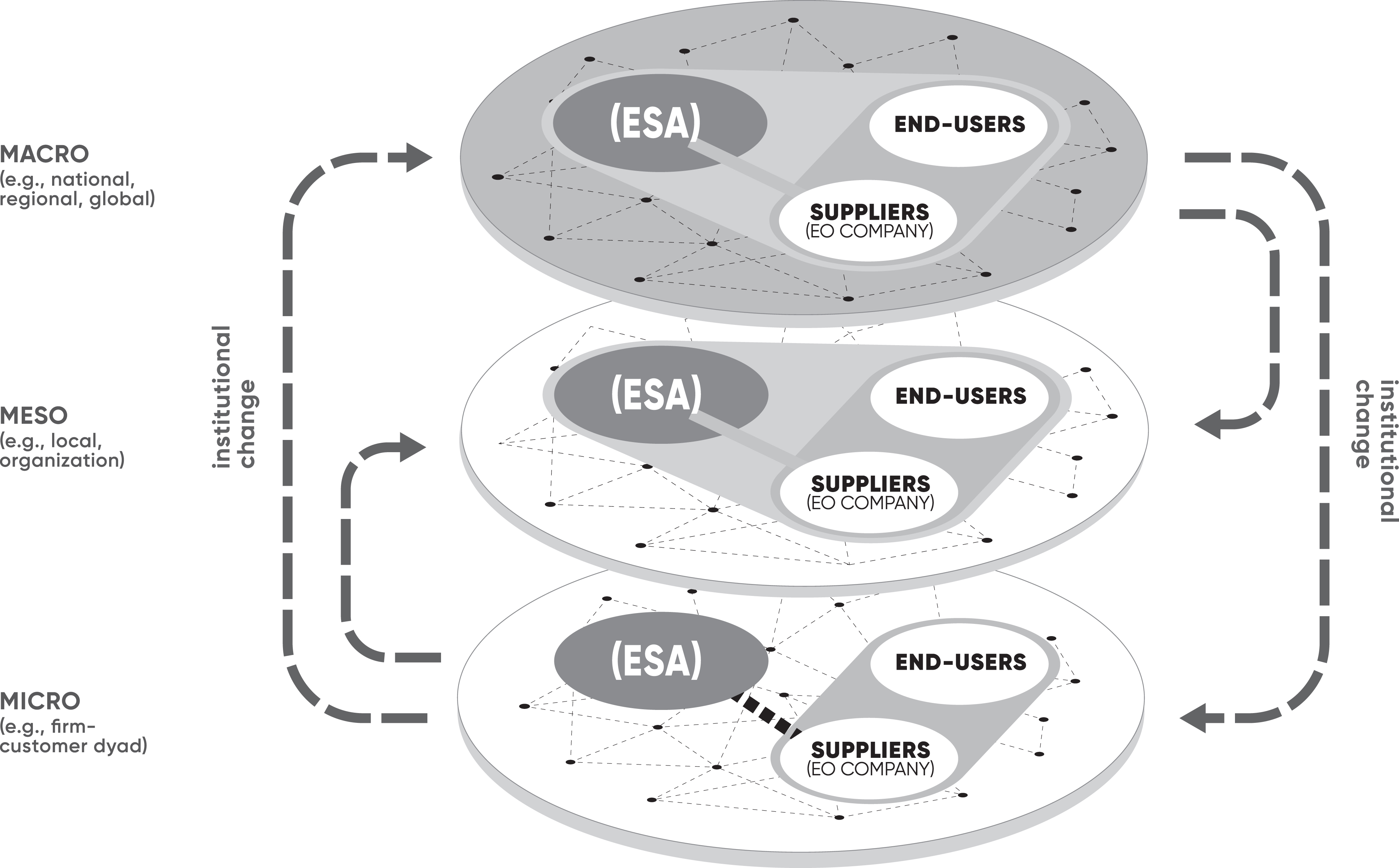
Interactions between the triad members as well as between the triad members and other actors in the service ecosystem are steered by a dynamically evolving bundle of micro-, meso-, and macrolevel institutions. These institutional arrangements, which shape resource integration and value cocreation activities, are endogenously generated and regenerated. Higher level institutions may emerge from microlevel interactions. Institutional change at a higher level of aggregation affects institutional dynamics at lower levels of aggregation.
METHODS AND DATA
This study focuses on how supranational-level procurement of space solutions affects institutional change in an evolving service ecosystem. We chose the service ecosystem of EO applications as our research setting, with a particular interest in the role of the intermediary—in this case, the ESA. ESA is one of the leading space agencies in the world, pushing the frontiers of knowledge in space science. At the same time, it has a significant impact on its member states' economic and institutional development. Prior research does not provide sufficient information about how processes of institutional change take place; therefore, our study is exploratory.
The study is an empirical multiple-case study, the latter being appropriate for novel research questions when little is known about the relevant constructs and associations between them.54,55 We applied the in vivo approach, 56 that is, the created framework shown in Figure 2 was a point of departure. Still, as a result of systematic combining 57 and continuous dialogue between theory and data, our understanding of the empirical phenomenon increased and the framework was modified during the research process. Consequently, our case studies provided a contextualized explanation of institutional changes in the evolving service ecosystems in which the case companies are situated. 58
Multiple cases allowed us to compare the findings and check whether they could be replicated across cases, thus resulting in more accurate theoretical conclusions. 59 We followed a purposeful sampling strategy to ensure that the cases provided rich information. 60 For our empirical study, we chose cases in which the focal phenomenon was likely to occur. The number of companies in the Central and Eastern European (CEE) countries involved in the European space industry value chains was close to zero when these countries first approached ESA to accede to the organization. 61 Such environments were expected to be fertile grounds for institutional change.
Specifically, we wanted to investigate triads, which emerged when ESA, that is, the intermediary, made a contract with an EO application supplier. Interactions with ESA staff members enabled us to prepare a comprehensive initial list of companies in the CEE countries that satisfied the most important criterion: the companies had to be involved in the catalytic procurement of ESA in the field of EO services. Then, additional criteria were applied to narrow down this list to manage different variance dimensions relevant to the research question, such as cross-country variance related to the institutional environments and cross-case variance to control for the firm's size and maturity level. Finally, an essential criterion for the final case selection was access to information. 62
To magnify the phenomenon under observation, we wanted the institutional arrangement of the case companies to vary. Therefore, the selected case companies are located in three small countries that are all members of the European Union: Estonia, Latvia, and Slovakia. Although membership in the European Union makes the institutional environment somewhat similar for the companies, the countries vary in terms of their institutional arrangements with the ESA (Table 1). The European Cooperating States (ECS) § agreement that regulates ESA's cooperation with Slovakia allows indirect access to ESA programs and activities, while Estonia and Latvia have passed this stage of cooperation. Estonia is now a full ESA member state, and Latvia is an associate ESA member state. These cooperation formats grant direct access to ESA mandatory and optional programs. 63 This research setting allowed us to capture variation, but at the same time to control for macrolevel changes in the selected research context.
Status of Cooperation Between the Country of Origin and European Space Agency
ESA, European Space Agency.
We examined the triad and change from the viewpoint of the supplier. The cases we selected for in-depth investigation had to fulfill two main criteria. First, to manage variance between the cases, we focused on a single type of PPI: the development of new services based on satellite data. The fact that ESA contracts with these companies go through a standard procurement process and share the general clauses and conditions of procurement secures the needed stability of our research setting. Second, we chose companies whose relationship with ESA we could track from birth, thus increasing the validity of our findings. We identified the case companies from the ESA's contractor databases. Our screening resulted in eight companies in three target countries that met our requirements and agreed to be part of this study. A summary of the key information about the case companies is presented in Table 2.
Summary of Case Companies
CEO, chief executive officer.
We sought the most knowledgeable informants for the study; in the case companies, they were either the board members or project managers responsible for ESA projects. All the interviewees had been involved with the development of EO applications since the inception of this business area in their companies. Being responsible for business development in this domain, they were knowledgeable about the respective service ecosystems at the national and international levels as well as about dynamic changes in context over the years.
Nine semistructured interviews were conducted at the case companies' premises between January and April 2019. The interviews lasted between 40 and 100 min, 65 min on average. All interviews were recorded and subsequently transcribed verbatim. The interviews with four Estonian case companies were conducted face-to-face in Estonian, as the interviewees and the interviewing author are Estonian nationals. The interviews with Slovakian and Latvian entities were conducted face-to-face in English.
Data collection and analysis were supported by engaged scholarship. Engaged scholarship 64 provides an opportunity to enrich scientific knowledge with practical knowledge for better sense-making of the empirical context and, consequently, for a deeper understanding of the phenomena and processes under investigation. 65 One of the authors worked as a consultant assisting the case companies in matters related to ESA industrial policy. He could closely follow the ESA suppliers' activities without direct involvement in those aimed at institutional change and, thus, functioned as an observer. 66
Engaged scholarship enabled access to the case companies' internal documents, such as reports related to publicly funded projects or internal memos. We also relied on publicly available documents, such as company websites, annual reports, brochures, newsletters, professional magazines, and newspapers. In our case database, we complemented the interview transcripts with 850 pages of additional material.
Aside from structured data gathering, the author was in constant contact with the managers of the ESA suppliers through digital communication channels, such as Skype. Such information exchange sessions were informal, mainly focusing on different aspects of managerial decision-making in the EO applications industry. The information exchange sessions provided supplementary data to the semistructured interviews. Different data sources for data triangulation allowed us to validate the informants' views and better capture the focal phenomenon over time.
The aim of our analysis was to create a thick description of the cases. 67 The Gioia method 68 was applied in the early phases of data analysis to manage rich information collected during fieldwork, and an NVivo software tool was used for data coding to support this analytical phase. The Gioia method helps create a bridge between informant-centric terms and conceptual interpretations of data by a researcher, that is, moving from raw data to first-order codes and then to second-order theoretical themes and dimensions. 69 The list of codes evolved over the research process, as new themes and concepts emerged inductively from the data and deductively from the simultaneously evolving theoretical framework. 70
The structured data emerging through this analytical step were used in the later stages of analysis. First, case narratives were prepared on the basis of the structured data. 71 This involved the process of selecting, focusing, simplifying, abstracting, and transforming the data by writing summaries and coding. Based on this analysis, we were able to capture institutional changes in the service ecosystems and related critical events. The concepts that emerged from the data were then linked to formulate dynamic relationships between them and, finally, to derive descriptions of the processes of interest. These formed the “skeleton” of our understanding of the emergence of the triad and the related institutional change.
FINDINGS
The Emergence of the Triad
The development of the service ecosystems in which the case companies are embedded can be linked to the emergence of two broader institutional initiatives that shape those ecosystems: the European Union's Copernicus program's
**
data policy and cooperation with ESA. The Copernicus program is the most ambitious EO program worldwide. The Copernicus data policy ensures full, free, and open access to space-based data and information. Also, ESA and the European Union have jointly invested in terrestrial data dissemination platforms to make these data accessible to economic actors.
72
For service suppliers, this macrolevel regulative institution implies access to resources that enable them to offer new value propositions to multiple other actors without paying for the usage of satellite data with global coverage. As one informant put it:
“If the data had not been free, if the data did not cover the whole world, if the data were not guaranteed to be uniform for the whole world, then it is very, very probable that we would not do it [be in the business of EO solutions]” (Company D, square brackets the authors').
The gradual deepening of the cooperation between ESA and the case companies' countries of origin implied disruptions of institutional arrangements guiding the nascent service ecosystem, primarily due to changes in the meso- and macrolevel regulative institutional pillars. These changes spawned a new context for revaluing the case companies' existing resource bases. Company A, Company D, and Company G offered geographic information systems before ESA and their home countries concluded the first cooperation agreements.
Imminent access to ESA programs formed a backdrop for investigating new opportunities for resource integration involving the companies' geospatial data processing skills and competencies. As a result of internal revisions of resources, companies created small teams dedicated to processing satellite imagery to establish their presence in the nascent service ecosystem. Also, the new macrolevel regulative institutions played a crucial role in the emergence of new actors in the service ecosystem. The foundation of university spin-offs in the sample (Company B and Company H) coincided with adjustments of cooperation statuses between respective host nations and ESA, Estonia's accession to the ESA Convention, and signature of the ECS agreement between Slovakia and ESA. The following quote illustrates the impact of the change in macrolevel institutional arrangement on the behavior of actors:
“It [concluding an ECS agreement] was a huge breakthrough. We founded the company on two prerequisites - the launch of Sentinel satellites [of the Copernicus program] and Slovakia becoming affiliated with ESA” (Company H, square brackets the authors').
The companies' internal responses to changes in their institutional arrangements laid the foundation for initiating value cocreating activities in the EO domain. Within this new context, actors were continuously involved in planning, searching, and evaluating a range of value propositions that was possible to develop with their resources. They analyzed the unmet user needs of existing customers, conducted meetings with various potential end-users, and assessed the existing value propositions of actors with similar resource bases.
However, the case companies' attempts to initiate value cocreation processes with potential end-users usually failed. Lack of knowledge resources on the prospective customers' end was one of the factors in this: “there weren't any public organizations in Estonia [at the time] with technical competence or capability to describe the technical requirements [to us]” (Company A, square brackets the authors').
ESA launched dedicated procurement mechanisms in all three countries in which the case companies were located. ESA purchased EO-based services to serve needs residing outside the organization (catalytic procurement), for example, to monitor critical infrastructure. During the contract implementation, it became evident to the case companies that ESA had the potential to be much more than merely a procuring authority providing financial resources. In fact, ESA could operate as an intermediary between suppliers and end-users:
“It is a new technology to the customer, who does not know quite precisely what the opportunities and limitations are. And it is a new technology to us, also, who do not know, either, precisely what the opportunities and limitations are. But it is a well-known technology to ESA; with their experience, they know precisely what the technology's opportunities and limitations are” (Company D).
However, such a value-generating exchange of information was held back by certain microlevel normative institutions framing the relationship between ESA and the supplier. ESA follows its own procurement regulations and practices. Its standard tender evaluation methodology offers rewards for the innovativeness of a proposed solution and the uniqueness of competencies and experience of a project team. These regulative institutions are reflected in normative institutions.
ESA appeared to assume different roles in the dyads depending on the technical content of the procurement contract. If solving an end-user's problem would entail perceived value for ESA, as well, for example, the technological advances could be reusable for some future missions, then its technical staff members were more eager to bring their knowledge resources to the conversation. At the same time, regular interaction between parties was prescribed by the provision of the procurement contract.
“And what we would have expected from them, for instance—more mentoring along the way, during the project implementation. Because actually what we have received so far—it's more administrative feedback than competence-based feedback. And I think mentoring would have helped new players in this arena. They were more concerned whether we have used the right formatting of references instead of what we have actually done and whether it is really something that is competitive” (Company E).
The relational dynamics between the suppliers and end-users changed after ESA signed contracts with the suppliers. Following ESA's suggestions, activities aimed at collecting end-user requirements through direct interaction with actors in the ecosystem were added to the tasks of procurement contracts. As a result, following the practices that were considered the norm in the ESA procurement system, the suppliers were able to initiate active interaction with other actors and maintain it throughout the implementation of the contract. This exchange for collecting user requirements evolved over time into a deeper and more regular interaction between the actors, as portrayed by the interviewees:
“As soon as we have something to show them, when we have some results to present… of course, we present and we expect feedback. This feedback is built in our methodology that we follow. When we get feedback from the customer, then we adapt to it, maybe we will do something differently. So, we are sure that we go the right way and the result will be valuable” (Company F).
Scholars have argued that interaction, as such, is not a sufficient condition for resource integration and value cocreation. Interaction is merely a necessary precondition for resource integration.
74
The interaction between the suppliers and end-users catalyzed by the ESA contracts entailed knowledge resource integration through which end-users contributed with special domain knowledge:
“End-user contributed with their in-house data, and very deeply with their expert knowledge in this field of activity… Without that… we are an IT company, we don't know anything about the infrastructure objects. What are the problems there, what can be done with remote sensing, how the problems change over time, and which problems can be detected? There may be such problems that—sorry!—you cannot ever detect them with an Earth observation solution” (Company D).
As a result of changes in macrolevel regulative institutions, a triad emerged comprising two dyads connecting three associated actors. The relationships between suppliers and end-users were affected by the arrival of the third party, ESA, even if ESA did not commit itself to knowledge resource integration with other parties in the triad.
Endogenous Institutional Change in the Triad
When winning the first ESA contracts, the respondents exhibited relatively uniform attitudes toward ESA (e.g., Company E: “we were glorifying ESA in the first hand”). The informants had normative expectations about ESA's modus operandi. ESA was regarded as a highly technologically competent organization. The case companies had a perception that ESA bought a service prototype from them mainly because of the prototype's unique value proposition. The companies anticipated that ESA had internal thresholds for the technological uniqueness of the EO applications that were purchased. Therefore, the ESA contract was seen as the validation of the company's assumptions about the context in which value is created (e.g., Company F: “we were thinking that this was a right kind of niche for us because ESA accepted this idea”).
New microlevel cognitive institutions started to emanate from the normative pillar of the institutional arrangement. The case companies tended to embrace certain beliefs about the value potential of their new offerings because of their perceived innovativeness and unique value propositions. These emerging cognitive proto-institutions transcended the relationship between supplier and ESA 51 and shaped the behavior of the ESA contractors in relationships with other actors in the service ecosystem. The described change in the microlevel cognitive institutional pillar happened without intensive interaction between the suppliers and ESA. Still, it evolved due to normative expectations about how ESA acts in social interactions. Cognitive disposition, that is, the adoption of new strong beliefs about reality, 40 is one of the mechanisms through which a relationship with an intermediary affects a dyadic relationship (e.g., between the company and an end-user) nested in the triad.
However, the interviews showed that these microlevel cognitive proto-institutions were prone to fade away. The suppliers reached out to various potential end-users. It turned out that despite the involvement of the intermediary in the service ecosystem, which brought along new configurations of knowledge and competencies, disparities in knowledge persisted. The respondents described cases in which resource integration with an end-user was hindered by the latter's inflated expectations about the technical parameters of services, such as spatial and temporal resolutions enabled by the usage of EO data. The case companies knew that the customers' expectations could not be met with the state-of-the-art technologies in the field as the suppliers had access to knowledge of ESA experts to assess their technical challenges:
“… he [contact person at ESA] has a very technical background. He understands very well what we are doing. If I communicate our possible challenges, that we have two alternative pathways, then he takes initiative and tells us “don't mess with this approach, take the second option” (Company C, square brackets the authors').
However, it was disappointing that the potential end-users—key actors in the service ecosystem—were unaware of the potential value of EO solutions. This meant that the suppliers still needed to invest a considerable amount of time and resources to create a market and arouse the interest of potential customers.
“Sitting behind the table with people, even with experts in the spatial data domain, it is a total… ‘rocket science’… That you are able to measure deformations on Earth from 800 kilometers above with a precision of one millimeter, globally, without leaving your desk… is kind of incomprehensible to them./…/Last year we made around 400 customer demos and I can boldly claim that 99 percent of them had not ever heard about the technology we use./…/The guys that could extract the most value from the technology, they are not aware of it” (Company D).
Consequently, the experiential knowledge acquired through interactions with end-users forced the actors to rethink the context for value cocreating activities. 45 Because of their failed attempts at value cocreation, the case companies' beliefs about the advantages of satellite-based solutions over other technologies and appropriate business models for delivering value changed quite profoundly within 2–3 years from the start of their collaborations with ESA. A word commonly used by the interviewees to describe initial beliefs that emerged through cognitive disposition was naive: “I was very naïve about that. I thought the technology was so ground-breaking that everybody would pay for this but after 3 years of travelling and talking to people I have to say I was naïve” (Company H).
“We then sat down with the guys [after establishing the company] and thought what strategy we could have altogether. The strategy was quite naïve./…/The reality is that it doesn't work in such a way. Particularly with a public sector customer” (Company B, square brackets the authors').
Interaction with other parties in the service ecosystem gradually lifted the veil on the complexities related to the systemic nature of value cocreation. The views of the actors just starting the development of EO applications (e.g., Company G: “End-users want to see results like maps showing change”) were considered overtly simplistic or even fundamentally fallacious by the actors that had been a part of the service ecosystem for a longer time. One interviewee painted a much broader picture of a network of actors involved in value cocreation rather a dyadic relationship between the supplier and an amorphous end-user:
“Technology does not give the last mile of information. It is not like that—bang!—and value is delivered to engineer, bookkeeper, manager, society, and user. All of them have to get value from the service/…/In fact, these layers must be solved simultaneously, I think./…/It is not the way forward, just to solve a manager's problem up there, but the specialist does not get anything, it is useless to him. Then this chain just does not work” (Company D).
Furthermore, the accumulating knowledge about the context of value creation induced changes in the microlevel cognitive institutional pillar. The case companies formed new insights of potentially successful business models. The shift in their institutional arrangements changed the structure and context for resource integration in their service ecosystem. This new context guided the suppliers' sense-making about the “resourceness” of resources.
75
As a result, some of the operant resources were devalued, while other resources gained value. One informant described the attribution of value to resources:
“Now, if we build systems that rely on machine learning or deep learning, such technologies, then—as strange as it appears—the most valuable resources are not our expert knowledge of satellite technology or excellent skills to build information systems but high quality training and testing data./…/Ultimately, this game will be won by a company that has the largest volume of representative training and testing data” (Company B).
Actors in the service ecosystem differ in their beliefs and values, and this has a bearing on their understanding of how to seek solutions to a problem. Inevitably, actors' different interpretations cause tensions in dyadic relationships. In the case companies, such tensions brought about entrepreneurial behavior that aimed to break the institutional barriers impeding value cocreation. The institutional work for altering the mental models of other actors in the ecosystem took different forms, such as private persuasion
76
(also labeled “evangelism” by Company A), to give rise to new cognitive proto-institutions:
“It was very tough… They did not understand initially that we are building a system that automatically detects these red polygons. They were thinking that a person always has to go through all the infrastructure objects: ‘That is so much work! We do not want to do this!' We had to give presentations to fully convince them that is automatic” (Company F).
There was also resistance to institutional reconciliation due to deeply rooted assumptions about the roles and ways of working of different ecosystem actors. The following quote exemplifies microlevel normative institutions inhibiting effective resource integration in a dyad:
“I think that the barrier is simply in the failure to break the block from governmental organizations: ‘My first choice is to perform a task with my own people, I don't purchase services from experts, from industry…’/…/Links to a company that offers professional-grade services with all the extras—availability, security, sustainability—and cost-sharing due to economies of scale… They are not mentally ready for that” (Company A).
The case companies' entrepreneurial efforts, aimed at the convergence of dissonant microlevel institutions in the triad, eventually led to the emergence of more enduring proto-institutions at the mesoscale. The institutionalization of cognitive proto-institutions resulted from several “recursive loops” 18 of deliberate actions to change the prevalent institutional arrangement. The microlevel cognitive institutional pillar was the most unstable. 52 The case companies pursued various business models to push for the emergence of shared understandings about the value potential of EO technologies in the triad.
Eventually, a more stable institutional environment manifested in the readiness of the end-users in the triad to procure EO applications directly from suppliers without ESA's intermediation. This indicates that different actors' perceptions about the capabilities of the technology and ways of converting the technologies into reciprocal value became aligned. Estonia's first national-level PPI activities took place in 2018, 7 years after the case companies had signed their first contracts with ESA. According to the opinions of the Estonian suppliers, the initiation of national-level procurement processes would have remained unfeasible without the mesolevel institutional changes that emerged in the triad, related mostly to the cognitive and normative pillars.
CONCLUSIONS AND DISCUSSION
This study contributes to an understanding of institutional change in the service ecosystem of EO applications. Multilevel change in the institutional arrangement steering the ecosystem was brought about by a decision by policymakers to procure prototypes of the innovative applications at the supranational level, through ESA programs, instead of using national-level tendering. Through this decision, a triad of connected actors emerged: ESA, suppliers, and end-users. This is denoted as Step 1 in Figure 3. The immediate impact of ESA's involvement in the service ecosystem was marked by a more intensive interaction in the relationships between the EO companies and (potential) end-users. ESA acted as a mediator in this dyadic relationship.

A process toward stable institutional arrangements in the studied service ecosystems comprised four major steps. Step 1: the involvement of ESA in the service ecosystem mediates more intensive interaction in dyadic relationships between the EO companies and their end-users. Step 2: new proto-institutions emerge through the cognitive disposition mechanism. The proto-institutions guide the interactions of the EO companies with other actors in the service ecosystem. Step 3: the EO companies do institutional work to forge new proto-institutions to overcome barriers to effective resource integration in dyadic relationships. Step 4: stabilization—the new proto-institutions become full-fledged institutions to support the value cocreation activities of actors in the service ecosystem.
This study's findings show that outsourcing the procurement function disrupts the prevalent institutional arrangement in the related ecosystem and triggers an endogenous multilevel change therein. New macrolevel regulative institutions, such as access to ESA programs and the EU Copernicus program's data policy—which grants actors full, free, and open access to space-based data generated by the Sentinel constellation—induce institutional change in the microlevel normative and cognitive pillars. The suppliers embrace certain normative expectations regarding ESA's role in the ecosystem and attribute meanings to ESA's actions. The normative institutional pillar moderates the emergence of new microlevel cognitive proto-institutions, such as beliefs about appropriate business models for converting technologies into desired market outcomes (Step 2 in Fig. 3). The adoption of new strong beliefs about reality through cognitive disposition processes 40 started to guide the behavior of the suppliers in dyadic relationships with other actors in the service ecosystem.
This study's findings highlight the central role of institutional entrepreneurship in such change. Actors in the service ecosystem differ in their beliefs and values. Also, knowledge resources are unevenly distributed, and this challenges value cocreation. The entrepreneurial efforts of the suppliers are aimed at reconciling different opinions and beliefs to overcome tensions in dyadic relationships. New proto-institutions emerge as a result of this institutional work. 50 After several “recursive loops” 18 of deliberate actions to change the prevalent institutional arrangement, these proto-institutions institutionalize (Steps 3 and 4 in Fig. 3) to support the value cocreation activities of actors in the service ecosystem.
Multilevel institutional changes are driven by changes in the microlevel cognitive institutional pillar. The emphasis on institutional change and the processes behind such change contrast with Wong et al., 20 who show how various existing stable institutional logics and patterns shape the space actors' behavior. Our results stress the actors' agency, while in Wong et al., 20 agency is hidden and the prevalent institutional arrangements guide the actions of space companies. These controversial results lead us to toe the paradox of embedded agency 77 : how can actors change institutions if their actions are determined by the very same institutions?
In this case, the answer lies in the disruptions in institutional arrangements due to the stepwise deepening of cooperation between ESA and the case companies' countries of origin. These higher level changes of the regulative pillar create preconditions for institutional work and contribute to new ideas. 78 The initial conditions were different for Wong et al.'s Austrian case. 20 Austria has been an ESA member state since 1987. The institutional arrangements steering the service ecosystems have been stabilized over the past 30 years.
The present study has significant implications for public policy, particularly for emerging European space nations. Under certain initial conditions in a country, launching cooperation with ESA may strongly affect the dynamics of institutional arrangements that coordinate value cocreation in the service ecosystems related to space technologies. New business models and technologies become institutionalized over time as an outcome of these processes of institutional change. Country-level studies that aim at measuring the economic impacts of public investment in space programs concentrate mostly on the output additionality of space R&D investments. Output additionality deals with outputs from the PPI process such as revenue derived from new space products, which would not have been achieved without public investment in space programs. 79
The studies measuring output additionality fail to capture endogenous institutional change, an important effect of public investment in space. Changes in the microlevel cognitive institutional pillar constitute the learning effect that leads to output additionality in the long term. In the current research context, governments achieved enduring differences in firm behavior by procuring new space applications using ESA as a contracting authority. These differences in firm behavior, referred to as behavioral additionality of a public policy instrument, 80 justify a switch in the procurement level.
The policy choice between the implementation of national space programs and participation in international space programs is contingent on a country's or an industry's overall institutional development. When the institutional change set in motion by involving ESA in the service ecosystem matures into a stable new institutional arrangement, then the need for an intermediary that acts as a catalyst in the dyadic relationship between the suppliers and end-users in the service ecosystem—such as ESA—gradually fades.
The Estonian data show that the described mesolevel institutional convergence process took at least 7 years in some service ecosystems, in which there were no additional public policy interventions to accelerate the process. In reaching toward stable institutional arrangement, it becomes relevant for policymakers to reconsider the costs and benefits of continuing with outsourced public procurement of space applications—especially participating in programs that do not necessarily assume supranational collaboration for resource consolidation. Outsourcing entails agency and transaction costs, 81 as ESA as a supranational organization and its member states and cooperating states may have conflicting policy goals and interests. These costs have to be considered in light of input-, output-, and behavioral additionalities of this mode of governance of national space investments and compared with other available alternatives.
The processes of institutional change toward new, stable mesolevel institutions could be accelerated. According to the case companies, the dyad linking the intermediary (ESA) and end-users was characterized by an almost complete lack of interaction. This comes down to the existing micro- and mesolevel regulative and normative pillars of the institutional arrangement in the ecosystem that do not steer the parties toward mutual interaction. Knowledge transfer from the intermediary that possesses superior domain knowledge to actors in the service ecosystem could be encouraged by introducing new microlevel regulative institutions, such as terms of procurement contracts that foresee direct interaction between ESA and end-users. Activating the third dyad in the triad reconfigures the three-actor system and addresses disparities in knowledge and skills that hinder the integration of resources for value cocreation.
This study's main limitation relates to its research context. The case companies are actors in emerging markets for EO services. In nascent industries that are characterized by incomplete offerings, uncertain customers, and ambiguous business models, 82 more vigorous institutional change in the service ecosystem is anticipated as institutions evolve to reduce the uncertainty of interaction between actors. 83 This limits the generalizability of the findings. At the same time, it opens up new avenues for extending the theoretical framework to study market formation. Vargo and Lusch conceptualize markets as specific service ecosystems, that is, institutionalized practices. 18 Following the interplay of resource integration practices in the service ecosystem and institutional dynamics at different aggregation levels over a longer period of time would offer new insights into the role that an intermediary such as ESA plays in the formation of new markets.
Footnotes
AUTHOR DISCLOSURE STATEMENT
No competing financial interests exist.
FUNDING INFORMATION
No funding was received for this study.