




Abstract
This article extends the rigorous, interdisciplinary investigation of social-ecological systems (SESs) to an emerging resource system, the Moon. The Lunar Resources Database (LRD) project showcases the diversity and complexity of lunar SESs in support of ongoing global lunar governance and policy discussions. We find that many characteristics that lead to successful self-governance and collective action in terrestrial resource systems are present in the lunar context. An initial analysis of 5 likely lunar resource systems highlights their differences and foreshadows the need for diverse management regimes and modes of governance. We propose that the ongoing analysis of complex social-ecological lunar systems through the LRD is a valuable contribution to lunar governance and policy development. Finally, we outline an institutional analysis framework of conventional and new modes of governance within the context of the Moon as future work is required to progress evidence-based research to inform coherent, timely, sustainable, and equitable lunar governance.
Introduction
The Outer Space Treaty (OST) famously establishes the exploration and use of outer space as “the province of all humankind” and requires “free access to all areas of celestial bodies.” 1 These tenets imply non-excludability, and, as such, outer space is frequently referred to as common. More specifically, economics characterizes many of these systems as common-pool resources (CPRs). An extensive body of literature has accumulated on successes and failures in addressing those concerns.2,3 This includes a conceptual framework called the Social-Ecological Systems (SESs) framework, which offers a methodology for studying complex interactions between social, ecological, and governance systems that influence the outcomes of resource management. 4
However, “outer space” is not a single system.5,6. Much like Earth, outer space contains countless types of resources, each with distinct features and numerous potential use cases. Thus, different systems may warrant distinct management practices. Therefore, specificity and empirical observation of individual resources will be required to develop coherent and effective governance.
The lunar ecosystem, as it develops, will also consist of complex webs of interactions. Although specific use cases for lunar resources have yet to crystallize, this article explores the suggestions that emerge from applying the SES framework to a set of likely lunar resource systems. Use cases of those systems will emerge within existing social and governance systems, including economic and scientific values, cultural and spiritual values, social relations between space operators, treaties, recommendations, guidelines, bilateral agreements, and national laws and policies.
First, we introduce the fundamental concepts of SESs and use them to design a lunar resources database (LRD) that facilitates structured comparisons of different lunar resources. Then, we explore the application of the database by discussing a specific set of lunar resource systems. After this, we describe the utility of the database as a tool and how it may help understand and assess governance needs. Finally, we conclude by reflecting on the utility of approaching the lunar environment as a plurality rather than one monolithic system.
The Need for Nuanced Governance Approaches
The current international regime for space governance must evolve to govern lunar activities effectively. The OST stands firm as the guiding agreement governing space activities; however, there are growing questions around its operationalization as plans for ongoing and sustained activities continue to advance. 7 Most recently, the international conversation has begun to focus on the necessity of shared agreements or frameworks for space resource utilization (SRU). The OST does not directly address SRU, although it prohibits “national appropriation” by any means. 1
The consequences of this prohibition for the extraction and ownership of resources are ambiguous. 8 In recent years, attempts to address these ambiguities have taken the form of political debates about whether or not to legislate the exploitation and utilization of space resources. 9 However, there is still a limited understanding of the diversity and concentration of lunar resources, the morphologies of each lunar resource system, and the harsh environmental conditions that will affect exploitation. These debates and uncertainties risk oversimplifying the governance needs of the lunar environment, overlooking approaches that could otherwise incorporate more specific, targeted governance.
However, the lunar ecosystem as a whole need not be governed through a single body of law, nor simply under the exclusive jurisdiction of nation-states. With this project, we intended to inform alternative modes of governance that diffuse the polarity of the international debate and are less inhibiting for near-future lunar activities. We propose that a formal tool such as the SES framework can help to consider the implications of potential use cases, and to be proactive and responsive as such use cases arise.
A deeper understanding of ecological system characteristics and associated social factors can then inform congruent and nuanced governance solutions to individual lunar resource systems, which are crucial for successful governance of resources at large. 3
Tools to Inform Congruent Governance
The selection of a governance strategy over a particular resource system is a function of technological, sociopolitical, and economic factors operating on diverse temporal scales. The so-called “goods matrix” in economics is a standard way to understand resource systems as classic economic goods, 10 which can be organized according to 2 independent properties: excludability and subtractability (or rivalrousness). Excludability explains whether a good or resource can be defended physically, legally, or technically against its use by others. At the same time, subtractability describes whether multiple one use of a resource subtracts from another's possible use of the same good or resource. 2 Resources that can be consumed or are destroyed during use are rivalrous. Both properties exist on sliding scales, and they are used together to form the goods matrix, indicating a standard set of goods types (Table 1). 3
The Goods Matrix with Some Examples of Different Lunar Resource Systems
The goods matrix offers a way to array the features of resource systems, and in doing so can help to anticipate challenges or suggest specific types of governance regimes by learning about and from other resource systems with the same classification. However, the goods matrix is just a starting point for understanding the properties informing effective management. Notably, a resource system and its management regime are distinct, and the same resource system under different local conditions will be subject to different rules, regulations, and procedures (i.e., potentially multiple regimes). 11 As such, the goods matrix is a valuable tool for guiding intuition, but it is not sufficient for determining the applicability of specific governance regimes.
A more elaborate framework to inform specific governance regimes is the SES framework. Each SES is a combination of physical properties that are influenced by the overarching political, social, and economic setting it is embedded in, as well as through interactions with related and adjacent ecosystems (Fig. 1). These interactions make SESs complex, and every SES is unique. 4 Analyses of local system dynamics and the institutions they are embedded in can help move beyond the tendency to search for “panaceas.”3,4 Even objectively similar systems can and will have drastically different institutional arrangements. 4 The SES holds great potential to identify the social-ecological components of the lunar SESs, increase general understanding, and inform effective, congruent lunar governance.

The overarching framework for analyzing social-ecological systems. Complex interactions between each of the subsystems are shown. Subsystems from left to right: The RU are an assemblage of one or more types of resources that constitute a resource system. An RS is a natural resource with distinct physical characteristics and a spatial extent, distribution, and boundaries. Governance systems are the institutions established to guide interactions between U and the RS as a whole and/or its RU, and U is the social system of actors and their preexisting relationships. Adapted from Ostrom and Hess. 11 RS, resource system; RU, resource units; U, Users.
Lunar Resources Database
To support the development of coherent lunar governance and SRU, we developed the LRD. The LRD analyzes lunar resource systems by using the variables of the SES framework. 10 The LRD extends the use of the SES framework to compare and systematically analyze individual examples of governance of lunar resources. As such, the dual purpose of the LRD is to offer comprehensive institutional advice on the design of potential governance systems; and to depict and express the complexity and diversity of the lunar goods and resource systems.
The LRD uses an original set of variables derived from the SES framework and the Social-Ecological Systems Meta Analysis Database (SESMAD).12,13 This was achieved by elaborating and applying variables initially associated with each of the subsystems in the SES framework (Fig. 1).
The LRD excludes variables that are irrelevant to lunar resources such as some natural and environmental factors (i.e., equilibrium properties, growth and replacement rates, distinct markings), preexisting governance systems and institutions (i.e., government organizations, network structure, operational rules), and outcomes (i.e., social performance, ecological performance).
Importantly, rather than studying preexisting space governance arrangements,8,9,14 this approach seeks to aid in identifying and proposing future governance arrangements that are equipped to address the relevant environmental and social variables. Therefore, the LRD consists of 38 variables selected from across the SES and SESMAD's categories of environmental commons and social systems (Table 2). Mirroring the SES framework, the LRD has subsystems defined as the Lunar Resource System, the Social System, and the Governance System (Table 3).
Lunar Resource Database Variables
GS, governance system; LRS, lunar resource system; SS, social system.
Lunar Resource Database Subsystems
Is the Moon Conducive to Self-Governance?
Self-governance refers to the self-organization of stakeholders to collaboratively deal with problems derived from CPR characteristics. 15 Since self-governance is associated with effective governance of complex SESs, understanding the conditions that enable successful self-organization and enforcement of local institutions can be of great interest for governance scholars and practitioners. Leveraging the large body of literature on collective action in CPR governance, Agrawal synthesized a collection of factors that can foster (or inhibit) successful collective action for governing resources in general. 16
For instance, resource system size can significantly influence the emergence and effectiveness of self-governance: Too large a system may be challenging to monitor and obtain cohesive knowledge, whereas too small a system may not offer enough benefit for multiple users to coordinate. 10 Resource mobility and storage also influence conduciveness for collective action: The increased reliability and predictability of immobile and storable resources positively influence users' abilities to arrange institutional solutions. 16 Thus, in addition to in-depth analysis of system dynamics, these variables offer a generalizable framework for common research that enables individual case studies to inform critical intervention points and governance alternatives based on the findings of collective-action literature.
Many of the key SES variables that are critical for enabling collective action are present in the lunar ecosystem. For example, Permanently Shadowed Regions (PSRs) and the Peaks of Eternal Light (PELs) are small resource systems compared with the entirety of the Moon's surface, finite in extent with sufficient benefits to motivate coordination. Boundaries can be defined to some extent already based on current remote sensing data, and precision will increase with progressive prospecting efforts, as will the predictability of resource utilization. Many lunar resources are immobile, and derivatives can be stored easily.
Lunar actor group size for individual activities (e.g., mining, resource processing, scientific investigations, manufacturing, construction, tourism) at specific locations will be small and distinguishable, especially if registration and transparency of mission planning becomes the norm. Entrepreneurship and leadership, both of which are seen as conducive to self-organization, are inherent within stakeholder groups of commercial and public actors.
As for the relationship between resource system and social system characteristics, high dependence on lunar goods and resources of every actor in the lunar ecosystem strongly increases conduciveness to self-governance. Likewise, the gradual but sustained growth in demand predicted in the coming decades motivates and creates the conditions for resilient cooperation between local actors.
Case Studies of Diverse Lunar Resource Systems
Later, we introduce 5 lunar resource systems and analyze them according to the variables of the LRD framework. After a detailed treatment of each resource system, the section that follows discusses governance implication, including conduciveness (or not) to self-governance.
These resource systems may or may not represent the first locations where humans conduct activities on the Moon, but they can regardless serve as test cases to explore whether the framework offers insights in thinking about this environment. Ultimately, what comes to be considered a single lunar resource system will be a function of the emergent use cases and technology development. As a tool, the LRD is a living product, gaining value as new use cases and analogs are identified, explored, and analyzed.
Radio-Quiet Zone
The Radio-Quiet Zone (LRS1) is an area on the lunar far side shielded from radio frequency (RF) interference originating on or within a distance of 100,000 km from the center of the Earth (LRS2) because of the size and geometry of the Earth, the Moon, and their respective orbit and spin. 17 This provides a unique physical resource that is particularly suited to radio astronomy in the low-frequency range used for investigating the universe's early evolution, the habitability of exoplanets, and other science areas that can only be accessed from the lunar far side (LRS3, LRS10).18–20
However, radio astronomy is not the only contender for RF lunar far side. 21 As missions begin to operate in that region, they will require the RF spectrum both locally for scientific payloads on landers and rovers and to relay signals back to lunar orbit (LRS14). 22
The use case for radio astronomy is rivalrous, but non-excludable (LRS4). The curvature of the Moon provides natural shielding, but this will change with increased lunar activity. Although frequency-sharing is possible for non-astronomical use cases, benefiting from the “quiet” needed for astronomy requires a monopoly (LRS11, LRS12). The electromagnetic spectrum is a renewable resource in the sense that use by one operator can be traded for use by another without any degradation of the resource (LRS9).
Our technical knowledge of the radio-quiet system is high (LRS8). The region is contiguous, but the extent of the purely “geometric” quiet region is reduced by diffractive radiation as a function of wavelength 17 ; thus, the precise spatial extent will be a function of the specific frequencies in operation (LRS6). These diffractive effects also impact system homogeneity, potentially increasing the scarcity of the “true” quiet region (LRS3, LRS7). The boundary of the radio-quiet region, though not discrete, is well characterized (LRS5).
The stakeholders of radio-quiet regions are diverse, with science and communications being the 2 primary interests. That includes every operator with equipment requiring communication/monitoring on the far side and it may even include every operator requiring communication on the entire Moon if radio comms cannot be switched off during transiting the far side (U1). Because of the region's uniqueness and the difficulty of achieving these observations otherwise, the possibility for contention is high. Interest heterogeneity also exists since the envisioned use cases for each stakeholder group are competing with one another (U4).
As with almost all lunar use cases, leadership capacity is inherently high due to the complexity of mounting lunar missions (U5). The science use case involves high desirability but not dependence per se, whereas the communications use case involves high dependence as communications is a necessary component of any future mission activity (U3).
Permanently Shadowed Regions
Due to the Moon's small axial tilt of rotation with respect to the ecliptic, cold traps with subsurface temperatures as low as ∼40°K can occur at the lunar poles (LRS5) within topographic depressions and impact craters permanently shielded from sunlight (Fig. 2) (LRS2). These areas are called PSRs (LRS1). Coupled with the lack of an appreciable atmosphere, the temperature conditions allow for primitive outer solar system objects that are rich in volatiles to be delivered and retained over time as potential frozen ore deposits23,24 (LRS11). The rare combination of sufficient depths or crater wall heights, latitude and longitude, and temperature make PSRs scarce and unique resource systems 24 (LRS3, LRS10).
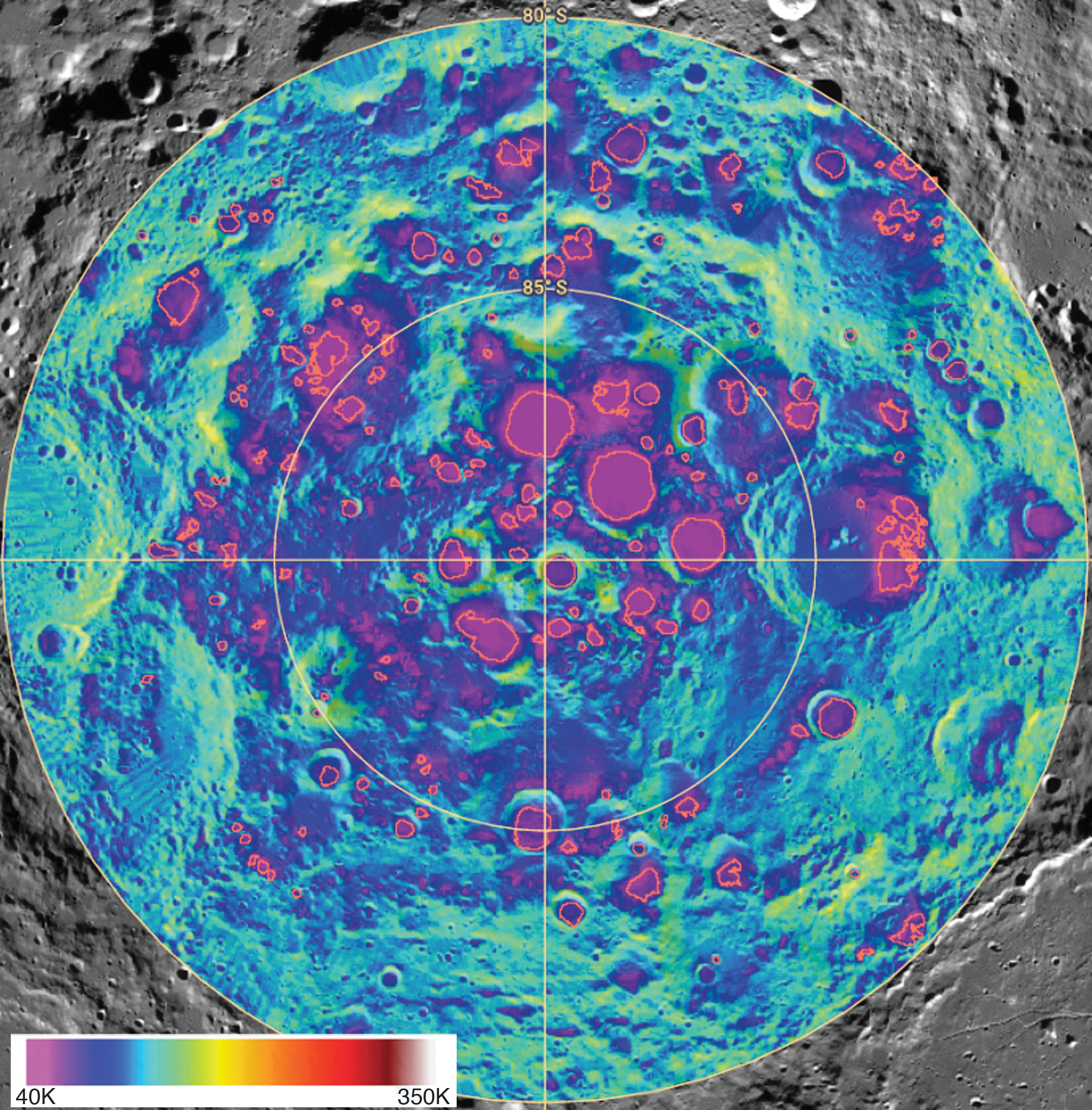
The extent of permanently shadowed regions (outlined in pink) 53 from 80° poleward. The basemap is an LROC WAC/NAC ROI Mosaics, which is an overlain with a false color map representing the average summer bolometric temperature values of the lunar surface.26,54 Image produced using LROC's Quick Map Tool. Credit: NASA/GSFC/ASU.
Although the general location of most large PSRs is well known, estimates about their spatial extent range from 25,000 to 40,000 km2 (LRS6, LRS12). 25 The physicochemical properties and topographic characteristics within PSRs are also highly heterogeneous (LRS7), and our system knowledge is constrained to orbital data products (LCROSS, LOLA, LAMP, DIVINER, LEND, M3) (LRS8). The PSR volatiles are non-renewable on human timescales (LRS9) and are finite, subtractable resources.
Under the current legal regime, freedom of access, use, and exploration prohibits any exclusionary provisions and thus any property/land claims. 1 Hence, PSRs have the physical characteristics of a private good, but due to the lack of a legal regime they would be classified as a CPR (subtractable/non-excludable) (LRS4).
The PSRs are of interest to many stakeholders (U3). The expected use cases include extraction and collection of water, scientific research, and manufacturing (U1, U4).24,25,27 The PSR volatiles will be essential for the production of key commodities such as O2, H2, and H2O used in the production of rocket propellant, consumables to support a sustained human presence on the surface, chemicals and binders for use in mineral processing and additive manufacturing pipelines, and for various scientific reasons (LRS14).
Based on results from the LCROSS experiment, additional volatile species were deemed to be trapped within PSRs (e.g., CO2, H2S, and CH4), suggesting that secondary resources could also be recovered through the purification of resource units derived from this system. 23 All stakeholders will likely have a high dependence on resources found in the PSRs (U2), making it potentially extremely rivalrous.
Lunar Lava Tubes
Lava tubes (LRS1, LRS11) are natural “roofed” channels that likely formed from the extrusion of low-viscosity basaltic magma (LRS2). Over time, the outer lava in a flow solidifies to form a shell, whereas the inner lava continues to flow, carving a channel. Eventually, the lava flow subsides, creating an empty void space. Lunar lava tubes (LLTs) are inferred by surface features known as pit craters, which form when the ceiling of the lava tube collapses 28 (LRS5). More than 220 pits have been identified in the lunar maria and highlands, though most occur within impact melts 29 (LRS5, LRS13).
Though it has been proposed that these pits indicate collapsed lava tubes, multiple geologic processes have been proposed for lunar pit formation, making it challenging to address the abundance or scarcity of lava tubes as a resource (LRS3). The most enticing evidence was the discovery of a large hole in Marius Hills, which was hypothesized as a skylight and an opening into an LLT.30,31 Subsequent gravity data analysis using GRAIL data provided more evidence that the Marius Hills feature was, indeed, a skylight into an intact lava tube. 31
The LLTs are heterogeneous resource systems, and thus their classification depends on their use case (LRS7). They are found in lava fields associated with shield volcanism and are commonly located near mare-highland boundaries. 29 The LLTs formed under lunar conditions have increased dimensions by at least an order of magnitude or greater in size compared with those found on Earth, suggesting that these structures can be tens or hundreds of meters wide, hundreds of meters deep, and tens of kilometers long 29 (LRS6).
Although the difficulty of accessing LLTs suggests they are unlikely as a short-term destination, their medium to long-term use cases might include natural shielding for habitats, data centers, and natural refrigeration and temperature control for food, supplies, machinery, feedstock, and waste storage (LRS14, U4).32–34
Their value is based on protection from the harsh lunar environment (e.g., dust, solar particle radiation and galactic cosmic radiation, micrometeorite impacts, and severe temperature fluctuations). 32 The LLTs may also be sources of pristine materials from the Moon's early formation period such as mantle-origin rocks and volcanic and cometary volatiles, which might not otherwise be preserved if they were exposed to the harsh lunar environment 32 (LRS14).
Such materials would make enticing targets for scientists and economic geologists. If used for science, shelter, and storage purposes, LLTs can be restored and made available to other users, making them renewable (LRS9). However, if they are utilized to extract resources, LLTs would be non-renewable and subtractable. Because knowledge about the abundance and internal characteristics of intact LLTs is still limited, the extent of demand remains unknown (LRS8). The LLTs may be classified as a public or club good, depending on their use case (LRS4).
If LLTs are used for shelter, transport, and storage, their use would be highly excludable, but they exhibit low rivalry since the scale of LLTs implies shared use of the resource. However, if the primary use case is to extract resources, its degree of rivalrousness increases, shifting the resource to a private good.
Peaks of Eternal Light
The phrase “peaks of eternal light” is a form of colloquialism that refers to a terrain with relatively high illumination near the lunar poles (LRD1). These exist due to a combination of local topography and the low tilt angle of the Moon, resulting in a solar ground trace at the lunar poles (LRD5) that continuously “bobbles” around the horizon 24 (LRD2). Although they are not truly eternal in their illumination, the fraction of time with solar exposure can be in the 80%–90% range, even just a few meters off the ground. 33
Because the sun is constantly so close to the horizon, the actual illumination at any given location is highly dependent on the height, where even tens of meters can change the illumination quotient by tens of percentage points 35 (LRS12). Human-constructed towers are one way of achieving additional height (LRD14), though natural features also offer this elevation. For example, crater rims formed by ancient asteroid impacts constitute regolith ejecta piled higher than their surrounding environment (LRS5).
These naturally forming phenomena offer a valuable source of solar power 24 as well as thermal consistency. Craters, as discussed earlier, are also believed to be likely sites for cold traps containing water ice and other important volatiles. This makes the PEL of additional interest as future sites for rover missions and surface infrastructures such as habitats and power stations (U1).
Because the PEL are estimated to cover only ∼1e-11 the surface area of the Moon, they are considered an extremely scarce, naturally occurring resource 24 (LRS6). Technical substitutes do exist in the form of constructed towers (though envisioned use of such towers tends to see them installed on the peaks themselves, it does significantly broaden the area of consideration) as well as thermonuclear power sources (LRS10, LRS13).
Due to the consistently low incidence angle of the son on the horizon at these locations, the sun never goes overhead as we are familiar with on Earth. The result is that if solar panels are installed to cover the entire area at one of these peaks, it would only be those at the very front, as seen by the sun, that receive any solar illumination. Put another way, there is a significant shadowing effect experienced by solar panels not on that front line, creating possibilities for contention and interference (LRS9).
The system heterogeneity is high, varying significantly in size, extent, and local features such as crater slope and mineralogical content (LRS7). Although the stakeholder interest is diverse (U4), there may be a convergent interest in using these sites for power stations, which potentially motivates shared infrastructure as well as coordination for access to their valuable services (U2).
Lunar Regolith
The particles constituting the Moon's regolith (LRS6) are a product of millions to billions of years of continuous impacts from small and large meteoroids, the steady bombardment of solar wind and cosmic radiation, and thermal cycling 36 (LRS2). This process is naturally renewing, but on geologic, not human timescales (LRS9). The regolith ranges from anorthositic to basaltic and comprises several minerals in different forms, with the most abundant being calcium-rich plagioclase, pyroxene, olivine, ilmenite, and spinel (LRS1, LRS11).
The relative abundance of these minerals is highly variable depending on location and what fraction of the regolith is being sampled (i.e., particle type, grain size) (LRS7). Our knowledge of the lunar regolith as a resource is limited to terrestrial telescopic data, remote sensing data, and the 382 kg of sample returned from the Apollo and Luna programs36,37 (LRS8).
Clearly defined boundaries of regolith resource systems could be drawn based on one or more characteristics such as composition, mineralogy, slope, block abundance, maturity, etc. based on remote sensing and sample return data (LRS5). The regolith's composition is primarily a function of the source region (highlands, mare) and consists of multiple potential resource units depending on the use case. The bulk lunar regolith has been considered as a potential feedstock for the production of oxygen and alloys,36–39 for the construction of roads, habitats, radiation protection, etc., and glass making,40–43 whereas others have targeted specific components (e.g., ilmenite, volcanic glass) within the lunar regolith for specific purposes such as oxygen production or horizontal construction (LRS14).40,43–48
The regolith “soil” (<1 cm fraction) from the highlands may be targeted as a raw material for further beneficiation to produce a feedstock upgraded in aluminum and calcium. In contrast, mare-derived soils may be targeted for iron, titanium, oxygen, and sulfur. The potential resources and use cases of lunar regolith are clearly heterogeneous. Thus, a diversity of stakeholders from commercial, public, and scientific sectors will be present (U1).
The bulk lunar regolith as a resource unit is quite abundant (LRS3). Some individual components (e.g., volcanic-derived glass, ilmenite) that might be considered as resource units are quite scarce relative to the bulk composition, 49 whereas others such as anorthite will likely be quite abundant. Moreover, suppose additional constraints on a resource unit such as particle size are required, which may be the case for specific manufacturing processes such as selective laser sintering or selective laser melting. In that case, resource units will be even more scarce (LRS12).
The regolith as a whole is not easily excludable, for it exists nearly everywhere (LRS6). There are geographically confined regions on the lunar surface where the regolith may be considered more valuable due to concentrations of specific components (i.e., ilmenite in Oceanus Procellarum and Mare Tranquillitatis; volcanic glass in Dark Mantle Deposits) (LRS7).50–52 If specific regolith units become targets for exploitation, their degree of rivalrousness will increase.
Thus, although the bulk regolith is essentially a public good (non-rivalrous and non-excludable due to its abundance and scale, not to mention the legal regime), individual components in exploitable concentrations exhibit physical features of a private good, but are subject to non-excludability provision, 1 making it a CPR, with the possibility of extracted materials becoming private goods, policy permitting (LRS4).
Governance Implications and Next Steps
Having outlined the earlier resource systems through the lens of the LRD variables, we can now explore the potential implications for governance needs. As emphasized throughout this article, we do not yet know which use cases will emerge and endure on the Moon. However, it is already clear that each lunar resource system may not warrant involvement from the same stakeholders or necessitate the same permissions, systems of coordination, or approval processes. These factors subsequently have implications for efficiency, cost, development, management strategies, and stakeholder involvement in governance arrangements.
Although the diversity of lunar resources will involve various applicable policies, we distinguish between governance and policy implications. A governance arrangement is not just a policy; it is a policy that results from active ongoing coordination and decision making among actors with distinct knowledge and experience specific to that system. Collective-choice arrangements are considered most effective when they involve self-determined rules with mutual monitoring and sanctions. 3
Operationally, the distinction comes down to which actors are involved on an ongoing basis. To speak of different governance arrangements is to point out how it may be more efficient and effective to have different sets of actors involved in implementing the management of different resource systems. There is sufficient dissimilarity between systems to warrant distinct expertise, time requirements, oversight, and monitoring involved during management. Decisions may emanate from, rather than simply be adopted by, the specific stakeholders operating in that system.
Some resources, such as the PEL, might primarily require international coordination of priority rights to and duration of access. Still, once an operator has been permitted to use a site, activities might proceed according to a local coordination regime involving one or more actors. Other resources, such as spectrum, will require shared standards and ongoing coordination of use, not just priority. The radio-quiet region could involve a system of timesharing, the technical details of which would involve very specific expertise associated with scientific interests, which would not be relevant for review and approval of a mining site.
The bulk regolith may be sufficiently abundant that access and use do not need to be coordinated at all, such that extraction and processing for generic building materials may proceed quite differently than oxygen production. Water ice and oxygen deposits might be found in numerous locations. Therefore, management may involve a notification and prioritization process. Still, the scarcity of PEL, their general utility for power provision, and potential interference due to shadowing suggest that they may warrant on-site coordination, which is quite different from a priority system.
Conservation and heritage designations for scientific or cultural purposes may warrant a dedicated group of professionals who can evaluate proposals in an adaptive fashion, rather than a strict set of rules imposed from the top down. Some activities (i.e., water ice at the lunar poles) might involve planetary protection considerations, whereas others (i.e., equatorial regolith) likely will not.
Although all lunar operators will be stakeholders in global issues such as large-scale dust mitigation, spectrum allocation, or perhaps even more importantly, orbital management, regional considerations for shadowing at the PEL or access coordination for specific PSRs will more likely involve a subset of stakeholders.
Governance questions and needs clearly differ in multiple dimensions, even for the limited resource systems discussed earlier. Therefore, we doubt that one single governance regime or organization will coherently or efficiently address them all. Thus, to inform effective and sustainable governance, we must analyze more lunar SESs in an inter- and trans-disciplinary fashion and interrogate alternative modes of governance from a variety of disciplines/fields of knowledge.
Global frameworks that allow for diversity and subsidiarity of governance systems should be researched and considered for lunar governance. One such potential framework is polycentricity. In polycentricity, collective choice agreements of semi-autonomous decision makers are encouraged under a shared set of goals and institutions. Polycentricity leverages localized synergies and deep system knowledge for high social-ecological and governance congruence, but more missions and experience will be needed before such an approach can be thoroughly developed.
Through subsidiarity and diversity, polycentric governance enables institutional experimentation and exchange in uncertain and complex SESs. In a polycentric lunar governance system, the variety of complex lunar SESs can be addressed locally and individually while conforming to universal norms and principles such as transparency, sustainability, peace, cooperation, and justice. Thus, as one potential mode of governance, along with other terrestrial-institutional arrangements, we intend to further investigate the applicability and operationalization of polycentricity to lunar governance in a future step of our project.
Conclusion
Future governance of the Moon will require specificity, interdisciplinary, and empirical observations to inform the development of a congruent regime(s). Thus, rather than analyzing the current space governance regime, in this article, we examined the social-ecological diversity of lunar resources through the lens of the SES framework to envision coherent, timely, sustainable, and equitable lunar governance. The SES framework clearly outlines the importance of broad and deep investigation of human-environmental networks to identify potential complications and anticipate system dynamics.
Thus, borrowing from the original SES framework and the rigorous research associated with SESMAD, we created a systematic database to investigate potential lunar SESs. The LRD displays the intricacies of lunar resource systems and showcases their diversity. In applying our coding scheme, our 5 mini-case studies demonstrate both the utility of a comparative approach and the complexity of lunar resource systems. As we leverage substantial existing work on SESs, we enjoy the benefits of an empirical theory of multiple disciplines. Evidence from collective action theory and sustainability sciences indicates that system characteristics present in many lunar SESs suggest conduciveness to self-governance.
Therefore, high-level institutional arrangements fostering and supporting such governance should be analyzed further. In a future phase of the project, we intend to contribute to this investigation by further developing and populating the LRD with conceivable lunar resource systems, systematically investigating analogous terrestrial resource systems and related governance regimes, and analyzing terrestrial governance analogies within the lens of the SES framework to provide governance recommendations for future lunar resource systems.
The governance implications from our analysis re-emphasize the diverse nature of lunar resource systems and the resulting governance challenges and requirements that lie ahead. This diversity cannot be coherently addressed or governed by one single set of rules or one body of governance. As we point out, the social systems interlinked with lunar resources suggest more dynamic and adaptable arrangements than a single centralized permission system. Though not commonly investigated as an applicable governance regime, polycentricity offers a potential solution to the governance challenges of diverse, complex systems.
Experimentation and adaptiveness in resource and location-specific regimes would allow congruence between social, ecological, and governance systems while following shared norms, principles, and goals. It will take disciplinary and interdisciplinary efforts to further this promising governance agenda for coherency, timeliness, sustainability, and equity for future lunar activities.
Footnotes
Acknowledgments
Special thanks are due to the Moon Dialogs' Lunar Resources Action Team, in particular Maria Rhimbassen, and Angeliki Kapoglou; as well as Chelsea Robinson, and expert insights from Brian Weeden, Nivedita Mahesh, and Martin Elvis.
Author Disclosure Statement
No competing financial interests exist.
Funding Information
This research received no specific grant from any funding agency in the public, commercial, or not-for-profit sectors.