




Abstract
After being regarded almost exclusively as a research domain, today, the space sector has transformed into a comprehensive economy seeing growth in the number of new business entities and markets. This transformation has contributed to increasing governmental and private activities in the space domain worldwide. This increase motivates new countries to launch their space programmes, develop national space sectors, and establish respective space sector development infrastructure in form of national administration. The nature of this national infrastructure varies from country to country, depending on the national focus as well as industrial and research capabilities. In many emerging space countries, this infrastructure has most recently been concentrated around ministries responsible for the economy, innovation, entrepreneurship, or transport, reflecting the emerging space nation mindset transformation. This article outlines a case study of the mindset transformation process for emerging space nations, mapping the approaches and tools used by the Slovak sector in various aspects of space ecosystem development. The purpose of this article is to share the experience gathered over the past 2 years in Slovakia and contribute to the discussion related to government-driven space industry development.
INTRODUCTION
This article explores the concept of emerging space nations in the era of “New Space.” Based on the Slovak case study, the article reflects on the current trends in the domain of space sector development, by providing an example of sector development mechanisms. It explores the historical tradition and current governmental management responsible for the space sector development. The objective of this article is to provide a basic knowledge overview to explore the Slovak story in space, and embedded it into the current theoretical traditions and established definitions of emerging space nation and the “New Space” era.
The purpose of this study is to provide an overview of the current mechanisms of the space sector development in Slovakia, by providing a description of the national space management and to provide a quantitative descriptive analysis of the current industrial ecosystem.
Thus, the main research questions of this article are what are the mechanisms for space sector development in Slovakia and how do these mechanisms impact industry development?
This article is structured into several chapters. First, it reflects on several definitions of emerging space nations and the “New Space” concept. Second, it discusses the research setting by exploring the most significant achievements of past and current space activities in Slovakia. Third, it provides a description of the current governance and mechanisms for sector development, conducted by the Slovak Investment and Trade Development Agency (SARIO). Fourth, the article provides a basic quantitative descriptive analysis of the current industrial ecosystem. The article concludes with a discussion on the effects of a more business/investment-oriented role in the national space ecosystem development.
THEORETICAL BACKGROUND
Emerging Space Nation
Nonetheless of its long tradition in space research starting in the 1970s, Slovakia is considered an emerging space nation. The emerging space nation can be defined as a country that increases its efforts in the space domain, for example, by establishing broader autonomous capacities to access or operate in space. 1 The transition toward an emerging space nation can be defined by several important milestones, such as the adoption of space policy or strategy (including the definition of the national legal regime), the foundation of a national institution in charge of space activities (e.g., space office or agency), the establishment of a national space programme and dedicated budget, development of domestic industrial capabilities, and participation in international programmes, including space diplomacy.
The growth of emerging space nations and their sectors is mainly associated with emerging socioeconomic opportunities discovered by the sector, the trends that have lowered the barriers of entry, and the quest of nations to play an active role in addressing global challenges and sustainable development. 2
Emerging space nations have usually created their space agencies after already have been engaged with space activities, such as launching a satellite, promoting space-related scientific activities, or participating in international space-related organizations. By providing a more centralized structure to national space sectors, emerging space nations hope to reduce redundancy, increase awareness of existing opportunities, stimulate participation in space-related activities, and enable more efficient use of resources. 3
The “New Space” Era
An important aspect to be a successful emerging space nation is to realize the new trends and approaches in the space sector. Over the past decade, the space sector has passed a certain transition from traditional institutional/national-based activities toward more business and commercially oriented activities. This transition is currently known as the “New Space” era. New space pursues common nongovernmental market-oriented goals bounded primarily by market forces (cost and time pressures, exposure to risks, etc.), or executing activities in an entrepreneurial way (risk taking, private financing, disruptive innovation, commercial of-the-self innovation, etc.).4–6
The new space ecosystem is focused on space as a resource and a venue for a profitable business. Most of the undertakings in space are private and commercial, offering variability of business models for innovative initiatives. Clients and investors in the “New Space” era are private actors that create a shift in the financial models from costs plus to fixed prices, have different methods of management, or demand shorter durations of time devoted to research and development (R&D).
The “New Space” ecosystem offers dynamic and creative changes in space activities. The change toward the “New Space” era brings new issues to be targeted by both, private and government actors, such as the model for space economy, financing, regulations, space traffic management, frequency spectrum, space debris, export control, and the new models of international cooperation. 7
BACKGROUND SETTING
Slovak Space Sector History
Slovakia has a long tradition in space research and development. The first space-related activities already took part within the time of Czechoslovakia by the end of the 1960s. Czechoslovakia was a collaborating state of the Inrecosmos program, which was under the leadership of the former USSR, and ended in the early 1990s. 8
During this period, several significant achievements were reached by Czechoslovak scientists, such as the flight of the first Czechoslovak citizen (and the first non-USA/non-USSR astronaut/cosmonaut) to space, Mr. Vladimir Remek, or participation in several deep-space missions such as Vega 1 and Vega 2 to visit Venus and the Halley comet, or the first national satellite series called Magion. After 1993, when the independent states of the Czech and Slovak Republics were established, Slovakia started its own path toward space activities.
The most significant achievement in the early period of independence was the 1999's flight of the first Slovak citizen, Mr. Ivan Bella (Mission Stefanik), who spent a week onboard the Russian MIR station, and performed various scientific experiments including Slovak-designed experiments involving the possibility of survival of Japanese quails during long flights.9,10
In addition, Slovak scientists were taking a part in space missions such as, for example, Intercosmos (IK)-5, IK-13, IK-17, IK-24-Active, Prognoz-8, Prognoz-10, Interball-A, Interball-T, Mars-96, Coronas-I, and Coronas-F. 11 A comprehensive list of Slovak involvements is given in Table 1. After the independence of Slovakia, Slovak scientists were taking a part in space exploration missions such as Spektr-R, JEM-EUSO, Rosseta, or more recently European Space Agency (ESA)-JUICE. It took 2 decades since 1993 to launch the ever first satellite in 2017, and the second in 2021.12,13
Involvement of Slovak Researchers in Space Projects Before European Space Agency-Focused Collaborations 17
The Era of Space Sector Integration
After the scientific and human spaceflight achievements in the 1990s, the significant change for the Slovak space sector started during the early 2000s when Slovakia become a member of the United Nations Committee on Peaceful Uses of Outer Space (UNCOPUOS) in 2001, European Union (EU) in 2004, and the European Organisation for the Exploitation of Meteorological Satellites (EUMETSAT) in 2006. In 2010, Slovakia signed the first Cooperation Agreement with the ESA and started its more than a decade-long integration process. In 2015, the 5 years Plan for the European Cooperating States (PECS) started.
During this period, the Slovak ministry of education published its first conceptual framework for space activities. 14 After the end of the 5 years long PECS period, the Slovak government decided to keep the support of the integration process to ESA and decided that Slovakia wish to become an associate member of ESA by 2022.
Toward the Foundation of the Space Economy
Slovakia is a modern European economy relying dominantly on services, yet at the same time maintaining its rich manufacturing heritage in several sectors including for example machinery and electronics. Over the past decades, these historically strong manufacturing areas have helped to create a new pillar of the Slovak economy—the automotive sector. Today, Slovakia has the largest car production per capita in the world, producing about 1 million vehicles every year.
Since the 1990s, Slovakia has become the regional leader in the proportion of value-added jobs and overall manufacturing value-added growth. This specialization helped new innovative segments to emerge, including progressive material development, or Industry 4.0 fostering R&D activities in sensors, robotics, and industrial IT solutions. This has created a promising base for space sector spinning-in and future businesses related to upstream and downstream products and services.
Institutionalization and Mechanisms for Sector Development
The fastly growing interest in space-related business has brought the need for institutionalization and support mechanisms. The Slovak Trade Development Agency (SARIO) is a governmental agency working under the Ministry of Economy of the Slovak Republic (ME) as the main national investment and trade consultancy stakeholder. 15
Slovak Trade Development Agency (SARIO) has become a part of the Slovak space governance structure in the summer of 2019 when it launched diversification services aimed at supporting the diversification of Slovak companies toward high-tech and high-growth sectors. The combination of Slovakia's background setting with SARIO's traditional agenda resulted in adopting a unique approach—supportive mechanisms—toward space sector development with a strong industrial and business orientation.
The supportive mechanisms can be divided into 2 main categories. First, the domestic ecosystem development is carried out mainly through supporting sector portfolio diversification of existing technological companies. This mechanism supports the entry to the space sector through outreach and active identification of companies, followed by sector-entry consultancy, supporting the establishment of their first relevant connections in the sector, and other “spinning-in” support. The activities were conducted with the support of ESA's technological experts who helped with the assessment of respective technological sectors.
These sectors were analyzed to find companies possessing technological competencies useful in a variety of space economy domains. A list of relevant companies potentially suitable for spinning-in was created (containing >50 entities from mainly electronics, machinery, and IT industry), which then served as a basis for one-on-one meetings focused on introducing the sector to the companies and providing them with a comprehensive consultancy regarding utilizing these competencies as a base to start working in the space sector and receive first contracts or business collaboration proposals.
Second, the international collaboration development mechanism is building connections between SARIO and relevant foreign partners (e.g., agencies, offices, associations, as well as the Large System Integrators and other companies), and subsequently using these contacts to help Slovak companies and researchers in establishing international partnerships. These partnerships are often created through matchmaking events or tailor-made supporting activities for foreign partners in the identification of the most suitable partners in the local ecosystem.
Over rather a short period of 2 years, SARIO has become the leading space industry stakeholder in Slovakia, providing a comprehensive package of support to the Slovak space industry, which resulted in the formation of a joint Slovak Space Office (SSO) project together with the Ministry of Education, Science, Research and Sport of the Slovak Republic (MESRS). The SSO consists of 2 components. The political branch (under MESRS) is responsible for interministerial political coordination and multilateral international cooperation (ESA, UN, and EU). The second component represents the industrial branch of the SSO acting under SARIO. 16 It covers the implementation part of the agenda, especially developing the space ecosystem, local and international partnerships, and outreach.
As the industrial branch of the SSO, SARIO further aims to support Slovak entrepreneurs and researchers in integrating into European industrial structures and participating in international projects. The industry branch further supports broadening the whole space ecosystem and especially the industrial base across the country.
However, with the new formal status, SARIO has gained new opportunities and tools for space ecosystem development. As the first, SSO is the official national contact point for international cooperation for the space agencies, offices, associations, businesses, and research entities, which makes the whole international vector of its agenda easier. Furthermore, the range of sector development tools has significantly broadened, covering now also start-up-related activities such as hackathons or a business incubator project both launching in 2021. Last but not least, SARIO has gained the possibility to conduct more general outreach activities involving social media communication, media activities, or events with young experts, raising overall awareness about the space sector and possibilities for industry and research.
METHODOLOGY
Research Approach
This study represents a quantitative descriptive analysis. A quantitative data collection is provided with a descriptive analysis of multiple variables defining the appropriate indicators on the national space industry size and participation in relevant space sector domains. In addition, a longitudinal analysis is provided in the case of the Slovak industry's participation in the ESA PECS program over the past 5 years, to identify the effects of the mechanisms applied for the sector development.
Data Collection
The data sets of this study target the Slovak industrial actors. The main data on these actors were collected from multiple sources, including internal databases of SARIO, or publicly available sources (Slovak Space Portal, FinStat.sk, webpages of the companies, etc.).
Variables
The collected data were structured into general categories of variables, such as the name, size in terms of the number of employees, or the annual turnover of the company. Regarding the space sector domains, specific variable categories were created, based on the categories of activities, such as Earth observation, positioning & navigation, space components, launch vehicle components, ground systems, production solutions, spacecraft integration, stratospheric probe components, and training & consulting).
To identify the longitudinal participation of industry in international cooperation with ESA, a second data set on PECS participation was conducted. It includes variables such as the type of entity, type of PECS activity, technology readiness level, or the maximum contribution per project.
EMPIRICAL RESULTS
The first data analysis explores the change in the general participation of companies in the space sector. Figure 1 shows the situation in 2020 and Figure 2 shows that in 2021. The total annual increase of companies active in the space sector has increased by >20%. The most significant change per domain is in the downstream sector of Earth observation and navigation, followed by spacecraft components in the upstream sector. The result of this analysis has proved the positive effect of the sector portfolio diversification mechanism.
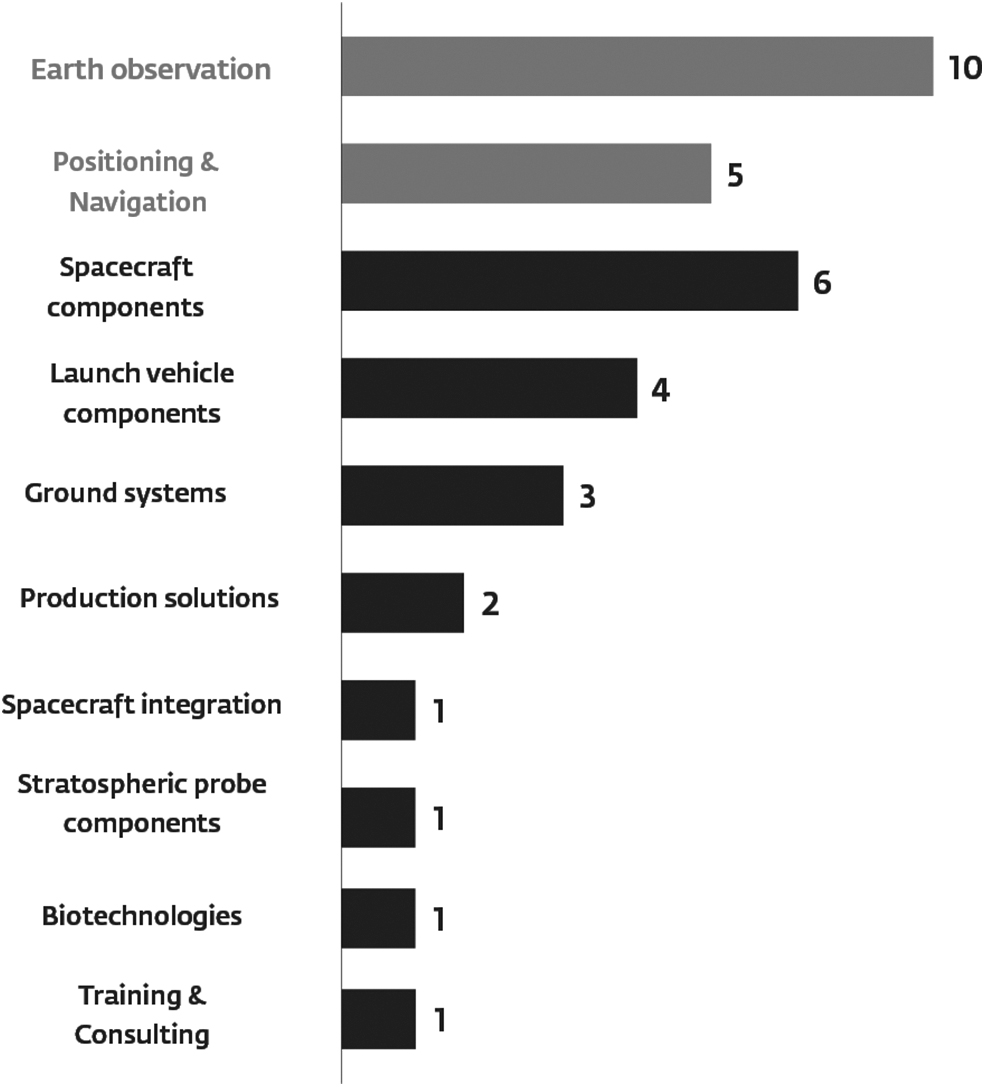
Number of companies in 2020 involved in respective segments of the space economy in Slovakia (red, downstream; blue, upstream).

Number of companies in 2021 involved in respective segments of the space economy in Slovakia (red, downstream; blue, upstream).
The second data analysis targets the effect of the international collaboration development mechanism. Between 2015 and 2021, there were 6 PECS calls in total, representing 54 projects in the total amount of €8.3 million. Figure 3 shows the total participation in all PECS calls per type of entity. It shows that more than half is represented by the companies. Figure 4 shows the number of participations per entity in all 6 PECS calls from 2015 until 2021 (call numbers I, II, III, IV, V, and VI). It supports the notion that the participation of companies has been significantly improving over the past 3 calls of 2019, 2020, and 2021.
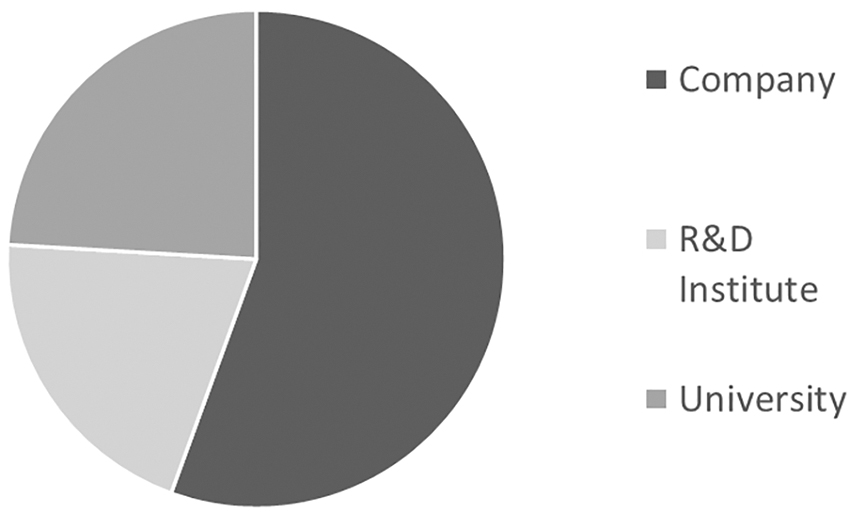
Participation in all ESA PECS calls per type of entity. ESA, European Space Agency; PECS, Plan for the European Cooperating States.

Participation per type of entity, in particular, ESA PECS calls.
Figure 5 proves this notion when comparing the total value of the maximum amount of contribution redistribution per type of entity. As shown in Figures 4 and 5 , the absorption capability of companies related to the size of the project contribution in ESA PECS calls has significantly increased over the period for several reasons. The role of SARIO and its mechanisms actively involved in national space sector development plays a role in this shift. At the same time, the changing mindset of international collaboration toward more active industry involvement and commercially based projects has supported more industrial than R&D participation in PECS calls.
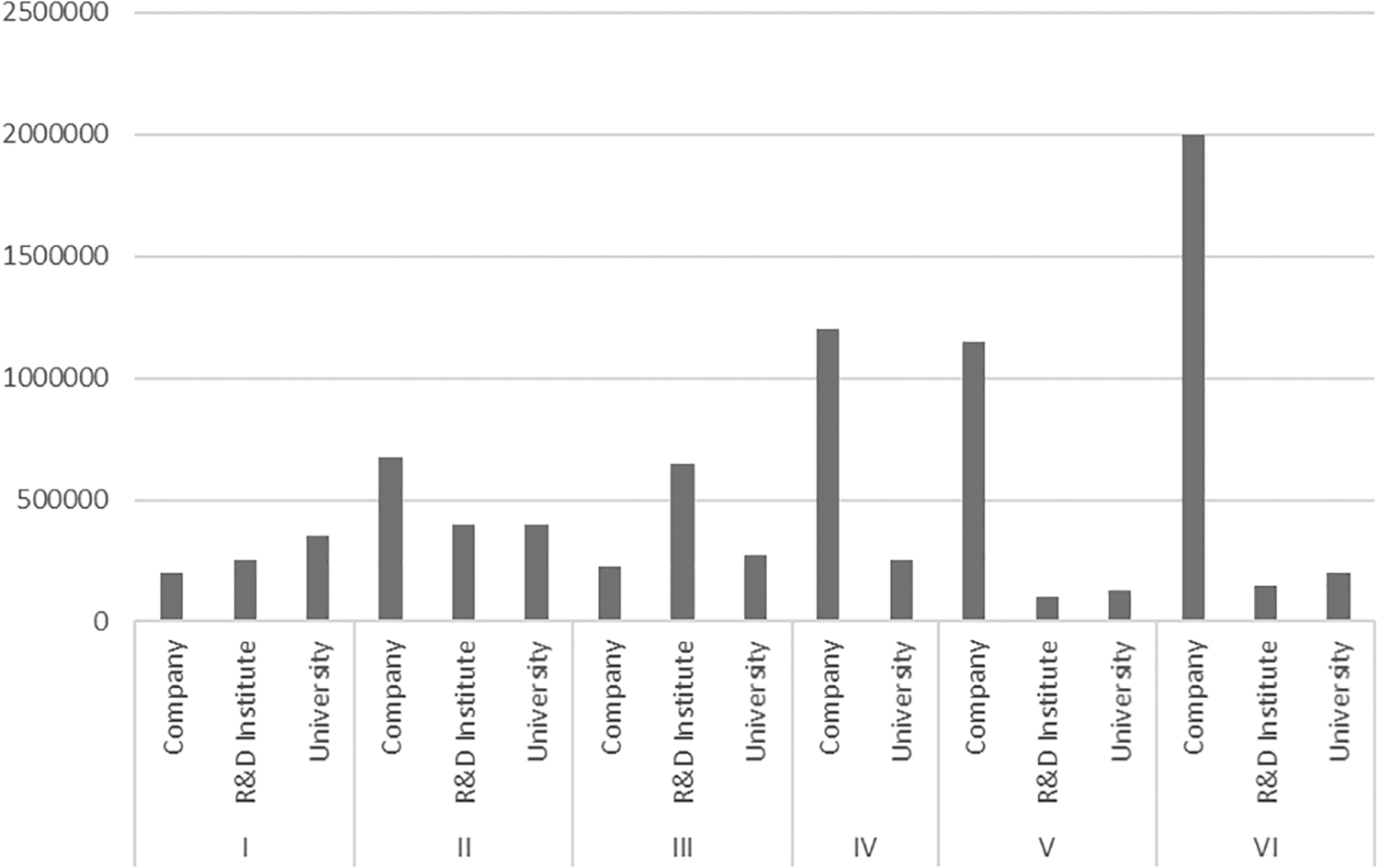
ESA PECS absorption capacity of project proposal maximum contributions (in €) per type of entity and number of the ESA PECS call.
DISCUSSION
Practical Implications
Based on this study, it was approved that Slovakia is a typical emerging space nation, when, for example, is developing its institutional framework by establishing a conceptual framework for national space strategy, has established a space office, is constantly improving and deepening its international cooperation, and has launched its first satellites.
The national ecosystem development fully recognizes the potential and needs of the “New Space” era. The national agency responsible for space sector ecosystem development established mechanisms supporting more internationalization, spinning-in and identification of commercially based services and products, such as in the downstream Earth observation and navigation or upstream space out-of-the-shelf components development.
The 2 years of SARIO's activities in the space sector development have brought not only qualitative but also quantitative results. As a direct result of these activities, 13 new Slovak companies have started their first projects and activities in the space sector (originally mainly existing nonspace technological small and medium enterprises, only 1 of them is known to have ceased its space activities) and >22 new local and international partnerships were established involving Slovak companies and researchers.
As shown in the ESA PECS analysis, since SARIO entered the space sector development in Slovakia, it has clearly demonstrated the positive effect of the mechanisms applied. For example, the participation of industry in ESA PECS has constantly increased. Furthermore, the number of entities participating in the space sector is also constantly increasing. The spinning-in of well-established entities into the space sector has proved as an important mechanism for space sector development.
Limitations and Future Research
This study is limited in its scope focusing on mechanisms and quantitative analysis only. Further research on national space policy development brings an important addition to the complexity of the national space sectors, especially in the case of Slovakia. Last but not least, a comparative study with a similar national case will bring important comparisons and potentially enrich or prove the generally established definitions of emerging space nations or identification of new mechanisms for national space sector development in the era of “New Space.”
CONCLUSIONS
Despite having already 50 years of space research and development experience and a human spaceflight track record, during the past decade, Slovakia has only recently started to focus on its space-related industry development.
Since 2019, the Slovak Investment and Trade Development Agency (working under the Ministry of Economy of the Slovak Republic) has been actively involved in developing Slovakia's space industry ecosystem. This involvement shifted the country's space governance settings as well as the general perception of the space sector more toward industry and entrepreneurship. It also helped to increase the number of companies launching space R&D and engaged in space-related international cooperation.
Footnotes
ACKNOWLEDGMENTS
This study was performed with the support of the Slovak Investment and Trade Development Agency and its Slovak Space Office—Industry Branch. The authors offer special thanks to their colleagues Lenka Tkacova and Denis Sedlak for their valuable support in this study.
AUTHOR DISCLOSURE STATEMENT
No competing financial interests exist.
FUNDING INFORMATION
No funding/grant received to write this paper.