




Abstract
With recent advancements in space exploration plans and human spaceflight, civilian participation is no longer imaginary. This study aimed at exploring young professionals' perceptions of space exploration and space medicine in Saudi Arabia during the Saudi Vision 2030 era. This cross-sectional survey-based study was conducted in Saudi Arabia. The inclusion criteria were residents of Saudi Arabia with educational levels of high school or higher. In total, 341 participants completed the survey. The mean age of the participants was 23 years (interquartile range: 10). A total of 31.1% (106 participants) were medical students and 17.9% (61 participants) were physicians. Most participants (75%) had never heard of space medicine. Among physicians and medical students, more than 85% responded with “yes” and “maybe” when asked whether they will pursue a career in space medicine if given the opportunity. This is the first study to evaluate young professionals' perceptions of space exploration and medicine in Saudi Arabia during the Saudi Vision 2030 era. This study offered insights into the limited perception and expectations of the participants toward ongoing advancement in the space industry. Nevertheless, Saudi physicians' and medical students' perceptions of space medicine as a pursued sub-specialty in the future are very optimistic. Raising awareness about the importance of space medicine is highly recommended.
INTRODUCTION
Humans began exploring space in 1957, beginning with the launch of the Sputnik, followed by the Apollo Space Program and the Mars Rover. Space exploration has evolved since then. The National Aeronautics and Space Administration (NASA) announced its plan to send humans to Mars by 2030s. 1 Moreover, NASA successfully launched the Artemis program to prepare the Moon for human exploration and establish a sustainable human presence. 2
The interest of Saudi Arabia in space was explicit through the establishment of the Saudi Space Commission in 2018 in alignment with the Saudi National Vision of 2030, which aims at building a knowledge-based economy in the Kingdom.3,4
The 2022 NASA spinoff showed how space exploration led to many discoveries and innovations in many fields such as medicine, environmental resources, public safety, and computer technology. 5 Nonetheless, space exploration and travel are not without health-associated risks. A recent article by Patel et al. discussed the distinctive hazards associated with spaceflights, including exposure to space radiation, neuro-ocular syndromes, and cognitive and behavioral disorders. 6
Space medicine is a known sub-specialty in the medical field and is defined as “the practice of all aspects of preventative medicine including screening, healthcare delivery, and maintaining human performance in the extreme environment of space, and preserving the long-term health of space travelers.” 7 This field is well recognized and is rapidly evolving worldwide with many opportunities to make spaceflight safer and help humans become a multi-planetary species, while also having a significant translational impact on humans on Earth. However, space medicine is still limited in Saudi Arabia.
Engaging the public in space exploration and understanding its health-associated risks is of paramount importance. A study conducted by Dick 8 discussed how space exploration is linked with society and culture. The author stated that “the idea of extraterrestrial life, a main driver of the space program through the Mars program, the exobiology and astrobiology programs, and the search for the origins of life, permeates culture in the latter half of the 20th century.” 8
Moreover, a meta-analysis reviewing public support for space exploration funding in the United States showed that “spending preferences on space exploration are largely apolitical in nature and based more on the public's knowledge of and appreciation for science.” However, the authors concluded that the findings represented a smaller portion of society than anticipated, which might be a challenge for NASA in the future. 9
This study aimed at exploring young professionals' perception of space exploration and medicine in Saudi Arabia in the Saudi Vision 2030 era. This study offered insights into Saudis' perception and expectations toward the ongoing advancement in the space industry and assessed their concerns about space exploration. Further, it assessed Saudi physicians' and medical students' perceptions of space medicine as a pursued future sub-specialty.
MATERIALS AND METHODS
This cross-sectional online survey was conducted across Saudi Arabia. The inclusion criteria were residents of Saudi Arabia with educational levels of high school or higher. Non-Saudi nationals were excluded.
We used non-probability sampling techniques. The estimated population of Saudi Arabia as per the World Population Review in 2021, dated July 26, 2021, was 35,379,111, with 67.6% of them aged >15 years. Using a finite population for the sample size calculation with a confidence interval of 95% and a 5% margin of error, a minimum of 337 participants were required.
Multiple data collectors were assigned to each region. Several social media platforms were used to disseminate electronic forms of the study questionnaire. The questionnaire contained 8 parts:
Part 1: Demographic data: it included nationality, sex, age in years, occupation, highest educational level, and geographic location.
Part 2: Construct 1: it measured the perception of human space exploration through 4 statements using a 5-point Likert scale (strongly agree, agree, neutral, disagree, and strongly disagree). The first 3 statements were adapted from a Eurobarometer study titled “Space activities of the European Union.” 10
Part 3: Construct 2: it measured perception toward the future of civilian spaceflight through 4 questions using a 5-point Likert scale (strongly agree, agree, neutral, disagree, and strongly disagree).
Part 4: A direct question asking whether the participant had ever heard of space medicine.
Part 5: Construct 3: it measured the perception toward health risks associated with space travel through 3 questions using a 5-point Likert scale (strongly agree, agree, neutral, disagree, and strongly disagree).
Part 6: A checklist of multiple space travel health concerns for participants to choose from. Some were recognized in the field of space medicine, whereas others were not.
Part 7: A question directed at physicians and medical students as to whether they would pursue a career in space medicine if given the opportunity to do so.
Neutral-sounding wording with no leading questions in both Arabic and English was used to minimize response bias. The reliability was assessed by calculating Cronbach's alpha to measure the internal consistency of each construct. Descriptive analysis was performed using mean and standard deviation for quantitative data and numbers and percentages for nominal data.
This study was approved by the institutional review board of King Abdullah International Medical Research Center (approval no.: NRJ21J-191-08). The research was completed in accordance with the Declaration of Helsinki as revised in 2013.
RESULTS
In total, 341 participants completed the study. The sex distribution showed that the majority of participants (62.2%) were women. The mean age of participants was 23 years (interquartile range: 10). A total of 31.1% (106 participants) were medical students and 17.9% (61 participants) were physicians. The remaining participants had different educational backgrounds and occupational statuses. The highest educational levels obtained by the participants were high school degrees (147 participants; 43.1%), followed by bachelor's degrees (141 participants; 41.3%). Most participants (63.6%) were from the western region of Saudi Arabia followed by the central region (27.9%). Detailed demographic data are presented in Table 1.
Demographics Data
The bold values indicate the highest percentage of responses.
Table 2 shows the perceptions toward human space explorations. Most participants chose “strongly agree” across all human space exploration statements. Overall perception had a mean of 4.42 ± 0.62. Cronbach's alpha for the attitude construct was 0.86.
Overall Perception and Agreements to Human Space Exploration Statements
The bold values indicate the highest percentage of responses.
Table 3 shows attitudes toward the future of civilian spaceflight. The mean attitude score was 3.59 ± 0.91. Across all statements, most participants were “neutral” to the future of civilian spaceflight statements apart from one statement where most of the participants (35.5%) chose “agree” (civilians will be able to take trips to space in the future). Cronbach's alpha for the perception construct was 0.73.
Overall Attitudes and Agreement Toward the Future of Civilian Spaceflight Statements
The bold values indicate the highest percentage of responses.
Most participants (75%) had never heard of a specialty called space medicine (Fig. 1). Moreover, among the 167 participants who were either physicians or medical students, 64.7% declared that they had never heard of space medicine.
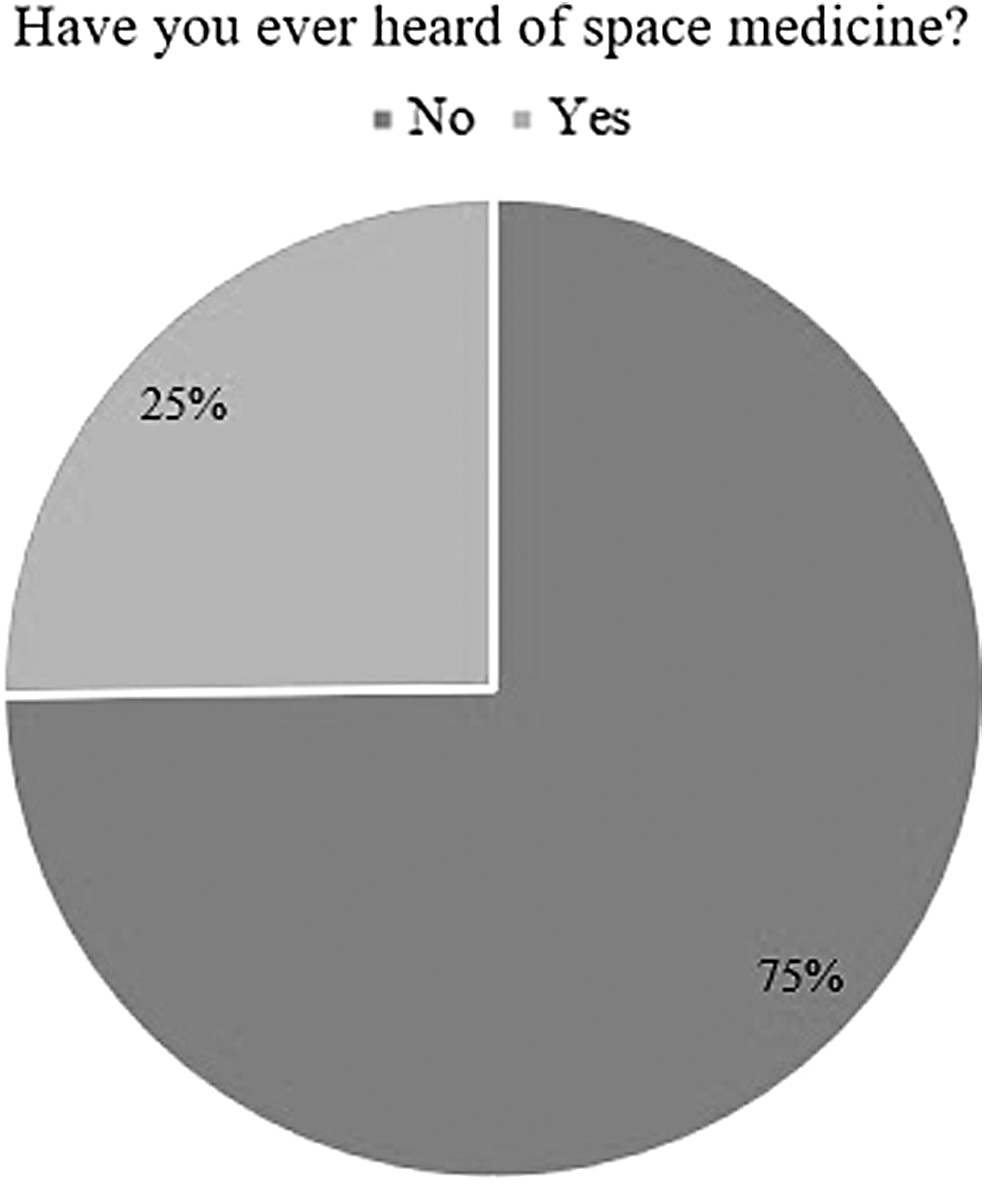
Public perception of space medicine.
A 123 (36.1%) and 170 (49.9%) participants chose “strongly agree” and “agree” (36.2%), respectively, in response to the statement that space travel and exploration can lead to serious health issues (Table 4). Of the 293 participants, the most concerning health issue was increased intracranial pressure (91.8%), followed by heart diseases and psychological disorders (81.6%) (Fig. 2). Other concerns included stroke (58%), blindness (33.1%), malignancy (32.1%), and infertility (15.4%).

The concerns of 293 participants who chose “strongly agree” and “agree” to the statement that space exploration can lead to serious health issues.
Overall Attitudes and Perceptions Toward the Role of Space Exploration in Health and Related Concerns
The bold values indicate the highest percentage of responses.
Among physicians and medical students, 73 (44%) responded “yes” to the question on whether they would pursue a career in space medicine if given the opportunity. The remaining 42% responded “maybe,” and 14% responded “no” (Fig. 3).
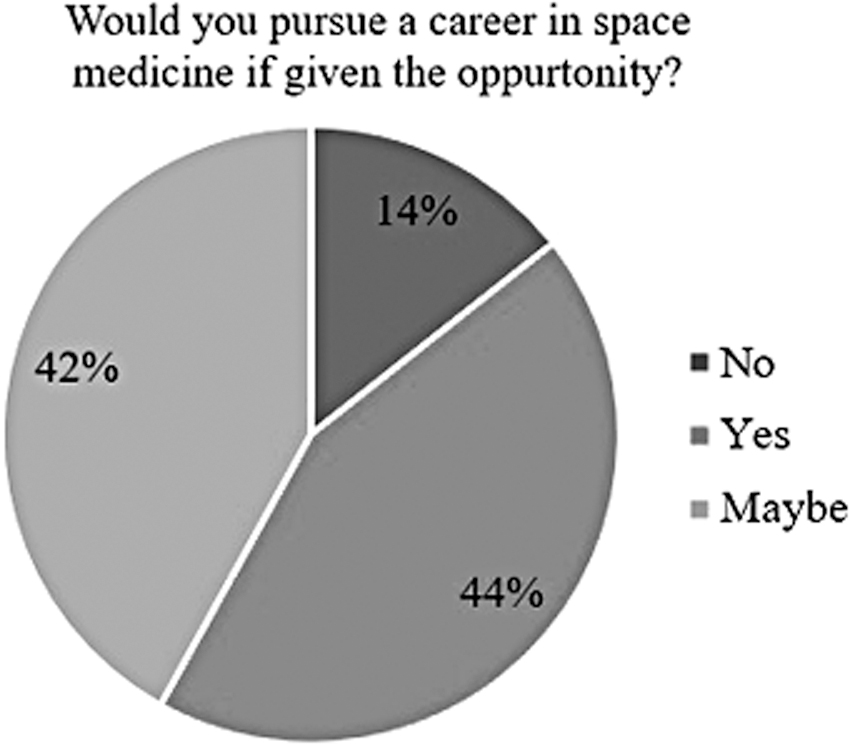
Participants' responses to whether they would pursue a career in space medicine.
DISCUSSION
To the best of our knowledge, this is the first study to assess the perceptions of young health care professionals across Saudi Arabia. The participants had diverse educational backgrounds, but the medical community was the most abundant. Most participants held high school degrees or higher. They were mostly from the western region of Saudi Arabia, followed by the central region, reflecting the distribution of highly active populations within these 2 regions. Overall, this group seems representative of the perceptions and attitudes of young, highly educated, and active health care professionals in Saudi Arabia, who will be actively involved in shaping the future of the country and fulfilling the objectives of Saudi Vision 2030.
The first part of the questionnaire assessed the perception of human space exploration and revealed that the participants strongly agreed that space exploration and other space activities were important for Saudi Arabia's future international position. This result aligned with the current Saudi ambitions in the field of space to build a strong presence and position for Saudi Arabia in the international space community.
Further, most participants strongly agreed that technologies derived from space activities contribute to the development of innovative terrestrial applications, and that space activities can boost industrial competitiveness, growth, and job creation in Saudi Arabia. This result demonstrated an excellent understanding of the importance of building a strong space economy where innovative space solutions can benefit humans on Earth, create jobs, and support the country's economy.
The agreement of the participants was less for the question asking whether they believed that humans had landed on the moon, and multiple trips were made to outer space for exploration. The percentage of neutral or disagreeing responses was higher compared with other questions, indicating that participants may not have been aware of the current advances in space travel and recent trips by multiple commercial space launchers.
The responses to the first 3 questions in our questionnaire were significantly higher than those in the European Union report, from which the questions were adapted. In the European Union report, only 20% strongly agreed that space exploration and other space activities are important for the future international position of the European Union; 24% strongly agreed that technologies derived from space activities contribute to developing innovative terrestrial applications and that space activities can boost industrial competitiveness, growth, and creation of jobs; and 16% strongly agreed on the importance of building a strong space economy where innovative space solutions can benefit humans on Earth, create jobs, and support the union's economy. 10
The participants' responses to the future of civilian spaceflight domains were less impressive. Participants were mainly neutral but overall agreed that civilians will be able to take trips to space, humans will take residence on the moon and Mars in the future, and that jobs will be available for humans in space in the future were the lowest compared with other sections. This indicates a gap in the Saudi population's awareness of the current advances in the international space sector, as well as the current ambitions to travel to the moon, Mars, and beyond.
Saudi Arabia recently signed the Artemis Accords with NASA to join the international effort to take humans back to the Moon. 11 The questionnaire findings highlight the need for more public outreach activities and public engagement to enable the general population to visualize the future of the rapidly evolving space industry.
More than two-thirds of the physicians and medical students had never heard of space medicine. The lack of awareness of the specialty among the participants was considered high. In studies conducted in Turkey and the United States, the lack of awareness among medical students was reported to be 49.2% and 42.1%, respectively.12,13
Despite international advances in the field of space medicine research, as well as educational opportunities in many top space nations, the Saudi medical population seems to lag behind in their knowledge about the existence of such a field, which also reflects the current lack of educational activities about space medicine in the curricula of Saudi health specialty colleges.
In addition, it demonstrates that activities that raise awareness involving young physicians and medical students in this field and demonstrates its recent advances are lacking. There is an urgent need to make not only physicians and medical students aware, but also other health specialties and the Saudi general public aware regarding the history, current status and advances, and future of the field of space medicine.
It is of great significance that the current international efforts to take humans back to the moon and, for the first time, Mars be widely shared and broadcasted, so that Saudis can keep up with the recent evolution in space travel and exploration. Such awareness will enable greater Saudi engagement in the field and contribute to progress in space medicine.
Most participants agreed that exploring space will lead to major discoveries and innovation in health care, which is a positive response indicating that the respondents can see a future in which space medicine revolutionizes health care in Saudi Arabia and internationally. Most participants strongly agreed that space travel and exploration require intense training and high standards of health qualifications.
This does not fully align with the current commercial space flights, which include older individuals and those not at the peak of their health. Although space travel inherently requires intense training and qualifications, current opportunities for civilian space flights have rendered these requirements obsolete.
Overall, the majority of participants agreed that space exploration could lead to serious health issues. The conditions selected most frequently by the participants included increased intracranial pressure, psychological issues (such as depression), and heart disease. These conditions occur during and after spaceflight. Extensive research is underway to mitigate the risk of space travel on humans. 14
With the current rapidly evolving field of commercial spaceflight and the expected number of individuals traveling, living, and working in space, there is an enormous need to involve more scientists, researchers, and physicians in the field of space medicine to contribute to making spaceflight safer in the future.
When participants were asked whether they will pursue a career in space medicine if given the opportunity, the majority responded with “yes” and “maybe.” Given the fact that 75% of the respondents had never heard of space medicine, the level of readiness to pursue a career in the field they never heard about earlier confirmed the widespread interest in the field of space medicine among young health care professionals and health science students in Saudi Arabia.
This observation confirms the need to create more educational opportunities and jobs to attract young minds in the health sciences to make meaningful contributions to the field and make spaceflight safer in the future.
Overall, this study identified major gaps in the community of young, highly educated, and active health care professionals in Saudi Arabia. These gaps represent barriers in building an international position in the field of space medicine in Saudi Arabia. Addressing these gaps is extremely important because it is the best possible time to be involved in the field of space medicine given the huge, unprecedented progress and rapid steps toward humans becoming a multi-planetary species.
We previously published several key initiatives to establish and develop the field of space medicine in Saudi Arabia. 4 We believe that following the proposed roadmap will positively impact the perception and attitudes of young health care professionals regarding space exploration and medicine and lead to major contributions from Saudi Arabia to the field of space medicine.
There are several limitations to this study related to its cross-sectional design, electronic distribution of the survey, and small sample size. However, this study is the first to formally assess the perceptions of space exploration and medicine among young Saudi health care professionals. Identifying the major knowledge gaps is an urgent call for action. Future studies assessing perceptions using larger sample sizes after corrective interventions are warranted.
CONCLUSION
Serving as the first study to evaluate young professionals' perception of space exploration and space medicine in Saudi Arabia in the Saudi Vision 2030 era, this study provided insights into the limited perception and expectations of Saudis toward the ongoing advancements in the space industry.
It also identified concerns regarding space travel and exploration among the Saudi public. Saudi physicians and medical students were very optimistic about space medicine as a pursued sub-specialty in the future. Raising awareness about the importance of space medicine is highly recommended.
Footnotes
AUTHOR DISCLOSURE STATEMENT
No competing financial interests exist.
FUNDING INFORMATION
This work was supported by Nebula Research & Development (A Limited Liability Company, Saudi Arabia).