




Abstract
Among developing countries, Brazil has been one of the pioneers to invest in the space sector. The Brazilian Space Program has been trying to spread the New Space culture and environment, massively encouraging the private sector to participate. An important strategy in this new path is to establish itself as a launching country, by using and commercially opening the Alcantara Space Center. This article aims to analyze the initiatives already taken for this purpose, such as the Technological Safeguards Agreement signed between Brazil and the United States, the public calls for the use of the launch center, and the revision of Brazilian space regulations, as well as to point out possible new actions necessary for these initiatives.
INTRODUCTION
The space sector has been through many changes in recent decades, becoming increasingly more present in the population’s daily life, owing to globalization and the advancement of technology. Communication services, meteorology, industry, education, health, science and technology, agriculture, border monitoring, and many other sectors have directly benefited from this technological evolution of space.
Far from its historical role in defense and state sovereignty goals, space today meets society’s needs, thus leading to a large market to be explored. These changes are usually referred to as “New Space”, whose main characteristic is to increase the role of private actors. Brazil has timidly joined this trend.
The Brazilian Space Program (PEB) aims to effectively insert itself into the New Space scenario by promoting the commercial opening of the Alcantara Space Center (CEA), allowing for the civil and commercial launch of vehicles from national or foreign companies. The challenges are great, but the country has already taken some steps toward this goal.
In this context, the goal of this article is to present a brief history of the Brazilian space sector; the changes that have taken place in it recently, with the emergence of New Space; and the role of the CEA in these changes. The article will, therefore, focus on the actions taken so far by the Brazilian government to ensure the commercial opening of the CEA and to increase access to space in Brazil.
AN OVERVIEW OF THE HISTORY AND INSTITUTIONALIZATION OF THE BRAZILIAN SPACE SECTOR
Brazilian space development began in the 1960s, boosted by the launch of the first artificial satellite, Sputnik, by the former Soviet Union. Brazil was one of the pioneers, among the developing countries, to invest in the space sector, recognizing the potential of the national territory for the exploration of this sector. 1
The institutionalization of space area in Brazil began with the creation, in 1961, of the National Commission for Space Activities Organization Group, with attributions to propose space policy, promote scientific research, and train human resources, as well as encourage international cooperation, and, in 1964, of the Special Projects Study Group, linked to the Air Force, which focused on the development of rockets and sounding technologies. 1
An important milestone for the development of the space sector in the country was the creation, in 1971, of the Brazilian Space Activities Commission (COBAE), an advisory body to the Presidency of the Republic, chaired by the Chief Minister of the General Staff from the Armed Forces. COBAE held several seminars and studies on space activities in the country, which in 1979 culminated in the elaboration of the Complete Brazilian Space Mission (MECB).
MECB can be considered the first PEB. For the first time, Brazil had a long-term program, for a period of 10 years, with well-defined strategies, goals, and objectives. The Mission had three major goals: (1) to develop a satellite launcher, (2) to develop environmental monitoring satellites, and (3) to operationalize the Alcantara Launch Center (CLA). 2
Despite facing many challenges, MECB obtained positive results, such as the launch of satellites SCD-1, in 1993, and SCD-2, in 1998, and the implementation of essential institutional infrastructure that still supports space activities in Brazil nowadays, such as the Satellite Integration and Testing Laboratory, the Satellite Tracking and Control Center, and the CLA, inaugurated in 1983. 1
In 1994, the Brazilian Space Agency (AEB) was created to assume the role previously developed by COBAE, and MCEB was succeeded by the National Space Activities Program, an instrument of the PEB that plans the Brazilian space activities for 10-year periods.
CHANGES IN THE SPACE SECTOR: THE NEW SPACE AND THE BRAZILIAN SPACE PROGRAM’S SEARCH FOR INSERTION
Since the launch of the first artificial satellite in 1957, the space sector has been constantly evolving. In addition to technological advances, the sector has given new meaning to its domain, going from a demonstration of state force focused on the military sector and then the civilian sector, first with partnerships between public and private entities, until reaching the private sector, once and for all, with the introduction of new actors, services, and markets. 3
In a globalized scenario, space technology has evolved rapidly, with new launch technologies, increasingly smaller and lighter orbital equipment, and greater service capacity. Although the traditional model still has great value, new opportunities gain strength. 4
The private space is expanding, and a new universe is opening up, with the so-called “New Space” and a new form of space exploration, defined by the changes of the actors of the sector in its origin, with governments being the main players. 4 According to Andrade et al., 5 New Space can be seen, above all, as a transformation from a sector sponsored and dictated by the government, with long-term and high-value projects, to a format in which private sector participation grows daily, in short-term projects with lower values, thus increasing the economy and ensuring its developments through the use of space technologies to meet the population’s increasing demands.
As demand and consumption of services and products from space technology increase, the companies are stimulated to create and develop new projects and actions, thus increasing the volume of satellites and space vehicles that come into operation. 6
This phenomenon ends up generating pressure to improve technologies, seeking a consolidation of space transport systems, in addition to a significant reduction in current launch costs. To achieve these goals, efforts have been made to optimize performance and restructure the production chain of parts and components. 6 Although Brazil has a well-established history in the space sector, the country has found difficulties in establishing itself as an important player in this New Space reality. One of its strategies is the commercial opening of the CEA, allowing for the civil and commercial launch of vehicles from national or foreign companies, to try a percentage of the market in this branch of constant rise. The next section will discuss this launch center.
ALCANTARA SPACE CENTER
The CEA includes all existing space infrastructure, including the assets of the CLA and Barreira do Inferno Launch Center (CLBI), making most of its geographical position. CLBI, inaugurated in 1965, was the first launch center in South America, aiming to monitor and launch small- and medium-sized rockets. 5 CLA, on the contrary, was built in the 1980s and its entire design was aimed at building a more isolated center than the CLBI, to enable launches of larger rockets and satellites.
The city of Alcantara was chosen because it has a strategic geographical position, located just 2° 18′ south of the equator line; it has an advantage for launches in the equatorial orbit, because of the possibility of increasing the payload with the same amount of fuel and because of the wide azimuth range (horizontal angular aperture measure, defined in degrees), which offers greater economy and safety for space vehicle launches. 5
In addition to these, the CLA has other favorable points for a launch center, of which the following stand out:
Favorable safety conditions for launches in the northeast quadrant, which includes trajectories toward polar, inclined, and equatorial orbits. This is because, in the most critical moments that comprise the initial phases of the trajectory, the vehicle moves over the sea, minimizing the use of maneuvers to deviate from inhabited areas. Favorable climatic conditions, with well-defined rainfall and tolerable winds, allowing ample use of the annual calendar, with records of small variations in temperature. Geological stability. Low population density in the region, which allows for the implementation of several launch sites and also areas for logistical support infrastructure. Logistical support facilities, given the relative proximity of a city the size of São Luís, which can be accessed by air, sea, or land, in conditions of greater speed or availability than in other large centers. Equidistance from important space operations centers (CLBI – Natal – BR/Kourou Space Center (CSG in French) – Guyana – CSG).
7
All these characteristics of Alcantara are seen as attributes of safety, economy, and availability, which gives the Center relevant competitive advantages that, if well used, can make it one of the best space centers in the world. 5
OPENING CEA FOR COMMERCIAL ACTIVITIES
An important strategy in the attempt to bring a New Space mindset to Brazil is to establish Brazil as a launch country, through the use and commercial opening of the CEA. The launch market has been steadily increasing, hitting a record in 2021, with 144 launches, of which only 11 were not successful—approximately 7%. 8
However, to open the CEA to commercialization, greater government investments are essential, especially in infrastructure. Also, an integrated socioeconomic development plan for the area, to consolidate public investments already made, should be pursued 6 along with initiatives regarding the information security and the protection of intellectual property, because only then the country can reach a truly competitive and attractive environment internationally. 6
In the next section, we will highlight some initiatives that have already been taken for this opening, such as the Technological Safeguards Agreement (TSA) between Brazil and the United States, the public calls made by the AEB for the use of the Center, and the revision and standardization of the spatial regulations, currently in progress.
TSAs AND THE PROTECTION OF INTELLECTUAL PROPERTY
TSAs are quite common in the space sector. A TSA is a formalization of a reciprocal commitment to protect technologies and can also be defined as an agreement to guarantee intellectual property.
The World Intellectual Property Organization (WIPO), as established by the Stockholm Convention of 1967, understands intellectual property as the relative rights:
literary, artistic, and scientific works; performances of performing artists, phonograms, and broadcasts; inventions in all fields of human endeavor; scientific discoveries; industrial designs; trademarks, service marks, and commercial names and designations; protection against unfair competition; and all other rights inherent to intellectual activity in the industrial, scientific, literary, and artistic domains.
9
According to Jungmann, 10 intellectual property is a set of immaterial rights, which constitutes an intangible asset. This is owing to the fact that it is related to information or knowledge that can be incorporated, concomitantly, into an unlimited number of copies of a created object, anywhere in the world, and not to the copied object itself. Therefore, intellectual property does not translate into objects and their copies but into the information or knowledge reflected in those objects and copies.
The rise of the private sector brings to light the study and application of intellectual property in this sector. The space sector is a high-technology sector, in which private companies invest high resources in technology and knowledge for commercial exploitation, aiming at gains/profits, and for that, they want to have their “ownership” guaranteed. 11
The TSA between Brazil and the United States
A TSA between these Brazil and the United States is not a recent initiative. In 2000, the first TSA was signed between Brazil and the United States. However, its text was highly criticized, interpreted as a severe threat to national sovereignty, and ended up not being ratified by the Brazilian National Congress. 12 It was only in 2018 that negotiations on the agreement returned, this time focusing especially on the economic advantages of the CEA’s opening for commercialization. 13 The new agreement discussion was favored by the potential of Alcantara, as not only the United States but also other countries could be interested in using the excellent geographic conditions that Brazil has. 5
Even though the negotiations for the signing of the new TSA were resumed in 2017/2018, this process took a while. Therefore, in March 2019, in Washington, the TSA was signed between Brazil and the United States, related to the access given to the United States in launches in the CEA.
Therefore, the TSA between Brazil and the United States was essential for the commercial use plans of the CEA. The commercial operation of the Center and the permission for private companies to use the area required an agreement with the United States owing to the American components that are present in the satellites and launch vehicles that may be used. 14 Although there is no definitive study on the subject, it is estimated that most space systems have American components.
Public Calls
Post the signing of the TSA, Brazil has already made two public calls for the use of the CEA area. These public calls aimed to identify companies interested in carrying out suborbital and orbital launch operations of space vehicles from the CEA. The companies can be national or foreign and public or private. 15
The AEB released the first public call in May 2020, focused on specific areas of the CEA, as described below:
The target is to provide the set of goods and services used for launching nonmilitary space vehicles from the areas occupied by the VLS Platform System, the Universal Platform, and the Wind Profiler at the CLA, as well as from aircrafts with takeoff from the Alcantara airport, as shown in Figures 1 and 2.
Even before the disclosure of the companies selected by the first public notice, the AEB launched the second public call, in April 2021, for use of another CEA area, as shown in Figure 3. This selection process is still in progress. 16
As a result of the first call, four companies were selected, having advanced to contractual negotiation, with three being American—Hyperion, Orion AST, and Virgin Orbit—and one being Canadian—C6 Launch. Each company must operate a specific unit of the center, as shown in Table 1.

Annex B from AEB Public Call n° 2/2020—Preparation and Launch Sector. Source: Google Earth—Access in March 2024. AEB, Brazilian Space Agency.
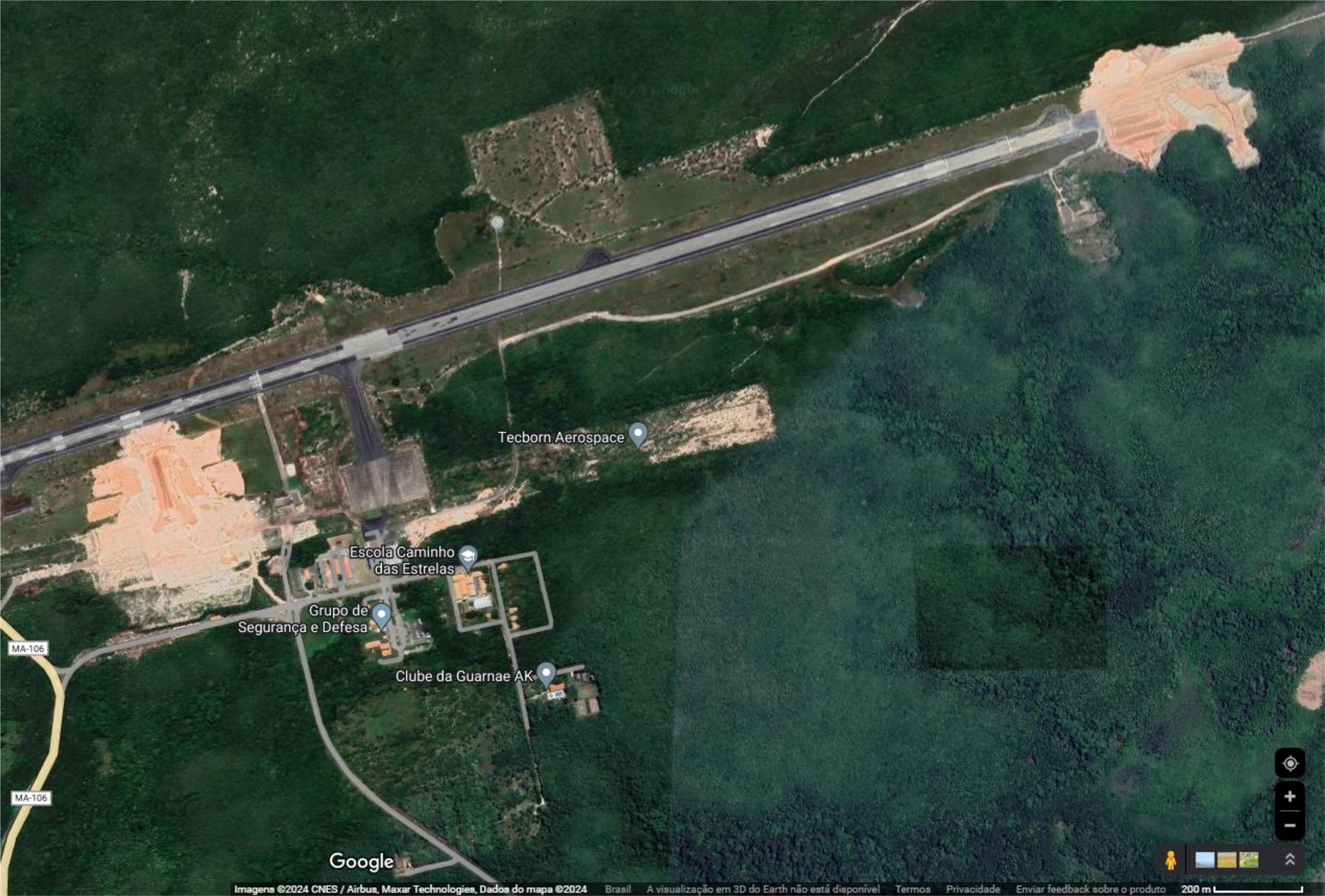
Annex B from AEB Public Call n° 2/2020—Alcantara Airport. Source: Google Earth—Access in March 2024. AEB, Brazilian Space Agency.

Annex I from AEB Public Call n° 7/2021—CEA Area 4. Source: Google Earth—Access in March 2024. AEB, Brazilian Space Agency; CEA, Alcantara Space Center.
Company/Area of CEA—Public Call 02/2020
Data from O Globo. 17 CEA, Alcantara Space Center.
The first company to sign the contract was C6 Launch. 18 Although contracts are still pending, it is possible to notice the interest of foreign and national companies in using the center, because of the growth in demand for launches and, consequently, for active launch centers.
It should be noted, however, that the public calls already launched by the AEB seek companies that, in addition to developing their activities, create opportunities for local development.
Space Regulations
Another important advancement on the commercial opening front of the CEA were the updates of the Brazilian space regulations, published at the end of 2021, for launch authorization in Brazilian territory. 19 These regulations now try to match those used by the Federal Aviation Administration (FAA). The AEB itself points out this relation, as highlighted below:
The requirements for the regulations refer to the FAA (Federal Aviation Administration) standard, FAA 14 CFR part 450 (Rationalization of launch and re-entry licensing requirements), as well as related standards divided into five annexes adapted to Brazilian legislation. We sought to establish a standardization of Brazilian regulations at international levels, in the same way as those carried out in the aeronautical sector. 19
The AEB is still updating the regulations and, to this end, launched, on April 1, 2022, a public consultation to update another regulation, on the Brazilian Space Regulation—Part 3: Insurance Requirements for Space Launch. This specific part of the regulation aims to establish the amount of insurance to be taken out by the company that intends to make a space launch from a Brazilian territory (Plataforma Mais Brasil, 2022).
This initiative for regulatory standardization is important for not only standardizing the documents required for licensing and authorizing launches but also enabling the exchange of licenses between launch centers around the world.
ANALYSIS
The Brazilian space sector has already started to trace its steps on the New Space era, seeking to establish itself as a launch country, through the use and commercial opening of the CEA, thus using the existing structure, added to the excellent geographical conditions, to try to become a competitive front to new markets and competing launch centers.
The signing of the TSA with the United States was essential for Brazil’s intentions to enter the segment of satellite-launching countries. Despite being under discussion for a long period and receiving criticism from the Brazilian Congress, the agreement is essential to guarantee legal certainty for the launches that contain North American components from Brazil. A country that seeks to place itself as an option for private foreign companies cannot have a restriction on the use of components from the main manufacturer of space systems and subsystems.
In addition, signing the TSA (Technological Safeguards Agreement) provides the guarantee of intellectual and industrial protection for the companies that manufacture the components, which already constitutes an incentive to allow operations from Brazil.
The goal, however, should not be just to guarantee the commercial operation of the Center but to also use space activities from the CEA to promote the socioeconomic development of the region and the State. The CEA has the potential to generate socioeconomic benefits for the city of Alcantara, one of the poorest cities in the country, and for the state of Maranhão, where it is located.
The holding of public calls for the use of the Center was another important step, as the attraction of foreign companies guarantees, in part, the internalization of technological development, the training of the national workforce, and the incentive for Brazilian technical training.
The public call takes place at an opportune moment when several smaller companies that invest in the development of their launch vehicles are looking for a launch center capable of receiving their operations. Larger companies are already established and have their own centers. There is, therefore, a window of opportunity that several countries, such as Portugal and Australia, are seeking to take advantage of. Brazil has the conditions for foreign companies to settle permanently in the country and, with this, develop technologies and skills in the country. However, for this to effectively occur, the country needs to guarantee the legal conditions and economic incentives necessary for operations, so that the country is competitive in relation to other countries.
One of the initiatives was precisely the addition of space regulations to guarantee standardization and rules for the operations of private companies in launch activities in Brazil. Another interesting point was the partnership between the AEB and the FAA to guarantee the similarity between the North American and Brazilian regulations, aiming toward an exchange of information in the future between the countries for American companies that are interested in using the Brazilian launch center.
This standardization is an initiative that will likely be followed by other countries seeking agreements with the United States, the largest player in the special area, for private operations. The tendency is to create international rules for space launch activities, along the same lines created for the aviation area, with the rules defined by the International Civil Aviation Organization, which are known and followed by all companies and countries, to avoid incidents and accidents.
The publication of a general law on space activities is another need to ensure legal certainty. In recent years, several countries have published their general laws, as a way of attracting investments and ensuring compliance with rules, in line with international standards, for space activities. In the case of Brazil, discussions have already started, although the legislative process for its approval is long and slow.
The law is an instrument that defines the rules for private activities, their limits of action, and, mainly, the responsibilities in cases of accidents and incidents. It is also important to regulate, via this instrument, the responsibility of the Brazilian State, as the launching country, in accordance with the international conventions ratified by Brazil. But more than that, the general law should seek to create financial and economic incentives for the performance of private companies, through the establishment of a friendly regulatory environment.
FINAL CONSIDERATIONS
In recent years, Brazil has adopted instruments to guarantee its entry into the select group of countries that launch satellites through their own centers. Measures such as the signing of the TSA with the United States, issuing public calls for use of the CEA by private companies, and updating space regulations are essential actions to demonstrate the country’s seriousness in attracting private companies to carry out commercial activities in the country.
The actions mainly pervade the technical field, with the signing of agreements that enable the operations of private companies from the national territory. Ensuring that vehicles with North American components can be launched from Brazil is essential for the success of private activities; after all, most space products will have parts produced by companies in the United States.
The addition of regulations in an internationally standardized manner and with adherence to the American rules is also an important action to attract American companies to the country, as it guarantees that the process for licensing and authorization for launching will be identical to the process that is already carried out by them, reducing the time and complexity of the processes.
The creation of a more favorable business environment for private investment is the point of attention for Brazil. There is an urgent need to discuss the publication of a general law on space activities, with the aim of guaranteeing legal security for space activities.
Footnotes
AUTHORS’ CONTRIBUTIONS
T.P. wrote the first version of the article in Portuguese. M.M. did a thorough content review and adjusted theoretical issues. A.C. did the final English version, review, and adjusted formatation.
AUTHOR DISCLOSURE STATEMENT
No competing financial interests exist.
FUNDING INFORMATION
No funding was received for this article.