




Abstract
Lunar ice is a strategically important resource due to its potential to enable in-situ production of propellants for in-space refueling. However, existing remote sensing data are insufficient to determine whether prospective ice deposits meet reserve criteria. This study applies value of information (VOI) theory to investigate the economic rationale for completing ground-based exploration for lunar ice reserves. By investigating a range of potential extraction and exploration scenarios, the analysis demonstrates the utility of linking VOI to cash flow models as a framework for evaluating future missions. This study finds that uncertainties in deposit composition and technology performance are primary factors undermining the business case. Lunar-sourced propellant could yield positive net present value (NPV) outcomes—even with low propellant prices and launch costs. In representative future scenarios, the VOI from ground-based exploration is likely to exceed mission costs, suggesting that such campaigns can be economically justified.
INTRODUCTION
Lunar ice, which can be processed via electrolysis to produce rocket propellant, has the potential to significantly reduce the cost of lunar and Mars missions. Earth-launched spacecraft must reach high velocities to escape Earth’s gravity well, which demands sustained propellant consumption at high rates. Since carrying fuel requires additional fuel to accelerate it, this creates an exponential mass penalty known as the tyranny of the rocket equation. Consequently, a large portion of rocket mass must be allocated to fuel, leaving only a small fraction of total mass available for payload transport. This allocation varies by destination based on delta-V requirements. For Earth-to-Low Earth Orbit (LEO) missions, around 4% of the mass of a Falcon 9 is available for payload; for Earth-to-GEO it’s 1.5%; and for Earth-to-Mars it’s <1%. 1 Limited payload capacity presents a particular challenge for long-duration human missions which require additional consumables and life support systems to support the crew (6–9 months travel time one way to from Earth to Mars). In-space refueling allows Earth-launched vehicles to carry only the fuel needed to reach a refueling depot, rather than fuel for the entire mission. This reduces the compounding fuel penalty and increases payload capacity. Sourcing propellant from the Moon for refueling offers an intriguing alternative to transporting propellant from Earth, because of the lower escape velocities required, which allow for larger payload-to-total-mass ratios in fuel transport mission architectures. For example, a single rocket launched from the Moon to Geostationary Transfer Orbit (GTO) could transport the same payload mass as 24 rockets launched from Earth to GTO. 2 Previous studies indicate that supplying lunar-produced propellant to various locations in space could be achieved at a lower cost than transporting propellant from Earth.2,3
Despite the physics-based advantages of lunar propellant for spacecraft refueling, large-scale investments in lunar ice exploration and extraction campaigns have yet to materialize. To unlock large-scale investments, investors require a higher degree of confidence in the commercial and technical viability of the endeavor. In addition to the uncertain market demand for lunar-sourced propellant, the limited nature of available data on the composition, grade, location, and depth of ice deposits introduces considerable economic uncertainty and constrains the development of machines that can extract ice economically. 2 Comprehensive evaluation of the commercial viability of ice extraction operations requires accurate mapping of ice deposits through resource exploration. However, justifying exploration missions requires that the expected value of exploration data exceeds the cost of obtaining it. This creates a sequential decision problem under uncertainty where progress requires strategic decision-making despite incomplete information. To address this challenge, this research applies VOI theory to investigate the economic rationale for completing a resource exploration campaign for lunar ice. The analysis describes the current information relative to terrestrial reserve standards and leverages a thermal mining architecture from Sowers et al. (2020) to investigate lunar ice extraction economics. VOI for an exploration campaign is estimated using the outputs of this model and compared to the cost of completing a representative campaign. 4
TRANSITIONING FROM RESOURCES TO RESERVES
The terms “Resource” and “Reserve” are defined by the Joint Ore Reserves Committee (JORC) code, which is a widely embraced framework in the mining and oil and gas industry (Fig. 1). 5 The JORC code characterizes mineral deposits by assessing geological knowledge/confidence and key modifying factors, including mining, processing, metallurgical, infrastructure, economic, marketing, legal, environmental, social, and governmental considerations. Assessing these key modifying factors determines the distinction between resources and reserves, with reserves having a high chance of being commercially recoverable. Assessing the level of geological knowledge and confidence determines the distinction between indicated versus measured resources and probable versus proved reserves. 5 Operators classify deposits as proven reserves before committing to develop them, and generally require >90% likelihood of commercial recoverability based on a thorough assessment of the geology and modifying factors. 6 Lunar propellant production requires high-confidence geological understanding for economic and operational viability and would be subject to similar modifying factors. Thus, meeting the requirements of a proven Reserve per the JORC code, would be a valuable step in validating the commercial recoverability of ice deposits.
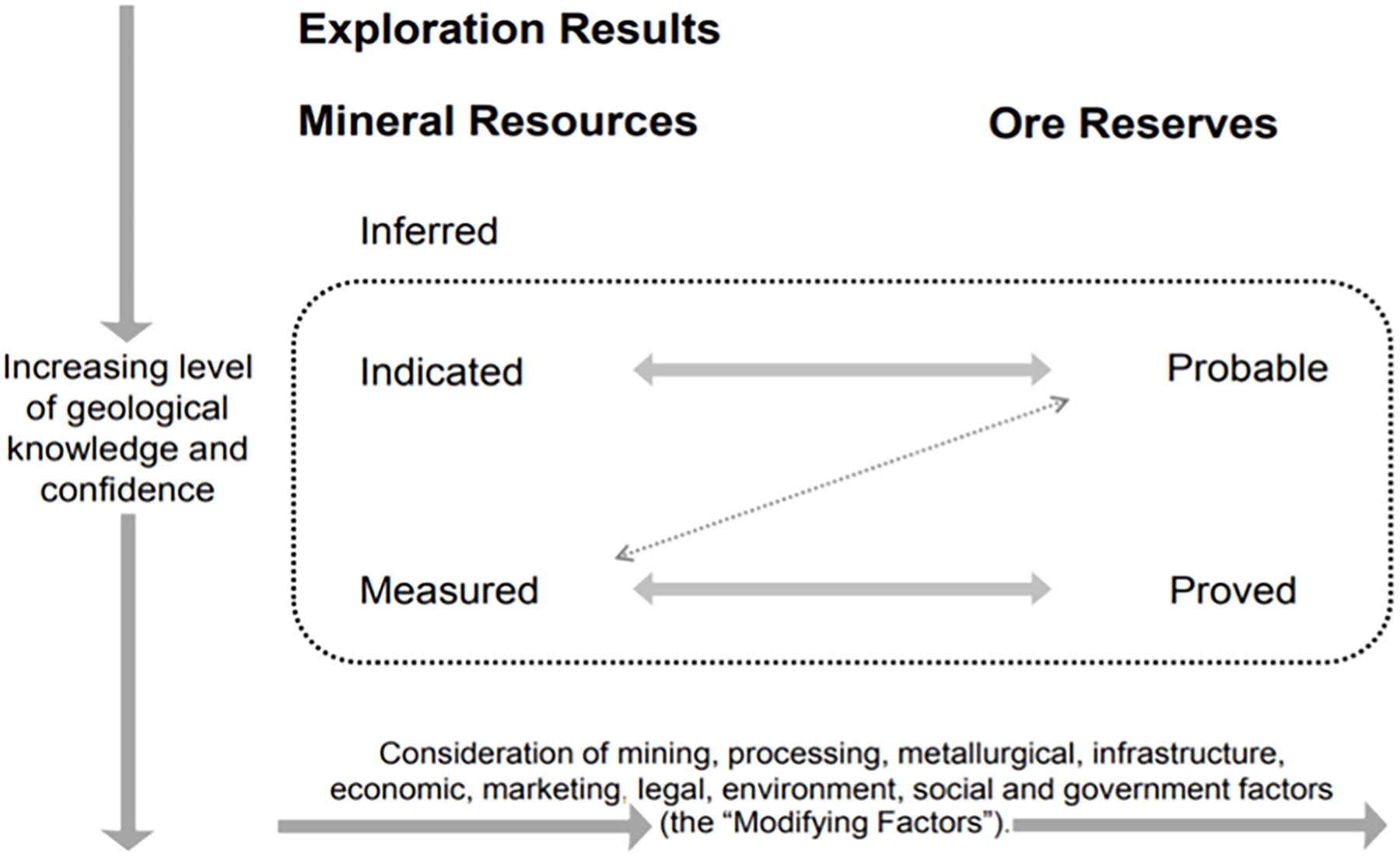
JORC Code Diagram.
Previous studies completed by NASA researchers have estimated the criteria for a lunar ice reserve. Findings from the Lunar Water ISRU Measurement Study (LWIMS) suggest that a reserve would necessitate over 2% water ice with a 1% detection limit. 7 Key parameters include water depth distribution (5–100 cm in ≤10 cm increments), overburden depth (5–50 cm in ≤10 cm increments), and lateral distribution within a 500 m radius. For the LWIMS study, the baseline mine site was 32x32m, with 398 mT of regolith moved to obtain 15 mT of ice under 30 cm of overburden. These criteria are highly contingent on factors such as consumables, production timelines, infrastructure, delivery points, mobility, autonomy and the operational life of equipment. Existing data are insufficient to meet NASA’s requirements for a reserve. (Table 1), shows a summary of the previously obtained measurements. Although initial exploration data indicate the presence of lunar ice, new data are required to meet the spatial resolution, volume, and accuracy criteria required to define a reserve. The critical question that this research investigates is how exploration campaigns designed to gather this data can be economically justified.
Water Ice Exploration Data from Previous Missions—Adapted from the Kleinhenz et al. (2021) 7
THERMAL MINING ECONOMIC MODEL
To investigate the value of obtaining more information through exploration, it is necessary to estimate the potential economic outcomes of a resource extraction campaign that would take place if favorable information is recovered. The economic model proposed by Sowers 2021 was used to baseline the assessment. 13 Several adjustments were made to the model to integrate additional parameters for technology performance and deposit geology. Assumptions regarding launch costs and the target market were also adjusted. The model is intended to serve as a high-level example to demonstrate how a discounted cash flow model can be paired with VOI calculations. Many of the assumptions that feed into the model could be argued and refined with further research. The following sections detail the key input parameters and assumptions. The baseline values were selected by working backward from a target IRR of 30% to identify what technology performance and deposit conditions would be required to achieve an attractive investment return. This target aligns closely with the hurdle rate of 25%, determined by related research to represent a reasonable cutoff value for an attractive investment opportunity. 14
TRANSPORT COSTS AND PROPELLANT SALES
The study assumed low launch costs and propellant sales prices that would be enabled by SpaceX Starship in the 2040 timeframe. Launch costs play a dual role in the economics of lunar ice extraction. First, they directly impact the capital expenditures required to deploy equipment to the lunar surface. Second, they affect the potential profitability by establishing a competitive price ceiling for lunar-sourced propellant. This dynamic relationship means that decreasing Earth-to-Moon transport costs both reduces deployment expenses and puts downward pressure on potential revenue streams. The Monte Carlo assessment accounts for this by integrating a link between launch costs and sales price so that each scales proportionally in the simulated scenarios. Citi estimates that the launch cost to LEO for Starship will be $100/kg within this timeframe. 15 In a scenario where the first stage, second stage, and fairing of Starship can be reused around 10 times, the cost to LEO would be around $300/kg, while in an ideal case with 100+ reuses per vehicle, launch costs could drop to approximately $30/kg. These estimates are substantially lower than current prices for Falcon Heavy (∼$1500/kg). 16 To derive cost estimates for various destinations, we apply gear ratios from Metzger’s model, which are based on the delta-v requirements between locations. 2 The gear ratios account for the propellant mass needed to achieve the velocity changes for travel beyond LEO. The baseline figures are selected to be ∼3x the low-cost, and ∼1/3 of the high-cost scenarios. The market estimate for the model integrates two main propellant sales options. The first was for vehicles traveling from the lunar Gateway to the lunar surface. Kornuta et al. (2019) estimate that 150 MT/year of lunar water would need to be processed to meet the propellant demand for two such missions. 17 Assuming four missions per year, this equates to a demand estimate of 300 MT/year and 200 MT of propellant produced. The second was refueling Mars missions at the lunar Gateway. For the analysis, it was assumed that there would be demand for 140 MT of propellant at Earth-Moon Lagrange Point 1, which would require 280 MT of propellant produced on the lunar surface. The total market demand for propellant was 480 MT/year. The sales price range is assumed to equal the cost of delivering propellant from Earth to the lunar Gateway, where refueling would take place. A significant market uncertainty is that SpaceX’s Starship does not utilize liquid oxygen and hydrogen propellant but rather methane and oxygen. This technical distinction creates uncertainty regarding demand projections for lunar-sourced hydrogen and oxygen propellant. The propellant sales price ceiling is estimated to be between $105 and $1,050/kg, with $350/kg used as the baseline. Additionally, the analysis considers a propellant sales price that leverages Earth-based refueling in LEO as an alternative. With a delta-v of 3.8 km/s from LEO to EML1 and an Isp of 450 s yields a mass ratio of 2.3, meaning each kilogram delivered to EML1 requires 1.3 kg of propellant consumed during transit from LEO. At baseline launch costs of $100/kg to LEO, delivering 1 kg of payload plus 1.3 kg of refueling propellant costs $230/kg delivered to EML1.
ARCHITECTURE, PRODUCTION, AND DEVELOPMENT COSTS
The thermal mining architecture used in the study includes one capture tent, two ice haulers, power generation and transfer infrastructure, water processing, and communication systems. The originally reported assumptions regarding system mass and production costs were adjusted to represent a scaled-down version to match market demand estimates of 480 MT/year. An additional subsystem for the repair and replacement of robotic units was included (Table 2). The baseline scenario excludes the cost of thermal mining technology development. The model represents a steady-state operation, where revenues from extraction activities do not cover the cost of maturing the technology. The model assumed that the thermal mining technology had not been deployed previously (no learning curve cost discounts for previous production units). The costs of duplicate components followed a learning curve of 90%. The assessment focused purely on a private venture—with no offset costs due to government subsidies. The baseline production cost, which includes the cost of spares, was estimated at $27000/kg to be $493M.
Summary of Unit Costs and Mass for Thermal Mining Architecture
TECHNOLOGY PERFORMANCE PARAMETERS
The model assumed a baseline penetration depth of 1.5 m (range 0.5 m-2 m), and a recovery factor of 35% (range 10%-50%). The recovery factor represents the average portion of ice extracted and processed into propellant relative to the ice mass in the undisturbed regolith. Thermal modeling studies that investigated the use of heated drills in addition to direct heating suggest that recovery may be limited to under 50%. 18 The model does not account for potential changes in energy consumption or recovery rates at depth. Extraction rate estimates were based on previous work completed by Sowers (2021) to estimate the average cycle time for operations. The original architecture was capable of mining 100,000m2 per year (280m2 per day). A smaller system assumed in the model was capable of mining ∼50,000m2 per year (140m2 per day). Equipment utilization was integrated into the model and represents the portion of operating time relative to the total time. This parameter accounts for periods of inactivity due to scheduled maintenance/repair operations and unexpected downtime. The baseline input value for equipment utilization was 75% (range 95%-50%).
A key concern for ISRU missions is the reliability of mining and transport systems required to achieve sustained operations. Environmental factors such as the abrasiveness and electrostatic properties of fine lunar regolith, continuous exposure to cosmic and solar radiation, and steep heterogeneous terrain present unique challenges for machines operating for extended periods. Previous studies have stressed a minimum usable life of 4–5 years.19,20 Although achieving this level of reliability has been demonstrated by previous rover campaigns, such as Perseverance, lunar ice extraction presents unique environmental and operational challenges, and there is a severe cost penalty for developing highly reliable systems. 21 Related studies have shown that the cost of developing new hardware scales exponentially with reliability requirements. For example, if a vehicle’s reliability requirement increases from 78% (22% of mass replaced over usable life) to 96% (only 4% of mass replaced over usable life), development costs would increase by a factor of 8. 2 Rather than being designed for maximum reliability, terrestrial mining equipment is designed to undergo frequent servicing and maintenance. For example, mining haul trucks operate for extended periods of 10+ years with planned maintenance/servicing every 500 h of operations (∼monthly). 22 The model integrated reliability through a parameter representing the percentage of system mass replaced each year. The baseline reliability value was 5%, meaning that over the mining duration of 10 years, half of the system mass was replaced. The range for reliability was 2% to 20%. The model includes the transport and production cost for this additional equipment. Infrastructure for routine repairs and maintenance was included. Several novel technologies and architectures are proposed to allow for this, including modular interface connectors, automated robotic warehouses for spares, and robotic and human repair stations. 23
GEOLOGICAL AND DEPOSIT INPUT PARAMETERS
The model assumes a baseline overburden depth of 0.2 m (range 0 m-1 m) and ice grade of 5% (range 1%-10%). Deposit continuity was introduced as a variable to represent the spatial distribution of regions of economically viable ice deposits. For example, an extraction operation targeting many small, isolated areas that are large distances apart will involve a larger portion of time dedicated to repositioning equipment, and production on an annual basis will be reduced. The baseline input for deposit continuity was 80%, with ranges between 50% and 95%. A value of 80% represents an operation where the system spends 80% of the operational time on the areas of the deposit that meet extraction criteria and 20% of the operational time traveling across areas that do not meet the cutoff criteria.
BASELINE MODEL AND SENSITIVITY ANALYSIS
Figure 2 displays how variations in individual model input parameters, from high to low values, impact NPV outcomes over a 10-year operation. The cutoff values identified through the sensitivity analysis assume that all other variables are held at baseline. The baseline scenario values were selected to represent favorable technology performance and deposit conditions that would result in an IRR of 30%. The NPV point estimate for this baseline scenario was $686M.
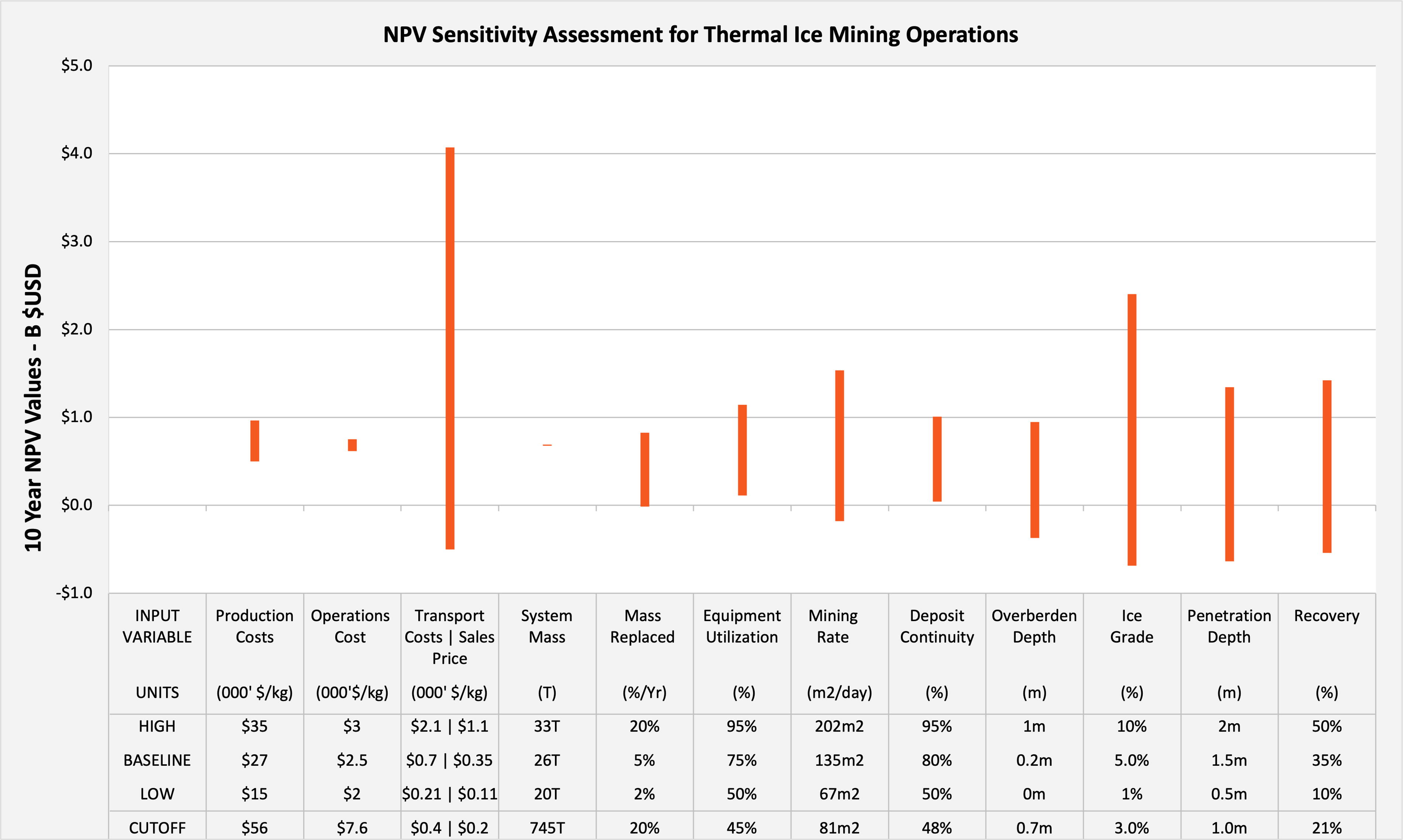
NPV Sensitivity Assessment Results.
NPV outcomes were sensitive to changes in technology performance parameters (mining rate, penetration depth, recovery) and deposit/geological parameters (ice grade, overburden depth). Transport cost and propellant sales price, which were integrated as linked parameters for the assessment impacted NPV values the most. Other cost parameter inputs (production cost/kg, operations cost) had a smaller effect on NPV outcomes.
TECHNOLOGY DEVELOPMENT AND EXPLORATION
Monte Carlo assessments were performed for three scenarios to investigate the impact of technology validation and exploration on the business case. Scenario 1 represents the current status regarding technology and available data. Scenario 2 represents a future state where the technology for thermal mining has been validated, but additional information regarding the deposit is not yet available. Technology validation is represented by adjusting the range of input parameter values to represent more favorable performance. Scenario 3 represents a future state where the technology has been validated, and a successful exploration campaign identifying a favorable deposit has been completed. Table 3 displays the input values for these three scenarios, and Figure 3 shows the results.

NPV Frequency Distribution for Monte Carlo Assessment of Scenarios 1, 2, and 3.
Input Assumptions for 10 years NPV Assessment
For comparative analysis, the study maintains a consistent 10% discount rate across all scenarios when calculating NPV, following McKeown et al.’s (2024) recommendation for standardizing discount rates in space resource project valuations. 14 This approach aligns with established practice in the U.S. oil & gas industry, enabling clearer comparisons between scenarios. However, investment decisions are evaluated against different hurdle rates that reflect the varying risk profiles between scenarios. Using the Risk Build Up Method (RBUM), which quantifies commercial risk by assessing factors such as the legal/regulatory environment, geological uncertainty, technical complexity, and infrastructure requirements, the pre-exploration scenario would require a significantly higher hurdle rate (∼50%). 14 This elevated threshold accounts for the considerable uncertainties in both deposit geology and technology performance. In contrast, the post-exploration scenario, with its reduced geological and technological uncertainties, would warrant a lower hurdle rate (∼25%), reflecting the substantial risk reduction achieved through exploration data. This methodological choice acknowledges that while access to capital would likely become cheaper after exploration reduces uncertainty, capturing this effect through differential hurdle rates rather than varying discount rates provides a more transparent framework for evaluating the value of information.
Figure 3 demonstrates how validating the technology performance and completing a successful exploration campaign can shift the distribution of expected economic outcomes. For scenario 1, 30% of the NPV outcomes were greater than 0. For scenario 2, around 80% of outcomes were greater than 0. For Scenario 3, 95% of outcomes were greater than 0. Per terrestrial mining standards, Scenarios 1 and 2 would not be considered attractive business opportunities, but Scenario 3 would meet the criteria of having a >90% probability of generating positive NPV outcomes. For scenario 3, the average NPV from the Monte Carlo assessment was $3.8 B.
VALUE OF INFORMATION RECOVERED FROM EXPLORATION
While gathering favorable information about technology performance and ice deposit geology clearly improves economic projections, the main challenge lies in demonstrating how exploration campaigns, which are not guaranteed to recover favorable data, can be economically justified. In terrestrial resource exploration, only a small fraction of initial drilling campaigns result in the development of operational mines. Although there is a low hit rate (∼1 in 1,000 for some minerals), the payoff for finding a favorable reserve is high enough to offset the low probability of success. 24
To address this, VOI theory is commonly used to evaluate the benefits of gathering additional information, such as through drilling, based on its effectiveness in reducing uncertainty and improving decision-making. Calculating the VOI involves comparing the outcomes of decisions made with additional information against those made without it.
25
The VOI value represents the maximum price a profit-seeking, risk-neutral decision-maker would be willing to pay for the information. More specifically, the VOI represents the difference between the posterior value (PoV), which reflects the expected value when information is available, and the prior value (PV), which represents the expected value without that information. The equations for PoV and PV are as follows:
26
Posterior Value (PoV): Prior Value (PV):
In these equations,
VOI:
Due to inherent challenges including natural heterogeneity, complex stratigraphy, and limited sampling, the information gathered through mineral exploration is often imperfect. Additionally, equipment and sensor errors and data processing inaccuracies can lead to misleading or incomplete information. Therefore, to accommodate this, decision-makers must evaluate the probability that a given condition (denoted as Bayes Theorem:
To demonstrate the calculation for the VOI recovered from a lunar ice exploration campaign, inputs regarding deposit types, associated probabilities of locating each deposit type, NPV outcomes, and accuracy of information, are required. For this simplified example, three deposit variations were considered (Table 4). The NPV’s listed in Table 4 represent the average NPV value from Monte Carlo simulations. For these simulations, other parameter values were set to the values described by Scenario 3 in the prior analysis.
Input Assumptions for VOI Assessment
Bayes Theorem was used to convert the prior (probability that a certain deposit of lunar ice is located with no additional information) and the likelihood (probability that the deposit is accurately characterized by an exploration campaign focused on gathering additional information) to the pre-posterior and posterior distributions—which represent the conditional probabilities (Fig. 4). The accuracy of correctly characterizing a deposit using data from an exploration campaign was baselined at 90% for each deposit type.

Posterior and Prior Value Calculation Example.
The decision tree in Figure 5 demonstrates the VOI calculation under imperfect information (Fig. 5). If results from exploration campaigns indicate that either a favorable or moderate reserve is present, extraction will occur. If exploration indicates that a resource is present, extraction will not occur. In improbable scenarios, inaccurate data recovered from an exploration campaign results in a resource being characterized as a reserve, and extraction takes place.

VOI Calculation Example.
Under the assumptions regarding the probability associated with each deposit type and the associated likelihood of accurate detection through mineral exploration, the VOI is $0.6B. This result suggests that risk-neutral firms should be willing to pay up to $0.6B for resource exploration efforts. Table 5 shows that VOI is maximized when the probability that a favorable reserve can be located using readily available data is ∼10%, suggesting that a moderate level of uncertainty regarding outcomes is required for information to be valuable. When considering this conclusion, it is important to distinguish VOI from favorable/unfavorable exploration results. This VOI assessment considers these outcomes to provide a guidepost for risk-neutral decision-makers.
VOI Sensitivity Assessment
EXPLORATION MISSIONS FOR LUNAR WATER ICE
To justify an exploration campaign for lunar ice, the expected value of information must exceed its cost. With limited ground truth data available on the composition and distribution of water ice and limited validation of drilling and/or above-ground sensing technologies, there is significant uncertainty regarding the cost and scope of an exploration campaign. To investigate this, a high-level model was built to simulate a drilling campaign completed by one rover. In terrestrial mineral exploration, many drill core samples are required to map a deposit. For lunar ice resource exploration, it is expected that at least some drilling will be required to provide ground-truth data on the subsurface composition. In addition to drilling for lunar ice, there is the option of using above-ground sensing methods from a rover platform. Proposed sensors include a neutron spectrometer, ground-penetrating radar, and seismic sensors. In scenarios where above-ground sensors can produce results that are highly representative of those produced by drilling, the amount of drilling relative to the amount of above-ground sensing may be reduced significantly. The assessment focused on modeling a drilling campaign with the following input assumptions.
TECHNOLOGY PERFORMANCE AND COSTS
NASA’s previously proposed Volatiles Investigating Polar Exploration Rover (VIPER) was used to baseline technology cost and performance assumptions. Serving as the first ground-based mission targeting water ice, the VIPER mission’s objective was to “Characterize the distribution and physical state of lunar polar water and other volatiles in lunar cold traps and regolith to understand their origin.” 28 NASA’s VIPER integrates a drill capable of gathering ice data from 1 m below the surface, Neutron spectrometers for detecting subsurface hydrogen, and infra-red and mass spectrometer instruments to analyze mineral and volatile content. Although the data collected from the proposed VIPER mission would likely be insufficient to characterize a lunar ice reserve, the base components and costs offer a valuable reference for evaluating a larger-scale exploration campaign. VIPER performance parameters were assumed for the assessment. The average driving speed while sensing was 0.3 km/h, and the average speed while traversing (no sensing) was 0.72 km/h. In tests, VIPER has demonstrated the capability to drill to a depth of 1 m within 1 h. 29
A key consideration for lunar exploration is the power source used by the rover. Previous studies indicate that ice is concentrated in permanently shadowed regions at the lunar south pole. VIPER was equipped with solar panels and intended to traverse briefly into PSRs for less than 50 h. Restricted operating time in darkness may make VIPER less suitable for extensive drilling and sensing campaigns within PSRs. 30 The RTG option was the only scenario investigated in the study, as this technology has been used successfully in recent missions and requires the least risk from a site setup perspective. VIPER’s estimated total development and production cost was $433M, with a planned launch cost of $235M for the lander. 31 Adding the cost of an RTG similar to what was used on Perseverance would bring the total cost estimate to $508M. Operational cost estimates for VIPER were unavailable, so Perseverance operations costs estimated at $291M for 2.5 years of operations were assumed (116M/yr). 32
MAPPING REQUIREMENTS
The analysis assumes that satellite-based remote sensing had been completed and a promising region for exploration drilling was available. The analysis also assumes that the lunar reserve region mapped by the exploration campaign must be large enough to support thermal mining operations for 10 years. The previous assessment assumed an annual mining area of 50,000 m2. It is anticipated that exploration will need to cover a larger area than the reserve to define its boundaries (+50%). Based on these assumptions, the exploration area required is estimated to be ∼2.5 km2. The model incorporates a parameter for spacing between drill holes (10–50 meters). When traveling between drill holes, the model assumes that the rover is taking sensor measurements and is moving at a reduced speed (0.3 km/h).
MODEL SENSITIVITIES
The sensitivity assessment showed that drill time per hole, mapped area, and hole spacing significantly impacted mission duration (Fig. 6.). Mission duration is a key consideration for evaluating the cost of such a campaign, as operational costs are high (∼100M/year), and the requirement to operate reliability for extended periods may drive up technology development costs and add considerable mission risk. To investigate this further, an assessment was completed comparing drill spacing input assumptions and time to drill each hole—for the baseline scenario described in (Table 6). The results of the assessment suggest that if drill holes are required every 10 m, and all exploration is completed in 1 year with one rover, the average time to drill one hole would need to be around 10 min. With current drill speeds estimated at 60 min per hole, this same campaign would take over 5 years. With current drill speeds, exploration could be completed within 1 year if holes are spaced 25 m apart. Exploration could be completed in scenarios where drilling is spaced greater than 50 m in a few months. These results suggest that there are considerable advantages to drilling holes quickly and relying more heavily on above-ground sensing so that fewer holes are required. Additionally, multiple exploration rovers may be required if exploration is to be completed within a short timeframe.

Sensitivity Assessment for Exploration Drilling Campaign.
Input Assumptions for Lunar Ice Drilling Mission
COST OF INFORMATION vs VALUE OF INFORMATION
Assuming that an exploration drilling campaign can be completed within 1 year, the total cost of launch and operations is estimated to be ∼$350M. Regarding the VOI recovered for a thermal ice mining campaign, the operational cost of exploration drilling would be less than the previously identified VOI threshold ($0.6B). If the full development and production costs are considered in this estimate, the total cost would approximate the VOI estimate ($624M). However, the cost of developing/producing a rover similar to VIPER may be considerably less than the originally quoted amount, as many of the sensors and subsystems may not need to be redesigned.
OTHER CONSIDERATIONS
Cost Savings and Capability
Rather than considering NPV outcomes presented in the study to represent profit for a private company, it is more practical to consider them as savings to NASA Mars and lunar campaigns. The propellant sales price for these scenarios is likely to be correlated to the price of delivering propellant from Earth. Positive NPVs represent scenarios where propellant can be supplied at a lower cost than delivering from Earth, suggesting an overall cost reduction to NASA’s future missions. Beyond cost considerations, in-space refueling using lunar-sourced propellant provides a significant capability multiplier for missions. The gear ratios in Table 7 illustrate not just cost relationships, but also payload capacity implications. For example, with Earth-to-LEO having a gear ratio of 1 and Earth-to-Lunar Surface having a ratio of 7, a mission refueled with lunar propellant could deliver approximately 7 times more payload mass to its final destination compared to an equivalent mission launched fully fueled from Earth. This “capability premium” represents additional value beyond direct cost savings. For Mars missions specifically, where Earth-launched rockets might allocate less than 1% of total mass to payload, lunar refueling could significantly increase mission capabilities by unlocking additional payload capacity. This enhanced capability may have compounding effects that accelerate exploration and settlement endeavors. For example earlier deployment of large-scale robotic systems for exploration and infrastructure development (e.g., landing pads), alongside infrastructure-building technologies such as 3D printers, may create a foundation for subsequent developments with multiplicative benefits. While refueling in LEO with Earth-launched propellant offers initial capability improvements, lunar-derived propellant delivered to EML1 could complement this approach, further expanding capabilities through a multi-node propellant supply chain.
Launch Cost Assumptions
Integrated Mission Architectures
The economic case for lunar ice mining strengthens considerably when integrated with other lunar activities. Shared infrastructure costs across multiple objectives (science, tourism, manufacturing) could improve overall economic viability through the amortization of fixed costs across multiple revenue streams. Additionally, the study assumed an architecture where machines are serviced and repaired frequently over their usable life—reducing overall mission risk. Development timelines for robotic repair and maintenance technologies/capabilities are not clear. However, the need for this capability has been demonstrated by related studies, which suggest that 12 backup lunar surface vehicles would be needed for each operating vehicle to sustain a 2-year operation in the absence of repair/servicing. 23 Infrastructure to complete servicing and repairs would have utility across a wide range of mission architectures. Additionally, the capability to accurately estimate spares required, predict maintenance cycles, 3D print required components, and repair components would be highly advantageous to achieve sustained operations.
Alternative Forms of Value
Conducting ground-based exploration would advance planetary science by providing critical ground-truth data which would improve our understanding of volatile history, the thermal and physical evolution of the moon, and help to validate remote sensing measurments. From a mission risk perspective, ISRU could reduce dependency on Earth-launched consumables, providing redundancy that protects against supply chain disruptions and launch failures. Societally, exploration missions like Perseverance demonstrate how planetary ventures can catalyze STEM engagement and inspire educational pursuit and technological innovation. Additionally, secondary markets extend beyond propellant production to include life support applications (potable water, oxygen for breathing), radiation shielding, agricultural support, and various industrial applications. While difficult to quantify precisely, these alternative value streams are highly aligned with strategic initiatives and should be considered when evaluating exploration campaigns.
Geopolitical, Legal, and Environmental Factors
The Moon’s South Pole is optimal for a lunar base due to its regions with continuous sunlight, providing constant access to solar power and stable thermal conditions. However, there are limited favorable areas with high illumination and proximity to permanently shadowed regions (PSRs). Being the first entity to explore these regions with a ground-based mission may present considerable strategic advantages, especially considering legal uncertainties and potential land ownership disputes. Establishing a legal framework that allows for lunar resource utilization, akin to the regulations terrestrial mining companies operate under, could help attract investment into such operations by lowering project risk. While various treaties, such as the Outer Space Treaty of 1967 and the Moon Agreement of 1979, govern the use of lunar resources, no comprehensive legal standards comparable to terrestrial mining exist. Moreover, enforcement mechanisms for space resource law remain unclear and untested, with limited international consensus on regulatory oversight. Resource extraction and exploration at the lunar South Pole would inevitably disturb the natural environment. Thermal mining is a noninvasive method that avoids large-scale excavation, offering a clear advantage in terms of environmental footprint compared to mechanical excavation approaches. As with terrestrial mining, high-value projects often face rejection due to environmental concerns, and there is a long list of projects that have caused irreparable damage to natural environments, underscoring the need for measures to study environmental impact and minimize disruption.
Project Option Value
Our approach primarily values the benefit of collecting information upfront through exploration before major investment decisions are made, thereby reducing geological and technological uncertainty. In contrast, project option value accounts for the continuous flexibility to adjust operations throughout a project’s lifecycle as new information emerges—expanding production when conditions are favorable or contracting when unfavorable. Typically, the Project Option Value is greater than the NPV + VOI, which is greater than the NPV. This inequality exists because option value captures the full spectrum of operational flexibility beyond the initial decision to invest. The option value framework would additionally incorporate the value of operational adjustments during the exploration and extraction campaigns.
Private–Public Partnerships
Due to the large capital requirement and risks associated with exploration, private-public partnerships may be essential to completing exploration campaigns. Specific policy instruments such as anchor customer commitments, milestone-based payments, or guaranteed purchase agreements could substantially alter the risk profile by providing revenue certainty. The VOI calculated in this article is relevant to a risk-neutral decision-maker. In practice, an entity may be unable to recover from an unsuccessful exploration campaign and therefore may be risk-averse. Similar research has shown that private-public partnerships could facilitate mineral exploration by preventing the need for private firms to duplicate information and facilitating risk-based decision-making. 33
Additionally, multinational collaboration for gathering sensing data could significantly de-risk the effort and open a clear path for collaboration and profit sharing. Previous literature has highlighted the need for such an effort. 34 In the event that a public-private partnership is formed, VOI still applies, as the expected value of the information from the exploration must outweigh the costs.
CONCLUSIONS
Current data are insufficient to define a lunar ice reserves. To justify large-scale investment in lunar-sourced propellants, uncertainties regarding ice deposits and technology performance must be addressed. The study’s NPV estimates for an extraction campaign using a thermal mining architecture were most sensitive to deposit parameters addressing ice grade, overburden depth, and deposit continuity. These results suggest that information from ground-based exploration would be invaluable for evaluating the business case for extraction operations.
While the analysis presents specific numerical outcomes that may reflect optimistic assumptions, its primary contribution is methodological—demonstrating how the VOI framework can be used to evaluate exploration investments. The model illustrates that exploration can be economically justified, even in scenarios with significant uncertainty regarding extraction outcomes and low probabilities of identifying favorable reserves. This framework can be applied to assess various architectures and operational scenarios as technology and market conditions evolve.
If thermal ice mining technology is matured and a favorable reserve of ice is mapped, ice extraction may present an attractive business opportunity, even in scenarios with low launch costs and propellant sales prices. At present, lunar-sourced propellant remains highly uncertain as a business opportunity due to information gaps, but our analysis shows there are conditions under which it becomes economically viable to support NASA missions. Beyond improving economic projections through better geological and technical data, exploration campaigns fundamentally transform the investment landscape by reducing project risk, thereby lowering the acceptable threshold for investors. This dual benefit of exploration—potentially enhancing expected returns while reducing the hurdle rate that must be cleared—significantly improves project viability. Additionally, other factors, such as scientific, societal, and geopolitical considerations, can enhance the overall value of information from resource exploration. The study focused primarily on monetary value, but a comprehensive analysis should consider these broader impacts.
Footnotes
ACKNOWLEDGMENTS
The authors would like to thank Ian Lange for his guidance and support throughout this research.
AUTHORS’ CONTRIBUTIONS
S.C.: Conceptualization, methodology, data curation, writing—original draft preparation, visualization, investigation, supervision. G.S.: Writing—reviewing and editing.
AUTHOR DISCLOSURE STATEMENT
No competing financial interests exist.
FUNDING INFORMATION
No funding was received for this article.