




Abstract

To the Editor:
Genital tuberculosis is one of the leading causes of infertility in developing countries. Diagnosis is often elusive. Laparoscopy is used frequently in the evaluation of these patients. There are various case reports of port site tuberculosis following laparoscopy. The cases reported are mainly from the Indian sub-continent. We need to examine whether these are due to improper sterilization techniques or inoculation and activation of sub-clinical tuberculosis after laparoscopy. The reported cases have developed port-site tuberculosis after surgery for a varied pathology. The infection has been attributed to improper sterilization of laparoscopic equipment. There has been no evidence of intra-abdominal tuberculosis in any of these cases. This is the first case, to our knowledge, of documented intra-abdominal infection causing port-site tuberculosis.
A 30-year-old woman was being investigated for infertility. She had a normal physical examination, and her menstrual history was unremarkable. Her routine blood test, chest radiograph, ultrasound, and Mantoux test results were all normal. Endometrial biopsy and culture did not reveal any abnormality. She had been married for five years, and her spouse's sperm count was normal. She had had a laparoscopy to assess her tubal patency. At laparoscopy, there was minimal fluid in the pouch of Douglas and few scattered tubercles in the peritoneum. Biopsy of the tubercles revealed a granulomatous lesion, and polymerase chain reaction of the fluid was positive for tuberculosis. She was subsequently started on anti-tuberculous therapy. One month later, she developed an abscess at the umbilical port site. The abscess was drained, and the pus culture did not grow any organism. Subsequently, she developed another abscess, which burst spontaneously and formed a sinus (Fig. 1). The sinus was laid open, and the wall was biopsied, which confirmed tuberculosis. The patient was started on a four-drug daily regimen of isoniazid (5 mg/kg), rifampicin (10 mg/kg), pyrazinamide (25 mg/kg), and ethambutol (15 mg/kg) for two months, after which the abdominal sinus healed. The patient was then started on a two-drug regimen of isonicotinic acid hydrazide and rifampicin daily for 10 months. She has no constitutional symptoms at a two-year follow up, but she remains infertile.
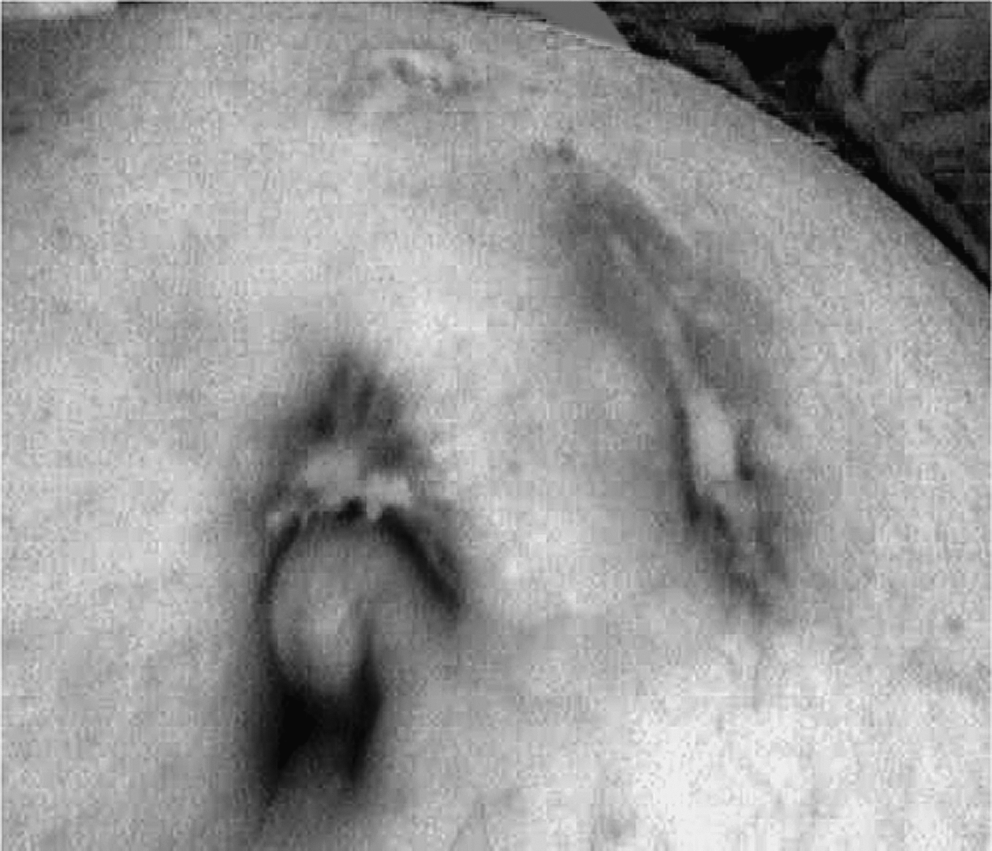
The umbilical port site and surrounding skin, showing multiple sinuses and healed scars.
Discussion
Genital tuberculosis is one of the leading causes of infertility in women. Most of these infections are latent, and the only presenting symptom may be infertility [1]. They are usually secondary to tuberculosis elsewhere in the body and spread through the blood stream to reach the genital system. They are often difficult to diagnose, with endometrial biopsy, diagnostic laparoscopy, and radiological parameters being normal. The advent of polymerase chain reaction has improved the diagnostic yield of laparoscopy [2]. With laparoscopy gaining popularity in gynecologic procedures, the concern of improper sterilization becomes a priority. It remains common practice to immerse instruments in 2% glutaraldehyde for 20 min [3]. Several reports have been published on the presence of Mycobacterium tuberculosis even after a 45-minute exposure [4]. Port site tuberculosis has been reported after various surgical procedures [5–7]. There was no clinical, radiological, or laparoscopic evidence of tuberculosis in any of these cases. The authors postulate that contamination or improper sterilization of instruments caused it. Tuberculosis is highly prevalent in developing countries, and with the advent of the human immunodeficiency virus, it is also increasingly being seen in developed countries. Florid intra-abdominal tuberculosis is easy to diagnose, but tuberculosis that is latent or presenting with only minimal ascites or mesenteric adenitis is easy to miss, especially when a surgeon is addressing other intra-abdominal pathology, such as during a cholecystectomy.
There are also various reports on port-site metastasis after laparoscopy [8,9]. This is attributed to wound implantation caused by surgical technique, leakage of gas through the ports (chimney effect), or use of pneumoperitoneum under high pressure [10,11]. It is possible that port site tuberculosis occurs in the same way. If tuberculosis is latent, inoculation of infection could occur in the subcutaneous plane and lead to cutaneous tuberculosis [12].
In our case, the patient had pelvic tuberculosis followed by port site tuberculosis. Although the organism could not be cultured to prove that it was the same strain of tubercle bacilli, it most likely was an endogenous infection. A PubMed search revealed 11 cases of port site tuberculosis, all of them due to exogenous infection.
Author Disclosure Statement
No conflicting financial interests exist.