




Abstract
Abstract
Background:
Clostridium perfringens bacteremia accompanied by extensive intravascular hemolysis is an almost inescapably fatal infection.
Methods:
Case report and literature review.
Results:
A 52-year-old man with a recent history of liver transplantation developed sepsis and severe hemolytic anemia. The patient had multiple organ dysfunction syndrome and required aggressive transfusion, antibiotics, and continuous hemodialysis. Blood cultures grew C. perfringens. With appropriate resuscitation and antibiotic treatment, the patient had a complete, although complicated recovery.
Conclusion:
This is the first reported case of a liver transplant patient developing fulminant C. perfringens sepsis with hemolysis. This infection usually kills patients within hours of presentation. Early recognition and aggressive treatment is necessary to avoid this outcome.
We recently treated a patient in whom pan-enteritis was the suspected source of C. perfringens. To our knowledge, enteritis as a sole portal of infection has not been reported previously. His survival was especially remarkable in that he had received a liver transplant and was taking immunosuppressive drugs.
Case Report
A 52-year-old male with a history of successful orthotopic liver transplantation for hepatocellular carcinoma presented to the Emergency Department four months after discharge with complaints of fever, right upper quadrant abdominal pain, weakness, and confusion. The patient reported malaise and loose bowel movements for two weeks prior to presentation. On examination, his pulse was 140 beats/min, the respiratory rate was 40 shallow breaths/min, the temperature was 39.2°C, and the blood pressure was 108/62 mm Hg. He was jaundiced and had non-focal abdominal tenderness without signs of peritonitis.
Laboratory studies at the time of presentation showed acute kidney injury, compensated metabolic acidosis, and possible hemolytic anemia. The serum creatinine concentration was 2.4 mg/dL, and the bicarbonate concentration was 9 mEq/L. Hemoglobin was 6.9 g/dL, and the hematocrit was 14.9%, decreased from 12.2 g/dL and 38%, respectively, at a health maintenance visit two weeks prior to presentation. Total bilirubin was 22.5 mg/dL with an indirect fraction of 12.5 mg/dL, and the International Normalized Ratio was 1.9. A peripheral blood smear demonstrated polychromatic spherocytes. The patient's urine was dark brown, with urinalysis demonstrating hemoglobinuria without red blood cells. A fecal occult blood test was positive. Blood cultures were obtained, and he was started on an empiric regimen of intravenous piperacillin-tazobactam, vancomycin, and fluconazole. Oral metronidazole was started initially as empiric therapy for C. difficile infection, but the patient was unable to tolerate the drug by this route, so it was switched to intravenous therapy.
The patient was admitted to the surgical intensive care unit and needed to be intubated endotracheally soon afterward because of acute respiratory failure and worsening mental status. The patient's hemoglobin decreased to 5.2 g/dL < 3 h after admission, and he was given six units of packed red blood cells and six units of fresh frozen plasma. Despite transfusion, there was little initial hemodynamic improvement, and he required vasopressor support with norepinephrine, dopamine, and vasopressin, as well as ongoing fluid resuscitation. A sodium bicarbonate infusion was used to treat the metabolic acidosis. The patient also developed new-onset atrial fibrillation with a rapid ventricular response and was treated with an amiodarone infusion.
On hospital day 2, computed tomography (CT) scans of the chest, abdomen, and pelvis demonstrated ground-glass pulmonary opacities and diffuse bowel wall thickening from the duodenum to the sigmoid colon (Fig. 1). Transhepatic cholangiography showed widely patent bile ducts, and normal bile was aspirated. Anaerobic blood cultures grew spore-forming, gram-positive bacilli on that day, consistent with Clostridium bacteremia. The patient's antibiotic regimen was narrowed to metronidazole alone on the basis of susceptibility studies. Microbiology examination confirmed the presence of C. perfringens.
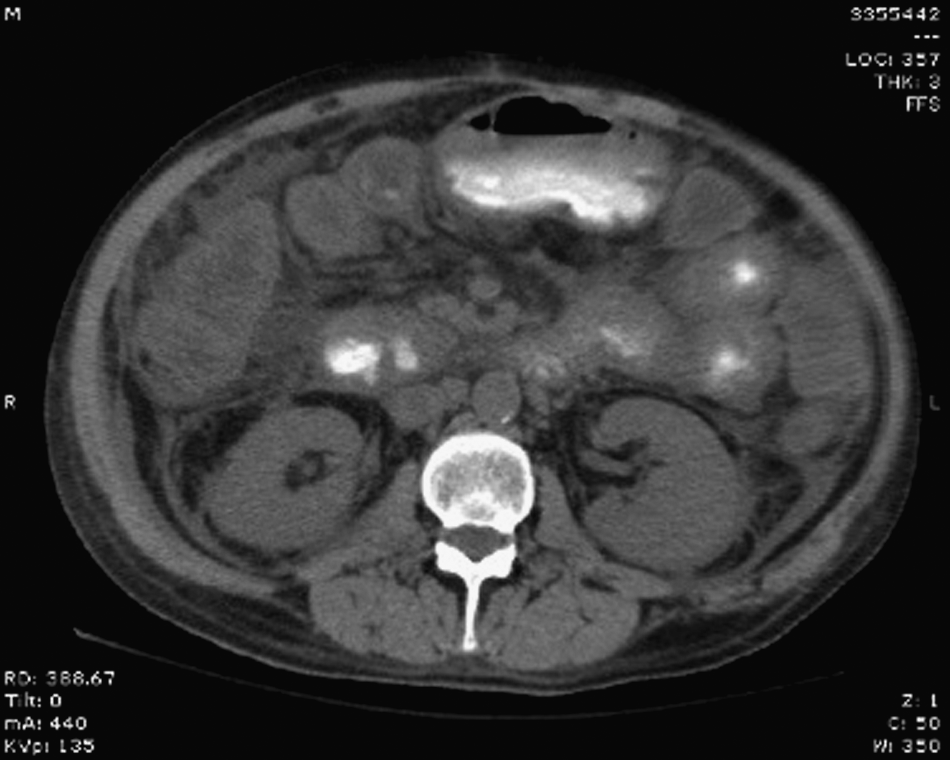
Axial computed tomographic image of upper abdomen at presentation showing diffuse inflammation of both small and large intestines.
The patient's renal function continued to deteriorate, and continuous renal replacement therapy was started on hospital day two and continued for 10 days. The patient was weaned from vasopressors by hospital day five and extubated on hospital day 10. He was discharged from the hospital on day 34 with some residual renal dysfunction, which resolved over the following six months.
Discussion
The severe hemolytic reaction that is only rarely seen in cases of C. perfringens sepsis is the result of several toxins produced by that bacterium. This organism produces more than 20 toxins, most of which act by forming channels in susceptible host plasma membranes, causing permeability alterations and, ultimately, death by cell lysis or induction of apoptosis. In addition to several pore-forming toxins that target red blood cells, phospholipase C (PLC), an alpha-toxin, has been well characterized as a hemolytic agent: This toxin hydrolyzes sphingomyelin and lecithin, disrupting erythrocyte membranes directly. In a prior case report, Hubl et al. demonstrated a 4.5-fold increase in PLC activity over the course of only 3 h in the serum of a patient undergoing an acute hemolytic reaction (the patient succumbed to the infection in just over 3 h) [1].
The rapidity with which this bacterium can upregulate the production of its toxins is manifested by rapid clinical deterioration of the patient. Thankfully, bacteremia with hemolysis is a rare clinical presentation. In a retrospective review of patients with clostridial bacteremia at the M.D. Anderson Cancer Center, approximately one-third of 136 incidents were attributable to C. perfringens. Of these, only two patients experienced hemolytic complications, and both of these patients died within hours of presentation [2]. Similarly poor prognoses have been described in prior case series. In a review series published in 1989, Tsai et al. reported that in the 30 years previously, there had been only seven cases of hemolytic C. perfringens septicemia, with two patients surviving and the remainder dying within 36 h of presentation [3]. Subsequent literature review confirms the lethality of this infection, with cumulative mortality rates > 70% and death characteristically occurring within 24 h of presentation as the result of cardiovascular collapse [4–7].
Patients typically are characterized by the conditions that predisposed them to C. perfringens infection. They often have neoplastic disease, colon cancer in particular, as well as invasive tumors of the genitourinary tract or leukemia. Infrequently, benign disease processes such as gangrenous cholecystitis, idiopathic liver abscess, diverticulitis, or peptic ulcer disease are proved to be the portal of infection. On the basis of our patient's CT scan at presentation, pan-enteritis is the suspected predisposing pathology of his infection, although stool samples were never positive. To our knowledge, enteritis as a sole portal of infection has not been reported previously. Also, no prior reports exist of patients on life-long immunosuppression for solid organ transplantation contracting this disease, which makes our patient's survival all the more remarkable.
Treatment of this rapidly lethal infection is based on immediate administration of antibiotics, transfusion with blood products, and measures to correct metabolic derangements and support failing organ systems. Given the rapidity with which the bacteria can upregulate toxin production, empiric antibiotic delivery is the most urgent concern in patients suspected of having hemolytic C. perfringens sepsis; this is especially true because perfringens toxin production can be suppressed rapidly by administration of antibiotics. Stevens et al. demonstrated that at the appropriate doses, clindamycin, metronidazole, and rifampin suppressed in vitro alpha-toxin activity and production in 15–45 min [8]. Transfusion is a second concern that needs to be addressed rapidly in the setting of hemolysis; our patient required both blood and plasma in the initial stages of the illness. With the appropriate antibiotic regimen, the patient's hemoglobin values stabilized, further proof of the rapidity with which toxin production can be suppressed. Finally, hypotension, systemic inflammatory products, and free hemoglobin in circulation cause end-organ damage. Our patient deteriorated mentally and required mechanical ventilation, vasopressors, and continuous renal replacement therapy for both his sepsis and the oliguric acute kidney injury. Surviving patients can suffer longer-term sequelae such as renal insufficiency, central nervous system injury, and disseminated infection [9].
Our initial choice of antibiotics was exceptionally broad but may have been serendipitous in this patient. Although piperacillin-tazobactam has excellent anerobic coverage, it does not treat C. difficile, which was the rationale for the addition of metronidazole. Early treatment with this drug may have contributed to a reduction in C. perfringens toxin concentrations early in the course of the disease, increasing our patient's chance of survival.
In summary, hemolytic C. perfringens bacteremic sepsis is a rare, highly lethal infection. Clinicians should suspect this infection in patients who present with a rapidly deteriorating clinical picture and profound anemia with signs of intravascular hemolysis. Although gastrointestinal or genitourinary cancers are frequent portals of infection, benign or previously occult disease processes also can lead to catastrophic infection. In all cases of hemolytic C. perfringens bacteremic sepsis, rapid recognition and treatment based on a constellation of non-specific clinical indicators is the key to preventing otherwise almost certain patient death.
Footnotes
Author Disclosure Statement
There were no sources of funding or conflicts of interest in this study. All authors affirm that they have no commercial interests or conflicts of interest that may appertain to the materials discussed in this paper.