




Abstract
Abstract
Background:
Acute suppurative parotitis (ASP) is a severe infection seen particularly in elderly surgical patients. Factors that increase the risk of ASP include post-operative dehydration, debilitating conditions, and immunosuppressed states.
Method:
Case report and literature review.
Results:
An 82-year-old female patient was admitted because of paralytic ileus, dehydration, and poor oral hygiene, and was in distress. After two days of hospitalization, the patient developed a progressive painful swelling of her right parotid gland and fever up to 39.0°C. Computed tomography scanning showed an abscess in the parotid gland. Because of her progressive clinical deterioration, the patient underwent operative drainage of the abscess and removal of the necrotic material. Unfortunately, she suffered multiple organ dysfunction syndrome and died.
Conclusion:
Acute suppurative parotitis requires prompt aggressive treatment that nevertheless may fail.
Case Report
An 82-year-old female patient was admitted to our surgical department because of paralytic ileus. She had been treated recently in the cardiology department for uncontrolled hypertension and atrial fibrillation but had a satisfactory left ventricular ejection fraction. The patient was in distress and dehydrated with poor oral hygiene. During the second day of hospitalization, she developed progressive swelling and tenderness of her right cheek. Her temperature was 39.0°C with a pulse rate of 95 beats/min and blood pressure of 105/80 mm Hg. Clinical examination demonstrated a firm, warm, erythematous, and extremely tender swelling of the right cheek, with pus oozing from Stenton duct. Cultures were obtained from the pus and blood. Intravenous cefoxitin 2 g T.I.D. was administered, and hydration and oral hygiene measures were instituted. The patient's status worsened, however, and a computed tomography (CT) scan of the affected area showed an abscess in the right parotid gland (Fig. 1). The patient was taken immediately to the operating room for drainage. Through a preauricular retromandibular incision, the parotid gland was approached, and multiple incisions were made parallel to the branches of the facial nerve (Fig. 2). Necrotic debris was removed, and cultures were obtained. A surgical tracheostomy was performed.
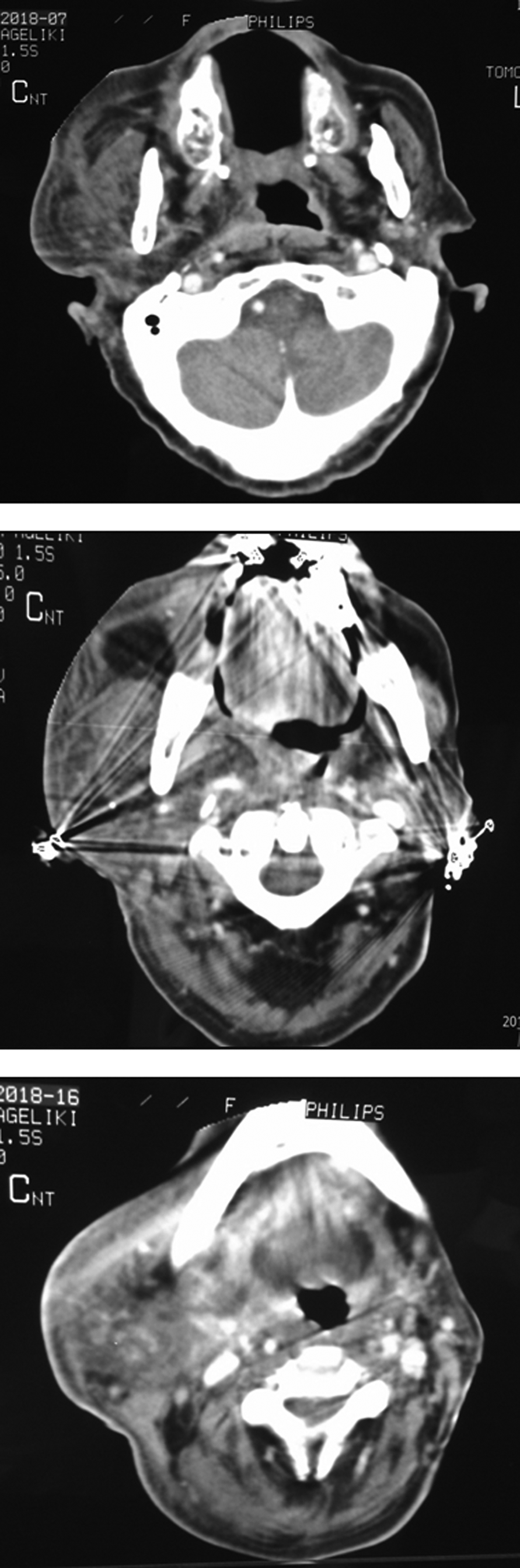
Neck computed tomography demonstrating abscess in right parotid gland.

Flaps and drainage incisions of the parotid gland made in parallel to course of branches of the facial nerve.
The microbiology report revealed Pseudomonas aeruginosa sensitive to imipenem-cilastatin, and appropriate antibiotic therapy was administered. Unfortunately, the patient's sepsis worsened, leading to death on the eighth post-operative day secondary to multiple organ dysfunction syndrome.
Discussion
The parotid gland is the largest of the three main paired salivary glands. It produces a watery saliva and salivary amylase, which are necessary for forming the food bolus, food digestion, and facilitation of passage to the upper digestive system. The parotid duct leaves the gland halfway between the zygomatic arch and the corner of the mouth. It follows a transverse direction and, after crossing the masseter muscle, enters the buccal fat, pierces the buccinator muscle, and drains near the second upper molar tooth. The facial nerve, the external carotid artery and its branches, and the retromandibular vein with its tributaries are major structures that pass through or deep to the parotid gland.
Acute suppurative parotitis has been well recognized since the time of Hippocrates [2]. It is an inflammatory and infectious process of the parotid gland. It occurs most commonly in infants under two months of age and elderly patients who are debilitated by a systemic illness or have had an abdominal surgical procedure [3]. Dehydration, poor oral hygiene, advanced age, immunosuppression, salivary duct obstruction (e.g., stones), excessive alcohol intake, autoimmune diseases, Sjögren syndrome, diabetes mellitus, and anticholinergic drugs are the most common predisposing factors. Typically, the patients present with sudden onset of an enlarged, tender, and erythematous parotid gland, pus oozing through the parotid duct (especially with palpation of the gland), fever, and granulocytosis [4,5].
Most commonly, suppurative parotitis is caused by Staphylococcus aureus and anaerobic bacteria. The predominant anaerobes are gram-negative bacilli, Fusobacterium, and Peptostreptococcus. Streptococci and aerobic gram-negative bacilli may be found also. Gram-negative organisms have been reported in hospitalized patients. Organisms less frequently found are Arachnia, Haemophilus influenzae, Klebsiella pneumoniae, Salmonella spp., Pseudomonas aeruginosa, Treponema pallidum, Bartonella henselae (cat-scratch bacillus), and Eikenella corrodens. Mycobacterium tuberculosis and atypical mycobacteria are rare causes of parotitis [6].
Once a presumptive diagnosis of acute suppurative parotitis is prompted by a clinical sign, routine laboratory blood testing, chemistry panel, culture, and imaging are mandatory as soon as possible. There are three important elements to consider when dealing with such an infection: The health of the host, the intensity of the physiologic response, and the nature of the pathogen. Immunosuppressed (e.g., human immunodeficiency virus infection, lymphoma) and old patients may be unable to manifest the clinical signs of infection seen in normally responsive patients, so these signs may be absent or develop at a later stage of the infection. Unfortunately, acute suppurative parotitis is common in these groups of patients. Fever, tachycardia, tachypnea, and an enlarged, tender parotid gland are universal signs of parotitis.
Computed tomography scanning with intravenous contrast material is helpful for detecting lesions or masses in or around the parotid gland. It also is possible to differentiate a mass arising from the parotid gland from invasion of the gland from adjacent structures. The specificity of the CT scan in distinguishing between benign and malignant neoplasms and inflammation is only about 75%, although it may reach 90% when the findings are integrated with clinical and laboratory data. The main diagnostic problem is the differentiation of local inflammation of the gland without calculi from malignant neoplasms [7]. Compared with magnetic resonance imaging (MRI), CT provides the same information for detecting salivary gland neoplasms, but CT is superior in cases of inflammatory salivary gland “masses” [8]. Undoubtedly, the algorithm for imaging the parotid gland depends on the clinical presentation of the patient [9]; non-enhanced CT often is the best initial study for the evaluation of a painful gland. If an infiltrative neoplasm is highly suspected, non-enhanced and enhanced MRI may be superior in demonstrating invasion of other structures. Sialography is reserved for the evaluation of chronic sialadenitis without calculi.
As soon as the diagnosis of ASP is established, cultures should be obtained by careful palpation of the affected gland and collection of pus from Stenton duct. Immediate attention should be directed toward improving the patient's oral hygiene and correcting any water deficit. Intravenous antibiotic therapy should not be delayed and should cover all possible anaerobic and aerobic bacteria. Broad-spectrum empiric antibiotics should be used initially, with appropriate de-escalation according to the individual patient's culture results. If the disease subsides promptly, no further intervention is needed. However, if these measures fail to improve the patient's status or the disease progresses to an abscess, surgical intervention is needed. If the disease escalates, in no circumstances should surgery be delayed beyond the fourth day.
The surgical technique employed is nearly that introduced by Blair and Pagett in 1923 [10]. Through a pre-auricular retromandibular incision, flaps of skin and subcutaneous tissue are reflected, exposing the gland. Multiple drainage sites are created along the course of the branches of the facial nerve, and any necrotic tissue is excised. The incision is left open and packed. Paralysis of the facial nerve and its branches, skin flap necrosis, and hemorrhage are possible early complications but can be avoided with thorough knowledge of the anatomy and meticulous surgical technique.
Conclusion
Acute suppurative parotitis is a serious medical condition, especially for elderly patients. The mortality rate is high, although it has decreased dramatically since the introduction of broad-spectrum antibiotics, improvement of perioperative care, and better understanding of the pathophysiology of the disease. When the disease does not respond promptly to supportive and antibiotic therapy, surgical drainage should not be delayed. Finally, it is important to educate patients on good oral hygiene to prevent future infection of the gland.
Footnotes
Author Disclosure Statement
No conflicting financial interests exist.