




Abstract
Abstract
Background:
Waterless alcohol-based hand sanitizers are an increasingly popular method of hand hygiene and help prevent hospital-acquired infection (HAI). Whether hand sanitizer dispensers (HSDs) may themselves harbor pathogens or act as fomites has not been reported.
Methods:
All HSDs in the surgical intensive care unit of an urban teaching hospital were cultured at three sites: The dispenser lever, the rear underside, and the area surrounding the dispensing nozzle.
Results:
All HSDs yielded one or more bacterial species, including commensal skin flora and enteric gram-negative bacilli. Colonization was greatest on the lever, where there is direct hand contact.
Conclusion:
Hand sanitizer dispensers can become contaminated with pathogens that cause HAI and thus are potential fomites.
Today, HAI continues to be a substantial problem, accounting for an estimated 1.7 million infections and 99,000 deaths each year in the United States [2]. Such infections can be spread by direct person-to-person contact, as well as via contaminated inanimate objects in the environment, known as fomites. Fomites act as reservoirs for pathogens that can then be passed to the hands of HCWs, who, in turn, act as vectors in the spread of organisms to patients.
Fomites can be found throughout the hospital. Better-known fomites are the bed linens, bed rails, furniture, countertops, and floors of patient rooms [3,4]. Door handles and curtains have been found to harbor pathogens [5,6]. Mobile fomites that may themselves act as vectors include stethoscopes, blood pressure cuffs, phlebotomy tourniquets, pens, staff identification badges, and cellular telephones [7–12].
Pathogens can survive on their inanimate hosts for long periods of time and may be difficult to eradicate despite conventional cleaning [13]. The most common nosocomial pathogens may survive for months on dry, inanimate surfaces, with longer persistence associated with humid cool conditions, higher inoculum, and certain surface characteristics [14]. Efficient transfer of pathogens from fomites to the hands of HCWs has been demonstrated [3,6,15]. Finally, the subsequent transfer to patients resulting in HAI has been shown [4,16].
Just as hand hygiene helps to prevent HAI, ironically, the equipment used in hand hygiene may itself fall victim to fomite contamination. Soap, soap dispensers, and faucets have all been found to be potential fomites. Bacterial contamination with pan-resistant Acinetobacter and Klebsiella, multi-drug-resistant Pseudomonas, and methicillin-resistant Staphylococcus aureus (MRSA) has been noted on the surfaces of dispensers of hand soap with 2% chlorhexidine [17]. Contamination of liquid soap with Serratia marcescens has resulted in hand-borne transmission to HCWs [18] and an outbreak in a neonatal intensive care unit [19]. In addition, faucet handles have been found contaminated with MRSA [20].
Whether the alternative hand hygiene method of using waterless alcohol-based sanitizers can similarly transmit contamination has not been studied. As hand sanitizer dispensers (HSDs) have become ubiquitous in hospitals, we were interested in examining the possibility that they may themselves act as fomites. We focused on the wall-mounted manual HSDs used in our hospital to deliver Purell® (Purell Instant Hand Sanitizer Foam, GOJO Industries, Akron, OH) (Fig. 1).
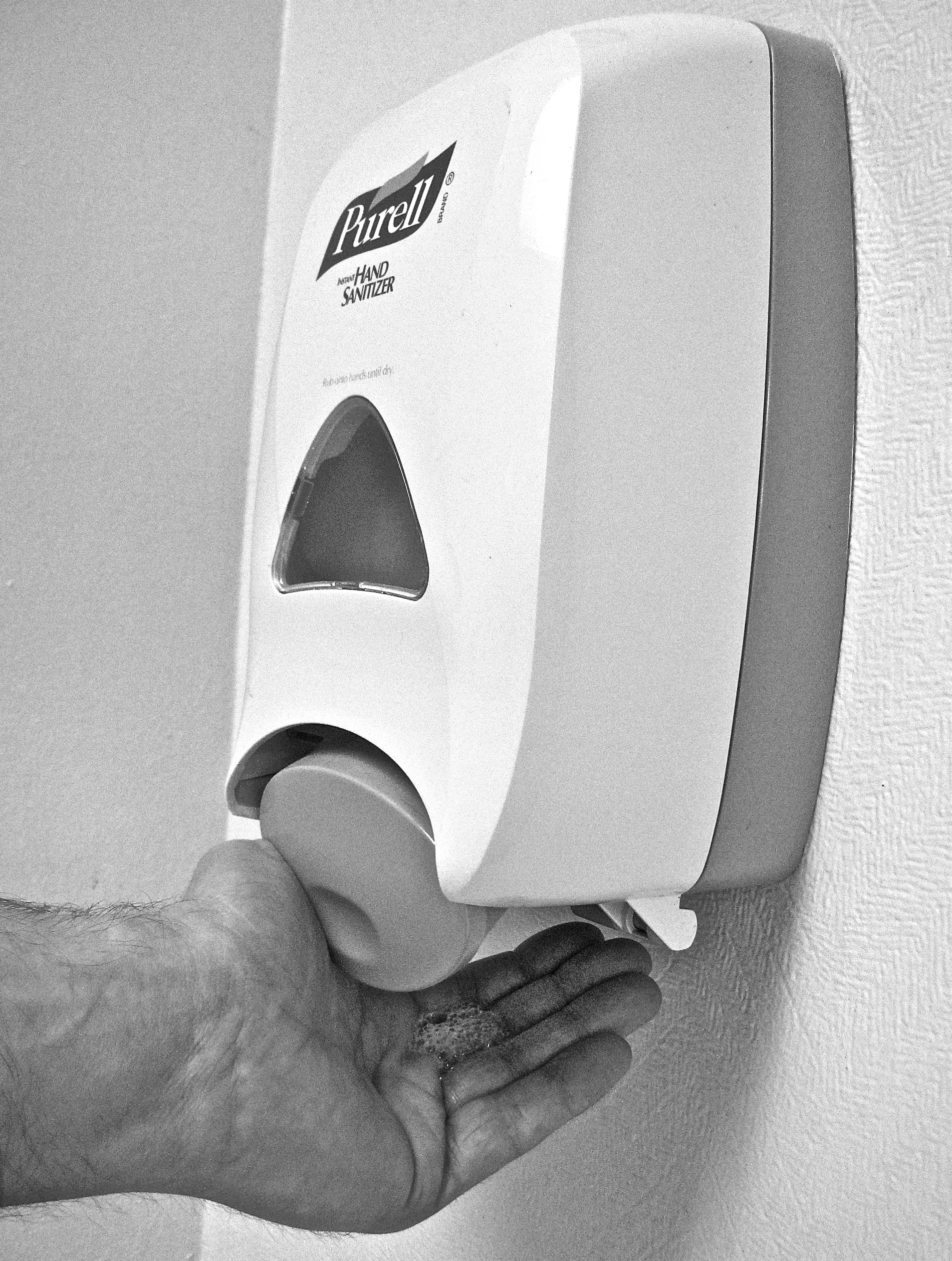
Hand sanitizer dispenser being used.
We hypothesized that HSD structure, care, and location could make them susceptible to meaningful contamination. The HSD lever is a smooth plastic surface, which makes hand contact efficient but could encourage pathogen persistence. Cleaning of HSDs may be relatively infrequent despite their repetitive contact with HCWs' contaminated hands. In addition, HSDs often are located in high-volume critical care units, where multiple-drug-resistant organisms are prevalent. The goal of this study was to determine if HSDs could become contaminated with pathogens that cause HAI.
Materials and Methods
The study took place in the 12-bed surgical intensive care unit of an urban teaching hospital. The unit maintains hand hygiene compliance rates of >93%. It has a protocol to have the surfaces of all HSD cleaned during each day shift using SaniMaster 4 Disinfectant (ServiceMaster Clean, Memphis, TN). The wall-mounted manual HSDs (Purell® FMX-12™ Dispenser, GOJO Industries, Inc., Akron, OH) are located in the individual patient bays (total 12), hallway (total three), and centralized charting area (total two). The dispensers deliver a solution containing 62% ethyl alcohol (Purell®). Cultures were obtained during the late morning and midweek, when the unit had a census of 10 patients.
Sterile cotton-tipped swabs moistened with sterile saline were used to sample three surfaces of each HSD unit: The entire surface of the dispenser's lever, the underside adjacent to the wall, and the area surrounding the dispensing nozzle. These areas were chosen because it has been our observation that during normal operation, the user's hand makes contact with the HSD at its lever, using the palm, and occasionally also touches the underside of the HSD adjacent to the wall when the fingers are outstretched. Furthermore, the area surrounding the dispensing nozzle was sampled to rule out Purell contamination, where deposits of Purell film might accumulate. The dispensing nozzle is located high up in the HSD unit, protecting the nozzle from hand contact during normal operation but making it harder to clean during surface disinfection.
The swabs were cultured to trypticase soy blood agar (BBL, Becton Dickinson, Sparks, MD). All cultures were incubated at 35°C for 24–72 h with observations at 24-h intervals. At each observation, bacterial morphotypes were semi-quantified and presumptively identified using gram stain and appropriate screening methods. Isolates determined to be of particular interest were identified using Vitek 2 (bioMerieux, St. Louis, MO). Methicillin resistance was determined for the S. aureus isolates using the Kirby-Bauer disk diffusion method.
Results
All 17 HSD yielded one or more bacterial species. Distribution of contamination included the lever in 82%, underside in 35%, and nozzle in 23% of HSDs. Multiple bacterial species were obtained from 50% of the contaminated sites. Growth ranged from 1 to 50 colonies, with a median of 5 and a mean of 8.3.
Gram-positive cocci predominated, with the majority being coagulase-negative staphylococci (16; 94%). Methicillin-sensitive S. aureus and Micrococcus spp. grew from 2 (12%) and 1 (6%) HSD, respectively. Gram-positive bacilli, including Bacillus species, diphtheroids, and aerobic actinomycetes, were isolated from 6 (35%) HSD. Gram-negative bacilli, including non-lactose fermenting non-enterics and lactose-fermenting enterics, were isolated from 5 HSDs (29%) (Table 1).
In comparing HSD from patient bays with those in the hallway and charting area, rates of and types of bacterial contamination were similar. With respect to the three surfaces cultured on the HSD itself, the lever was the most frequently and diversely populated and the sole site of gram-negative contamination. The underside grew gram-positive cocci and gram-positive bacilli, whereas the nozzle grew only gram-positive cocci (Table 2).
Discussion
The present study showed that 100% of waterless alcohol-based HSDs from a surgical intensive care unit were contaminated with bacteria, both commensal skin flora and gram-negative enterics. Colonization was greatest on the lever. Rates of contamination were not influenced by HSD location.
Commensal skin flora contaminated the majority of HSDs. These gram-positive cocci and bacilli typically are not associated with HAI, but may become opportunistic pathogens in patients who are immunocompromised or have indwelling medical devices. Micrococcus spp. and coagulase-negative staphylococci are both examples of potentially opportunistic pathogens isolated in the study. Micrococcus spp. can cause pneumonia in hosts with compromised immune systems. Coagulase-negative staphylococci can cause nosocomial blood stream infection, and produce a biofilm that facilitates their adherence to medical devices. Wound, prosthetic device, and catheter infections can result.
In addition, lactose-fermenting enterics contaminated a quarter of the HSDs. Although not speciated in this study, lactose-fermenting enterics include members of the familiar genera: Escherichia, Enterobacter, Klebsiella, Serratia, and Citrobacter. Many of these bacteria can develop drug resistance. They are major pathogens of HAI throughout a hospital.
As expected, bacterial contamination was greatest on areas having the most hand contact: Lever > underside > nozzle. The lever is touched routinely by the palm of the hand during normal HSD use. In contrast, the rear underside is touched relatively infrequently and only by the fingertips, when the hand is outstretched. The nozzle is protected from hand contact during normal operation, but as it is difficult to clean during surface disinfection, contamination could occur during maintenance of the dispenser unit. Also, build-up of Purell® residue on the nozzle might pose a risk for bacterial contamination, as has been found with chlorehexidine-based soaps [17].
The limitations of the study include the fact that it was not designed to show whether fomite contamination of HSD necessarily leads to HAI. Such a study would be complex to design. Hypothetically, passage of pathogens from the HSD to HCW hands could result in HAI if proper hand hygiene is ignored. In this case, application of too small a volume of sanitizer, inadequate coverage of all hand and finger surfaces, or short drying times could enable pathogen persistence on an HCW's hands.
Spread of these pathogens can be decreased by correct application of the waterless alcohol-based hand-sanitizer and donning of gloves prior to patient contact. In addition, routine cleaning of HSD is recommended to diminish their reservoir of pathogens. Cleaning should cover both external surfaces and the dispenser nozzle. Lastly, changing to automated or pedal-operated HSD that require no hand contact might reduce the chances of contamination. Further research is needed to explore this possibility.
Footnotes
Author Disclosure Statement
No conflicting financial interests exist.